
SO! Reads: Kirstie Dorr’s On Site, In Sound: Performance Geographies in América Latina
 “World Music,” both as a concept and as a convenient marketing label for the global music industry, has received a fair deal of deserved criticism over the last two decades, from scholars and musicians alike. In his famous 1999 op-ed, David Byrne wrote that the term is “a none too subtle way of reasserting the hegemony of Western pop culture. It ghettoizes most of the world’s music.” Ethnomusicologists have aldo challenged the othering power of this term, inviting us to listen to “worlds of music” and “soundscapes” as the culture of particular places and times, suggesting that these sonic encounters with difference might teach “us” (in “the West”) to consider how our own musical worlds are situated in social and historical processes.
While this has been an important move toward recognizing the multiplicity of musicking practices (rather than reinforcing a monolithic “Other” genre), the study of “musical cultures” runs the risk of territorializing musical “traditions.” Linking them to geographically delineated points of origin, nations or homelands that are made to seem natural, fixed, or timeless often overlooks the heterogeneity of places, essentializing the people who make and listen to music within, across, and in relation to their ever-changing borders. The challenge for music critics and scholars has been–and still is–to delegitimize the alienating broad brush of the “world music” label without resorting to a classification system that reifies music production and circulation into exotic genres or fetishized “local” traditions.
 In her 2018 book, On Site, In Sound: Performance Geographies in América Latina(Duke University Press), Kirstie A. Dorr demonstrates a method for conceptualizing relations between music and space while avoiding the pitfalls of colonial and capitalist definitions of “culture” and “identity.” She takes the term “performance geography” from Sonjah Stanley Niaah, whose discussion of Jamaican dancehall employs this analytic as “a mapping of the material and spatial conditions of performance: entertainment and ritual in specific sites/venues, types and systems of use, politics of their location in relations to other sites and other practices, the character of events/rituals in particular locations, and the manner in which different performances/performers relate to each other within and across different cultures” (Stanley Niaah 2008: 344). Dorr looks at “musical transits” rather than musical cultures, focusing on the politics and relations within sound and performance across South America and its diasporas; one particular relation serves as the central argument of the book: “that sonic production and spatial formation are mutually animating processes” (3).
Three conceptual frames help Dorr follow the musical flows that push against national and regional boundaries sounded by the global music industry: listening, a form of attention toward the interplay of sensory content, form, and context; musicking, or conceptualizations of music-making in terms of relationships and creative practices, rather than the musical “works” they produce and commodify; and performance as “a technique of action/embodiment that. . .potentially reshapes social texts, relationships, and environments” (14-16). Through close listenings to performances in Peru, San Francisco, and less emplaced sites such as YouTube and the “Andean Music Industry,” Dorr makes a strong case for performance geographies as creative decolonial strategies, both for participants in musical transits and for scholars who imagine and invent the boundaries and trajectories of musicking practices.
***
Nearly a century after Peru won its independence from Spain, limeño playwright Julio Baudouin debuted El Cóndor Pasa, a two-act play promoting national unity through a tale of indigenous miners in a struggle against their foreign bosses. The play’s score, composed by musician and folklorist Daniel Alomía Robles, weaves Peruvian highland music into Western-style arrangements and instrumentation, and was widely received by its 1913 audience as the sound of what Peru was to become: a modern nation firmly rooted in the cultures of its indigenous peoples.
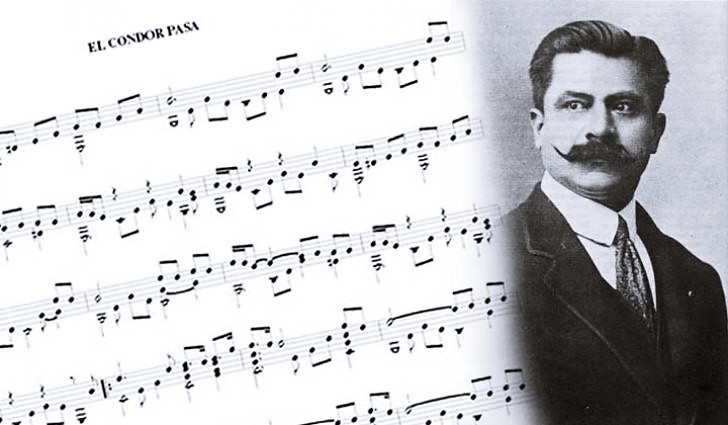
Daniel Alomía Robles
In the century that followed, the score’s homonymous ballad has been interpreted and recorded by countless artists around the world. Easily the most well-known rendition of this famous melody is Simon and Garfunkel’s “El Cóndor Pasa (If I Could),” (1970) which Dorr credits with catalyzing a Latin American music revival as well as spurring on a wave of Euro-American musicians and producers who collaborated with and brought into the international spotlight a number of groups who otherwise would have remained in relative obscurity. The tendency to see these projects as the work of (typically white) Westerners “discovering” and “saving” or paternalistically “curating” the dying musical cultures of the world, Dorr suggests, is part and parcel of a World Music concept that frames “primitive” traditions as fair game for extraction and appropriation into innovative sonic hybrids.
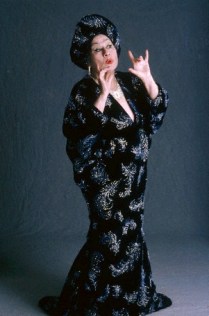
15 Nov 1991, Paris, France — Peruvian singer Yma Sumac
The “exotica” category follows the same logic, as the case of Yma Sumac illustrates. From the beginning of her career in the early 1940s with el Conjunto Folklórico Peruano to her 1971 psychedelic version of “El Cóndor Pasa,” Sumac’s vocal versatility and stylistic experimentations map out an experience of Andean indigeneity that Dorr hears in stark contrast to the narratives of the global music industry. While Capitol Records performed their own geography via their marketing of this sexualized “Incan princess,” the singer strategically composed her own sonic-spatial imaginary, not rejecting the difference suggested by “exotica,” but by synthesizing a “space-age” modern aesthetic with traditional songs. Dorr challenges us to listen to Sumac’s “El Cóndor Pasa” against Simon’s arrangement, thinking of her performative dissonances as disruptions of “the static geotemporal imaginaries of ‘authentic indigeneity’ that have most often informed the ballad’s deployment” (59).
If Chapter One makes a case for performance’s potential to shape notions of place and time, Chapter Two explores “spatial(ized) relations of musicking” (68) through a broader consideration of market strategies and the politics of sound in public space. Putumayo serves as another classic example of the global music industry’s pandering to multicultural idealism, promoting itself as “lifestyle company” that brings conscious capitalism into the curation of musical worlds. Dorr keeps her critique of Putumayo rather brief, but uses it as a convincing contrast for the focus of this chapter: the informal streams of economic activity and performance that she calls the “Andean music industry” (AMI). Among other examples from transnational and virtual “sites,” the Andean bands that performed in San Francisco’s Union Square throughout the 1990s demonstrate how performance geographies can challenge state and capitalist power while simultaneously running parallel to the marketing and distribution practices of the world music industry.
The AMI story is one of migration and the formation of a pan-Andean diaspora, of busking and bootlegging tactics that tested the boundaries of zoning and noise regulations as well as California’s immigration and labor policies, and of transposing music networks onto the internet when public performance became too precarious. It is also another case of dissonance, in which musicians willfully use their own cultural difference to their advantage, but not without consequences for poor musicians in South America; a telling example is the “Music of the Andes” CD, a mass-produced compilation used by various groups who, instead of having to record and press their own albums, could simply print their own covers for the Putumayoesque compilation and sell them to their none-the-wiser U.S. audiences (84).
But if the diasporic politics of the AMI came up short in challenging a monolithic representation of “Andean culture” or in highlighting the dynamic transits of Andean fusions such as chicha and Nueva Canción, the daily performances of street musicians in the race- and class-ordered Union Square support Dorr’s argument about the co-constitutive relationship between sound and space: “This unmediated display of embodied and sonic ‘otherness’ threatened the coherence of the square’s representational function by converting it into a spectacle of work and play for a population upon whose concealed labor the economic foundations of California’s wealth largely depend: undocumented migrant workers from the global South” (81).
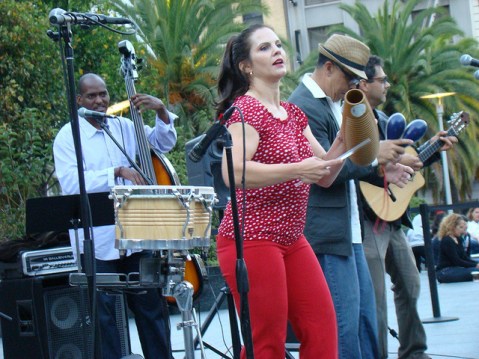
Busking in Union Square, 2013, Image by Flickr User Dr. Bob Hall
Elsewhere in 1990s San Francisco, musicians, artists, and activists formed a collective that, like the busking Andean groups, challenged dominant notions of public and private space while performing its own transnational and migratory experiences of Latinidad. In Chapter 4, Dorr relates the story of La Peña del Sur, a grassroots organization in the Mission District and, like the many anti-imperialist peñas popular throughout Latin America since the 1960s, a space for artists to perform or display their work for local audiences. While this peña provided a community for undocumented immigrants and local residents threatened by gentrification, it also served as an unsettling force against the sort of geographies that separate “queer space” from “heterosexual space” without regard for how these neighborhoods are also classed and racialized.
The founder and director of La Peña del Sur, Chilean exile Alejandro Stuart, was among several queer community members whose efforts constituted their shared space as a challenge to normative boundaries, a site for musicking that engendered dialogue among a wide range of people with divergent visions and motivations. Community organizers and students of cultural sustainability would do well to read Dorr’s account of this decade-long experiment that “enabled the exploration of sound-based solidarities rooted in the identification of common historical and political ground through improvisation and participatory performance” (168).

Victoria Santa Cruz, Image courtesy of Flickr User “Traveling Man”
Between these two compelling tales of the dynamic relationship of sound and space in San Francisco, Chapter 3 explores the significance of race, nation, gender, and sexuality within the performance geographies of several Afro-Peruvian artists. Dorr traces the movements of performers and activists who challenged the colonial boundaries that framed blackness as “antithetical to the emergent nation” (111); unlike the indigenous traditions that could be appropriated for an imagining of Peru as modern yet firmly rooted in history, Afro-Peruvian bodies and sounds were treated as contaminants within the postcolonial order.
Listening to Black feminist performance geographies, from Peru’s Black Arts Revival in the ’60s and ’70s to the recent hemispheric collaborations of “global diva” Susana Baca, one can hear the formation of not only such racially imagined communities as “the coastal” and the “Afro-Latinx diaspora,” but also of “the body.” A powerful case of this latter sort of performance is heard in the lyrics and experiences of Victoria Santa Cruz, who, in her choreographed, cajón- and chorus-accompanied poem, “Me Gritaron Negra,” contests the ways in which “[t]he physical contours of her body – her lips and skin and hair – become a geography inscribed with social meaning, an ideological imposition intended to enact and legitimate her ongoing displacement” (121).
Santa Cruz’s pedagogical and performative practices, in particular, reveal why Dorr has chosen sound – and not only broader analytics of performance and musicking – as a central theme to explore in terms of its relation to places and bodies. While this book might leave a few sound studies scholars wanting more elaborate description of particular sonic phenomena or ethnographic consideration of how sound is imagined among Dorr’s interlocutors, a few examples in particular are keys to thinking about how sound signifies, and is signified by, racially mapped bodies and places.
Most intriguing here is a discussion of Santa Cruz’s 1971 book, Discovery and Development of a Sense of Rhythm, which outlines the artist’s approach to “listen[ing] with the body” and tuning in to “rhythm’s Afro-diasporic logics” (116). A pedagogy and practice developed well in advance of Henri Lefebvre’s theory of rhythmanalysis, Santa Cruz’s concept of ritmo–internal rhythm— deserves consideration alongside the work of Amiri Baraka, Jon Michael Spencer, Fred Moten, and Daphne Brooks as crucial for thinking about how Black aesthetics and diasporic sensibilities are cultivated through sound and capable of mobilizing new mappings of bodies and their worlds.

Victoria Santa Cruz, still from el programa de La Chola Chabuca. (Video: América TV)
On Site, In Sound also calls for renewed thinking on sonic-spatial relations and the meanings that emerge from within them – how the sounds of particular Latin American voices and instruments come to be understood as masculine or feminine, indigenous or modern, exotic or local. Although “sound” as a specific performative or sensory medium might seem, at times, only one among many phenomena examined within the book’s threefold conceptual framing – listening, musicking, and performance – Dorr weaves it throughout her own performance geography where it takes on multiple forms and scales, challenging even the very boundaries defining what sound “is.” More importantly, this is a geography that scholars of “the sonic” or “music worlds” should read (and hear) as a reminder of sound’s unique ability to create and transcend boundaries – but rarely without a great deal of dissonance.
—
Featured Image: “Gabriel Angelo, Union Square,” by Flickr User Brandon Doran
—
Benjamin Bean is a PhD student in sociocultural anthropology at The University of California, Davis. His research interests include Afro-Caribbean music and sound, food and the senses, Puerto Rico, religion and secularism, and the Rastafari movement. During his undergraduate studies at Penn State Brandywine and graduate studies in cultural sustainability at Goucher College, Ben’s fieldwork focused on reggae music, the performativity of Blackness, and the Rastafari concepts of Word, Sound, and Power and I-an-I. His current fieldwork in Puerto Rico examines flavor, taste, and marketing in the island’s growing craft beer movement. Ben was formerly a vocalist and bass guitarist with the Philadelphia-based roots reggae band, Steppin’ Razor.
—
 REWIND!…If you liked this post, you may also dig:
SO! Reads: Dolores Inés Casillas’s ¡Sounds of Belonging!–Monica De La Torre
SO! Reads: Roshanak Khesti’s Modernity’s Ear–Shayna Silverstein
SO! Reads: Licia Fiol-Matta’s The Great Woman Singer: Gender and Voice in Puerto Rican Music–Iván Ramos
Share this:

Doubled Double Consciousness and the Sound of New Afrikan Expression

 Inspired by the recent Black Perspectives “W.E.B. Du Bois @ 150” Online Forum, SO!’s “W.E.B. Du Bois at 150” amplifies the commemoration of the occasion of the 150th anniversary of Du Bois’s birth in 2018 by examining his all-too-often and all-too-long unacknowledged role in developing, furthering, challenging, and shaping what we now know as “sound studies.”
It has been an abundant decade-plus (!!!) since Alexander Weheliye’s Phonographies “link[ed] the formal structure of W.E.B. Du Bois’s The Souls of Black Folk to the contemporary mixing practices of DJs” (13) and we want to know how folks have thought about and listened with Du Bois in their work in the intervening years. How does Du Bois as DJ remix both the historiography and the contemporary praxis of sound studies? How does attention to Du Bois’s theories of race and sound encourage us to challenge the ways in which white supremacy has historically shaped American institutions, sensory orientations, and fields of study? What new futures emerge when we listen to Du Bois as a thinker and agent of sound?
Over the next two months, we will be sharing work that reimagines sound studies with Du Bois at the center. Pieces by Phillip Luke Sinitiere, Kristin Moriah, Aaron Carter-Ényì, Austin Richey, Jennifer Cook, Vanessa Valdés, and Julie Beth Napolin move us toward a decolonized understanding and history of sound studies, showing us how has Du Bois been urging us to attune ourselves to it. To start the series from the beginning, click here.
Readers, today’s post by Austin Richey considers the possibilities of Du Bois’ idea of double consciousness, as it applies to the Black Atlantic in general. He approaches “doubled double consciousness” through the case study of two artists: Tendai “Baba” Maraire and Efe Bes.
–Jennifer Lynn Stoever and Liana Silva, Eds.
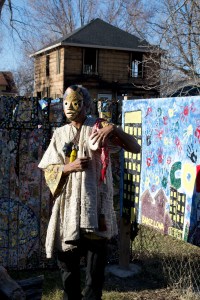
Efe Bes with his tama at Ohana Gardens, Highland Park, MI – taken by the author
In his 1903 text The Souls of Black Folk, W.E.B. Du Bois expresses the “otherness” of Black American identity as a “double consciousness,” an internalized condition whereby an individual’s self is contested by what Du Bois describes as the “sense of always looking at one’s self through the eyes of others…One ever feels his two-ness, an American, a Negro; two souls…; two warring ideals in one dark body” (2). This in-between status requires one to negotiate between these dual perspectives, and through the sonic expressions of cultural mediation, we may hear the tactics with which Black American culture creators select and present a particular version of their cultural identity.
In this essay, I argue for a doubled double consciousness that extends Du Bois’s conception into an increasingly interconnected space that Paul Gilroy called the Black Atlantic, a space which includes the histories and traditions of distinct African cultures, diasporic African communities, and Pan-African ideology. Based on the sonic practices of two artists, Seattle-based Zimbabwean American rapper and multi-instrumentalist Tendai Maraire, and Detroit-located Afrikan drummer and storyteller Efe Bes, we may hear doubled double consciousness as a multi-dimensional site of negotiation whereby musicians source from plural geographic, temporal, and cultural springs to compose a sonic “mix” of Black musical histories; this “mix” echoes the space where the hip hop DJ “noisily bring[s] together competing and complementary beats without sublating their tensions” (Weheliye 13). This anti-anti-essentialist tactic, as Carter Mathes describes in “The Sounds of Anti-Anti-Essentialism: Listening to Black Consciousness in the Classroom,” demonstrates that “it is the open space of sound that invests the project of black radical thought with the uncanny spontaneity of experimentation.”

“Tendai Maraire of Shabazz Palaces, Sub Pop Silver Jubilee, Pop Stage” by Flickr user Jeff Few, CC BY-NC-ND 2.0
Importantly, doubled double consciousness is a challenge to the received status of the “other,” and reveals a multiplicity of gazes through which an individual is viewed. As Maraire reflected,
I always felt that America saw us the same; not as African-American, Zimbabwean or even Black. Just Ignorant Negroes. As I got older my friends and I learned we’re all in the same social and economic positions. But I still had American friends who thought I felt better than them because I was Zimbabwean, and friends that were from Zimbabwe who thought I was better than them, or lost my culture because I had a curl and wore Jordans. (quoted in Devriendt)
Maraire assumed a singular, hegemonic gaze, yet his lived experience in America and Zimbabwe exposed him to critiques from black Americans, diasporic Africans, cosmopolitan and rural Zimbabweans, not to mention advocates, and sometimes appropriators, of different cultural lineages in a diverse city like Seattle.
While Du Bois claimed that the doubly conscious individual “does not wish to Africanize America,” the sonic expressions of doubled double consciousness reflect a particular Afrikan perspective, that is, a redefined social discourse which emerged from the intertwining of Black American activist efforts and knowledge derived from plural ancestral histories and African culture. By positioning themselves as Afrikan – not American, not African, but in-between – these artists showcase how doubled double consciousness is not a condition, but a tactic of negotiation and re-presentation.
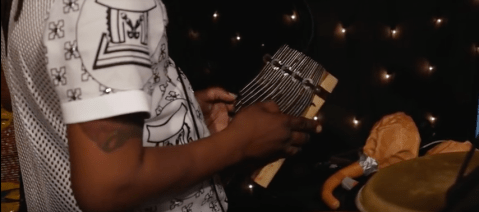
Screenshot of Maraire playing the nhare mbira, from the video “Chimurenga Renaissance – The B.A.D. Is So Good (Live on KEXP)”
Rapper and multi-instrumentalist Tendai “Baba” Maraire has been a staple of the Seattle hip hop scene since the early 1990s. While he honed his lyrical style in the cyphers of Seattle’s Columbia City, his parents Dumisani Maraire and Lora Chiorah-Dye, a renowned Zimbabwean ethnomusicologist and performer, and Zimbabwean dancer and instructor respectively, fostered a cosmopolitan Zimbabwean household; musically, Maraire performed live with his parents’ drum, dance, and marimba ensemble, sung Christian hymns in Shona, and opened for hip hop legends Snoop Dogg and Slick Rick. This provided Maraire with an extensive sonic palette to source from, yet his early attempts to bring these worlds together into an Afrocentric message were met with resistance:
[Audiences] didn’t even know what I was playing when I pulled out an mbira [a Zimbabwean lamellaphone] on stage 20 years ago and rapped with it. No one cared, rappers laughed. The world just wasn’t ready for that. With gangsta music at the time…they didn’t want to accept a dude with an mbira talking about political views out in Zimbabwe.” (Maraire interview)
Today, as half of the Afrofuturistic hip hop duo Shabazz Palaces, Maraire has continued to incorporate the mbira, ngoma (drums), and hosho (gourd rattles) into his musical production; as Shabazz Palaces toured with artists such as Radiohead and Lauryn Hill, Maraire’s Afrikan hip hop style reached a global stage.
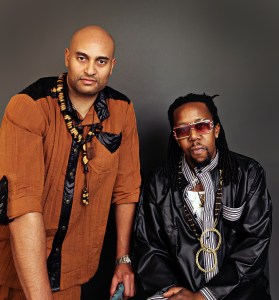
Tendai Maraire and Hussein Kalonji – courtesy of the artists
Doubled doubleness tactics come out forcefully in Maraire’s side project Chimurenga Renaissance, a moniker which connects chimurenga, a Zimbabwe-specific political struggle, to a global Black consciousness movement. Maraire and musical partner Hussein Kalonji, son of the famous Congolese Rhumba guitarist Raymond “Braynck” Kalonji, blend the melodic elements of Zimbabwean mbira and Congolese guitar with the sounds of the Roland 808 drum machine, funk and soul samples, topped by Maraire’s stream-of-consciousness lyrical flow.
Chimurenga Renaissance’s single “Pop Killer,” from 2013’s Defenders of the Crusades EP, exemplifies the power of doubled double consciousness to signify complex ideas to a variety of audiences: through his dismantling of problematic pop musicians who have left their culture behind, Maraire aims his Afrikan hip hop at American and Zimbabwean communities who have critiqued his cultural claims, as well as encourages other black musicians to dig deep and proudly represent their heritage. The video for the track follows Maraire as he travels to the ruins of Great Zimbabwe, the capital of the Kingdom of Zimbabwe (11th-15th centuries), with his mbira to confer with his ancestors. Sonically, the song has three distinct sections whose juxtaposition showcases the multiple sound cultures which make up Maraire’s complex identity.
The track opens with sound of wind, followed by a sampled and chopped up boom-bap drum beat. As Maraire improvises on his reverb-drenched mbira he is joined by a sampled walking bassline, while the chorus and reverb effects Kalonji uses for his arpeggiated melodies complement the timbre of Maraire’s amplified mbira. In the second section, the mbira remains while sampled drums are replaced by hand clapping, hosho, and ngoma, signifying a shift from the reproduction of electronic sounds to the liveness of group participation. Over this, Maraire’s unremitting lyrics call out those who reject their histories, telling them, “This ain’t a show, this a sacred ritual. You can’t possess it because your life is hypocritical.” As Kalonji’s guitar re-enters, the track slows to a third section where Maraire’s raps: “The gold on my pinkie represents where I’m from. If you ain’t never seen it then we ain’t close enough. I got some bigots in my wallet, sativa’s in my pocket, passport to touch the world cause the man can’t stop me.”
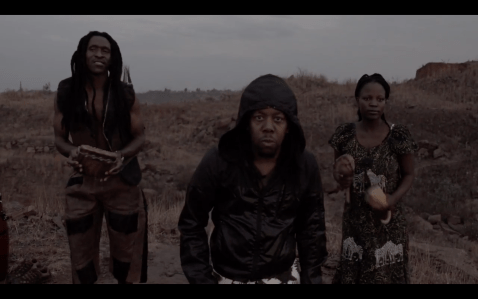
Jacob Mafuleni, Tendai Maraire, and Martha Thom in a still from Chimurenga Renaissance’s “Pop Killer”
The official video also includes a bonus verse, featuring Maraire rapping live in a field accompanied by Zimbabwean musicians Jacob Mafuleni and Martha Thom; this rural scene, featuring an unamplified mbira and driving rhythms from the hosho, further amplifies Maraire’s connection to ancestral life, while his raw vocals and intense delivery are reminiscent of a rap cypher.
In Detroit, Afrikan drummer and storyteller Efe Bes has used doubled double consciousness as a platform to critique those who have lost a cultural connection to African ancestors.
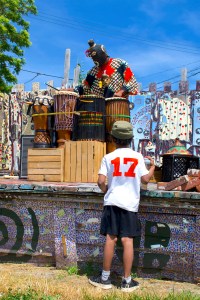
Efe Bes performing at Dabls’ MBAD African Bead Museum, Detroit, MI – taken by author
His own Afrikan-ness is marked not just visibly by his self-made Afrikan masks but also aurally through his unique musical instrumentation and style: Bes plays a collection of drums from across the African continent, including Senegalese sabar drums, West African tama and dundun, and South African ngoma, as well as a modified kora, balafon, and multiple drum machines. Bes performs complex patterns that source from the polyrhythms of West African music to the shuffle of American Blues, occasionally over instrumental recordings of popular hip hop singles, such as rapper Future’s “Fuck Up Some Commas.” For Bes, these musical traditions are connected by an emphasis on the drum, and his performances are marked by shifting patterns that easily move from the deep swing of the blues to the automated soul of techno, a tactic which he developed while DJing for Aretha Franklin in the early 1990s. Weaving these multiple black musical traditions, Bes creates a soundscape that simultaneously looks back to ancestral sound cultures while pushing the boundaries of what Detroit’s musical legacy will sound like in the future.
In addition to live performances, Bes produces his own music videos and promotes his music through YouTube. His archive of over 200 videos shows the breadth of his musical abilities, ranging from spoken word poetry combined with talking drum, to his most viewed original song, “Gimme Back My Shit,” an Afrikan funk tune in which Bes demands reparations for the devastation of Black culture worldwide.
The song begins with Bes humming and performing the main melody of the piece on electric piano. While his humming is laid back, the insistent rhythms of the piano foreshadows the lyrical intensity of this “real reparation song”; this is highlighted by the piano’s synthesized guitar sound, whose bright, cutting timbre and plucked sound are reminiscent of an amplified kora. This introduction leads to the main groove, where looped samples of syncopated funk drums and guitar accompaniment create a foundation for improvised tama drumming and his soulfully styled yet acerbically lyrical vocal performance.
“Give me back my shit, you done had it for so long you think that you own it.
I’m not talking about some, I’m talking all of it.”
Bes’s lyrics go beyond simple criticism, and instead, demand reparations in the form of cultural repatriation, or as Bes sings, “Give me back my ancestors you grave-robbing bitch.” In the self-produced music video, visuals of Pan-African statues, masks, and Mbuti pygmies are juxtaposed with images of Cecil Rhodes, starving children, and cellphones which rely on conflict materials like coltan; these images are punctuated by the sounds of African languages, such as the clicks and pops of Xhosa, as well as the sound of deforestation, such as gas-powered saws, further emphasizing the degradation and destruction of African cultures through the loss of music, language, tangible culture, and environment.
Through the sonic practices of Tendai Maraire’s Afrikan hip hop and Efe Bes’s Afrikan drumming, we may hear how doubled double consciousness is a tool used to negotiate complex ancestral recall. For these artists, doubled double consciousness is not simply a condition, but a powerful space to negotiate and re-articulate what it means to be Afrikan in America.
—
Featured image: Screenshot from video “Pop Killer” by Chimurenga Renaissance
—
Austin T. Richey is a Ph.D. candidate in Ethnomusicology at Eastman School of Music in Rochester, New York. His current dissertation research is based in his hometown of Detroit, Michigan, where he is exploring the resonances between diasporic African musical, dance, and visual arts and Detroit-specific musical genres, such as techno, in this historically multifaceted American city.
Richey has published original research in African Music, and has forthcoming articles in the Routledge Handbook of Music in the New African Diaspora and Opioid Aesthetics: Expressive Culture in an Age of Addiction, published by West Virginia University Press. Support for his work has come from the Society for Ethnomusicology’s African Libraries Prize, the Frederick Douglass Institute, as well as the Society for American Music, where he is an Adrienne Fried Block Fellow. Richey is also an active performer, playing regularly in the New York area with Serevende Mbira and Mounafanyi Drum and Dance.
—
REWIND! . . .If you liked this post, you may also dig:
“Most pleasant to the ear”: W. E. B. Du Bois’s Itinerant Intellectual Soundscapes–Phillip Luke Sinitiere
On Whiteness and Sound Studies–Gustavus Stadler
Unlearning Black Sound in Black Artistry: Examining the Quiet in Solange’s A Seat At the Table–Kimberly Williams
Share this:


Current Top Posts





April 2021

January 2020

November 2019

October 2019

August 2019

April 2014

November 2017

March 2015

December 2017

October 2015
 Sounding Out!
Recent Comments