
“Don’t Be Afraid to Pogo!”: Chicana Hollywood Punks Negotiate ‘h/Home’ After Hardcore Takes L.A.

 For the full intro to the forum by Michelle Habell-Pallan, click here. For the first installment by Yessica Garcia Hernandez click here. For the second post by Susana Sepulveda click here. For the third post by by Wanda Alarcón click here. For last week’s post by Iris C. Viveros Avendaño click here.
The forum’s inspiring research by scholars/practioners Wanda Alarcón, Yessica Garcia Hernandez, Marlen Ríos-Hernández, Susana Sepulveda, and Iris C. Viveros Avendaño, understands music in its local, translocal and transnational context; and insists upon open new scholarly imaginaries. . .
Current times require us to bridge intersectional, decolonial, and gender analysis. Music, and our relationship to it, has much to reveal about how power operates within a context of inequality. And it will teach us how to get through this moment. –MHP
—
When did punk become white? Sound white? Sound male, even? The story of moshing–a dance where predominantly young men gather in a half circle aggressively pushing into each other –which is integral to how the history of punk is shaped, understood, and passed on, offers a window into investigating the outright erasure of Chicana punk from broader punk history which has generally centered cis-heterosexual men from either the U.K. or New York scenes.
Yet, the story of slam dancing, later known as moshing, was also not always a part of punk. In the early 80s slam dancing was introduced by Orange County punks to the Hollywood/ LA scene and through the advent of technologies such as the VHS and Betamax, punk then consequently becomes satirized, recorded, and archived as angry, white, and “Hardcore.”
I argue that the erasure of the Los Angeles punk scene and queer Chicanx youth from punk history can be mapped through the story of when and how the pogo was replaced by slamming. I position the Los Angeles punk scene of the late 1970s and early 1980s as a prime example of how the experiences of punk youth were deeply shaped by the conditions of possibility the pogo offered, creating a completely different scene than the ones more popularly archived as white, male, and devoid of queer people of color and women. Here, gentrification takes the noisy and rapid shape of upper- to middle-class OC Hardcore beach punks introducing slamming and eventually pushing out the pogo –– mirroring the co-optation of L.A. punk and finally cementing the story of US Punk as white. Therefore, the genealogies of these punk dances demonstrate the ways that dance and sound together can produce the gentrification and expulsion of an entire scene.
Pogoing, the predecessor to moshing, as a physical dance consisted of jumping up and down with varying degrees of contact danced usually by participants across venue space. The pogo’s movements embodied a kind of fun that was quite equitable across gender expressions and sexualities. I put this thesis into practice every time I ask my students to pogo with me in class, mainly because literature on the pogo is very scarce and recreating the pogo through movement serves as a pedagogical tool. The pogo was a common form of punk dancing in the earlier days of punk and can be seen more prominently in The Punk Rock Movie (1980), The Great Rock and Roll Swindle (1980), and Decline of Western Civilization (1981).
Though pogoing goes as far back at the U.K scene, it reached the L.A. scene last, just before it became slamming. Broader than a dance, the pogo signified a particular relationship between sound, community and a sense of belonging––a home for the outsider and their band of misfit friends, a home that created space for queer Chicanx/POC youth later forced to reckon with a new wave of punks wearing Swastika patches as eviction notices on their sleeves. The band X said it best on an interview with NPR’s Fresh Air.
X NPR Interview with Terry Gross, 2 May 2016, “A Personal History Of L.A. Punk: ‘It Was A Free-For-All For Outcasts'”
Singer Exene Cervenka explained how the pit formed following a trajectory of spontaneous punk dancing, which includes the pogo, that blurred the lines between audience and performer, particularly during a time where punk was not yet under the scrutiny or rubric of what it meant to be “punk.”
While the pogo was still relatively aggressive by many accounts, according to the late MTV program UltraSound, pogoing began as a response to mainstream Disco’s “the bump” or “the hustle.” These dances signified order and more broadly a celebration of U.S. mass consumer culture that punks from the U.K. and U.S. desired to resist. Though positioning the pogo as a direct response to disco can be deeply racialized–as disco initially was a queer, brown musical movement before mass marketing brought it beyond underground urban dance clubs to the white suburbs– I would rather look to to the pogo’s embodiment of an era of punk in the U.S., with a focused gesture to L.A. punk, that existed before hardcore. Susana Sepulveda defines hardcore as an intensified version of 1970s punk coming out of the local beach cities and commemorated by white cis men despite hardcore’s queer and POC ties from earlier scenes, especially via L.A. I would also add a class analysis, in which hardcore was welcome to upper to middle class punks unlike the scenes before that catered to poor whites and people of color. Yet, the question of how punk became white through the arrival of hardcore and the push back from Chicanx youth, I argue, meet in the pit.
Slam dancing, the predecessor to the mosh pit, is described by Joe Ambrose, as the accompaniment to hardcore shaped by its fast pace and as an expression of male youth aggression that includes a mix of the pogo, circle pitting, and stage diving. Slamming, unlike the pogo, is gendered as predominantly male and performed at the front and center of the stage. Ambrose maps the history of mosh pit by placing slamming as the main dance of the 1970s scenes, with very little attention to the pogo. Yet, I posit slamming as a variant of the pogo that was more violent and reflective of the anxieties and frustrations of upper to middle class white punks. And as a reactionary dance rooted in a bourgeois definition of boredom which punks before them could not afford, since boredom was for them rooted in poverty.
Yet, Ambrose’ erroneous conflation of slamming and the pogo is challenged by various L.A. punks, who have specifically pinpointed the moment they witnessed slamming taking over. Decline of Western Civilization, the aforementioned documentary featuring many queer/POC artists, allows the viewer to bear witness to the act of sound and dance used as a form of gentrification. The Bag’s performance of “Gluttony” and “Prowlers in the Night” alongside FEAR’s “I Don’t Care About You” demonstrates an evolving kind of bodily relationship with the sound of punk, one that began to incite and accommodate the sounds of hardcore through more violent touching and a gendered/racial divide on the dancefloor informed by the slam dance. I expand on Michelle Habell-Pallan’s analysis of Alice Bag’s performance in Decline by adding on how her hot pink mod dress is not just a marker of her unapologetic femininity but also as an unwavering reminder of the long time Chicana residency within L.A. punk unbothered by the misogyny and racism of hardcore, even as its encroachment intensified.
In the chapter “Hard To The Core” from her memoir Violence Girl, Bag recounts how the new wave of younger punks from the Southern California beach cities took over the scene and disinvested in punk as a creative and generally inclusive musical space. Just like Bag, Jello Biafra of the Dead Kennedys also recognized that slamming helped sever the connection between audience and performer, writing the song “Nazi Punks Fuck Off” to call out the dance’s connection between whiteness, heteromasculinity, and violence that was rapidly and radically changing the scene. As he told the LA Times in 2012:
I wrote that song in 1981, and at the time, it was aimed at people who were really violent on the dance floor; they didn’t call it mosh pits yet. It began to attract people showing up just to see if they could get in fights in the pit or jump off stage and punch people in the back of the head and run away.
Drawing from Bag and Biafra, I argue the pogo then also ceased to serve as a conduit for community and home for its LA initiators. OC/Beach punks finally drove out the Hollywood scene by relying on slamming as a classed expression of boredom, antipathy, and anti-patriotism fueled by the Reagan administration, which were all aspects later exploited within mainstream popular culture and through the advent of talk shows. As early as 1982, this wave of coverage created moral panics within conservative American white families about punk rock––finally cementing punk as white and violent.
The process of gentrification is most often perceived as a relatively quiet process where changes to an entire landscape are made against the demands of the community being affected. Yet, the threat and aftermath of gentrification also affects music, such as punk, that is particular to working class artistic spaces. Delinking gentrification as exclusively spatial and analyzing it as also a sonic force of expulsion can help us understand how public access to the arts and music making can be quickly demolished and replaced with new forms of expressive art symbolizing the modern day eviction notice. If the music, and its music makers, and its scene participants no longer have a home within the city, how then can any artistic expression survive in the face of displacement? How does the process of gentrification facilitate the pushing out of already existing music practices, the pogo, while simultaneously allowing windows for gentrification’s beneficiaries to replace and redefine an entire soundscape? Yet, the ways that dance in particular is also affected by gentrification are central to understanding how the eviction of the pogo, and its replacement replaced by slamming, reveals yet another gentrifying force that is not just physical demolition but a palpable vibrational form of sound and dance.

1980 flyer from the East LA punk club The Vex featuring The Brat and Los Illegals.
Although the legacy of care from the pogo has transcended into what we now know as “pit etiquette,” the mosh pit has made its home within punk and much like the process of gentrification, is secured at the expense of the communities that came before it. Thus, I look to the the current struggles of Mariachis in Boyle Heights to analyze gentrification as not just the displacement of a community or neighborhood, but also as a contemporary reminder that the attack on Latinx artistic practices is both ongoing and deeply rooted in Los Angeles history. The resilience of Chicana/Latina soundscapes today attests to our D.I.Y/Do It Yourself tools of recovery, testimonio, sonic and physical nepantlerisma or sonic in-betweenness that made it possible for me to share my interpretation of what happened to the pogo, a side of Chicanx L.A. history that neither physical demolition, hipsters, or even the current political climate can take away.
—
Featured Image: Alice Bag in mid-pogo, at Cinco de Mayo show, 2007. Lysa Flores on guitar.
—
Marlen Ríos-Hernández is a Ph.D. Candidate in the Ethnic Studies Department at the University of California, Riverside. Her current research revolves around queer Chicana/Mexicana punks in Mexico and Los Angeles from 1977-early 2000s. Her dissertation aims to theorize and argue how Alice Bag, an innovator of the 1970s Los Angeles punk scene alongside other Mexicana punks, utilized noise to correlate the systemic disenfranchisement of womxn of color with the desire for transformational change integral to the survival of Mexicanas and first generation Chicana womxn, especially during the Reagan and Bush Administrations. Via Ethnic Studies as her area of study along with her humanities and arts training as a Musicologist, Marlen investigates the relationship between unruly Chicana/Mexicana performing bodies and bisexuality, swapmeets, police brutality, photography, and film as instruments of noise-making necessary to invert normative gender and sexual politics in punk.
—
 REWIND! . . .If you liked this post, you may also dig:
If La Llorona Was a Punk Rocker: Detonguing The Off-Key Caos and Screams of Alice Bag – Marlen Ríos-Hernández
Riot-Grrrl, Punk and the Tyranny of Technique – Tamra Lucid
An Evening with Three Legendary Rebel Women at Le Poisson Rouge, January 27, 2017: Margot Olavarria, Bibbe Hansen, and Alice Bag –Elizabeth K. Keenan
Share this:

Hardcore as “Home”: An Etymology of CORE through Chicana Punk Sound

For the full intro to the forum by Michelle Habell-Pallan, click here. For the first installment by Yessica Garcia Hernandez click here.
The forum’s inspiring research by scholars/practioners Wanda Alarcón, Yessica Garcia Hernandez, Marlen Rios-Hernandez, Susana Sepulveda, and Iris C. Viveros Avendaño, understands music in its local, translocal and transnational context; and insists upon open new scholarly imaginaries. . .
Current times require us to bridge intersectional, decolonial, and gender analysis. Music, and our relationship to it, has much to reveal about how power operates within a context of inequality. And it will teach us how to get through this moment. –MHP
—
Chicana punk is a Chicana feminist punk rock subculture within a subculture and a countercultural formation. Although ‘Chicana’ identity is typically thought of as a politicized Mexican-American woman shaped by Chicana/o politics, I recognize that there are varying participants that constitute this subculture, its scenes, and/or communities. Punk is in constant movement and formation, especially as its participants come in and out of the scene, contributing to and reshaping the subculture. The same can be said about Chicana punk.

ATRAKO live @ The Smell–by Susana Sepulveda
Chicana/o and Latina/o studies cultural theorist Michelle Habell-Pallán notes in Loca Motion: The Travels of Chicana and Latina Popular Culture that punk is a “site of possibility” (150), a mode in which Chicanas and Latinas challenge the status quo and “disrupt fixed notions of Chicana identity framed by the dominant culture” (153). Thus, Chicana punk is constituted through different subjectivities, experiences, and imaginings (specifically Chicanisma, or Chicana feminist ideologies and consciousness formations rooted in the Chicana Feminist Movement) that continue to be pertinent for young women in punk today.
In this post, I explore an etymology of “core” and the relationship of this term to Chicanas and Latinas immersed in hardcore punk. I ask: How is “core” theorized as a conception of “home” within Chicana punk? Drawing from Chicana feminist theorist Gloria Anzaldúa’s notion of “making face, making soul” and the sound and performance practice of Los Angeles based Latina/o hardcore punk band ATRAKO, I frame core as home, while considering how a Chicana punk listening practice of hardcore emerges.
ATRAKO is Samahara (Vocals), Irvin (Guitar/vocals), Suzy (Bass), and Cindee (Drums). Although ATRAKO was made up of both Chicanas and non-Chicana Latina/os in 2012, their participation in Chicana punk spaces, events, and adoption of Chicana feminist ideologies help to constitute Chicana punk subcultures more broadly. ATRAKO illustrates this through their performance on Feburary 27, 2015 at Xicana Punk Night. This was to be one of their last shows before their split on July 5, 2015 at the Riot Grrrl Carnival annual musical fundraiser event held at The Smell, an all-ages-volunteers-run, do-it-yourself art and music space. Xicana punk night was a community fundraiser event for Nalgona Positivity Pride, “a Xicana-Brown [and] Indigenous project that focuses on intersectional body positivity, eating disorders awareness and cultural affirmation.” ATRAKO’s lyrics also address issues of gender, racial, and environmental violence; and resonate with Chicana feminist critiques. Moreover, they exemplify how Chicana subjectivities are reconfigured and ‘sounded out’ through hardcore.
Hardcore is a style of punk music and aesthetics that arose in the early 1980s in varying urban geographies including Southern and Northern California, Washington D.C. and New York City, with intensified musical characteristics that differ from the 1970s punk movement. Hardcore is characterized by its aggressive aesthetics typically depicted by its fast sonic tempos, short song lengths, and gritty confrontational vocals. Despite the queer Chicana/o influences on the sound of hardcore by punk artists such as Alice Bag and Kid Congo Powers, it has remained predominantly represented by white, heterosexual, masculine figures of middle class suburbia, epitomized by Keith Morris, Henry Rollins, and Ian MacKaye. But what happens when Chicanas and Latinas engage hardcore? By focusing on the relationships Chicanas and Latinas forge through hardcore, especially in relation to Chicana punk subcultural formations, I argue we can reconfigure hardcore narratives. It is also important to note that not all participants that engage Chicana punk necessarily identify as Chicanas. Yet non-Chicana/o identified Latina/os are entangled and implicated within Chicana punk subculture through their participation and co-production of Chicana punk spaces.
To theorize Chicanas’ and Latinas’ participation in hardcore, I consider an etymology of core–specifically its articulation as ‘heart’ and as ‘coring,’ that is, “the act of removing a core or of cutting from a central part.” These meanings help me to conceptualize core, and by extension, hardcore as home. As early hardcore punks began to distinguish themselves from 1970s punk, they formed new punk scenes, subjectivities, and sound. These new social formations offered new generations of punks another mode, or set of tools, to contest the status quo and articulate new social conditions, like for instance, Reaganism in the 1980s. But more than anything else, hardcore was the result of a new generation of punks creating a niche for themselves, that is, a “home,” within the broader punk movement. Thus, the formation of hardcore was an act of “coring” that produced a new site of belonging. I view these articulations of “core” further, alongside Anzaldúa’s framework and metaphor “making face, making soul” (i.e. making heart). This framework enables me to theorize hardcore as home in Chicana punk.
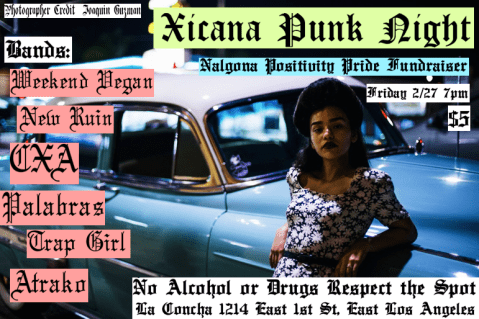
Xicana Punk Night Flyer– by Gloria Lucas, NPP
Making ‘core’
In Making Face/Making Soul, Anzaldúa writes, “‘making faces’ is my metaphor for constructing one’s identity” (xvi). In Light in the Dark/Luz en lo Oscuro, she extends this idea stating “The heart es un corazón con razón, with intelligence, passion, and purpose, a ‘mind-full’ heart with ears for listening, eyes for seeing, a mouth with tongue narrowing to a pen tip for speaking/writing” (153). Within Anzaldúa’s theorizations, “heart” is rendered a part of one’s conocimiento, a self-reflective awareness of how one is cultivating an identity and generating consciousness formations. But through this self-reflective process, one is also creating notions of home and belonging.
Through the notion of coring, self-reflective processes become about de-hearting, decentering and/or disrupting what is presumed to be foundational (i.e. what is central/core), in order to refashion. In other words, coring is a process of making anew. Hardcore demonstrates “coring” in its formation, as it emerged from the early punk movement yet reconfigured its notion of punk sound, style, and identity. In a way, punk ripped out its heart to start anew as hardcore. Similarly, Chicana punk has cored and reconfigured notions of punk and hardcore sound, style, and identity. For instance, ATRAKO offers a queer Chicana feminist representation that disavows dominant hardcore punk portrayals. They spit out lyrics in Spanish only, and use metaphorical language and visuals in their lyrics and album covers addressing gendered violence in relation to environmental abuse. Furthermore, while embodying hardcore’s “traditional” characteristics, ATRAKO dramatizes hardcore sound by performing a more melodic dissonance. The music compliments the lyrical narrations and arguably enacts a call-and-response to the sung lyrics posing its own sonic narration.
The song “Madre” (2014), which translates as “mother,” exemplfies this as the guitarist begins with a lamenting introductory verse, followed by thumping drums and a grito reminicent of a battle cry. In the first chorus Samahra blurts out:
ya es tiempo de entender
quien te dio la vida
es la muxer la encarnación
la esencia de la tierra
ya es tiempo de entender
quien te dio la vida
es la muxer quien tiene el poder. (Madre, 2014)
As Samahra is singing, the drums, guitar, and bass sound out a response to the chorus’s statements. This sonic accompaniment articulates a “coring” of hardcore music through the queer brown bodies animating this sonic experience, the exclusively Spanish lyrics and narrative, which centralize women and their relations to the natural world through the figure of mother, as well as a spiritual activism–what Anzaldúa called “a spirituality for social change” (323). In other words, the song presents all things that are not typically represented in American hardcore. ATRAKO tears up hardcore to make it anew and to speak to their experiences, politics, and identities, creating a “home” for themselves in hardcore.
In addition, Chicana punk reconfigures Chicana feminist politics, experiences, and subjectivities. Punk artists and bands such as ATRAKO articulate, or rather (re)articulate, Chicana feminist discourses through the platform of punk, and more specifically, hardcore. ATRAKO demonstrates a reconfiguration of Chicana feminisim through their sonic expression which shapes a listening practice of Chicana feminist theory and praxis through a “coring” of hardcore. As ATRAKO presents Chicana feminist discourse through non-traditional avenues and hardcore style, they bring visibility to Chicana feminist experiences and subjectivites within punk subcultures. Moreover, given the ethnic heterogeneity of the band, ATRAKO demonstrates how Chicana feminist politics is engaged by non-Chicana Latinas, particulatly punks, who help shape these politics just as much as they are impacted by them. ATRAKO’s hardcore sound reveals how Chicana and Latina punks engage and reconfigure Chicana feminist discourses, positing the political potentiality punk offers Chicana feminism. In considering the conceptual framework of making heart, or rather making ‘core,’ Chicana punk, as exemplified by ATRAKO, sounds out a process of deconstruction and reconstruction.
Additionally, these continuous processes of reconstruction in punk and more specifically Chicana punk, are made possible though the cultivation of practices and cultural productions of its active participants. For instance, ATRAKO’s sound stems from a variety of musical influences that might not necessarily be typically associated to or rendered Chicana or Chicana affiliated (such as metal, punk, and hardcore). Yet, their coring practices reconstruct hardcore as a Chicana genre. In addition, events such as Xicana Punk Night illustrate how Chicana punk subculture is constituted by varying participants who enact and identify with Chicana feminist politics in one way or another. ATRAKO’s participation at this show, as well as other non-Chicana Latina attendees, highlights how a Chicana punk space and genre is generated through a structure of feeling that extends across ethno-national identities. It might be suggested that the term “Latino punk” may best describe this structure of feeling; however, the fact that participants continue to specify the genre and spaces as “Chicana” or “Xicana” punk complicates such general descriptions.
Future Developments
The theoretical basis I have presented here is a stepping-stone for thinking about Chicana punk listening practices and what can be imagined through Chicana punk sound. Considering the etymology of “core” through the context of hardcore, I have argued that one way of imagining Chicana punk sound is through a reconfiguration and articulation of home. ATRAKO offers a new way to conceptualize how Chicana punk subculture and sound is constituted through varying Latina/o identities and non-Chicana subjectivities, and how it is also a site of home, belonging, and community for such participants, culminated through the act of listening. Listening is performative here, in the sense that it is a part of the “coring” process of hardcore, as Chicana feminist praxis is enacted through hardcore sound. The connection between “core” and listening practices in Chicana punk echoes a structure of feeling and political potentiality that emanates from the scene, music, and sound, exceeding their subcultural formations. Participants engage this structure of feeling, shaped by processes of making anew, that functions as a site of belonging that speaks to new Chicana subjectivities, politics, and experiences in hardcore.
—
Featured Image: ATRAKO live–via https://atrakopunx.bandcamp.com
—
Susana Sepulveda is a PhD Student in the Department of Gender and Women’s Studies at the University of Arizona. Her developing dissertation project engages Chicana feminist studies, cultural studies, subcultural studies, and sound studies. She focuses on consciousness and subject formations in Chicana punk subcultures, emphasizing the importance of punk for understanding Chicana identities, subjectivities, consciousness, politics, and representations. Susana’s research has received support from the Barnard Library, the American Association of University Women (AAUW) of Arizona, the Women Studies Advisory Council (WOSAC), as well as numerous conference associations including the American Studies Association, the Cultural Studies Association, the National Women’s Studies Association, and Feminisms & Rhetorics. She earned her M.A. in Gender and Women’s Studies at UA, and her B.A. in Feminist Studies and Latin American and Latino Studies at the University of California, Santa Cruz. In addition to her scholarship, Susana is the founder and organizer of the annual music fundraiser event Riot Grrrl Carnival, a punk musician in the Los Angeles based punk band Las Sangronas y El Cabron, zinester, and creator of the zine series “La Sangrona.”
—
REWIND! . . .If you liked this post, you may also dig:
G.L.O.S.S., Hardcore, and the Righteous White Voice – Chris Chien
If La Llorona Was a Punk Rocker: Detonguing The Off-Key Caos and Screams of Alice Bag – Marlen Ríos-Hernández
Riot-Grrrl, Punk and the Tyranny of Technique – Tamra Lucid
An Evening with Three Legendary Rebel Women at Le Poisson Rouge, January 27, 2017: Margot Olavarria, Bibbe Hansen, and Alice Bag –Elizabeth K. Keenan
Share this:


Current Top Posts





April 2021

January 2020

November 2019

October 2019

August 2019

April 2014

November 2017

March 2015

December 2017

October 2015
 Sounding Out!
Recent Comments