
To Sir, With Ratchety Love: Listening to the (Dis)Respectability Politics of Rachel Jeantel

 Editor’s Note: July 18th, 2013 has been designated as World Listening Day by the World Listening Project, a nonprofit organization founded in 2008 “devoted to understanding the world and its natural environment, societies and cultures through the practices of listening and field recording.” World Listening Day is a time to think about the impacts we have on our auditory environments and, in turn, its affects on us. Once again, Sounding Out! has decided to observe World Listening Day by planning a month-long special forum of posts exploring several different facets of listening such today’s offering by SO! regular Regina Bradley, questioning how American racial ideologies impact listening as a cultural, embodied act. Listen carefully, because we will be following Regina’s post with a special Sounding Out! Comment Klatsch on Wednesday, July 3rd that considers the consequences of racialized refusals to listen. What are the consequences of a listening that is interrupted? distorted? denied? perpetually deferred?—Editor-in-Chief, Jennifer Stoever-Ackerman
—
Rachel Jeantel gave me life with a curt “that’s real retarded, sir.” Responding to George Zimmerman’s attorney Don West’s suggestion that Trayvon Martin pursued and wanted to hurt Zimmerman, Jeantel undoubtedly lifted many eyebrows and possibly a few “hell naws” under the breaths of those watching her testify. Her response to West regarding his lack of understanding can be extended to assess the firestorm of controversy surrounding her testimony: questions of her literacy as oppositional to the prosecution’s hopes of conviction, surprise at her brashness and demonstrative gestures of irritation, and, worst of all, judgments about the literal and figurative fullness of her girlhood/womanhood and chocolate skin as signs to ring the alarm as grounds for dismissing justice for Trayvon Martin. Because her testimony operated outside of normal constructs of witness etiquette and respectability, it was greeted with a hailstorm of controversy paralleling the rawness of responses to scripted reality shows. The shallowness of “critique” of Jeantel—whom, it must be continually repeated, is not on trial—was disgusting.
But you don’t need me to tell you that, because if you were really listening to Rachel Jeantel, SHE told you. Jeantel’s delivery was particularly striking, offering her audience low timbred and often emphatic quips of “what?!” and “you ain’t get that from me” to indicate her irritation and frustration with West. Jeantel’s refusal and inability to conform to expected cultural and aural scripts of black womanhood within the confines of the courtroom – the epitome of a hyper-respectable space – destabilizes not only racial paradigms of black (southern) respectability but Americanized expectations of black women’s scripts of respectability. As Brittney Cooper points out, “Rachel Jeantel has her own particular, idiosyncratic black girl idiom, a mashup of her Haitian and Dominican working-class background, her U.S. Southern upbringing, and the three languages – Haitian Kreyol (or Creole), Spanish and English – that she speaks.” Her people ain’t from hea and because of her upbringing can’t be categorized like other black girls from hea. In this sense, Rachel Jeantel is ratchet.
As I previously define in an analysis of Beyonce’s “Bow Down,” [sonic] ratchetness is a means of navigating sliding representations of respectability within American popular culture. Jeantel’s testimony, however, thinly treads between ratchetness as performative discourse and lived experience. Her reference to the television show The First 48, during a line of questioning regarding how she knew the police would contact her, for example, signified to some that Jeantel was oblivious to the judicial process.
Upon closer examination, however, The First 48 is a touchstone in understanding her negotiation of the criminal justice system as a series of steps/performances surrounding the policing of black bodies from her native Miami (which, it seems, is always on the show). It provides a widely acknowledged– and commodified – representation of black trauma in relation to the U.S. justice system. Jeantel’s ratchetness, then, is a tragicomedic site of cultural and gendered trauma accessible to the national public. Her personal loss of a close friend is overshadowed by her performance of that grief in a space of hyper-respectability. Her emotionally charged question “are you listening?” jolted not only West but those watching the trial. Were we listening? What were we listening for?
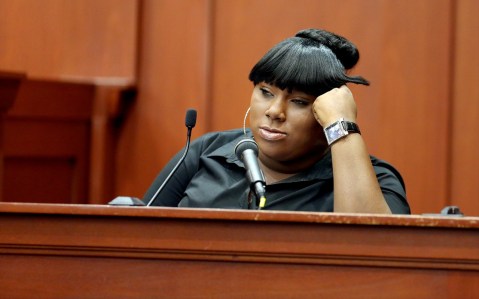
Jeantel’s performance of ratchetness both pointed out and disrupted America’s racialized and gendered listening practices. I’d like to suggest her two-fold performance of ratchetness – sonic and cultural, imposed and embodied –presented ratchetness outside of a strictly pop culture lens. Instead, Jeantel’s performance and lived experiences present ratchetness as an antithetical response to (hetero)normative politics of respectability currently in place in the black (diasporic) community.
The lightning-speed meme-ification of Jeantel invoked flatter, more familiarized representations of ratchet. Because of our inability to translate Jeantel’s grief as “respectable,” she bore the brunt of public scorn and attempts of humiliation. The idea that Jeantel signifies a real life Precious, for example—the main character of Lee Daniel’s Oscar-nominated 2009 film adaptation of Sapphire’s novel Push, played by Gabourey Sidibe—demonstrates increasingly blurred lines between black women’s performative and lived experiences. It should be noted that Sidibe herself was frequently attacked in the press and on the Internet, to the point where she told her co-star Mo’nique in Interview Magazine, “I try to stay off the Internet. Just because people hurt my feelings sometimes. . .a lot of people commented that I’m an incredible actress. But other opinions weren’t so nice, physically or whatever.” Jeantel-as-Precious inadvertently suggests Jeantel’s ratchetness is grounded in the sense that she is plus-sized, dark, “illiterate,” and from a working class background. Precious-as-Sidibe becomes the medium through which Jeantel’s (il)legible womanhood is comprehensive.
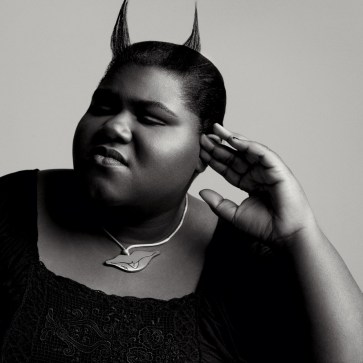
Gabourey Sidibe, from Interview Magazine, Photography by Vinoodh Matadin and Inez Van Lamsweerde
Further, meme-ing Jeantel as Precious solidifies her working class background and ultimately her testimony as a threat to Trayvon Martin’s (re)deemed middle class respectability as a portal of victimization. Returning to Cooper’s observations of Jeantel’s use of hybrid-linguistics, it is Jeantel’s sonic delivery that most threatens Martin’s perceived and scripted middle class respectability. Jeantel’s use of so-called “broken” English has overwhelmingly been heard by what Jennifer Stoever-Ackerman calls America’s dominant “listening ear” in “Reproducing U.S. Citizenship in Blackboard Jungle” as a marker of her working class background – not her trilingual background – and thus, it sonically aligns Martin with the black working class and voids prospects of him being considered a victim of violence rather than its perpetrator. Don West’s treatment of Jeantel on the witness stand attempted to impose a parallel between Jeantel’s alleged “illiteracy” and Martin’s criminality. The “crime” of illiteracy within the courtroom and supposed “crime” of Martin beating Zimmerman into shooting him co-exist within a policed space of (white) respectability that black bodies are frequently forced to adhere.

Jeantel retaliated against West’s attempts to back her into this tight space, however, with her emphatic use of “sir.” Jeantel’s brilliantly subversive tactic demonstrates ratchety resistance because it provides a subtle inversion of the white supremacist discourse directed towards her. Her use of “sir” reminded me of the unnamed protagonist’s grandfather at the beginning of Ralph Ellison’s Invisible Man, who on his deathbed commanded his family to “live with your head in the lion’s mouth:” “I want you to overcome ‘em with yeses, undermine ‘em with grins, agree ‘em to death and destruction, let ‘em swoller you till they vomit or bust wide open” (16). Indeed, Jeantel busted “the lion’s mouth” wide open vis-à-vis a hybridized slang and an emphatic “yes sir” or “no sir.” Most importantly, Jeantel sustained her dignity and self-respect in the process. Jeantel’s mastery of a low, monotone “sir” signifies her existence outside of the politics of respectability that frame not only black women’s experiences but blacks’ submission to white supremacy.
Where West and others focused on her facial features or even her delivery of “sir” as a sign of (dis)respect, what was lost upon many was how her aurally subversive delivery of arguably the most hyper-respectable word in (American) English kept her in command of her testimony.
 Rachel Jeantel is ratchety brilliance. She witnessed, performed, and sounded her truths in ways that complicated if not contradicted the normative discourse policing black women’s bodies. Although much of her cunning was shortsightedly heard as uncouth and aural evidence of a lack of (middle class) home training, Jeantel signifies the usefulness of ratchet as a form of resistance to the white privilege that dictates respectable spaces like the U.S. courtroom. Sir.
—
R.N. Bradley recently graduated with a PhD in African American Literature at Florida State University and is a regular writer for Sounding Out!
—
 REWIND! . . .If you liked this post, you may also dig:
Death Wish Mixtape: Sounding Trayvon Martin’s Death–Regina Bradley
Hearing the Tenor of the Vendler/Dove Conversation: Race, Listening, and the “Noise” of Texts–Christina Sharpe
The Noise of SB 1070: or Do I Sound Illegal to You?–Jennifer Stoever-Ackerman
Share this:

Sonic Brownface: Representations of Mexicanness in an Era of Discontent

Image by Flickr User Thomas Hawk
In the current anti-immigrant climate, the visual, sonic, and textual modes of representation are becoming battlegrounds we must consider. Arizona, Georgia, and Alabama’s takes on immigration policy and eliminations of ethnic study course offerings from college and high school curricula, are signs of a climate fraught with discontent. However, these fights are not limited solely to the political sphere; in fact, the arena of cultural production—music, literature, theater, and film—facilitates a generalized outlook on Latinidad in the United States by representing Dreamers (the generations of children who were raised in the U.S. from a young age but are not citizens), and/or the thousands of undocumented immigrants who sustain an infrastructure of cheap labor. Within these often stereotypical representations, it is frequently sound that produces the strongest sense of social, cultural, and political difference for Latino subjects.
In this post, I analyze the 2006 film Nacho Libre, a comedy starring Jack Black as a friar who becomes a Lucha Libre fighter, as symptomatic of what I term “sonic brownface,” an aural performativity of Mexicanness. My interest on Nacho Libre is to elucidate how sonic brownface manifests on the big screen, and what is at stake through these seemingly innocent (re)presentations of Mexicanness. I characterize “sonic brownface” as a “speedification” of a Mexican accent, named after Speedy Gonzalez’ infamous call “¡Ándale! ¡Ándale! ¡Arriba! ¡Arriba! ¡Epa! ¡Epa! ¡Epa!” Although comedian Jack Black intends to present a respectful portrayal of a Mexican, his speech enables my analysis of “sonic brownface” within popular culture, a sound that reproduces ideologies about an invisible majority that is also perceived as non-American: Latinos, undocumented immigrants, and dreamers.

The May 1, 2006 protest in Los Angeles, Image by Flickr user The Korean Resource Center 민족학교
Voicing the Other…

Popular silent-era leading man Ramon Novarro (née José Ramón Gil Samaniego) as photographed by Carl Van Vechten in 1935
The last scene of the Academy Award winning film The Artist (2011), presents why the silent film Artist was against the industry’s move toward the “talkie.” His voice collided with the visual representation of the suave debonair cosmopolitan man—and audience expectations of what such privilege sounds like. Though French actor Jean Dujardin plays the lead character in the film The Artist, it must be noted that several Mexican and Latin American actors did quite well in those early years of Hollywood cinema. Their exotic looks made them desirable and allowed audiences to fantasize about the man or woman on the screen because they could not hear them speak. Moreover, their physicality allowed some actors to “pass” as white. When talkies became the norm, Latino actors began performing now familiar stereotypical characters because in the U.S., their voices were indelibly associated with their “foreignness.”
In the realm of popular culture, both Disney and Warner Brothers created their own “Mexican” characters. In 1944, Disney introduced a Mexican and a Brazilian in the animated film Three Caballeros. Joaquin Garay was a Mexican voice actor featured in the voice of Panchito Pistoles in the Three Caballeros.
.
His accent and his singing sounded like someone who is Mexican speaking English, as oppose to an exaggerated Mexican accent heard later in the cartoon character of Speedy Gonzalez. Panchito Pistolas showcases a pride in being Mexican as heard in the singing of a ranchera and wearing his gun like the Mexican Revolutionaries of the 1910s. In the 1950s, Warner Brothers introduced Speedy Gonzales to their pantheon of animated characters, coinciding with the next wave of anti-Mexican sentiment during the campaign of Operation Wetback.
In his essay “Autopsy of a Rat,” William Nericcio posits that viewers come to recognize a series of stereotypes about Mexicans through the animated character of Speedy Gonzales. Nericcio incorporates historical references that influenced the design and creation of Gonzalez. He stipulates that this animation creates visual cues which American audiences connect as qualities of Mexicanness, “how this popular animated star comes to function in a way that reinforces politically charged, visions/versions of the ‘Mexican’ on ‘American’ soil” (212). Nericcio emphasizes the “visuo-ethnic clues” to deconstruct the Speedy Gonzales cartoon, and his definition of the stereotype helps corroborates my interest in how “sonic brownface” manifests as a “Speedification” of a Mexican accent. “Strapped for existential input as to the dynamic of Mexican subjects, we turn to stereotypes to provide us with visuo-ethnic ‘clues’ that fill in for empirical data and satisfy the lazy desire of our collective curiosity (219). Whereas Nericcio emphasizes the visual, however, I argue that sound has also held a strong purchase on the American racial imaginary in the case of Latinos. When audiences see and hear Jack Black as Nacho Libre, for example, they already recognize the accent.
Nacho Libre, sonic brownface personified
I propose the concept of “sonic brownface,” which pairs auditory with visual signs of Mexicanness as mediated in popular culture, to characterize the Mexican as a perpetual foreigner within the national imaginary. My interest in a film like Nacho Libre is to elucidate how audiences already recognize “Speedification,” a voicing of Mexicanness that manifests as a performance of “sonic brownface.” This conceptualization of “sonic brownface” is informed by Jennifer Stoever-Ackerman’s work on the “sonic color-line.” In “Splicing the Sonic Color-Line: Tony Schwartz Remixes Postwar Nueva York,” she posits that “sound is not merely a scientific phenomenon—vibrations passing through matter at particular frequencies—it is also a set of social relations … the “sonic color-line” begins to theorize the mutually constitutive relationship between sound, listening, and race.” She elaborates how “aural signifiers of race are thoroughly enmeshed with the visuality of race [because] they never really lose their ultimate referent to different types of bodies” (65). In the case of “sonic brownface,” Jack Black does not need to be a Mexican actor, he just needs to sound “Mexican” to conjure a physical referent.
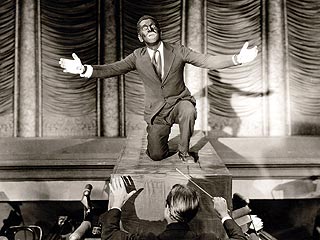
Still from The Jazz Singer
In utilizing the term “brownface,” I also reference minstrel entertainment in which blackness fetishized and simultaneously disavowed African American entertainers consequently framing racial codes onto a spectrum of racialized bodies. In his analysis of the first talkie The Jazz Singer (1927) “Blackface, White Noise,” Michael Rogin proposes that the “protagonist adopts a black mask and ventriloquiz[es]the black, sings through his mouth” (419). Through this masking, the Jazz Singer becomes Americanized through “appropriat[ing] an imaginary blackness” (421). Even as our contemporary sensibility would call out any form of contemporary blackface performance, we have yet to identify a similar masking when it occurs with Mexican or Latino characters. I contend that the models seen in blackface entertainment have already placed familiar scenarios of seeing White or Jewish actors performing an ethnic Other. When American audiences see Jack Black as “Nacho Libre,” they do not need to see him brown his skin; it is enough to hear a “speedification” of Spanish to have us entertain his believability. When “sonic brownface” occurs, it does not Americanize the performer, rather it perpetuates the Mexican and by extension Chicanos and Latinos as always already foreigners.
In order to recognize how “sonic brownface” is performed in the comedy Nacho Libre, it is also necessary to understand how its sound echoes a political climate that conflates “Mexican” with “Immigrant,” thereby representing Mexicans as undocumented people who have no right to be on this side of the U.S./Mexico border, and lumps all Latinos together as “Mexican.” The film was released a month after the nation’s largest immigrant rallies on May 1, 2006, occurring throughout many cities. The timing of the film also coincided with the first series of policy measures on immigration reform proposed by Congress. Whereas before the May Day marches, some members of congress discussed immigrants as criminals, after the big turnout Congress changed their tune, beginning to consider amnesty or easier paths to citizenship for undocumented immigrants, including generation Dreamers, already raised and finishing their schooling in the States. Cue Jack Black.

Image by Flickr User Thommy Browne
Speedification del Celluloid: “sonic brownface” in Nacho Libre
Nacho Libre, directed by Jared Hess (of Napoleon Dynamite fame) presents a comedic fictionalization of the story of Fray Tormenta, a career Lucha Libre fighter who was actually Reverend Sergio Gutiérrez Benitez. The film highlights Black’s strengths as a singer and presents him in a character that is the classic underdog trying to achieve his wrestling dream. As Nacho, the cook for the orphanage, he also wishes to provide the children a better meal, at least once in a while. I will highlight a few scenes in which Black’s sonic brownface performance stands in contrast to the other Mexican cinema actors who speak English. I will conclude with a proposition as to why sonic brownface is already so familiar to us.
From the opening sequence, we see the quaint orphanage located in a small Mexican pueblo. “Sonic brownface” is introduced in the film from Black’s first words “Be grateful Juan Pablo today is especially delicious.” In the next sequence, Hess films the Father saying mass in Spanish with no translation, or subtitles. I point this out because it sets up a type of authenticity with the Mexican orphanage, and that the film brings together both American actors speaking “Es-Pan-ish” and Mexican actors speaking in English. Ana de la Reguera, “Sister Encarnación,”–a nun who arrives to teach the children–also does not perform sonic brownface. She sounds like a Mexican actress speaking English, very much like other Mexican actors preceding her in Hollywood, adding a third later of sonic representation that actually works to heighten sonic brownface’s effects.
However, the sequence that most prominently presents the visual and auditory cues of sonic brownface appear in a twenty-minute segment when Nacho recruits his partner, Esquelito, and they transform into luchadores. In the midst of Nacho’s transformation, he must also contend with his carnal feelings for Sister Encarnación and to instruct the boys that wrestling is not good. Black goes from Italian in “taste of glory” (19:114-16); to Cuban “take it easy” (24:03); to urban Mexican American “my life is good, really good. It’s fantastic” (35:50). The sequence ends as Nacho cannot defend Sister Encarnación and blames Esqueleto for the mishap. Here sonic blackface culminates this performativity of Other with “get that corn outta my face. I looked like a fool last night. What took you so long?!” (39:54-40:29).
One could read this performativity of Otherness in the remix of accents as Black’s self-awareness that he is voicing something not of his experience. However, that he is Jewish and a comedian implies a privileged position already granted to him through blackface performances: the permission to co-opt ethnic and racial identities. When he inflects a Cubanesque accent, audiences can recall Al Pacino in Scarface, an earlier articulation of “sonic brownface.” Or the urban Chicano accent as seen in Born in East L.A. when Cheech Marin teaches the Mexicans waiting to cross the border how to blend in with Chicanos. By the time Black performs sonic blackface, as audiences we have been cued to these auditory references, thus we do not need him to alter his physicality to match the accent. It is enough to hear it to understand the referent. The sequence reaffirms Nacho as the luchador, since we also see his persona of the fighter come to life.
Rogin’s analysis can help us understand these slippages, as well as the role of “sonic brownface” in representations of Latinos by white actors. Rogin posits how Jolson’s performance in the first talkie simultaneously killed Vaudeville entertainment and reintroduced blackface into popular media (429). It is Rogin’s conclusion that it is with the appearance of “Jack Robin” in blackface, that the Jewish individual “Jakie Robinowitz” becomes white and thereby successful, mediating this success through visual codes of blackness. Similarly, in Nacho Libre, sonic brownface operates as both the visual and sonic cues of Mexicanness that enable Jack Black to become the luchador who doesn’t need to live behind a mask. As the film ends, Nacho is content, becoming a hero to the orphans who no longer bemoans his lot in life. This ending is contrary to the plight of immigrants from Latin America who must leave their home in search of better economic opportunities.
By identifying sonic brownface, we can see how American audiences fetishize the sounds of the Mexican/Latin Other yet simultaneously disavow their presence by placing non-Latino actors in these roles. Through the performativity of sonic brownface, popular media and film reify codes of Mexicanness as always foreign, silencing their accents because español is still an unwelcomed sound. Sonic brownface can also be a useful tool by which to investigate similar auditory articulations of Latino sounds. I’m thinking here of Rita Moreno in West Side Story (1961)—see Priscilla Peña Ovalle‘s Sounding Out! post “Aurally Other: Rita Moreno and the Articulation of ‘Latina-ness’” (January 2011)–George Lopez in Beverly Hills Chihuahua (2008), Wilmer Valderrama “Fez” in the television series That 70s Show, and the panoply of Latino actors in Machete (2010) by Richard Rodriguez. Given that media tends to recycle tropes and stereotypes, as audience members we have developed a keen awareness of these sonic markings of Otherness.
Most importantly, my intent in identifying sonic brownface concerns its re-appearance during another surge of anti-immigrant rhetoric. The rallies that occurred on May Day 2006 became synomous with immigrant rights. The release of Nacho Libre shortly after these rallies unknowingly silenced immigrant Spanish speaking voices in the popular imaginary until the film A Better Life (2011) staring Demián Bichir, connected undocumented immigrants with an empathetic experience. The strongest counteractions, however, have not been channeled through Hollywood. With the 2012 election, another surge of immigrant rallies happened at the Democratic National Convention with UndocuBus riders arriving in time to call attention to immigrant rights (start at 8:10-11:24).
As seen in this video clip, undocumented immigrants, Dreamers, Latina/s, and Chicana/os committed acts of civil disobedience because their voices will not be silenced.
—
reina alejandra prado saldivar is an art historian, curator, and an adjunct lecturer in the Social Science Division of Glendale Community College in Glendale, California.As a cultural activist, she focused her earlier research on Chicano cultural production and the visual arts. Prado is also a poet and performance artist known for her interactive durational work Take a Piece of my Heart as the character Santa Perversa (www.santaperversa.com) and is currently working on her first solo performance entitled Whipped!
—
REWIND! . . .If you liked this post, you may also dig:
Sound and Curation; or, Cruisin’ through the galleries, posing as an audiophiliac-–reina alejandra prado saldivar
Chicana Radio Activists and the Sounds of Chicana Feminisms–Monica De La Torre
Listening to Modern Family’s Accent–Juan Sebastian Ferrada and Dolores Inés Casillas
Share this:


Current Top Posts





April 2021

January 2020

November 2019

October 2019

August 2019

April 2014

November 2017

March 2015

December 2017

October 2015
 Sounding Out!
Recent Comments