
A Listening Mind: Sound Learning in a Literature Classroom

“Listening is little short of a synonym for learning.”
–Julian Henriques, Sonic Bodies
DOI: https://doi.org/10.59350/th0ht-v6j23
This is the third post in Sounding Out!’s July forum on listening in observation of World Listening Day on July 18th, 2013. World Listening Day is a time to think about the impacts we have on our auditory environments and, in turn, its affects on us. To read last week’s post by Maile Colbert click here and Regina Bradley’s discussion of listening, race, and Rachel Jeantel (and to read more about World Listening Day) click here.
—
How can listening, which I’ve come to understand as an essential way of knowing, enhance the learning experience? My pedagogical challenge over the past few years has been to develop a heightened awareness of the ways our ears are not necessarily, as Robert Frost asserts, “the only true reader and the only true writer,” but certainly an essential mode of reading and writing that is too often underdeveloped. As my high school students read works by Zora Neale Hurston, Ralph Ellison, Michael Ondaatje, Jonathan Safran Foer, James Baldwin, and Lucille Clifton, I want their ears to become increasingly attuned to the sounds, silences, vibrations, and other sonic significance embedded within printed words. I want them to experience how listening enhances their understanding of literature, that listening is learning.
I’ve taught A Listening Mind, a trimester course for high school juniors at Princeton Day School in New Jersey, for two years. Inspired by Toni Morrison’s 1996 National Book Award acceptance speech, “The Dancing Mind,” the course title signals my interest in challenging students to practice writing and reading in ways that are collaborative and cognitively (and otherwise) dissonant with their usual English classroom habits of mind. For my students, at least initially, writing is ruled solely by the mantra “Show. Don’t Tell.” This course, then, creates preconditions for a new kind of learning. It aims to heighten students’ aural attentiveness in general, and particularly in relation to the sonic life that inhabits the lower frequencies of the printed word. In many ways, the class resonates with Liana Silva’s discussion of sound as significant to writing and learning. In this course, we grapple with essential questions such as: How might we read and write with our ears? What happens when we take the risk to do so? As I design assessments and moderate the course, I keep in mind my own essential question as an educator: How can my scholarly interest in listening as a significant mode of cultural and social engagement translate into sound study learning opportunities for my students? The assignments students complete in A Listening Mind, a few of which I share next, are my response to these questions–a response that is in constant development.
CULTIVATING A LISTENING MIND
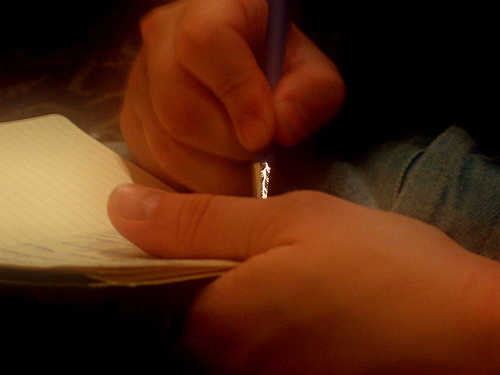
On the first day of class, I play Jason Moran’s “Cradle Song” from his most recent album, Artist in Residence. Moran plays the Carl Maria von Weber-composed lullaby on unaccompanied piano; the urgent scratching of a closely miked pencil on paper writes slightly ahead of the calming melody.
The song, a tribute to Moran’s mother who would stand over his shoulder taking notes as Moran practiced piano as a child, amplifies a sonic life that more often lingers within the printed word. Thus, it allows us to begin exploring the possibilities of listening as an approach to reading and writing.
In the first month of the course, students practice low stakes listening and writing: they go on short listening walks and record by hand what they hear in their sound journals. Rutger Zuydervelt’s Take a Closer Listen, an excerpt from the opening pages of Jonathan Safran Foer’s Extremely Loud and Incredibly Close, and the New York Times Magazine prose and audio essay, “Whisper in the Wind” are our inspirations for this assignment. They visit a space in which they feel most like themselves and tune into the space’s acoustics. They do the same in a space where they are less comfortable. Students also tune their attention to eco-listening – listening with intention to the natural or man-made environments in which we find ourselves. The idea is to notice the sounds our ears have become deaf to as we’ve become accustomed to a space. Their eco-listening results in their creating individual listening booklets that record the sounds we hear and our occasional reflections on them. By listening to various sounds and in various ways during the early weeks of the course, students exercise their ears and, along the way, some even realize that you need more than just ears to listen.
SONIC MATERIAL CULTURE
One of the assignments of the course involves work in what I call “sonic material culture.” According to the University of Delaware’s Center for Material Culture Studies, the study of material cultural objects “promotes the learning from and the teaching about all things people make and the ways people have acted upon the physical and visible world.” But, what about the ways in which material culture impacts the audible world? Sonic material culture looks at how material cultural objects help create cultural meaning through the sounds they make and the ways in which people use those sounds. Students explored an array of “sonic objects” that included, among others, a Tibetan singing bowl, steel drum, Shofar, typewriter, stethoscope, and a boom box. They then chose one of the items – an item that either makes sound (like a steel drum) or allows for access to sound (like a stethoscope), and began their research with a specific focus on how this item holds sonic cultural significance.
To research the stethoscope, for example, one student interviewed a cardiologist and a medical historian. She learned that sounds doctors hear through the stethoscope “comprise a language, spelling out diagnoses and prognoses” and provide “gateways to our understanding of the heart.” Another student chose the Steel Drum, an instrument developed in the 20th century in Trinidad and Tobago, and ended up discussing the innovation involved in reusing oil containers to produce a new cultural sound. Another student’s research on the Tibetan Singing Bowl led him back to a moment in Jonathan Stroud’s The Bartimaeus Trilogy: Book Three, Ptolemy’s Gate when the character Kitty Jones describes the ringing of a Singing Bowl that signals her transport into the world of magical spirits. Listening to the Singing Bowl made this student more attentive to this moment that he initially skimmed. And, one student’s love of all things vintage led her to her father’s manual typewriter and an essay combining family history and larger insights about education, workplaces, and mechanical writing. In each of these cases, the students realized that the sounds cannot be extricated from the material, social, and historical conditions that produce them.
SOUNDING HISTORY
The last time I taught the course, I designed a sound history mini-project. Students read excerpts from the work of Mark A. Smith and my work on historical listening in David Bradley’s The Chaneysville Incident, and considered these question: How might sound function as a way to narrate a specific historical moment? Students needed to choose a historical moment, locate a sound, and then create a museum card that, among others, answered the following key questions: What does this sound bring to our attention that we might not otherwise consider? What questions does this sound raise? What does it leave mute? Since students had watched Django Unchained recently, we discussed sounds of slavery in that film. If you write slavery through the crack of the whip, then your focus might be on violence and torture used during that peculiar past. If you tell slavery, though, from the code-laden singing enslaved persons used to send messages to flee, then you have a different frame, a different sonic way into the historical moment.
One student used the opening sounds from The Wizard of Oz to narrate the Dust Bowl. Another examined news reports and hip hop music to listen back to the Los Angeles Uprisings. One young woman interviewed her mother about her immigration experience from Guatemala; in her project, the sound of a train whistle signaled arrival to the United States and a new life. One of the most striking projects consisted in an inventive student engineering her own sound using a teakettle in order to recreate what she imagined as the sound inside a gas chamber in a concentration camp during World War II. As she explained during her presentation, the screeching teakettle captures for her both the sound of gas and the screaming of those persons trapped within a chamber. What an empathetic choice to make as a listening scholar: to imagine the voice of one in the midst of death.
Students worked on this assignment as part of their culminating assessment for the course. I assigned this work at the end of the course because it gave students an opportunity to delve into the work of a Sound Studies scholar: students drew on their skills as listeners developed over the term; returned to questions we asked regarding listening and interpretation of written and recorded texts; framed their own questions for inquiry; and used sound technologies such as Audacity and GarageBand to amplify their historical sound.
LISTENING BACK
As I tune my ears excitedly towards another World Listening Day (this year on July 18, 2013), I find myself remembering my students’ portfolio reflections of their learning in this course. Students mentioned that their time in the course helped them pay more attention to sounds around them: “my ears have been retrofitted by my experience in this class.” Some students became more in tune with their own sound: “The world is too noisy. I need to focus in, to tune in to myself.” Yet others found themselves “slowly opening [them]selves up to others” and becoming “more engaged with others’ opinions even if they were different from” their own. Even though some students entered the class resistant to, uncertain about, or “unnerved” by the thought of a listening English course, they felt by the end that, in the words of one student, “Now I leave this class with a purpose and clearer understanding of the importance of listening to my own echo.” In short, the two groups of students who have taken this class grow more “in tune” to multiple frequencies of reading, writing, and learning.
Lastly, while I hoped students would grow as listeners, I did not anticipate that their perceptions of themselves as readers and writers would also shift. Students who previously described themselves as “just not an English student” or who began writing and reading assignments with self-defeating “I’m just not good at this” comments, delved more deeply into the writing process and produced strikingly confident, nuanced pieces by term end. They have grown in their sonic literacy. In this, my students remind me of the most essential of questions: How, to borrow Carol Dweck’s language, do we help students develop a growth, rather than a fixed, mindset where learning is concerned? In my view, listening—practiced as a dynamic, tinkering, beta-type approach to the study of literature and writing—provides interesting answers.
—
Featured image photo credit: “Listen, Understand, Act” by Flickr user Steven Shorrock, CC-BY-NC-SA-2.0
—
Nicole Brittingham Furlonge earned her PhD in English from the University of Pennsylvania. Her dissertation, “On the Lower Frequencies: Listening and African American Expressive Culture,” marks the beginnings of her investment in sound studies as the field resonates with issues of race, class, gender and education. Her work has been published in the academic journals Callaloo and Interference, and in the publication St. Andrew’s Today. She also has published a cookbook for young children, Kitchen Passports: Trinidad and Tobago. She has taught in independent high schools and colleges for 16 years, including University of Michigan, UPenn, The Lawrenceville School, Holderness School and St. Andrew’s School in Delaware. She has extensive experience in the classroom and in administrative roles dealing with curriculum development, diversity issues, faculty development and issues regarding education, equity and access.Currently, Nicole chairs the English Department at the Princeton Day School in New Jersey and blogs at the Huffington Post. She lives in the green part of New Jersey with her spouse and their three young children.
—

REWIND! . . .If you liked this post, you may also dig:
“The Sounds of Anti-Anti-Essentialism: Listening to Black Consciousness in the Classroom“–Carter Mathes
“Deejaying her Listening: Learning through Life Stories of Human Rights Violations“–Bronwen Low and Emmanuelle Sonntag
“Audio Culture Studies: Scaffolding a Sequence of Assignments“–-Jentery Sayers
—
Share this:

To Sir, With Ratchety Love: Listening to the (Dis)Respectability Politics of Rachel Jeantel

DOI: https://doi.org/10.59350/a8b9k-xr548
Editor’s Note: July 18th, 2013 has been designated as World Listening Day by the World Listening Project, a nonprofit organization founded in 2008 “devoted to understanding the world and its natural environment, societies and cultures through the practices of listening and field recording.” World Listening Day is a time to think about the impacts we have on our auditory environments and, in turn, its affects on us. Once again, Sounding Out! has decided to observe World Listening Day by planning a month-long special forum of posts exploring several different facets of listening such today’s offering by SO! regular Regina Bradley, questioning how American racial ideologies impact listening as a cultural, embodied act. Listen carefully, because we will be following Regina’s post with a special Sounding Out! Comment Klatsch on Wednesday, July 3rd that considers the consequences of racialized refusals to listen. What are the consequences of a listening that is interrupted? distorted? denied? perpetually deferred?—Editor-in-Chief, Jennifer Stoever
—
Rachel Jeantel gave me life with a curt “that’s real retarded, sir.” Responding to George Zimmerman’s attorney Don West’s suggestion that Trayvon Martin pursued and wanted to hurt Zimmerman, Jeantel undoubtedly lifted many eyebrows and possibly a few “hell naws” under the breaths of those watching her testify. Her response to West regarding his lack of understanding can be extended to assess the firestorm of controversy surrounding her testimony: questions of her literacy as oppositional to the prosecution’s hopes of conviction, surprise at her brashness and demonstrative gestures of irritation, and, worst of all, judgments about the literal and figurative fullness of her girlhood/womanhood and chocolate skin as signs to ring the alarm as grounds for dismissing justice for Trayvon Martin. Because her testimony operated outside of normal constructs of witness etiquette and respectability, it was greeted with a hailstorm of controversy paralleling the rawness of responses to scripted reality shows. The shallowness of “critique” of Jeantel—whom, it must be continually repeated, is not on trial—was disgusting.
But you don’t need me to tell you that, because if you were really listening to Rachel Jeantel, SHE told you. Jeantel’s delivery was particularly striking, offering her audience low timbred and often emphatic quips of “what?!” and “you ain’t get that from me” to indicate her irritation and frustration with West. Jeantel’s refusal and inability to conform to expected cultural and aural scripts of black womanhood within the confines of the courtroom – the epitome of a hyper-respectable space – destabilizes not only racial paradigms of black (southern) respectability but Americanized expectations of black women’s scripts of respectability. As Brittney Cooper points out, “Rachel Jeantel has her own particular, idiosyncratic black girl idiom, a mashup of her Haitian and Dominican working-class background, her U.S. Southern upbringing, and the three languages – Haitian Kreyol (or Creole), Spanish and English – that she speaks.” Her people ain’t from hea and because of her upbringing can’t be categorized like other black girls from hea. In this sense, Rachel Jeantel is ratchet.
As I previously define in an analysis of Beyonce’s “Bow Down,” [sonic] ratchetness is a means of navigating sliding representations of respectability within American popular culture. Jeantel’s testimony, however, thinly treads between ratchetness as performative discourse and lived experience. Her reference to the television show The First 48, during a line of questioning regarding how she knew the police would contact her, for example, signified to some that Jeantel was oblivious to the judicial process.
Upon closer examination, however, The First 48 is a touchstone in understanding her negotiation of the criminal justice system as a series of steps/performances surrounding the policing of black bodies from her native Miami (which, it seems, is always on the show). It provides a widely acknowledged– and commodified – representation of black trauma in relation to the U.S. justice system. Jeantel’s ratchetness, then, is a tragicomedic site of cultural and gendered trauma accessible to the national public. Her personal loss of a close friend is overshadowed by her performance of that grief in a space of hyper-respectability. Her emotionally charged question “are you listening?” jolted not only West but those watching the trial. Were we listening? What were we listening for?
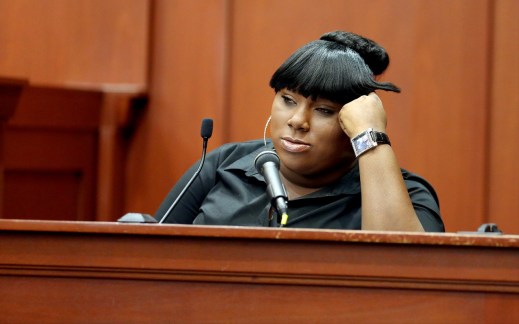
Jeantel’s performance of ratchetness both pointed out and disrupted America’s racialized and gendered listening practices. I’d like to suggest her two-fold performance of ratchetness – sonic and cultural, imposed and embodied –presented ratchetness outside of a strictly pop culture lens. Instead, Jeantel’s performance and lived experiences present ratchetness as an antithetical response to (hetero)normative politics of respectability currently in place in the black (diasporic) community.
The lightning-speed meme-ification of Jeantel invoked flatter, more familiarized representations of ratchet. Because of our inability to translate Jeantel’s grief as “respectable,” she bore the brunt of public scorn and attempts of humiliation. The idea that Jeantel signifies a real life Precious, for example—the main character of Lee Daniel’s Oscar-nominated 2009 film adaptation of Sapphire’s novel Push, played by Gabourey Sidibe—demonstrates increasingly blurred lines between black women’s performative and lived experiences. It should be noted that Sidibe herself was frequently attacked in the press and on the Internet, to the point where she told her co-star Mo’nique in Interview Magazine, “I try to stay off the Internet. Just because people hurt my feelings sometimes. . .a lot of people commented that I’m an incredible actress. But other opinions weren’t so nice, physically or whatever.” Jeantel-as-Precious inadvertently suggests Jeantel’s ratchetness is grounded in the sense that she is plus-sized, dark, “illiterate,” and from a working class background. Precious-as-Sidibe becomes the medium through which Jeantel’s (il)legible womanhood is comprehensive.
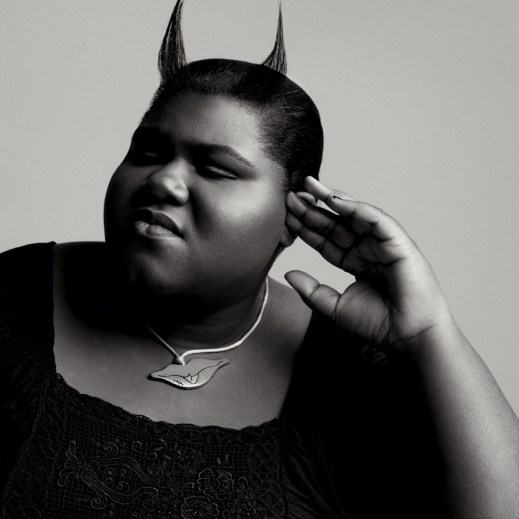
Further, meme-ing Jeantel as Precious solidifies her working class background and ultimately her testimony as a threat to Trayvon Martin’s (re)deemed middle class respectability as a portal of victimization. Returning to Cooper’s observations of Jeantel’s use of hybrid-linguistics, it is Jeantel’s sonic delivery that most threatens Martin’s perceived and scripted middle class respectability. Jeantel’s use of so-called “broken” English has overwhelmingly been heard by what Jennifer Stoever-Ackerman calls America’s dominant “listening ear” in “Reproducing U.S. Citizenship in Blackboard Jungle” as a marker of her working class background – not her trilingual background – and thus, it sonically aligns Martin with the black working class and voids prospects of him being considered a victim of violence rather than its perpetrator. Don West’s treatment of Jeantel on the witness stand attempted to impose a parallel between Jeantel’s alleged “illiteracy” and Martin’s criminality. The “crime” of illiteracy within the courtroom and supposed “crime” of Martin beating Zimmerman into shooting him co-exist within a policed space of (white) respectability that black bodies are frequently forced to adhere.
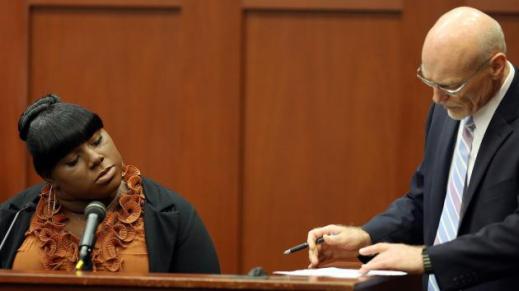
Jeantel retaliated against West’s attempts to back her into this tight space, however, with her emphatic use of “sir.” Jeantel’s brilliantly subversive tactic demonstrates ratchety resistance because it provides a subtle inversion of the white supremacist discourse directed towards her. Her use of “sir” reminded me of the unnamed protagonist’s grandfather at the beginning of Ralph Ellison’s Invisible Man, who on his deathbed commanded his family to “live with your head in the lion’s mouth:” “I want you to overcome ‘em with yeses, undermine ‘em with grins, agree ‘em to death and destruction, let ‘em swoller you till they vomit or bust wide open” (16). Indeed, Jeantel busted “the lion’s mouth” wide open vis-à-vis a hybridized slang and an emphatic “yes sir” or “no sir.” Most importantly, Jeantel sustained her dignity and self-respect in the process. Jeantel’s mastery of a low, monotone “sir” signifies her existence outside of the politics of respectability that frame not only black women’s experiences but blacks’ submission to white supremacy.
Where West and others focused on her facial features or even her delivery of “sir” as a sign of (dis)respect, what was lost upon many was how her aurally subversive delivery of arguably the most hyper-respectable word in (American) English kept her in command of her testimony.

Rachel Jeantel is ratchety brilliance. She witnessed, performed, and sounded her truths in ways that complicated if not contradicted the normative discourse policing black women’s bodies. Although much of her cunning was shortsightedly heard as uncouth and aural evidence of a lack of (middle class) home training, Jeantel signifies the usefulness of ratchet as a form of resistance to the white privilege that dictates respectable spaces like the U.S. courtroom. Sir.
—
R.N. Bradley recently graduated with a PhD in African American Literature at Florida State University and is a regular writer for Sounding Out!
—
REWIND! . . .If you liked this post, you may also dig:
Death Wish Mixtape: Sounding Trayvon Martin’s Death–Regina Bradley
Hearing the Tenor of the Vendler/Dove Conversation: Race, Listening, and the “Noise” of Texts–Christina Sharpe
The Noise of SB 1070: or Do I Sound Illegal to You?–Jennifer Stoever
—
Share this:




Current Top Posts





April 2021

January 2020

November 2019

October 2019

August 2019

April 2014

November 2017

March 2015

December 2017

October 2015


Recent Comments