
Straight Leanin’: Sounding Black Life at the Intersection of Hip-hop and Big Pharma

 Marginalized bodies produce marginalized sounds to communicate things that escape language. The queer body is the site of sounds that engage pleasure, repression, rage, isolation, always somehow outside of dominant language. Sound Studies tells us that we should trust our ears as much as our eyes, justifying our trust in sound, and of the resonating body. Affect Theory goes further, saying that all senses play into a body that processes input through levels of response, experience, and anticipation. Affect is the vibrational space that is both bodily memory and anticipation. So where do sound and affect meet in queer bodies? How do marginalized peoples use sound and the body to express liberation, objectification, joy, and struggle?
Our writers in Sound and Affect tackle these questions across a spectrum of the marginalized experience. Last week, I opened by offering the concept of the tremble, a sonic form of affect that is necessarily queer in its affective reach. Next week, Maria Chaves explores the connection between voice, listening, and queer Chicana community formation: through space, across time, and with laughter. The series finishes with Justyna Stasiowska bringing the noise in a discussion of the trans body and the performance work of Tara Transitory. Today, Kemi Adeyemi, sloooooooows thingggggggggs doooooooooownnnnn so that we can hear the capitalist connections between the work expected of black bodies and the struggle for escape from this reality through the sonic affects, temporal shifts, and corporeal elsewhere of purple drank. —Guest Editor Airek Beauchamp
—
The first track on Future’s 2015 album Dirty Sprite 2 opens with the gassy sounds of the rapper preparing “lean”: a prescription promethazine and codeine cough syrup mixture that is cut with sweet sodas and candies. He vigorously shakes the syrupy Sprite together before cracking the bottle open and pouring the fizzing drink over ice likely held in two stacked Styrofoam cups, the vessel of choice for hip-hop’s most audible drug. As Future takes his first sips his mouth puckers with the sweetness. He swirls and sips again, sighing with pleasure as he begins boasting “…I just took a piss and I seen Codeine coming out/We got purple Actavis, I thought it was a drought.”
Otherwise known as syrup, sizzurp, purple stuff, drank, Texas Tea, and barre, lean is a highly addictive concoction that is sipped slowly to release a potent blend of euphoria, hallucinations, and motor impairment—especially when consumed in conjunction with alcohol. Lean slows you down, muddies your perception, and makes you physically sway, recline, lean. Future’s album, like much of his oeuvre, pays homage to lean and this particular song, “Thought It Was a Drought,” flies in the face of the pharmaceutical company Actavis that stopped producing the drug in 2014 amidst fears that it was being illegally distributed to and consumed by non-prescription holders. The lack of production has apparently not stopped Future’s consumption, however. On 2014’s “Codeine Crazy” he explains in a lean-fueled cadence that trails into his Southern accent that “I’m an addict and I can’t even hide it.”
Future’s demonstrations of addiction speak to a significant strain of hip-hop’s cache that stems from the genre’s long engagement with the terse intersections of drugs and black life. As Touré succinctly described in a 2012 piece in the Washington Post, early hip-hop often charted the realities of the drug-addled inner city that arose in the 1970s and ‘80s. “If you’re wondering why hip-hop has often been angry, sneering, nihilistic and dystopic,” he explains, “you can blame the war on drugs, and how it feels to be on the wrong side of it.” Rappers such as Future continue to bolster their legitimacy by narrating their functional (if fabricated) knowledge of selling drugs and thus being on the “wrong side” of this so-called war. But where the crack/trap rap genre documents the rapper’s mastery of the war by espousing the maxim that you never snort what you sell, the acceptance of prescription drugs as a product the rapper can hustle and consume has become commonplace.

Spotted at SXSW 2008, Image by Jazzbeezy
The hardest working people in hip-hop are at the forefront of their craft, and they are seemingly wasted every step of the way. In this, the mainstreaming of lean within contemporary hip-hop tells a familiar story of how embedded prescription drugs are within and across USAmerican societies. This essay offers a cursory glance at the sonic, physical, and affective terrain of lean in mainstream hip-hop, however, to query how prescription drugs are seen to generate productively intoxicated states that counter the violent realities of a particularly black everyday life. Contemporary soundscapes of lean have taken hold at a point when the intersections of neoliberalism and Big Pharma circumscribe particularly black ways of being. Beginning the work of understanding the discursive entanglements of race, labor, and drugs that are sounded by lean reveals larger questions about the subtle and covert ways that black consciousness itself is produced and policed in the neoliberal state.
As has been well documented by popular news outlets such as The Guardian and scholars such as Mac McCann, the sounds of lean were developed in the 1990s by Houston’s DJ Screw, who worked to record the loosened, detached body-feeling accessed through lean with his “chopped and screwed” productions. He slowed the tempo of whole songs to around 60 bpm, which elongated the vocals to an underwater slur, and chopped the rhythm up with strategic pattern interruptions that created even more goopy space between beats. Swishahouse Records took this droning Houston sound mainstream in the early 2000s with Top 40 radio hits by artists such as Mike Jones, whose song “Back Then” paired slow and guttural choruses that maintained the core elements of the chopped and screwed sound with bouncy lyrics about girls, cars, and money that trended toward mainstream pop rap.
By 2011, gesturing to the sounds of lean become a virtual guarantor of mainstream hip-hop success. This was evidenced in part by Harlem’s A$AP Rocky, who compiled the essential audio components of lean for his debut mixtape Live.Love.ASAP—which sampled Mike Jones on the ode to lean,“Purple Swag”—and immediately nabbed a $3 million dollar deal with RCA.
While the chopped and screwed aesthetic fell a bit by the wayside in ensuing years, recording the literal sounds of lean being poured, swirled, and sipped became increasingly common in hip-hop recordings—as did capturing the swooning effects the drug has on rappers’ flow. Lil Wayne’s public addiction to lean took center stage on his prolific and sometimes-erractic mixtapes such as Dedication 5 that feature many interludes where his words bleed into one another or trail off altogether following the droopy intoxication promethazine was having on his body. The devastating effects of the controlled substance became starkly clear when Wayne suffered multiple seizures, and when Rocky’s manager, A$AP Yams, passed away following complications with drugs—a fate Houston’s own DJ Screw and the beloved Pimp C had already met.

Lil Wayne
Despite the physical risks of consuming lean, the drug appears to be a stalwart coping mechanism for artists whose work ethic has led to extravagant excesses that are balanced by the increasingly visible violence done onto black bodies. Future himself repeatedly strikes a balance between his addiction to lean and the conditions of his particularly black stardom. His video for “Codeine Crazy” is a swirling, purple-inflected picture of the artist in various states of repose: the video opens with him in a club attempting to hold his head up straight, taking his first wobbling steps after lying down in a field once populated by purple horses, and being shaken awake on an Atlanta porch while holding Styrofoam cups full of lean.
The production, lyrics, and imagery underscore his apparent struggles balancing celebrity life with the realities of his difficult upbringing, encapsulated in the admittance that he is “Drowning in Actavis suicide.” The sentiment is exacerbated in the video for “March Madness,” where iconic clips of Civil Rights Movement protesters being beaten by the police provide visual background while Future intersperses dedications to lean and exaltations of the good life with lamentations of the loss of black civil rights: “Ballin’ like the March Madness/All these cops shooting niggas, tragic/I’m the one that’s living lavish.” In these works, Future paints a picture whereby the entire spectrum of black life from extraordinary celebrity to mundane tragedy can only be understood in and through drug-induced states.

Schoolboy Q show at The Door in Dallas 6/30/12, Image by Flickr User Mikel Galicia
Future’s balancing act is common among artists for whom prescription drug abuse is both a status symbol and a requirement of black everyday life where maintaining success requires that you work nonstop. When Hot 97s Angie Martinez queried the relationships between lean and seizures, the self-confessed functional addict Schoolboy Q responded with incredulity: “Man that shit ain’t from no lean, man…Bro, we are rappers; we don’t sleep. People don’t understand.” His story of churning out features, mixtapes, albums, and tours for Interscope Records reflects our larger neoliberal economy that places a premium on the individual’s maximum, efficient output. As Q suggests in his interview, prescription drug use has blossomed under these conditions whereby the individual is made to feel perpetually behind, as Joanna Moncreiff writes in the essay “Psychiatric Drug Promotion and the Politics of Neoliberalism.” Prescriptions are marketed to stabilize, enhance, and/or find relief in one’s productivity in an age where individual entrepreneurship and competition are rewarded. Set against a larger national reliance on prescriptions to remain physically and mentally “stable” enough to remain efficient under this intensity, the black coping strategies heard through lean are innately USAmerican coping strategies.
At the same time, the slowed pace of lean is also attuned to the national epidemic whereby black people are routinely killed whether they are working or not. The racialized politics of productivity required by neoliberalism are thrown into relief as black people such as Eric Garner are killed because of their entrepreneurial efforts. As a result, attending to the sounds of lean must necessarily reflect gaps in our understanding of how particular patterns in drug use do and do not render black people intelligible as functional citizens worthy of life. Rappers like A$AP Rocky, Schoolboy Q, Future and others create musical odes to and demonstrations of the slowed pace of lean as it provides them a break from norms of physical and affective comportment. The drug incurs simultaneous sensory overload and the critical detachment from their bodies that allows them to experience (and potentially control) this overload at a slower pace—a physical and affective space that several rappers discuss in the Vice article “Lean on Me.” Lean radically grounds them, in other words, in an alternative body-space-time continuum that converses with the demands the neoliberal state places on the black body.
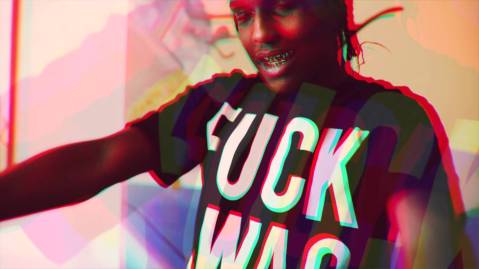
A$AP Rocky, Still from “Purple Swag Bootleg” (Director’s Cut)
The dissociative pleasures controlled substances offer to black people have been historically criminalized, and radically different sentencing guidelines continue to be handed down for the perceived consumers of “crack” (black people) versus “cocaine” (white people). In this milieu, black reliance on prescription drugs for pleasure, physical ailments, mood stabilization, or otherwise has proven to be dangerously unintelligible. Sandra Bland and Ralkina Jones died while their requirements and requests for the proper prescription meds they took to remain alive were ignored if not refused outright by the police. The question of whether or not black people experiencing alternate states of reality are more or less deserving of death is further triggered by the murders of people who may have been knocked into “discombobulated” states following car accidents, such as Renisha McBride and Jonathan Ferrell. The many deaths of black transpeople killed in the midst of various stages of medical reassignment further underscores a need for larger awareness of the ways that alternative conceptions of reality and consciousness map onto black life.
A critical history of hip-hop’s pharmaceutical undercurrent is not just an exercise in examining aesthetics. We can examine how lean is Auto-Tuned, chopped and screwed, and lyricized until we’re blue in the face. Sitting in the muck of lean-addled songs—theorizing how it feels to lean back and let our heads roll off our necks while we watch our surroundings fade and sway to purple—reveals a critically important rubric of black bodies, sounds, and affects that are wholly circumscribed by the entanglements of race, political economy, and the medical industrial complex. Reading black life against the sounds of lean subsequently makes the intersections of black labor, joy, and depression audible. This reading will not only take prescription drugs and hip-hop seriously within the canon of music and sound studies, but will also raise questions about intoxication—in its most expansive definition—as a critical component of black labor and survival from slavery to the neoliberal moment.
—
Featured Image: A$AP Rocky, Image by Flickr User Mira Shemeikka, Extra-swagged by SO!
—
Kemi Adeyemi is about to complete her PhD in Performance Studies at Northwestern University. Her dissertation examines how blackness is produced as an aural, visual, and embodied economy in the white nightlife scenes of Chicago’s gentrifying neighborhoods; the work illuminates how a small community of queer women of color that circulates through these scenes mobilize black sound as a theory and method taking pleasure therein.
—
 REWIND!…If you liked this post, check out:
“This is Your Body on the Velvet Underground“-Jacob Smith
“The (Magic) Upper Room: Sonic Pleasure Politics in Southern Hip Hop“–Regina Bradley
“Tomahawk Chopped and Screwed: The Indeterminacy of Listening“–Justin Burton
Share this:

Listening (Loudly) to Spanish-language Radio

 This is the third post in Sounding Out!’s 4th annual July forum on listening in observation of World Listening Day on July 18th, 2015. World Listening Day is a time to think about the impacts we have on our auditory environments and, in turn, their effects on us. For Sounding Out! World Listening Day necessitates discussions of the politics of listening and listening, and, as Inés Casillas prescribes, a wider understanding of the power and meaning of volume as material sensation as well as listening practice, particularly in communities marginalized by U.S. racial and ethnic hierarchies. “Listening loudly in the face of anti-immigrant public sentiment,” Casillas tells us, “becomes a form of radical self-love, a sonic eff-you, and a means of taking up uninvited (white) space.” –Editor-in-Chief JS
—
Chicana and Chicano friends across the southwest share different renditions of a similar childhood memory. The one where Mexican parents or grandparents crank up the rancheras -mournful, classic Mexican melodies – on an early Saturday morning or what seems to be an inappropriate, way-too-late weeknight. They reminisce about listening as children in wonderment to the familial, communal sing-along that seemed to instinctively take place among extended kin. That, or they tell of listening, cringing in silence, in fear that the non-Mexican neighbors will overhear the radio and spontaneous serenade; a telltale sign that their family is, indeed, Mexican. “As if,” shared Deborah Paredez in her account, “those few white neighbors somehow didn’t already know you were Mexican.”
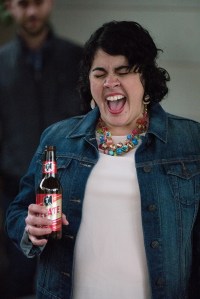
“Woman Doing a Mexican Grito” by Flickr User Nan Palmero
For unfamiliar ears, the sounds of Spanish, the mariachi ensemble, and/or accented karaoke all work together to signal brownness, working-class, and even, according to Jennifer Stoever, illegality. To me, the most provocative detail in these recurring childhood stories rests more on the volume, often stationed on one of two settings – “loud” or “real loud.” Excessive, “loud accouterments,” according to Deborah R. Vargas, are heard and identified as unforgiving, racialized and queer forms of surplus; what she calls “lo sucio” (a vernacular for dirty or grimy). The high volume allows Mexicans and Chicanas/os to publically flaunt their brown identities under the increasingly watchful gaze of a post-9/11 state, during a record-deportation Obama era, and when Latinos have officially outnumbered whites in the Golden (now brown) state of California. Listening loudly in the face of anti-immigrant public sentiment becomes a form of radical self-love, a sonic eff-you, and a means of taking up uninvited (white) space.
These stories, strikingly similar, often point to the ranchera song-style, specifically, the talents of Vicente Fernández and his regal voice as the beloved malefactor. The timbre in Fernández’s famed voice rouses (drunken) merriments of Mexico, with lyrical utterings about acrimonious, heteronormative loves and losses. The gritos or sentimental cries that accompany such songs are gendered, nostalgic stand-ins for an affect of displacement shared by both Mexican immigrants and Chicana/os. Simon O’Sullivan insists that, “you cannot read affects, you can only experience them.” I would add, “through sound” to stress the ways in which sound travels and emotionally anchor a listener’s body. The fact that so many Chicanas and Chicanos have these recollections and several (read: me) reproduce these loud practices with our own children says more about the continued racialized, brown experiences of Mexicans and Chicana/os in the U.S. than perhaps the prowess of rancheras themselves.

Vicente Fernández Performing Live in 2010, Image by Flickr User Jennifer Cachola
In many ways, the workings of race, language and labor resonate through radio. I argue that the very public nature of Spanish-language radio listening represents a communal, classed, and brown form of listening that differs markedly from “white collar” modes of listening, which offers more solitary practices, promoted by commuting in private cars and listening to personal satellite radios, iPods, or Internet broadcasts.
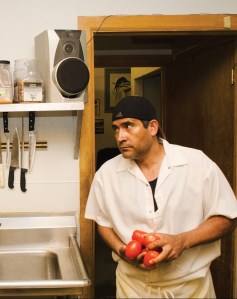
Workers listen to the radio in the kitchen of Taqueria El Nopal in Glenwood Springs, CO, Image by Andrew Cullen, High County News
For instance, one can routinely overhear loud Spanish-language broadcasts from the back kitchens of restaurants (regardless of the ethnic cuisine); outside bustling construction sites and Home Depot storefronts as day laborers await work; or from small radio sets balanced heroically on hotel housekeeping carts. On-air salutations heard throughout the day on Spanish-language radio are vocal nods to worksites as radio hosts greet washeros (car wash personnel), mecánicos (mechanics), fruteros and tamaleras (fruit and tamale street vendors), and those, presumably farmworkers, toiling under the sun. Despite the passivity in terms such as informal, invisible, and “under the table” to characterize a significant component of both U.S. and transnational economies, these recurrent and strong vocalizations of work and worksites makes audible the statistics of economist Lisa Catanzarite. She cites that recently immigrant Latino men constitute 40 to 71% of low-level service work such as “construction, agriculture, and manufacturing jobs, including waiters’ assistants, gardeners and groundskeepers, cooks, farm workers, and painters.” Not only do patrons and those passing by overhear radio at/near such worksites but radio also makes routine reference to labor and laborers. These “brown-collared” occupations coupled with the swift growth in Spanish and bilingual (Spanish-English) stations, have crafted a not-so-discrete, brown form of listening.
Arguably, it’s difficult to not hear the growth of Spanish-language radio as heavy metal, oldies, and jazz radio dials have surprised English-dominant listeners by switching to banda, norteños, and morning chatter in Spanish. In 1980 the Federal Communications Commission identified sixty-seven Spanish-oriented radio stations on the air. The 2010 figures list over 1300 radio stations broadcasting exclusively in Spanish. Proving all too well that those media pundits and scholars championing the digital era do not tune into broadcast Spanish-language radio.

“We espeekinglish tu!!!” Los Angeles, 2007
Spanish-language radio stations openly cater to a working-class and immigrant-minded listenership by advertising their call numbers and radio personalities at public transit stops. Latinos, loyal listeners of Spanish-language radio, are more likely to ride a bus or subway than to drive in a carpool lane to get to work. As an acoustic ally, these broadcasts not only assume listeners are a mix of undocumented persons, legal residents, and from mixed-status families, but radio hosts and radio programs openly rally in solidarity of their listeners’ civil rights, a provocative feat, given the recurrent changes in immigration politics. In fact, promotional billboards for radio stations often double as political statements. This one, for instance, featured Univisión’s then top rated morning host. The slogan symbolically pokes fun at unfriendly English-only attitudes and keenly reminds drivers that the United States is the second largest Spanish-speaking country in the world.

Dolores Inés Casillas’s Sounds of Belonging (NYU Press, 2014)
The portable and inexpensive cost of radio sets makes it possible for Latinos to tug their sets to work with them. Indeed, a recent listening report verified that the average Hispanic radio listener makes less than $35,000 a year and tunes in as early as 4am; indicative of graveyard, swing shifts and/or early treks to work. Closely aligned with my own assumptions about listening, Jose Anguiano’s doctoral study includes an insightful chapter on the listening preferences of custodial workers during late night shifts; in particular, how workers decided on where to place radio sets to optimize the acoustic sound of empty building spaces.
Yet, a troubling National Public Radio (NPR) segment devoted to the difficulty of finding a simple radio set bared the distinct classed uses of radio and radio listening. Producers visited high-end specialty stores in search of an AM/FM radio. The program broadcasted their collective laments at finding one radio set at their fifth store. Of course, their pursuit would have ended much earlier if they had visited a local swap meet, a K-Mart, or asked any of said laborers above where they had purchased their radio set. During my own research for Sounds of Belonging, twenty-seven of the thirty-three immigrant focus group participants interviewed indicated that a radio set was their first media purchase in the U.S.

Inside Espacio 1839 in Boyle Heights, California, retail and performance space and home of RADIO SOMBRA, a 24/7 community-based Internet radio station, Espacio is located at 1839 E. 1st Street and is open Wed-Sun, 12-8 pm. Image by Oliver Wang for KCET Artbound
Of course, such lucrative opportunities to woo radio listeners are not lost on corporate media. Latino listeners (whether they identify as Spanish-dominant or not) tune in to radio an average of three hours a week more than the “general” (white) U.S. radio listener, with an impressive 13.5 percent of all U.S. radio now broadcasting in Spanish. Univisión, a name long associated with Spanish-language television, now reigns as the empire of radio, owning the most Spanish-language radio stations in the United States.
Although tabulated figures showcase the popularity of left-leaning political broadcasts on Spanish-language commercial radio, Mari Castañeda and Monica de la Torre remind us of the significance and efficacy of community-based, Low Power FM radio for rural, Spanish-dominant Latino communities. Without the privilege of corporate sponsors such as McDonalds, or Kohls, small and fiercely independent, community-based bilingual and Spanish-language radio still thrives in farmlands across the U.S.
Sound, especially at high volume, daringly seeps and trespasses across public, racial boundaries. The policing of sound, according to Derek Vaillant, beginning in the nineteenth century were orchestrated civic attempts to eliminate unsightly and “noisy” cries from poor, ethnic immigrant street vendors peddling their goods. Another instance, during World War II, foreign language broadcasts were outlawed out of monolingual American fears that enemies were communicating via radio. City transits often post rules asking that passengers use audio/video equipment only with headphones. Public etiquette about appropriate levels of volume enforced through noise ordinances and ways of listening (privately) speak to larger issues about race, labor, and class. Not only do these public campaigns and transit rules privilege the dominant, western ear but it also, according to Jennifer Stoever, focuses on white sensory orientations of noise which inherently positions those most marginalized as the “noise makers.”

Lowrider Trike with Sound System, Image by George Garcia
For generations, Chicana/o and Mexican listeners have gravitated to radio for far more than the musical sounds of homelands imagined or left behind. Raising the volume on Spanish-language radio sends neighbors a racialized sign of “Mexican-ness” often heard as unruly, “noisy,” and perhaps worse, unassimilated. High volume from the private spaces of homes and cars disrupts the quiet, public acceptance of ear buds while also providing sheer, public glee. An audible, unabashed reminder of other forms of “lo sucio” – high credit card debt, more than 2.2 children, vegetable gardens in front yards, too-much-cologne or Virgin de Guadalupe adornments – and the brown refusal to tone, much less, to turn it down.
—
*Inspired by my six year old’s attempts to grito along with “Volver, Volver.”
—
Featured Image: Inside Espacio 1839 in Boyle Heights, California, retail and performance space and home of RADIO SOMBRA, a 24/7 community-based Internet radio station, Espacio is located at 1839 E. 1st Street and is open Wed-Sun, 12-8 pm. Image by Oliver Wang for KCET Artbound
—
Dolores Inés Casillas is an associate professor in the Department of Chicana and Chicano Studies and a faculty affiliate of Film & Media Studies at the University of California, Santa Barbara. She writes and teaches courses on Latina/o sound practices, popular culture, and the politics of language. Her book, Sounds of Belonging: U.S. Spanish-language Radio and Public Advocacy, was published in Fall 2014 by New York University Press as part of their Critical Cultural Communication series.
—
 REWIND! . . .If you liked this post, you may also dig:
“Speaking ‘Mexican’ and the use of ‘Mock Spanish’ in Children’s Books (or Do Not Read Skippyjon Jones)“–Dolores Inés Casillas
“Óyeme Voz: U.S. Latin@ & Immigrant Communities Re-Sound Citizenship and Belonging” –Nancy Morales
“Sonic Brownface: Representations of Mexicanness in an Era of Discontent“–reina alejandra prado saldivar
“Chicana Radio Activists and the Sounds of Chicana Feminisms“–Monica De La Torre
Share this:


Current Top Posts





April 2021

January 2020

November 2019

October 2019

August 2019

April 2014

November 2017

March 2015

December 2017

October 2015
 Sounding Out!
Recent Comments