
The Plasticity of Listening: Deafness and Sound Studies

“Listening Post” by Flickr User Theory
Editor’s Note: Steph Ceraso‘s post wraps up Sounding Out!’s three-part February forum on the intersection of deafness, Deaf Studies, and sound studies. However, SO! would like this series to open an ongoing conversation. If you would like to respond to these posts and/or pursue your own avenue of inquiry, please direct your pitches to jsa@soundingoutblog.com. We’d love to hear from you. By the way, if you missed (or want to re-read) Liana Silva‘s “Listen to the Word: Deafness and Participation in Spiritual Community” click here and C.L. Cardinale‘s “my mother’s voice, my father’s eye, and my other body: the sound of deaf photographs” click here.
There is no difference in being deaf or hearing—one will always appreciate the subtleties of sound because of the ability to feel things in greater depth to what the ear alone will allow us to hear. -Evelyn Glennie from Shirley Salmon’s Hearing—Feeling—Playing: Music and Movement with Hard-of-Hearing and Deaf Children
DOI: https://doi.org/10.59350/jqk23-5t005
I am not deaf, nor am I someone who is affiliated with the scholarly field of disability studies. However, I am someone who is very interested in expanding notions about what it means to listen. For my dissertation research, I have been working on developing a theory of what I call “multimodal listening.” Rather than understanding listening as something that is dependent upon the ears, “multimodal” listening refers to the various ways in which sound is felt throughout the body (via vibration), and to the multiple senses in addition to the auditory sense that are employed during a listening event.
Because of my interest in moving beyond ear-centric models of listening, I really appreciated Liana M. Silva’s recent post on the Deaf International Community Church (DICC). I was especially struck by how her experience as a hearing individual attending a Deaf church service suddenly defamiliarized her own relationship to sound and voice. The visual nature of this service, which was conducted through the use of American Sign Language (ASL), prompted her to consider listening practices that do not rely on a fully functioning auditory system.
I wonder, though, if swapping the ears for the eyes is still too limiting—too dependent on a single mode. For instance, if a non-signing deaf person was attending a service similar to the one Silva described, visual listening (in a discursive sense) would not be a possibility. My use of “deaf” (with a small “d”) is a strategic choice here. The descriptor “Deaf” (with a capital “D”), as Silva uses it in her discussion of the church, is almost always employed to refer to the Deaf Community as a cultural and linguistic entity, whereas “deaf” refers to an audiological deficiency. Since the use of ASL is most often associated with individuals in the Deaf community, those who do not sign would most likely avoid churches like the DICC. However, depending on the acoustics and the material features of the church, a non-signing deaf person might be able to experience the sound of music through vibration in a more full-bodied kind of listening practice.
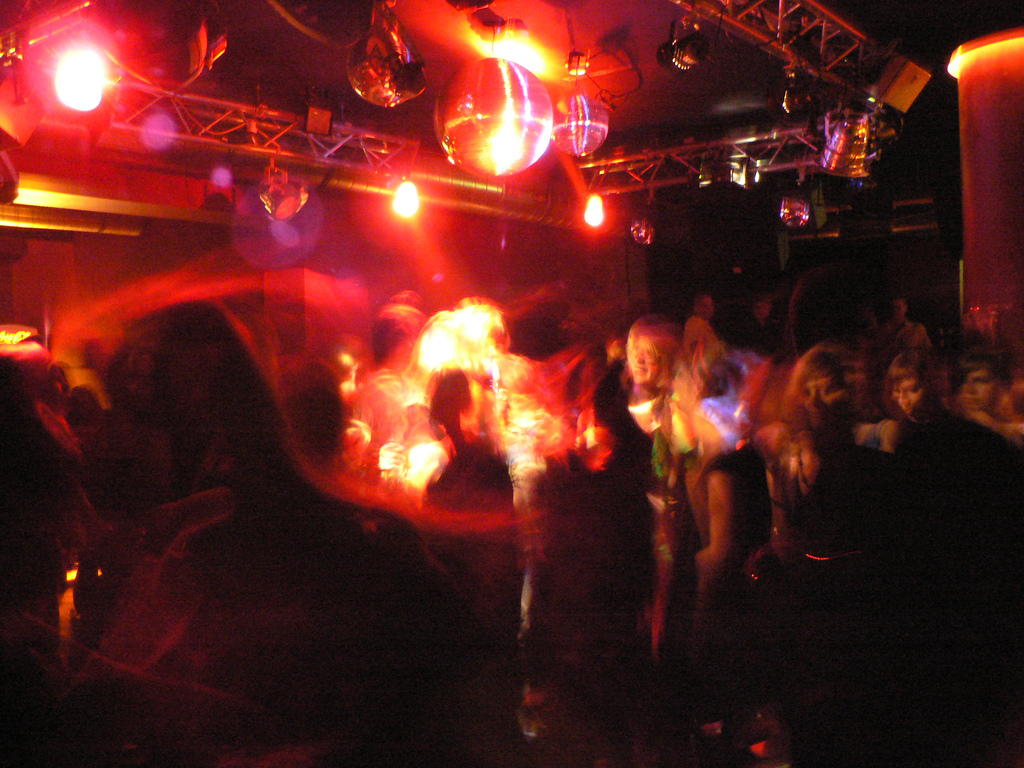
Listening via vibration is something that Cara Cardinale Fidler writes about in her poetic account of growing up with deaf parents. She remembers,
In high school, I went to a dance at the Fremont School for the Deaf where my parents were chaperones. It was easy to find the dance; you could hear the throbbing bass from across campus. It was so loud, it hurt. When I walked in, I wasn’t surprised to see a wall full of uncomfortably dressed teenagers holding balloons to feel the sound and bobbing their heads in tempo.
In this passage, Cardinale Fidler amplifies the tactile experience of sound—the ability of all bodies to listen-feel through the force of vibration. Sometimes we feel sound in our guts or throats or teeth, but this is not usually an aspect of listening that most people with a working auditory system meditate on, or try to refine in any way.
I think it is important to acknowledge, as Silva and Cardinale Fidler do by example, that the labels “deaf” and “hearing” are not as clear-cut as they may seem. There is a whole range of auditory function among people who are given these labels, or who fit somewhere between them. Sound scholars might think of deafness, then, not as a uniform lack, but as a range of listening practices in which sensory modes other than the ears are employed. Some people rely more on one mode than others, and some might develop synesthetic listening practices.
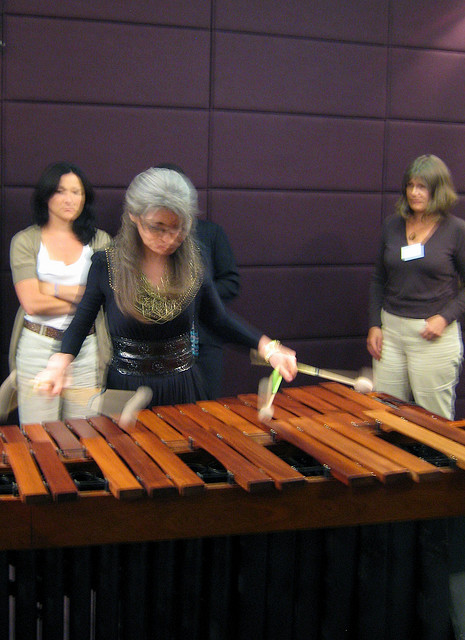
For instance, in the documentary Touch the Sound, percussionist Evelyn Glennie uses the convergence of sound, sight, and touch in her own listening training. We need to start thinking about listening less in terms of binaries (e.g. you either have the capacity to listen or you do not), and more in terms of possibilities. The fact that bodies can be retrained to experience listening via multiple modes highlights the extremely flexible, plastic nature of listening habits and practices. In considering this diverse range of listening possibilities, I wonder how we might design more listening experiences that are truly multimodal—that require or at least present the possibility of listening with more than one sensory mode. How might we expand the listening capacities of all bodies?
Deaf space and architecture is one area that is beginning to take up such questions. Based on the concept of universal design, which emphasizes the production of products and environments that are accessible to both so-called “disabled” and “able-bodied” individuals, deaf architecture considers the ways in which deaf listening bodies move through and communicate within space. These spaces seem particularly well-designed for visual and tactile listening situations. For example, according to blogger Scott Rains, some key principles of deaf architecture include: the use of partial walls or open concept spaces, no sharp angles and curved corners to increase visual range, no sources of glaring light that might impede vision, and wooden floors for more pronounced vibration. Bodies, spatial and material configurations, and the senses were all taken into account in this kind of design. The visual and tactile elements in these spaces accommodate particular bodies and communication practices, but there would be no need for such spaces without the existence of those particular bodies and communication practices. The design of deaf architecture is based on the reciprocal relationship between cultural and physiological needs, which in turn broadens the listening possibilities of the inhabitants of deaf spaces.
Deaf studies and deaf scholars have much to contribute to sound studies. Expanding ideas about what it means to listen, coming up with new ways to extend the capacities of all listening bodies, and developing more dynamic and complex theories of listening will require sound studies scholars to think about listening not only in terms of the ears, but in terms of bodies, affects, behaviors, design, space, and aesthetics. In this sense, deafness may be one of the most significant and generative areas of research in the continuing development of sound and listening studies.
Conversely, sound studies can offer deaf studies fresh ways to think about how sound shapes/enhances/disrupts deaf cultural practices. As we have seen from the examples above, sound plays a powerful and sometimes complicated role in deaf contexts. Using sound studies approaches and methodologies, then, could help to augment the ways in which sound figures into deaf culture–a subject that has received very little attention thus far. Collaborations between these seemingly contradictory areas of study have the potential to enliven and enrich each other in mutually beneficial ways. Sound studies and deaf studies have a lot to say to each other. They just need to start listening.
__
Steph Ceraso is a 4th year Ph.D. student in English (Cultural/ Critical Studies) at the University of Pittsburgh specializing in rhetoric and composition. Her primary research areas include sound and listening, digital media, and affect. Ceraso is currently writing a dissertation that attempts to revise and expand conventional notions of listening, which tend to emphasize the ears while ignoring the rest of the body. She is most interested in understanding how more fully embodied modes of listening might deepen our knowledge of multimodal engagement and production. Ceraso is also a 2011-12 HASTAC [Humanities, Arts, Science, and Technology Advanced Collaboratory] Scholar and a DM@P[Digital Media at Pitt] Fellow. She regularly blogs for HASTAC.
—
Share this:

On Donuts, Sandwiches and Beattapes: Listening for J Dilla Six Years On

DOI: https://doi.org/10.59350/yns4n-b5v12
It has been six years this week since the passing of James “J Dilla” Yancey, considered by many in hip-hop as the quintessential producer’s producer. Over the course of his career the Detroit-born beatmaker garnered production credits with artists ranging from The Pharcyde to Janet Jackson. Since his passing there has been a substantial amount of posthumous output, including a Yancey Boys album with his brother Illa J, Ruff Draft, The Shining and Jay Stay Paid. There have also been the tons of unofficial releases by artists using material from his beattapes without prior permission. An unofficial discography of projects ‘featuring’ Dilla’s work could eclipse his official one.
Dilla’s beattapes, which he shared amongst friends and associates via CDs, eventually traveled the globe via message boards years prior to his passing. His legacy became what it is, at least in part, due to the reach of these CDs, but unfortunately it has also made monetizing the work after his passing a difficult task. There were early issues between Dilla’s family and the legal estate, but for the last couple of years there has been a process established which allows for the use of tracks from his vaults. They are currently set to release The Rebirth of Detroit, which boasts unheard Dilla beats featuring the Detroit artists he came up with:
In addition to posthumous releases under Dilla’s name the estate also licenses tracks for projects by other artists. With over 4000 tracks in their possession, it stands to reason there will be plenty more Dilla in the future. Yet still there is a sense that ‘new Dilla’ will never be new again, as in the future we will only be able to look at Dilla’s past. How would his process as an artist have grown? Surely whatever he was doing before he passed sounds nothing like what he would be doing in 2012.
Fortunately, the creativity of Dilla lives on through his influence on others. In the years since his passing, that influence has gone beyond hip-hop into jazz, indie rock, classical, and electronic music; some might argue Dilla’s influence has spawned new styles or even genres of music . The LA beat scene was seemingly born in homage to him; with its off kilter drums and wild sample chops, it extends beyond the initial influence, projecting into the future a lineage which will forever trace back to Dilla. Another of those lineages takes Dilla to perhaps the least likely place for a hip-hop producer: late-night television, through the figure of Ahmir “?uestlove” Thompson of The Roots.
At the end of the 90s until around 2001, Dilla was a member of The Soulquarians creative team that produced albums for Erykah Badu, D’Angelo, Common, and Bilal:
During this time Dilla worked closely with drummer, producer, and founding member of The Roots ?uestlove. There was a musical bond established over countless studio hours which allowed for a fusion of styles between them that carried Yancey from his Jay Dee period into his J Dilla period, and which ?uestlove continues to carry to this day.
Since Dilla’s passing, ?uest has been an instrumental voice in keeping Dilla’s legacy alive. He regularly DJ’s events celebrating Dilla’s work. On all of The Roots albums except for the most recent one, there have been musical dedications to Dilla. It is when ?uest goes into the studio with The Roots, however, that the living continuation of their musical fusion can be found.
The studio is where ?uest spends a lot of his time, rehearsing The Roots for their role as the house band on the Late Night with Jimmy Fallon show; ?uest records the sessions to listen back before and after the show. On Late Night The Roots play new songs in front of a live audience five nights a week. These songs only air for ten to twenty seconds going in and out of commercials. If you run to grab something from the refrigerator you might miss them. Or, coming back you might find your head nodding to them. Not only are they original works (other than walk on music for show guests, and musical performances), they are an insight into the creative process which shaped both ?uest and Dilla.
?uest names the tracks Sandwiches, a nod to his former collaborator’s Donuts. Donuts was the last official project that Dilla worked on, quite literally on his death bed, and is considered his instrumental opus. It opened up the notion of the short-form instrumental hip-hop work, which traces its own lineage to the history of beattapes. Today, a beattape is a collection of hip-hop instrumentals released as a product through distribution channels (free or paid). In the beginning however, beattapes were physical cassette tapes (and later CD-Rs) passed around from hand to hand. Tracks from beattapes were snippets of beats often recorded right after they were made so the producer could listen to them again outside of the studio setting. They were passed amongst friends and eventually within the industry as a means of selling the producer’s beats.
Early beattapes were not meant for public consumption or as cohesive projects. It’s important to remember that at the time you didn’t finish productions in a home or project studio. Artists, labels, producers etc. would listen to a beattape and select tracks to be purchased for a project. If a beat was bought, the producer would meet the artist in a large studio with an engineer, which is where the beat went into production. The beattape at the time was not considered a final anything, but a sketch of what could become a production.
In addition, beattapes had a secondary purpose as a measure of skill and technique. They became a format for rehearsal and practice. Where a traditional instrumentalist may practice chord changes on their instrument, a beat maker makes beats and records them for easy playback later. For example, a producer could decide to sample the same record as another producer to show how they would use the sample differently. There would be no intent to turn such a track into a full fledged song (though it could happen), instead it would be recorded so they could play it back to a friend or even the producer who originally used the sample for bragging rights.
Dilla was an active participant in this trade. His beat CDs became his calling card particularly for the techniques displayed on them. Donuts was his expansion of that beattape format. Rather than a display of short rough sketches that serve as indications of productions to come, Dilla produced intricate and layered flaunts of technique compacted into short sketches.
The most recognized technique from Donuts is the chop. The chop comes out of the stab line of techniques. A stab is a single instrumental hit played on a sampler. On the MPC line of samplers (which Dilla was famous for using), stabs could be spread across trigger pads pitch shifted chromatically allowing melodic sequences to be played using a single stab. The chop takes that a step further by using multiple samples from the same source (chops) to replace the chromatic stabs, and play melodically. What Dilla displayed on Donuts however, is not merely the chop but the variety of techniques available by which a producer can chop. Working outside the limitations of loops and stabs, new techniques like drum and instrument isolation, de-quantization, vocal stabs and more come at you, one layered technique after the other.
Many of these techniques have been canonized today, but some quality has been lost with that normalization. With de-quantization by example, overuse has practically rendered the technique cliché because its depth was reduced by its definition. De-quantization translates to simply turning off the preference in software programs or hardware beat machines that align all sound triggers to the grid of the tempo and time signature. That definition speaks nothing to what Dilla actually did with that preference off, which was impose his own humanized sense of timing onto the de-quantized patterns of the machine.
Of those that followed Dilla, most got the de-quantization part but missed his sense of time. While de-quantization has shown influence, outside of the ‘stock Dilla’ pattern, his sense of timing has been continued by only a few. At the top of that list is ?uestlove, as he is as responsible for the development of that sense of timing as Dilla is his own. The root of that development can be found in the The Soulquarians period, which can be marked as the time both artists came into their own by working together. That they would come together at all was quite serendipitous, as no player has a better sense of timing than a drummer. It was the mutual sense of timing between Dilla and ?uest that worked to produce the amazing material that resulted.
In The Soulquarians studio sessions ?uest and Dilla created a feedback loop between the drum machine and the drums. This pushed their sense of time as they fused a sonic texture for their drums, which can be heard between their productions. There is a shuffling urgency with a tick of hats between pulses that lead one into the other; the snare or clap crisp, never aggressively cracking, the kick big but not over dominant. It is sequence-based music turned into grooves that maintain the variable constraints of the sequence. They each took these elements with them in their post Soulquarians work, and after Dilla’s passing, you can frequently hear ?uest calling back to those days through his music.
Take a Sandwich like “Gross Understatement.” At the onset a drum loop with a prominent clap is layered into the snare on alternate hits, while a keyboard moves through presets until an organ sound is found. The bass noodles patiently until, with a chord, they meet. When ?uest comes in it takes a couple of bars of him pushing the drums to get everyone else to fall in on his time, but once it hits he can’t control himself, letting out a holler, “something flew out the gate.” What follows is three minutes of magic as the band jams to a grove that is the perfect cross between Dilla and ?uest.
Gross Understatement (G minor) #Sandwich 1397
Up until November 2011, by ?uest’s count, The Roots had created almost 1800 Sandwiches. He has released a stream of Sandwiches through his Swift FM account (the page is currently down until the site relaunches). By his own admission though, all of the Sandwiches aren’t as good as “Gross Understatement.” Out of the 2 to 23 they record each day, he says only about 1 in 19 are bangers. At 94 out of 1800 it isn’t a bad count, enough for nine albums. The only format in these tracks exist however, is as they appear on Late Night, on ?uest’s harddrive and whatever Sandwiches he decides to share. What would a studio project of this material sound like? As big of an audience as they receive on Late Nite, Sandwiches are buried in the mix of television things where it’s not easy to give them the musical attention they deserve. Perhaps in the future an official release of a project from this line will emerge. In the meantime catch them on NBC when you can and stay tuned to ?uest’s social stream.
—
Primus Luta is a husband and father of two (maybe three by the time this goes up). He is a writer and an artist exploring the intersection of technology and art, and their philosophical implications. He is a regular guest contributor to the Create Digital Music website, and maintains his own AvantUrb site. Luta is a regular presenter for the Rhythm Incursions Podcast series with his monthly show RIPL. As an artist he is a founding member of the live electronic music collective Concrète Sound System, which spins off into a record label for the exploratory realms of sound in 2012. Luta is currently working on completing his first book, BeatGenealogy: A History of the Electronic Beat From WWII to Now.
—
Share this:




Current Top Posts





April 2021

January 2020

November 2019

October 2019

August 2019

April 2014

November 2017

March 2015

December 2017

October 2015
 Sounding Out!
Recent Comments