
Introduction to Sound, Ability, and Emergence Forum
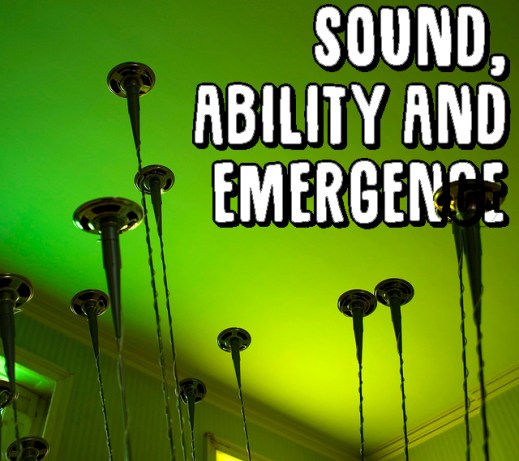
The language of sound studies, and even the word sound itself, doesn’t do justice to our scholarship. Sound studies is, to me, a populist discipline that has given me a social setting and theoretical framework in which to develop my own ideas. Into this field I can carry my own history and let it screech and flash until it finds at least passing resolution.
Sound studies is less about sound than vibration, though this distinction is not easy for me to clarify. My experience of sound studies is somewhere in the web of music-as-activism, music-as-tactile-experience, and cultural studies. It all comes back to music, but music is, to me, a fairly broad term. I have written about the work of Diamanda Galás and Throbbing Gristle— lately I have been going back to early Sonic Youth and Aphex Twin’s song [Equation] which, at the end features noise that, when sent through a spectrogram analysis, reveals a visual face. The thread that runs through this music is a lack of “standard” musicality. Instead many of these artists create an atmosphere of sound, a deeply affective field in which the audience is immersed. Although not music in the traditional sense, these musical experiences produce the shrill prick of goosebumps in my body, the deeply triumphant bass in my bones. It is a convergence of things that can’t be contained in the auditory cortex.

On rhythm: My tattoo artist working on the last piece of my half sleeve. Usually I find the visceral rattle of the gun trumps physical discomfort, and I try to remain as quiet as possible and focus on the whir, the vibration, echoing between layers of my skin, somewhere in the connection between bodily stimulus and neural recognition.
Eleni Ikoniadou’s 2014 book The Rhythmic Event explores rhythm from a confluence of media theorists and artists who embrace the body and temporal experience as an immanent mode of becoming. While criticized by Eddie Lohmeyer (2015) for not drawing explicit connections between theorists, I believe Ikoniadou prevails in her attempt to theorize the rhythmic event as a means of collapsing or decoding linear time and discrete experience into an underlying and rhizomatically immanent means of affective and affinitive connections. Rich in theory and exciting in promise, Ikoniadou’s work builds on preexisting theory and syncs it with the body in its ambient, affective field. As she deftly explains, rather than a Platonic understanding of rhythm as a means of ordering time, Ikoniadou adopts a Deleuzian view of rhythm as “a middle force that occupies the distance between events, hinting that there is no empty space or void waiting to be filled by human perception” (13). This immanence— an ontology in which the universe thrums always with a richness of vibration, sets in motion new ways of understanding art and experience, replacing the subjective with the affective. In many ways Ikoniadou’s work informs and reinvigorates the convergence of affect theory, queer theory, and sound studies. Often, it is transcendent, enabling “sound studies” to encompass any possible connotation of feeling, of touch, of culture, of intuition, of the intricate nature of intersectionality, interconnectedness.
While sound studies once fought to decenter the Western cultural reliance on the gaze as the default sense through which critical theory should run, we are now as a discipline much more textured, synaesthetic. Through sound studies we learned of remote intimacy (Jennifer Terry via Karen Tongson) and the network of interlinking experience that connected us past simple auditory stimuli. We now have constructed a vibrational ontology in which sound is essential, though it is not always experienced as simply sound.
The Sound, Ability, and Emergence Forum stretches, yearns, and trembles toward these critical questions: Where do we move from here? How will our language reflect the broadening sense of sound as delicately connected to all our other experiences? and how can we allow for theories and experiences from those who listen but might not hear in the traditional and often ableist sense of the word?
—
Airek Beauchamp is an Assistant Professor at Arkansas State where he specializes in Writing Studies. As Assistant Director of Campus Writing at Arkansas State he has the privilege of engaging academic and community activism, and he attempts to tie all of his scholarship to concrete political action. His other areas of research include queer theory, affect theory, and trauma in the LGBTQ community.
—
 REWIND! . . .If you liked this post, you may also dig:
The Listening Body in Death –Denise Gill
Live Through This: Sonic Affect, Queerness, and the Trembling Body–Airek Beauchamp
Queer Timbres, Queered Elegy: Diamanda Galás’s The Plague Mass and the First Wave of the AIDS Crisis –Airek Beauchamp
Share this:

The Hysterical Alphabet

 To conclude our Hysterical Sound series, we are pleased to present an excerpt from John Corbett, Terri Kapsalis and Danny Thompson’s performance of The Hysterical Alphabet.
Through this series we have explored a history of fetishizing women’s hysterical vocalizations with Gordon Sullivan’s post on Clayton Cubitt’s video work, and my post on Sam Taylor-Johnson’s film Hysteria and it’s relation to the “silence” of hysteria in medical history.
Today, Kapsalis gives us a piece in which “the ABCs are seized in a convulsive fit,” each letter of the alphabet serving to introduce some episode of the history of hysteria. Accompanied by the sound design of Corbett and Thompson’s visual collage, this performance of The Hysterical Alphabet offers a multi-sensory engagement with the past to “disprove the theory that time heals all wombs.”
SO! is grateful to the artists for sharing their work with us.
— Guest Editor Karly-Lynne Scott
—
Inspired by primary medical writings and actual case histories, “The Hysterical Alphabet” tracks the 4,000 year history of hysteria starting with A in ancient Egypt. First published as a book with text by Terri Kapsalis and drawings by Gina Litherland, it subsequently assumed a different form as a performance featuring video and live soundtrack. Terri Kapsalis (voice), John Corbett (sound), and Danny Thompson (video) performed the feature length piece from 2007-2012 in many different venues, including the Art Institute of Chicago, Emory University, RISD, Bates College, Clark University, and the University of Chicago. The video documentation included here excerpts the letters S, T, U, and V, which focus on the 19th century, moving into the 20th century, and were drawn from the work of Charlotte Perkins Gilman, S. Weir Mitchell, Jean-Martin Charcot, and Sigmund Freud, among others.
—
John Corbett (sound) is a writer, sound-artist, and curator. He is the co-director of the art gallery Corbett vs. Dempsey. In 2002, Corbett served as Artistic Director of JazzFest Berlin, and he co-curated the Empty Bottle Festival of Jazz & Improvised Music for nine years. He is the producer of the Unheard Music Series, an archival program dedicated to creative music issues and re- issues, and he is the author of Extended Play: Sounding Off from John Cage to Dr. Funkenstein and Microgroove: Forays into Other Music. Corbett can be heard on a number of CDs including I’m Sick About My Hat and has brought his sound skills to two previous Theater Oobleck productions.
Terri Kapsalis’ (text/sound) writings have appeared in such publications as Short Fiction, The Baffler, Denver Quarterly, new formations, Public, and Lusitania. She is the author of Jane Addams’ Travel Medicine Kit, Hysterical Alphabet, and Public Privates: Performing Gynecology from Both Ends of the Speculum. Kapsalis is a founding member of Theater Oobleck, works as a health educator at Chicago Women’s Health Center, and teaches at the School of the Art Institute of Chicago.
Danny Thompson (video) is a founding member of Theater Oobleck, for which he has written (and performed in) 20 plays and solo performances, including Necessity, Big Tooth High-Tech Megatron vs. the Sockpuppet of Procrastination, and The Complete Lost Works of Samuel Beckett as Found in an Envelope (Partially Burned) in a Dustbin in Paris Labeled “Never to be Performed. Never. Ever. Ever. Or I’ll Sue! I’ll Sue from the Grave!!! The latter was given the “Comedy Excellence Award” at the 2000 New York Fringe Festival, “Top Ten of the Fest” at the Edinburgh Fringe Festival in Scotland, and extensively toured the U.K. and Ireland.
Share this:


Current Top Posts





April 2021

January 2020

November 2019

October 2019

August 2019

April 2014

November 2017

March 2015

December 2017

October 2015
 Sounding Out!
Recent Comments