I want to enable my students to mobilize sound studies not just as an analytic filter to help them understand the world, but as a method enabling more meaningful engagement with it. This post, an abbreviated version of the paper I recently gave at the Invisible Places, Sounding Cities Conference in Viseu, Portugal on July 18, 2014, explores my pedagogical efforts to move my sound studies work from theory to methodology to praxis in the classroom and in my larger community. In particular, I am working to intervene in the production of social difference via listening and the process by which differential listening practices create fractured and/or parallel experiences of allegedly shared urban spaces.
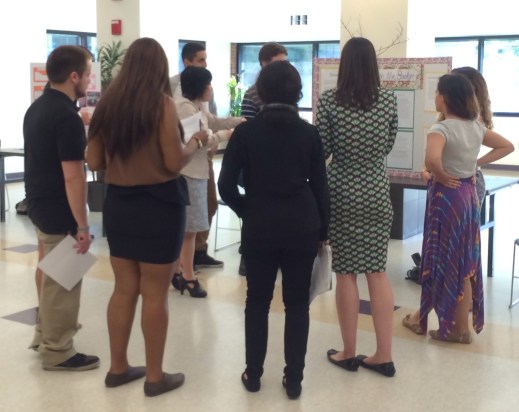
Inspired by ongoing efforts such as ReBold Binghamton–the visual arts group alluded to by my assignment’s title– Blueprint Binghamton, and the Binghamton Neighborhood Project, I wanted to articulate sound studies methods with long-term community engagement interventions. I decided to task the upper-level undergraduate students in my Spring 2014 “How We Listen” course with designing community engagement projects that identified and addressed an issue in Binghamton, the de-industrialized town in upstate New York housing our university. My students’ proposals ranged from rain-activated sound art, to historical sound walks that layered archival sounds with current perceptions, and a “noise month” sound-collection and remix project designed to challenge entrenched attitudes. They then presented the projects via a public poster session open to faculty members, administrators, community representatives, and peers.
Working with local residents and using asset-based theories of civic engagement, the students’ projects sought to re-sound Binghamton, enhancing existing forms of communication, amplifying hidden sounds and histories, and creating new sounds to resound throughout Binghamton’s future. While the students initially set out to “fix” Binghamton—bringing year-round residents into the world as their largely 18-21 selves heard it—the majority opened their ears to alternative understandings that left them questioning the exclusivity of their own listening practices. Students realized that while they may have been inhabiting Binghamton for the past few years, they hadn’t been perceptually living in the same town as year-round residents, and, conversely, that the locals’ tendencies to hear students as privileged nuisances had historical and structural roots.
The historical, theoretical, and methodological groundwork that scholars of sound have laid in recent decades toward heightened social and political understandings of sound—fantastic in volume, quality, AND reach—have equipped sound studies scholars with powerful critical tools with which to build a more directly, civically engaged sound studies, one as much interested in intervention and prevention as continued reclamation and recovery. Scholar-artists such as Linda O’Keeffe have begun to fuse audio artistic praxis with the more social science-oriented field of urban studies. O’Keeffe’s community project, highlighted in “(Sound)Walking Through Smithfield Square in Dublin,” set out to solve an audio- spatial problem at the very heart of the city: why did the city’s efforts to “rehabilitate” the landmark Smithfield Square—which had been a public market for hundreds of years—bring about its demise as a thriving public space rather than its rejuvenation? Equipping local students with recorders, O’Keeffe documented the students’ understanding of the space as “silent,” even though it was far from absent of sound. She noted local teenagers felt repelled by the newly wide-open square; the reverberation of their sounds as they grouped together to chat made them feel uncomfortable and surveilled—so it remained an isolating space of egress rather than a gathering place.
The Smithfield square in 2009, Image by Linda O’Keeffe
Importantly, O’Keeffe’s conclusion moved beyond self-awareness to political praxis; she presented her students’ self-documentation to Dublin city planners, intervening in Smithfield’s projected future and attempting to prevent similar destruction of other thriving city soundscapes unaligned with middle-class sensory orientations. O’Keeffe’s work sparked me to think of listening’s potential as advocacy and agency, as well as the increasing importance of reaching beyond the identification of diverse listening habits toward teaching people to understand the partiality and specificity of their sonic experience in combination with the impact listening—and the power dynamics it is enmeshed in—has on the lives, moods, and experiences of themselves and others. Listening habits, assumptions, and interpretations do not just shape individual thoughts and feelings, but also one’s spatial experience and sense of belonging to (or exclusion from) larger communities, both actual and imagined. Learning to understand one’s auditory experience and communicate it in relation to other people enables new forms of civic engagement that challenge oppression at the micro-level of the senses and seeks equitable experiences of shared space to counter the isolating exclusion compelled by many urban soundscapes.
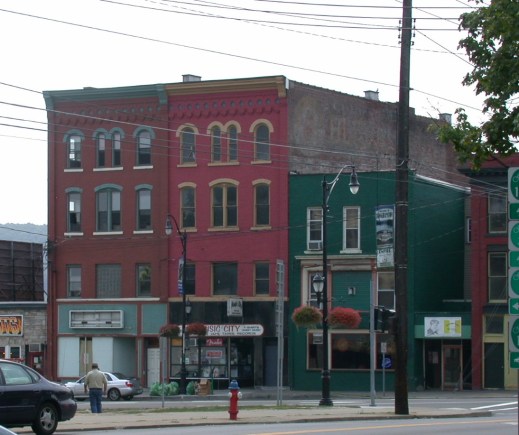
Corner of Front and Main Street, Binghamton, NY, Image by Flickr User Don Barrett
O’Keeffe’s project also made me rethink how space-sound is shaped through social issues such as class inequity, particularly in my community of Binghamton, a small town of approximately 54,000 currently facing profound economic challenges. The end of the Cold War devastated Binghamton’s economy—then primarily based in defense—and the economic downturn of the early-1990s provided a knock-out punch, severely impacting the region in ways it has yet to recover from: the behemoth local IBM relocated to North Carolina, manufacturing jobs permanently decreased by 64%, and the population shrank almost by half. Recent climate-change induced disasters have also left their mark; massive floods in 2005 and 2011—on a geographic footprint historically flooding only 200-500 years—displaced thousands of low-income residents, destroyed many businesses, and collectively caused close to 2 billion dollars in damage. The global recession of 2008 left over 30% of Binghamton’s residents below the poverty line, including 40% of all children under 18.
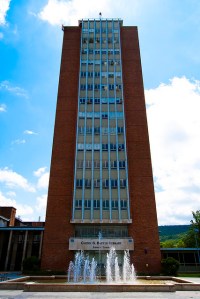
Library Tower, Binghamton University, Image by Flickr User johnwilliamsphd
The campus, 12,000 undergraduate students strong, often seems remote from the city I just described. Only 6% of BU students are drawn from its surrouding Broome County. The vast majority (60%) of BU’s students hail from the New York City metro area, a site of racialized economic tension with the rest of the state, evidenced by campaigns such as “Unshackle Upstate.” Indeed, Binghamton’s student body is more racially diverse than Binghamton the city (Vestal, where the university is located, is 88% white), and even though the relatively low-cost public university–approximately eight thousand dollars a year for in-state tuition– serves many first-generation college students, students with generous financial aid packages, and students employed while matriculating, the city’s poverty amplifies even slight class privilege.
These long-term structural fissures have led to tensions between the university students—whom some Binghamtonians problematically peg as wealthy outsiders and/or racially target—and full-time residents, dubbed “Townies” by many students and dehumanized as the backdrop to their college experience. While students and year-round residents inhabit the same physical spaces in Binghamton, they are not in fact living the same place and they often experience, interpret, and act on the same auditory information in drastically different ways. Binghamton sounds differently to each group, in terms of the impressions and interpretations of various auditory phenomena as well as the order of importance an individual gives to simultaneous sounds at any given moment.
Embodied aural perceptions shaped by class, race, age, and differing regional experience may in fact drive many of the “town and gown” conflicts—noise complaints most obviously—and exacerbate others, particularly mutually distorted perceptions that students bring Binghamton down and that residents are, as one student cruelly stated in the campus newspaper, “creatures” from “an endless horror movie.” So how to address this divide? And how to use sound studies to do it? I knew I did not want to impose a community project on my students that did not have their buy in and creative energy behind it. I decided on a group-sourcing project that asked students to work together to design a sound-studies based community project. I envisioned the assignment as the first phase of a longer-term project, with the most workable idea serving as the basis for a full-blown service learning experience in future courses. However, the assignment proved to be pedagogically valuable in its own right, not just as a prelude to future work.
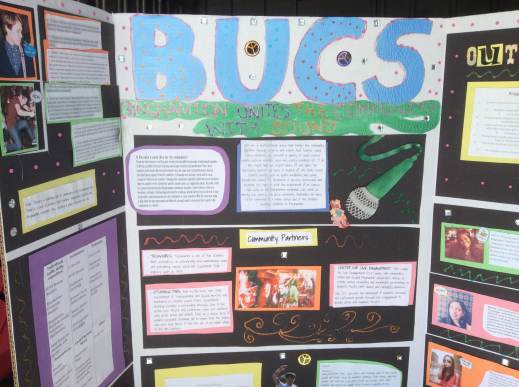
“Binghamton Unites Community Through Sound” Poster Project, Image by Author
I arranged my course around the proposal assignment, providing students with the critical thinking skills to imagine a project of this type. We began with theoretical and methodological materials that would introduce them to sound studies—none of my students were familiar with the field and its assumptions—and ground their thinking in the idea that listening is a complex sociocultural, political, and critical practice. While we read and discussed multitude of pieces on listening, the students reported four scholars as especially inspirational to the project: Yvon Bonenfant’s theorization of “queer listening” as a listening out (rather than the more normative taking in), Regina Bradley’s work on race and listening in American courtrooms that focused on how white lawyers discredit witnesses speaking patois and African American Vernacular English, Maile Costa Colbert’s artistic imagining of a “wayback sound machine,” and Emily Thompson’s work on noise and time/space/place, particularly in her new interactive “Roaring Twenties” project. Student Daniel Santos reported in a survey following the project,
The relationship between sound and time was very useful to our project; we understood the concept that no city ever sounds the same after a long period of time, and we sought to take advantage of this fact. Through our residents’ stories, we learned that Binghamton was once booming with sound from numerous, lucrative industries. Walking into a factory brought an industrial cacophony: card punchers thudded as steel was pounded against steel. However, today, a walk into these factories results in an eerie silence. We wanted our soundwalk participants to realize and become affected by this lack of and difference in sound, and raise pertinent questions: what happened to these sounds? Why is there such a large difference in sound levels? Where do I place myself within this soundscape?
I worked with Binghamton’s Center for Civic Engagement—a model program founded in 2010—and in particular with Assistant Director Christie Zwahlen, to equip students with basic-but-solid knowledge that would enable a new understanding of community work. Zwahlen brought home two major principles to students: 1) service learning has a pedagogical component; it is important to a project’s success that students learn something through their work rather than merely donating time or skills, 2) Community engagement works best when based on identifying and mobilizing a community’s assets rather than implementing an external project addressing perceived deficits. These two concepts meshed especially well with the students’ evolving understanding of listening as multifaceted, political, and deeply impacted by temporal and spatial contexts, because it required the students to engage directly with community members and learn how to listen to their voices, histories, and needs.
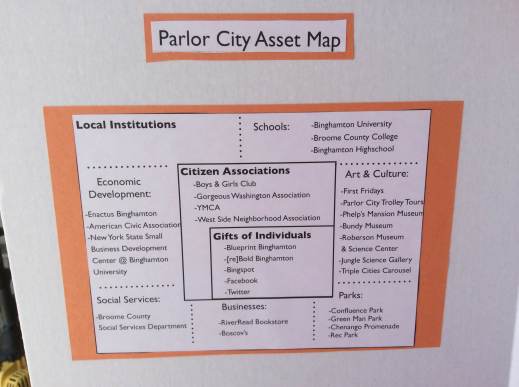
For both civic engagement and sound studies, Zwahlen and I introduced students to the various methods used to solve problems and answer our most important questions. For civic engagement, Christie focused on the asset map, which forced students to think of the surrounding community in terms of its strengths rather than the weaknesses they could already readily list. This exercise not only flipped their perspective but also helped them imagine and hone their project by identifying community stakeholders who would be receptive to their inquiries.
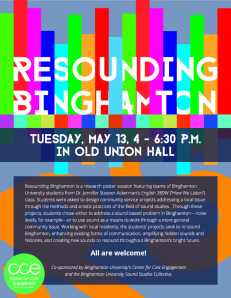
ReSounding Binghamton Project, Image by author
In terms of sound studies, I introduced them to a multiplicity of methods through readings, experiential activities, and process writing, in particular sound provocations and sound walks. According to student Hannah Lundeen’s post-project survey, the sound walks she performed proved especially fruitful:
Initially, solving a community issue through sound seemed next to impossible. It wasn’t until sitting down and thinking about the sound studies methods of soundwalks that it became clear. I liked soundwalks because they are a way to engage anyone in sound studies. They are an easy concept to explain to people who may not have thought much about their soundscape previously. They are an active and fun way to engage all community members in listening well.
As Lundeen relates, interweaving these methods formed the foundation of their community projects, enabling their inquiries regarding understanding differences in listening, how to enable people to recognize and discuss aspects of their listening, and to provoke some kind of impactful social change.
The final third of the semester was devoted to working on the final project [Click these links for the Rubric for Final Poster Presentation we used to assess the projects as well as the assignment sheet with Tips for Successfully Completing this Project both of which I handed out on day one! ]. Following an initial period of research and discussion, students narrowed down their project ideas, identified and met in person with potential community partners–ReBold Binghamton, Binghamton’s Center for Technology & Innovation, the Parks Department and several City Council members were especially helpful– and put together their proposals, emphasizing their new understandings of listening and its relationship to space and place via community mobilization. Students prepared a 7-minute gloss of their projects for public presentation that
identified an issue (supported by research)
described how project addressed the issue
presented community asset map as a foundation
shared list of potential community partners
discussed sound studies methodologies supporting the project
estimated benchmarks for the project’s completion
projected the project’s long-term outcomes
prepared personal reflections on the process.
ReSounding Binghamton Student Presentation, Image by Shea Brodsky
Here is a sampling from the rich palette of student project pitches:
Restoring the Pride: A public art initiative building rain-activated sound sculptures.
BUCS: Binghamton Unites Community with Sound: A public group karaoke project.
Safe and Sound: A “kiosk walk” of 10-interactive electronic sound art pieces that increase downtown destination traffic by day and operate as a “blue light” safety system by night.
Blues on the Bridge Junior: A children’s music stage at one of Binghamton’s most popular yearly events.
Happy Hour: A weekly campus radio show designed to combat seasonal depression.
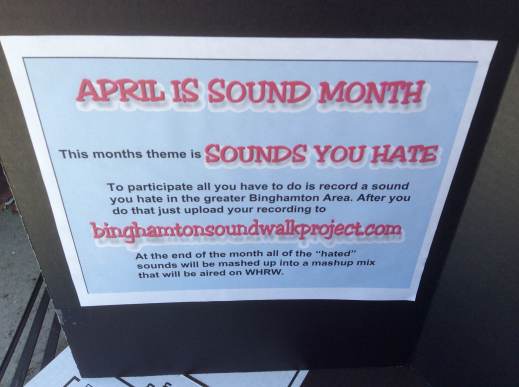
Listen Up!: Sound Month Binghamton: An annual themed digital “sound collection month” in March with accompanying “sounds of Binghamton” remix project. This project fosters community habituation to “Others’” sounds while also tracking long-term changes in the soundcape and in residents’ ideas of noise.
A Sound Walk Through Binghamton: Historical soundwalks through several areas in Binghamton, where archival sounds of the past (some compiled from recordings, some performed) are placed in continuity and contrast with contemporary soundscapes.
Zwahlen and I understand that this iteration of the project does not constitute civic engagement as of yet. Certainly, the students raised more questions than solutions: how to work with—and equitably solicit contributions from—community members rather than organize classroom-first? How to increase community involvement on a campus that is a foreboding maze at best—and how to increase student traffic in the many sites not reached by Binghamton’s limited public transportation? Most importantly, How to share sound studies epistemology beyond the classroom, creating listening experiences that not only take differences into account but potentially re-script them?
ReSounding Binghamton Student Project, Image by Author
As we move forward with long-term development, we will undoubtedly encounter more questions. However, even at its earliest stages, I believe guiding my students to integrate sound studies methodologies with asset-based service learning provided them with a transformative experience concerning the powerful resonance of applied knowledge and sparked the kind of self-realization that leads to civically engaged citizens. It created meaningful connections between them and a local community suddenly made significantly larger. For my students, listening became more than a metaphor or an individualized act of attention, rather they began to understand its role as a material conduit of location, outreach, and connection. As an anonymous student shared in my teaching evaluations: “This class was different, but in a very good way. It has been so involved with the human experience, more so than with other classes.” In the middle of the so-called “humanities crisis,” this response points to the potential power of a civically engaged sound studies, a branch of the field combining research with praxis to reveal the role of listening in the building, maintenance, and daily experiences of diverse communities in the city spaces they mutually inhabit but often do not fully and equitably share.
—
Featured Image by Shea Brodsky, (L to R) Binghamton University Students Robert Lieng, Daniel Santos, and Susan Sherwood, Director of Binghamton’s Center for Technology & Innovation (CT&I)
—
Jennifer Stoever is co-founder and Editor-in-Chief of Sounding Out! She is also Associate Professor of English at Binghamton University and a recipient of the 2014 SUNY Chancellor’s Award in Teaching.
As I write this, I am sitting on the return flight from Portugal, where I spent an utterly transformational four days at the Invisible Places, Sounding Cities conference (deftly organized and elegantly curated by Raquel Castro), a sensory torrent that still has me buzzing. While there, I was thrilled, provoked, taken, shaken, intrigued, pleased, taught, energized, exhausted, re-energized, puzzled, lifted up. . .all of the things I hope a truly great meeting will do (and then some). What I wasn’t prepared for—and when going to a conference featuring sound artists and performers, I imagine myself ready for anything—was the flood of gratefulness and gratitude that I felt every time I had a conversation about Sounding Out!, every time all of our stickers disappeared off the registration table, every time I introduced myself and there were nods of recognition from people I had never met—people located thousands of miles from my home IP address—and every time my scouting attempts were met with enthusiasm that matched (and often rivaled) my own.
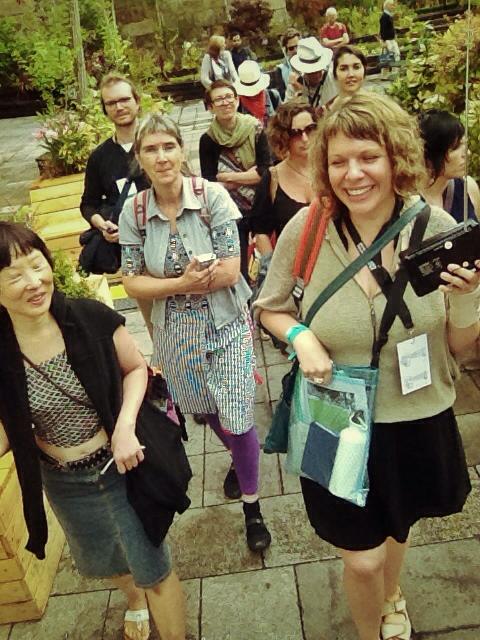
Multimedia artist, SO! Regular Writer, and Portugal resident Maile Colbert leading Invisible Places attendees on the Radio Terramoto soundwalk co-created with her partner Rui Costa (of Binaural/Nodar).
And, while I cannot deny that I my work on Sounding Out! has generated personal pride—speaking honestly, sometimes I go to soundstudiesblog.com just to LOOK at it—but the feeling I enjoyed in Viseu was different from “accomplishment.” I felt grateful for the support of our editors, writers, and podcasters—sharing the best of themselves, tirelessly and without compensation other than mad props and ‘nuff respect—for our readers, ever stretching across the globe, sharing, liking, and ReTweeting, until this endeavor became a networked community, and for our fans—Yes! We have received fan mail!—whose enthusiasm always seems to arrive at the right time, the Hail Mary eleventh hour when the editors are fighting sleep and/or needing another reason to allow Dora the Explorer to play a little longer to steal time to finish a piece. I also felt gratitude for the diverse and full-bodied sound studies community, particularly its rigorous but generous, inviting embrace, which extended to the fledgling Sounding Out! experiment five lightning-quick years ago.
In that time, I hope we have expressed our gratitude in return, by deepening and extending our mutual community, binding us in new and unexpected ways, showcasing our best and giving air to our challenges, and, most importantly, enabling us to greet each other as familiar colleagues—in Viseu, Berlin, Toronto, San Juan, Los Angeles, Copenhagen, New York, Sao Paolo. . .—even if we had never before met “In Real Life.” Know that as we continue to grow and renew the site that the function of community will always remain a prime directive of SO!. I welcome the responsibility we have collectively invested in Sounding Out!; it makes my decisions both more contemplative and surefooted. Thank you, everyone, for the last five years—lets raise a glass of Grão Vasco Dão Tinto toward many more together!
As we sip, let’s also partake in the annual SO! tradition of taking stock of the last action-packed year, with soundtrack supplied by another artist having a #flawless year, Ms. Beyoncé Knowles herself. . .
“Irreplaceable” (Goodbye, Liana): I write this first update completely under protest. I know I am not supposed to admit to affective reactions, especially in cyberspace and especially as a woman with her feet in several male dominated fields, but when Liana Silva-Ford, our stalwart and smoothly bad-ass Managing Editor and Co-Founder, told me she was considering leaving SO!, my eyes welled up instantaneously. Okay, so she very straightforwardly told me she was leaving—even now I still have to sneak in the modifier “considering.” Liana was recently named Editor-in-Chief of the longstanding publication Women in Higher Education(now on Wiley-Blackwell)—read her first “Editor’s End Notes” here—and she is embarking on a book project on her not-so-secret passion, postcards. Liana has, rightly and deservedly, decided to bestow more of her time on these two *amazing ventures. Even though none of us has yet to successfully visualize SO! without her, we know this is right and we wish her all and only the best. Thank you, Liana for your steady hand but light touch, your sharp yet generous editorial eye, and the intelligence, professionalism, and enthusiasm you brought to every meeting, every challenge, and every writer. Working (and SO!-hiveminding) with you has been an exquisite pleasure. And thank you for letting me twist your arm into a permanent “Editor-at-Large” position (whew!).
“Green Light” (Welcome Cara, Neil, Will): On the other hand, I am pleased to announce that the O.G. SO! triumvirate has happily expanded to a sextet. Media scholar Neil Verma (Visiting Assistant Professor in the Department of Radio/Television/Film at Northwestern University) our new ASA/SCMS Special Editor, came on board in late 2013, curating our new Thursday stream that launched in January 2014. Neil has already proved himself to be a skilled editor, an intuitive curator, and a natural at the brand of humor and enthusiastic tomfoolery we thrive on behind the scenes. We initiated our “L.A. Office” in December with the addition of William Stabile, our new Assistant Visual Editor, who is responsible for many of the mighty fine layouts that that you have seen this year. He is flexible, patient, and extremely gifted in the visual arts, with a wit dryer than Riverside, California this time of year. We value his work and presence immensely. And, drum roll please (especially with our crowd), we are pleased to announce right here today, that Cara Lynne Cardinale is our new Managing Editor, coming to us live from the East Bay in Northern California with a soaring collection of great ideas and her feet firmly planted on the ground of spreadsheets, calendars, and deadlines. Cara graduated in 2010 with her Ph.D. in English from the University of California, Riverside, with a brilliant dissertation that I am constantly telling my graduate students to seek out: “‘Through the Eyes’: Reading Deafened Gestures of Look-Listening in Twentieth Century Narratives.” A unanimous selection for her intensity, sharpness, and style-for-miles, Cara will undoubtedly turn this mother out!.
“Upgrade U” (Thursday Stream!): You may have noticed that there has been twice the SO! to love in 2014, thanks to Neil Verma’s work on the Thursday stream, with his cadre of guest editors and an array of media-related subjects that has greatly expanded and deepened the site’s threshold. The year is only a little more than half-over and already we have been treated to forums on Cuban radio history (Tom McEnaney’s “Radio de Acción”), Lou Reed’s voice and sonic influence (NV’s “Start a Band”), and Justin Burton’s rumbling “The Wobble Continuum” of dubstep sounds and scholarship. Jump on the most current series of the stream, “Sculpting the Film Soundtrack” (guest edited by Katherine Spring), a collection of posts that re-frames the cinematic soundtrack to to be heard anew. The media stream + our monthly podcast series + SO!’s monthly pass-the-mic “Sound Off! // Comment Klatsch” = vibrant sounding Thursdays. We like this new math.
“Check on It” (“SO! Amplifies”) b/w “Schoolin’ Life” (Book Reviews): Sounding Out!, by design, is not a clearing house for any-and-all sound-related events [however, you CAN get all that information by following us on Twitter, liking us on Facebook, and Tumbling with us too]. BUT, we realized this year that relationships are built and connections are made through support of one another’s work, and, more often than not, it takes more than 140 characters to properly accomplish this important task. So, in 2014, we launched two new ongoing series, “Sounding Out! Reads,” reviewing the latest monographs of interest to Sound Studies peeps, and a curatorial series called “SO! Amplifies” that enables selected makers, artists, authors, researchers, designers, and other creative/creating folks to introduce their work and tell SO! readers how/why it is important to them (and should be to us). In addition to amplifying the signal sent out by our featured works, we also hope to enable the production of new research, art, and other types of projects and connections through the introduction of these new tools, models, information, and archives. At the very least, we will be hipping your ears and eyes to some seriously cool new ish.
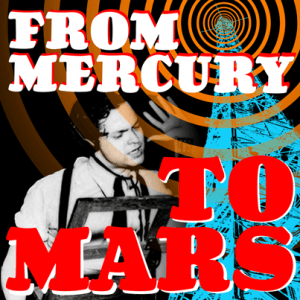
“Satellites” b/w “Rocket” (War of the Worlds collabo extravaganza): Neil Verma came to the SO! team last summer in search of a site to host observations on the occasion of the 75th Anniversary of Orson Welles’ 1938 broadcast of War of the Worlds. Knowing the brilliance and exceptional quality of Neil’s work—please buy and devour his 2012 Theater of the Mind (University of Chicago Press, SCMS First Book Award Winner) ASAP—I automatically said an enthusiastic “YES.” BOOM. Just like that, an international multimedia fandango was born. On the ground, or since we are talking radio, terrestrially, #WOTW75 sounded like a three-hour radio broadcast on Binghamton University’s WHRW 90.5 with 2 hours of original content produced by Team SO! (one of them live!) bookending a re-broadcast of Welles’ original at the precise date and time of its debut, 8:00 PM EST, October 30th [1.5 hours are available via our podcast series: EPISODE XXII: Remixing War of the Worlds presents an original creative sound composition by Monteith McCollum and his Performative Processes class at Binghamton University that re-imagined act three of WOTW and EPISODE XXIII: War of the Worlds Revisited, the new 60-minute audio documentary featuring interviews with top media scholars engineered by our very own Multimedia editor Aaron Trammell]. BUT, out in the aether and Twittersphere, #WOTW75 looked like so much more: simultaneous listening parties dotting the globe—a special shout out to Jake Smith’s event at Northwestern U in Chicago—a months-long supergroup collabo between the Sounding Out! crüe and the University of Wisconsin-Madison’s Antenna—mad props to Andrew Bottomley—a real-time Twitter conversation using the hashtag #WOTW75 that sparked myriad reactions from excitement to snark—NV has curated the best of these for the upcoming sound special issue of Velvet Light Trap—academic panels, radio interviews, podcasts—thank you Aca-Media!—TV interviews, live dramatic radio performances—you rock, Charles Berman and the WHRW drama dept—a live collaging project put on by Toronto’s Collage Collective at the Textile Museum of Canada, martian-themed cupcakes, commemorative T- shirts by artisanal screen printers Muckles Ink, a theme-song (!!) written and performed by Binghamton’s finest ambient surf-noise band The Short Waves, and, we dearly hope, renewed excitement for the experience of “liveness” in the twenty-first century, an experience greatly changed since 1938, but no less vital in importance and thrilling in affect.
We also congratulate our writers on their recent news and updates!
Kaj Ahlsved is working hard on his PhD dissertation “Music and sport: soundscape, identity, context and function.” He published his first article in the 2013 Yearbook for the Finnish society for Ethnomusicology. His second article, “Let’s Play Hockey,” is currently under peer review. He is also part of a research project called Kiekkokansa that will publish a book on Finnish ice hockey culture in April 2015. For this project he and a few other researchers had the opportunity to do ethnography in Minsk during the 2014 World Ice Hockey Championships.
Regina Bradley released her video dialogue series called Outkasted Conversations. She has a chapter titled “Kanye West’s Sonic [Hip Hop] Cosmopolitanism” in the collection The Cultural Impact of Kanye West. She also has an article forthcoming on Edward P. Jones’ The Known World and the Hip Hop Imagination in Southern Literary Journal.
Dolores Inés Casillas was promoted to Associate Professor with tenure at the University of California at Santa Barbara.
Kariann Goldschmitt will be a Visiting Lecturer in the Faculty of Music at the University of Cambridge this upcoming October. Her essay on mobile tactics in the Brazilian independent music industry has been published in The Oxford Handbook of Mobile Music Studies, Volume 1.
Jonathan Sterne is co-organizing, with Nick Mirzoeff and Tamar Tembeck, the first-ever sound studies-meets-visual culture studies conference. Called Sound, Vision, Action, it puts scholars and artists in dialogue across sonic and visual traditions. They are especially interested in how each field addresses questions of power. The lineup is still being confirmed, but it will be hosted by Media@McGill in Montreal, 14-15 November 2014. Sterne is teaching a graduate seminar in conjunction with the conference in the Fall. More details will be available at http://media.mcgill.ca.
Jennifer Stoever was promoted to Associate Professor with tenure at the State University of New York, Binghamton where she was also awarded a 2014 Chancellor’s Award in Teaching.
And now. . .because this is how we do year after year, roll up your rug or roll down your partition, please, it is time to celebrate our #flawless 5.0 blog-o-versary, ‘Yonce-style. –JS, Editor-in-Chief
—
Jennifer Stoever is co-founder and Editor-in-Chief of Sounding Out! She is also Associate Professor of English at Binghamton University.
—
Click here for Sounding Out!‘s Blog-O-Versary #Flawless 5.0 mix with track listing
(Just in case you missed last year’s 4.0 celebration and mix click here; 3.0 click here; for year two, click here; and for our first Blog-O-Versary party mix click here)
























Recent Comments