
!!!!!!!, or Blog-o-Versary 7.0

** Click here to just cut to the chase and get the new mix already! LOL!**
DOI: https://doi.org/10.59350/yq47y-ph856
From the very beginning, the exclamation point has been our thing. Our deeply meaningful, utopically earnest, passionately heartfelt, stubbornly insistent, collectively exposing-our-geeky-love-and-enthusiasm-to-the-world THING. And over the past seven years we have fought for it, demanded it—#sorrynotsorry print copy editors!—and, as is our fondest wish, lived and embodied it for our readers each and every Monday (and the occasional Thursday too).
On the occasion of our seventh Blog-o-versary, we wanted to share the affective vibrations of our ! with y’all, for the deceptively simple reason that we want you to feel !!!!!!!, too.
After seven years of inserting it here, there, and everywhere, we assure you our ! is not merely a visual throwaway or empty hijinks. Neither is it a public punchline to a private joke, a snooty/snotty academic tic, nor a precious hipster eye-roll. It’s not a “brand.” It was not intended as nostalgic homage to the many ! bands from the aughts or the many !-heavy songs of 1970s and 80s punk (although “Oh Bondage! Up Yours!,” totally). And during these times of solidarity and upheaval, let us be especially LOUD and clear: the exclamation mark in Sounding Out! is not, and has never been, tongue-in-cheek. We really, really mean it!
So what, then, is the “!” in Sounding Out!??
You already know what it is.
It’s a sound.

It’s a shoulder-shaking shout expressing our desire for ourselves and our writers to be heard, a sound that reaches out and touches, and hears in turn. It’s a sound that viscerally performs our down-ness, our dedication, our willingness to go there (and to stay put and listen). It’s a wail of feedback. a belly laugh. a grito. a hearty WTF. a down low OMG yes OMG (s/o to ATCQ!). a tsk of tongue against teeth. a ribcage-rattling beat. a yessssss with an ‘80s elbow pump. It’s the sound—heard, known, and sensed—of all those women feeling themselves at Beatles concerts, of thousands of voices rising together in love, power and frustration to tell the world (yet again) that #blacklivesmatter, to #sayhername and #stopkillingus . . .it’s not a specific sound, but yet you know it when you hear it, because it gives you goosebumps.
Our “!” is a—BLAM—mic drop, mixed with the grumble of the roadie who picks it up, fixes it, and passes it on. and, oh!, that anticipatory, skin-pricking static of listening out for who’s got next.
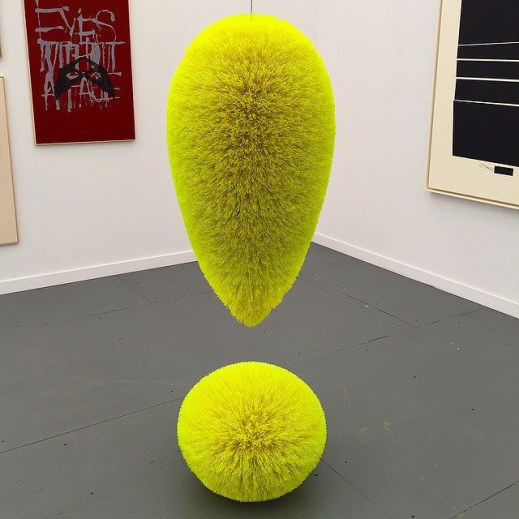
When we decided on the blog’s title back in 2009, the ! in Sounding Out! was never a subject of debate—it just appeared organically as an organic “AHA! of course!” At the time, the “!” acoustically mirrored of how the editorial collective communicated enthusiastically with each other, and symbolized, sonically and ineffably, how we thought and, more importantly, felt about the mission we laid out for ourselves and the blog, the mission we explore, challenge and renew in the company of our readers each July. That “!” puts in deeply resonant WORK, with dedication and feeling, just like we do—through words, but beyond, above, around, and below them too, hitting all those affective frequencies we don’t—or can’t—often talk about. It’s a sound that, like us, merges and keeps changing with history, context, and experience.
Here’s what the “!” has meant, and sounded, in our seventh year:
!!!!!!! Dedication!!!!!!!

This spring, we completed our indexing project, which has been years in the making, with the dedication and assistance of our three undergraduate interns from the Binghamton University English Department: Daniel Santos, Dhruv Sehgal, and Michele Quiles. In exchange for mentorship and the opportunity to throw themselves into the inner workings of SO!, these three tirelessly compiled a hotlinked listing of each and every post we have ever published (of which today’s is the 466th!).
Click here to view the index in all of its scrollable glory!
You can reorganize the list by title, date, or author—whatever suits your needs. We hope this continues to keep our very worthy back catalog in circulation and that SO! only becomes easier to read, teach and learn from!
And, of course, we extend huge, hearty, and numerous praise-hand emoji thank yous to our trusty Assistant Visual Editor, Will Stabile, to Special Editor Neil Verma, who curated several series for SO! Thursdays this year, and to you, our dedicated writers, readers, retweeters, word-of-mouthers, sticker bearers, and general good vibe givers. We are here because you are!
!!!!!!!SOUND!!!!!!!!
This year found our podcast series—helmed by Multimedia Editor Aaron Trammell—more experimental and sonic than ever. While continuing to offer recordings of symposia (here’s one on Dirty Jerz punx), soundwalks (here’s one aural trip through Yoshiwara, Tokyo), and documentaries (here’s one on the New England Soundscape Project), our podcasts have included more installation work, bringing the sound art of folks such as Cecelia Suhr (“From Ancient Soul to Ether”) and David Mollin and Salomé Voegelin (“Languages of Exile”) directly to your inboxes, earbuds, and audiostreams. By way of celebrating our 50th (!!!!!!!) podcast, AT also handled some audiophile beef regarding our so-called “low-fi” aesthetic in his February 2016 post “A Manifesto, or Sounding Out!’s 51st Podcast!!!,” click here to read more about how and why we sound like we do.
!!!!!!!Exploration!!!!!!!
Sounding Out! continued to push the boundaries of the field of sound studies this year, geographically and intellectually. We continued to amplify artists, scholars, research, and experiences beyond the US borders, this year focusing intensively on Canada (see the bold “Unsettling the World Soundscape Project” series curated by Neil Verma, edited by Randolph Jordan and featuring himself, Vincent Andrisani, and Mitchell Akiyama, ) and focusing more intensively on Asia, particularly Thailand, Indonesia, Japan, China-via-Canada (in an excellent post by University of Southern California graduate student Christopher Chien on how format–and so-called “surface noise” record and express diasporic movements) and the pan-Asian performances of transgender sound artist Tara Transitory (Singapore, Vietnam, and Laos, as analyzed in a moving post by Justyna Stasiowska, a PhD student at Jagiellonian University in Poland). We also began an experimental multi-part series tracing Rui Chaves‘s efforts to develop new, more context-oriented methods to archive Brazilian sound artists that will continue through early next year.
Intellectually, our themed series and forums explored–and pushed beyond–various boundaries in the cultural study of sound– challenging alleged demarcations between sound and “sense” (Karly Lynne-Scott‘s Hysterical Sound), queering distinctions between sound and touch (Airek Beauchamp‘s Sound and Affect), amplifying the sonics of ancient, seemingly-silent texts for contemporary listeners (Dorothy Kim and Christopher Roman‘s Medieval Sound) and challenging distinctions of canny and uncanny in regard to the “voice” (Julie Beth Napolin‘s Sonic Shadows).
Not to be outdone, our individual posts, too pushed the study of sound toward new knowledge, perspectives, politics, and ethics. In year 7, SO! documented how recording amplifies acts of protest and makes them “multi-sited,” identified “Afecto Caribeño” across migrations of time, space, and media, remembered the sound of Public Enemy’s afro-future twenty-five years on, broadcasted live from the Radio Preservation Task Force Conference at the Library of Congress, delved into the “slow, loud, and banging” sound Paul Wall pumps out of Houston’s slabs, eulogized the sound of freedom Prince offered his listeners, questioned how “listening fits into reparative justice for the victims of sterilization,” and shouted Sandra Bland’s name, LOUD.
!!!!!!!Expansion!!!!!!!
7.0 brought us our first regular podcaster, Native American (Ojibwe) interdisciplinary video artist and scholar Marcella Ernest (Phd Candidate in American Studies at the University of New Mexico, listen to her exemplary “Finding the Lost Sounds of Kaibah” here) and two new regular writers, Robin James (Associate Professor of Philosophy at UNC Charlotte) and Justin Burton (Assistant Professor of Music at Rider University) both of whom think through the vexing but productive nexus between popular music and sound studies. Justin and Robin engage each other’s work in an ongoing dialogue about music, race, and gender even as they push toward diverse theoretical horizons and musical genres.
!!!!!!! Presence!!!!!!!
SO! continues to bring you the best, most exciting and incisive work in the field because we GO there–there in this case being conferences, concerts, art openings, receptions and other happenings–and we listen, meeting potential writers and encouraging them to become part of Team SO! and share their work with our readership. We work hard to merge the amazing technological opportunities for digital communication with the best of “IRL” camaraderie and collegiality, opening up new affective channels that nurture ideas and accountable communities.
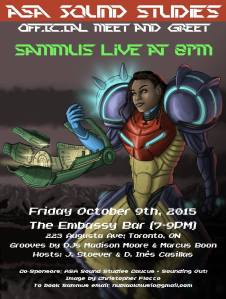
This past year, SO! editors repped the blog in person in Toronto, ON (#2015ASA); Washington DC (#rtpf); Riverside, CA (#showprove16); Stony Brook, NY (#periodsandwaves); Madison, WI; Los Angeles, CA; Irvine, CA; Houston, TX, New York City, NY; Albuquerque, NM, Las Vegas, NV, and Montreal, Quebec. We gave talks, checked out panels, livetweeted, co-sponsored events (hip hop concert by Sammus, anyone? YES PLEASE!), met one-on-one with graduate students, attended caucus meetings, ran for office, worked rooms, gave workshops on digital publishing, and even passed out the last (!) of our yellow-and-red stickers. In short, we hustled to be present for you and for the work, and we will continue on into year 8!
!!!!!!!Amplification!!!!!!!
Our ongoing SO! Amplifies series really took off this year, and we took seriously the task of scouring the web to bring you truly innovative praxis in sound. It’s purpose is twofold: to increase your awareness of cool people and projects engaging sound as an active medium–listen to them! write about them! spread the word!–AND to present insight into how archivists, makers, editors, and curators understand their own work, a sort of “behind the sound” perspective into their work. This year, we brought you preservation outreach! apps + maps! hashtag projects! podcasts! archives! art exhibits!
But, wait! There’s more!
The “notes” on our Facebook page is *still the best place to hear about calls for art, calls for posts, and upcoming conferences, shows, and volumes in sound studies. “Like” us here and please continue to keep us in the loop regarding new projects. We love to signal boost!
!!!!!!! Highlight Reel!!!!!!!
See what’s new with SO! authors and community members this year (courtesy of managing editor Liana Silva). Congratulations everyone (and keep those cards, letters, and pitches coming!).
- Since contributing to Sounding Out! last fall, André Carrington’s book Speculative Blackness: The Future of Race in Science Fiction has made its debut. He’s been doing events across the country and blogging about them at http://www.andrecarringtonphd.com. Following up on research that he presented at the Society for Cinema & Media Studies conference, he will be participating in the 2016-2017 Penn Humanities Forum on Translation to further a project titled “Audiofuturism: The Alchemy of Race in Radio Drama.”
- In the last year Robin James has been working on a book manuscript called The Sonic Episteme: Acoustic Resonance & Post-Identity Biopolitics. It argues many “neo-” and “post-” theories, like neoliberal political economy or new materialist posthumanism, double down on the “audiovisual litany” and use the shift from visual to sonic epistemologies to mark their supposed overcoming of modernity’s limitations. When she’s not franticly finishing that book, she’s been giving talks and interviews about her book Resilience & Melancholy, and written a lot for SO! James is already thinking about her next book project, which uses radio station WOXY/97x “The Future of Rock n Roll” to think about what the “future” of rock n roll sounded like in the late 20th and early 21st centuries, right before it slipped into a seemingly vicious cycle of retromania.
- Gretchen Jude presented earlier this year a paper on Vocaloids at the EMP Conference in Seattle (http://www.empmuseum.org/programs-plus-education/programs/pop-conference.aspx). Her submission to the !!!!!!! mixtape reflects this line of research. Next March, she will be presenting a paper in Tokyo on female vocality in early 20th century Japanese popular song (at the first International Musicology Congress in Asia). The music she’ll talk about in this second paper also appeared in her Sounding Out! soundwalk post. Her dissertation research will be supported by a UC Davis Bilinski Dissertation Year Fellowship in 2016-17.
- This year Carlo Patrão produced and debuted four documentaries about Sound and Listening for the Portuguese national radio station Antena 2 RTP, covering the themes of bioacoustics, archaeoacoustics, sonic violence, endangered soundscapes and sonification of cosmic data. Also, he participated in WFMU’s expanded radio stream Optimized!, programmed by Vicki Bennet/People Like Us. You can find out more about his radio work here: zeppelinruc.wordpress.com
- Daniel Santos recently graduated from SUNY Binghamton with highest honors after completing his thesis on the relationship between BU students and Triple Cities residents. Next week he starts a position as an associate teacher with Success Academy Charter School.
- For more information about Assistant Visual Editor Will Stabile, please visit your local library. You’ll learn about his burgeoning work in the field of comedy, and if you ask they might let you look at the microfiche.
- Liana Silva will be taking her presence to the public classroom this fall, as she becomes a high school English teacher in her new home, Houston TX. #htownvicious She continues to research Jean Grae’s music for an upcoming chapter in The Oxford Handbook of Hip Hop Studies. And of course she wouldn’t leave SO!, so you can still find her here at the blog, where she’s currently editing the series DH and Listening.
- Jennifer Stoever‘s book, The Sonic Color line: Race and the Cultural Politics of Listening will be published this November by New York University Press (preorder available here). She also has chapters forthcoming in The Oxford Handbook of Hip Hop Studies (on the importance of black women and Latina record collectors to hip hop) and in the Provoke! volume on digital sound studies (Duke UP), co-authored with Liana Silva and Aaron Trammell, a tell-all exposing exactly how much fun we all have working our asses off on this blog.
- Aaron Trammell earned his doctorate from the Rutgers University School of Communication and Information in Fall 2015. He was a Provost’s Postdoctoral Scholar for Faculty Diversity in Informatics and Digital Knowledge at the Annenberg School for Communication and Journalism at the University of Southern California for 2015-2016. He will start as Assistant Professor of Games and Interactive Media this fall at the Department of Informatics at the Donald Bren School of Information and Computer Sciences at the University of California, Irvine.
- Neil Verma was recently appointed Assistant Professor of sound studies at Northwestern University to help run the new MA in Sound Arts and Industries. He co-edited the book Anatomy of Sound: Norman Corwin and Media Authorship, which started out as an SO! series. If you’re in Germany in October, you can catch him speaking at Radio Revolten in Germany on Oct 27.
—
Jennifer Stoever is co-founder and Editor-in-Chief of Sounding Out! She is also Associate Professor of English at Binghamton University.
—
Click here for Sounding Out!‘s Blog-O-Versary “!!!!!!!” mix 7.0 with track listing.
—
REWIND! . . .If you liked this post, you may also dig:


- 2015 Blog-o-Versary 6.0 Keep on Pushing! (Our 400th post!!)
- 2014 #flawless 5.0 celebration and mix
- 2013 Blog-o-Versary 4.0: Solid Gold Summer Countdown!
- 2012 #Blog-O-Versary 3.0: Can’t Stop Won’t Stop (The Awesomeness)!
- 2011 “Awesome Sounds from a Future Boombox” 2.0
- 2010 First Blog-O-Versary party mix: A Celebration of Awesomeness
Share this:

SANDRA BLAND: #SayHerName Loud or Not at All
DOI: https://doi.org/10.59350/rfz76-2d642
It is customary that whenever I go to my Nana’s house I turn the car speakers as low as possible. She has super hearing. Sometimes I forget, and the following conversation takes place:
“What’s up Nana Boo?”
“I heard you before you got the house, girl. I told you about playing your music too loud.”
“It wasn’t too loud.”
“I heard you before I saw you.”
“Yes ma’am. I’m sorry.”
“Don’t bring attention to yourself.”
Don’t bring attention to yourself.
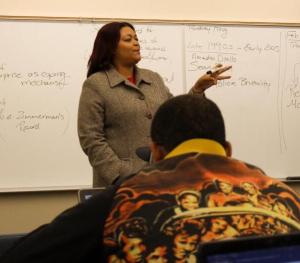
Physically this is impossible. I am a black woman over six feet tall. My laugh sounds like an exploding mouse. I squeak loudly and speak quickly when I get excited. I like knock in my trunk and bass in my music. Don’t bring attention to yourself. I frequently heard this warning as a girl and well into my adult life. I rarely take it as a slight on my grandmother’s account – though she is the master of throwing parasol shade. She spoke to me with a quiet urgency in her warning. In the wake of the murders of Jordan Davis, Sandra Bland, and other black lives that vigilantes and mainstream media deemed irrelevant, I understand her warning better from the perspective of sound.
As a loud, squeaky black woman I am especially attuned to how my sonic footprint plays into how I live and if I should die. As a black woman, the bulk of my threat is associated with my loudness. My blackness sonically and culturally codes me as threatening due to the volume of my voice. This is amplified, as a southern black woman. I exist and dare to thrive in a country that historically and socially tries to deflate my agency and urgency. The clarity of my sentiments, the establishment of my frustration, and the worth of my social and cultural interventions are connected to how others hear my voice. It is not what I say but how I say it.

Black women navigate multiple codes of sonic respectability on a daily basis. Their sonic presence is seldom recognized as acceptable by society. Classrooms, homesites, corporate spaces, kitchen tables, and social media require a different tone and volume level in order to gain access and establish one’s credibility. Like other facets of their existence, the way(s) black women are expected to sound in public and private spaces is blurry. What connects these spaces together is a patriarchal and racially condescending paradigm of black women’s believed inferiority. A black women’s successful assimilation into American society is grounded in her ability to master varying degrees of quiet and silence. For black women, any type of disruptive pushback against cultural norms is largely sonic in nature. A grunt, shout, sigh, or sucking teeth instigates some type of resistance. Toning these sonic forms of pushback—basically, silencing themselves—is seen as the way to assimilate into mainstream American society.
In what follows I look at the tape of Sandra Bland’s arrest from this past summer to consider what happens when black women speak up and speak out, when they dare to be heard. As the #SayherName movement attests, black women cannot express sonically major and minor touchstones of black womanhood – joy, pleasure, anger, grief – without being deemed threatening. These sonic expressions force awareness of the complexity of black women’s experiences. In the case of Sandra Bland, I posit that the video of her arrest is not a video of her disrespecting authority but rather shows her sonic response to officer Brian Encinia’s inferred authority as a police officer. I read her loud and open interrogation of Encinia’s actions as an example of what I deem sonic disrespectability: the use of sound and volume to contest oppression in the shape of dictating how black women should or should not act.
The sonic altercation in the video (see full-length version here) sets the stage for Encinia’s physical reprimand of Bland, a college graduate from Prairie View A&M who hailed from Chicago. Bland is not physically threatening—i.e. she emphatically states she’s wearing a maxi dress—but her escalating voice startles and even intimidates Encinia. Bland is angry and frustrated at Encinia’s refusal and to answer her questions about why she was pulled over. Encinia’s responses to Bland’s sonic hostility are telling of his inability to recognize and cope with her anger. In fact, he refuses to answer her questions, and she repeats them over and over again while he barks orders. Encinia states later in the dashboard camera that Bland kicks him and thus forces him to physically restrain her. However, Bland’s vocal assertion of her agency is more jarring than her physical response to Encinia’s misuse of power.
The dashboard camera footage is indicative of their vocal sparring match. Encinia’s voice starts calm and even. He explains to Bland he pulled her over for failure to indicate a lane change. Bland’s responses are initially low and nearly inaudible. However, after Encinia asks Bland if she is “okay,” her responses are much louder. She does not just follow orders but expresses her displeasure in sonic ways, while she stays in the car. His tone shifts when Bland refuses to extinguish her cigarette. Encinia then threatens to pull her out of the car for disobedience. He begins to yell at her. Bland then voices her pleasure in taking Encinia and his complaint to court. “Let’s take this to court. . .I can’t wait! Ooooh I can’t wait!” Bland’s pleasure in taking Encinia to court is an expression of her belief in her own agency. The act of voicing that pleasure is particularly striking because it challenges an understanding of courts and the justice system as hyperwhite and incapable of recognizing her need for justice. Her voice is clear, loud, and recognizably angry.
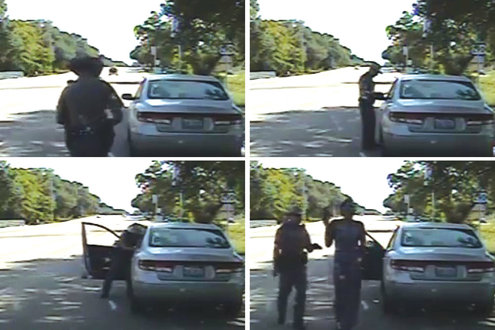
Her voice crescendos throughout the video, signifying her growing anxiety, tension at the situation, and anger for being under arrest. However, Bland’s voice begins to crack. Her sighs and grunts signify upon her disapproval of Encinia’s treatment of her physical body and rights. Once handcuffed, Bland’s voice is very high-pitched and pained, a sonic signifier of submission and Encinia’s re-affirmation of authority. She then is quiet and a conversation between Encinia and another officer is heard across the footage.
Many critiques of Bland center around her ‘distasteful’ use of language. One critic in particular described the altercation as “an African American woman had too much mouth with the wrong person and at the wrong time.” The assumption in those critiques is that she was not properly angry. Instead of a blind obedience of Enicnia’s inferred authority (read: superiority), she questions him and his inability to justify his actions. Sandra Bland’s sonic dis-respectability (dare I say, ratchet), is a direct pushback against the cultural and social norms of not only rural Southern society but the mainstream American (inferred) belief of southern black folks’ blind respectability of white authority and law enforcement.
Although Bland was a graduate of a southern HBCU, I do not want to assume that Bland possessed the social sensibilities that upheld this unstated social practice of blindly obeying white authority. Her death runs parallel to those of Emmett Till and Mary Turner. The circumstances of Till’s death swirled around his alleged whistling at a white woman – read as a sonic signifier of Till’s black masculine sexuality instead of boyhood – and disregard for white femininity, a protected asset of white men’s authority. Till, from Illinois like Bland, allegedly ignored his cousins’ warnings about the ‘proper protocol’ of interacting with white folks. Mary Turner, a black woman from Valdosta, Georgia, spoke out publicly against the lynching of her husband in 1918. She and her unborn child were also lynched in response to her sonic audacity. Before her death, members of the mob cut open her belly and her unborn baby fell on the ground; it was stomped to death after it gave out a cry. Turner’s voice disrupted white supremacy. Her baby’s lone cry re-emphasized it. Sound grounds much of the racial and gendered violence in the South.
The Southern U.S. emphasizes listening practices as part of social norms and cultural traditions. Listening was an act of survival more so than vocalizing the challenges facing black folks. (Jennifer Stoever’s upcoming book on the sonic color line addresses how advertisements for runaway slaves, for example, mentioned whether they were good listeners, as a way to codify whether they were compliant slaves.). Consider my grandmother’s warning about not bringing attention to myself. In her eyes, by not bringing attention to myself I’m able to remain invisible enough to successfully navigate society’s expectations of my blackness and my womanhood. Silence and listening are tools of survival. Contrarily, Bland’s loud disapproval and emphatic use of curse words registered her blackness and womanhood as threatening. She was coded as less feminine and therefore threatening because of her direct verbal confrontation with Encinia. She was not quiet or polite, especially in the south where quiet is the ultimate and sole form of women’s politeness and respectability. The combination of these multiple representations of black women’s anger invoked Encinia’s hyper-authoritative response to regain control of the situation.
Black folks are increasingly pushing back against “being in their place.” Sandra Bland’s death is rooted in an unnecessarily escalated fear of black women literally speaking their truth to power. In a moment where black women are speaking on multiple wavelengths and levels of volume, it is imperative to single out instances and then implode outdated cultural and social practices of listening.
—
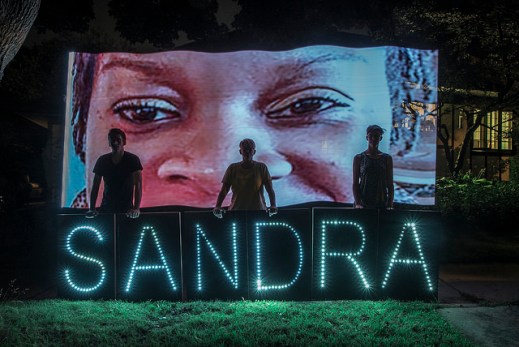
Featured image:”Sandra Bland is Her Name” by Flickr user Light Brigading, CC BY-NC 2.0
—
Regina Bradley is a writer, scholar, and researcher of African American Life and Culture. She is a recipient of the Nasir Jones HipHop Fellowship at Harvard University (Spring 2016) and an Assistant Professor of African American Literature at Armstrong State University. Dr. Bradley’s expertise and research interests include hip hop culture, race and the contemporary U.S. South, and sound studies. Dr. Bradley’s current book project, Chronicling Stankonia: Recognizing America’s Hip Hop South (under contract, UNC Press), explores how hip hop (with emphasis on the southern hip hop duo Outkast) and popular culture update conversations about the American South to include the post-Civil Rights era. Also known as Red Clay Scholar, a nod to her Georgia upbringing, Regina maintains a critically acclaimed blog and personal website – http://www.redclayscholar.com. She is a regular writer for Sounding Out!
—

REWIND! . . .If you liked this post, you may also dig:
I Been On: BaddieBey and Beyoncé’s Sonic Masculinity — Regina Bradley
“President Obama: All Over But the Shouting?” — Jennifer Stoever
Óyeme Voz: U.S. Latin@ & Immigrant Communities Re-Sound Citizenship and Belonging-Nancy Morales
—
Share this:




Current Top Posts





April 2021

January 2020

November 2019

October 2019

August 2019

April 2014

November 2017

March 2015

December 2017

October 2015


Recent Comments