
Feeling Through the Keen and Grind: Team Dresch’s Personal Best

DOI: https://doi.org/10.59350/qxd9d-6v278
“Genres, styles form around places of cohesion, of transport, of passage. Not an instrumental mathematics (though it can be that too), but a speculative one that seeks out locations of collective affect, of resonance between micro and macro spheres.” –Marcus Boon, “One Nation Under a Groove”
Yes. Punk, is a way of living, being, thinking, and relating to the world. Yes, it is bigger than borders. . .greater than the sum of than any number of bands or even the label of “musical genre” altogether. Its dynamic style visually signifies; its DIY mode-of-operations can empower, even as its more capitalist-oriented versions can frustrate and exploit.
YES YES YES.
But also, NO!
Punk sounds!
Even if punk’s sound intentionally evades classification and clichéd high-fidelity top-ten lists like Keanu Reeves dodges bullets in the Matrix, it nonetheless exists. and means. and incites. and motivates. and creates powerful structures of feeling that resonate through entire lifetimes, reverberations of that one all-ages basement show.
How do we know? Because, at the absolute very least, both of us have heard it with–and through–our bodies. It has moved us, and not just symbolically, intellectually, politically, and metaphorically. It has quite literally vibrationally, kinesthetically, heart-throbbingly, finger bleedingly, head-bangingly, body-smashing-up-against-others-bodily, in the pit of our stomachs-y, angry tear cryingly, skin tinglingly moved us.
Without universalizing our respective experiences in the Jersey and Inland Empire/SoCal punk scenes of the 1990s/early 2000s–and our wide listenings and local involvements since then–we want to say simply that punk sound is not an abstract and negative entity. Punk sounds–and punk’d sounds–form distinct sonic calls to some of us out there in the world that our bodies yearn to answer.
And its listeners’ understanding of and relationship to punk’s sound(s) matters. In her essay “On Not Playing Dead,” Bikini Kill, Le Tigre, and (the) Julie Ruin lead singer Kathleen Hanna described one of the key powers of punk’s live sound as creating a threshold of physical exchange, a vibration drawing folks into “one of the only spaces where we give and receive pleasure publicly” to friends and strangers alike, which she argues “seems radical for a myriad of reasons, especially because it challenges the idea that sexuality/pleasure is only for people in straight/monogamous relationships and not something we as a community can have through music.” Punk sound constructs, enables, and sometimes downright demands a variety of participatory responses, both individual and social.
In short, just ask a punk about what punk sounds like! They know! And they will tell you about it! It’s up to us to figure out how to listen. And what better space to try in the audiovisual ‘zine that is Sounding Out!, started by folks whose scenes taught them how to forge and sustain community with and through sound.
This series (and its follow up in Spring 2017) calls bullshit on the related notions that punk sound is either simple presence–ye olde “three chords,” a misnomer that is always already more geographically and historically specific than popular discourse allows–or overdetermined absence, a too-open, too-inclusive sound that, to riff on Green Day, is simultaneously “nothing and everything all at once.” And we very deliberately use “sound” rather than “music” as our guiding framework to think through punk’s sonic pull, not because punk “isn’t music” (a stale but ever present dis on the genre), but because punk itself sounds out the limitations of musical study ( in addition to Alice Bag’s musical manifesto below, see Leandro Donozo’s “MANIFIESTO POR UNA MUSICOLOGÍA PUNK” suggested to us by Alejandro Madrid).
Our Punk Sound series implicitly argues that sound studies methodologies are better suited to understanding how punk works sonically than existing journalistic and academic conversations about musical genre, chord progressions, and/or genealogies of bands. Alexandra Vasquez’s sound-oriented work on Cuban music, for example, in Listening in Detail (2014) opens up necessary conversations about the “flashes, moments, sounds” in music that bear its meanings and its colonial, raced, classed, and gendered histories in material ways people can hear and feel. While retaining the specificity of Vasquez’s argument and the specific sonic archive bringing it forth, we too insist on “an ethical and intellectual obligation to the question: what do the musicians sound like” (12) and how do folks identifying with and through these musical sounds hear them?
In this series, we invite you to amplify varied historicized “details” of punk sound–its chunk-chunk-chunk skapunk riffs, screams, growls, group chants, driving rhythms, honking saxophones–hearing/feeling/touching these sounds in richly varied locations, times, places, and perspectives: as a pulsing bead of condensation dripping down the wall of The Smell in Downtown LA (#savethesmell), a drummer making her own time on tour, a drunk sitting too near the amp at a backyard party, a queer teenager in their bedroom being yelled at to “turn it down” and “act like a lady[or a man]”. . .and on and on. Today’s essay is by Gretchen Jude. Listen along as she reflects on growing up through listening to Team Dresch’s Personal Best. And keep coming back every Monday in November for more!
SOUND!
–Aaron Sounding Out! + Jenny Sounding Out!
—
.

.
In the spirit of Critical Karaoke, first introduced by Joshua Clover at the Experience Music Project annual Pop Conference, this piece was written to be read with the album playing alongside. In anchoring my text/your reading so directly/literally in the sound, I hope those who have not had first-hand experience of growing up queer can understand on a more visceral level how I have heard/felt/lived through this music. Sounds work on bodies in non-verbal ways, so the sharing of these queer(ing) vibrations may allow fans to sense an underlying queerness in all punk sound.
Released in January 1995, Personal Best, the first album from Pacific Northwest quartet Team Dresch, rode the crest of the Queercore wave, itself propelled by decades of feminist, gay rights, and AIDS activism. The lesbian-identified band—Donna Dresch (guitar and bass), Jody Bleyle (guitar, bass, and vocals), Kaia Wilson (guitar and vocals) and Marci Martinez (drums)—was also fueled by the punk energy and DIY ethos that flared back to life with the Seattle grunge scene and Riot Grrrl movement.
The quartet’s technical skill showed their commitment to music; Dresch (who also produced the album) and Bleyle co-released the band’s debut on their respective labels, Chainsaw and Candy Ass Records. At the same time, the group’s cohesiveness and cooperation was evidenced in the complexity of their compositional strategies: self-produced albums, multiple time changes, shifts between guitar effects. Personal Best managed to rage without outward aggression. The band seemed to feel, like me, an anger that was full of anguish, a pointed fury at the causes of their anguish—yet leavened with humor (‘I spent the last ten days of my life ripping off the Smiths’).
The following is a critical listening of Personal Best.
(Side 1)
Something still remains in my body from the very first time I heard this album. The audaciously-titled “Fagetarian and Dyke” goes off like an alarm, with insistent guitar string strikes that ring in my ears and run down my spine with a shock. Once the drums come in, I am already swaying in time as the vocalist demands a breathless ‘how’ before rapidly morphing into a long-held growl—‘searching for you’. It was the music I had long needed without knowing.
The second song starts spare to the point of hesitance, a thin bassline with ominous guitar jangles and a backbeat promising a break in the intensity—until the band coalesces around Wilson’s rhythmic chant bristling with articulate screams. But contrary to the title—“Hate the Christian Right—I hear less hate than angry frustration. Bleyle’s vocals take the fore with melancholic power, making explicit the fundamental feeling, ‘the fear, fear I’m sick with it.’. The sound is dense and close, mixed with no reverb so I feel like I’m deep inside the music, sweating with the band. My hand moves with a will of its own toward the volume control, I crank it to feel the kick beating inside my chest like another heart, I can’t stop moving my feet, my legs, I am impelled to motion.
Looking back twenty-one years at this musical moment, it’s hard to fathom how much society has changed—in terms of both the structures of musical production/distribution and our understandings of gender/sexual identity. Yet when I encounter these songs once again, my listening remains fully present. How is it that this album still works to electrify me even today? Pressing play now, I hear this album through the patina of nostalgia. Even calling it an ‘album’ evokes another time, conjuring the act of flipping through stiff pages of family photos. There are tactile similarities—I slide the vinyl disc from its paper sleeve, grasp the edges of the cardboard dust jacket, leisurely run my eyes over the hand-scrawled track listing. I regard the cover image and recall my pleasurable smirk at the in-joke. But even back in 1995, when I listened on cassette and CD Walkman, I wanted to take this album with me everywhere.
Jangly guitar riffs, popping tom hits and Wilson’s clear soprano in multi-tracked harmony give “She’s Crushing My Mind” a jaunty opening. But the tension amps up with feedback on ‘she was born this way,’ and Wilson punches the verse: ‘she wants to (forget it)’. The song ends abruptly, no resolution, reflecting the unrequited queer love the lyrics express.
Even the words I use to describe the world have changed since 1995. I came out in 1986, before the word ‘queer’ was wrested from the verbal fists of homophobes. In retrospect, it was a brief moment, after feminism came out as lesbian, but before the ‘lesbian body’ was deprived of its ‘radical’ prefix—a time when it made sense to call lesbians ‘avengers’ or even ‘amazons’ (always in the plural). By 2016, having come out so many times in so many ways, I am no longer sure what others hear when they regard me pronouncing myself ‘queer’. And yet then as now, the energy I feel in this music goes beyond representation. The sound moves me with what Julian Henriques terms an “energetic patterning of vibrations” (76), setting in motion a sort of sympathetic resonance that shakes off labels and identity categories.
Just as I wonder when the darkness will end, “Freewheel” gallops in, cavalier, and drags me into the afternoon grass for some silliness. Wilson and Bleyle’s sweetly ironic harmony on ‘you can go back to your boyfriend’ sidelines ‘that girl,’ instead placing camaraderie front and center.
Nowadays, like most, I listen digitally, soft noise-reduction earbuds squished into my ears. Through my headphones, the violence of the 21st century bleeding light-speed across my mediated vision makes the sheer vulnerability underlying Team Dresch’s mad sounds even more striking. As a teen, I avoided mosh pits. Bony boy-elbows shot out at exactly the height of my eye sockets, and even combat boots weren’t enough protection from the public risk of my female body. At home or with friends, I sometimes reveled in the nihilism voiced by male punk bands. But the performance of an all-inclusive anger blindly striking out at society-at-large (which often seemed to involve getting drunk and fighting) mostly felt intimidating to me. Team Dresch retuned the timbre of punk rage—from frustration with authority-as-abstraction to lamentation over first-hand experience of oppression—then directed that incisive anger toward fundamentally feminist self-protection and catharsis.
The sincerity and solemnity of the riff that opens “She’s Amazing” bloom into a punk ballad that resonates with my best experiences of friendship. Wilson and Bleyle alternate and harmonize in tribute to female wisdom and strength. Even as the vocalists acknowledge their deep self-doubt and insecurity, the decisive instrumentals bolster them up.
It’s not that I didn’t feel angry. It’s that angry men sounded scary.
In a moment of stillness, I hear echoes of Patti Smith’s amazing(ly bent) cover of Van Morrison’s “Gloria” (1976). Smith’s fearless androgyny, her working-class snarl, her performance of desire for a woman exhilarate even today. Another old favorite rings in my ears: The Slits, playing as outlaws-on-the-lam. Underclass anthem “Shoplifting” (1979) double-dared me to flaunt needless authority, as Ari Up’s breathy vocals accelerate to an almost feline scream—‘run!’—and jangling guitars veer chromatic. I adored The Slits for their fearless extroversion—audacious yet always girly. I am ready, hungry for more.
(RECORD FLIP INTERLUDE)

.
(Side 2)
“Fake Fight” opens punchy, with space in the bass and insistent hi-hat. Bleyle’s reedy tomboy alto alternately croons low and close into the mic (as if directly into my ear), then shouts along with synched noise pedal interludes: ‘I can see a brave tomorrow, don’t let this spaceship bring me down’.
Yvon Bonenfant describes the practice of queer listening—of listening as deeply feeling—as an attempt to recuperate queerness as community: “Queer listening listens out for, reaches toward, the disoriented or differently oriented other. So far, there are no majority queer cultures. Queer is always listening out through the static produced by not-queer emanations of vocalic bodies. Queer can like, love and enjoy those bodies in every way, but still needs to twist around and negotiate through them to find other queer” (78). For years I did this by instinct, paying attention to any hint of coded lesbian tendencies. In the pre-Ellen world, this was a survival technique.
Quirky “#1 Chance Pirate TV” shifts into high gear with 4/4 drumsticks and a vigorous punch on the toms. The song (a tribute to Sinead O’Connor) then suddenly slows into restful repetitions; ‘Sometimes it feels all right,’ Bleyle intones again and again—in a kind of mantra for getting through all the times when it doesn’t.
By the time I heard Personal Best, I had all but given up listening for my own bodily experiences—in the specifics of its love, anger, desire, suffering—offered back to me in music. Sure there were decades of lesbian folk music (yawn). But with Team Dresch, I didn’t need to engage in recuperative queer listening—this was unapologetically queer sounding. I was bowled over with this feeling—when you can give yourself over to the music because the people making the sounds know exactly what you’ve gone through, what you are living through. The reality you know by heart but have never heard affirmed in the voices around you.
“D.A. Don’t Care” rocks like a regal lullaby, but on a theme so heavy it presses my heart to diamond. Wilson’s caustic deployment of the cliché ‘and how was he supposed to know’ subverts the always-overdone ‘her word against his.’ From here the band rushes the album to its apotheosis, as Bleyle proclaims her own physical autonomy in the wake of abuse: ‘I know what to do with this body.’ The following verse leaves behind the dry vocal mix of the rest of the album, as the haunting image of a ‘polyester basketball uniform’ is buried deep in heavy bass, chilling with reverb.
In the hard-earned, bittersweet privilege of reaching my middle-age, I still shiver at Beyle’s chorus—not for myself now, but on behalf of those now young: the trans and genderqueer kids, an upcoming generation of dykes and fags—the ones mistreated, raised to have their own bodies and hearts turned against themselves. I want them to find music that catalyzes the scream: ‘I KNOW WHAT TO DO WITH THIS BODY.’
Barely time to breathe and then the grinding lead-in to “Growing Up in Springfield,” a confessional of rejection and isolation in small-town America. Unlike Wilson’s, my mother didn’t ‘cry when I shaved my head.’ Nevertheless, the biting affirmation, ‘Those were the worst years of my life,’ rings satisfyingly through a burst of white noise.
With Personal Best, Team Dresch generates a synergy of sound and affect that engages me beyond nostalgia. The band weaves together multiple elements—voices with instruments, tempo and pedal shifts, the trajectory of song order, and lyrics that express the fallout of a queer girlhood in the rural Northwest isolation—to transform fear and self-hatred into courageous resistance. This synergy reflects (to paraphrase Adrienne Rich) a visionary, cleansing anger that dares me to feel new possibilities, both personal and political. Guitars chorus, drums pop sharp and clear, and vocals lie low but clear in the mix, embedded in a basement mix of mourning and menace. The keening rage in this album lances like a healing needle.
The lo-fi opening lines of “Screwing Yer Courage” break into Bleyle’s full-on howl. The heavy cacophony of the band feels like body-surfing like a 10-foot wave of sound. Even as she voices the desire to ‘move to the woods,’ the band’s sound performs a sense of community. The album ends with a tornado of noise, a storm that spins at exactly the right speed for me to join in. Softly, then more insistently Bleyle murmurs then cries: ‘I love you, baby, I love you.’ With one final delicious guitar arpeggio, slowly drawn out, the album is…
The music itself, the specificity of its vibrations, is of the essence. Attending to the experiential conditions of our listening is equally fundamental, and through articulating both sounds and contexts we may move past merely gesturing towards taste and invoking genre as shorthand for what we already value. As Nina Eidsheim describes, “in encounters through and with music, we are physically touched and we tangibly touch others” (183). In the case of punk and its queer progeny, we vibrate together in and with a visceral noise that harmonizes through its very dissonance.
—
Cover image is of crowd surfing at a 2006 Team Dresch reunion show by Flickr User Frances, Attribution-NonCommercial-NoDerivs 2.0 Generic (CC BY-NC-ND 2.0).
—
Gretchen Jude is a PhD candidate in Performance Studies at the University of California Davis and a performing artist/composer based in the San Francisco Bay Area. Her doctoral research explores the intersections of voice and electronics in transcultural performance contexts, delving into such topics as presence and embodiment in computer music, language and cultural difference in vocal genres, and collaborative electroacoustic improvisation. Interaction with her immediate environment forms the core of Gretchen’s musical practice. Gretchen has been studying Japanese music since 2001 and holds multiple certifications in kotoperformance from the Sawai Koto Institute in Tokyo, as well as an MFA in Electronic Music and Recording Media from Mills College in Oakland, California. In the spring of 2015, a generous grant from the Pacific Rim Research Program supported Gretchen’s intensive study of hauta and jiuta singing styles in Tokyo. This podcast (as well as a chapter of her dissertation) are direct results of that support. Infinite thanks also to the gracious and generous assistance of Shibahime-sensei, Mako-chan and my many other friends and teachers in Japan.
–

REWIND! . . .If you liked this post, you may also dig:
Sounding Out! Podcast #50: Yoshiwara Soundwalk: Taking the Underground to the Floating World – Gretchen Jude
SO! Amplifies: Indie Preserves – Norie Guthrie and Scott Carlson
Sounding Out! Podcast #55: New Brunswick Music Scene Symposium – Frank Bridges
This is Your Body on the Velvet Underground–Jacob Smith
Live Through This: Sonic Affect, Queerness, and the Trembling Body–Airek Beauchamp
Garageland! Authenticity and Musical Taste–Aaron Trammell
Sounding Out! Podcast #28: Off the 60: A Mix-Tape Dedication to Los Angeles–Jennifer Stoever
—
Share this:

The Amplification of Muted Voices: Notes on a Recitation of the Adhan

DOI: https://doi.org/10.59350/d8pq1-j7478
Where do we begin?
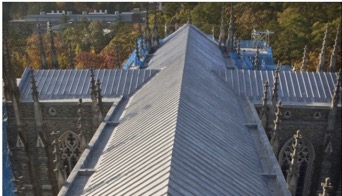
On Tuesday January 13th, 2015, my first-year students and I gathered for the second meeting of our seminar, “Soundscapes: Artistic, Social, and Biological Approaches to Acoustic Environments.” We were just a few steps away from the iconic Duke chapel, almost in its shadow.
The chapel is an example of a revivalist architectural style known as “Collegiate Gothic.” Its steps were constructed with soft stone, intended to wear down quickly and provide an accelerated impression of age and prestige. The chapel’s cruciform blueprint is an unambiguous symbol of its Methodist Christian roots, as is the university’s motto: “eruditio et religio” (“erudition and religion”). In true Gothic revivalist style, the phrase is a Latin translation of a line from an 18th-century, English-language Methodist hymn titled “Sanctified Knowledge.”
.

On Tuesday, January 13th—the second day of my Soundscapes seminar—Duke’s Office of Communications announced that the Islamic call to prayer, the adhan, would sound from a bell tower of its iconic chapel in Durham, North Carolina. According to a press release, Duke’s chapel administrators and Muslim Students Association felt the three-minute long, “moderately amplified” recitation “represents a larger commitment to religious pluralism” on campus and that the sound of the adhan “connects the university to national trends in religious accommodation.”
The story was picked up by WRAL, the television news outlet based in nearby Raleigh. The web-based stories included a photo of the student slated to be the muezzin, the person appointed to recite the call to prayer. In the photo, the student was shown rehearsing from the bell tower. I read the announcement just before walking to class and thought the event would be a historic opportunity for my students and I to make field recordings of their university soundscape.
Where do we begin?
The adhan was scheduled to take place on the afternoon of Friday, January 16th. On Wednesday, January 7th—a week before the announcement of the adhan at Duke—twelve people were murdered during an attack on the Paris offices of the satirical newspaper Charlie Hebdo. Ostensibly, the murders were committed on behalf of Al-Qaeda in the Arabian Peninsula as a retaliation for the newspaper’s cartoon depiction of the prophet Mohammed.

Where do we begin?
Islamic theology posits that the adhan is not music. It is recited, not sung. Likewise, the text of the Qu’ran is not poetry. These sacred texts are certainly musical and poetic, but they are neither music nor poetry. These theoretical distinctions have complex and profound implications: more than soundscapes or sound art or acoustemology, the Islamic premise underlying recitations of the adhan and Qu’ran provoked my students to reconsider entire constellations of historical, cultural, linguistic, political, and—indeed—spiritual phenomena.
My students and I conducted a survey in which they asked classmates to identify a recording of the adhan. Only 2 out of 48 students recognized it as a recitation of the Islamic call to prayer; most guessed it was “Arab” or “Middle Eastern” music, but it seemed universally familiar as a “soundtrack” for a film sequence. One student who had lived in Morocco recognized the adhan immediately; another recognized it as the sound of his Lebanese grandmother’s alarm clock, automated to remind her to pray. We became acquainted with Cairo in One Breath, a documentary film project about post-revolutionary Egypt’s 2010 Adhan Unification Project, an effort to “replace individual muezzins with a single voice, broadcast to Cairo’s [thousands of] mosques from a radio station.”

We also became familiar with the mythology of the first muezzin: Bilal, who was born in Mecca to Abyssinian slaves—in other words, a black man who was freed from slavery.
Where do we begin?
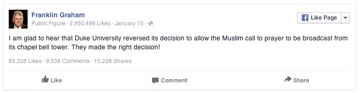
On Wednesday January 14th, the Reverend Franklin Graham posted a reaction to Duke’s announcement on his Facebook account. Franklin is the son of evangelical Baptist preacher Billy Graham, close friend and advisor to American presidents from Dwight D. Eisenhower to George W. Bush and known as “America’s pastor.” Franklin Graham is a resident of High Point, North Carolina (an hour’s drive from Duke) whose salary from tax-exempt, non-profit religious organizations is reported to be $880,000 per year.

Graham’s post “went viral,” and his threat of financial sanctions—aimed squarely at donors and alumni—seemed to land on its mark. Within hours, Duke’s proposed adhan recitation became the subject of a flood of media coverage, and the university received “credible threats” of violence; public relations and financial concerns were quickly compounded by “safety concerns.” My students and I—whose safety was being threatened—wondered whether the phrase “safety concerns” was a euphemism for terrorism, or vice versa.
On Thursday January 15, the university’s administration announced that they were canceling the planned recitation from the chapel bell tower. Instead, the adhan would be recited just outside the chapel, at the top of the steps leading to the chapel’s front doors. Franklin Graham celebrated the decision—again, on Facebook.
Later in the day, Richard Hays, the dean of the Duke Divinity School, released a letter outlining his objections to the proposed recitation. Hays’ letter revealed a somewhat obscure but significant division between the Divinity School and the chapel administration, each of which see themselves—in their own ways—as custodians of Duke’s Christian image. For the Divinity School administration, the chapel is a symbol of the university’s Christian identity. For the chapel administration, its Christian heritage is an aspect of a fundamentally pluralistic identity.
It is worth pausing here to emphasize that the controversy—now national in scope—was provoked by the mere prospect of sound. More specifically, a sound amplified at “moderate volume.”
By this point, the student muezzin and his family requested that his photo and name be removed; like the university, the young man and his family expressed “safety concerns.” Duke removed his image and name from the official online version of the announcement immediately. WRAL, the Raleigh television station, have still not removed the student’s image or name from their website.

Where do we begin?
On the morning of Friday, January 16th?
The adhan was scheduled to take place at 1PM. At 12:30, I met two of my students—Tanner Waters and Jee Yoon—near the chapel. A large crowd was already gathering. Tanner, Jee, and I equipped ourselves with identical digital audio recorders so we could make a trio of stereo recordings, each from a distinct position; later, we would synchronize the recordings, mixing them in different ways to experiment with sonic “versions” of the event.
A half-dozen news vans were parked around the circular driveway leading to the chapel, their satellite antennas projecting into the clear blue sky. This was news. The news’ cameras were arranged on tripods in a straight line at the rear of the crowd; university security were maintaining a perimeter around the chapel that kept broadcast media at a distance. As I approached with my headphones on and my audio recorder in my hand, a chapel staff member asked mildly, “Excuse me, sir. Are you with the media?” I smiled and shook my head. No.
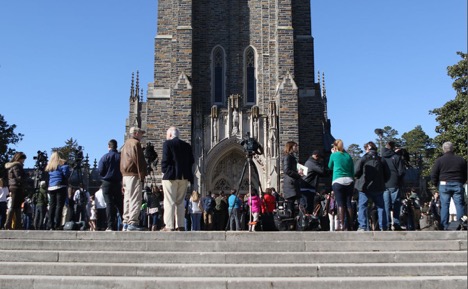
A small PA sat at the top of the steps. Very small. There were no cables attached to it, and a small radio antenna extended from the top. It took me a few minutes to realize that this was the amplification, the moderate “loudspeaker” for the adhan. It took me another moment to realize the student muezzin would not appear: instead, he would transmit his recitation remotely. I was told later that he was just behind the closed doors of the chapel. Like so many recitations of the adhan, the transmission, amplification, and conceptual layers of it seemed uncannily like a sound art installation.
We all faced the loudspeaker, waiting for sounds to happen. The crowd went from murmurs to whispers, then silent. After a few seconds, the voices of members of the Muslim Students Association began to broadcast from the loudspeaker.
A young man’s voice introduced the adhan—a brief, prosaic context for what we would hear. Then a woman’s voice (also young) offered a literal English translation of the the adhan’s Arabic text. She spoke plainly, without the melodic contours of a recitation.
Now, before sharing recording of the Duke student muezzin’s recitation, I offer a bit of context—not an explanation or translation, but a comparative musical example. First, let’s listen to an iconic recitation style—albeit with a bit of YouTube-style hyperbole—recorded in Medina, Saudi Arabia. This recitation lasts four minutes—a fairly typical length of time for a complete recitation.
Now, let’s listen to the entire recitation of the adhan at the Duke chapel.
.
The prevailing quality of the Duke recitation is extraordinarily subdued. It is a vocal expression of the “moderate” sound and Muslim identity at the center of the controversy. At one minute and thirty seconds, it is less than half as long as most recitations.
Where do we begin?
Perhaps we might analyze this adhan as a peculiar instance of acousmatic sound: the student muezzin, like Pythagoras or the Wizard of Oz behind a curtain, was separated or dissociated from a discernible source by a curious bit of technology. When I asked Omid Safi, the director of Duke’s Islamic Studies Center, about this aspect of the story—the unseen and moderate voice of the student—he responded that for Muslims at Duke, the entire episode was about “safety and inclusion.”

Safi is a Duke alum. He studied there as undergraduate, co-founding the Muslim Students Association as a freshman, and went on to earn his Masters and PhD degrees at Duke. Since returning as director of the Islamic Studies Center two and a half years ago, he has been vocal and visible in the mass media. Safi himself has been labeled a “radical Muslim professor” by white conservatives and subjected to online “takedown articles,” particularly surrounding this event. Safi told me,
Part of the reason why … there was amplification but no person in sight [was] that people were scared. And it sounds hysterical … In retrospect, knowing what took place in Chapel Hill a few weeks later, [it was] not so unreasonable.
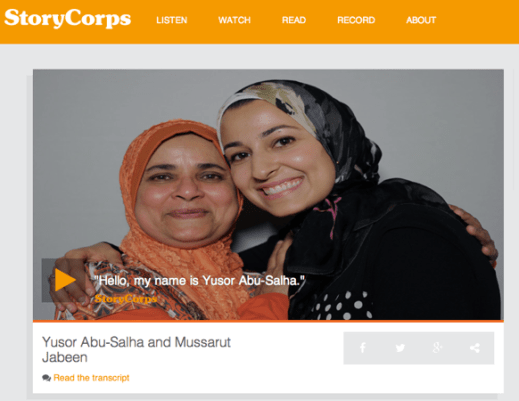
On Tuesday February 10, 2015, three Muslim college students—Deah Barakat, Yusor Abu-Salha, and Razan Abu-Salah—were murdered in their Chapel Hill home, just a twenty-minute drive from Duke. Less than a year earlier, Yusor Abu-Salha had been interviewed by her third-grade teacher for the StoryCorps oral history project.
.
At horrifying moments like these, I think to myself, “This is why people pray.”
I was deeply ambivalent about discussing the murders with my students. After speaking to a handful of students individually and discreetly, I found most of them were completely unaware of the murders. I wondered—mostly silently, to myself—what impact the news might have on them, then decided to share the story obliquely: I discussed StoryCorps (“listening is an act of love”) in class, an important resource for those of us interested in oral history and I concluded by mentioning the recording of Yusor Abu-Salha. I never asked if they listened to Yusor’s voice, and I cannot know how they might have been affected. I simply did not know what to ask, nor what to say.
Less than one year later, in September, I surveyed my next cohort of incoming freshman. Less than half of them knew anything about the adhan controversy. Among the few who had heard something about it, the event had already acquired dubious mythological qualities: in one account, Muslim students were forced to move their call to prayer from the chapel tower to the nearby Sara Duke Gardens.
Analyses of the event varied considerably. In an op-ed for Duke’s student newspaper titled “Deconstructing the National Fear of Duke’s Adhan,” freshman Eidan Jacob—an Israeli Jew—offered a brilliant context and synthesis, expressing “surprise and disappointment” that the adhan was “so poorly received.” He observed that in his hometown of Haifa, “recitations of the adhan are simply part of the soundscape.”
A broad cultural and political context reveals that xenophobia and—more specifically—Islamophobia, remain cultural common sense in the post-9/11 United States. Both supporters and opponents of the adhan at Duke were disappointed by the controversy, and I do not discern a tidy moral to the story.
The sounds and discourse of the adhan at Duke suggest a narrative preoccupied with “decibels and debate,” but the subtle dynamics and textures of thoughtful, moderate conversation suggest an audible alternative to the loudness and noise of mass media discourse. The diverse qualities of the voices in this story—musical and otherwise—are more than poetic metaphors: the “voices of moderates” and “moderate-sounding voices” deserve close attention; regardless of the causes or motives underlying their subdued tones, their very quietness demands nuanced, high-fidelity listening. The literal and metaphorical amplification of voices might be a distraction from more important matters of range and intimacy.
Where do we begin?
—
In May 2015, the Duke chapel was closed for restoration. It is scheduled to reopen in May 2016.
Plans for a weekly adhan recitation elsewhere on the Duke campus are under consideration.
—
Featured Image by Elysia Su, The Duke Chronicle
—
David Font-Navarrete is an artist, musician, and ethnomusicologist. He is currently a Lecturing Fellow at Duke University’s Thompson Writing Program.

—
REWIND!…If you liked this post, check out:
“Beat-ification: British Muslim Hip Hop and Ethical Listening Practices” –Jeanette Jouili
“Rallying Cries as Suffering Sounds: “Allah-O-Akbar” and the Aurality of Feminized Iranian Suffering–Roshanak Kheshti
“An Ear-splitting Cry: Gender, Performance, and Representations of Zaghareet in the U.S.“-Meghan Drury
—
Share this:




Current Top Posts





April 2021

January 2020

November 2019

October 2019

August 2019

April 2014

November 2017

March 2015

December 2017

October 2015


Recent Comments