
SO! Reads: Todd Craig’s “K for the Way”: DJ Rhetoric and Literacy for 21st Century Writing Studies


DOI: https://doi.org/10.59350/s59r2-jwr11
or, Last Summer a DJ Saved My Life
“Hip Hop does work that a lot of other things don’t do” Young Guru (viii).
The way that we imagine English Studies, specifically Composition and Rhetoric (Comp/Rhet), today needs a radical shift. Specifically, we need new techniques for Writing Studies pedagogy to reach students in a more meaningful and contemporary fashion. Todd Craig’s “K for the Way:” DJ Rhetoric and Literacy for 21st Century Writing Studies (Utah State University Press, 2023) both documents the need for this shift and enacts it. Craig’s work enables us to recognize the pedagogical impact on writing that Hip Hop has had over the last 50 years—specifically how the DJ/deejay as twenty-first century new media reader and writer teaches students not just to think about sound, but to compose with it, too.
An Associate Professor of English at CUNY Graduate Center, Craig has little desire to shake the foundations of English Studies, but instead do what Hip Hop has always done—make a way where there is none. The point is to (re)imagine new ways of doing old things; in this case, of teaching and reaching students who arrive in First-Year Writing courses. “K for the Way” does more than demonstrate the ways in which the DJ is a twenty-first century pedagogical savant; it also teaches readers, using DJ Rhetoric and DJ Literacy, about the culture that makes them possible.
This summer, a DJ really did save my life: as someone who feels consistently overwhelmed by the vast nature of scholarly discourse, “K for the Way” gave me a chance to breathe, to identify with something that has been a part of me for the better part of my life, and to see myself in a conversation about a topic I am more than passionate about. For Craig, community, history, and culture are the core of his mission as a scholar, educator, and DJ.
Craig defines several new terms that bridge the worlds of Hip Hop and Composition and Rhetoric. First, we have DJ Rhetoric, which can be understood as the modes, methodologies, and discursive elements of the DJ. For Craig, it “encompasses the quality of oral, written, and sonic language that displays and expresses sociocultural, historical, and musical meanings, attitudes, and sentiments” (23). Next, there is DJ Literacy, which is the “sonic and auditory practices of reading, writing, critically thinking, speaking, and communicating through and with the rhetoric of Hip Hop DJ culture” (23). These two definitions, operating in conjunction, situate the DJ as a kind of griot, a figure that Adam Banks invokes as a carrier of tradition, stories, and histories in Digital Griots: African American Rhetoric in a Multimedia Age (Studies in Writing and Rhetoric) (2011). The mission of the griot is to carry stories and translate them to various audiences while adhering to the rhetorical conventions and modes of whichever audience they find themselves before; similarly, the DJ is responsible for “communicating the pulse and the evolution of a culture that once sat as ‘underground’ but now has dramatically evolved to ‘mainstream’” (25). These definitions serve as guides for the reader as they are tethered to all of the concepts and (re)imagining happening throughout the book.
Craig is intimately close to the work he is doing. He lives and breathes Hip Hop; and what should a book about the Hip Hop DJ be if not written by someone who embodies the role, culture, and practice of DJing? Craig uses a a research methodology known as hiphopography in which Hip Hop ways of being are central to studying it. Coined by James G. Spady, this term is defined as “a shared discourse with equanimity, not the usual hierarchical distancing techniques usually found in published and non-published (visual-TV) interviewers with rappers” (27). Craig states that hiphopography “allowed me to engage a variety of Hip Hop DJs while also maintaining my own shared values and sentiments around my love of Hip Hop culture and DJ practices” (28). Hiphopography constructs a conversational, intimate space—touched by history, culture, and music—wherein the interviewer and interviewee can engage and produce meaningful data. This methodology—and Craig’s many interviews with DJs about their craft—becomes part of the text’s core as we begin to see how Craig’s two-pronged argument connects DJ Rhetoric and DJ Literacy to bring both life throughout the book.
If one understands the DJ as a twenty-first century rhetorician and compositionist and considers the ways in which the DJ is a cultural meaning-maker, sponsor, and master sampler, then one can clearly see the connections between the DJ, DJ culture, and Writing Studies in the contemporary moment. In the first part of his argument supporting the significance of DJ Rhetoric and Literacy in writing pedagogy Craig asserts that, “it is essential that the academy at large works to strengthen students’ undergraduate experiences by reinforcing their racial, ethnic, and cultural ties” (14). This perspective provides the foundation for the second part of his argument that “the DJ (and thus, Hip Hop DJ culture) is the epicenter of Hip Hop culture’s creation” (23). Taken together, these dynamic arguments make the claim that the DJ offers a powerful model of a new media reader, writer, and critic. Today, our students come to writing classrooms with a “vast array of cultural capital. . .in their philosophical and cultural backpacks” (107). If we, as writing teachers, want to honor that cultural capital and build with it, we should follow Craig’s lead and look toward the DJ for some pointers on how to expand students’ access to a language that represents them.
Readers will also see a developing research agenda in “K for the Way” that thinks toward changing the culture beyond the present, while acknowledging the groundwork laid for the current moment and building genealogically upon that foundation, just as DJs do with sampling. Craig best exemplifies this when he writes, “in order to fully engage in a conversation—whether intellectual, pedestrian or otherwise—that discusses what DJ Rhetoric might look like, one has to think about the cultural and textual lineage of sponsors and mentors” (51). This notion of textual lineage is borrowed from Alfred W. Tatum who explains the term as “Similar to lineages in genealogical studies” and continues to note that textual lineage is “made up of texts (both literary and nonliterary) that are instrumental in one’s human development because of the meaning and significance one has garnered from them” (Tatum, qtd. in Craig, 51). Craig builds upon Tatum’s idea by introducing sonic lineage, which follows the same logic as Tatum’s term, but through sound (51). What becomes apparent, is that the DJ, as a cultural sponsor, can deploy sonic lineage as a way of communicating history and culture to members within and outside of the Hip Hop community and, more specifically, DJ culture.
Chapter three, especially, works at the interdisciplinary junction of Sound Studies, Writing Studies, and Hip Hop studies to convey a clear critique of the dominant discourse surrounding plagiarism. Craig is unsatisfied with the black-and-white conception of plagiarism as it presents itself in the academy. As a result, he moves to inquire “how we as practitioners [of teaching composition] approach citation methods and strategies within a twenty-first century landscape” (75). Craig promptly turns us toward the DJ’s conceptualization of sampling as a citation practice. Sampling in Hip Hop, as defined by Andrew Bartlett, “is not collaboration in any familiar sense of the term. It is a high-tech and highly selective archiving, bringing into dialogue by virtue of even the most slight representation” (77). The highly selective archiving, a.k.a crate diggin’, builds upon the idea of sonic lineage.
For the DJ, the process of diggin’ through crates to find that right sound, that one joint that going to get the party jumpin’, is a key element in the practice of “text constructing” (79). The Hip Hop sample functions alongside an understanding, offered by Alasdair Pennycook, of “transgressive-versus-nontransgressive intertextuality,” which, for an academic audience, complicates the idea of plagiarism.. The DJ becomes a figure through which we can understand intertextuality, sampling becomes the practice through which we can see parallels to citation through text construction, and the mix is where we begin, with the help of Pennycook, to complicate notions of plagiarism. In this chapter, readers are able to understand through sound.
Subsequently, Craig explores the concept of revision as it relates to the DJ’s ability to engage with an emcee on the point of “remix as revision” (107). Building from on Nancy Sommers’ article, “Revision Strategies of Student Writers and Experienced Adult Writers,” Craig lifts and examines four strategies of revision through the lens of the Hip Hop DJ: deletion, substitution, addition, and reordering (Sommers, qtd. in Craig, 107). These practices not only identify the Hip Hop DJ as a master of revision but also center the DJ, in the context of the writing classroom, as a key figure for understanding editorial practice. As teachers of writing—and especially for those of us who are deeply connected to Hip Hop culture—we have traditional scholars, such as Sommers, but we also have the DJ as cultural scholar, which offer new models with communicating and practicing the craft of writing in the twenty-first century.

Chapter Five, which is co-written by Craig and Carmen Kynard, centers on six women DJs: DJs Spinderella, Pam the Funkstress, Kuttin Kandi, Shorty Wop, Reborn, and Natasha Diggs to work toward developing a “Hip Hop Feminist Deejay Methodology” that positions women in Hip Hop culture as a key source of key knowledge production–as meaning-makers, theoreticians, storytellers–and as tastemakers in twenty-first century discourse about education, technologies, race, and gender. This chapter is also apt representation of hiphopography at work, as both Craig and Kynard ground their position in the interviews of these six women deejays, “deliberately situating their stories first… as opposed to the usual academic expectation that a tedious delineation of methods and an extant literature review come before a discussion of the actual subjects” (123).
In part, this chapter focuses on the affordances and limitations—political, social, and economic—present in DJ culture, and the effects it has on these women DJs to make it do what it does. For example, the introduction of the digital software Serato has simultaneously made access to music easier, and complicated access to the cultural archive that made the music possible in the first place. Natasha Diggs, states, “While she values the ability to access mp3 files so readily, she argues a deejay’s research and craft suffer, because many times the mp3 files do not include information about an artist’s name, history, or band” (129). Pam the Funkstress ties this sentiment up nicely when she argues, “There’s nothing like vinyl” (129).
The final chapter is fashioned like a Hip-Hop outro, with Craig leaving with a few parting ideas. Most important among them is his vision of “Comp 3.0,” a version of Comp/Rhet wherein “we have to push the scope of writing and rhetoric—with or without the field’s permission or acknowledgement” (171). For scholars of composition and rhetoric and writing teachers who ground part of their understanding of the field in Black Studies, Hip Hop, and the DJ, we gotta make it do what it do, regardless of who says what! Comp 3.0 does not seek approval or recognition from the powers that be; instead, it focuses on the new ways of thinking and writing, and of teaching, that we are able to conjure—with history, culture, and practice propelling us—when we invoke that which got us to the academy in the first place.
What is at stake, for those of us who engage Black Studies, Sonic Studies, Comp/Rhet, and Hip Hop Studies as critical points of departure for the teaching of writing, is that our presence—our being, methods, and our teaching—is crucial for developing a genealogy of scholars and world citizens who are aware of the myriad possibilities present in the twenty-first century.
—
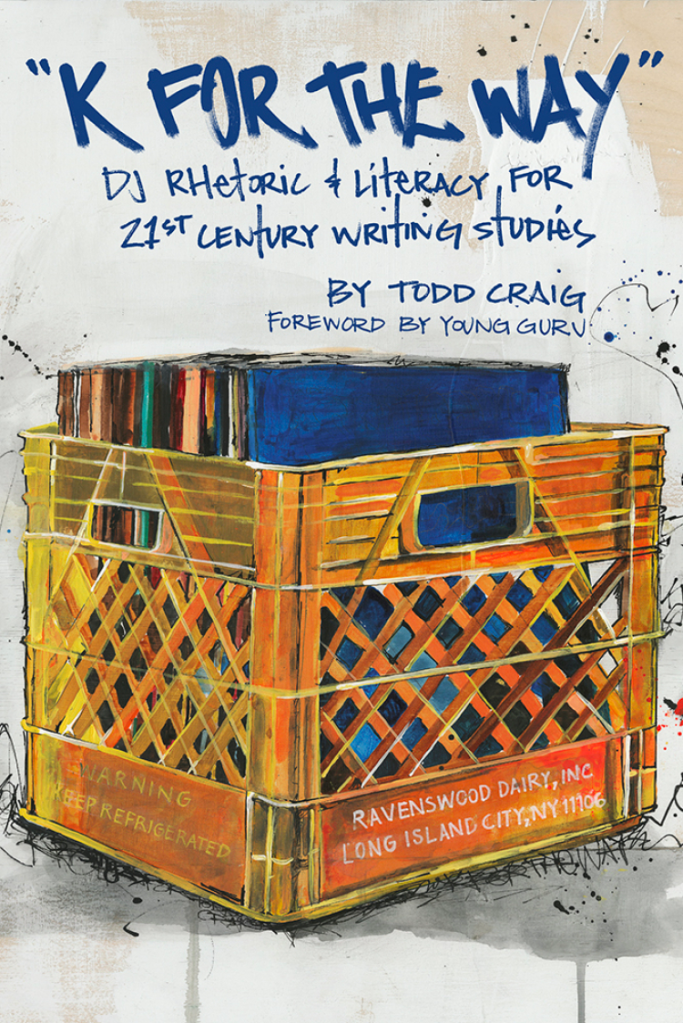
Featured Image: Cover Art for “K for the Way”: DJ Rhetoric and Literacy for 21st Century Writing Studies by Cathey White
—
DeVaughn (Dev) Harris is a PhD student studying composition and rhetoric in NYC. His academic interests are mainly in writing studies and pedagogy, but those are often supported by other sub-interests in music, creative writing, African American studies, and philosophy. When not reading or writing, Dev enjoys making music wherever and however possible. He has published music before under the collective AbstraktFlowz.
—

REWIND! . . .If you liked this post, you may also dig:
“Heavy Airplay, All Day with No Chorus”: Classroom Sonic Consciousness in the Playlist Project—Todd Craig
Deep Listening as Philogynoir: Playlists, Black Girl Idiom, and Love–Shakira Holt
SO! Reads: Steph Ceraso’s Sounding Composition: Multimodal Pedagogies for Embodied Listening--Airek Beauchamp
The Sounds of Anti-Anti-Essentialism: Listening to Black Consciousness in the Classroom- Carter Mathes
Contra La Pared: Reggaetón and Dissonance in Naarm, Melbourne–Lucreccia Quintanilla
Ill Communication: Hip Hop and Sound Studies–Jennifer Stoever
SO! Amplifies: Regina Bradley’s Outkasted Conversations
A Listening Mind: Sound Learning in a Literature Classroom–Nicole Brittingham Furlonge
—
Share this:

“So Jao”: Sound, Death and the Postcolonial Politics of Cinematic Adaptation in Vishal Bhardwaj’s “Haider” (2014)
DOI: https://doi.org/10.59350/cfg6n-vb715
The beginning of this year witnessed a significant reportage on films inspired by the Kashmir conflict in India, occasioned by the release of Vivek Agnihotri’s The Kashmir Files on March 11, 2022. The polarized reaction to the film, which single-mindedly focuses on the exodus of Kashmiri pandits from the valley and the violence they were subjected to at the hands of their Muslim counterparts, makes visible the complexity of the understanding of Kashmir’s political history in contemporary India. While Agnihotri’s film, whose propagandist agenda in favor of the state won approvals from the ruling political party in India, Vishal Bhardwaj’s 2014 film Haider, despite its extremely sensitive and responsible treatment of the problem of militancy in Kashmir was targeted for passing over the plight of Kashmiri pandits. But eight years after its release, Haider, which won five National Awards in 2015, still wields the power to move its audience regardless of their religious and communal bearings through its portrayal of a terrible human tragedy in the wake of Kashmir militancy in the 1990s.
Bharadwaj’s Haider completes his trilogy of cinematic adaptations of Shakespearian tragedies: Macbeth, Othello, and Hamlet translate as Maqbool (2004), Omkara (2006), and Haider (2014) respectively, in their Bollywood avatars. Bhardwaj, in his unique style, imports the original tragic plots into an identifiable and contemporary Indian context, through the assimilation of the plot material with the personal life stories he tells in his films. The plot of Haider centers around the disappearance and death of Haider’s father, which exposes the dark menagerie of political corruption and murders that Haider’s uncle is embroiled in. The pursuit of this traumatic truth sets the stage for Haider’s alienation from his mother and the motherland.
Integral to Bhardwaj’s style is the use of music in a typical Bollywood blockbuster formula, with song and dance sequences interrupting the linearity of cinematic storytelling. While certain film adaptations of Shakespeare operate simply as vehicles for the transmissions of ideology, Graham Holderness argues in “Radical Potentiality and Institutional Closure” (published in Political Shakespeare: New Essays in Cultural Materialism), others “block, deflect or otherwise work on ideology in order partially to disclose its mechanisms.” Holderness evaluates the possibility of the film form to be a radical medium to challenge dominant ideologies or value systems. Analyzing Akira Kurosawa’s film adaptation of Macbeth—Throne of Blood (1957)–he argues in favor of the film’s dynamism to be able to liberate the original text.
Holderness’ reading of Kurosawa raises important questions for the postcolonial film importing from the English literary canon to speak uniquely to a postcolonial audience. In Bhardwaj’s undertaking, this import is singularly anchored and strengthened in a powerful musical idiom. Instead of containing the meanings of the original text, Bhardwaj’s Haider expands and pluralizes the levels of signification that Hamlet produces. By making the stock Hamlet plot be the medium for staging the tragic history of Kashmir, Bhardwaj’s film is a direct address, on one level, to the former imperial master discourse. On a more immediate and radical level, the film hits back very strategically at the Indian state and the numerous killings that have been sanctioned in the name of controlling terrorism in the recent past. In this capacity, the film liberates the textual Hamlet, making its echoes reverberate in a new sound and a new linguistic register.
Through a strategic integration of dance and music–both diegetic (within the frame of the film) and non-diegetic (for the audience’s listening only)– Bhardwaj’s film not only succeeds in delivering its radical political message to a popular film audience, it also speaks back to the former imperial discourse. Non-musical sounds are also key to Haider (2014) as a careful sonic anchoring of the story. The abstract potential of musical and non-musical sounds open up new horizons of meaning in the film, exceeding the confines of the original verbal register of the literary text. The loud, blaring and constant sound of the army car’s horn, for example, signals the death of Hilal in the beginning scenes of the film triggering the tragic plot. The unsettling tones of despair, melancholia and death which open the film remain a haunting and pervasive presence throughout.
“Jhelum” the song that sings the lament of Hilal’s tragic loss, invokes the river that passes through the valley. The song describes the elemental quality of the river into whose womb-like depths Hilal’s body receded till it was posthumously discovered by villagers. The fading melancholic melody of the song seems to suggest the slow disintegration of Haider’s sanity, as he is seen staring into blankness in several shots as well as attempting to merge with the river in an act of suicide. The opening sounds evoke a song that comes later in the narrative, “Bismil,” that stands in place of the play within a play sequence in Hamlet and expands the affective reach of the themes of death, love and betrayal.
One of the most intriguing moments in the film is the musical rendition of the gravedigger scene, an archetypal commentary on human mortality in Shakespeare’s Hamlet. Performed by three old men in a snow-covered graveyard in conspicuously tired voices, the song “So Jao” (“Sleep!”) has a deceptively bare and sparse quality. The song opens with the rough, scratching of the gravedigger’s shovel scraping the cold hard ground, a sound that becomes the acoustic base for the bizarre lullaby-like deathsong. The choppy, staccato-like rhythmic impact of the metal on the resistant icy ground announcing “the final rest” is executed with a disturbing sonic clarity and certitude. This gritty foreground sound is supported by the reverberating sound of the rubab that transports the tune from an immediate closed verse recitation into an expanded musical interlude, as the vocals echo “Arey ao na…!” (O come…!) stretching the last syllable into a dying, falling note. “So Jao“‘s loaded simplicity dispassionately delivers this bare truth: that all life is inevitably moving towards its end, or as Freud says in Beyond the Pleasure Principle (1922) towards its inanimate origin.
While the men who perform “So Jao” are past their prime in life, they are far from being incidental characters in the film as they are in Shakespeare. They are woven into the narrative as militants who protect Haider and do not hesitate to wield heavy duty weapons when the time comes. It comes as no surprise that they are digging their own graves, even as the seriousness and fear of death are subsumed in the larger political cause they serve in the plot. The sound of the shovel overlaps with Gazala’s first phone call to Roohdaar, the embodied ghost who brings Hamlet’s father’s message to the son (the Urdu word rooh literally translates as soul or spirit), signifying an ominous anticipation in the narrative at this point. The grave, as the song says, is ultimately where you sleep your longest sleep. The scene is one of the three men lying supine each in his own hole, with one in the center housing the little boy who enters the frame perkily dancing into the gray and barren scene. His sprint-like entry walk carrying bread and sustenance for the gravediggers, the well-choreographed lifting of his body to the beat of the song heightened just very slightly by the clinking bell sound once every four beats is an unsettling reminder of the happy ignorance that we immerse ourselves in being simultaneously aware and oblivious of the inevitable imminent end. These stark juxtapositions in the gravedigger’s song works as a telling sonic metaphor for the state of hopelessness, confusion and despair that has historically assailed Kashmir for many, many decades. The song is also a commentary on the futility of violence instigated in the name of religion, when man must ultimately surrender to one common fate, one common remainder.

Haider’s presence in the graveyard song introduces the inevitable vectors of vengeance and death that awaits his fate following the knowledge of the truth of his father’s institutional murder. The further breakdown of his psyche and the increasing dissociation from his world is dramatized brilliantly in the song “Bismil” that publicly calls out Khurram on his crime (1.44.59). The song marries the allegorical with folk costumes, and incorporates exaggerated and physically intense dance steps to impose the serious weight and inescapable gravity of the accusation of murder that Haider ascribes to Khurram. The song and dance sequence are staged as a public performance, one that happens a few scenes before in the film too, when Haider is seen surrounded by a crowd in a new avatar with shaved head and grown beard (1.25.53). This distinct change in appearance along with the masques he uses later in Ghazala’s wedding (1.40.51) and the “Bismil” song are markers of Haider’s increasing dissociation from his absurd reality—one that he can only make sense of as a character in a play. Khurram’s crimes are not separate from the questionable workings of the Indian state, and Bhardwaj does a good job tapping into the folk idiom and the song-and-dance format to critique what Haider calls the state’s “chutzpah” (pronounced tʃəʊzpə, not ˈho͝otspə), the infamous Armed Forces Special Powers Act (AFSPA). The alteration of the first syllable is possibly to bring in an echo of a popular north Indian abuse word to take a jab at the impunity enjoyed by state officials for the crimes committed on the Kashmiri people.
Haider remains a brave directorial undertaking not only aesthetically but also politically, given that the issue of Kashmir’s independence (azadi) is still a burning issue in India 27 years since 1995, the year in which Haider is set, and 8 years since the film’s release. Bharadwaj’s self-composed music in the film is not simply a placeholder for the dazzling verbal exchanges of Shakespeare’s Hamlet. The music in Haider magnifies and intensifies the local mood of the scenes where they feature. This function is not only limited to the background soundtrack which, in its haunting atmospheric quality, renders a hollow despair and anguished hopelessness throughout. The songs additionally step in to carry the expression beyond the register of words and visuals to render a poetic and sonic intensity to the film, making it more memorable and impactful to a wider audience. In Haider, the formula of the Bollywood blockbuster film is effective not only as good entertainment, but also as a means to tie the story together in a haunting soundscape which refuses to fade long after the film ends.
Featured image: screen capture from Haider created by SO!
—
Abhipsa Chakraborty is a PhD candidate in the English Department at SUNY Buffalo. She holds a BA, MA and MPhil from the Department of English, University of Delhi, and has worked as an Assistant Professor (Ad-hoc) at University of Delhi. Her research interests include Modernism, Sound Studies, Digital Humanities, and South Asian cultures. She is a trained vocalist in Hindustani Classical Music and hopes to integrate her musical knowledge with her academic research on aurality and narrative styles in 20th-century novels.
—

REWIND! . . .If you liked this post, you may also dig:
“Gendered Soundscapes of India, an Introduction“–Monika Mehta and Praseeda Gopinath
“Out of Sync: Gendered Location Sound Work in Bollywood“—Priya Jaikumar
Sonic Connections: Listening for Indigenous Landscapes in Kent Mackenzie’s The Exiles–Laura Sachiko Fugikawa
—
Share this:




Current Top Posts




April 2021
January 2020

November 2019

October 2019

August 2019

April 2014

November 2017

March 2015
December 2017

October 2015


Recent Comments