
The Noises of Finance
DOI: https://doi.org/10.59350/5v3ds-zzw51
What does finance sound like? Is it the clanging of the opening and closing bells at the New York Stock Exchange? The shouting of offers to buy or sell? The beeps made by cash registers as a credit card is swiped? The whirring of fans working overtime to cool computers? What is this noise?
Noise, however, is not purely a sonic phenomenon. Since the late 1940s, noise has been intimately linked with theories of communication and information, as Aaron Trammell discusses in Sounding Out! posts such as “What Mixtapes Can Teach Us About Noise.” My research attempts to bring these two aspects of noise—the sonic and informatic—into conversation. I trace the interferences noise makes within a set of disparate disciplines: I listen to the history of the impact of information theory on experimental and electronic music; investigate the interferences of “fearless speech,” artistic robotics, and the public; and examine how noises digital and sonic have impacted the development of finance. Rather than creating my own definition of noise, I follow how other disciplines deal with their encounters with noise as both a material phenomenon—something that interferes with a signal, or a sound that is deemed unwanted—and as something to be theorized, asking questions such as what are the meanings of these noises? or should we be controlling noise at all?
In this post, I discuss three vignettes that outline the different ways in which noise (sonic and informatic) interferes with different aspects of finance: the shouts of open-outcry pits and the information they may or may not convey; new forms of electronic trading and the noises of server farms and trading behavior; and the Flash Crash of May 6th, 2010 that provoked noises from both traders and artists. Each reflects a particular conjunction of the sonic and informatic aspects of noise. When we attend to both components simultaneously, we discover that financial noises are complex entities that are not inherently revolutionary nor regressive, but are rather an elusive combination of both.
Noisy Trading: The Pits
My interest in the noises of finance comes in part from listening to open-outcry trading, following the work of Caitlin Zaloom’s Out of the Pits: Traders And Technology from Chicago to London and the documentary Floored (2008). An open-outcry pit, such as that found on the floor of the Chicago Board of Trade (CBOT), pairs buyers and sellers through a bodily practice of trading involving the extremities of behavior. Shouting, pushing, and shoving occur on the steps of the pit as buyers and sellers work to match their orders through nearly whatever means necessary.
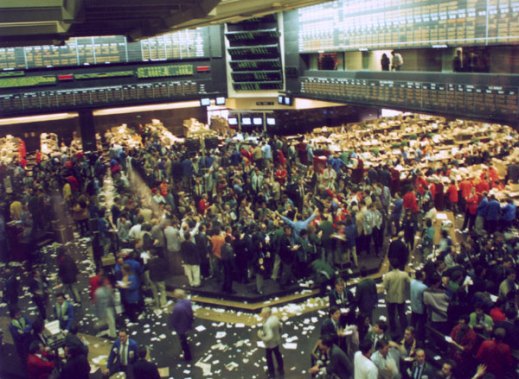
In the wonderfully titled article “Is Sound Just Noise?”, the business school professors Joshua Coval and Tyler Shumway ask, in one of the few academic articles related to the sounds of the pits, whether or not the shouting might convey information that is not necessarily available on the computer screens that were then coming to dominate trading:
we ask whether there exists information that is regularly communicated across an open outcry pit but cannot be easily transmitted over a computer network. Any signals that convey information regarding the emotion of market participants—fear, excitement, uncertainty, eagerness, and so forth—are likely to be difficult to transmit across an electronic network (1890).
Coval and Shumway found that the ambient sound level of the pits did have predictive impact regarding various aspects of the market: in short, the louder the pits got, the higher the volatility in the prices of securities and the decrease in the likelihood of conducting a trade.
Noisy Trading, Redux: Datacenters
Yet changes in the structure of the market have not only shifted the location of activity to people behind computer screens and away from these types of sounds, it has also shifted the actual location of the exchanges themselves. No longer do most trades take place in the physical location of, for example, the NYSE; rather, they take place in buildings like this one, at 1700 MacArthur Boulevard in Mahwah, NJ.
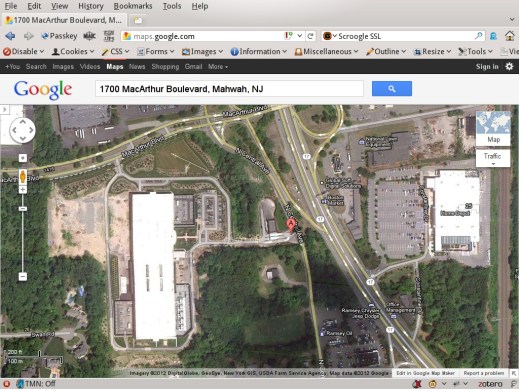
This is the location of the NYSE’s new datacenter, a 400,000 square foot facility. (In the linked video, note the whirring of the fans, a new noise of finance beyond that of the pits.) The servers in these datacenters—run by highly-capitalized financial firms large and small alike—are able to respond much quicker to market information the closer they are to the computers that run the exchange. And what can be closer than being co-located in the same datacenter as the exchange? This need for speed has lead to all sorts of interesting situations, such as new fibre-optic lines being laid to shave off a millisecond or two in travel between New Jersey and Chicago, or the taking into account of special relativity effects in the location of future datacenters. The new High-Frequency Trading (HFT) algorithms run on these servers in these datacenters.
Noisy Trades, Sonified: May 6th 2010
The voice on this recording, made on May 6th, 2010, belongs to Ben Lichenstein, an employee of a firm called Trader’s Audio. Now, Trader’s Audio provides live coverage of market movements from a person on the floor of an exchange in order for day traders and others to get an idea of the “sentiment” of a market. It’s kind of like a play-by-play of market activity, a running commentary of major market movements that can’t be discerned soley by the watching of numbers on a screen. What, then, could have been going on for Ben Lichenstein to be in such a frenzy, for his voice to be inflected in such a way? What are we to make of this noise?
Well, May 6th, 2010 was the day of what has infamously become known as the Flash Crash. The full details of this day are beyond the scope of this post, so I will outline it schematically, following the findings of the official US report produced by the Commodity Futures Trading Commission (CFTC) and the Securities and Exchange Commission (SEC). (For a different take on this, see the sociologist of finance Donald MacKenzie’s “How to Make Money in Microseconds”.) In short, between the hours of 2 and 3PM Eastern Time the New York Stock Exchange (NYSE) had both its largest single day loss as well as its largest single day gain, a swing of over 600 points. A series of trades made by algorithms that failed to take into account their impact on the market caused the prices of securities to swing to extremes, excerbated by the activity of High-Frequency Trading (HFT) algorithms. While the market eventually recovered—in part due to the activity of the same algorithms that caused the problem in the first place—the event indicated the precariousness of the stock market, the potential for things to spiral quickly out of control, and the difficulty in forecasting the behavior of an ecosystem of opaque algorithms.
How do the HFT algorithms relate to the Flash Crash that took place on May 6th, 2010? While the report of the CFTC and the SEC regarding the Flash Crash does not lay blame on HFT in particular, it did indicate how these algorithms contributed to the large price swings, the immense number of shares traded, and the drying up of liquidity (that is, the ability to find buyers and sellers in the market). One of the reasons why the market swings were so severe on May 6th, 2010 was due to the fact that HFT algorithms react immediately to small fluctuations of price, a quality of markets that financial economists call microstructure noise, a fascinating topic that is unfortunately beyond the scope of this particular post. In general, HFT and these datacenters go hand-in-hand, as it is a truism that it will take longer for data to travel between a machine in New Jersey and one in Chicago, than it will to travel between two machines in the same data center in New Jersey. HFT works to take advantage of this shorter latency in order to exploit market movements on the timescale of milliseconds, accelerating trading far beyond the open-outcry pit.
Noisy Finance: The Sonic and the Informatic
.
Let’s conclude with a sonic artifact of the Flash Crash from the French collective rybn. Their work has explored the concept of “antidatamining,” that is, the use of the “data mining” techniques of computational capitalism in order to shed light on the intersection of data and society. Consider their piece FLASHCRASH SONIFICATION (one of the few artistic responses to the Flash Crash), where rybn took trading data from nine different exchanges on the afternoon of the Flash Crash and created an austere, digitally-sharp yet undulating soundscape that recalls the work of artists Ryoji Ikeda or Carsten Nicolai without the rhythmic precision. If you can, listen to their online-available, two-channel mix on headphones in order to appreciate the details of the piece.
The building towards the end of “FLASHCRASH SONIFICATION” was meant to “emphasize the moment of the crash, [by] adding an effect of resonance, which propagates slowly, making it more tense, as the krach goes on” (all quotes in this paragraph from author’s personal interview with rybn). Thus instead of merely transparently translating the data into sound, rybn constructed the sonification in order to bring out this resonance: “resonance is pointed [to] as one of the major risk[s] of HFT by many economists and the feedback phenomenon was in the center of our discussions when we were preparing the piece.” Isolating the Flash Crash was important for rybn as it was perhaps the “moment when people started to understand financ[ial] orientations more clearly” thereby highlighting the symptomatic nature of the “speculative short-term loop finance seems to be stuck in.”
In FLASHCRASH SONIFICATION, sonic noise becomes a translation of the data from the market—abstract yet eminently material—into a different abstract form that does not immediately signify. FLASHCRASH SONIFICATION suggests rather than indicates; listening to it cannot provide us with rational information regarding the dynamics of the Flash Crash. Instead it produces a dark foreboding of the mechanisms at work, the high-frequency pulses first recalling heartbeats that soon speed up beyond any ability for distinction. In FLASHCRASH SONIFICATION, rybn comments on the inability for computation—and by extension, the market—to be the perfectly rational, ordered space it is ideally understood to be.
In Noise We Cannot Trust
If there is one thing clear about the examples of noises heard and encountered in this post—the shouting in the pits, the fluctuations of prices, the whirring of air conditioning, the sonification of the Flash Crash—it is that noise cannot be counted upon for positive or negative disruption. Noise cannot be counted upon as a political exploit in the market, as it can signify the potential of a trade, or be recuperated into profit through the activity of HFT algorithms. Yet noise can also provide an alternative experience of the Flash Crash beyond that of bureaucratic reports and figures. It is thus through the interferences noise causes within the dynamics of finance that we come into contact with the equivocality of noise as a phenomenon, and thus become attuned to a particular need to not confine noise to preconceived notions of positivity or negativity.
—
Adriana Knouf (she/her/hers, sie/hir/hirs) is an Assistant Professor of Art + Design in the College of Arts, Media, and Design at Northeastern University. She is a media artist and scholar researching noise, interferences, boundaries, and limits in media technologies and communication.
Her current research project, tentatively entitled The Xenology Notebooks, is a transmedia, transdisciplinary corpus expansively considering the “xeno”. Her first book, How Noise Matters to Finance (University of Minnesota Press, 2016), traced how the concept of “noise” in the sonic and informatic domains of finance mutated throughout the late 20th century into the 21st.
Her current artistic research explores queer and trans futurities on earth and in the cosmos. Projects include Enredos Sónicos/Sonic Plots, a collaborative sonic exchange between the US and Cuba; they transmitted continuously / but our times rarely aligned / and their signals dissipated in the æther (2018-present), a 20 channel sound art installation with speakers made from handmade abaca paper and piezo electric elements, with sounds collected by custom antennas from satellite transmissions; and PIECES FOR PERFORMER(S) AND EXTRATERRESTRIAL ENTITIES (2017-present), event scores laser etched into handmade translucent abaca paper.
—

REWIND! . . .If you liked this post, you may also dig:
Experiments in Agent-based Sonic Composition–Andreas Pape
Listening to Disaster: Our Relationship to Sound in Danger–Maile Colbert
SO! Reads: Jonathan Sterne’s MP3: The Meaning of a Format–Aaron Trammell
—
Share this:

Radical Listening and the People’s Microphony: A Conversation with Elana Mann
Listen to everything all the time and remind yourself when you are not listening–Pauline Oliveros
DOI: https://doi.org/10.59350/qs23g-16v34
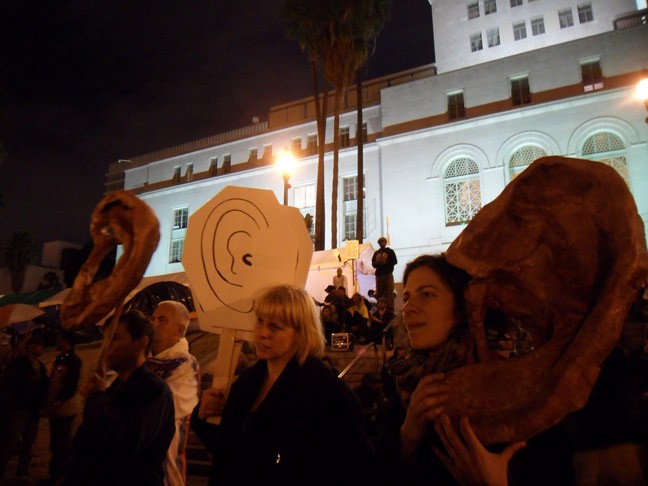
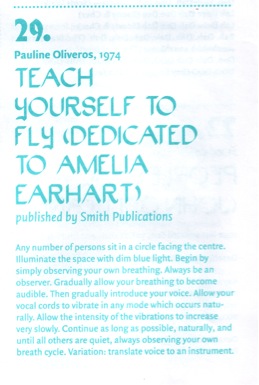
“CAN YOU HEAR ME?!” “I CAN HEAR YOU!!” “IT’S A VAN GOGH PARADE!!” . . .were some of the enthusiastic replies when artist Elana Mann, musician Juliana Snapper, and other members of ARLA (Audile Receptives Los Angeles) arrived on the scene at Occupy LA with giant hand-made ears. Mann co-founded ARLA in the Spring of 2011 with Snapper, filmmaker Vera Brunner-Sung, and choreographer Kristen Smiarowski. After studying scores and techniques on listening developed by composer Pauline Oliveros, ARLA developed a workshop geared toward Occupy LA that included a listening parade in which they held up the giant ears and protest signs with ears on them. Snapper recalls, “The simple physical presence of people carrying large paper-mache ears was met with a kind of hungry recognition…recognition of what it meant that we were holding the symbols (giant ears).” They led workshops, listening sessions, and discussion groups. They performed Oliveros’ sonic meditation “Teach Yourself to Fly” and a composition written by Mann and Snapper entitled “People’s Microphony.” And a project was born. Through personal interviews and audio-visual examples, I document, contextualize, and analyze its work.
Mp3=The People’s Microphony Camerata performing “Teach Yourself to Fly” Pauline Oliveros
I am happy that Elana Mann chose to use my Sonic Meditations for the People’s Microphony project. These pieces are meant for anyone that wants to perform them regardless of musical training.” –Pauline Oliveros
For Mann, active listening is “a process of tuning in simultaneously inward and outward. Active listening allows for an awareness of and an opening up to sounds around me and also a digestion of what is happening inside of me in relation to these sounds.” Much of the recent focus on this practice comes from the music and sound art worlds, as well as acoustic ecology, a field formed from the overlapping area between science and art that concentrates on the importance of experiencing and investigating our sonic surroundings with detailed care and respect to understand its importance on our world and our place within it. Mann’s work addresses a unique angle at the intersection of these fields: listening’s empathetic effect on those whom you are listening to, a consideration arising from a project she worked on between 2007-2010 with Iraq war veteran Captain Dylan Alexander Mack, called “Can’t Afford the Freeway.”
. “Can’t Afford the Freeway” highlights how her collaborations emerge as conversations between involved artists as well as the audience. Speaking to Mann about the project, she stated,Alex created some recordings for me and I kept listening to them over and over again trying to figure them out. I eventually produced more interviews with him and realized that he needed his story to be heard and I needed to try and understand his story. So I created a project in which I attempted to listen as best I could. Listening to his recordings made me feel close to him, but I also recognized that no matter how many times I heard his words they were still foreign to me. Still the very act of me struggling to listen was important for both of us, and I think this is true of many interpersonal/political and social situations. You can never experience what it is like to be someone else, but active listening opens up a space of empathy and connection. I also think we can see how a lack of active listening is affecting the political landscape in the United States so negatively, by producing a highly polarized and vitriolic environment.
And what about at Occupy LA?
At Occupy LA I was hopeful that there would be a place for listening to voices that had not been heard before and sometimes that happened. Other times people used the space for projecting, not receiving. I think that there needs to be strong voices making themselves heard, but I don’t want to lose the other part of that equation, which is those voices being quiet and listening to others, and themselves.
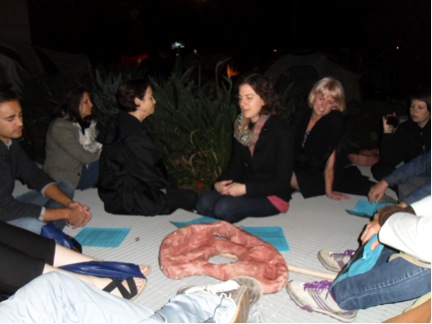
Mann, thinking and researching about social, aesthetic, and political points of listening and voicing, felt there was something to be considered about the “radical receptivity and the core message of the OWS movement” and its global amplification of voices struggling to be heard. In the Spring of 2012, she formed The People’s Microphony Camerata with Snapper, a radical experimental choir based in Los Angeles exploring the process of the People’s Microphone. The exact history of the “People’s Microphone,” or “People’s Mic” is unclear, but its use in the Occupy Movement has already become iconic. Ted Sammons discusses the implications of the People’s Mic for communication in his October 2011 post, “‘I didn’t say look; I said listen’: The People’s Microphone, #OWS, and Beyond.” The human microphone is a way to deliver one person’s message to a large group of people in situations where amplification tools, such as bullhorns, are either not allowed or unavailable, or if the acoustics of a space distort amplification. The speaker calls, “mic check!” to alert their intentions. Those around them call back, “mic check!”, until the gathering understands something will be said. The speaker breaks their statement into short sentences, pausing to allow those around them, or the “first wave,” to repeat them in unison. They then pause for those further away, or the “second wave,” to repeat again…and so on until those in the back of the gathering have heard the statement.
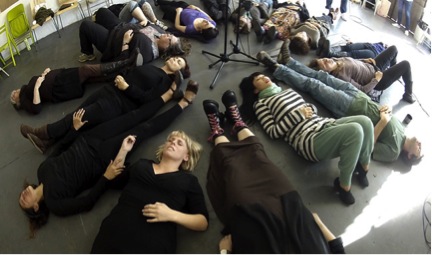
The group’s trademark intensity sometimes carried over to the audience. Mann discovered such transference often had to do with prior associations with a location or context. Mann recalled a particular performance at the Occupy movement called “Chalkupy” that was formed in response to a protest running simultaneously with the LA Art Walk, in which activists had handed out chalk and told stories of police repression while chalk drawings were created on the walkways. The police shut down the art walk and a violent struggle ensued. The Occupy LA movement called for people globally to take to the street with chalk in protest, and the day was called “Chalkupy”. The audience of protestors was mixed and tense, and when the PMC began their performance of a highly emotive score called “Sob-Laugh” by Daniel Goode, people were either drawn to or repelled by the performance.
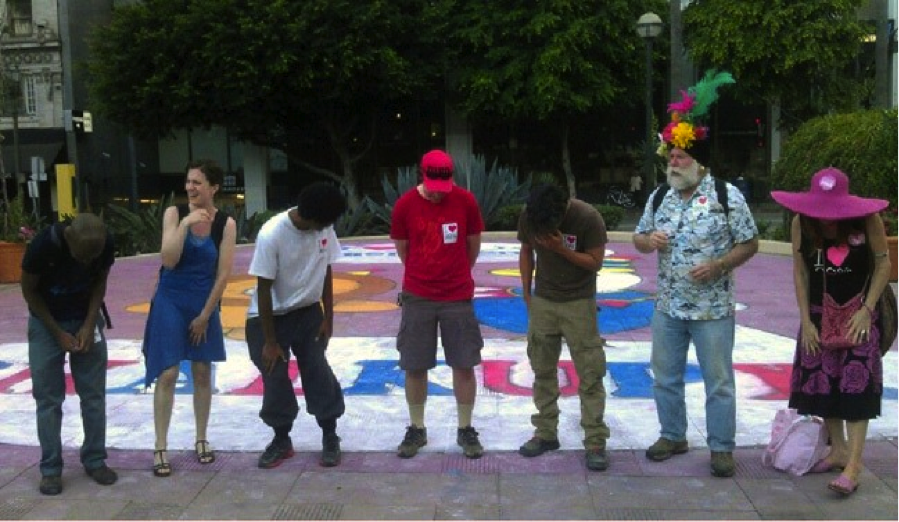
I think there was some fear about the vulnerable revelation of emotions in the space of the protest. Many of the Occupy LA protests were so risky that everyone had to be extremely tough to exist in that activist space. I respect that. Still I think there are other things that can happen in a space of protest that bring out different feelings. Some activists wanted us to be more musically conventional, “why can’t you just sing some folk songs like normal protest choirs,” we were asked. But we really were not into that kind of thing. . .
In most protest situations, the audiences welcomed their activities. Many shared that it opened up a new space where people could meet each other as humans rather than adversaries or collaborators. Mann edited and published a monochromatic grassroots songbook with the various scores the PMC received for performance, opening up the circle for anyone and everyone to perform and feel that closeness.
Sometimes it was hard to translate a piece that worked during a group rehearsal to something for an audienceperformer situation. . .The PMC never fully developed how to deal with audience participation, but this is something I have been developing on my own in working with students on PMC materials. The scores from the People’s Microphony Songbook and the techniques Juliana and I developed when we first formed the PMC create an immediate closeness within a group, which is remarkable.
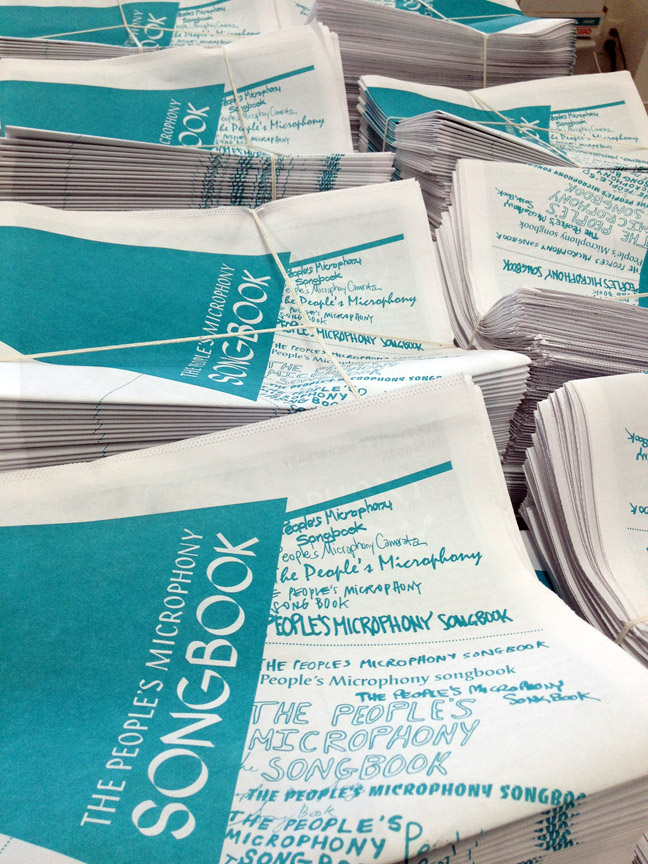
From the “People’s Microphony Songbook”: Many voices that were once silenced are now resonating through large crowds, not only of activists, but ordinary people all over the world, assisted by internet networks, and a simple technology called the People’s Microphone. The People’s Mic expressed the interrelated desires of collective and individual voices to speak and be heard, to hear one’s words spoken back through different mouths, and to digest someone else’s words through one’s own body. Beyond projecting an individual’s voice further then it can resonate on its own, the People’s Mic has implications for all of the bodies in its vicinity. It energizes listeners in ways the microphone or megaphone cannot by making listening active, vocal, and embodied. The project, like the Occupy movement, holds all the complexity, beauty, and drive of being human, whether you consider it “working” or not. When I asked Mann about how changes within and towards the Occupy Movement affected the choir, and whether they were winding down or taking a new form, she answered:
I think more than anything else, our group faced a lot of the same challenges that the Occupy Movement faced challenges in horizontality, in the push and pull between interior and exterior exploration, in the sometimes painful vulnerability of investigating the intimate personal and political space with others. I think the project is still developing. The choir still communicates, and some members are currently collaborating with composer Daniel Corral, but the PMC does not meet and rehearse like we used to I think it will continue to wax and wane. In the meantime, I am still working on ideas of active listening. I am currently creating a project called “Listening as (a) movement” within an under-served neighborhood in Pasadena, CA, exploring ideas of radical listening within a specific neighborhood.
In an age of constant bombardment of stimuli, our heads scream with thoughts, opinions, arguments, and expressions. With our current technology, our input and output can be a constant rush of snap reactions and impulses, which has a profound effect, of course, on our day-to-day lives, on our culture(s), on our politics. But these circles cannot be affectively complete without the other side. We need someone to hear us, and, more then that, we need someone to listen to us. And we, in turn, need to listen to them.
—
Maile Colbert is a multi-media artist with a concentration on sound and video who relocated from Los Angeles, US to Lisbon, Portugal. She is a regular writer for Sounding Out!
—
REWIND! . . .If you liked this post, you may also dig:
“Sensing Voice”–Nina Sun Eidsheim
“Within a Grain of Sand: Our Sonic Environment and Some of Its Shapers”–Maile Colbert
“Listening to #Occupy in the Classroom”–Travers Scott
—
Share this:




Current Top Posts





April 2021

January 2020

November 2019

October 2019

August 2019

April 2014

November 2017

March 2015

December 2017

October 2015


Recent Comments