
Sonic Connections: Listening for Indigenous Landscapes in Kent Mackenzie’s The Exiles

DOI: https://doi.org/10.59350/dxhjn-03j69
In April 2015, ten American Indian extras walked off the set of Adam Sandler’s new film The Ridiculous Six, a spoof on the classic Magnificent Seven (1960), in protest over the gross misrepresentation of Native cultures in general, and in particular over its insults to women and elders. Allison Young, a Navajo actress who participated in walking off, stated, “Nothing has changed. We are still just Hollywood Indians.” Young is referencing a long history of the film industries’ construction of stereotypical American Indians by non-natives created to entertain non-natives.
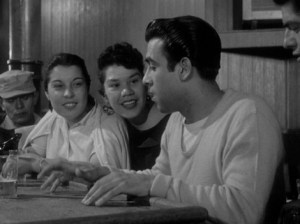
Within this long history exists a rare film, Kent Mackenzie’s 1961 The Exiles, re-restored and re-released in 2008 by Milestone Films. The Exiles is one of the few 20th century films that feature urban American Indians; it follows three main Native narrators from dusk to dawn as they experience the joys and struggles of urban life. Without an official score, this black and white docudrama places sound against haunting 35 millimeter black-and-white images of a downtown Los Angeles landscape. This mis-en-scène creates what Mackenzie (the white screenwriter, director and producer) asserts is “the authentic account of 12 hours.” The voiceovers of Homer Nish, a Hualipai from Valentine, Arizona who recently moved to Los Angeles after fighting in the Korean War; Yvonne Walker, originally from the White River Apache reservation in San Carlos, Arizona who first moved to the city to work as a domestic; and Tommy Reynolds, who is identified only as Mexican-Indian and is portrayed as a comedic playboy and the life of the party; narrate the intimate, day-to-day lives of urban American Indians.
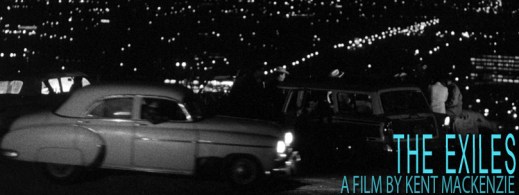
In this post, I consider what we can hear if we pay close attention to how the director incorporates the narrators in a kind of Indigenous soundscape. Mackenzie’s soundscape bring together voices as well as music. The collage of sounds traces the journeys of American Indians to and from Los Angeles in the mid-twentieth century. The sonic connections in The Exiles provide a cacophony of histories of forced movement, transit, and re-making spaces as Indigenous at the same time that it perpetuates important historical silences. I borrow Chickasaw scholar Jodi A. Byrd’s term from The Transit of Empire: Indigenous Critiques of Colonialism (2011), cacophony—or “discordant and competing representations” and experiences— and apply it to the sounds that inform the indigenous space represented through the film.

The narrators are part of a large population of American Indians who moved from rural reservations to urban centers after WWII. Due to the federal government’s mismanagement of Native tribes’ land and resources, and the genocidal abandonment of treaties made with tribes, the late 1950s and 1960s were times of dire economic and social conditions on reservations. The influx of Native Americans to cities also came because of assimilation campaigns in boarding schools, military service and the Bureau of Indian Affairs’ “Termination Era” policies (1940s –1960s) that intended to terminate the state’s bureaucratic relationships with Native tribes. Relocating Native populations from reservations into cities where work was available year-round was a key aspect of the Termination Era policies. According to Norman Klein (The History of Forgetting: Los Angeles and the Erasure of Memory), areas near downtown Los Angeles, including Bunker Hill where the film is primarily shot, were multi-racial neighborhoods in economic decline and therefore became relocation sites for American Indians. Importantly, both Klein and Mackenzie are silent about the prior forced removal of Tongva on that very same location that began in the 1840s.
The audio track of The Exiles contradicts the stereotypical American Indian sounds featured in Hollywood movies. The film’s contemporary mainstream Hollywood releases included sounds such as the whooping sounds of “hostile Indians” in John Ford’s The Searchers (1956), the broken English spoken by the “Apache” in Delmer Daves’ Broken Arrow (1950), and stereotypes played out in John Sturges’ Magnificent Seven (1960). In the soft Southwestern Native lilt of Yvonne’s voice, the way that Homer and others add “you know?” to the end of almost every sentence they utter, alongside the rhythm of the casual banter and tenor of the men’s laughter, I hear a potential sonic archive of American Indians that talks back. For example, in a short clip when Tommy and his friends enter Café Ritz, an Indian bar, Thomas calls out over the loud rock and roll music as he passes people at the bar. Tommy shifts easily between English (“What’s happening there, man?”), Spanish (“Gracias amigo, ¿cómo estas?”), and Dine (“Yá’át’ééh. E la na tte?”). Careful attention to the cinematic soundscape provides access to voices of discontent and resiliency, practices of building and maintaining multilingual multi-tribal Indian spaces, and the flow of American Indians between reservations and multiple cities.
Understanding the sounds and the silences of The Exiles as a cacophony offers a way to appreciate how the film both perpetuates stereotypes but also provides insights into the urban American Indian experience. Mackenzie’s construction of Homer Nish and American Indian men continues a myth that it is individualized behavior that keeps Indians from the American Dream. (In his 1964 masters thesis, “A Description and Examination of the Production of The Exiles: A Film of the Actual Lives of a Group of Young American Indians” Mackenzie states outright that he believes they are responsible for the mess they created). The Exiles portrays American Indian men reading comic books, listening to rock and roll, hanging out at bars instead of working, and taking rent money away from their suffering women and children to gamble. These formulaic images of Native Americans are informed by a long history of visual, literary and legal representations of American Indians that compose Indian men as either savage, infantile and emasculated. But if we listen to the banter and laughter in the bar scenes and at home, we also hear the caring intimacy of camaradrie. The cacophony of sound provides a counterbalance to the visual representations.
The Voiceover and Realism
Mackenzie uses dialogue to direct the visual and sonic narrative of the docudrama’s soundscape. Ironically, this collaborative low budget project that stretched on for three and a half years has minimal original dialogue. They could not afford sound techs on site, so the most obvious sonic evocation of realism Mackenzie explores is asynchronous sound performed in a studio months later. In Mackenzie’s master’s thesis he writes that, to construct dialogues (they often voiced their lines with a group of people around), “people would joke around a lot” while “everybody was drinking beer” (76). The filmmaker did not find that dialogue on larger budget feature films at the time were “lifelike” and believable. He writes that people
seldom spoke of important matters directly; they seldom spoke clearly or coherently when they did speak and their everyday language was full of overlaps interruption and communications through looks, gestures and shrugs. Many sentences made the end understood. …What a person said seemed less important than how he said it. (73)
Here, it becomes clear that the “realism” Mackenzie pursues is more about a style of filmmaking rather than about an authentic rendering of Native American everyday life. If he found the actors performing lines too dramatically Mackenzie states he “would blow the scene apart by asking for more casual and apparently pointless lines” (73). He created a specially mediated recording of the people, downtown Los Angeles and the time period. In other words, he pursued realism: he did not seek to fully capture real experiences.

Through interviews he guides the actors to talk about their everyday lives, their problems and their thoughts about life. Mackenzie used “improvised tracks” out of individual interviews in an attempt “to help preserve their point of view in the film.” He interviewed Homer, Tommy and Yvonne for several hours apiece, questioning and re-questioning them – not necessarily to document the subjects’ truths but “for emotional quality and general attitudes and feelings” (78). Despite his intentions, the voiceovers provide some context of the trials of everyday life and how the leads negotiated their belonging in a space far from home. Mackenzie’s realism builds a collage of soundscapes—voiceovers, background noise, music—to orchestrate a scene rather than simply document part of a 12-hour period of life.
Rock and Roll and Urban Indian Sounds
Mainstream “Hollywood Indians” are associated with a limited soundscape of drums and whoops, but Mackenzie’s use of contemporary rock and roll illustrates the complexity of the indigenous soundscape. Even though the film opens with the slow repetitive beating of the buckskin drums and a contextual opening monologue, after the drums stop it is the early surf music of Anthony Hilder and his five-piece band, The Revels, that drive many of the scenes. The music renders audible the many ways people tried to belong in new locations and within new cultures, juxtaposing the fast blast of the trumpet and guitar riffs of the Revels with the steady beat of the drum and shake of a turtle rattle.
Mackenzie continues this juxtaposition later in the film. Homer, alone on the street in front of a liquor store, opens a letter a bartender handed to him earlier in the evening. At the top of the letter is written “Peach Springs, Arizona” and tucked within the letter is a picture of an older man and woman. The camera focuses on the picture that dissolves and reemerges as a rural desert scene. The man from the picture sits beneath a tree with a girl and the woman, and rhythmically chants and shakes a rattle. There is no voice-over or dialogue; ceremonial singer Jacinto Valenzuela’s repeats a song multiple times without an English translation. The steady rattle of the dry seeds in the gourd are a sharp contrast to the pace of the Revels’ songs that saturates Homer’s earlier scenes.
Without guidance from a narrator, the scene is left to audience interpretation. The scene and its sounds could represent Homer’s sense of being displaced between times, or a homesick romanticized remembrance of family life: the moment quickly dissipates and Homer once again stands alone on a corner bathed in the streetlight. However, the music here could be a sonic connection that provides an alternative geography of indigenous space and place. Mackenzie’s collage of sound echoes the circuitous path of indigenous bodies and ideas of indigenous life in diasporas described in Winnebago Tribe of Nebraska scholar Renya Ramirez’s work in Native Hubs: Culture, Community, and Belonging in Silicon Valley and Beyond. The rattle and drum can instead signal a belonging to a community and people in a present that Homer carries within him. Through sound, Mackenzie connects Homer with his communities, traditions, and a sense of belonging regardless of spatial distance.
Mackenzie deepens this connection when he imbeds Homer in a place and community through the dancing and drumming on Hill X in the penultimate scene of the film sounds. When Homer talks about Hill X (formerly Chavez Ravine, then a site of the forced displacement of Mexican residents in Los Angeles in 1950-1952, now the site of Dodger Stadium) we hear his strategy for his own and his tribe’s collective survival. The shaking of the gourd in the desert and the dancing, singing and drumming of the 49 —lead by Mescalero singers Eddie Sunrise Gallerito and his twin cousins Frankie Red Elk and Chris Surefoot—shows a reclaiming of Los Angeles as indigenous land. Thus practices of sound and movement function as what Tonawanda Seneca scholar Mishuanna Goeman identifies as “remapping” of Indian space. Taken together with the beat of the drum, the bells and rock and roll compose the content of a Los Angeles indigenous soundscape.

The Exiles registers contemporary American Indians in motion. Homer and his comrades reclaim Hill X as Indian land with song and dance over a century after the City of Los Angeles displaced the Tongva out of that same location. At the time of the filming, American Indians were also forced to move within Los Angeles- their homes on Bunker Hill soon demolished and replaced by high rises. Paying attention and critically re-listening to the sounds of The Exiles offers an alternative soundscape of Indigenous life.
−
Featured image: “chavez ravine” by Flickr user Paul Narvaez, CC BY-NC 2.0
−
Laura Sachiko Fugikawa holds a doctoral degree in American Studies and Ethnicity with a certificate in Gender Studies from the University of Southern California. Currently she is working on her book, Displacements: The Cultural Politics of Relocation, and teaches Asian American Studies at Northwestern University.
−

REWIND! . . .If you liked this post, you may also dig:
Sounding Out! Podcast #40: Linguicide, Indigenous Community and the Search for Lost Sounds–Marcella Ernst
The “Tribal Drum” of Radio: Gathering Together the Archive of American Indian Radio–Josh Garrett Davis
Vocal Gender and the Gendered Soundscape: At the Intersection of Gender Studies and Sound Studies–Christine Ehrick
—
Share this:

“Cremation of senses in friendly fire”: on sound and biopolitics (via KMFDM & World War Z)

DOI: https://doi.org/10.59350/s21v3-yp322
There’s a 20-year gap in chronology between KMFDM’s 1993 song “A Drug Against War” and Marc Forster’s 2013 film World War Z, but sonically and ideologically they’re very, very similar. They contain the same kinds of sounds–machine guns, military orders barked over radios, buzzing crowds–and they use these sounds in the same way: to build sonic intensity past its breaking point (a “sonic bombardment brighter than sunlight,” as the KFMDM lyrics say). Their sonic similarity is evidence of neoliberalism’s intensification in the 20 years between them: what was once avant-garde opposition is later mainstream norm.
The songs’ sonic similarity reveals the central role of sound in contemporary biopolitics. By listening closely to “A Drug Against War” and the soundscape of World War Z—a film in which Brad Pitt saves humanity from a zombie apocalypse by giving all survivors a terminal disease—I show sound as more than a privileged aesthetic domain; sound actually provides the epistemic background and the concrete mechanisms for organizing society. Just as vision and “the gaze” are the ideological and technological foundation of panopticism, sound is the ideological and technological foundation of contemporary biopolitics. Much more is at stake in this post than just a song and a film: it takes on how—and why—society is organized as it is. It’s also about a particular understanding of “the sonic”: sound as dynamic patterning.
Because “A Drug Against War” lays out, in fairly elementary form, this “biopolitical” sonic vocabulary, it makes sense to start there. But before I do that, I will briefly define what I understand as ‘biopolitics.’
Life
Like “neoliberalism,” “biopolitics” is a trendy concept whose precise meaning can get lost in loose usage. By “biopolitics,” I mean both an ideology of health and vitality and a political strategy whose medium is “life.” “Life,” here, isn’t individual health, wellness, or existence; it’s the ongoing vitality of the segment of society that counts as “society” tout court (e.g., in white supremacy, that segment would be whites). Biopolitics manages society like a living thing; for example, we often talk about the “health” of the economy, or use metrics such as obesity rates to compare different countries.
As Foucault explains in Society Must Be Defended, biopolitics’ “basic function is to improve life, to prolong its duration, to improve its chances, to avoid accidents, and to compensate for failings” (254). But to do that, power sometimes has to kill. Pruning my raspberry bush causes more berries to sprout, for example, just as weightlifting tears all my muscle fibers so they’ll rebuild in bigger, stronger shape. Killing off the weak is a positive investment in society’s overall strength. Again, Foucault:
The fact that the other dies does not mean simply that I live in the sense that his death guarantees my safety; the death of the other, the death of the bad race, of the inferior race (or the degenerate, or the abnormal) is something that will make life in general healthier: healthier and purer. (Society, 255).
Hitler’s “final solution” is an obvious example of this biopolitical approach to killing, but this practice also informs many contemporary US policies and practices. In the US, black people as a population have significantly higher mortality rates than any other race, for example. Following Foucault, we could say it’s in the interest of white supremacist society to maintain a high mortality rate among black populations because this makes white supremacist society “healthier.” The key point here is this: biopolitics promotes and administers life by generalizing and naturalizing what Foucault calls “the relationship of war: ‘In order to live, you must destroy your enemies’” (Society 256). Biopolitical warfare is precisely what is waged in both “A Drug Against War” and World War Z, and sound emerges as a weapon of choice.
“Kill Everything”

In its original context, KMFDM’s “A Drug Against War” used sound to counter US Presidents Reagan and Bush 1’s War on Drugs/”New World Order” thinking. Indeed, in 1993, it was hard not to hear it as a response to 1991’s Operation Desert Storm, the US’s first military action as the ‘winner’ of the Cold War. It performs, in music, the “cremation of senses in friendly fire,” that its lyrics describe. It burns out our hearing, realizing through sound the sort of “creative destruction” or “shock doctrine” that characterizes neoliberalism more generally. In this rather Nietzschean model, the only way to make something “stronger than ever, ever before” is to first kill it. Death is the means to the most vibrant life.
The lyric–“stronger than ever, ever before”–is the first line of the chorus. At the end of every verse, there’s a short drumroll that leads into it. As S. Alexander Reed notes in Assimilate: A Critical History of Industrial Music, “clocking in at “322 bpm, the eighth-note snare fills at the end of the verses fire at about eleven rounds every second–the same rate as an AK-47” (29). This flourish foreshadows the gesture that, in the song’s bridge [after the second chorus, around 2:17 in the video above], musically “cremates” our senses in friendly fire–in this case, in the rapid fire of percussion. This rapid-fire percussion is one of the sonic elements that “Drug” shares with WWZ; in fact, the chorus uses what is likely (according to Reed) a machine gun sample. The machine gun effect mimics blast drumming. As Ronald Bogue explains in Deleuze’s Wake, blast drumming is a “tactic of accelerating meters to the point of collapse,” produced through the “cut-time alteration of downbeat kick drum and offbeat snare, the accent being heard on the offbeat but felt on the downbeat” (99). “A Drug Against War”’s AK-47 rolls actually accelerate to the point of auditory collapse, i.e. to the point at which humans generally can’t distinguish individual sonic events—the aural equivalent of seeing 24 frames per second as one continuous image. The AK-47’s rolls of ‘friendly’ fire cremate our sense of hearing.
The song’s chorus includes many other sonic elements shared by World War Z: doppler effects (such as the sounds of dropping bombs or planes buzzing the ground), rubble being moved around, military orders barked over radio. In the bridge several kinds of crowd noises are introduced: first, guitars buzz like a swarm of insects; then, a call-and-response in which singer Sascha Koneitzko echoes the chorus (which reverses the usual order in which the chorus echoes the individual leader); finally, a chaotic rabble of voices builds in intensity and leads into the sense-cremating climax.

An extended and intensified version of the “friendly fire” at the end of each verse, “A Drug Against War”’s climax builds to a peak by layering two full measures of AK-47-style drumroll on top of sounds of rabble, evoking the image of the military firing on an unruly crowd. This roll barrels towards the point of auditory collapse–if it got much faster, we’d be unable to distinguish individual rhythmic events, and hear a constant buzz (like in the beginning of the bridge), not a series of eighth notes. The roll’s forward momentum intensifies musical energy to an apex, culminating on the downbeat of the next measure in a florid lead guitar solo.
Describing the song as “sonic bombardment brighter than sunlight,” the lyrics confirm the music (and vice versa). The song overdrives sound until it sublimates into something else–if sunlight is more intense radiation than even soundwaves, here soundwaves amplify to a state more powerful than that. Cremating our senses in friendly fire, KMFDM channels soundwaves into a revolutionary drug, a drug against war. The band presents cleansing fire meant to purify us of disease: just as a fever kills pathogens in our bodies, the song burns our senses to kill a pathogenic ideology. Overdriving mainstream musical taste, offering something so brutal, so damaging to one’s ears, that only the avant-garde can survive, KMFDM inoculates the population against its most reactionary, war-mongering elements. “A Drug Against War” uses sound to perform a biopolitical operation, one that emerges as the basis of WWZ’s plot: the only way to save the human race from the zombies is to kill everything.
WWZ

World War Z intensifies the horrors of contemporary biopolitics to the point that the only way to recuperate from them is to intensify them even further: in order for humanity to survive, everyone must be dead on their feet. In the sci-fi universe of World War Z, zombies aren’t eating for their survival, but for the survival of the virus they carry; they only attack and eat prey that are also (and primarily) attractive hosts for the virus. Pitt’s character, protagonist Gerry Lane, discovers that terminally ill humans aren’t legible to the zombies as human—that is, as attractive hosts. They won’t live long enough and/or are too weak to aggressively spread the virus. So, he decides the best way to protect humans from zombies and the virus they carry is to infect the remaining people with a deadly but ultimately curable illness. The World Health Organization develops a vaccine that allows healthy people to ‘pass’ as terminal cases. The only difference remaining in the post apocalyptic world of WWZ is between the quasi-dead and the walking dead. Death is the drug against WWZ.
The film doesn’t represent or express the biopolitical recuperation of death visually, but sonically: to make audiences feel what the narrative depicts, WWZ cremates their sense of hearing–often with more amplified and complex versions of the same sonic elements mobilized in “Drug.” Doppler effects, crowd noises, machine guns, military orders barked over radio bombards the film’s audience as sonic “friendly fire.” Though the film’s soundtrack doesn’t actually blow out its audience’s ears (what lawsuits!), it repeatedly simulates sonic cremation; the tinitus-y buzzing one hears after auditory trauma–what one hears in lieu of hearing—functions as a constant refrain. Narratively climactic moments are composed, cinematically, as sonic overdrive. The massive car crash as everyone tries to evacuate NYC in the beginning of the film, the moment when Pitt’s character thinks he may have been infected atop the NJ apartment building, the plane crash outside the Cardiff WHO office–each of these events culminates in tinitus-y ringing. As physical and psychological trauma overwhelms the characters, the film pretends to inflict overwhelming—cremating—auditory trauma on its audience.

In the WWZ universe, sound is destructive; it unleashes the zombie horde. At 49:00, a soldier says: “remember these things are drawn to sound…there’s only one way we’re getting you on that plane, and that’s quiet.” In a scene set in Jerusalem, excessive sound turns something miraculously positive—a Muslim girl and a Jewish girl leading a mixed crowd in song, a mini Arab-Israeli peace accord—Into a massacre. The sound attracts the zombie horde, leading them to swarm and overrun Jerusalem’s walls. Similarly, at the film’s end, Pitt’s character empties a soda machine so the cascade of cans will attract zombies away from the doors he needs to enter. By this point, Pitt’s character has injected himself with a deadly disease, effectively killing himself in order to preserve himself from zombification. The cascade of cans aesthetically represents this narrative point and hearkens back to KMFDM. The cans drop out of the machine at an increasingly rapid rate, mimicking “Drug”’s intensification of percussion events to and/or past the limit of human hearing. Just as Pitt’s character has crashed his body, the cascade of cans crashes our hearing.
The climax presents a narrative and the auditory convergence on the same biopolitical idea: kill everything, because then the best will bounce back, phoenix-like, from that sensory cremation, stronger than ever. Zombies can’t rebound from death, but still-living humans sure can (via immunization). Like a sonic bombardment brighter and more radiant than sunlight, this anti-zombie camouflage tactic phase-shifts death into exceptionally lively life. Just as the muted, tinitus-y moments in the film make the subsequent scenes feel comparatively more sonically rich and dynamic, intentional and carefully managed mass extinction ultimately makes the living more vibrant.
Sound & Biopolitics
Such vibrancy–that is, what Julian Henriques dubs “the dynamics of [the] periodic motion of vibrations” in Sounding Bodies: Reggae Sound Systems, Performance Techniques, and Ways of Knowing (265)–is what “life” and “sound,” as they are conceived by and function in contemporary biopolitics, have in common. “Sound,” according to Henriques is “a particular kind of periodic motion, variation and change” (247). Sound waves are dynamic patterns of intensities (pressure); they move through matter and respond in turn, both to that movement itself and the secondary sound waves (harmonics) that movement produces. WWZ treats this notion of periodic motion, variation, and change as the conceptual basis for the ideally biopolitical “life.” At around 20:00, when Pitt’s character attempts to convince the Latino family sheltering him to leave their apartment with him, he says “movement is life…Moviemento es vida.” Sedentary fortresses protect no one from zombies–we see this repeatedly in the film. The only way to survive is by rapidly adjusting to new conditions. The dynamism of adaptive flows—the ability to bounce back and recuperate (like an echoing pressure wave), to dynamically recombine (like both harmonizing frequencies and like a virus), to find signal in noise–this dynamism is life. Because it adapts to new challenges, because it moves, varies, and changes, life can bounce back from total annihilation, stronger than ever before. Only life lived like sound can be properly and sufficiently resilient. In WWZ, the zombie virus is a eugenic tool that weeds out insufficiently “sonic” life, life that is too static to respond to capitalist and biopolitical mandates for calculable motion, variation, and change.

When read through “Drug,” WWZ illustrates the epistemic and ontological importance of sound to contemporary biopolitics. We think “life” works like we think sound works. Because “life” is the object and the mechanism of biopolitical government, power works on and through us sonically. If we want to analyze, critique, and fight the institutions, structures, and practices that put power to work for white supremacy, cis/het patriarchy, and all other forms of domination, then we need to start thinking and working sonically, too.
Some theorists, such as Elizabeth Grosz and Adriana Cavarero incorrectly think this move to sound and voice is itself revolutionary and counter-hegemonic. Just as the critique posed in 1993’s “Drug” has been co-opted by 2013’s WWZ, white feminist theory’s sonic counter-modernities are the medium of biopolitical white supremacist patriarchy. When we think and work sonically, we’re working with the master’s tools; to bring down the master’s house, we have to use them critically and strategically.
—
Featured Image by Flickr User crisper fayltrash
__
Robin James is Associate Professor of Philosophy at UNC Charlotte. She is author of two books: Resilience & Melancholy: pop music, feminism, and neoliberalism will be published by Zer0 books this fall, and The Conjectural Body: gender, race and the philosophy of music was published by Lexington Books in 2010. Her work on feminism, race, contemporary continental philosophy, pop music, and sound studies has appeared in The New Inquiry, Hypatia, differences, Contemporary Aesthetics, and the Journal of Popular Music Studies. She is also a digital sound artist and musician. She blogs at its-her-factory.com and is a regular contributor to Cyborgology.
—

REWIND!…If you liked this post, check out:
Queer Timbres, Queered Elegy: Diamanda Galás’s The Plague Mass and the First Wave of the AIDS Crisis–Airek Beauchamp
On Sound and Pleasure: Meditations on the Human Voice–Yvon Bonenfant
The Noises of Finance— N. Adriana Knouf
—
Share this:




Current Top Posts





April 2021

January 2020

November 2019

October 2019

August 2019

April 2014

November 2017

March 2015

December 2017

October 2015


Recent Comments