
What Feels Good to Me: Extra-Verbal Vocal Sounds and Sonic Pleasure in Black Femme Pop Music

The lyrics to Beyoncé’s 2008 song “Radio” treats listening pleasure as a thinly-veiled metaphor for sexual pleasure. For example, they describe how turning up a car stereo transforms it into a sex toy: “And the bassline be rattlin’ through my see-eat, ee-eats/Then that crazy feeling starts happeni-ing- i-ing OH!” Earlier in the song, the lyrics suggest that this is a way for the narrator to get off without arousing any attempts to police her sexuality: “You’re the only one that Papa allowed to hang out in my room/…And mama never freaked out when she heard it go boom.” Because her parents wouldn’t let her be alone in her bedroom with anyone or anything that they recognized as sexual, “Radio”’s narrator finds sexual pleasure in a practice that isn’t usually legible as sex. In her iconic essay “On A Lesbian Relationship With Music,” musicologist Suzanne Cusick argues that if we “suppose that sexuality isn’t necessarily linked to genital pleasure” and instead “a way of expressing and/or enacting relationships of intimacy through physical pleasure shared, accepted, or given” (70), we can understand the physical pleasures of listening to music, music making, and music performance as kinds of sexual pleasure.
Though Cusick’s piece overlooks the fact that sexual deviance has been, since the invention of the idea of sexuality in the late 19th century, thoroughly racialized, her argument can be a good jumping-off point for thinking about black women’s negotiations of post-feminist ideas of sexual respectability; it focuses our attention on musical sound as a technique for producing queer pleasures that bend the circuits connecting whiteness, cispatriarchal gender, and hetero/homonormative sexuality. In an earlier SO! Piece on post-feminism and post-feminist pop, I defined post-feminism as the view that “the problems liberal feminism identified are things in…our past.” Such problems include silencing, passivity, poor body image, and sexual objectification. I also argued that post-feminist pop used sonic markers of black sexuality as representations of the “past” that (mostly) white post-feminists and their allies have overcome. It does this, for example, by “tak[ing] a “ratchet” sound and translat[ing] it into very respectable, traditional R&B rhythmic terms.” In this two-part post, I want to approach this issue from another angle. I argue that black femme musicians use sounds to negotiate post-feminist norms about sexual respectability, norms that consistently present black sexuality as regressive and pre-feminist.
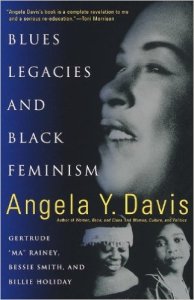 Black women musicians’ use of sound to negotiate gender norms and respectability politics is a centuries-old tradition. Angela Davis discusses the negotiations of Blues women in Blues Legacies & Black Feminism (1998), and Shana Redmond’s recent article “This Safer Space: Janelle Monae’s ‘Cold War’” reviews these traditions as they are relevant for black women pop musicians in the US. While there are many black femme musicians doing this work in queer subcultures and subgenres, I want to focus here on how this work appears within the Top 40, right alongside all these white post-feminist pop songs I talked about in my earlier post because such musical performances illustrate how black women negotiate hegemonic femininities in mainstream spaces.
As America’s post-identity white supremacist patriarchy conditionally and instrumentally includes people of color in privileged spaces, it demands “normal” gender and sexuality performances for the most legibly feminine women of color as the price of admission. As long as black women don’t express or evoke any ratchetness–any potential for blackness to destabilize cisbinary gender and hetero/homonormativity, to make gender and sexuality transitional–their expressions of sexuality and sexual agency fit with multi-racial white supremacist patriarchy.
It is in this complicated context that I situate Nicki Minaj’s (and in my next post Beyoncé’s and Missy Elliott’s) recent uses of sound and their bodies as instruments to generate sounds. If, as I argued in my previous post, the verbal and visual content of post-feminist pop songs and videos is thought to “politically” (i.e., formally, before the law) emancipate women while the sounds perform the ongoing work of white supremacist patriarchy, the songs I will discuss use sounds to perform alternative practices of emancipation. I’m arguing that white bourgeois post-feminism presents black women musicians with new variations on well-worn ideas and practices designed to oppress black women by placing them in racialized, gendered double-binds.
 For example, post-feminism transforms the well-worn virgin/whore dichotomy, which traditionally frames sexual respectability as a matter of chastity and purity (which, as Richard Dyer and others have argued, connotes racial whiteness), into a subject/object dichotomy. This dichotomy frames sexual respectability as a matter of agency and self-ownership (“good” women have agency over their sexuality; “bad” women are mere objects for others). As Cheryl Harris argues, ownership both discursively connotes and legally denotes racial whiteness. Combine the whiteness of self-ownership with well-established stereotypes about black women’s hypersexuality, and the post-feminist demand for sexual self-ownership puts black women in a catch-22: meeting the new post-feminist gender norm for femininity also means embodying old derogatory stereotypes.
I think of the three songs (“Anaconda,” “WTF,” and “Drunk in Love”) as adapting performance traditions to contemporary contexts. First, they are part of what both Ashton Crawley and Shakira Holt identify as the shouting tradition, which, as Holt explains, is a worship practice that “can include clapping, dancing, pacing, running, rocking, fainting, as well as using the voice in speaking, singing, laughing, weeping, yelling, and moaning.” She continues, arguing that “shouting…is also a binary-breaking performance which confounds—if only fleetingly—the divisions which have so often oppressed, menaced, and harmed them.” These vocal performances apply the shouting tradition’s combination of the choreographic and the sonic and binary-confounding tactics to queer listening and vocal performance strategies.
Francesca Royster identifies such strategies in both Michael Jackson’s work and her audition of it. According to Royster, Jackson’s use of non-verbal sounds produces an erotics that exceeds the cisheteronormative bounds of his songs’ lyrics. They were what allowed her, as a queer teenager, to identify with a love song that otherwise excluded her:
in the moments when he didn’t use words, ‘ch ch huhs,’ the ‘oohs,’ and the ‘hee hee hee hee hees’…I ignored the romantic stories of the lyrics and focused on the sounds, the timbre of his voice and the pauses in between. listening to those nonverbal moments–the murmured opening of “Don’t Stop Till You Get Enough,” or his sobbed breakdown at the end of “She’s Out of My Life,’ I discovered the erotic (117).
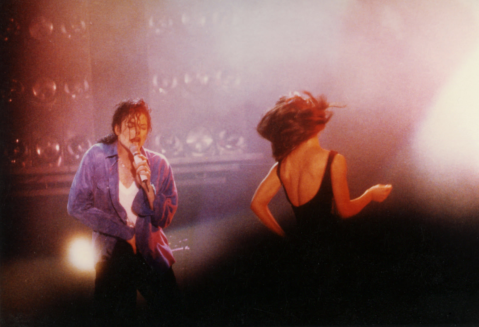
“Michael Jackson” by Flickr user Daniele Dalledonne, CC BY-SA 2.0
Royster references a black sexual politics in line with Audre Lorde’s notion of the erotic in “The Uses of the Erotic,” which is bodily pleasure informed by the implicit and explicit knowledges learned through lived experience on the margins of the “European-American male tradition” (54), and best expressed in the phrase “it feels right to me” (54). Lorde’s erotic is a script for knowing and feeling that doesn’t require us to adopt white supremacist gender and sexual identities to play along. Royster calls on this idea when she argues that Jackson’s non-verbal sounds–his use of timbre, rhythm, articulation, pitch–impart erotic experiences and gendered performances that can veer off the trite boy-meets-girl-boy-loses-girl stories in his lyrics. “Through his cries, whispers, groans, whines, and grunts, Jackson occupies a third space of gender, one that often undercuts his audience’s expectations of erotic identification” (119). Like shouting, “erotic” self-listening confounds several binaries designed specifically to oppress black women, including subject/object binaries and binary cisheterogender categories.
Nicki Minaj uses extra-verbal sounds as opportunities to feel her singing, rapping, vocalizing body as a source of what Holt calls “sonophilic” pleasure, pleasure that “provide[s] stimulation and identification in the listener” and invites the listener to sing (or shout) along. Minaj is praised for her self-possession when it comes to business or artistry, but such self-possession is condemned or erased entirely when discussing her performances of sexuality. As Treva B. Lindsey argues, “the frequency that Nicki works on is not the easiest frequency for us to wrestle with, because it’s about…whether we can actually tell the difference between self-objectification and self-gratification.’’ Though this frequency may be difficult to parse for ears tempered to rationalize post-feminist assumptions about subjectivity and gender, Minaj uses her signature wide sonic pallette to shift the conversation about subjectivity and gender to frequencies that rationalize alternative assumptions.
In her 2014 hit “Anaconda,” she makes a lot of noises: she laughs, snorts, trills her tongue, inhales with a low creaky sound in the back of her throat, percussively “chyeah”s from her diaphragm,among other sounds. The song’s coda finds her making most of the extraverbal sounds. This segment kicks off with her quasi-sarcastic cackle, which goes from her throat and chest up to resonate in her nasal and sinus cavities. She then ends her verse with a trademark “chyeah,” followed by another cackle. Then Minaj gives a gristly, creaky exhale and inhale, trilling her tongue and then finishing with a few more “chyeah”s. While these sounds do percussive and musical work within the song, we can’t discount the fact that they’re also, well…fun to make. They feel good, freeing even. And given the prominent role the enjoyment of one’s own and other women’s bodies plays in “Anaconda” and throughout Minaj’s ouevre, it makes sense that these sounds are, well, ways that she can go about feelin herself.
Listening to and feeling sonophilic pleasure in sounds she performs, Minaj both complicates post-feminism’s subject/object binaries and rescripts cishetero narratives about sexual pleasure. “Anaconda” flips the script on the misogyny of Sir Mix-a-Lot’s hit “Baby Got Back” by sampling the track and rearticulating cishertero male desire as Nicki’s own erotic. First, instead of accompanying a video about the male gaze, that bass hook now accompanies a video of Nicki’s pleasure in her femme body and the bodies of other black femmes, playing as she touches and admires other women working out with her. Second, Nicki re-scripts the bass line as a syllabification: “dun-da-da-dun-da-dun-da-dun-dun,” which keeps the pattern of accents on 1 and 4, while altering the melody’s pitch and rhythm.
Just as “Anaconda”’s lyrics re-script Mix-A-Lot’s male gaze, so do her sounds. If the original hook sonically orients listeners as cishetero “men” and “women,” Nicki’s vocal performance reorients listeners to create and experience bodily pleasure beyond the “legible” and the scripted. Though the lyrics are clearly about sexual pleasure, the sonic expression or representation of that pleasure–i.e., the performer’s pleasure in hearing/feeling herself make all these extraverbal sounds–makes it physically manifest in ways that aren’t conventionally understood as sexual or gendered. Because it veers off white ciseterogendered scripts about both gender and agency, Minaj’s performance of sonophilia is an instance of what L.H. Stallings calls hip hop’s “ratchet imagination.” This imagination is ignited by black women’s dance aesthetics, wherein “black women with various gender performances and sexual identities within the club, on stage and off, whose bodies and actions elicit new performances of black masculinity” renders both gender and subject/object binaries “transitional” (138).
Nicki isn’t the only black woman rapper to use extra-verbal vocal sounds to re-script gendered bodily pleasure. In my next post, I’ll look at Beyoncé and Missy Elliot’s use of extra-vocal sounds to stretch beyond post-feminism pop’s boundaries.
—
Featured image: screenshot from “Anaconda” music video
—
Robin James is Associate Professor of Philosophy at UNC Charlotte. She is author of two books: Resilience & Melancholy: pop music, feminism, and neoliberalism, published by Zer0 books last year, and The Conjectural Body: gender, race and the philosophy of music was published by Lexington Books in 2010. Her work on feminism, race, contemporary continental philosophy, pop music, and sound studies has appeared in The New Inquiry, Hypatia, differences, Contemporary Aesthetics, and the Journal of Popular Music Studies. She is also a digital sound artist and musician. She blogs at its-her-factory.com and is a regular contributor to Cyborgology.
—
 REWIND! . . .If you liked this post, you may also dig:
“I Love to Praise His Name”: Shouting as Feminine Disruption, Public Ecstasy, and Audio-Visual Pleasure–Shakira Holt
Music Meant to Make You Move: Considering the Aural Kinesthetic–Imani Kai Johnson
Something’s Got a Hold on Me: ‘Lingering Whispers’ of the Atlantic Slave Trade in Ghana–Sionne Neely
Share this:

The Listening Body in Death

Editors’ note: As a discipline Sound Studies is unique in its scope—under its purview we find the science of acoustics, cultural representation through the auditory, and, to perhaps mis-paraphrase Donna Haraway, emergent ontologies. Not only are we able to see how sound impacts the physical world, but how that impact plays out in bodies and cultural tropes. Most importantly, we are able to imagine new ways of describing, adapting, and revising the aural into aspirant, liberatory ontologies. The essays in this series all aim to push what we know a bit, to question our own knowledges and see where we might be headed. In this series, co-edited by Airek Beauchamp and Jennifer Stoever you will find new takes on sound and embodiment, cultural expression, and what it means to hear. –AB
—
My voice melds with the sound of the water pouring from the hose, as I gently massage the waste, blood, and tears from the body of the deceased. In the act of washing the dead, water is simultaneously sound, spirit, and sensory experience for the deceased and for the washer herself.
Washing the deceased in groups of three, our individual solo voices punctuate space at our own paces and intensities. Our sound soothes and cleanses the deceased as much as our washing. The melodic recitations we provide when gently holding the deceased are the most important components of ritual cleansing before one is buried. We repeatedly sound “Forgiveness, o Teacher [e.g., God]” while exhaling and inhaling. Often we recite the Tekbir—which articulates God’s greatness—adding a melodic architecture to our textured calls for forgiveness.
In washing the dead, we touch the deceased with respect and humility. “Please,” a family member will often beg, “please do not use cold water.” We quickly respond, “of course, this sister is still sensing us.”
Approaching the grieving we smile and gently say, “she is only without breath.” We turn on the water and gently command: “bring me your hand.” And the bereaved joins hands with the washer and feels the warmth of the water. We espouse a tactility exclusively belonging to the washer—as the choreographer and improviser of mourning—with the one who is left alive and in grief.
Our touch and voices alter with each separate experiencing of washing the dead. Because each deceased woman is her own person with her different body and causes of death, no encounter is the same. In the way that we leverage our own bodily movements of lifting and turning the deceased’s body, we actively chose to duet with sounds pouring from the mourning family members in the room. If the mourners are silent, we tend to fill the space with our sound. Our recitations are not only for ritual per se, but exist to offer pleasing sounds to the dead herself.
We recite believing, as Muslims do, that her soul still hears us. While “dead,” she can communicate with all or part of her former body, cooperating with us, the living, as we mediate mourning and prepare her body for burial.
One of the most hard-drawn sensory lines we assume and maintain is the border of death. Death ostensibly marks the end of our constellation of sense experience, engenders the limit of the body, and demarcates the edges of aurality. While we know that hearing remains the last of the senses experienced in dying, scholars of sound studies have yet to extend our exceptional inquiries on hearing, aurality, and listening into posthumous auralities practiced by multiple communities throughout the world. How might sound studies scholars attend to the multi-sensory perceptions and auralities that extend beyond the grey where western epistemological structures end?
As a specialist of Ottoman and Turkish classical musics, I have long been interested in how variant Sunni Islamic practices—themselves rooted in centuries of philosophical debates outside of those generated in “the west”—unsettle categories that many scholars globally assume to be fixed and natural. My current projects have led me to consider the intensity of diverse listening structures attuned to violent thresholds of death in Turkey’s Aegean and Mediterranean seas.
In fall of 2016, my ethnography on listening towards posthumous aurality brought me to Karacaahmet Cemetery in Istanbul, a critically important burial ground of the Ottoman Empire and reportedly the second largest cemetery in the world. Here I was apprenticed to the women of Karacaahmet, practicing Sunni Muslims and official state employees who provide the service of conducting the Islamic rituals of washing the dead. During this time I had the privilege of laying dozens of women and girl-children of all ages, diseases, and accidents to rest with sound.

Walking in Karacaahmet. Istanbul, September 2016. Photograph by the author.
In taking posthumous aurality seriously, I have few paths of translation available to me. I am challenged by normative secular belief structures that we may uncritically reproduce in scholarship. Death is not necessarily the end of aurality. Provincializing western critical theory and engaging ethnographic insight from non-western eschatologies—the areas of theology concerned with death and dying—invites one path for expanding our structures of listening beyond a body’s end.
For decades now, scholars have studied the body not as an accomplished fact but rather as a process. Yet in the body praxis long upheld in Islamic death rituals in Turkey, the vitality, socialization, and subjection of the body does not end in death, but rather passes into an alternate sensory and dialogically sonic realm. Death offers a space akin to what Bohlman and Engelhardt have considered as the sonic emptiness of religious ontologies, or “a space of perception and experience, not of silence and absence.”
Posthumous aurality, as I define and explore it, takes both an ethnographic and a sound studies approach to consider sensory possibilities of death. In this liminal space of mingled bodies—the bodies of the dead, the washers as care laborers, and the deceased’s mourning family members—I listen at a crossroads in which local belief structures mediate and structure sounds, soundings, silences, and voicing.
In Muslim cemeteries in Istanbul, it is believed that there is life in the grave. Death is described in terms of development, progression, pathway, and mere transition from one stage of life to another stage. The barzakh, the barrier of the grave and time spent dwelling posthumously in it, is an interstitial zone entered upon death which the soul can experience pleasure and pain, socialize and commune with others. There exists no necessary binary of life versus death, sound versus silence in these spaces.
The barzakh is a stage of movement, a zone of transference and oscillation. The body is a listening body—its soul communicates and lingers around it, sensing the sounds and touch offered by the washers. Ottoman poetry abounds about such sensings, echoing the understanding the body is a cage and the spirit is incarcerated in it. Artists of the word—with wording historically experienced aurally—narrate the body as wishing for its release (e.g., death) and the possibility of being reunited with its beloved (e.g., the divine) and returning to the earth as soil.
Sonic generosity in the face of death requires washers to engage a modality of listening, touch, and sounding to send an individual to the next realm to await resurrection. Her soul circles the room where we wash her body, listening and participating with us sonically, called back to her body in the grave three times before it is closed.
We believe we hold the body in its second most intimate moment in life, after that of its emergence from the womb. The scent of death fills our nostrils as we sweat to lift the deceased after we finish shrouding her and sprinkling the shroud with rose water. Gently, we ease her into the pine box that transports her to her grave.
And after we are done washing someone—whether we refer to her as “sister,” “aunt,” or “daughter”—we later, in our back tea room, remark upon the grieving of the family members joining us in the room and the discovery of ailments or sores on our sister.

The shoes that we shed at the entrance to our back tea room. Istanbul, October 2016. Photograph by the author.
In these moments of collective sharing, we discover ourselves in our shared similarities with the dead. Wisdom is, after all, listening in tandem with others and recognizing that which is most human in all of us.
In the context of Cairo, Egypt, Charles Hirschkind has beautifully analyzed “the ethical and therapeutic virtues of the ear.” Yet in washing the dead, I produce and engage in a space beyond the pieties maintained by circulating listening structures in particular places. I enter a particular and intimate form of relationality—not a relationship to myself as a subject or the subjection of the dead other, but rather to relationality itself as a form of the sonorous. Jean-Luc Nancy reminds us that the sonorous “outweighs form.” In listening towards posthumous aurality, I am ushered into a unique corporeal and sensorial form of access. Posthumous aurality is simultaneously “mine” and also shared.
Posthumous aurality renders all of our bodies—including that of the literal post-human dead—as capable of being influenced by others in that place. Sharing posthumous auralities in tandem with the washers, the grieving, and the deceased echoes in a space that is indissociably material and spiritual, internal and external, singular and plural.
The critical theories and methodologies of sound studies tend to not center diverse non-western tenets of sensory apparatus espoused by individuals and communities who perceive sound outside of the boundaries of western metaphysics. Posthumous auralities—when translated and mediated linguistically—offers a sound path to understanding the continuations and transformations of sense experience that occur in death. Tuning into posthumous auralities in Turkey’s urban Muslim cemeteries has helped me recover sounds long unheard because they have been relegated to the boundaries of our academic disciplines and the fringes of our very lives.
—
Featured Image: A view from Eyüp Sultan. Istanbul, October 2016. Photograph by the author.
—
Denise Gill is assistant professor of ethnomusicology at Washington University in St. Louis in the Departments of Music; Women, Gender, and Sexuality Studies; and Jewish, Islamic, and Near Eastern Languages and Cultures. Her research has been supported by Fulbright and ACLS. Her book, Melancholic Modalities: Affect, Islam, and Turkish Classical Musicians (Oxford, 2017), introduces methodologies of rhizomatic analysis and bi-aurality for scholars of sound, musical practices, and affect. Her current projects focus on listening structures of death, refugee loss, and acoustemologies of Muslim cemeteries and shrines in Istanbul. A kanun (trapezoidal zither) player, Denise has performed in concert halls in Turkey, the U.S., and throughout major cities in Europe.
—
REWIND! . . .If you liked this post, you may also dig:
Something’s Got a Hold on Me: ‘Lingering Whispers’ of the Atlantic Slave Trade in Ghana–Sionne Neely
The Amplification of Muted Voices: Notes on a Recitation of the Adhan–David Font-Navarrette
“An Ear-splitting Cry: Gender, Performance, and Representations of Zaghareet in the U.S.“-Meghan Drury
Share this:




Current Top Posts





April 2021

January 2020

November 2019

October 2019

August 2019

April 2014

November 2017

March 2015

December 2017

October 2015


Recent Comments