
An Ear-splitting Cry: Gender, Performance, and Representations of Zaghareet in the U.S.

At the opening of a recent annual “Under a Desert Moon” concert presented by Sahara Dance, a belly dance studio located in Washington, DC, one of the teachers began by telling the audience that the dancers would appreciate vocal feedback during the show. Holding a microphone with one hand and the other in front of her mouth, she demonstrated the practice known in Arabic as zaghareet, asking audience members to imitate her sound. This pedagogical interaction with an ethnically and generationally diverse audience on the campus of American University illustrates some of the complexities of translating sonic practices across cultural and economic divides. Zaghareet carries very different weight in a Palestinian wedding in the West Bank, where it is one piece of a larger formation of celebratory experience, than it does in a belly dance performance in Washington, DC, where it is used in part to generate authenticity in a tradition both geographically and culturally removed from the Middle East.
Located somewhere between singing and yelling, ululation occupies a unique position in the spectrum of human vocality. The sound is created by touching the tongue either to the sides of the mouth or the teeth in rapid succession, and it is characterized by a piercing sound quality enacted in the upper vocal register.
Having taken belly dance classes in the U.S. and seen a number of performances, I thought I had a sense of what ululation was and what it represented. The more I ran across it in the course of my dissertation research, however, the more I wanted to know about its historical background and affective meanings across contexts. In other words, what are the cultural genealogies of zaghareet in the Middle East, and how has the sound been perceived and represented in the U.S.? Although ululation is performed in a range of locations in South Asia, the Middle East and North Africa (MENA), my research is on U.S.-Middle East sonic encounters, and thus I will focus primarily on that context in this post. In particular, I became interested in why female voices typically perform zaghareet, and how its circulation in U.S. media and pop culture fit into larger narratives about the Middle East before and after 9/11.
Zaghareet is auditorally conspicuous, and in U.S. during the postwar decades before 9/11, it was often framed as a sonic encapsulation of an Arab exotic. The sound itself came to invoke elements that constitute classic Western stereotypes about the region known as the Middle East: veiling, gender oppression, desert wandering, and pre-modern ritual. Its status as a primarily female practice made it appealing as a sign of difference, since the West has been notoriously preoccupied with the status of women in the Middle East (see Chandra T. Mohanty, “Under Western Eyes: Feminist Scholarship and Colonial Discourses;” Lila Abu-Lughod, ed., Remaking Women: Feminism and Modernity in the Middle East; Leila Ahmed, Women and Gender in Islam: Historical Roots of a Modern Debate, among others). Zaghareet poses a contradiction to this orientalizing logic, as it works against the image of the oppressed Arab woman “silenced” by her surroundings. Instead, her voice takes on an uncanny resonance, indicating the tantalizing alienness of Arab culture. In a post-9/11 U.S. context, zaghareet become directly correlated with premodern barbarity, taking on more menacing anti-American associations. By taking a critical approach to the practice of zaghareet and its representations I hope to deflate some of these prevalent views and help to develop a new framework for thinking about aural exoticism.

Celebration of Egyptian revolution in DC, 2011, Image by Flicker user Collin David Anderson
Zaghareet’s combination of high pitch, loud volume, vibrato, and tongue oscillation contributes to its prominent, distinctive sound. In Jennifer Jacobs’ dissertation on ululation in the Levantine context (the term Levant refers to a region made up of Syria, Lebanon, Jordan, Palestine/Israel, and other areas in the Eastern Mediterranean), “Ululation in Levantine Society: The cultural reproduction of an affective vocalization” she points out that zaghareet typically last approximately 3 1/3 seconds, which is longer than the articulation of most words in speech, but not beyond the length of a typical speech phrase (111). Thus, though it is not speech or singing, zaghareet is related to these vocalizations in the sense that it lasts approximately the length of one breath. The practice is most often performed by women, and its acoustic intensity is remarkable considering that in an indoor setting with the performer near the microphone it can reach 85 dB, a level that can cause hearing damage with prolonged exposure. These components highlight the significance of zaghareet as a primarily female performance, making the practitioners audible at a level that isimpossible to ignore.

Woman at pro-Palestinian rally in France, Image by Flickr user lookingforpetry
Zaghareet takes place within a unique set of circumstances with a range of other sounds occurring simultaneously, and therefore should be conceptualized as part of a web of social meanings and practices, not as a discrete element to be observed on its own. The history of zaghareet (and ululation more generally) reaches back to ancient Greece, where the practice was referred to as ololuge, an onomatopoetic reference to the sound. In the 21st century Levant, zaghareet is often part of social gatherings where live music and dancing are also present. While most often situated in celebratory social settings, zaghareet can also take place in a variety of everyday circumstances, but in almost all cases it connotes farah, or joy. Performers generally do zaghareet to express their excitement, delight, and/or encouragement to others present. The practice tends to be contagious in that after hearing it others tend to join in, but the exact origins of the sound can remain mysterious due to the fact that most practitioners cover their mouths with their hands or clothing. This produces an omnipresent effect that both dislocates the listener and develops shared experience, and the collectivity of the performance magnifies its affective power. Jacobs writes, “When one person begins performing zaghareet, another person might join in; then, a third person might also join just as the first vocalist is dropping off. This overlapping of performances creates a perceptual experience of zaghareet as something layered, continuous, and emanating from different spatial locations, a haunting bodily experience, especially for a first-time listener” (75). This is complicated by broader soundscapes in which it is performed, which may include music, clapping, firing of guns, traffic, and other sounds.
In addition to performance setting, gender is a key component of zaghareet. While it is performed more often by women than men, in certain contexts and communities, men do participate. Jacobs describes one case in which men had demonstrated that they could skillfully perform zaghareet, but only minutes later jokingly denied that they knew how to do it when she asked. This emphasis on modesty is also apparent in the way that most female practitioners cover their mouths while doing zaghareet to hide the movement of the tongue, which tends to be considered immodest or impolite. In this Youtube clip, for example, the zaghareet performer covers her mouth with her hijab:
.
And as is shown in the clip, zaghareet often takes place in homosocial environments where men are not immediately present, providing space for playful exchange between women in ways that heterosocial settings may not. The homosociality of the sonic practice is related to its affective reverberations, as the sound is used to convey bonds of attachment, conviviality and mutual appreciation between women. In this sense zaghareet embodies these interpersonal connections, and also reinforces them through its aural intensity.
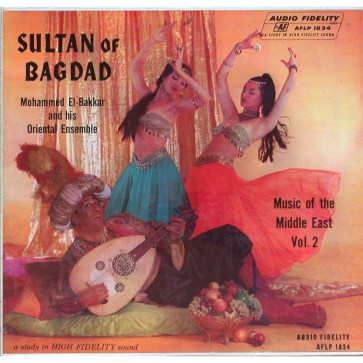
In American and European popular culture, zaghareet has played a notable role in framing depictions of the Middle East, particularly through the female body. In the years following World War II, zaghareet samples often marked the Middle East as wild and exciting. Lebanese-born singer Mohammed El Bakkar, for example, used the sound of zaghareet on his song “Yalla-Yalla” from the 1958 album The Sultan of Bagdad, one of several albums he recorded for the Audio Fidelity label in the late-1950s marketed to a mainstream American audience.
.
“Yalla-Yalla,” which translates loosely as “Come with me,” features finger cymbals, clapping, and female zaghareet, along with jovial calls from El Bakkar at the ends of phrases, conjuring a celebratory setting. All of these elements–along with the album cover photo that shows El Bakkar lounging on a cushion with two beautiful dancers standing over him–combine to create a quintessential exotic scene for many American listeners.
Although unintentionally kitschy at times, the 1962 British epic Lawrence of Arabia—a film which has the dubious distinction of having no spoken lines by a woman in its 3 1/2 hour running time—represents zaghareet quite seriously. The ululations first appear about half of the way through the film, where Lawrence and the Arab forces set off to fight the Turkish at Aqaba, and women provide blessings and encouragement.
.
Lawrence of Arabia is a classically orientalist film about the scope of British empire, and in this instance, zaghareet accentuates the majesty of the scene where Lawrence rides beside his Arab counterparts through the desert with veiled women calling from the cliffs above. Like the previous example, the women here constitute part of a foreign landscape, and their cries of encouragement serve along with the visuals to construct a multi-sensory experience of otherness.
Zaghareet has taken on more explicitly violent associations in a post-9/11 American context, where it is often coupled with Arab depravity and linked to terrorism. Zaghareet was demonstrated in a newsclip aired on CNN, Fox, and several other news networks displaying Palestinians in the West Bank “celebrating after 9/11.” One woman in the clip briefly ululates in front of the camera, connecting the sound to perceived Arab hatred for Americans.
.
The video went viral, and reactions to it exemplify the extent to which zaghareet has come to symbolize a new stereotype in the post-9/11 era: the depraved Middle Eastern Other. This formula collapses and combines the categories of “Arab” and “Muslim,” and, although it complicates the figure of the terrorist as male, since it is a woman who is shown celebrating after 9/11, it also reveals western anxieties about the power that Lawrence of Arabia represented as harnessed by colonial forces.
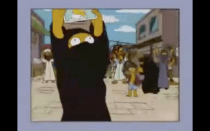
Screen shot by author
A parody of the viral news clip appeared on a 2004 The Simpsons episode entitled “Bart-Mangled Banner” in which Bart accidentally moons the American flag at a basketball game, and subsequently faces a public outcry from critics calling him anti-American. The nightly news shows the “overseas” response, in which a woman wearing niqab holds up a photo of Homer and says “Simpsons be praised! Praise be to Springfield!” and then performs zaghareet against a backdrop of celebratory gunfire. This satire hints at the absurdity of controversies over such displays, but it also reinscribes the idea of the Arab/Muslim female as a source of danger, a new element of anti-American hostility that became associated with the sound after 9/11.
Unlike previous impressions of zaghareet, which focused on the sound as part of an exotic terrain, post-9/11 visions tend to locate practitioners in a distinctly antagonistic matrix. The distinctive sonicity of zaghareet makes it particularly susceptible to portrayals that frame it as a sign of Arab barbarity. For certain performers, however, such as belly dance students in Washington, DC, zaghareet is not subject to this type of racialized logic, and is instead treated as an ethnic novelty. In American film, TV, music, and a range of other contexts, zaghareet is becoming increasingly audible, and it is a phenomenon that deserves thoughtful and critical attention.
—
Meghan Drury is a fifth-year Ph.D. candidate in the Department of American Studies at the George Washington University. She received an MA in ethnomusicology from UC Riverside in 2006. She is currently working on a dissertation tentatively titled “Aural Exotics: The Middle East in American Popular Music 1950-2011.” This project examines the interplay between popular music and American cultural representations of the Middle East from the mid-20th century to the present, illustrating how music and sound acted a means of consolidating and disseminating a range of ideas about Middle Eastern culture in the American mainstream. She is particularly interested in the way that sound increased the visibility of Arab Americans both before and after 9/11, offering a space for negotiations of identity. More broadly, Meghan’s interests include sound studies, U.S.-Middle East cultural relations, and Arab American cultural performance.
—
 REWIND! . . .If you liked this post, you may also dig:
Rallying Cries as Suffering Sounds: “Allah-O-Akbar” and the Aurality of Feminized Iranian Suffering–Roshanak Kheshti
Aurally Other: Rita Moreno and the Articulation of “Latina-ness”–Priscilla Peña Ovalle
Beat-ification: British Muslim Hip Hop and Ethical Listening Practices–Jeanette Jouili
Share this:

Love and Hip Hop: (Re)Gendering The Debate Over Hip Hop Studies
Today’s post from Cornell professor Travis Gosa (Africana Studies) marks the return of our “Sound and Pedagogy” Forum for a spring semester refresher course. It’s a hard time of the school year–fatigue can creep up in exponential relation to the sudden increase in sunshine. We at SO! want to put some spring back into your classroom with Gosa’s discussion of the relationship between hip hop and the university classroom–to sample De La Soul, stakes is high–followed up next week with Emmanuelle Sonntag and Bronwen Low‘s (McGill) exploration of hip hop pedagogies in the urban classroom in their joint post on “The Student as Broadcaster and DJ of Her Listening,” and rounded out with a hands-on self-assessment of how sound media can be a productive classroom tool in teaching black political history by Carter Mathes (Rutgers). Grab a new notebook, sharpen some pencils, and enjoy some (funky) fresh perspectives this spring. And now, I pass the mic to Dr. Travis Gosa–Editor-in-Chief Jennifer Stoever-Ackerman
—
The three-year appointment of DJ Afrika Bambaataa at Cornell University has caused me to think about the sexual politics of sound created by the artist-centered hip hop studies movement. College students have been reading hip hop textbooks since the early 1990s, and Arizona University students can now earn a minor in hip hop studies. However, the recent professorial appointments of artists like Bambaataa, Bun-B of UGK (Rice University), M1 of dead prez (Haverford College), Wyclef Jean (Brown University), and 9th Wonder (Harvard University) is shaping how hip hop is heard.
The embodied collision of instrumentation, lyricism, and experience in the artist-centered classroom can create spaces for empowerment and emancipatory learning. There is also a risk, however, that the artist-professors trend will reproduce the same sexist logic about hip hop and women that recirculates in mass-mediated rap music.
Since Common’s 1994 song “I Used to Love H.E.R,” the bodies of women of color have served as the sonic battlefield for wars over the authentic boundaries of hip hop culture. On the track, Common falls out of love with H.E.R (“hip hop”) when White corporations and West-Coast emcees gangbang his once virgin, “untampered” girl, and turn her into a promiscuous, weed-smoking “gangsta bitch.”
.
Compared to Lil’ Wayne’s lyrics about “beating the pussy up like Emmett Till,” or Rick Ross’ molly-infused date rap anthem, Common’s nostalgic back-in-the-day rhymes are tame. The love affair is sonically wrapped in the thick intertexuality of George Benson’s mellow jazz guitar of “The Changing World,” timeless emcee clichés like “yes yes ya’ll,” and classic quotables like Easy-E’s “Easily I approach…” (minus the punchline about having sex with your momma).
Rap legends Scarface and Nas use the H.E.R. trope to frame the appropriation of hip hop by colleges. On the DJ Khaled assisted track “Hip Hop,” they describe hip hop as a “middle-aged cougar,” and threaten to murder the “bitch” for being a gold digging “whore.”
.
According to Scarface, he has fallen out of love with Ms. Hip Hop because she is sleeping around with everyone, including college professors:
Now you all in the lectures
Being studied by the college’s professors
Now I regret the day I met ya, Bitch
I’ll be the first one to say it
She ain’t the one you want to play with
I fucked Hip Hop
When the imaginary borders of hip hop are expanded or violated by academia, Scarface defends hip hop by slut shaming Black women. The hegemonic masculine frame perpetuates the virgin/whore dichotomy of womanhood, justifies violence against women, and evaluates women (“hip hop”) according to their ability to fulfill the needs of men. DJ Khaled’s production reinforces the message by sampling Mott The Hoople’s “She Does It.” The 1975 British glam rock song is a little ditty about cocaine and/or rough sex with groupies.
Too often, loving hip hop involves remaining uncritical about sexualized violence and the silencing of women in the culture. “Sentimental attachment” to music, as Barry Shank described at the 2013 IASPM conference, is not the same as “interrogative listening,” the recognition that musical pleasure can involve dominance and oppression. Interrogative listening begins by acknowledging that being a member of a musical community comes with responsibility.
Hip hop studies professors face the monumental task of reeducating students in the art of interrogative listening. As scholar Tricia Rose noted in her keynote address at the opening of the Cornell Hip Hop Collection in 2008, the commercial rap industry has trained young people to nod to the beat while passively accepting misogyny and oppression. Rose writes in her book The Hip Hop Wars that pointing to real life “tricks” and “hoes” is often a strategy used to absolve male hip hop artists of their culpability in profiting from rape culture.
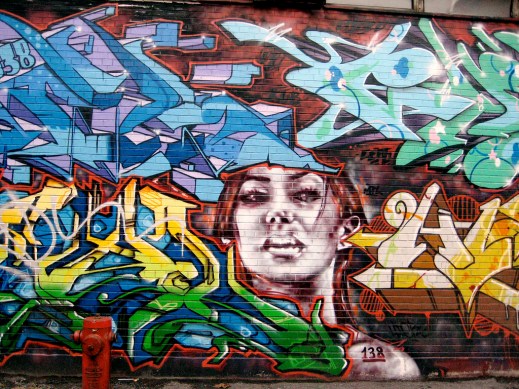
I have been impressed by the ability of pre-rap, 1970s hip hop artists to demonstrate a love for the culture without reproducing the woman-hating narrative found in rap music. The South Bronx DJs (i.e., BreakBeat Lou), graffiti artists (i.e., Carlos “Mare 139” Rodriguez), photographers (i.e., Joe Conzo, Jr.), and break-dancers (i.e., Richard “Crazy Legs” Colon and Jorge “Popmaster Fabel” Pabon) who make guest appearances in my courses explicitly disassociate themselves from the logic of commercial rap industry. Not surprisingly, it has been most intriguing to listen to the sexual politics created by the Afro-futuristic DJ Bambaataa.
Bambaataa is known for transforming the notorious Black Spades gang into the fledgling 1970s South Bronx hip hop scene. His Universal Zulu Nation has forcibly removed drug dealers from neighborhoods, rallied around political prisoners, and just last month, warned WorldStarHipHop.com to stop pandering violent and sexual images to youth.

Image by Pete Best, Courtesy of Cornell News
Less obvious is Bambaataa’s political work through sound performance. His signature soulsonic soundspace mocks the boundaries of music genre and the specificities of race, social class, and place, in favor of the universal. For example, when asked to explain early hip hop to my undergraduate class last fall, he sat back and played Ray Steven’s 1969 hit “Gitarzan” and The Music Man’s “Ya Got Trouble.” Hilarity and cognitive dissonance ensued, as the country-rock and Broadway tunes shattered the commonsense of hip hop as “rap music,” “black,” “youth,” or “urban.”
His universalism is not meant to obscure the contributions of women with a generic masculine narrative. Bambaataa has spent the first year of his appointment mapping out the centrality of women’s role in creating hip hop culture. Like Kyra Gaunt in Games Black Girls Play: Learning The Ropes from Double-Dutch to Hip Hop, Bambaataa traced rap and dance to double-dutch, hand-clipping, and rhythm games played by Black girls. To demonstrate how women pioneered rapping, he played Shirley Ellis’ The Name Game and The Clapping Song. During his first official sound lecture, a DJ set at an Ithaca nightclub, the music of Aretha Franklin and Miriam Makeba were interwoven into the more recognizable hip hop staples like James Brown.
Observing Bambaataa’s musical performances at Cornell gives me hope that sound and listening can be used to disrupt dominant modes of gender politics in the hip hop classroom. However, the ability of Black male artists to articulate the contributions of women is in no way a replacement for creating spaces which are actually inhabited by those who are not Black, male, or heterosexual. There is nothing universal about male bodies, thoughts, or voices. Unfortunately, this new trend of artists in the classroom is being constructed almost exclusively around Black/Brown, heterosexual men.
To date, no “b-girls,” “femcees,” or “flygirls” have been appointed to high profile positions in the academy. I struggle with this at my home institution, as Cornell’s “Born in the Bronx” archival project risks perpetuating the myth of a woman-less birth. This gender-limited vision of hip hop’s roots has been compounded by the silencing of legendary battle emcee Roxanne Shanté, whose relationship with Cornell ended after a witch-hunt surrounding her academic credentials back in 2009. MC Sha-Rock, an early female emcee, will end the four-year estrogen drought when she participates in Cornell’s 2013 Unbound From the Underground hip hop celebration on April 4-7, 2013.
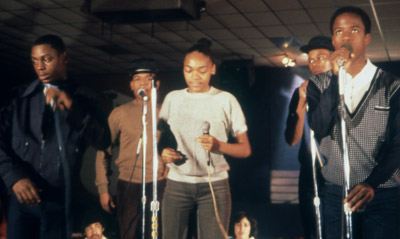
MC Sha-Rock in 1982’s Wild Style, Charlie Ahearn/Cornell Hip Hop Collection
Our efforts to connect academic hip hop studies to its cultural practitioners must honor women and empower female agency. The critical praxis has already been constructed by Black feminist scholars, such as Tricia Rose, Joan Morgan, Patricia Hill-Collins, Gwen Pough, Kyra Gaunt, Ruth Nichole Brown, and countless others. Hip hop feminism or “Crunk feminism” dictates that academic spaces support emancipatory gender politics, which starts with teaching and celebrating a truthful history focused on the agency of women of color. It does not involve participating in Black male violence under the guise of loving hip hop.
Every university that claims to teach or “preserve” hip hop should appoint female/feminist/queer artists. No doubt, fierce emcees like Yo-Yo, MC Lyte, Missy Elliott, and Lauryn Hill should be on the short list at many colleges. Still, we have to be wary of gender tokenism; the end-game should not be finding a honorary female artist to provide “a woman’s point of view.” Rather, the goal should be to create opportunities for women to narrate history, redefine the spaces occupied by hip hop, and to rearticulate the logic of critical listening.
Regendering hip hop studies will require a paradigm shift and a new soundtrack about love. Perhaps we can begin the work by replacing the H.E.R. tracks with Akua Naru’s “The World is Listening.” It is a dope, feminist homage to women’s journey through hip hop history, without all the slut shaming.
—
Featured Image by Flickr User LizSpikol
—
Travis L. Gosa is an Assistant Professor at Cornell University’s Africana Studies & Research Center. He teaches courses on hip hop culture, African American families, and education. He is an advisory board member of Cornell’s Hip Hop Collection, the largest archive on early hip hop culture in the United States. He can be reached at tlg72@cornell.edu and on Twitter @basedprof.
—
REWIND! . . .If you liked this post, you may also dig:
“‘I’m on my New York s**t’: Jean Grae’s Sonic Claims on the City”––Liana Silva
“Ill Communication: Hip Hop Studies & Sound Studies @ Show And Prove”— J. Stoever-Ackerman
“The Victoria’s Secret Fashion Show and the Soundtrack of Desire“— Marcia Dawkins
Share this:


Current Top Posts





April 2021

January 2020

November 2019

October 2019

August 2019

April 2014

November 2017

March 2015

December 2017

October 2015
 Sounding Out!
Recent Comments