
Decolonizing the Radio: Africa Abroad in the Age of Independence
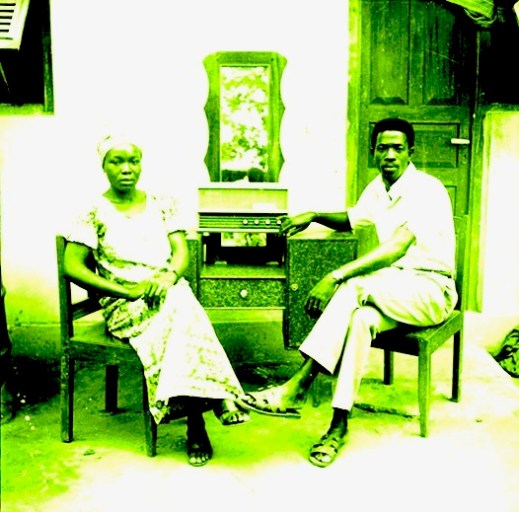
I never meant to write about radio. Film, video, music, the Internet, television even– but radio had not made a dent in my scholarship or teaching, for embarrassing reasons: it seemed nostalgic even to think about it. It was a residual technology, obsolete even at mid-century, I thought.
And then I stumbled onto the transcripts of “Africa Abroad,” part of The Transcription Centre archives at The Harry Ransom Center.
I was doing research on African American playwright Adrienne Kennedy when two of the fantastic staff at the HRC (Molly Schwartzburg, now Curator at the UVA Special Collections Library, and archivist Gabby Redwine) shared their working African Collections finding aid with me. The description of The Transcription Centre caught my eye, as a radio and public media presence across Africa and the metropolitan diaspora at mid-20th century, whose work included the short variety radio program Africa Abroad (1962-1965) as well as Arts festivals and other cultural events based in London and headed by a former BBC employee. Africa Abroad, a variety show dedicated to the music, art, theatre, literature, and politics of Africa and the African diaspora, offers a compelling glimpse at Independence-Era Africa and some of the technologies that made it, briefly, the center of contemporary diaspora politics.
The transcripts of Africa Abroad document the progressive hope that theorists like Frantz Fanon had for the revolutionary potential of radio in the hands of the (semi)proletariat with cheap access to both production and distribution networks. The background materials on the Centre document its inception as the brainchild of the Congress for Cultural Freedom, a CIA-funded effort to fund anti-communist, pro-democracy sentiment on the continent (a continent who was also being wooed by Russia and China at the time). Africa Abroad then stands as an attempt to rethink the relationship between politics and culture in a difficult, compromised time, self-consciously negotiating the media and mediated trade on Africa as a place and Africa as an international symbol. The radio program takes this moment of African celebrity and finds in it not teleology but proliferation, and a self-aware critique of ‘Africa’ and its public image as it is employed by the diaspora.

released on Riverside Records, 1961.
By the second installment of Africa Abroad on the 26th of April, 1962, what becomes the standard format of the programming emerges, one that begins to place culture as the center of diaspora identity—and politics. There is usually a musical lead—by the 4th installment to become the same “signature tune,” “African Waltz” by Canonball Adderley)—after an announcement of the location (London) and organization of the broadcast. The music and the site identification augurs the emphasis on the multiple and conflicting sites of the black diaspora that are performed within each episode and across the radio series as it continues, starting with an invocation of “Mother Africa”; in this particular episode, James Baldwin calls for the revision of the “American Negro” breaking free of representational binds via “the rise of Africa in world affairs,” then moving to a commentary on a Max Roach jazz piece by Nigerian Aminu Abdullahi that emphasizes the role of pan-African politics in Jazz music, then to a review of Ezekiel (later Es’Kia) Mphahlele’s book The African Image from a Nigerian literature Ph.D. in London, finally leading to a brief interview with Robert Resha, “one of the leaders for the ANC [African National Congress] which has been banned in South Africa, on the eve of his leaving London for a tour of African countries.” This eclectic mix becomes Africa Abroad’s signature format, and its particular concerns—that of the keen recognition that the world’s eyes are on Africa anew during this period of independence, and that Africa is starting to work as a symbolic geography of hope for African America as well as Caribbean emigres to Britain—are also those that inform the rest of its run.

Two friends listen to the radio in the Ivory Coast, 1960s, image courtesy of the BBC Archives
While the range of listeners for Africa Abroad is still hazy—transcripts and recordings were made available across the continent, but there is no record of where they landed or when or if they aired—the way that even its material presence in London acted as a hub for political, literary, and cultural figures from Africa and the diaspora winds up as another meaningful site of contradiction. The programs’ circulation of major literary and cultural figures began to construct and map the canon of African authors we recognize today as the “fathers” of the African renaissance. That gendering is specific as it reflects the kind of access to travel, education, promotion, and connection that was required to be a recurring part of Africa Abroad’s brief run—with a limited number of women being sent to London for education in the time period, and even fewer representing those in privileged political exile. Though what amounts to a handful of women are interviewed on the program, rarely are women writers and thinkers featured beyond actresses. Such representation helped to solidfy a generation of African writers and politics that were defined by the questions of an elite, masculine imagination around what the continent, and art from the continent, should or could be—and this vision of diaspora art and politics circulated via the radio.
In other words, Africa Abroad was produced through and as a representation of the new celebrity of the continent, with the radio program serving as the ideal format to showcase and interrogate the global phenomenon of African Independence and as a harbinger of the postcolonial struggle for its resources that would ensue. As independence struggles adopt and adapt new technologies into forms of “combat,” to use Fanon’s terms from “This is the Voice of Algeria,” radio moves from strictly a medium of the colonizer to a tool, “a system of information, . . . a bearer of language, hence of message” (73). But it is also already “obsolete” by 1962 as a residual cultural form in the Western metropole, taken over in the mainstream by television. Hence, like the flexible political strategies of the Cold War that relied on more than just force, radio at this moment becomes both a tool of cultural revolution (and new-found global relevance) and one of stealth colonial influence. As a program rooted in the West but disseminated across and produced by African continental interests, “Africa Abroad” maintains the complex, contradictory desire of communication post World War II that media communications could both connect us all in a progressive intimacy or hail us into, effectively, sheep. Africa Abroad sounds out this tension in form and in content, through the radio.
As the range of scholars I’ve thankfully met post my encounter with radio attest to, this significant, one might say descendent, moment in radio history is constantly weighted by race, gender, and empire. Ivy Wilson is working on sound and the Transcription Centre on the actual recordings of Africa Abroad. Judy Coffin is mapping the complex work that radio did in the careers of Fanon, Simone de Beauvoir, and other intellectuals of the mid-century. Emily Bloom is tracing BBC radio alongside modernism’s literary pathways. This interdisciplinary community of scholars I’ve discovered alongside of radio signifies the important work being done to think through the possibilities for this medium after its dominant rise and into its political and cultural repurposing in the age of the Cold War—outside of the mainstream center at the same time that it serves to support and traverse new geographic and cultural fronts.
—
Featured Image: original from a BBC collection of images from the Ivory Coast, 1960s
—
Samantha Pinto is an Assistant Professor of English at Georgetown University. She is the author of Difficult Diasporas: The Transnational Feminist Aesthetic of the Black Atlantic (forthcoming from NYU Press) and is working on a new project on early black celebrity and human rights discourse. This research on radio is part of an in-process series of articles on institutional failure in the African Diaspora, Women’s Studies, and other critical sites of progressive political desire.
Share this:

Rallying Cries as Suffering Sounds: “Allah-O-Akbar” and the Aurality of Feminized Iranian Suffering
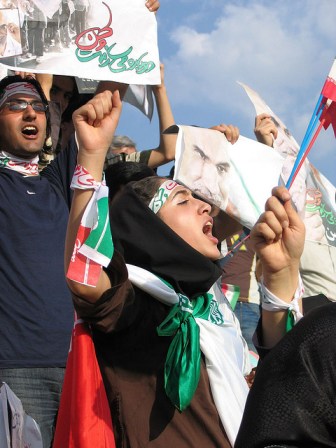
By July of 2009 dozens of pitch-black videos began to appear on YouTube. Documenting ambient noise, in some cases narration and, most prominent of all, impromptu collective outcries of “Allah-o-Akbar,” these videos resonate with an urgent gusto, punctuated with an eerie sense of desperation through faint echoic reverberations. By the level of desperation audible in every voice, at once dulcet and melancholic in tone, there is a distinct sense that Allah very well may be called forth. While most of these videos received scant attention, one entitled “Inja Kojast”](translated as “Where is this Place”) received over 174,000 hits (as of writing).
It was dubbed with English, Spanish, and Japanese subtitles, was sampled by a music producer (“Tehran’s Roof Tops _Remix”) and also played a prominent role in the 2010 French film Fleur du Mal. What is enabled, invoked, and signified by the layering of these multiple and disparate incantations? What is affectively evoked in the widespread circulation of these chants by YouTube and in Fleur du Mal? Why was this video circulated so widely and deemed so affectively resonant by disparate audiences?
Due to the fact that the Iranian government had barred entry to representatives of foreign media and systematically jailed Iranian journalists accused of being hostile to the regime, the disputed 2009 Iranian elections and ensuing protests were largely reported on by a new breed of “citizen journalists”. Filling in the information vacuum, citizen journalists tweeted and uploaded to the Internet raw video footage of protest marches and confrontations with Basiji militiamen by day – and the voices of dissent performed on Iran’s many rooftops by night. Donning the cloak of darkness, residents of Iran’s major cities climbed to the rooftops of their buildings to chant “Allah-o-Akbar” in numbers – a brief reprieve from the violent suppression of their street protests by Basiji militiamen.

“Women Smash the Shah’s Crown,” Poster from the Iranian Revolution, Courtesy of Flickr User Voyou Reserve
As Negar Mottahedeh has written in her online essay “Allah-o-Akhbar”: “The cry of “Allah-o-Akbar” was the defining sound of the 1978 protests against the Shah of Iran, during a revolution that toppled the Pahlavi monarchy and established the Islamic Republic of Iran.” This earlier revolutionary context is represented in the video for “Allah o Akbar, Khomeini Rahbar”, which hailed a politically diverse citizenry to stand behind this “rahbar” or new “leader.” The chanting of “Allah-o-Akbar” was further exploited as a nationalistic call-to-arms during the Iran-Iraq war in the music video for the anthemic “Allahu Akbar Iran, Iran.” The chant’s versatility and instrumentality in this immediate post-revolutionary period is due not only to its capacity to appeal to the pious and patriotic backers of the newly formed Islamic Republic but also because of its power as a performative political rallying cry. Mottahedeh’s essay title employs a pun: the addition of ‘h’ to the word “Akbar” in transliteration changes the word to “Akhbar” or news. Although she does not elaborate on this, her title suggests that this chant is itself a form of citizen journalism, a broadcast calling forth the revolutionary spirit that Iranians pride themselves for always having at the ready. But what kind of journal is “Allah-o-Akbar”? Is it a call to arms, a rallying cry, a collective sound of suffering or all of the above?
Despite its pious provenance and deployment as the paradigmatic cry of the revolutionary uprising against the Shah, the Islamic Republic currently led by Ali Khamenei and Mahmood Ahmadinejad–which was inaugurated by these earlier revolutionary calls–has interpreted the post-2009 chanting of “Allah-o-Akbar” as blasphemous and an affront to their authority. Journalist Jalal Hosseini argues that this is due in part to the fact that opposition candidate Mir Hossein Mousavi called upon his supporters to remember the revolutionary history of this performative chant in an open letter, stating “Let’s not abandon the green colour which is a symbol of spirituality, freedom and religious mentality and moderateness and the Allah O Akbar slogan that tells us of revolutionary roots.”
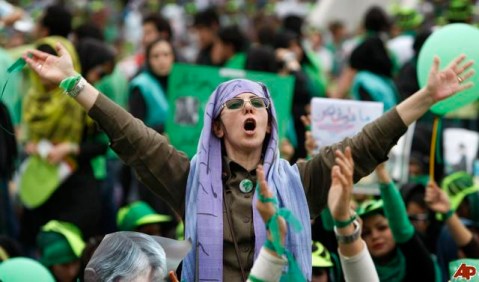
Women at the Front, 2009, Image by Flickr User Raymond Morrison
As Hosseini has written, “In a religious state, where religion is present in every aspect of life, Iran’s protestors have managed to turn religion against their government…Allah-o Akbar is perhaps the single most symbolic phrase in the Muslim world, yet Iran’s current rulers, who themselves employed this slogan in their struggle against the Pahlavi regime in the 1979 Revolution, did not tolerate the protesters’ cries of Allah-o-Akbar after the 2009 presidential election. Allah-o Akbar has essentially become a forbidden phrase.” Hosseini goes on to quote numerous Tehranis who testify to their disparate intentions behind the chanting, highlighting the ambivalence inherent to the slogan, which makes it available to Iranians of many stripes, and, as he argues, allows the calls to resonate even beyond the nation by appealing to other Muslims globally. But the widespread circulation of these videos and their popular impact on global YouTube audiences also suggests that the chanting has had an impact on non-Muslims as well.
Susan Moeller, who penned a Huffington Post piece right around the time of “Inja Kojast’s” semi-viral circulation, argues that this most recent phase of the chant’s resignification has helped to win Americans over to the protesting Iranian’s cause, writing, “watching Americans are learning to reframe the meaning of ‘Allah O Akbar’ and re-imagine the people of Iran. The pictures from Tehran are showing that Iranians are not monolithic in their beliefs.” Moeller suggests that this collective chanting has somehow cut through the status quo Islamophobic representations of a fundamentalist Iran to create an affective and empathetic pathway through which Americans can “re-imagine the people.” Moeller’s argument echoes the sentiment of the comments written on the YouTube page for “Inja Kojast,” comments like “This breaks my heart!” left by Annabanana23663 or “I have listened to this so many times already that you would think I would have moved on BUT I continue to listen and will continue to listen for there is truth in that voice of pain. And only by embracing pain can we love truth. And truth not only will set us free but without truth we cannot be free. Go you beautiful Persians. The people of the USA love you for your defiance” (by YouTube viewer HulkSmashPunyHumans).
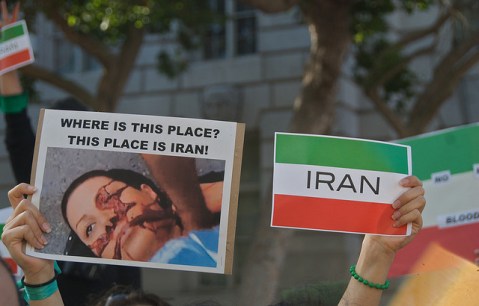
“Where is this Place?” San Francisco, CA, 20 June 2009, Image by Flickr User Steve Rhodes
Not only were YouTube users impacted by “Inja Kojast” but the video’s representation of Iran’s rooftop chants inspired the narrative arc of French filmmaker David Dusa’s Fleur du Mal (Flowers of Evil, 2010), a film that explores the precarity and instability of Iran after the 2009 elections. Through a chanting scene in which the two main characters, Gecko (Rachid Youcef) and Anahita (Alice Belaïdi), vociferously call out “Allah-o-Akbar” on the edge of a rooftop in the avowedly anti-Islamic nation of France, they thumb their noses at both nation-states at once while also sealing their romantic bond. Perhaps in an ironic play on Khomeini’s exile in the same city, the beautiful, educated and upwardly mobile Anahita is incubated in Paris for a time while the political instability following the 2009 elections settles down. Completely obsessed with the post-election struggles that she and her friends were actively engaging in on the streets of Tehran, she daily follows every new tweet and YouTube video. She bides her time in Paris by convincing Gecko, the bellhop at her swanky hotel, to give her a tour of the city and the two soon become lovers.
Despite the somber context of the film’s main narrative preoccupations with Iran’s botched 2009 elections, this plot point, I argue, enables the cathexis of an Orientalist drive that is shared by Western audiences: a drive to consummate the desire for the feminized Muslim woman seen to have suffered under the despotic rule of Muslim masculinity. It is this same desire that gets sublimated in a consumption of feminized Muslim suffering which has led to a reductive popular reading of “Inja Kojast” that eclipses the ambivalence of and disparate intentions behind the chanting it documents. In particular, it is through the cries of the narrator’s own female sounding voice that “watching Americans are learning to…re-imagine the people of Iran” as finally available to and eligible for their empathy, attention and yearning.
Fleur du Mal weaves narrative scenes with YouTube footage of Iranian post-election street protests and, in one scene, an image of Neda Agha Soltan’s assassination. Viewed over 1,200,000 times (as of this writing), there has been a wide-scale promotion through documentary films, video diaries, songs and various other imagery of what has been called Neda’s martyrdom for Iran’s “green revolution”. This representation of a feminized Iranian suffering at the hands of an Islamic fundamentalist Iranian masculinity has become a privileged symbol for Iran’s Green Movement outside of Iran. This has enabled an affective attachment to be made which has, quoting Moeller yet again, enabled Americans to “re-imagine the people of Iran.” This time, somewhat counter to Moeller’s claim, it is not only “pictures” that are functioning to transform perceptions of Iranians; sound operates as a critical conduit to an interiority characterized by pain and suffering that has particular appeal.

Image by Shahin Edlata, San Francisco
I argue that the suffering sounds of “Inja Kojast” resonate within what I have elsewhere termed an “aural imaginary” through which Americans and the West “re-imagine[s] the people of Iran.” Through the suffering sounds of an anonymous feminine-sounding voice–reflecting upon and poetically translating the suffering sounds of a nation’s nightly chanting of “Allah-O-Akbar”– a direct link has been made to the feminized victim of Islam.
As US-backed Israeli war-drums are beaten, and as conspiracy theories regarding Iran’s hand in the recent spike in oil prices resuscitate decades-long antagonisms, we must be mindful of the multi-sensorial cooptations of empathetic and affective attachment that have constructed feminized suffering as justification for military intervention and the instrumentalization of sound in support of this. The old Orientalist desire for a feminized opening through which to re-imagine and know the radical other that is Iran has been found through a new gateway: aurality.
—
Featured Image: “Iran 06” courtesy of Flickr User Chong Head
—
Roshanak Kheshti is Assistant Professor of Ethnic Studies and affiliate faculty in the Critical Gender Studies Program at the University of California, San Diego. She is currently completing a manuscript entitled “Modernity’s Ear: The Aural Imaginary and the World Music Culture Industry,” which theorizeshow an other to the listening self is racialized and gendered within the world music listening event. She has published in American Quarterly, Feminist Studies, Hypatia and Parallax.
Share this:


Current Top Posts





April 2021

January 2020

November 2019

October 2019

August 2019

April 2014

November 2017

March 2015

December 2017

October 2015
 Sounding Out!
Recent Comments