
Unlearning Black Sound in Black Artistry: Examining the Quiet in Solange’s A Seat At the Table

 Editors’ note: As an interdisciplinary field, sound studies is unique in its scope—under its purview we find the science of acoustics, cultural representation through the auditory, and, to perhaps mis-paraphrase Donna Haraway, emergent ontologies. Not only are we able to see how sound impacts the physical world, but how that impact plays out in bodies and cultural tropes. Most importantly, we are able to imagine new ways of describing, adapting, and revising the aural into aspirant, liberatory ontologies. The essays in this series all aim to push what we know a bit, to question our own knowledges and see where we might be headed. In this series, co-edited by Airek Beauchamp and Jennifer Stoever you will find new takes on sound and embodiment, cultural expression, and what it means to hear. –AB
—
On May 18th, 2017, Solange Knowles took viewers on an expedition as she glided, danced and “agonized” in a “joyful praise break” on the floor of New York City’s Guggenheim museum. Drawing from the museum’s narrative of introspection and multi-sensory connection, Solange’s performance of “An Ode To. . .” prompted viewers to relearn and reorient the melodies of A Seat at the Table (2016). Solange’s performance in this setting hearkened listeners to new concepts and emotions in the record they didn’t catch before as they consumed it. This begs the question– what other sonic elements have we neglected to identify in A Seat at the Table? And why?
A Seat at the Table integrates topics like race, depression, and empowerment. Although the younger sister of powerhouse Beyoncé Knowles, Solange has managed to carve out her own legion of dedicated listeners from her infusion of Minnie Ripperton-esque vocals, hip-hop production and Gil Scott-Heron storytelling. Thematically, the album incorporates issues of Black Lives Matter and cultural self-preservation. However, Solange weaves personal elements such as vulnerability, futurism and paternity throughout the record as well, which buoy the album to praise but are hardly discussed in the album’s many reviews. Instead, writers and listeners have largely focused on resistance, anger and reactionary concepts.

Image of Solange at Boston’s Calling Music Fest 2013 by Flickr User Jessy Gonzalez, (CC BY-NC-ND 2.0)
Because Solange is a black women, historical signifiers of black embodiment influence both the listeners’ senses and consumption of her album. Solange’s intimate moments and reveals are shrouded by the limitation of black sound to the disruptive, angry or depressive. Such masking demands a listening praxis akin to what sound artist Christine Sun Kim describes as “unlearning.” “I’m trying to unlearn what I’ve been taught by others,” she said in an interview about her work, “and trying to find my own definition of both sound and silence.” This unlearning and re-imagination of sound is a difficult transformation considering how sound is influenced by our racialized, gendered, and religious histories.
Consider the contemporary rhetoric of black sound. Black outcry and screaming is a banal American, banal soundscape. Blackness is grieving. Blackness tiptoes near death. Captivity is a breath away. Black Lives Matter leans on the Civil Rights Movement often sonically. Dr. J Marion Sims, both his medical torture of enslaved women and the widespread belief that black people are inured to pain, still haunts our research methodologies, medical practice and our daily lives. This ushering of strife consumes black life into a sound that bleeds—an aural transfer both material and metaphoric—black sound is never personal, individualized or singular, and such historical misperceptions influences black sound studies. The Western artistic critique of black sound and black artistry overwhelmingly focuses on the reaction of whiteness, black resistance, and little else—because supposedly—there is nothing notable about blackness in and of itself.
For example, revisit the 1968 Olympic photo of Tommie Smith, John Carlos and Peter Norman as they stand on the platform with their medals. What do you see in this photo? Perhaps nationalism, masculinity, aggression, or anger from their bodily gesture to the Black Panther Party Movement? What do you hear in the photo—what is its decibel? An outcry? A rebellious yell? desperate scream?
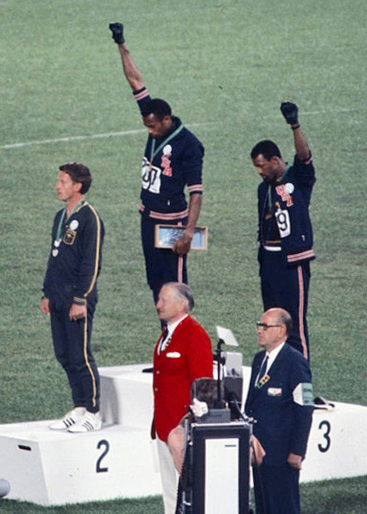
(l-r) Peter Norman, Tommie Smith, and John Carlos during the award ceremony of the 200 m race at the Mexican Olympic games. (creative commons, Wikipedia)
But what other nuances are in the photo? What other critiques are masked by this proscribed sound? In The Sovereignty of Quiet (2012), Kevin Quashie invites us to:
Look again, closely, at the pictures from that day and you can see something more than the certainty of public assertiveness. See, for example, how the severity of Smith’s salute is balanced by the yielding of Carlos’s raised arm. And then notice how the sharpness of their gesture is complemented by one telling detail: that their heads are bowed as if in prayer, that Smith, in fact, has his eyes closed. The effect of their bowed heads is to suggest intimacy…How is it that they are largely icons of resistance, and that vulnerability and interiority are not among all things we are encouraged to read on their image? (Quashie 2-3).
Because of racialized history, we have limited our conceptualization of blackness in literature, film and other mediums. We only hear blackness as it pertains to resistance, grief, and anger—the reaction to whiteness. Black people are verbs instead of nouns. The ’68 Olympic photo is particularly special as it captures the steadfast Western influence that infects our synesthesia because of political and social histories. Moreover, such defects are even internalized in the black artist. As an identity, Quashie argues that “blackness is always supposed to tell us something about race or racism, or about America, or violence, struggle and triumph or poverty and hopefulness (4). Sonically this means blackness in contemporary discourse is critiqued by its decibel of resistance. We cannot read or hear blackness without integrating white pain.
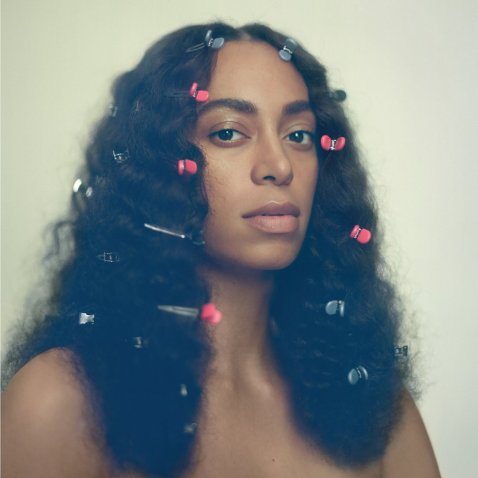
Much like typical readings of the ’68 olympic photo, Solange’s album cover might elicit themes of self-esteem, black-nationalism or even aggression. However, Solange quietly sounds her life transition and personal vulnerability, via her photo, if we would hear it.
But confining view of blackness as pain and resistance prevents us—including those who are black-identifying—from noticing and celebrating vulnerability, grace, and the interiority. Quashie describes interiority as the “inner reservoir of thoughts, feelings, desires, fears, ambitions that shape a human self. . .[it is] expansive, voluptuous, creative; impulsive…more akin to hunger, memory forgetting, the edges of all the humanness one has” (20-21). It’s the tender part of identity shown through subtlety—the desires and dreams spoken through prayer. It’s Martin Luther King Jr. tapping his feet to Coltrane or Tupac Shakur watching dancers to perfect his plié—it’s the soft falsetto Solange uses in her album that bolsters emotional healing and draws avian imagery.
Asking what quiet can bring to our personal, cultural, historical and political understandings of blackness does not signal the imposition of respectability politics or desire for post-racialism. Rather, Quashie’s theory considers how whiteness has constructed and limited our senses as it relates to blackness. Blackness will remain in resistance because of systemic oppression but there is so more to black life. The element of analysis and the sensorium itself needs expansion.
Subsequently, Solange Knowles’ recent album innovatively captures resistance but centers other aspects of black sonic experience: individualization—the nuances of interiority regarding mental health, paternity and forgiveness.
The first track of the song, “Rise,” flutters an anthem of well-being:
Fall in your ways so you can crumble.
Fall in your ways so you can sleep at night.
Fall in your ways so you can wake up and rise
Her tone and pitch is sweet, light and matter-of-fact. The repetition and delivery is similar to a lullaby —reminiscent of Langston Hughes’s poem “Mother to Son”—a soft plea to rest, welcome weariness and any conflict with authenticity but to also travel with a straight back and head looking forward. Fall in your ways… At the 1.11 mark, there is a break of silence in the song; thereafter, the synthesizer yawns into melody with a futuristic twang. This Afrofuturistic moment—the study of blackness as it relates to space, technology, art and futurism— continues later with the production and lyrical content with “Borderline (An Ode To Self Care).” Notably, “Rise” introduces the sonic atmosphere of the record through Solange’s honeyed tonal drops and leaps when she sings “So you can sleep at night.” Her delivery mimics a bird within a thermal lift—her voice calling the plight of the Flying African—the myth that Igbo people escaped slavery by flying back to Africa at night. “Fall in your ways” whispers the discovery and preservation of one’s interiority. Rise emphasizes inner, restorative practice.

Charles Dickson’s “Wishing on a Star” at the California African American Museum, Los Angeles, image by Flickr User ATOMIC Hot Links (CC BY-NC-ND 2.0)
Solange also highlights interiority through her album interludes, mostly narrated by Master P, rapper and owner of No Limit Records. This also relates to her inclusion of paternity alongside maternity—a bright distinction considering her identification with black womanhood and the historical racist exclusion of black fathers in the home (e.g. the Moynihan Report and welfare polices). Solange notes the importance of her father and Master P’s presence with an interview with her sister:
I remember reading or hearing things about Master P that reminded me so much of Dad growing up. And I wanted a voice throughout the record that represented empowerment and independence, the voice of someone who never gave in, even when it was easy to lose sight of everything that he built.
Thus the precursor to each song draws from Master P’s embodiment of kinship, lineage and esteem, traits the teenaged-Solange admired and later internalizes into her interiority.
Through these interludes, Solange redresses Master P’s sonic history, particularly his famous rap catch phrase. As he explains in the interlude “Pedestals“:
I never cried or nothing, and that’s where the, ‘Make ’em say uhh uhh,’ that’s like my pain…that’s my battle cry.
Solange spotlights Master P’s quiet–and accompanying tonal signature—while showing its relation to “louder” elements of masculinization and coping. P’s insoluble moan is a staple throughout his songs and a signature in other No Limit artists’s songs as well.
No longer limited to its “loudness” or flattened to party anthem accompaniment—as this song and sound has all too often been characterized—P’s “battle cry” calls out, sounding a communal harkening of empathy and relation.
. . .uhh uhh. . .
In tracks such as Don’t Touch My Hair, Solange makes Black Lives Matter a key sonic element in her album, but as with her rendering of Master P, in a way that “unlearns” previous assumptions and limitations and reveals how the Black Lives Matter Movement and network is pigeon-holed by American racial ideology and its accompanying sonic constriction. While the catalyst for the movement was white supremacy and police brutality, the movement’s guiding principles also highlight interiority-infused concepts of loving engagement, empathy, and restorative justice. Patrisse Cullors, co-founder of the network, has been vocal about the movement’s integration of the arts and the reimagination of blackness. The focus on black outcry and white sirens muffles the movement’s quiet. The consequences of ignoring the interiority dismisses the whole, black self.
Belying a similar dynamic, many listeners have pinned “Don’t Touch My Hair” as a declaration to whiteness, but considering Solange’s point of view, lyrics and gentle sonic value, makes the meaning of the stretch far wider.
As Solange divulges through the sound of the Mardi Gras trumpet that blares throughout the chorus and changes in volume and texture after the quiet interlude ends at 3:34, black hair is spiritual. As the trumpets blasts in hosannas in gospel celebration, the track also sounds honor, adoration, tribute and preservation in the thick of American, racialized fixation.
The unlearning of confined sensory orientation that Solange’s A Seat at The Table and “An Ode To. . .” demands unveils a progression to time travel, what Michelle Commander’s recent book calls Afro-Atlantic Flight. Solange further incorporates such spiritual, diasporic flight with her homage to Parliament-Funkadelic artist Junie Morrison–who passed just a few months after the record came out–in her futuristic track, “Junie,” punctuated with the light, avian melisma, one of her sonic signatures on the record:
Let’s go to moonlight, then they will never find
Let’s go to home, free from the mother mind.Come on along, along, along, along, along, along, along
—
Featured Image of Solange by Flickr User Greg Chow (CC BY-NC-ND 2.0)
—
Kimberly Williams oversees a Black Cultural Center at Virginia Tech where her work includes advocacy, policy, programming and bloodletting. She received her M.F.A. in poetry at Cornell University where she also became a Callaloo Oxford University fellow. Her thesis studied the sonic flight from the Stono Rebellion into contemporary dance and household rhythm. You can find her work in Gulf Coast, Callaloo, Drunken Boat and more. At night, you can catch her watching 90s live performances of Michael Jackson or Nine Inch Nails.
—
 REWIND! . . .If you liked this post, you may also dig:
The Listening Body in Death –Denise Gill
Black Mourning, Black Movement(s): Savion Glover’s Dance for Amiri Baraka –Kristin Moriah
Moonlight’s Orchestral Manoeuvers: A duet by Shakira Holt and Christopher Chien
How not to listen to Lemonade: music criticism and epistemic violence–Robin James
Share this:

SO! Amplifies: Allison Smartt, Sound Designer of MOM BABY GOD and Mixed-Race Mixtape
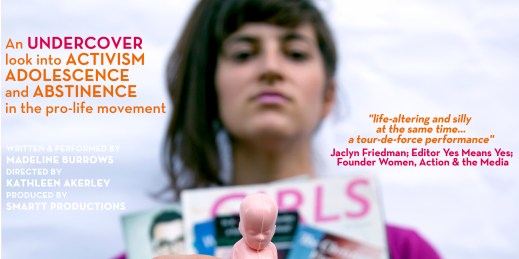
 SO! Amplifies. . .a highly-curated, rolling mini-post series by which we editors hip you to cultural makers and organizations doing work we really really dig. You’re welcome!
—
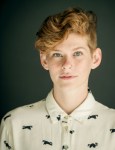
Currently on the faculty and the associate technical director of California Institute of the Arts Sharon Lund Disney School of Dance, Allison Smartt worked for several years in Hampshire’s dance program as intern-turned-program assistant. A sound engineer, designer, producer, and educator for theater and dance, she has created designs seen and heard at La MaMa, The Yard, Arts In Odd Places Festival, Barrington Stage Company, the Five College Consortium, and other venues.
Allison Smartt
She is also the owner of Smartt Productions, a production company that develops and tours innovative performances about social justice. Its repertory includes the nationally acclaimed solo-show about reproductive rights, MOM BABY GOD, and the empowering, new hip-hop theatre performance, Mixed-Race Mixtape. Her productions have toured 17 U.S. cities and counting.
Ariel Taub is currently interning at Sounding Out! responsible for assisting with layout, scoping out talent and in the process uncovering articles that may relate to or reflect work being done in the field of Sound Studies. She is a Junior pursuing a degree in English and Sociology from Binghamton University.
__
Recently turned on to several of the projects Allison Smartt has been involved in, I became especially fascinated with MOM BABY GOD 3.0, of which Smartt was sound designer and producer. The crew of MOM BABY GOD 3.o sets the stage for what to expect in a performance with the following introduction:
Take a cupcake, put on a name tag, and prepare to be thrown into the world of the Christian Right, where sexual purity workshops and anti-abortion rallies are sandwiched between karaoke sing-alongs, Christian EDM raves and pro-life slumber parties. An immersive dark comedy about American girl culture in the right-wing, written and performed by Madeline Burrows. One is thrown into the world of the Christian Right, where sexual purity workshops and anti-abortion rallies are sandwiched between karaoke sing-alongs, Christian EDM raves and pro-life slumber parties.
It’s 2018 and the anti-abortion movement has a new sense of urgency. Teens 4 Life is video-blogging live from the Students for Life of America Conference, and right-wing teenagers are vying for popularity while preparing for political battle. Our tour guide is fourteen-year-old Destinee Grace Ramsey, ascending to prominence as the new It-Girl of the Christian Right while struggling to contain her crush on John Paul, a flirtatious Christian boy with blossoming Youtube stardom and a purity ring.
MOM BABY GOD toured nationally to sold-out houses from 2013-2015 and was the subject of a national right-wing smear campaign. In a newly expanded and updated version premiering at Forum Theatre and Single Carrot Theatre in March 2017, MOM BABY GOD takes us inside the right-wing’s youth training ground at a more urgent time than ever.
I reached out to Smartt about these endeavors with some sound-specific questions. What follows is our April 2017 email exchange [edited for length].
Ariel Taub (AT): What do you think of the voices Madeline Burrows [the writer and solo actor of MOM BABY GOD] uses in the piece? How important is the role of sound in creating the characters?
Allison Smartt (AS): I want to accurately represent Burrows’s use of voice in the show. For those who haven’t seen it, she’s not an impersonator or impressionist conjuring up voices for solely comedy’s sake. Since she is a woman portraying a wide range of ages and genders on stage and voice is a tool in a toolbox she uses to indicate a character shift. Madeline has a great sense of people’s natural speaking rhythms and an ability to incorporate bits of others’ unique vocal elements into the characters she portrays. Physicality is another tool. Sound cues are yet another…lighting, costume, staging, and so on.
I do think there’s something subversive about a queer woman voicing ideology and portraying people that inherently aim to repress her existence/identity/reproductive rights.
Many times, when actors are learning accents they have a cue line that helps them jump into that accent. Something that they can’t help but say in a southern, or Irish, or Canadian accent. In MOM BABY GOD, I think of my sound design in a similar way. The “I’m a Pro-Life Teen” theme is the most obvious example. It’s short and sweet, with a homemade flair and most importantly: it’s catchy. The audience learns to immediately associate that riff with Destinee (the host of “I’m a Pro-Life Teen”), so much so that I stop playing the full theme almost immediately, yet it still commands the laugh and upbeat response from the audience.
AT: Does [the impersonation and transformation of people on the opposite side of a controversial issues into] characters [mark them as] inherently mockable? (I asked Smartt about this specifically because of the reaction the show elicited from some people in the Pro-Life group.)
AS: Definitely not. I think the context and intention of the show really humanizes the people and movement that Madeline portrays. The show isn’t cruel or demeaning towards the people or movement – if anything, our audience has a lot of fun. But it is essential that Madeline portray the type of leaders in the movement (in any movement really) in a realistic, yet theatrical way. It’s a difficult needle to thread and think she does it really well. A preacher has a certain cadence – it’s mesmerizing, it’s uplifting. A certain type of teen girl is bubbly, dynamic. How does a gruff (some may say manly), galvanizing leader speak? It’s important the audience feel the unique draw of each character – and their voices are a large part of that draw.
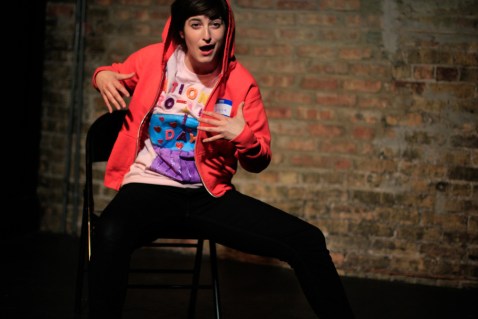
Madeline Burrows in character in MOM BABY GOD (National Tour 2013-2015). Photos by Jessica Neria
AT: What sounds [and sound production] were used to help carry the performance [of MOM BABY GOD]? What role does sound have in making plays [and any performance] cohesive?
AS: Sound designing for theatre is a mix of many elements, from pre-show music, sound effects and original music to reinforcement, writing cues, and sound system design. For a lot of projects, I’m also my own sound engineer so I also implement the system designs and make sure everything functions and sounds tip top.
Each design process is a little different. If it’s a new work in development, like MOM BABY GOD and Mixed-Race Mixtape, I am involved in a different way than if I’m designing for a completed work (and designing for dance is a whole other thing). There are constants, however. I’m always asking myself, “Are my ideas supporting the work and its intentions?” I always try to be cognizant of self-indulgence. I may make something really, really cool but that ultimately, after hearing it in context and conversations with the other artistic team members, is obviously doing too much more than supporting the work. A music journalism professor I had used to say, “You have to shoot that puppy.” Meaning, cut the cue you really love for the benefit of the overall piece.
I like to set myself limitations to work within when starting a design. I find that narrowing my focus to say…music only performed on harmonica or sound effects generated only from modes of transportation, help get my creative juices flowing (Sidenote: why is that a phrase? It give me the creeps)[. . .]I may relinquish these limitations later after they’ve helped me launch into creating a sonic character that feels complex, interesting, and fun.
AT: The show is described as being comprised of, “karaoke sing-alongs, Christian EDM raves and pro-life slumber parties,” each of these has its own distinct associations, how do “sing alongs” and “raves” and our connotations with those things add to the pieces?
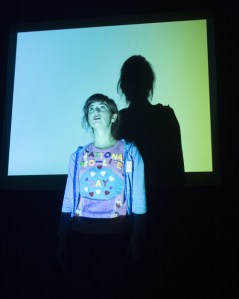
Madeline Burrows in character in MOM BABY GOD (National Tour 2013-2015). Photos by Jessica Neria
AS: Since sound is subjective, the associations that you make with karaoke sing-alongs are probably slightly different from what I associated with karaoke sing-alongs. You may think karaoke sing-along = a group of drunk BFFs belting Mariah Carey after a long day of work. I may think karaoke sing-alongs = middle aged men and women shoulder to shoulder in a dive bar singing “Friends In Low Places” while clinking their glasses of whiskey and draft beer. The similarity in those two scenarios is people singing along to something, but the character and feeling of each image is very different. You bring that context with you as you read the description of the show and given the challenging themes of the show, this is a real draw for people usually resistant to solo and/or political theatre. The way the description is written and what it highlights intentionally invites the audience to feel invited, excited, and maybe strangely upbeat about going to see a show about reproductive rights.
As a sound designer and theatre artist, one of my favorite moments is when the audience collectively readjusts their idea of a karaoke sing-along to the experience we create for them in the show. I feel everyone silently say, “Oh, this is not what I expected, but I love it,” or “This is exactly what I imagined!” or “I am so uncomfortable but I’m going with it.” I think the marketing of the show does a great job creating excited curiosity, and the show itself harnesses that and morphs it into confused excitement and surprise (reviewers articulate this phenomenon much better that I could).
AT: In this video the intentionally black screen feels like deep space. What sounds [and techniques] are being used? Are we on a train, a space ship, in a Church? What can you [tell us] about this piece?
AS: There are so many different elements in this cue…it’s one of my favorites. This cue is lead in and background to Destinee’s first experience with sexual pleasure. Not to give too much away: She falls asleep and has a sex dream about Justin Bieber. I compiled a bunch of sounds that are anticipatory: a rocket launch, a train pulling into a station, a remix/slowed down version of a Bieber track. These lead into sounds that feel more harsh: alarm clocks, crumpling paper…I also wanted to translate the feeling of being woken up abruptly from a really pleasant dream…like you were being ripped out of heaven or something. It was important to reassociate for Destinee and the audience, sounds that had previously brought joy with this very confusing and painful moment, so it ends with heartbeats and church bells.
I shoved the entire arc of the show into this one sound cue. And Madeline and Kathleen let me and I love them for that.
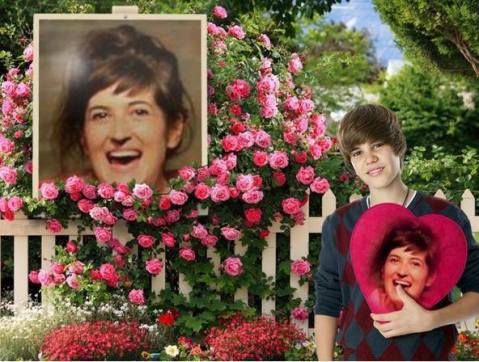
from madelineburrows.com
AT: What do individuals bring of themselves when they listen to music? How is music a way of entering conversations otherwise avoided?
AS: The answer to this question is deeper than I can articulate but I’ll try.
Talking about bias, race, class, even in MOM BABY GOD introducing a pro-life video blog – broaching these topics are made easier and more interesting through music. Why? I think it’s because you are giving the listener multiple threads from which to sew their own tapestry…their own understanding of the thing. The changing emotions in a score, multiplicity of lyrical meaning, tempo, stage presence, on and on. If you were to just present a lecture on any one of those topics, the messages feel too stark, too heavy to be absorbed (especially to be absorbed by people who don’t already agree with the lecture or are approaching that idea for the first time). Put them to music and suddenly you open up people’s hearts.
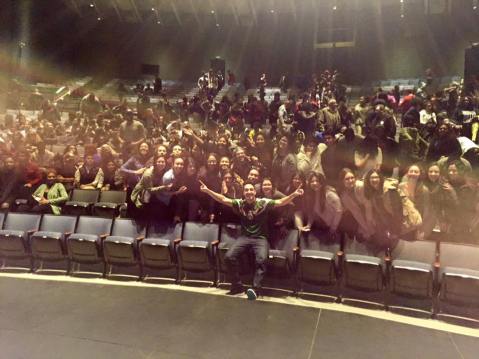
Post- Mixed-Race Mixtape love, William Paterson University, 2016 Photo credit: Allison Smartt
As a sound designer, I have to be conscious of what people bring to their listening experience, but can’t let this rule my every decision. The most obvious example is when faced with the request to use popular music. Take maybe one of the most overused classics of the 20th century, “Hallelujah” by Leonard Cohen. If you felt an urge just now to stop reading this interview because you really love that song and how dare I naysay “Hallelujah” – my point has been made. Songs can evoke strong reactions. If you heard “Hallelujah” for the first time while seeing the Northern Lights (which would arguably be pretty epic), then you associate that memory and those emotions with that song. When a designer uses popular music in their design, this is a reality you have to think hard about.
Cassette By David Millan on Flickr.
It’s similar with sound effects. For Mixed-Race Mixtape, Fig wanted to start the show with the sound of a cassette tape being loaded into a deck and played. While I understood why he wanted that sound cue, I had to disagree. Our target demographic are of an age where they may have never seen or used a cassette tape before – and using this sound effect wouldn’t elicit the nostalgic reaction he was hoping for.
Regarding how deeply the show moves people, I give all the credit to Fig’s lyrics and the entire casts’ performance, as well as the construction of the songs by the musicians and composers. As well as to Jorrell, our director, who has focused the intention of all these elements to coalesce very effectively. The cast puts a lot of emotion and energy into their performances and when people are genuine and earnest on stage, audiences can sense that and are deeply engaged.
I do a lot of work in the dance world and have come to understand how essential music and movement are to the human experience. We’ve always made music and moved our bodies and there is something deeply grounding and joining about collective listening and movement – even if it’s just tapping your fingers and toes.
AT: How did you and the other artists involved come up with the name/ idea for Mixed-Race Mixtape? How did the Mixed-Race Mixtape come about?
AS: Mixed-Race Mixtape is the brainchild of writer/performer Andrew “Fig” Figueroa. I’ll let him tell the story.
Andrew “Fig” Figueroa, Hip-Hop artist, theatre maker, and arts educator from Southern California
A mixtape is a collection of music from various artists and genres on one tape, CD or playlist. In Hip-Hop, a mixtape is a rapper’s first attempt to show the world there skills and who they are, more often than not, performing original lyrics over sampled/borrowed instrumentals that compliment their style and vision. The show is about “mixed” identity and I mean, I’m a rapper so thank God “Mixed-Race” rhymed with “Mixtape.”
The show grew from my desire to tell my story/help myself make sense of growing up in a confusing, ambiguous, and colorful culture. I began writing a series of raps and monologues about my family, community and youth and slowly it formed into something cohesive.
AT: I love the quote, “the conversation about race in America is one sided and missing discussions of how class and race are connected and how multiple identities can exist in one person,” how does Mixed-Race Mixtape fill in these gaps?
AS: Mixed-Race Mixtape is an alternative narrative that is complex, personal, and authentic. In America, our ideas about race largely oscillate between White and Black. MRMT is alternative because it tells the story of someone who sits in the grey area of Americans’ concept of race and dispels the racist subtext that middle class America belongs to White people. Because these grey areas are illuminated, I believe a wide variety of people are able to find connections with the story.
AT: In this video people discuss the connection they [felt to the music and performance] even if they weren’t expecting to. What do you think is responsible for sound connecting and moving people from different backgrounds? Why are there the assumptions about the event that there are, that they wouldn’t connect to the Hip Hop or that there would be “good vibes.”
AS: Some people do feel uncertain that they’d be able to connect with the show because it’s a “hip-hop” show. When they see it though, it’s obvious that it extends beyond the bounds of what they imagine a hip-hop show to be. And while I’ve never had someone say they were disappointed or unmoved by the show, I have had people say they couldn’t understand the words. And a lot of times they want to blame that on the reinforcement.
I’d argue that the people who don’t understand the lyrics of MRMT are often the same ones who were trepidatious to begin with, because I think hip-hop is not a genre they have practice listening to. I had to practice really actively listening to rap to train my brain to process words, word play, metaphor, etc. as fast as rap can transmit them. Fig, an experienced hip-hop listener and artist amazes me with how fast he can understand lyrics on the first listen. I’m still learning. And the fact is, it’s not a one and done thing. You have to listen to rap more than once to get all the nuances the artists wrote in. And this extends to hip-hop music, sans lyrics. I miss so many really clever, artful remixes, samples, and references on the first listen. This is one of the reasons we released an EP of some of the songs from the show (and are in the process of recording a full album).
.
The theatre experience obviously provides a tremendously moving experience for the audience, but there’s more to be extracted from the music and lyrics than can be transmitted in one live performance.
AT: What future plans do you have for projects? You mentioned utilizing sounds from protests? How is sound important in protest? What stands out to you about what you recorded?
AS: I have only the vaguest idea of a future project. I participate in a lot of rallies and marches for causes across the spectrum of human rights. At a really basic level, it feels really good to get together with like minded people and shout your frustrations, hopes, and fears into the world for others to hear. I’m interested in translating this catharsis to people who are wary of protests/hate them/don’t understand them. So I’ve started with my iPhone. I record clever chants I’ve never heard, or try to capture the inevitable moment in a large crowd when the front changes the chant and it works its way to the back.
.
I record marching through different spaces…how does it sound when we’re in a tunnel versus in a park or inside a building? I’m not sure where these recordings will lead me, but I felt it was important to take them.
—
REWIND! . . .If you liked this post, you may also dig:
Beyond the Grandiose and the Seductive: Marie Thompson on Noise
Moonlight’s Orchestral Manoeuvers: A duet by Shakira Holt and Christopher Chien
Aural Guidings: The Scores of Ana Carvalho and Live Video’s Relation to Sound
Share this:


Current Top Posts





April 2021

January 2020

November 2019

October 2019

August 2019

April 2014

November 2017

March 2015

December 2017

October 2015
 Sounding Out!
Recent Comments