
“Most pleasant to the ear”: W. E. B. Du Bois’s Itinerant Intellectual Soundscapes
Inspired by the recent Black Perspectives “W.E.B. Du Bois @ 150” Online Forum, SO!’s “W.E.B. Du Bois at 150” amplifies the commemoration of the occasion of the 150th anniversary of Du Bois’s birth in 2018 by examining his all-too-often and all-too-long unacknowledged role in developing, furthering, challenging, and shaping what we now know as “sound studies.”
It has been an abundant decade-plus (!!!) since Alexander Weheliye’s Phonographies “link[ed] the formal structure of W.E.B. Du Bois’s The Souls of Black Folk to the contemporary mixing practices of DJs” (13) and we want to know how folks have thought about and listened with Du Bois in their work in the intervening years. How does Du Bois as DJ remix both the historiography and the contemporary praxis of sound studies? How does attention to Du Bois’s theories of race and sound encourage us to challenge the ways in which white supremacy has historically shaped American institutions, sensory orientations, and fields of study? What new futures emerge when we listen to Du Bois as a thinker and agent of sound?
Over the next two months, we will be sharing work that reimagines sound studies with Du Bois at the center. Pieces by Phillip Luke Sinitiere, Kristin Moriah, Aaron Carter, Austin Richey, Julie Beth Napolin, and Vanessa Valdés, move us toward a decolonized understanding and history of sound studies, showing us how has Du Bois been urging us to attune ourselves to it.
Readers, today’s post by Phillip Luke Sinitere offers a wonderful introduction to W.E.B. Du Bois’s life’s work if he is new to you, and a finely-wrought analysis of what the sound of Du Bois’s voice–through first hand accounts and recordings–offers folks already well-acquainted.
–Jennifer Lynn Stoever and Liana Silva, Eds.
In her 1971 book His Day is Marching On: A Memoir of W. E. B. Du Bois, Shirley Graham Du Bois recalled about her late spouse’s public lectures that “everyone in that hall followed his words with close attention. Though he read from a manuscript replete with statistics and sociological measurements, he reached the hearts as well as the minds of his listeners.” Shirley’s memory about W. E. B.’s lectures invites reflection on the social and political significance of what I call his “itinerant intellectual soundscapes”—the spaces in which he spoke as an itinerant intellectual, a scholar who traveled annually on lecture tours to speak on the historical substance of contemporary events, including presentations annually during Negro History Week.
Yet Du Bois’s lectures took place within and across a soundscape he shared with an audience. In what follows, I center the sound of Du Bois’s voice literally and figuratively to 1) document his itinerant intellectual labor, 2) analyze how listeners responded to the soundscapes in which his speeches resided, and 3) explore what it means to listen to Du Bois in the present historical moment.
***
Upon completing a Ph.D. in history at Harvard in 1895, and thereafter working as a professor, author, and activist for the duration of his career until his death in 1963, Du Bois spent several months each year on lecture trips across the United States. As biographers and Du Bois scholars such as Nahum Chandler, David Levering Lewis, and Shawn Leigh Alexander document, international excursions to Japan in the 1930s included public speeches. Du Bois also lectured in China during a global tour he took in the late 1950s.
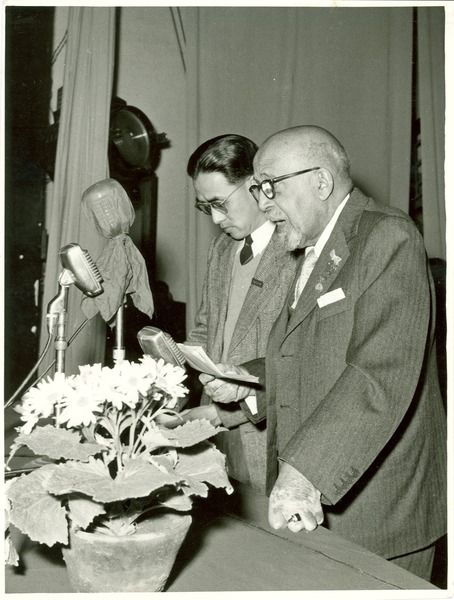
W. E. B. Du Bois delivering a speech in front of a microphone during trip to China, circa 1959, Courtesy of the Massachusetts Digital Commonwealth, physical image located in Special Collections and University Archives, University of Massachusetts Amherst Libraries
In his biographical writings, Lewis describes the “clipped tones” of Du Bois’s voice and the “clipped diction” in which he communicated, references to the accent acquired from his New England upbringing in Great Barrington, Massachusetts. Reporter Cedric Belfrage, editor of the National Guardian for which Du Bois wrote between the 1940s and 1960s, listened to the black scholar speak at numerous Guardian fundraisers. “On each occasion he said just what needed saying, without equivocation and with extraordinary eloquence,” Belfrage described. “The timbre of his public-address voice was as thrilling in its way as that of Robeson’s singing voice. He wrote and spoke like an Old Testament prophet.” George B. Murphy heard Du Bois speak when he was a high school student and later as a reporter in the 1950s; he recalled the “crisp, precise English of [Du Bois’s] finely modulated voice.”
One benefit of Du Bois’s long life was its intersection with technological advances in audio recording and amplification, the dynamics of which literary historian Jennifer Lynn Stoever insightfully narrates in The Sonic Color Line. This means that in 2018 we can literally listen to Du Bois’s voice; we can experience sonic dimensions of his intellect and sit with the verbal articulation of his ideas. For example, Smithsonian Folkways released two audio recordings of Du Bois: an April 1960 speech, “Socialism and the American Negro” he delivered in Wisconsin, and a 1961 oral history interview, including a full transcript. Furthermore, in his digitized UMass archive we can read the text of another 1960 speech, “Whither Now and Why” and listen to the audio of that March lecture.
The intersection of these historical artifacts texture understanding of the textual and aural facets of Du Bois’s work as an itinerant intellectual. They give voice to specific dimensions of his late career commitments to socialism and communism and unveil the language he used to communicate his ideas about economic democracy and political equality.
The act of hearing Du Bois took place within and across his itinerant intellectual soundscape was rarely a passive activity, an experience toward which Shirley’s comments above gesture. Those who attended Du Bois’s lectures often commented on listening to his presentations by connecting visual memories with auditory recollections and affective responses.
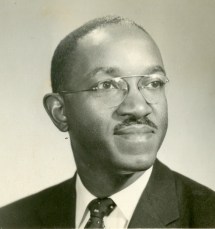
John Hope Franklin, 1950s, while Chair of Department of History at Brooklyn College, Courtesy of Duke University
For example, the late black historian John Hope Franklin penned an autobiographical reflection about his first encounter with Du Bois in Oklahoma in the 1920s at 11 years old. At an education convention with his mother, Franklin commented on Du Bois’s physical appearance: “I recall quite vividly . . . his coming to the stage, dressed in white tie and tails with a ribbon draped across his chest . . . the kind I later learned was presented by governments to persons who had made some outstanding contribution to the government or even humankind.” He then referenced a sonic memory. “I can also remember that voice, resonant and well modulated,” Franklin wrote, “speaking the lines he had written on note cards with a precision and cadence that was most pleasant to the ear . . . the impression he made on me was tremendous, and I would make every effort to hear him in the future wherever and whenever our paths crossed.” While Franklin did not remember the speech’s content, his auditory memories deliver a unique historical impression of the sound of Du Bois’s intellectual labor—a “resonant and well modulated” inspirational voice to which Franklin attributed his own career as an intellectual and historian.
A few years after the Oklahoma lecture, Du Bois gave a February 1927 presentation on interracial political solidarity in Denver during Negro History Week. Two audience members penned letters to him in response to his speech. A minister, A. A. Heist, told Du Bois that his encouragement for interracial work across the color line was bearing fruit through community race relation meetings. Attorney Thomas Campbell’s letter, like Heist’s, confirmed the speech’s positive reception; but it also revealed captivating details about the soundscape. Campbell described the lecture as a “great speech” and a “remarkable address.” “I have never heard you deliver such an eloquent, forceful and impressive speech,” he gushed, to an “appreciative and responsive audience.” Although the speech’s text does not survive, from correspondence we learn about its subject matter and receive details about the soundscape and positive listener responses to his spoken words.

NAACP Pres W.E.B. DuBois speaks Third Baptist Church 1958, San Francisco
The observations of Franklin, Heist, and Campbell collectively disclose pertinent historical, gendered, and racialized dimensions of listening to Du Bois. These historical documents convey what rhetoric scholar Justin Eckstein terms “sound ontology,” the multifaceted relationship between speakers, words, listeners, and the intellectual, cultural, and affective responses generated within such sonic settings. In other words, within the context of each speech’s delivery listeners heard Du Bois speak and felt his words which generated embodied responses. At the intersection of Franklin’s visual and aural memories is a well-dressed regal Du Bois, a male black leader whose presence in Tulsa a handful of years after a destructive race riot perhaps represented recovery and resurrection, whose words and voice commanded authority. Similarly, recollections of a leading lawyer in Denver’s early twentieth-century black community lauded Du Bois’s role in fostering interracial possibility. Campbell’s admission was important; it documents how a male race leader and key figure in one of the nation’s most important interracial organizations, the NAACP, inspired through an impactful, moving, and persuasive lecture collaborative conversations across the color line. Given Du Bois’s stature as a national and international scholar and intellectual leader, Franklin, Heist, and Campbell perhaps expected him to dispense wisdom from travel and study. Nevertheless, the historical record documents an interactive soundscape that emanated from Du Bois’s presence, his words, and the listening audience.
Ethel Ray Nance, a black educator and activist from Minnesota, first met Du Bois during the Harlem Renaissance. After she moved to Seattle in the 1940s, Nance helped to organize his west coast lecture tours and assisted with his United Nations work in 1945. Nance also assembled a memoir of her work with Du Bois, titled “A Man Most Himself.” Her reflections provide a unique personal perspective on Du Bois. She recalled meeting him at a reception held in his honor after a lecture in Minneapolis in the early 1920s. She described the larger soundscape of Du Bois’s lecture, especially how listeners responded to him. “The audience gave him complete attention,” she wrote, “they seemed to want him to go on and on. You could feel a certain strength being transmitted from speaker to listeners.”
Also in Minnesota, around the same time a young black college student named Anna Arnold Hedgeman heard Du Bois lecture at Hamline University. As she listened to a lecture on Pan-Africanism with “rapt attention,” Hedgeman wrote in her 1964 memoir The Trumpet Sounds, she noticed that Du Bois wore “a full dress suit as though he had been born in it” and commented that “his command of the English language was superb.” Hedgeman located her inspiration for a career in education and activism to hearing Du Bois speak. “This slim, elegant, thoughtful brown man had sent me scurrying to the library and I discovered his Souls of Black Folk,” she said.
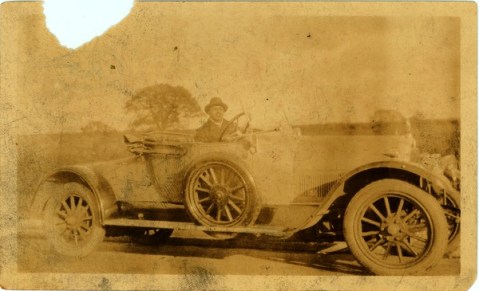
W.E.B. Du Bois on a country road in his own car, 1925, Courtesy of the Massachusetts Digital Commonwealth, physical image located in Special Collections and University Archives, University of Massachusetts Amherst Libraries
Broadly speaking, the listener responses mentioned above capture dimensions of Du Bois’s public reception at arguably the mid-life pinnacle of his career. He was in his 50s during the 1920s, an established scholar, author, and black leader. Yet due to shifting national and international conditions related to capital, labor, and civil rights during the Great Depression and World War II, his politics moved further left. He settled more concretely on socialist solutions to capitalism’s failures. This position became increasingly unpopular as the Cold War dawned. People still listened to Du Bois, but with far more critical and dismissive dispositions.

Page from W.E.B. Du Bois’s voluminous FBI file
Peering further into the historical record, part of Du Bois’s verbal archive and audible history resides in his FBI file. Concerned about his leftist political leanings, the Bureau had surveilled Du Bois starting in the 1940s by reading his publications, and dispatching agents or informants to attend his lectures and speeches. As the Cold War commenced, scrutiny increased. Redacted reports communicated his movements throughout the world in 1960, including a speech at the Russian Embassy in Washington, D. C. when he received the Lenin Peace Prize, and an address he gave in Ghana at a dinner celebrating that nation’s recent independence in 1957. The FBI file states that he received “an ovation as he rose to make a statement” about world peace and a more equitable distribution of resources. Similarly, the report from Ghana relayed that in his address he outlined two divergent world systems, “the socialism of Karl Marx leading to communism, and private capitalism as developed by North America and Western Europe.”
The bureaucratic construction of FBI reports reveals less about the audibility of Du Bois’s voice. However, unlike the listener reports presented above, the technical nature of bureaucratic communications offer a great deal more about the content of his speeches and thus documents another sense in which people—presumably FBI agents or informants—heard or listened to Du Bois as part of their sonic surveillance.
Du Bois’s audible history invests new meaning into his work as a scholar and public intellectual. Through John Hope Franklin, Shirley Graham Du Bois, and Anna Arnold Hedgeman we “see” Du Bois lecturing and speaking, in effect the public presence of a scholar we tend to know more readily through the printed words of his publications. With Thomas Campbell and Ethel Ray Nance—and from a different vantage point his FBI files—we “feel” the power of Du Bois’s words and the affective experience of his verbal constructions. Whether found in historical documents or narrated through vivid descriptions of the “clipped” aspects of his voice’s literal sound, investigating Du Bois’s audible history innovatively humanizes a towering scholar mostly readily known through his published words.
Attending to the audible and archival records of his life and times, we not only encounter the sonic dimensions of his literal voice, we observe how ordinary people listened to him and responded to his ideas. Some embraced his perspectives while others, especially during the Cold War, denounced his socialist vision of the world. Yet this is where the redactions in the FBI files ironically speak loudest: Du Bois’s ideas persisted, and survived. Scholars and activists amplified his words and retooled his ideas in service of black liberation, social justice, and economic equality.
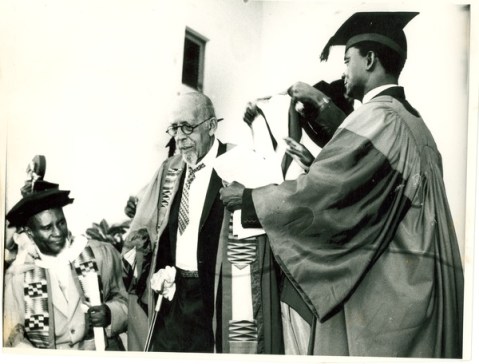
W.E.B. Du Bois receiving honorary degree on his 95th birthday, University of Ghana, Accra, 1963, February 23, 1963,Courtesy of the Massachusetts Digital Commonwealth, physical image located in Special Collections and University Archives, University of Massachusetts Amherst Libraries
By literally listening to and sitting with an audible Du Bois today there’s an opportunity to mobilize affect into action, a version of what Casey Boyle, James J. Brown, Jr. and Steph Ceraso call “transduction.” Du Bois’s voice digitized delivers rhetoric within yet beyond the computer screen. It (re)enters the world in a contemporary soundscape. Hearing his voice produces affect and thought; and thought provokes action or inspires creativity. Such a “mediation of meaning” shows that contemporary listeners inhabit a soundscape with Du Bois. Whether a scholar listens to Du Bois in an archive, students and teachers engage his voice in the classroom, or anyone privately at home leisurely tunes into his speeches, time, space, and place collectively determine how wide and expansive the Du Bois soundscape is. Advancements in communication, digital and sonic technologies mean that across whatever modality his voice moves there’s a sense in which Du Bois remains an itinerant intellectual.
—
Phillip Luke Sinitiere is a W. E. B. Du Bois Visiting Scholar at the University of Massachusetts Amherst in 2018-19. He is also Professor of History at the College of Biblical Studies, a predominately African American school located in Houston’s Mahatma Gandhi District. A scholar of American religious history and African American Studies, his books include Christians and the Color Line: Race and Religion after Divided by Faith (Oxford University Press, 2013); Protest and Propaganda: W. E. B. Du Bois, The Crisis, and American History (University of Missouri Press, 2014) and Salvation with a Smile: Joel Osteen, Lakewood Church, and American Christianity (New York University Press, 2015). Currently, he is at work on projects about W. E. B. Du Bois’s political and intellectual history, as well as a biography of twentieth-century writer James Baldwin. In 2019, Northwestern University Press will publish his next book, Citizen of the World: The Late Career and Legacy of W. E. B. Du Bois.
—
 REWIND! . . .If you liked this post, you may also dig:
Black Mourning, Black Movement(s): Savion Glover’s Dance for Amiri Baraka –Kristin Moriah
Saving Sound, Sounding Black, Voicing America: John Lomax and the Creation of the “American Voice”–Toniesha Taylor
The Sounds of Anti-Anti-Essentialism: Listening to Black Consciousness in the Classroom–Carter Mathes
“I Love to Praise His Name”: Shouting as Feminine Disruption, Public Ecstasy, and Audio-Visual Pleasure–Shakira Holt
Share this:

Episode I: The Greatest Sound in the Galaxy: Sound and Star Wars
Ever tried listening to a Star Wars movie without the sound? –IGN, 1999
Sound is 50 percent of the motion-picture experience. –George Lucas
In the radio dramatization of Return of the Jedi (1996), a hibernation sickness-blinded Han Solo can tell bounty hunter Boba Fett is in the same room with him just by smelling him. Later this month, Solo: A Star Wars Story (part of the Anthology films, and as you might expect from the title, a prequel to Han Solo’s first appearance in Star Wars: A New Hope) may be able to shed some light on how Han developed this particular skill.
Later in that dramatization, we have to presume Han is able to accurately shoot a blaster blind by hearing alone. Appropriately, then, sound is integral to Star Wars. For every iconic image in the franchise—from R2D2 to Chewbacca to Darth Vader to X-Wing and TIE-fighters to the Millennium Falcon and the light sabers—there is a correspondingly iconic sound. In musical terms, too, the franchise is exemplary. John Williams, Star Wars’ composer, won the most awards of his career for his Star Wars (1977) score, including an Oscar, a Golden Globe, a BAFTA, and three Grammys. Not to mention Star Wars’ equally iconic diegetic music, such as the Mos Eisley Cantina band (officially known as Figrin D’an and the Modal Nodes).
Without sound, there would be no Star Wars. How else could Charles Ross’ One Man Star Wars Trilogy function? In One Man Star Wars, Ross performs all the voices, music, and sound effects himself. He needs no quick costume changes; indeed, in his rapid-fire, verbatim treatment, it is sound (along with a few gestures) that he uses to distinguish between characters. His one-man show, in fact, echoes C-3PO’s performance of Star Wars to the Ewoks in Return of the Jedi, a story told in narration and sound effects far more than in any visuals. “Translate the words, tell the story,” says Luke in the radio dramatization of this scene. That is what sound does in Star Wars.
I believe that the general viewing public is aware on a subconscious level of Star Wars’ impressive sound achievements, even if this is not always articulated as such. As Rick Altman noted in 1992 in his four and a half film fallacies, the ontological fallacy of film—while not unchallenged—began life with André Bazin’s “The Ontology of the Photographic Image,” (1960) which argues that film cannot exist without image. Challenging such an argument not only elevates silent film but also the discipline of film sound generally, so often regarded as an afterthought. “In virtually all film schools,” Randy Thom wrote in 1999, “sound is taught as if it were simply a tedious and mystifying series of technical operations, a necessary evil on the way to doing the fun stuff.”
Film critic Pauline Kael wrote about Star Wars on original release in what Gianlucca Sergi terms a “harmful generalization” that its defining characteristic was its “loudness.” Loud sound does not necessarily equal good sound in the movies, which audiences themselves can sometimes confuse. “High fidelity recordings of gunshots and explosions, and well fabricated alien creature vocalizations” do not equal good sound design alone, as Thom has argued. On the contrary, Star Wars’ achievements, Sergi posited, married technological invention with overall sound concept and refined if not defined the work of sound technicians and sound-conscious directors.
The reason why Star Wars is so successful aurally is because its creator, George Lucas, was invested in sound holistically and cohesively, a commitment that has carried through nearly every iteration of the franchise, and because his original sound designer, Ben Burtt, understood there was an art as well as a science to highly original, aurally “sticky” sounds. Ontologically, then, Star Wars is a sound-based story, as reflected in the existence of the radio dramatizations (more on them later). This article traces the historical development of sound in not only the Star Wars films (four decades of them!) but also in other associated media, such as television and video games as well as examining aspects of Star Wars’ holistic sound design in detail.
A long time ago, in a galaxy far, far away . . .
As Chris Taylor points out, George Lucas “loved cool sounds and sweeping music and the babble of dialogue more than he cared for dialogue itself.” In 1974, Lucas was working on The Radioland Murders, a screwball comedy thriller set in the fictional 1930s radio station WKGL. Radio, indeed, had already made a strong impression on Lucas, such that legendary “Border blaster” DJ Wolfman Jack played an integral part in Lucas’ film American Graffiti (1973). As Marcus Hearn picks up the story, Lucas soon realized that The Radioland Murders were going nowhere (the film would eventually be made in 1994). Lucas then turned his sound-conscious sensibilities in a different direction, in “The Star Wars” project upon which he had been ruminating since his film school days at the University of Southern California. Retaining creative control, and a holistic interest in a defined soundworld, were two aspects Lucas insisted upon during the development of the project that would become Star Wars. Lucas had worked with his contemporary at USC, sound designer and recordist Walter Murch, on THX 1138 (1971) and American Graffiti, and Murch would go on to provide legendary sound work for The Conversation (1974), The Godfather Part II (1974), and Apocalypse Now (1979). Murch was unavailable for the new project, so Lucas then asked producer Gary Kurtz to visit USC to evaluate emerging talent.
Pursuing a Masters degree in Film Production at USC was Ben Burtt, whose BA was in physics. In Burtt, Lucas found a truly innovative approach to film sound which was the genesis of Star Wars’ sonic invention, providing, in Sergi’s words, “audiences with a new array of aural pleasures.” Sound is embodied in the narrative of Star Wars. Not only was Burtt innovative in his meticulous attention to “found sounds” (whereas sound composition for science fiction films has previously relied on electronic sounds), he applied his meticulousness in character terms. Burtt said that Lucas and Kurtz, “just gave me a Nagra recorder and I worked out of my apartment near USC for a year, just going out and collecting sound that might be useful.”

Ben Burtt plays the twang of steel guy wires, which formed the basis of the many blaster sounds (re-creating the moment with Miki Hermann for a documentary). Image by Flickr User: Tom Simpson (CC BY-NC-ND 2.0)
Inherent in this was Burtt’s relationship with sound, in the way he was able to construct a sound of an imaginary object from a visual reference, such as the light saber, described in Lucas’ script and also in concept illustrations by Ralph McQuarrie. “I could kind of hear the sound in my head of the lightsabers even though it was just a painting of a lightsaber,” he said. “I could really just sort of hear the sound maybe somewhere in my subconscious I had seen a lightsaber before.” Burtt also shared with Lucas a sonic memory of sound from the Golden Age of Radio: “I said, `All my life I’ve wanted to see, let alone work on, a film like this.’ I loved Flash Gordon and other serials, and westerns. I immediately saw the potential of what they wanted to do.”
But sir, nobody worries about upsetting a droid
Burtt has described the story of A New Hope as being told from the point of view of the droids (the robots). While Lucas was inspired by Kurosawa’s The Hidden Fortress (1958) to create the characters of droids R2-D2 (“Artoo”) and C-3PO (“Threepio”), the robots are patently non-human characters. Yet, it was essential to imbue them with personalities. There have been cinematic robots since Maria, but Burtt uniquely used sound to convey not only these two robots’ personalities, but many others as well. As Jeanne Cavelos argues, “Hearing plays a critical role in the functioning of both Threepio and Artoo. They must understand the orders of their human owners.” Previous robots had less personality in their voices; for example, Douglas Rain, the voice of HAL in 2001: A Space Odyssey, spoke each word crisply with pauses. Threepio is a communications expert, with a human-like voice, provided by British actor (and BBC Radio Drama Repertory Company graduate) Anthony Daniels. According to Hearn, Burtt felt Daniels should use his own voice, but Lucas was unsure, wanting an American used car salesman voice. Burtt prevailed, creating in Threepio, vocally, “a highly strung, rather neurotic character,” in Daniels’ words, “so I decided to speak in a higher register, at the top of the lungs.” (Indeed, in the Diné translation of Star Wars [see below], Threepio was voiced by a woman, Geri Hongeva-Camarillo, something that the audience seemed to find hilarious.)
Artoo was altogether a more challenging proposition. As Cavelos puts it, “Artoo, even without the ability to speak English, manages to convey a clear personality himself, and to express a range of emotions.” Artoo’s non-speech sounds still convey emotional content. We know when Artoo is frightened;
when he is curious and friendly;
and when he is being insulting.
(And although subtitled scenes of Artoo are amusing, they are not in the least necessary.) Artoo’s language was composed and performed by Burtt, derived from the communication of babies:
we started making little vocal sounds between each other to get a feeling for it. And it dawned on us that the sounds we were making were not actually so bad. Out of that discussion came the idea that the sounds a baby makes as it learns to walk would be a direction to go; a baby doesn’t form any words, but it can communicate with sounds.
The approach to Artoo’s aural communications became emblematic of all of the sounds made by machines in Star Wars, creating a non-verbal language, as Kris Jacobs calls it, the “exclusive province” of the Star Wars universe.
Powers of observation lie with the mind, Luke, not the eyes
According to Gianlucca Sergi, the film soundtrack is composed of sound effects, music, dialogue, and silence, all of which work together with great precision in Star Wars, to a highly memorable degree. Hayden Christensen, who played Anakin Skywalker in Attack of the Clones (2002) and Revenge of the Sith (2005), noted that when filming light saber battles with Ewan McGregor (Obi-Wan Kenobi), he could not resist vocally making the sound effects associated with these weapons.
This a good illustration of how iconic the sound effects of Star Wars have become. As Burtt noted above, he was stimulated by visuals to create the sound effects of the light sabers, though he was also inspired by the motor on a projector in the Department of Cinema at USC. As Todd Longwell pointed out in Variety, the projector hum was combined with a microphone passed in front of an old TV to create the sound. (It’s worth noting that the sounds of weapons were some of the first sound effects created in aural media, as in the case with Wallenstein, the first drama on German radio, in 1924, which featured clanging swords.)
If Burtt gave personality to robots through their aural communications, he created an innovative sound palette for far more than the light sabers in Star Wars. In modifying and layering found sounds to create sounds corresponding to every aspect of the film world—from laser blasts (the sound of a hammer on an antenna tower guy wire) to the Imperial Walkers from Empire Strikes Back (modifying the sound of a machinist’s punch press combined with the sounds of bicycle chains being dropped on concrete)—he worked as meticulously as a (visual) designer to establish cohesion and impact.
Sergi argues that the sound effects in Star Wars can give subtle clues about the objects with which they are associated. The sound of Imperial TIE fighters, which “roar” as they hurtle through space, was made from elephant bellows, and the deep and rumbling sound made by the Death Star is achieved through active use of sub-frequencies. Meanwhile, “the rebel X-wing and Y-wing fighters attacking the Death Star, though small, emit a wider range of frequencies, ranging from the high to the low (piloted as they are by men of different ages and experience).” One could argue that even here, Burtt has matched personality to machine. The varied sounds of the Millennium Falcon (jumping into hyperspace, hyperdrive malfunction), created by Burtt by processing sounds made by existing airplanes (along with some groaning water pipes and a dentist’s drill), give it, in the words of Sergi, a much more “grown-up” sound than Luke’s X-Wing fighter or Princess Leia’s ship, the Tantive IV. Given that, like its pilot Han Solo, the Falcon is weathered and experienced, and Luke and Leia are comparatively young and ingenuous, this sonic shorthand makes sense.
Millions of voices
Michel Chion argues that film has tended to be verbocentric, that is, that film soundtracks are produced around the assumption that dialogue, and indeed the sense of the dialogue rather than the sound, should be paramount and most easily heard by viewers. Star Wars contradicts this convention in many ways, beginning with the way it uses non-English communication forms, not only the droid languages discussed above but also its plethora of languages for various denizens of the galaxy. For example, Cavelos points out that Wookiees “have rather inexpressive faces yet reveal emotion through voice and body language.”
While the 1978 Star Wars Holiday Special may have many sins laid at its door, among them must surely be that the only Wookiee who actually sounds like a Wookiee is Chewbacca. His putative family sound more like tauntauns. Such a small detail can be quite jarring in a universe as sonically invested as Star Wars.
While many of the lines in Star Wars are eminently quotable, the vocal performances have perhaps received less attention than they deserve. As Starr A. Marcello notes, vocal performance can be extremely powerful, capitalizing on the “unique timbre and materiality that belong to a particular voice.” For example, while Lucas originally wanted Japanese actor Toshiro Mifune to play Obi-Wan, Alec Guinness’ patrician Standard English Neutral accent clearly became an important part of the character. For example, when (Scottish) actor Ewan McGregor was cast to play the younger version of Obi-Wan, he began voice lessons to reproduce Guinness’ voice. Ian McDiarmid (also Scottish), a primarily a Shakespearean stage actor, was cast as arch-enemy the Emperor in Return of the Jedi, presumably on the quality of his vocal performance, and as such has portrayed the character in everything from Revenge of the Sith to Angry Birds Star Wars II.
Sergi argues that Harrison Ford as Han Solo performs in a lower pitch but an unstable meter, a characterization explored in the radio dramatizations of A New Hope, Empire Strikes Back, and Return of the Jedi, when Perry King stands in for Ford. By contrast, Mark Hamill voices Luke in two of the radio dramatizations, refining and intensifying his film performances. Sergi argues that Hamill’s voice emphasizes youth: staccato, interrupting/interrupted, high pitch.
And affectionately parodied here:
I would add warmth of tone to this list, perhaps illustrated nowhere better than in Hamill’s performance in episode 1 – “A Wind to Shake the Stars” of the radio dramatization, which depicts much of Luke’s story that never made it onscreen, from Luke’s interaction with his friends in Beggar’s Canyon to a zany remark to a droid (“I know you don’t know, you maniac!”). It will come as no surprise to the listeners of the radio dramatization that Hamill would find acclaim in voice work (receiving multiple nominations and awards). In the cinematic version, Hamill’s performance is perhaps most gripping during the climactic scene in Empire Strikes Back when Darth Vader tells him:
According to Hamill, “what he was hearing from Vader that day were the words, ‘You don’t know the truth: Obi-Wan killed your father.’ Vader’s real dialogue would be recorded in postproduction under conditions easier to control.” More on that (and Vader) shortly.
It has been noted that Carrie Fisher (who was only nineteen when A New Hope was filmed) uses an accent that wavers between Standard North American and Standard Neutral English. Fisher has explained this as her emulating experienced British star of stage and screen Peter Cushing (playing Grand Moff Tarkin).
However, the accents of Star Wars have remained a contentious if little commented upon topic, with most (if not all) Imperial staff from A New Hope onwards speaking Standard Neutral English (see the exception, stormtroopers, further on). In production terms, naturally, this has a simple explanation. In story terms, however, fans have advanced theories regarding the galactic center of the universe, with an allegorical impetus in the form of the American Revolution. George Lucas, after all, is an American, so the heroic Rebels here have echoes with American colonists throwing off British rule in the 18th century, inspired in part because of their geographical remove from centers of Imperial rule like London. Therefore, goes this argument, in Star Wars, worlds like Coruscant are peopled by those speaking Standard Neutral English, while those in the Outer Rim (the majority of our heroes) speak varieties of Standard North American. Star Wars thus both advances and reinforces the stereotype that the Brits are evil.
It is perhaps appropriate, then, that James Earl Jones’ performance as Darth Vader has been noted for sounding more British than American, though Sergi emphasizes musicality rather than accent, the vocal quality over verbocentricity:
The end product is a fascinating mixture of two opposite aspects: an extremely captivating, operatic quality (especially the melodic meter with which he delivers the lines) and an evil and cold means of destruction (achieved mainly through echoing and distancing the voice).
It is worth noting that Lucas originally wanted Orson Welles, perhaps the most famous radio voice of all time, to portray Vader, yet feared that Welles would be too recognizable. That a different voice needed to emanate from behind Vader’s mask than the actor playing his body was evident from British bodybuilder David Prowse’s “thick West Country brogue.” The effect is parodied in the substitution of a Cockney accent from Snatch (2000) for Jones’ majestic tones:
A Newsweek review of Jones in the 1967 play A Great White Hope argued that Jones had honed his craft through “Fourteen years of good hard acting work, including more Shakespeare than most British actors attempt.” Sergi has characterized Jones’ voice as the most famous in Hollywood, in part because in addition to his prolific theatre back catalogue, Jones took bit parts and voiced commercials—“commercials can be very exciting,” he noted. The two competing forces combined to create a memorable performance, though as others have noted, Jones is the African-American voice to the white actors who portrayed Anakin Skywalker (Clive Revill and Hayden Christensen), one British, one American.
Brock Peters, also African American and known for his deep voice, played Vader in the radio dramatizations. Jennifer Stoever notes that in America, the sonic color line “historically contoured, identified, and marked mismatches between ‘sounding white’ and ‘looking black’” (231) whereas the Vader performances “sound black” and “look white.” Andrew Howe in his chapter “Star Wars in Black and White” notes the “tension between black outer visage and white interior identity [ . . ] Blackness is thus constructed as a mask of evil that can be both acquired and discarded.”
Like many of the most important aspects of Star Wars, Vader’s sonic presence is multi-layered, consisting in part of Jones’ voices manipulated by Burtt, as well as the sonic indicator of his presence: his mechanized breathing”
The concept for the sound of Darth Vader came about from the first film, and the script described him as some kind of a strange dark being who is in some kind of life support system. That he was breathing strange, that maybe you heard the sounds of mechanics or motors, he might be part robot, he might be part human, we really didn’t know. [ . . .] He was almost like some robot in some sense and he made so much noise that we had to sort of cut back on that concept.
On radio, a character cannot be said to exist unless we hear from him or her; whether listening to the radio dramatizations or watching Star Wars with our eyes closed, we can always sense the presence of Vader by the sound of his breathing. As Kevin L. Ferguson points out, “Is it accidental, then, that cinematic villains, troubling in their behaviour, are also often troubled in their breathing?” As Kris Jacobs notes, “Darth Vader’s mechanized breathing can’t be written down”—it exists purely in a sonic state.
Your eyes can deceive you; don’t trust them
Music is the final element of Sergi’s list of what makes up the soundtrack, and John Williams’ enduring musical score is the most obvious of Star Wars’ sonic elements. Unlike “classical era” Hollywood film composers like Max Steiner or Erich Korngold who, according to Kathryn Kalinak, “entered the studio ranks with a fair amount of prestige and its attendant power, Williams entered as a contract musician working with ‘the then giants of the film industry,’” moving into a “late-romantic idiom” that has come to characterize his work. This coincided with what Lucas envisioned for Star Wars, influenced as it was by 1930s radio serial culture.
Williams’ emotionally-pitched music has many elements that Kalinak argues link him with the classical score model: unity, the use of music in the creation of mood and character; the privileging of music in moments of spectacle, the way music and dialogue are carefully mixed. This effect is exemplified in the opening of A New Hope, the “Main Title” or, as Dr Lehman has it (see below), “Main/Luke A.” As Sergi notes, “the musical score does not simply fade out to allow the effects in; it is, rather literally, blasted away by an explosion (the only sound clearly indicated in the screenplay).”
As Kalinak points out, it was common in the era of Steiner and Korngold to score music for roughly three-quarters of a film, whereas by the 1970s, it was more likely to be one-quarter. “Empire runs 127 minutes, and Williams initially marked 117 minutes of it for musical accompaniment”; while he used three themes from A New Hope, “the vast majority of music in The Empire Strikes Back was scored specifically for the film.”
Perhaps Williams’ most effective technique is the use of leitmotifs, derived from the work of Richard Wagner, and more complex than a simple repetition of themes. Within leitmotifs, we hear the blending of denotative and connotative associations, as Matthew Bribitzer-Stull notes, “not just a musical labelling of people and things” but also, as Thomas S. Grey puts it, “a matter of musical memory, of recalling things dimly remembered and seeing what sense we can make of them in a new context.” Bribitzer-Stull also notes the complexity of Williams’ leitmotif use, given that tonal music is given for both protagonists and antagonists, resisting the then-cliché of using atonal music for antagonists. In Williams’ score, atonal music is used for accompanying exotic landscapes and fight or action scenes. As Jonathan Broxton explains,
That’s how it works. It’s how the films maintain musical consistency, it’s how characters’ musical identities are established, and it offers the composer an opportunity to create interesting contrapuntal variations on existing ideas, when they are placed in new situations, or face off against new opponents.
Within the leitmotifs, Williams provides various variations and disruptions, such as the harmonic corruption when “the melody remains largely the same, but its harmonization becomes dissonant.” One of the most haunting ways in which Williams alters and reworks his leitmotifs is what Bribitzer-Stull calls “change of texture.”
Frank Lehman of Harvard has examined Williams’ leitmotifs in detail, cataloguing them based on a variety of meticulous criteria. He has noted, for example, that some leitmotifs are used often, like “Rebel Fanfare” which has been used in Revenge of the Sith, A New Hope, The Empire Strikes Back, The Force Awakens, The Last Jedi, and Rogue One. Lehman particularly admires Williams’ skill and restraint, though, in reserving particular leitmotifs for very special occasions. For example, “Luke & Leia,” first heard in Return of the Jedi (both film and radio dramatization) and not again until The Last Jedi:
While Williams’ use of leitmotifs is successful and evocative, not all of Star Wars’ music consists of leitmotifs, as Lehman points out; single, memorable pieces of music not heard elsewhere are still startlingly effective.
In the upcoming Solo, John Williams will contribute a new leitmotif for Han Solo, while all other material will be written and adapted by John Powell. Williams has said in interview that “I don’t make a particular distinction between ‘high art’ and ‘low art.’ Music is there for everybody. It’s a river we can all put our cups into, and drink it, and be sustained by it.” The sounds of Star Wars have sustained it—and us—and perfectly illustrate George Lucas’ investment in the equal power of sound to vision in the cinematic experience. I, for one, am looking forward to what new sonic gems may be unleashed as the saga continues.
On the first week of June, Leslie McMurtry will return with Episode II, focusing on shifts in sound in the newer films and multi-media forms of Star Wars, including radio and cartoons–and, if we are lucky, her take on Solo!
—
Featured Image made here: Enjoy!
—
Leslie McMurtry has a PhD in English (radio drama) and an MA in Creative and Media Writing from Swansea University. Her work on audio drama has been published in The Journal of Popular Culture, The Journal of American Studies in Turkey, and Rádio-Leituras. Her radio drama The Mesmerist was produced by Camino Real Productions in 2010, and she writes about audio drama at It’s Great to Be a Radio Maniac.
—
 REWIND!…If you liked this post, you may also dig:
The Magical Post-Horn: A Trip to the BBC Archive Centre in Perivale–Leslie McMurtry
Speaking American–Leslie McMurtry
Out of Sync: Gendered Location Sound Work in Bollywood–Priya Jaikumar
Share this:


Current Top Posts





April 2021

January 2020

November 2019

October 2019

August 2019

April 2014

November 2017

March 2015

December 2017

October 2015
 Sounding Out!
Recent Comments