
SO! Reads: Roshanak Khesti’s Modernity’s Ear

 “I drifted to another place and time,” reminisces drummer and musicologist Mickey Hart in his 2003 book about salvaging indigenous musical traditions, Songcatchers: In Search of the World’s Music. He continues, “Every day I rushed home, put on the sounds of the Pygmies [on the old RCA Victrola], and melted into their very being.” For the Grateful Dead drummer and world music producer, this experience of disorientation would eventually shape his transformation into a “songcatcher,” or one who seeks to preserve the intangible cultural heritage of indigenous music. In Modernity’s Ear: Race and Gender in World Music, author Roshanak Kheshti interrogates the “origin myth” presented by Hart, along with other collective fantasies and historical narratives that urge listening to world music. She argues that we must look beyond the political and economic exploitation of actual musicians to consider the economy of desire in which the conditions of possibility for such exploitation are formed. In contrast to a critical discourse on musical appropriation and exploitation among ethnomusicologists, one that Martin Stokes acknowledges is “marked by an anxious awareness of complexity and complicity” with world music (835), Kheshti deftly tunes into racialized and gendered yearnings for the recorded sounds of others.

Sounds in bodies
Crucial to Kheshti’s argument is her radical proposition for what occurs as, to briefly return to Hart’s aural memories, the sounds of others “melt” into our “very being.” In a crucial maneuver that focuses on how what is being heard is shaped by the embodied experience of listening, Kheshti proposes that “the object [of listening] becomes a part of the self by being taken into the body” (41). Thus when “sound, the listener’s body, escape, and affect fold into one another” (54-56) in the act of listening (a Derrida-derived encounter that Kheshti dubs “invagination”), selfhood is performatively constituted through the aural other. Moreover, the pleasure of imagining the other through listening, writes Kheshti, is not only the hegemonic form of listening within the world music industry but an experience of desire that Western media markets have historically capitalized upon.

“Whispers” by Flickr user Nicola Colella, CC BY-NC-SA 2.0
Given the ways in which listening embodies an economy of desire, Kheshti tells the history of this libidinal economy through a narrative in which modern selfhood is constructed through the racialized and gendered aural other. The Godzilla in this narrative is the World Music Culture Industry (WMCI), an entity conjured by Kheshti in reference to the historical juncture of comparative musicologists in the early twentieth century with the popular music recording industry, a coupling that she argues spawned the globalized product of modern media known as world music. As a set of hybrid musical practices designed by and large for Western media markets, world music is the key object of her inquiry (in contrast to the diversity of musical practices worldwide).
The imagined listener
 Though the book does not proceed chronologically, the first chapter seeks to interweave memory with history by opening with the early twentieth century. Stressing the pioneering role of white female sound archivists, this chapter is crucial for setting up the historical significance of the feminization of listening, a process familiar to readers of Jonathan Sterne, Louise Michele Newman, and William Howland Kenney. Kheshti puts Songcatcher (2000), a feature film about a fictional comparative musicologist who dives into Appalachian country and “discovers” Scottish and Irish ballads thought to have gone extinct, into conversation with the iconic images of Frances Densmore, an ethnologist affiliated with the Bureau of American Ethnology in the 1910s, who famously staged phonographic recordings of the Blackfoot chief, Mountain Chief (Nin-Na-Stoko). The point of convergence between these materials is the gendered and racialized politics of who was sent where to record whose sounds: white female sound archivists, spurned by their male colleagues and sent to the periphery of their respective fields to practice their craft. Once in the field, these comparative musicologists, one fictional and one real, committed acts of racial appropriation and erasure. The song catcher deracinates Appalachia by stripping the region of its Native American and African-American histories in favor of the ‘collective origin fantasy’ that links European and American genealogies, while Densmore, among others, domesticates indigenous sounds in her work for the Bureau.

Frances Densmore recording Mountain Chief. Picture by Harris & Ewing [Public domain], via Wikimedia Commons
Though the book tends to favor intensive re-readings of critical and psychoanalytic theory (from Adorno and Benjamin to Freud and Lacan) over thick ethnographic description, Kheshti touches upon key encounters in this culture industry to explain how listening to world music engenders modernity’s ear. For instance, she transcribes segments from a radio show in Northern California in which the host, a middle-aged white female, discusses what constitutes “African rhythms” with a record label executive. The two banter about this misnomered subject for some length. The host interprets what she is hearing as “African rhythms coming through.” Her visitor, an expert in world music, affirms and clarifies this attribution: “Yeah, absolutely. The rhythm on this particular song… is from a style of music called Afro-beat… that rhythm you’re hearing is definitely African, so, you don’t know nothing, you’re learning” (52). Kheshti interprets this banter as an example of how world music listeners “cherish” the experience of listening to sonic difference as a moment to live out “fantasy and imaginative play” (54), in other words, that the pleasures experienced through aurality have become definitive of twentieth-century modernity.

“world music 2” by Flickr user wayne marshall, CC BY-NC-SA 2.0
In other chapters, she details how record labels fulfill this fantasy through the production of hybrid sound media. The orchestration of these sounds in the studio not only enables the listener to feel “lost” and transcend the contingencies of the listening event, they also “pronounce and suppress presences and absences of all sorts of bodies and grains” (77). Drawing on phenomenological descriptions of her own listening experiences as well as liner notes and other commercial media, she describes how non-Western sounds are encoded as feminine, whereas the synthetic production and digital manipulation of sounds are rendered techno-logically modern and masculine. Racialized and feminized bodies are put to work in constituting the modern cosmopolitan listener. Furthermore, Kheshti argues that market mobility and aesthetic mobility are gendered male and alterity is gendered female in ways that link, for her, to miscegenation. The listening self reproduces dominant forms of heteronormativity in the consumption of modern sound media.
The listening self reproduces dominant forms of heteronormativity in the consumption of modern sound media.
Kheshti offers a radical alternative to these normative listening practices by turning to field recordings taken by Zora Neale Hurston between 1933 and 1939. Trained by Franz Boas in the traditions of nascent cultural anthropology, Hurston is kin to Densmore and those who worked for the Bureau of American Ethnology a few decades earlier. Like them, she goes to record America’s aural others, or “black folk.” But unlike her white foremothers, Hurston does not attempt to splice out the “noise” of the recordings. She “refuses fidelity” (126). Instead of staging field recordings, she made studio recordings of herself performing songs and discussing rituals. When recording her interlocutors, she interrupts, interjects, and poses directorial cues that Kheshti reads as an attempt to resist the desire to faithfully (re)produce an archive of phonographic subjects.

ca. June 1935, Eatonville, Florida, USA — Author and anthropologist Zora Neale Hurston sitting on a porch in Eatonville, Florida with two musicians, Rochelle French and Gabriel Brown. — Image from Stuff Mom Never Told You
Recommended for advanced graduate students and faculty, this virtuosic and tightly rehearsed tour through critical and psychoanalytic theory offers an ambitious and groundbreaking retake on an industry that we thought we understood, perhaps too intimately. Kheshti asks her readers to hold themselves accountable to their own forms of aural pleasure. In so doing, she offers a fresh perspective on the role of embodiment in relation to knowledge production. Rather than embracing somatic methods of inquiry as a welcome challenge to inductive reasoning, she argues that taking pleasure in listening enables the commodification of desire that sustains the world music culture industry.
Kheshti shifts the discussion of world music qua music (aesthetics, history, representation) towards issues of alterity and sound. As such, this book contributes to sound studies by holding the field accountable for difference, and, by inscribing this accountability within the history of the field itself. Indeed, Modernity’s Ear is about how the forces of desire that constitute the modern listening self are enveloped in the aural other as phonographic subject.
—
Featured image: “ear” by Flickr user Leo Reynolds, CC-BY-NC-SA 2.0
—
Shayna Silverstein is an assistant professor of Performance Studies at Northwestern University. Her research generally examines the performative processes of politics, culture, and society in relation to sound and movement in the contemporary Middle East. Her current book project examines the performance tradition of Syrian dabke as a means for the strategic contestation of social class, postcolonial difference, and gender dynamics in contemporary Syria. She has contributed to peer-reviewed journals and several anthologies including The Arab Avant-Garde: Music, Politics, and Modernity, Islam and Popular Culture, the Sublime Frequencies Companion, and Syria: From Reform to Revolt. Previously a Mellon Postdoctoral Fellow in the Penn Humanities Forum, Shayna received her PhD in Ethnomusicology from the University of Chicago and her BA in History from Yale University.
—
 REWIND!…If you liked this post, you may also dig:
SO! Reads: Daniela Cascella’s F.M.R.L. (Finding Materials for Remembering and Listening) — Kyle D. Stedman
Lokananta: Sounds of Crisis and Recovery from Indonesia’s National Record Company — Ian Coss
Saving Sound, Sounding Black, Voicing America: John Lomax and the Creation of the “American Voice” — Toniesha L. Taylor
Share this:

“Share your story” – but who will listen?
 Editor’s Note: Welcome to the second installment in the “DH and Listening” blog series for World Listening Month, our annual forum that prompts readers to reflect on what it means to listen. This year’s forum considers the role of “listening” in the digital humanities (DH, for short). We at Sounding Out! are stoked to hear about (and listen to) all the new projects out there that archive sound, but we wonder whether the digital humanities engage enough with the the notion of listening. After all, what’s a sound without someone to listen to it?
On our opening week, Jacqueline Wernimont from the Vibrant Lives team shared with us about the ethics of listening to 20th century sterilization victims’ records. Then, Emmanuelle Sonntag introduces us to a figure from a long time ago, “la soeur écoute,” a nun whose was responsible for sitting in and listening when another nun had a visitor. This week, Fabiola Hanna reflects upon what DH means when it talks about participatory practices. –Liana Silva, Managing Editor
—
Germanic and Holocaust historian and Digital Humanist Todd Presner has worked through more than 52,000 testimonies of the Shoah Foundation’s Visual History Archive, perhaps the largest archive of testimony, to investigate “the ethics of the algorithm.” The scale of this participatory archive has prompted Presner to ask: is it possible for a computer to listen to testimony?
Digital Humanities (DH) projects are, in varying degrees, led by the desire to engage with a wider public. Some often include actions such as inviting participants to share their stories, images, audio clips, drawings, and videos. In order to avoid lumping all DH works under a broad category that includes, among others, text analysis, mapping, visualization, 3D, and archiving. Below I examine DH projects that collect oral histories: memories, stories, and testimonies.
I argue that it is not enough to share stories; it is also important to recognize how these stories are shared. A majority of these living histories end up in an audio or video database displayed in full on a webpage, not unlike oral history transcripts ending up in a dusty closet. Listening as an active mode of participation can provide us with a framework that reveals the relationships, aesthetics and politics engendered by participation. Although seemingly about access (and some have started questioning whether users of such an archive should have access by default, or whether you need to be part of a community in order to access certain stories, see Mukurtu CMS), my focus is rather on the medium that these stories are circulated in, how they are displayed to the user and what the user’s participation does to these stories.
I take the space here, on the one hand, to think through participation from two fields, archives and interactive documentary (i-docs), and on the other hand to write about how sound studies, particularly an attention to listening and its aesthetics, its affordances, and its politics, can offer another approach to participation.

SO! Screen Capture from Irene Lustzig’s “The WorryBox Project”
DH + participation: steps towards making place for popular
The work of requesting participation is in itself an accomplishment. It’s only been since the 1950s/60s, and perhaps more broadly since the 1990s, that ordinary peoples’ stories have been valued in the tradition that oral historians have established. It is possible to trace the field’s origins to Augusto Boal’s Theatre of the Oppressed (itself rooted in Paolo Friere’s work), to Howard Zinn’s A People’s History of the United States, or to postmodernism, the death of the author, and the end of grand narratives. With the arrival of Web 2.0, oral history seemed like the perfect medium for the ideals of participation on the Internet, precisely because it was about the everyday and involved “anyone” (with an internet connection). Video, audio and live streaming technologies made it possible for oral history to be recorded and displayed, and social media enabled unprecedented circulation through sharing. So the recent push to preserve everyday histories online, in DH projects, follows these ideals of stories from below.
Listening to stories as a mode of engagement is fitting with regards to oral history and testimony. Making space with openness and silence for someone’s testimony, especially when difficult, is a mode of participation that we aspire to. Media scholar Wendy Chun has argued that “a politics and practice of listening [is] a necessary complement to a politics of testifying.” In the case of Holocaust testimony, for instance, many scholars have argued that there is a responsibility to listen (Laub & Felman and Henry Greenspan).
I differentiate between two types of listening:
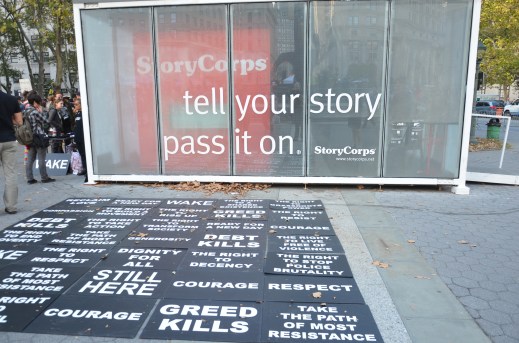
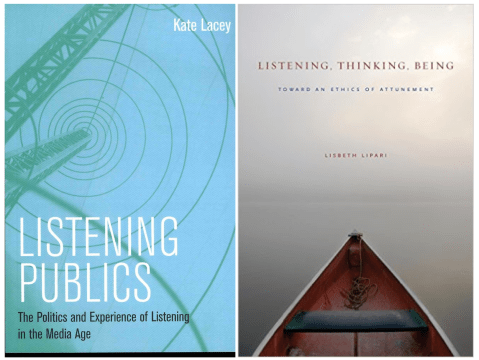
- Listening on the part of the users of these DH projects. Is it realistic to expect that users will listen to large archives of testimony? In Listening Publics, Kate Lacey writes that listening has been absent from theories of the public sphere, even where “the objective of political agency is often characterized as being to find a voice – which surely implies finding a public that will listen, and that has a will to listen” (viii). Because of their scale, these large archives of testimony pose a significant design challenge to the user, which could be resolved through curation. To build on one of the most successful digital storytelling projects, the Storycorps team knows very well that if they didn’t curate and edit together shorter versions, then no one would listen to the longer interviews in full.

- Listening on the part of the interface and its design. This involves questioning the medium and its effects on what it houses. Here I find Susan Bickford’s work very useful in her definition of listening and what it accomplishes: ‘the riskiness of listening comes partly from the possibility that what we hear will require change from us’ (1996, 149). If interfaces for stories pre-close any openness to what contributed stories could change, then listening is not being considered. This is more directly seen in the tagging of videos and their categorization without additional interpretational work. This will to not “add” to these stories seems to come from the premise that these testimonies should “speak for themselves” (I get to this point in a little bit); that no added interpretation is needed, even that any added interpretation distracts from the directness of the stories. But this often also means the medium and its effects on these stories are not carefully examined.
Contrary to Western cultural beliefs, listening can be seen as an active mode of participation in conversation. As Jodi Dean rightly argues, it is not enough to express one’s opinion, or for a message to be circulated: it is crucial to get a response to the message. Lisbeth Lipari writes that even in Dean’s formulation, however, the response as speech is still emphasized, thereby ignoring the work that happens beforehand: the listening. Apart from the major contribution of Susan Bickford, mentioned above, with the concept of political listening, little attention has been paid to listening in the field of political theory.
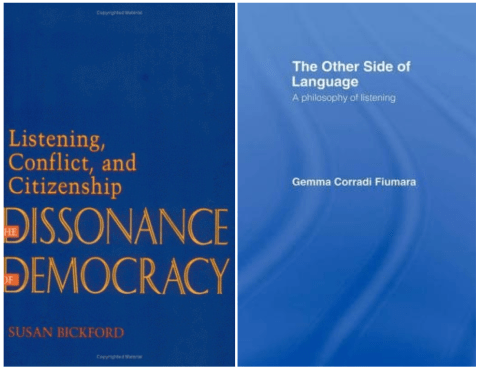
As arguably the most important philosopher on listening, Gemma Corradi Fiumara, writes: “listening involves the renunciation of a predominantly moulding and ordering activity; a giving up sustained by the expectation of a new and different quality of relationship” (as quoted by Lipari, 8). For Fiumara, listening is a mode of participation that is open and that does not pre-close potential possible contributions. Listening, therefore, as a mode of engagement can provide a useful method for thinking about participation in various contexts.
DH + Archives + i-docs
If a mission of a certain DH project is to engage with a wider public, then preservation of stories is not enough. More often than not, DH projects are already under difficult strain of resources, due to costs for developing technological projects and time for interviewing, collecting, indexing, tagging, uploading and making sense of these larger collections. DH have taken on a lot: preserving and archiving everyday stories with the mission to share with a wider public. It is useful to draw from experts who have been working through ideas of preservation and access: archivists. Archives generally have a mission of preservation, but when demands of sharing with a public arise, there are not many models from which to draw. Rick Prelinger writes that although the archive as a theoretical concept is overly theorized, its practice (in the plural form of the word) is under theorized.
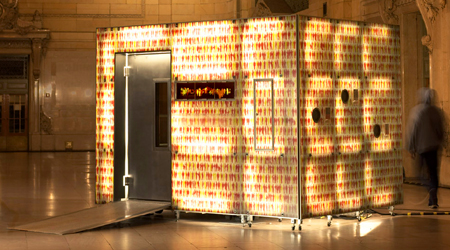
Image of StoryCorps collection area by Aaron “tango” Tang (CC BY 2.0).
Francis X Blouin and William G. Rosenberg trace the intersection of history and archives and found that Ranke, during the enlightenment, conceptualized history as a scientific endeavor in that truth could be extracted from archives through rigorous methodologies. This led to the idea that documents could “speak for themselves” (Blouin, 24). As if simply making documents available, without providing context of any sort, would reveal their inner truth. This is one of many cases where the reading of documents is taken for granted. It also ignores the effect that archivists have on the collecting, saving, and indexing of documents. Influential archivists such as Terry Cooke, Richard Brown and Brian Brothman have brought about new attitudes to repositories with an acknowledgment of the effect that archivists have on documents (as quoted by Richard J Cox, 33). This relatively recent push in archival theory, therefore, points to the flaws in the claim that documents on their own can represent themselves: that would be ignoring all the various power relationships at play, as well as the medium itself in which the stories are communicated.
In thinking about collaboration, with the unstated but implied goal of providing knowledge of a given subject, non-fiction film has experimented by inviting self-interested participants online and offline to contribute to projects. Sandra Gaudenzi makes clear that interactive documentaries, also called i-docs (documentaries designed for online or mobile viewing), are very distinct and that it is important to recognize the varying strategies employed by these digital projects: “uploading content is the most common way to collaborate in the case of online documentary, but it is definitely not the only one. […] contributions of content lead to co-creation but not to co-authorship, since the latter require a degree of intervention in the overall concept (i.e., form) of the product.” In her differentiation of co-creation and co-authorship, Gaudenzi points to the medium-limiting effect that users have in their participation. The “degree of intervention,” as a coming in between that leads to change, which Gaudenzi requires for co-authored documentaries, might be attained through listening, a listening through the work itself, such as The WorryBox Project.
Listening in The WorryBox Project
Irene Lusztig’s The WorryBox Project (2011) web-based documentary invites mothers to write their worries in an online form, which Lusztig then individually writes down on a piece of paper, rolls-up and stores in a physical box. The act of writing down in analog form what was input into a digital box goes an extra step beyond collection. It is emblematic of an extended care for these worries. The additional layer of documenting these actions, as part of the artwork itself, not only points to the embodiment of these worries but also to their representation.

Because listening has often been thought of as passive and feminine, it is also associated with a specific kind of caring, also in its passive and feminine forms. But I don’t equate that definition of care with listening, which surely the readers of this blog will question. In this case, care extends as a mode of listening because it pushes against the active/passive binary for speaking/listening. I use care in the sense it gave to curating (care is its early root), where curating points to the work of engagement and conversation. Curating as a form of listening.
This extended care would be an example of the listening I am thinking of. The work of translating the form’s digital input into the handwritten words and the documentation of that act stretch the layering of interpretation and with it the care given to these submissions. The change that occurs in this writing is definitely not an agreement or an endorsement of what is submitted but an open attitude of listening, of reception. This reinforces the notion that listening is not passive, but an active mode of participation.
This mode of listening does not imply an understanding, as the receipt of information in cybernetics theory suggested by Shannon and Weaver. Rather this mode of communication embraces the notion that listening does not necessarily mean an understanding. The audio action collaborative Ultra-Red conveys this idea perfectly: “Sound possesses a palpable promiscuity in relation to the body. One may say what one means, but somewhere between the mouth that speaks and the ear that hears, sound always exceeds its master. Politically, it may be useful to say that we hear the truth in the voice or that we listen with obedience, but sound always transgresses such duties.” So for DH storytelling projects to be participatory, it is beneficial to allow stories the space for listening, in a similar sense to Hannah Arendt’s “distancing” in order to understand. This brings me to media and communication’s scholar Lisbeth Lipari’s term for this: “listening otherwise.”

SO! Screen Capture of Irene Lustzig’s “The Worry Project”
For Lipari, in engaging with difficult stories or perhaps stories that offer different perspectives: “It is […] a listening otherwise that suspends the willfulness of self- and foreknowledge in order to receive the singularities of the alterity of the other” (185, emphasis in original). For this “listening otherwise” to work online, I argue that it is important for the employed structures, systems and processes to reflect this specific kind of participation. In other words, in addition to placing “different voices” side-by-side, it is equally critical for these different perspectives to exist in a space where the medium, whether the recording, the software, the interface and its design, listens to what these differences are. An interface designed in order not to predetermine, not to predict or preclose what others might contribute would then be an example of this listening. Anthropomorphizing aside, for a computer to listen to testimony, as Presner asks, it must be designed to be open to changing itself.
—
Fabiola Hanna is a new media artist & software designer currently working towards a PhD in Film and Digital Media at UC Santa Cruz where she also holds an MFA in Digital Arts & New Media. Her doctoral work is on building an automatic editing machine that weaves together competing narratives about the history of Lebanon, which has led her to engage with software studies & digital humanities, archives & memory and new media art activism.
Her work has been exhibited widely in California at the Museum of Art and History in Santa Cruz, the New Children’s Museum in San Diego, the SubZero Festival in San Jose, the Digital Arts Research Center in Santa Cruz, and the Maker Faire in San Mateo. She is also a 2015 fellow of the Institute for Critical Social Inquiry at the New School, New York and has previously taught at University of California, San Diego and at various maker spaces including FabLab San Diego and MakerPlace.
Her website is fabiolahanna.com and she can be reached by email fhanna {@} ucsc {dot} edu.
—
Featured Image: “Story Corps” by Steve Rhodes, (CC BY-NC-ND 2.0)
—
REWIND!…If you liked this post, you may also dig:
What Mixtapes Can Teach Us About Noise: Reading Shannon and Weaver in 2010–Aaron Trammell
Machinic Ballads: Alan Lomax’s Global Jukebox and the Categorization of Sound Culture–Tanya Clement
“Digital Analogies: Techniques of Sonic Play“-Roger Moseley
Share this:


Current Top Posts





April 2021

January 2020

November 2019

October 2019

August 2019

April 2014

November 2017

March 2015

December 2017

October 2015
 Sounding Out!
Recent Comments