
SO! Reads: Deborah R. Vargas’s Dissonant Divas in Chicana Music: The Limits of La Onda


Deborah R. Vargas’s Dissonant Divas in Chicana Music: The Limits of La Onda (2012) presents an alternate story of Chicana music through a collection of case studies in Chicana/o music history centering on Chicana/Tejana musicians active between the early decades of the 20th century to the present. Vargas assembles a mix of archival documents, interviews, images, songs, recordings, performances, ephemera, fragments, memories and engages intersectional feminist theory and queer of color critique to trace the music scenes her subjects inhabit.
A feminist oral historian, Chicano/Latino cultural studies scholar, and Associate Professor of Ethnic Studies at UC Riverside, Vargas’s research overlaps these disciplines and facilitates a conversation between popular music and sound studies that significantly considers gender, sexuality, and racialization in the construction of borderlands imaginaries. With Dissonant Divas Vargas makes an intervention both theoretical and methodological that greatly expands the Chicana/o musical archive and as well as the audiences for sound studies research. Furthermore, Vargas’s reflective writing voice locates her own Tejana/Chicana story in relation to her project and offers helpful insights into her research process at key moments. [The brief essay titled “Selena, Jenni Rivera, Eva Garza—meditations on an author’s soundtrack” published on the Minnesota Press webpages for Dissonant Divas is a generous methodology piece that should be read along with this comprehensive, satisfying, highly readable and often riveting text.]

“Dissonant Divas in Chicana Music” copyright University of Minnesota Press, all rights reserved
Vargas defines the term, la onda, in a general sense as “an umbrella term for Mexican American/Chicano/Tejano music (x).” More critically, la onda also “operates to represent musics that have been prominent in academic and cultural sites that have produced dominant discourses of sexuality, gender, class, race, geography, and language in the constructions of Chicano music.” “Dissonance” can be understood variously as “chaos, cacophany, disharmony, static” and “out-of-tuneness” that draws attention to “the power of music with regard to Chicana gender and sexuality (xiv).” Vargas’s main critique notes how the “limits of la onda” reveals the heteronormative and patriarchal underpinnings that construct dominant narratives of Chicano music historiography. She argues that the force of these narratives have naturalized a way of thinking about Chicano music in terms of the various “fathers” of Chicano rock, conjunto music, and of the field of borderland studies itself. The distortions produced by the assimilating cultural nationalist logic of “la onda” have not only suppressed Chicana music histories and/or enabled their mishearing, but they also hide the complex ways that race, class, gender, and sexuality converge to produce Chicana subjectivities within and against the Chicano musical canon. In theorizing “dissonance,” Vargas thus productively sounds the Chicana histories in Dissonant Divas as alternatively gendered and/or queered against the heteromasculine concord of la onda.
The chapter “Borders, Bullets, Besos: The Ballad of Chelo Silva” contains perhaps the most provocative pages, detailing Chelo Silva, a bolero singer with a distinct repertoire of songs that are still performed and kept alive by a diverse lineage of performers and audiences, yet whose renown is seemingly inseparable with her former marriage to Américo Paredes. Ubiquitous in borderlands studies, Paredes’s name and legacy are defined largely by his study of the corrido, With His Pistol in His Hand: A Border Ballad and Its Hero (1970). Vargas strategically positions Silva and Paredes as “embodied representations” of the bolero and the border ballad, respectively, taking up Sonia Salídvar-Hull’s proposal to “imagine new corridos” by proposing Silva’s boleros as “feminist border ballads.” Vargas parses the constructions, aesthetics, and values carried in each song form, exploring how the border ballad has been the primary counter-site for narrating the injustice of Tejano/Anglo conflict (bullets) while the bolero, whose constant subject is love, luxuriates in all its jouissance (besos). Vargas reveals that the border ballad “has allowed its authors, singers, and scholars to sound the borderlands imaginary into being,” illuminating how the contest over historical representation is tied to musical representation. Silva’s story cannot be found within this articulation of la onda without, in part, redefining the border ballad (54).
Vargas innovates and meticulously crafts an alternative archive better suited to narrating and hearing Silva’s fragmented story, what Vargas felicitously calls her archisme of knowledge. Engaging the silences in Silva’s story, the archisme sounds her presence in the recorded memories of her fans which include testaments to her unique vocal qualities, her powerful and evocative performances, her improvisations in music and in life,,along with a healthy amount of the chisme or gossip surrounding Silva. Proposing the archisme as a “feminist project for historicizing nonnormative Chicana/o genders and desires” Vargas extends both Sonia Saldivar-Hull’s directive for Chicana scholars to look in nontraditional places for theory and Lisa Lowe’s theorization of gossip as a destructuring site of knowledge production (Saldivar-Hull, 1998; Lowe, 1996).
As I read through the first three chapters, a question that kept coming up concerned why we should not consider this study on more specific regional terms, or why this book isn’t titled, “Tejana Divas”? Vargas finds the overdetermination of these Chicana/Tejana musicians as “regional” subjects a problem not typically encountered by musicians from a city like Los Angeles, for example, because of its construction as a global metropolis. I cannot dispute Los Angeles’s status as a world center and I wondered how to earnestly engage Vargas on this point. What are the stakes of locating this study of Tejana/Chicana musicians within a broader Chicano/a musical context?
The final two chapters make the case for remapping Chicana music, advanced in part by the capacious notion of queer “diva-scapes.” In “Sonido de las Americas: Crossing South-South Borders with Eva Garza,” Vargas employs what she calls a “transfrontera musical compass,” a feminist methodology deftly juxtaposing the notion of a “musical scale” with the concept of “geographic scale.” Eva Garza’s career begins in her San Antonio hometown but she eventually came to embody the “la vóz de las Américas” in a hemispheric sense via her participation in early Spanish language radio, recordings, and live performances in nightclubs and films that took her to Mexico City and Havana for significant periods; her genre-crossing repertoire mirrored her travels. Garza began as a singer of the appropriately feminine bolero, but through her contact with Cuban musicians, the Afro-Caribbean guaracha song–decidedly phallocentric and risqué in its subject matter–also became part of her repertoire. The song she was most known for, “Sabor de Engaño” adds a sensual register to her transfrontera compass, a lingering sabor or taste exceeding regional, national, formal, and gendered limits. This is most evident in the repeated examples of impromptu performances of a song verse or refrain of “Sabor de Engaño” by many Cubanos Vargas encountered in her research travels. Vargas employs the transfrontera musical compass as a “listening instrument” to trace Garza’s musical trajectory through spatial-temporal moments disrupting rigid and normative notions of community, nation, and Chicano music (147).

“Selena Live” by Flickr user hellboy_93, CC BY-ND 2.0
In “Giving Us That Brown Soul: Selena’s Departures and Arrivals,” Vargas addresses the multiple problems in the mainstream media’s designation of “crossover star” to narrate Selena’s story as a spectacular rise in fame marked by her violent death in 1995. Vargas seeks to correct the assimilationist narratives of Selena’s musical history that, in addition to figuring her as a marginalized Latina on the verge of “legitimate” status, problematically narrates a south-north trajectory “devoid of blackness and queerness.” Vargas both critiques how “brown soul” has been musically deployed to stand in for cultural nationalist “brown power” and extends previous work focusing on blackness in Chicano/Latino music that includes R&B and Afro-Caribbean influences but not necessarily the Afro-diasporic. Cumbia, an Afro-Columbian dance form popularized in Mexico in the 1940’s – 50’s is central to Selena’s Tejano sound as are 70’s era disco and 80’s freestyle, particularly in the cultivation of her iconic diva look which together resonate a queer of color musical legacy on the sonic and visual planes.
Selena’s “brown soul” and style moves Tex-Mex cumbias in what Vargas calls “queer misdirections” by traveling north-south, for example, while sounding counterhegemonic femininities that continue to reverberate in the many tribute drag performances to Selena in and beyond the borderlands of Tejas. In these ways, Vargas traces the “topography of Selena’s transformations and remappings of Chicano music (205). Just as audio technologies have been key in circulating Eva Garza’s and Selena’s music in multiple directions, so are the memories, repeated performances, and queer embodiments of their music by their diverse audiences. For both of the these artists, sound expands Vargas’s engagement with spatialization theories so that we may hear these productive dissonances and in these ways begin to imagine alternative borderlands imaginaries.
Upon finishing, a question that remains in considering “diva dissonance” is the implied consonance of Vargas’s theorization of “la onda.” At times, the term becomes too totalizing, and I would argue for the presence of heterogeneity and other musical diversities even within what Vargas denotes as la onda. We must both make and leave room to imagine the possibility of many unrecorded, captured, or yet unsounded transgressions for Chicanas whose paths may appear to follow a heteronormative logic. For this reason I found the reiteration of such rich findings against la onda asomewhat repetitive distraction from the richer tales Vargas’s archival work tells. What would these histories sound like if they weren’t always positioned against la onda—if they were sounded instead more toward each other?
What Deborah R. Vargas richly accomplishes in Dissonant Divas responds to Alejandro Madrid’s call for musicologists to establish critical conversations beyond “the conservatory” and to engage larger intellectual dialogues (AMS Vol. 64, No. 3, 2011).Vargas’s intersectional feminist-of-color argument extends the body of feminist Chicana/o cultural studies scholarship and equally extends Chicano music histories that may engage gender to some degree but do not fully interrogate those categorical constructions. Her theorization of the title’s key term “dissonance” as “both a methodological and analytic device” and her construction of a differential archive combine to create “alternative sonic imaginaries of the borderlands (xii).” More broadly, Dissonant Divas is an intervention to the problems of conducting research in marginalized communities and the racialized subjects often left out of official archives, institutional records, and studies of sound (Trouillot, 1995; Taylor, 2003). Each chapter reveals and addresses various barriers to conducting research on Chicana musicians whose uneven historical representation lead Vargas to turn to other sites, methodologies, and embodied practices where Chicana voices resound across temporal and spatial lines. In these ways, Vargas’s sustained engagement of race, class, gender, and sexuality with Chicana/o borderlands music is thoroughly new.
—
Featured Image: Pauline Oliveros by Flickr user Horacio González Diéguez, CC BY-NC-SA 2.0
—
Wanda Alarcón is a doctoral candidate of Comparative Ethnic Studies with a Designated Emphasis in Women, Gender, and Sexuality at the University of California, Berkeley where she is writing a dissertation titled: “Sounding Aztlán: Music, Literature, and the Chicana/o Sonic Imaginary”. Her research interests include Chicana/o cultural studies, U.S. ethnic literatures, popular music, sound studies, queer of color theory, and decolonial feminism. At Berkeley she has facilitated the working groups, “Decolonial Feminisms” and “Popular Music in Chicana/o Cultural Studies” at the Center for Race and Gender (CRG). Wanda is originally from Los Angeles and before starting graduate school she created the poetry zine, JOTA (2002 – 2006) and is updating that project by creating an archive for queer Chicana writing in cyberspace. She is a fan of radio genres and podcasts and writes micro radio plays while on the road. She is suspicious of the MP3 format yet enjoys curating party, tribute, and mood themed playlists on Spotify immensely. You can find her on Twitter depending on writing deadlines @esawanda.
—
 REWIND! . . .If you liked this post, you may also dig:
Chicana Radio Activists and the Sounds of Chicana Feminisms— Monica De La Torre
Could I Be Chicana Without Carlos Santana?— Wanda Alarcon
Listening to the Border: “‘2487’: Giving Voice in Diaspora” and the Sound Art of Luz María Sánchezˆ— Dolores Inés Casillas
Share this:

Learning to Listen: The Velvet Underground’s “Once Lost” LPs

 Welcome back to Start a Band, our two-part series on Lou Reed and the Velvet Underground, focusing on what the band’s sonic provocations mean for sound studies today. Last week, we heard from Jake Smith, who introduced us to a way of thinking about the Velvets that emphasized the “haptic” qualities that emerge so often while listening to them. Following that idea, Smith took us on a kind of journey from the skin to the musculature and the viscera through a deep analysis of key songs in their catalog — “This is your body on the Velvet Underground.”
This week, we’re delighted to welcome to Sounding Out! a writer whose work we’ve been eager to feature for a long while — Tim Anderson, Associate Professor of Communication and Theatre Arts at Old Dominion University. Tim has written extensively on popular music and sound, and is currently a leader of the Sound Studies Scholarly Interest Group at the Society for Cinema and Media Studies, one of the scholarly groups associated with the SO! Thursday stream. It’s such a pleasure to present this sensitive and personal account of the Velvet Underground — and of learning to listen.
– NV
—

Lou Reed and Andy Warhol as the respective definers of audible and visual cool for misfits and undergroundlings for the last five decades.
Reports of Lou Reed’s death came on a Sunday. Even though he was 71, it was still a shock. To many present-day friends and colleagues Reed’s Velvet Underground are a band that they understand are important, but just don’t get. In the case of an artist like Lou Reed, an artist who never had a top ten charting single and only two gold albums, you could see their point.
Still, I obsessed. Rattled from my travels in Washington, DC, I called my wife and we talked about his music for about an hour or so, after which I took a long walk to the Washington Mall. It was a sunny fall day, October 27, 2013, and I walked past the Smithsonian with its prominent memorials, such a clean space for so much past, some of which the nation has buried and some of which we don’t even bother to think about. The deceased have always done the most important work in our nation’s capital.
The day after, I really don’t remember doing much. I took a train home, read everything I could online about Reed, and thought a lot about his records. The ones I liked —New York and The Blue Mask—the ones I learned to like —it took me years to enjoy Transformer—and the ones I loved —The Velvet Underground and Nico, White Light, White Heat, The Velvet Underground and VU. Those four records, more than any records I can remember, altered me, many of my friends in my teens and in college, and almost every rock musician I admired in the 1980s. Velvet Underground records were simply foundational. Writing about Reed’s death, rock critic Greg Kot summed up the Velvet’s influence by claiming that they were “as influential as The Beatles” and if you named “just about any left-of-centre band or artist since the ‘70s”, some of whom like R.E.M., U2 and Talking Heads “became mainstream giants”all of them would “acknowledge a deep debt to the Velvet Underground.”
This influence is the reason that the collective mourning of such a marginally popular figure swelled to such a crescendo. However, to paraphrase the words of one of Reed’s most storied rivals, Lester Bangs, on the death of John Lennon, this was not the mourning of a person. Most of us never met Lou Reed. Instead, we were mourning ourselves. To lose Lou Reed was tantamount to losing the author of a proverbial urtext of a kind of secret rock language that has been passed down since the late 1960s on how to be cool. It was a language of composed of style, gestures, and reactions. It was one that was filled with a fun that was not of the obligatory “hey-dude-let’s-party!” party. The Velvet’s overdriven guitars repeatedly underscored that teenage kicks included other aesthetic pleasures such as contemplation and melancholy. Most importantly, the Velvet Underground offered a language of listening passed down from one rock underground to another.
Because pop fans of all stripes must learn how to be a fan, learning how and what to listen to is a taste-defining social exercise. Simon Frith once explained that, for him, “one aspect of learning how to be a rock fan in the 1960s was, in fact, learning to prefer [original records made by black artists of the 1950s] to covers [made by white artists of the same era]. And this was, as I recall, something that had to be learned [by Frith]: nearly all the records I had bought in the late 1950s had been the cover versions” (Performing Rites: On the Value of Popular Music, 1996). In my case, learning to listen also meant learning what to listen to while listening to The Velvet Underground, a process involving peers, record clerks, friends, musicians and reviews.
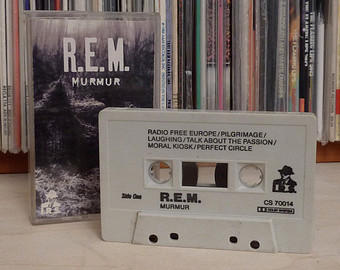
R.E.M.’s 1983 LP release of “Murmur” on cassette
As a young rock fan who began first collecting cassettes —that’s right, cassettes —this process would begin through an obsession with R.E.M.’s Murmur, a cryptic, odd inscrutable cassette with no lyrics, a black and white picture and layers of reverb. The copy I found had been severely discounted in a ma and pa record store in Globe, Arizona. In Summer 1983 I read a rave review in a copy of Rolling Stone and at 14 had purchased a cassette unlike anything I had ever heard; I wasn’t sure I enjoyed it. Why did so many reviewers seem to fall over themselves about this record? To solve this puzzle, it meant learning how to listen to music invested in tone rather than ostentatious chops. It meant paying attention to drones rather than solos. It meant following those features to Velvet Underground records after peers, record clerks, friends, musicians and reviews made a point that Murmur reminded them a bit of VU records.
Murmur was also the first record I ever purchased that embraced what Jacob Smith so wonderfully identifies as a distinctive trait of all Velvet Underground records. For Smith, these pop records are part of a genealogy that “stress evocative timbres, idiosyncratic voices, and signature sounds over structural or lyrical complexity.” The distillation of this pop ethos onto record was one of the reasons that so many musicians whose abilities may have been limited but whose tastes tended toward the poetic found The Velvets so influential. As Jonathan Richman explained, “I didn’t start singing or playing till I was 15 and heard the Velvet Underground. They made an atmosphere, and I knew that I could make one too!” (Quoted in Greil Marcus, Lipstick Traces: A Secret History of the Twentieth Century, 61). Indeed, Smith notes that the deceptive complexity of VU Records “can be found more on the level of timbre than in musical structure or instrumentation” and “lyrics often encourage a blurring of listening and touching”; his post actually reads like many of the conversations and reviews surrounding R.E.M.’s debut LP. The same could also be said of records released by other 1980s and 90s artists such as The Pixies, My Bloody Valentine, Opal, Mazzy Star, Radiohead, The Dream Syndicate, Galaxie 500, The Rain Parade, Green on Red, New Order, Joy Division, The Feelies, Spacemen 3, Sonic Youth, The Pretenders, The Sisters of Mercy, Ministry, The Jesus and Mary Chain, and The Violent Femmes, to name but a few who drew water from the Velvet Underground well. Bands sonically inspired by the Velvets often providing feedback before solos, drummed without cymbals, and portrayed dark themes sung in monotones that sounded sophisticated and obscure.
.
However, actually hearing a Velvet Underground record in 1983 and 1984 was a significant problem for newer fans, as their MGM catalog was out of print. Many understood these records to be effectively buried by label president Mike Curb’s infamous axing of the act from MGM along with seventeen others who allegedly promoted and exploited “hard drugs through music” (Tiegel, Eliot “Mgm Busts 18 Rock Groups.” Billboard, November 7 1970, 1, 70). As Lou Reed himself once noted, “it’s depressing when you’re still around and your albums are out of print.” I have often wondered if this was one of the reasons that The Velvets catalogue would have such a profound effect on so many of us. Sure, I had found a copy of Loaded, the band’s fourth official release, but its bright tones had none of the subversive menace that so many reviewers alluded to when speaking of the Velvets. Even in a mountain town in Arizona, I had a better chance of finding used copies of The Grateful Dead’s Wake of the Flood or Blues for Allah than I did The Velvet Underground and Nico. In other cities, in other record stores, when I did find those records they were used and prices started at $15 and up. They were records I simply could not afford to listen to.

The Velvet Underground’s “lost” fourth album, “VU”
All that changed after 1985, when every MGM Velvet Underground record would appear in my life for less than $25. Bill Levenson’s efforts as Polygram’s then A&R manager to reissue the buried and lost MGM catalog on Verve provided me and every other young person who had only “heard of The Velvet Underground” the chance to finally to listen to all of these records at once. Indeed, the moment of the catalogue’s reissue was simply a sonic flood, one where sounds filled in gaps that had been cut deeply by conversations, descriptions and my own imagination. Writing at the time about these reissues and the unveiling of a lost album’s worth of material that would be titled V.U., David Fricke argued that “rock historians and fans alike owe Bill Levenson, the executive producer of V.U., a debt of thanks for resurrecting these tracks and for giving the band’s first three LPs the proper reissue they’ve long deserved. At $5.98 list price, The Velvet Underground and Nico,White Light/White Heat and The Velvet Underground are essential purchases —certainly essential listening for any study of Seventies and Eighties punk evolution. As for V.U., the Great Lost Velvet Underground Album is no longer lost. It is simply great” (Fricke, David. “The Velvet Underground – V.U.” Rolling Stone, March 14 1985).
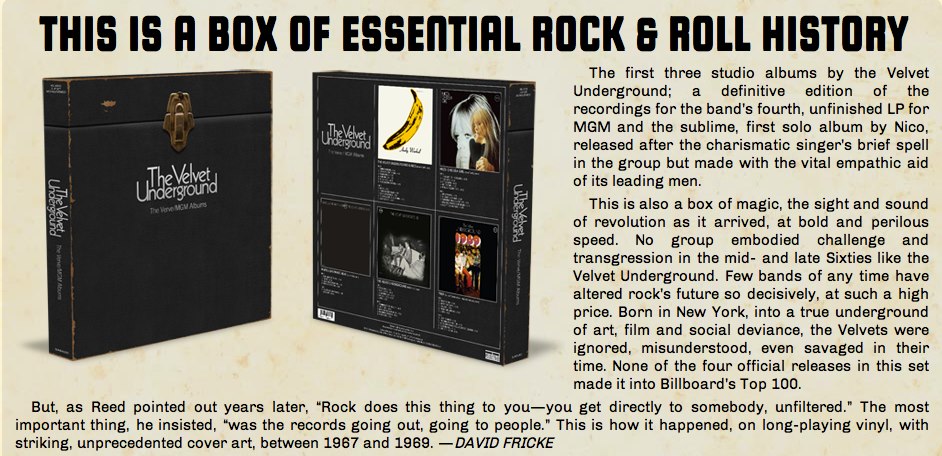
A 2012 ad for another reissue of the MGM Velvet Underground catalog and Nico’s first solo LP
Is it too much to suggest a that the pent up desire to hear a secret history sparked by The Velvet Underground’s reissues created the 80s/90s iteration of “alternative rock”? Perhaps, but history is filled with desires asserted, accepted and denied. Indeed, most of those aforementioned 80s alternative acts I came into contact with had been performing and recording and releasing records years before 1985. However, there is no doubt that the VU reissues turned a number of ears predisposed to hearing in a certain way onto new ways of listening to the Velvets concentrated doses of moody darkness, modes that earlier Velvet Underground fans simply had little access to.
Ignoring the impact of the sonic flood of VU material that fell upon my ears during this period turns away from a specific history of listening that, while personally unique, was an opportunity available to so many of my contemporaries. Indeed, if sounds have histories because their traces persist, then listening must have histories guided partially by testimonial. To hear these histories we might ask ourselves to remember how, why, and with whom did we listen, and to trade in this information. If we did so, we might better understand how we learned to listen: especially what to listen to and why it was important. And, without these testimonials of our pasts as listeners, we just may lose sound’s crucial other half.
—
Featured Image: “Velvet Underground Yellow Label Mono” by Flickr user Simon MurphyThe Velvet Underground – Yellow label mono
—
Tim J. Anderson is an Associate Professor of Communication and Theatre Arts at Old Dominion University where studies the multiple cultural and material practices that make music popular. He has published numerous book chapters, refereed journal articles, and two monographs: Making Easy Listening: Material Culture and Postwar American Recording (University of Minnesota Press, 2006) and Popular Music in a Digital Music Economy: Problems and Practices for an Emerging Service Industry (Routledge, 2014). His latest research project focuses on recordings, musicians, listeners and the public sphere. His website is timjanderson.weebly.com and he can be contacted at tjanders@odu.edu.
—
 REWIND!…If you liked this post, you may also dig:
“One Nation Under a Groove?: Music, Sonic Borders, and the Politics of Vibration” -Marcus Boon
“Sound + Vision: Andy’s Mick” -Eric Lott
“Hold this Thread: A Partial History of a Rock n’Roll Relationship”-Benjamin Gold
Share this:


Current Top Posts





April 2021

January 2020

November 2019

October 2019

August 2019

April 2014

November 2017

March 2015

December 2017

October 2015
 Sounding Out!
Recent Comments