
“Take ‘Em to Chuch”: OutKast and the Sounds of the Southern Black Church
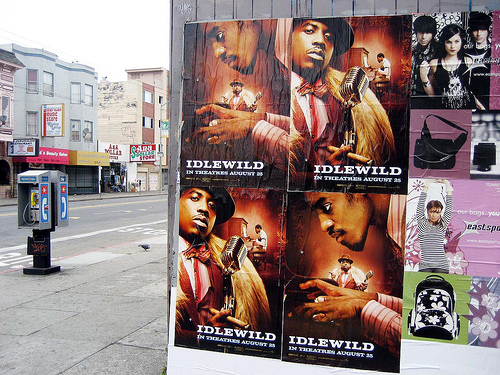
Advertising for Outkast
In 2006, I ventured into Hoosier Country. I found myself in the middle of…nowhere. And I was depressed. No, not because I decided to move to Indiana all by my lonesome on a huge leap of faith to pursue a graduate degree – I was too smooth for that – but because I found myself in a town where I couldn’t watch Outkast’s debut film Idlewild. Where they do that at? I am a Southern-bred, Southern-fed kinda girl. And Outkast was my muse. Hell, as a certified Down South Georgia Girl, all things Georgian were my muse. I planted my feet in red clay. My soundtrack was Organized Noise, the production team and heavy hitters that worked with OutKast, Goodie Mob, and a slew of other folks out of a rinky dink house basement that would later become known as the Dungeon (Family). I took pride in being from the Dungeon. And here I was, hundreds of miles away, frantically trying to find a theatre that would, if only for a brief 90 minutes, thrust me back into that familiarity of Southern life.
Of course, OutKast (comprised of members Andre Benjamin and Antwan “Big Boi” Patton) is hardly considered strictly Southern today. However, their 1994 release Southernplayalisticadillacmuzik shattered perceptions that Southern Rap was an oxymoron. In fact, OutKast’s initial sound updated tropes of southern black resistance and retaliation, fusing a lethal mastery of lyricism and flecks of a contemporary Southern culture too easily dismissed by non-Southerners. Calling upon and subverting the stereotypical traits of the Southern black voice – drawn out, slow, and heavy – OutKast sets up shop in hip hop by showcasing a rich history of Southern flair and homegrown sounds. The album made this intervention at the precise moment when hip hop became much more accessible to a mainstream white American market and the idea of being “post-Civil Rights” gained cultural traction. Combining narratives of being young, black, and frustrated with a sonic backdrop that includes an instrumental arsenal of horns, harmonicas, organs, drums, and bass, OutKast challenged and reconfigured how Southernness, Americanness, and contemporary black experience sounded at the turn of the millenium. Their initial releases seem to pick up the question of what it means to be displaced, Southern, and black after the South settled from its liberatory movements, pulling from the voices, images, and music of Southern protest like the Freedom Singers or Sweet Honey in the Rock and fusing these sounds with hip hop.

Andre Benjamin Onstage in 2003, Photo by Tulane University Public Relations
In order to discuss how they challenge and reconfigure notions of Southerness, Americanness, and contemporary black experiences, we should look at their musical nods to the black church. OutKast draws heavily on the Southern black church through sermon-esque flow, call and response, and snatches of “chuch” (lose the ‘r’) music. The black church is a staple in OutKast’s sound, reflecting what Guthrie Ramsey refers to in Race Music as community theatre, a site where “cultural, communal, and family memories associated with forms like music often become standards against which many explore and create alternative and highly personal identities for themselves” (33). The Southern black church provides such a site for communal and collective memory not only in Outkast’s music, but in African American history. Celebrated and upheld as a site of refuge from an abrasive and openly racist white supremacist environment, the black church provided a safe haven for freedom of cultural expression and social commentary unavailable in Southern white public space and discourse. OutKast challenges this older, static definition by updating its purpose to reflect the shifting social climate of the late-20th century American South. While they continue the resistance narrative tradition by bringing their marginalized experience to the forefront, they also sonically reorient mainstream views of contemporary Southern black life.
Instantly recognizable across OutKast’s recordings, their funky blend of sacred and secular musics–the blues, gospel, and hip hop–give sonic texture to something quiet-as-its-kept in black churches, how the so-called “bad” folks still come to church on Sunday, even if they were unholy on Saturday night. OutKast plays upon this unspoken understanding in songs like “Jazzybelle” from 1997’s ATLiens, “B.O.B. (Bombs Over Baghdad)” from their 2000 release Stankonia, and the straightforward “Church” from SpeakerboXXX/The Love Below (2003).
A particularly striking instance is heard on “B.O.B.,” a song which brazenly discusses issues that are often reserved for closet prayer and silent suffering. As Andre weaves a lyrical assault on the poor conditions of living in the black working class:
One-Nine-Nine-Nine, Ano Domini, anything goes, be whatchu wanna be
Long as you know consequences are given for livin – the fence is
too high to jump in jail
Too low to dig, I might just touch hell – HOT!
Get a life, now they gon’ sell
Then I might cast you a spell, look at what came in the mail
A scale and some Arm and Hammer, slow grow grid and a baby mama
Black Cadillac and a pack of pampers
Stack of question with no answers
Cure for cancer, cure for AIDS
Make a nigga wanna stay on tour for days
Get back home, things are wrong
Well not really, it was bad all along
Andre rhymes across an instrumental blend of bass and the church organ, inundating his listener’s ear with agency and anger. The church organ is as angry and explosive as his flow, with riffs and keys banged out loudly, quite different from the soft accompaniment often heard in a church setting. By heavily utilizing the organ and church choir at the end of the track, chanting “Bible music electric revival” OutKast subverts and updates the celebrated Black Church Revival, a gathering of church folk and the lost, swinging church music to give a voice to the marginalized black working class. The hybrid, urban sound of “B.O.B.” provides a space for the reclamation of a disenfranchised southern African American narrative that blends the suffering trope mandating much of African American religion with current trends in cultural expression reflected in Hip Hop. In Idlewild (which I FINALLY saw a year later, by the way), Andre and Big Boi visually annotate their secularized black church by creating an imagined community in rural Georgia that revolved around the jukejoint Church. OutKast’s audio-visual syncretism paved the way for later acts like Pastor Troy, who secularizes tropes of black masculinity and leadership in the black church, likening them to the struggles of being at war with those who don’t understand the struggles of a young black south.
The black church provides OutKast with a blueprint for reconciling displacement and authenticity by creating a sound that maneuvered a Post-Civil Rights landscape of shifting markers of social-economic identities and race. By connecting the historical context of the Southern black church with Hip Hop, OutKast’s sound reflects not only the historical residue of a pre-Civil Rights Movement South but also the constant search for a space of expression in an era where a stagnant or nonexistent “modern South” is a popularly comfortable disbelief. Perhaps this is why I was so desperate to find a theatre showing Idlewild; I found myself a geographically displaced Southern black youth searching to situate and sustain a new layer of my own post-Civil Rights narrative.


Share this:

Becoming a Bad Listener: Labyrinthitis, Vertigo, and “Passing”
 For the past three weeks I have been sick with labyrinthitis. It started with a bout of vertigo while picking up some essentials at a local pharmacy and has since recurred in various other locations. In the morning, when I stroll for coffee, it feels like I am walking a tightrope. Shelves after shelves of boxes at a local store have made the world spin. A determined trip to Manhattan (for a friend’s film release) quickly transformed into an incomprehensible blur of light and sound. Because of this lapse in cognition I have found myself listening to the world, and my body, in fascinating (although frustrating) new ways. The most frightening moments of vertigo I experienced have followed moments of both visual and audio overload. When I can no longer understand what I hear, panic is sure to follow. Worst of all, even though negotiating my day-to-day responsibilities has become a trial in patience, to most observers, I seem perfectly fine. I have decided to share these experiences because of how well they inform the ways that sound, specifically the practice of listening, informs the process of “passing” as normal in everyday life.
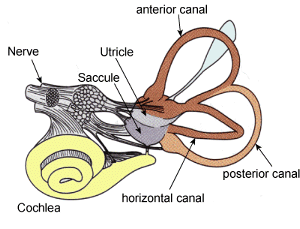
Labyrinthitis is often related to an inner ear infection. When the series of canals within the ear are damaged, a sense of balance is lost. This lack of balance completely skews all visual cues: things look blurry, there is an unsteadiness to things (as if on a boat), bright and flashing lights are extremely distracting . . .imagine being drunk, but with none of the perks. Another symptom of labyrinthitis is an occasional ringing in the ear. For me, this ringing is at its worst when I am trying to focus on a conversation in an environment with lots of ambient noise. For instance, if I try to hold a conversation while walking down the street and several cars pass by, the ringing will begin to overwhelm both the cars and the conversation. It’s like my brain is dialing back the volume of all the sounds around me. As mentioned earlier this is the most terrifying of all the symptoms that I experience – it feels, uncannily, like I am waking from a dream.
One labyrinthitis support site suggested that prolonged coping with the above symptoms in everyday life is, perhaps, the most difficult part of recovery. In an interesting twist they drew on sociologist Erving Goffman’s 1963 work Stigma to support this claim, “An individual carries a stigma if s/he is unable for any reason to fulfil society’s sterotypic criteria for normality – if this deviation is obvious (eg: physical deformity) the person is at once ‘discredited’. Failings that are less obvious or may be concealed (eg: vestibular problems) render the individual ‘discreditable’ in the sense that his/her identity is vulnerable. Whereas a discredited person must adopt a stigmatised identity – a discreditable individual may prefer the effort and risks attached to trying to ‘pass’ as normal to the frank stigma of admitting the attribute.” Has labyrinthitis rendered me discreditable? Although it is tempting to critique the armchair diagnosis above, I believe that it is a valuable basis for theoretical inquiry. What are the risks of acquiring the stigma of vestibular problems? In other words: do I choose to reveal my illness tactically?
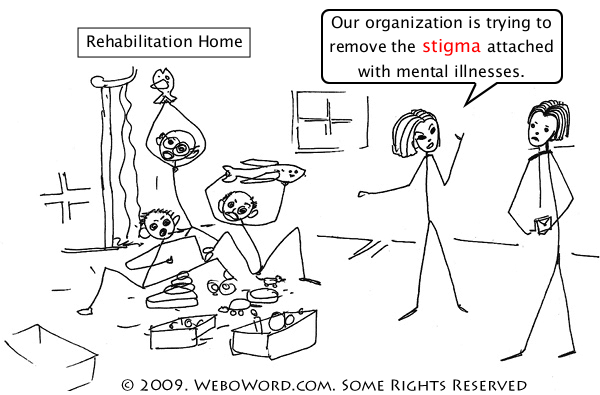
Surely, as this blog post attests, I am not too frightened by the stigma of revealing my illness. It is likely to pass in the next few months and I assume that most of our readers are not particularly judgmental. I am scared, however; when I lose track of conversations. Sometimes even to the point that I choose, as Goffman suggests, to “pass” and keep my lapse of understanding secret. As the ringing in my ear grows: I will often keep quiet, smile, and nod my head. There have been several times in recent memory that I have even forced a chuckle, or a short, daft, answer. Often these replies are deliberately vague, peppered with just enough key words to convince my companion that I was listening. At these times, in my head, I am lost – reeling with confusion. I’m trying to figure out where I am (what street is this, how can I get home quickly?), what has triggered this confusion (is it the noises behind me, or the lights ahead?), and if there is cause to be concerned (is this business as usual, or am I about to faint?). I want, at these moments, to “pass” as normal because I am scared of becoming too much of a burden to those around me. My Achilles’ heel in these situations is contingent on my ability to listen, passing, at least, as a good listener.
 The sense of stigma I imagine, as a bad listener, is infinitely worse than the sense of stigma I could accrue as a sick individual. Goffman, in 1963, had been writing in a late Fordist economy. As such, the stigma of illness related more to physical labor than one’s ability to socialize and fit in. In these context of illness could suggest an inability to produce; the diseased body set apart from all others. As immaterial and affective labor become valorized in new ways, stigma comes to relate to the inter-social processes of control that form the new societal knot. Chief among these stigmas, for myself at least, is the inability to listen. Listening cues others in to how well one is able to socialize, participate, and contribute to a tight web of everyday activities. When I cannot listen, yes, I am vulnerable. I am vulnerable, mostly, because I am suddenly and inexplicably alone.
The worst part of becoming a bad listener is recognizing how very little is required in a conversational exchange. As noted earlier, vagaries and key words are, for the most part, sufficient. Is there a final irony here, while my ability to listen to and understand others is diminished has my ability to listen to and understand myself increased? Many have argued that mimesis, or imitation, is, in fact, central to the way people communicate. “The whole of human culture,” according to Anna Gibbs, “then, is, perhaps, predicated on imitation, in which difference and innovation are as central as reproduction and similarity” (p.202). This notion sends eerie chills up my spine. Bad listening, is, from this perspective, simply an alternative mode of identity. Words come in through the ear, rattle around for a bit in the brain, and then come out of the mouth with sparse changes and a different order. Where difference and innovation can be considered the bi-products of good listening, reproduction and similarity stem from bad listening.
Perhaps bad listening is not all that bad. Gibbs also suggests that mimetic communication, “is the cement of parent-child, peer, friendship, and love relations” (p. 202). When “passing” for normal, I shift gears. I use my listening instincts to further a set of affective and emotional bonds which are equally important to my everyday life. Listening is central to “passing,” but there is a fine distinction between modes of listening. Listening analytically is the practice of listening in order to decipher, decrypt, suggest and parse new ideas from a statement or song. Listening affectively is, then, the binary. Not a mode which drives conversations, and/or innovates, but one which actively seeks to create bonds of comfort, compassion, and support. Listening for timbre, tone, and vibe instead of composition, consistency and argument.
AT


Share this:


Current Top Posts





April 2021

January 2020

November 2019

October 2019

August 2019

April 2014

November 2017

March 2015

December 2017

October 2015
 Sounding Out!
Recent Comments