
How Many Mics Do We Rip on the Daily?
A woman’s voice to this game right now is so extremely necessary in order to save it.–MC Lyte, My Mic Sounds Nice: A Truth About Women in Hip-Hop
On Monday August 30th, BET premiered My Mic Sounds Nice: A Truth About Women in Hip Hop, a documentary that traces the rise of female MCs within hip hop and that strives to challenge the view that hip hop is a “man’s game.” Although the rappers interviewed–for example Medusa, Salt N Pepa, Trina, Eve–all agreed that men are a strong presence in hip hop, they are proof that they are not living in the shadow of male rappers (perhaps in the shadow of Lauryn Hill? Yes? No? Maybe?). The documentary helped bring me back to questions I had about women and hip hop, questions that arose while doing my research on hip hop and representations of urban space.
I come to hip hop not just as a music fan, but as a cultural studies critic. I like hip hop, but I really started paying attention when I saw the connections between the music I was bopping my head to and the stuff I was reading and thinking about. It started with Kanye West, one of my favorite rappers, and his song “My Way Home” (from Late Registration). At the time I was taking a course on African American realist fiction and the City, and thinking through what the idea of home meant for all of the migrants who had come from the South to the North. Chicago weighed heavily on my mind as I drove up from New York City back to Upstate NY one weekend, and listened to Late Registration along the way. The opening sample, from Gil-Scott Heron’s “Home Is Where The Hatred Is,” came on, and I had one of those serendipitous moments researchers dream of: “Chicago is home for Kanye. Chicago is the place where many of these characters live. But is it home for them? Can this city ever be a home?”
My questions led me to revisit my iTunes and my boyfriend’s CDs (we’re both big music fans, and one of the bonuses of moving in together was that our music collections became one big collection) in search of other songs about cities. I started building a playlist for my paper and buying songs like no one’s business. I was drawing connections between the African American fiction I was reading and the songs I was listening to. They both underscored the importance of urban spaces in the development of a post-migration identity–a very urban one at that. And hip hop is an inherently urban genre. However, amidst Kanye and Mos Def, Jay-Z and Gil-Scott Heron, Murs and Ice Cube, I noticed a big, dark, deep hole: where were the female MCs? It had been easy to find plenty of songs about cities by male rappers, but songs by female rappers? Not so much.
After I got over my initial embarrassment that I had gone so long without noticing this lack in my iTunes playlist, I started to search for female MCs rapping about the city. I collected names and songs. I looked up obscure remixes online, and downloaded songs by female rappers I’d never heard of before. (My favorite from that search? “Philly Philly” by Eve. Once I start humming, I can’t get it out of my head.) But there was less of a variety, and they talked about urban space differently. Whereas many male rappers put the grit, the violence, and the dangerous streets of the city front and center in their music, this was not so for the female rappers I looked at. A good example of this is Lauryn Hill’s “Every Ghetto, Every City” where she reminisces about her childhood in Jersey, but says that “every ghetto, every city” brings her back to the streets where she grew up. I used to think that I didn’t have enough of a sample to say what was the tone of female MCs toward urban space; now I wonder if the sample issue had anything to do with the lack of female MCs nowadays.
However, the documentary ends on a positive note: after calling into question whether Nicki Minaj’s popularity is helping or hurting rap (see adurhamtamu’s post on The Crunk Feminist Collective for a more thoughtful look at Nicki Minaj’s performances), we have Glenisha Morgan from The Fembassy, who argues that if you want to listen to female MCs all you have to do is look for them. She provides viewers a long list of female rappers out there, albeit underground: Medusa, Jean Grae, Tiye Phoenix…Maybe my problem wasn’t that I couldn’t find female rappers rapping about cities, but that I was looking in all the wrong places. I am looking forward to checking out these female rappers and seeing what they have to say about their relationship to urban space through their music. Thanks, BET, for caring.


Share this:

The Noise You Make Should Be Your Own
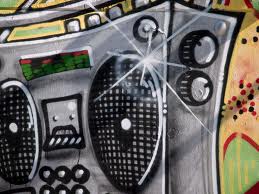 Before I suggested the name VIBE, even before the magazine was being called Volume, it was known as NOISE. I never liked that name. I mean, I knew what they were going for: “Noise” was meant to imply the loud raucousness of youth that defined the increasingly popular urban culture that would fill its pages. But the dominant strand of that youth culture was going to be represented by hip-hop, and I was quite sensitive to mainstream society’s tendency to think of hip-hop—what I liked to think of as the breakbeat concertos of inner city maestros—as not-music, as nothing but noise, something not necessarily from the street but of it, like a garbage truck or a knife fight.
I started to reminisce about the Noise name a coupla weeks ago when I walked into my university-owned apartment building and saw a note with the word “NOISE” poised at the top of it in a huge bold and italicized font, assured of getting everyone’s attention as they entered the elevator vestibule. According to the note taped to the wall, there was a noise problem in the building, and it was getting worse. Would tenants please be considerate of the other members of the apartment community and refrain from playing music loudly after certain proprietary hours?
I thought about it. I never heard music being played loudly. But maybe that was because I live on of the upper floors, away from the blaring speakers of others. The noise I was privy to was the natural noise of the many babies who lived in the building, the children of grad students, probably bored to tears (and tantrums) living in this austere monolith we all call home.
But then I thought about it some more. And I considered the musical noise I heard in this building, compared to the musical noise I’d heard in my building in Manhattan before I re-located to pristine, polite Cambridge, Massachusetts. In New York, I remember the guy on the second floor, the raging theater queen, who blasted cast albums and show tunes at top volume, usually during the day, when the only people in our small West Village building were him (a theater designer), me and the “model” who lived on the third floor—in other words, those of us who lived lives outside the traditional mainstream. The “model” cranked up the volume on her club-kid techno beats, while I was probably playing The Smiths or The Cure or R.E.M. at loud volumes, re-living my college rock days while missing a freelance deadline or two.
I remember, when I lived in New York, thinking that people had no shame when it came to making noise: people had loud  conversations about personal business on the subways; vendors shouted to (at?) delivery guys on street corners; sirens blared their way through the streets; boomboxes competed with car speakers for the ears and stares of passersby. But no one complained. If anything it was a competition of soundtracks in, on and around the streets of New York. Do the lipstick lesbians outside the bar across from my apartment mind, relish in the fact perhaps, that the iconic sound of Stevie Nicks growling out of the jukebox codifies them as queer women on the scene? That kid in the business suit and expensive Wall Street shoes on the train, bobbing his head to the rhythms of Jay-Z rapping loudly through his earbuds: does he really want those of us around him to know he was a hip-hopper? The 6’4” theatrical designer from the second floor who struts down 12th Street like a linebacker: does he simply want the world to know that Barbra’s star-making turn as Miss Marmelstein soothed his soul and that the Pippin version of “Corner of the Sky” is what gets him through the day?
And what was my noise telling the world? I was the queer black writer dude upstairs. But if someone had walked by the apartment, not knowing who was inside, and stopped to tap a toe or shed a tear at the mopey, fop-rock of Morrissey that so often cleared my door jamb, would I be what they expected? Perhaps; perhaps not.
But then I think about the times that I just had to hear Martika. And I had to hear her loud. Or I had to hear some 80s-style deep house, especially the tracks defined by the soul-shouting diva-fied orgasmic melismas that not only date me age-wise, but most definitely queer the space that was blasting the Rolling Stones’ Let It Bleed just a half hour before. I used to be self-conscious of those sonic shifts in my noise soundtrack, as if they highlighted a larger, deeper confusion about my own position, culturally-, racially-, and sexually-speaking.
But then I joined the team to start VIBE, a magazine once called NOISE. And my sensitivity over its possible name settled my own personal dilemma: We may want the world to hear our noise, because of its shorthand to who we are. But what we really want them to do is feel our noise, vibe it if you will, and hopefully feel our joy, pain, shame, love and contradictions in the process.
–SPB (Scott Poulson-Bryant)


Share this:


Current Top Posts





April 2021

January 2020

November 2019

October 2019

August 2019

April 2014

November 2017

March 2015

December 2017

October 2015
 Sounding Out!
Recent Comments