
Genre in the Age of Convergence: Mario Paint Composer
DOI: https://doi.org/10.59350/rg065-mge82
It’s no secret that over the course of the twentieth century, aesthetic productions have drawn increasingly on recycled and re-appropriated materials. Perhaps, for this reason, the above video – a rendition of Michael Jackson’s Thriller on the newly minted Mario Paint Composer – sounds absolutely mundane. Nothing new, just another curiosity born out of the collective consciousness we cannily refer to as the Internets, which we understand jokingly as a series of tubes, notably Youtubes. Laffs aside, this phenomena complicates many traditional modes of interpretation.How do we hear the music of a convergence era when within it lies a devious set of connotations, each serving to reorient the listener to its own particular theme? What tactics do listeners take when interpreting this semiotic collision of sound, icon and song? These questions complicate the topic of genre, where a social consensus traditionally guides the collective organization of a medium. What social and sonic forms shape our understanding of Thriller as it was reproduced by Mario Paint Composer on Youtube in 2008?
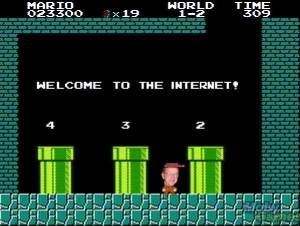
Before delving too deeply into a discussion of genre, it is important to situate the phenomena of convergence in a pre-digital context. Although the user-centric nature of web 2.0 has certainly helped to accelerate this process, one needs to look no further than Dick Hebdige’s “The Meaning of Mod,” in the anthology Resistance Through Rituals, to sense an earlier precedent to the mash-up culture we observe today. Drawn to the adventure of a dangerous soHo night-life culture, “The mod dealt his blows by inverting and distorting the images (of neatness, of short hair) so cherished by his employers and parents, to create a style, which while being overtly close to the straight world was nonetheless incomprehensible to it.” Although Hebdige is writing in 1974, long before computers would become mainstream, he makes a worthy point here about the appropriation of fashion. Constructing it as an act of distortion,Hebdige argues that early 1960s mods (understood here as a working class youth movement), through their stylistic appropriations were able to undermine the fabric of British society. By acting as criminals, but lauding the style of white collar workers – suits, short hair – mods help to show that semiotic convergence is not something new, instead it can be read as a stance of resistance.
In the case of Thriller, resistance is too strong a word. I prefer distortion, it is value neutral, although it can easily be understood in the context of resistance. Thriller on Mario Paint Composer distorts Thriller by Michael Jackson. By simplifying the song to a series of 16-bit samples, the song’s transcriber geoffnet1, translates it all to the symbolic language of Mario Paint – where mushrooms sound like drums, hearts are bass notes, ships are cymbals, flowers are horns, cars are synth pads and game-boys sound like blips. geoffnet1’s Thriller is a distortion of the Mario Paint Composer sound as well; originally a part of the 1992 Super Nintendo cartridge, Mario Paint, Mario Paint Composer is now a fan-modded update of its original form. Unlike the original Mario Paint Composer has been designed with functionality taking a precedent over accessibility. Originally marketed as an intuitive music scripting software, the following limitations were part and parcel of the platform (These restrictions have been copied from Tombobbuilder’s page, a musician who works with the limits of Mario Paint Composer as it was originally distributed.):
1. Only 24 measures are available.
2. No more than three notes at a time.
3. You can not double notes on the same line or space.
4. Tempo is restricted.
5. There is no fluctuation in dynamics (volume).
6. No sharps or flats are available.
7. Can only compose using the “white keys” from the piano.
8. Only two of each letter name are available (except A, where there is only one).
9. C major and A natural minor are the only keys to compose in.
Of these restrictions, Thriller only conforms to the third: “You can not double notes on the same line or space,” in this regard it distorts what most people understand as the Mario Paint sound as well. By no means am I calling this work inauthentic, instead I am calling attention to the stability of sonic tropes in our cultural memory. The sound of Mario Paint is not remembered for the limitations described above, instead, there is a stable and distinct sonic fingerprint which is derived from the alchemy of icon, sound and song though which genre can be constructed and maintained.
Thriller is 8-bit music, even though there is nothing 8-bit about it. Similar to the way in which mods subverted the British status-quo, Thriller puts the idea of genre into crisis. This is not a crisis that works to undermine the existence of genre as a phenomenon, it is instead a crisis of interpretation, where the traditional means through which a genre can be identified are called into question. No longer can the easy answers be found at Allmusic or Wikipedia, some sounds have become more epistemically ellusive. Ultimately, this is a good thing, as it encourages listeners to take a critical ear to what they are listening to – and how they come to understand it.
Aaron Trammell
—
Share this:

How Many Mics Do We Rip on the Daily?
A woman’s voice to this game right now is so extremely necessary in order to save it.–MC Lyte, My Mic Sounds Nice: A Truth About Women in Hip-Hop
DOI: https://doi.org/10.59350/7qwe5-gyf93
On Monday August 30th, BET premiered My Mic Sounds Nice: A Truth About Women in Hip Hop, a documentary that traces the rise of female MCs within hip hop and that strives to challenge the view that hip hop is a “man’s game.” Although the rappers interviewed–for example Medusa, Salt N Pepa, Trina, Eve–all agreed that men are a strong presence in hip hop, they are proof that they are not living in the shadow of male rappers (perhaps in the shadow of Lauryn Hill? Yes? No? Maybe?). The documentary helped bring me back to questions I had about women and hip hop, questions that arose while doing my research on hip hop and representations of urban space.
I come to hip hop not just as a music fan, but as a cultural studies critic. I like hip hop, but I really started paying attention when I saw the connections between the music I was bopping my head to and the stuff I was reading and thinking about. It started with Kanye West, one of my favorite rappers, and his song “My Way Home” (from Late Registration). At the time I was taking a course on African American realist fiction and the City, and thinking through what the idea of home meant for all of the migrants who had come from the South to the North. Chicago weighed heavily on my mind as I drove up from New York City back to Upstate NY one weekend, and listened to Late Registration along the way. The opening sample, from Gil-Scott Heron’s “Home Is Where The Hatred Is,” came on, and I had one of those serendipitous moments researchers dream of: “Chicago is home for Kanye. Chicago is the place where many of these characters live. But is it home for them? Can this city ever be a home?”
My questions led me to revisit my iTunes and my boyfriend’s CDs (we’re both big music fans, and one of the bonuses of moving in together was that our music collections became one big collection) in search of other songs about cities. I started building a playlist for my paper and buying songs like no one’s business. I was drawing connections between the African American fiction I was reading and the songs I was listening to. They both underscored the importance of urban spaces in the development of a post-migration identity–a very urban one at that. And hip hop is an inherently urban genre. However, amidst Kanye and Mos Def, Jay-Z and Gil-Scott Heron, Murs and Ice Cube, I noticed a big, dark, deep hole: where were the female MCs? It had been easy to find plenty of songs about cities by male rappers, but songs by female rappers? Not so much.
After I got over my initial embarrassment that I had gone so long without noticing this lack in my iTunes playlist, I started to search for female MCs rapping about the city. I collected names and songs. I looked up obscure remixes online, and downloaded songs by female rappers I’d never heard of before. (My favorite from that search? “Philly Philly” by Eve. Once I start humming, I can’t get it out of my head.) But there was less of a variety, and they talked about urban space differently. Whereas many male rappers put the grit, the violence, and the dangerous streets of the city front and center in their music, this was not so for the female rappers I looked at. A good example of this is Lauryn Hill’s “Every Ghetto, Every City” where she reminisces about her childhood in Jersey, but says that “every ghetto, every city” brings her back to the streets where she grew up. I used to think that I didn’t have enough of a sample to say what was the tone of female MCs toward urban space; now I wonder if the sample issue had anything to do with the lack of female MCs nowadays.
However, the documentary ends on a positive note: after calling into question whether Nicki Minaj’s popularity is helping or hurting rap (see adurhamtamu’s post on The Crunk Feminist Collective for a more thoughtful look at Nicki Minaj’s performances), we have Glenisha Morgan from The Fembassy, who argues that if you want to listen to female MCs all you have to do is look for them. She provides viewers a long list of female rappers out there, albeit underground: Medusa, Jean Grae, Tiye Phoenix…Maybe my problem wasn’t that I couldn’t find female rappers rapping about cities, but that I was looking in all the wrong places. I am looking forward to checking out these female rappers and seeing what they have to say about their relationship to urban space through their music. Thanks, BET, for caring.
—
Liana Marie Silva
—
Share this:




Current Top Posts





April 2021

January 2020

November 2019

October 2019

August 2019

April 2014

November 2017

March 2015

December 2017

October 2015


Recent Comments