
And you will know us by the sound of vuvuzelas
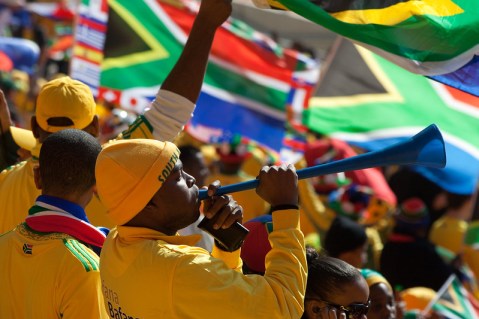
Despite some stunning matchups, the news story of the 2010 World Cup has undoubtedly been the vuvuzela. While there have been valiant efforts to the contrary (see Jennifer Doyle’s article in The Guardian about homophobia and sexual violence), not a newscycle goes by without some reference to this small plastic horn.
Designed in South Africa in the 1960s as a more portable facisimile of traditional kudu horns —and now mass-produced by the thousands in Chinese factories—the vuvuzela’s drone has been broadcast across the globe to the thrill of some and the annoyance of others. Non-African players have complained of headaches and difficulty playing because of the constant, loud sound; the BBC has created a special filter to block out some of the horn’s buzzing tones for at-home viewers. An oddly virulent backlash against the rising popularity of the horn outside of South Africa has effected bans against the vuvuzela at events as distant from South Africa and FIFA as one can get: the U.S. based Ultimate Fighting Championship, the Scottish T music festival, and, most recently, Nathan’s Coney Island Eating Competition, lest the horn “damage the competitive eating aesthetic.” The language used by many of these bans is that of contagion, like the sound of the vuvuzela is the herald of an infectious disease or a plague of locusts.
There have been many critiques of the horn at the level of decibels and hearing damage—the vuvuzela is reportedly 127 decibels, louder than a rock concert—although by that same logic the entire sport of NASCAR should be banned outright, as the New York Times reports it at a whopping 140 decibels. The pointed Nathan’s ban targeting “aesthetics” cuts to the quick of this heated debate. As an African instrument with its own particular history and cultural protocols, the vuvuzela seems to bother some people—namely members of Western and European nations—much more intensely than others, and for different reasons. Two of my husband’s coworkers, from the Ivory Coast and Grenada respectively, described the vuvuzela as a symbolic African diasporic sound of celebration that makes many white people uncomfortable; banning it outright would be not only an obvious pander to Western sensibilities—especially a preference for song over more random outbursts of sound—but also offensive, especially as South Africa is hosting the event. Or as the Botswana Voice Newsblog broke it down: “Hands Off the Vuvuzela!”
Dissenting voices have described the horn as annoyingly loud at best and disturbingly disruptive at worst. John Leicester, sports columnist for the Associated Press, managed to describe the sound of the horn as both “mindless” and “brainless” in his blog “Vuvuzela drone killing World Cup atmosphere,” as opposed to what he calls “football’s aural artistry”: the “ooohs,” “ahhhs,” and stadium chants of the “inventive” English who are “usually among the best-drilled noisemakers in football” but have been tragically drowned out by the “brainless” horns. After cultural comparisons like this—along the lines of the old racialized mind/body split concocted during the Enlightenment—it is difficult not to read Leicester’s closing plea, “Please, South Africa, make them stop. Give us a song, instead,” as a latent desire to control African people, not just their sonic output. At the very least, it is a tacit acknowledgement that the world is still divided along the lines of “us” and “them” and that sound plays a much larger role in facilitating these uneven power dynamics than previously thought.
It has also shown the world that struggles over the shifting border between sound and noise are rarely just that. It is precisely in such battles where sound studies can make an important intervention. . .so drop us a comment on the vuvuzela and the intense reactions it has elicited. What do you think? Has the vuvuzela been racialized? Is it a case of noise just being noise? Or is this phenomenon something else altogether? At the very least, blow one for yourself here and get a taste of what all the fuss is about.
JSA


Share this:

Sounds of Home
Last month, I braved hail, snow, and just about every kind of plague-like spring weather to hear Karen Tongson’s talk at Cornell about her soon-to-be-released book, Relocations: Emergent Queer Suburban Imaginaries (NYU Press’s Sexual Cultures Series). Karen’s project remaps U.S. suburban spaces as brown, immigrant, and queer, thus relocating the foundations of both queer studies and urban studies. While not a part of the “dykeaspora” of color that Karen deftly details, I am in solidarity with the lives she traces and the soundscapes she amplifies more passionately than Lloyd Dobler with his boom box.
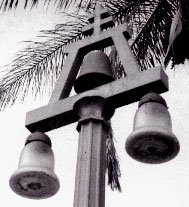 After all, Karen and I grew up together in the dusty, palm-tree lined streets of Riverside, California, meeting at Sierra Middle School and plotting our way the hell out of Dodge. . .only to later realize that our mutual plottings were really survivings—and a hell of a lot of fun—and the Riv—with its raincrosses and dry riverbeds, lifted trucks and low riders—would stay with us wherever we went.
Since leaving Ithaca—Karen’s voice still warm in my ears like it used to be when tying up our parent’s pre-call-waiting phone lines—I haven’t been able to stop thinking about the way in which Relocations also reimagines the power of music. For Karen, music can help us know and love who we are more deeply, to enable us to “make do” with what we have been given in a way that liberates rather than incarcerates. Music is not just about “the differences it makes audible” (as Josh Kun writes in Audiotopia) but also, as Karen argues, about the ways in which sound gives us back to ourselves.
For example, a song that is spliced into Karen and I’s mutual musical DNA is “There is a Light that Never Goes Out” by The Smiths, (from 1986’s The Queen is Dead). Its various revolutions—both on turntables and in life choices—have affected us profoundly. In “The Light that Never Goes Out: Butch Intimacies and Sub-Urban Socialibilities in ‘Lesser Los Angeles,’” Karen uses the song as an affective touchstone for the ways in which sound can create “queer sociability, affinity, and intimacy” (355) while providing sonic moments of “self- and mutual-discovery” (360) and mediating relationships of place, power, pleasure, and privilege.
Karen’s ideas have since helped me understand why I used to listen to the song over and over in my lonely yet womb-like suburban bedroom, as if it were revelation and incantation. As I struggled with issues—identity and otherwise—Morrissey’s silken voice had the power to sound out the shape of my most secret wounds and simultaneously soothe them. Although I now know I am not alone in this, I thought I was back then, alone and waiting for someone to:
“Take me out tonight
where there’s music and there’s people
who are young and alive.”
In a now slightly-embarrassing Anglophilic phase—this was also around the time I was reading The Adrian Mole Diaries, watching My Fair Lady with Karen, and exchanging mixtapes with my British penpal—the Smiths were part and parcel of an England that I imagined as a long lost home. The U.K.’s pop cultural exports made it seem so much more tolerant of misfits of all kinds, let alone more temperate than SoCal for black turtlenecks and Doc Martens. At the time, I thought I was listening to difference—to the most remote space imaginable from the sweltering hothouse of Riverside—but Karen’s work reveals that I was really hearing the maudlin voice of my own longing, the jangly chords of my own desire, the oddball rhythms of my own heart.
I finally got myself to the actual England years later, thanks to the wonders of credit-card leveraged conferencing in destination locations. After the conference—at which I was, ironically, presenting on Los Angeles—I had the pleasure of spending a damp, foggy day record-shopping my way through brick-bound Nottingham. While I was gleefully flipping through velvety fields of plastic covers and comparing American imports with their UK counterparts, “There is a Light that Never Goes Out” came on the shop’s PA. With the first flare of guitar, I looked up from the record bins, startled by the warm recognition I felt at the sound of “home.”
At the time, I remember thinking that my thirteen-year-old self would be totally geeked out. However, I harbor little nostalgia for the volatile claustrophobia of my lonely tweenhood. Karen would describe my flash of recognition as “remote intimacy,” an asynchronous experience of popular culture across virtual networks of desire, a way of “imagining our own spaces in connection with others.”
Singing along for the thousandth time to Morrissey’s bittersweet grain, I realized that I wasn’t listening to my past in that record shop, but rather my thirteen-year-old self had been hearing the future in her bedroom. Dreaming of England had given her a way to grapple with the pains that ultimately produced my deepest longings: to overcome the “strange fears that gripped” me, to one day be able take myself “anywhere, anywhere,” and to feel the “light” of a love that would “never go out.”

It had taken a 5500 mile plane ride for me to realize that “home” was, in fact, a feeling of arrival rather than site of destination . . .and I couldn’t wait to get back to L.A. to give my homegirl Karen a call.
“There is a light that never goes out
There is a light that never goes out
There is a light that never goes out
There is a light and it never goes out. . .”
JSA

Share this:


Current Top Posts





April 2021

January 2020

November 2019

October 2019

August 2019

April 2014

November 2017

March 2015

December 2017

October 2015
 Sounding Out!
Recent Comments