
#Blog-O-Versary 3.0
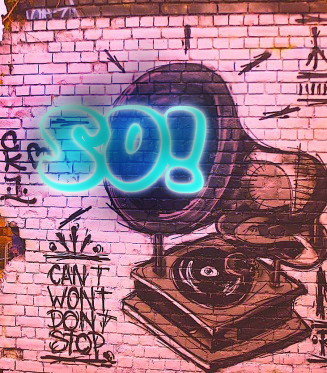
Click Phonograph to Download #Blog-O-Versary 3.0 Mix!
(Image by Mafleen; tunes picked by SO! writers & editors!)
Happy happy #Blog-O-Versary 3.0 to our readers, writers, retweeters, and supporters of all kinds!! This year proves that, to quote De La Soul quoting Schoolhouse Rock, “three is the magic number.” Of course a mic check also has to go out to another important trio, SO!‘s editorial crüe: Plug One: yours truly JSA, Editor in Chief and Guest Posts Editor, Plug Two: Liana Silva, Managing Editor, and Plug Three: Aaron Trammell, Multimedia Editor.
Here’s just a sample of the goodness that SO! has brought to y’all this past year, with some hints of how we “can’t stop won’t stop (the awesomeness)” on into year four!
- #itoughttobeillegaltolookthisgood: After copious troubleshooting meetings and readers’ polls–thanks for the great feedback, btw–we changed to our new layout on January 1st, 2012, an effort spearheaded by Managing Editor Liana Silva. #lovingit #ohsoreadable
- #ontheregular: SO! welcomed two new regular writers to our roster this year, multimedia artist Maile Colbert, who works out of Binaural Nodar in Lisbon, Portugal. and African American Studies scholar Regina Bradley, coming to you out of Florida State University. Look for their posts on full regular rotation in 2013.
- #puttingourbizinthestreets: The word is out! This year Sounding Out! has been all over the Internet and even the print-o-sphere–with citations (American Quarterly), links (The European Sound Studies Association), features (IASPM-US), re-posts (Cultural Weekly), allusions (Wi: A Journal of Mobile Media), recommendations (The Chronicle of Higher Ed‘s Prof Hacker), responses (SheSeesRed) , and even an analysis of our #Occupy coverage (The Incredible Kaleidophone). For the full listing of all the folks we’ve caught talking about Sounding Out! since Blog-o-Versary 2.0, see our brand spanking new media page. And, if you have taught an SO! post in your class, cited one in an article, discussed SO! in a blog, or even had a really good dream about SO!, drop me an email and tell me about it: jsa@soundingoutblog.com
- #hotoffthepresses: Sounding Out! worked overtime this year to be responsive to the sonic edge of major events–#Occupy, the murder of Trayvon Martin, the #casseroles protests, the Helen Vendler/Rita Dove American poetry anthology debates, the sudden international popularity of The Artist –showing the relevance of our scholarly work in everyday life and, now more than ever, the importance of the humanities and social sciences in interpreting the world we share.

Close-up of image by Flickr user Thomas Hawk
- #aaaahpushit: Our writers added over 15 new categories at SO! this year alone, based on the exciting new scholarship pushing sound studies into new directions: advertising, animals/animal studies, Carribbean Studies, curation, dance/movement, Deafness, economics, games/gaming, Islam/Muslim identity, Jewishness/Jewish identity, medicine, pedagogy, sound and region, religion and religious studies, time, vision/visuality, and writing. Big ups to Managing Editor Liana Silva for keeping our back catalogue up to date as new categories emerge, ensuring SO! will remain a fully searchable and usable tool for research, teaching, and pleasure reading.
- #seriesandforumsandCFPsohmy!: In addition to plotting our more broad general coverage, I began organizing special “Series” and “Forums” that took more lingering listens to specific issues and particular sites. In February 2012, SO! hosted a month-long forum on Deafness; throughout Spring 2012 we featured a series of dispatches, “Live From the SHC” that shared the new scholarship from the Sound Studies fellows gathered at Cornell’s Society for the Humanities. We just wrapped up a July forum on Listening in observation of World Listening Day and are in the midst of a summer series on radio history, “Tune in to the Past,” that sifts through the legacy of Norman Corwin. Look for a pedagogy forum to ring in the start of the academic school year in August, featuring the winner of our recent Call for Posts, “Sound and Pedagogy: Amplifying the Teachable Moment.” In fact, we received so many great pitches, we will offer a “refresher course” forum in spring 2013!
- #Puttingtheworldinworldlisteningday: U.S.-based sound studies is often critiqued for, well, being too U.S.-based. As a result I have sought out more posts that explore sound in transnational and diasporic contexts–such as “Everyone I listen to Fake Patois,” “Beat-ification: British Muslim Hip Hop and Ethical Listening Practices,” and “Listening to Disaster: Our Relationship to Sound in Danger”–and in sites across the globe: Ireland, Canada, England, and Portugal so far in 2012. Look for research focusing on (and located in) Ghana, Brasil, and Egypt in the months to come.
- #trippingthesoundpodcastic!: Directed by Multimedia Editor Aaron Trammell, SO!’s podcast series expanded this year to include regular quarterly installments, promising you a minimum of four experimental sonic explorations a year, with bonuses along the way. Since last year’s Blog-O-Versary podcast mixtape, we have taken you into the listening practices of sound artists, the roadside prayer containers of pious American truckers, memories of record store shopping, and deeper awareness of the soundscape. Subscribe to us on Itunes so you don’t miss a thing this year!
- #gonnagetourselvesconnected: Sounding Out! has forged relationships with many excellent sound-related organizations: American Studies Association Sound Studies Caucus, the Society for Ethnomusicology Sound Studies Special Interest Group, the Society for Cinema and Media Studies Sound Studies Special Interest Group, the Journal of Popular Music Studies, HASTAC (Humanities, Arts, Science, and Technology Advanced Collaboratory), the Society for the Humanities at Cornell and the World Listening Project. Look out for our upcoming IASPM-US collaboration (on tap for February 2013), which will involve cross-blog programming and conversation about the relationship (and tensions) between pop music studies and sound studies. Not to mention, we’ve hosted 46 guests and counting, representing over 37 unique institutions!

courtesy of Flickr user Stencil Terrorists
And that’s just a glimpse of how Sounding Out! “Can’t Stop, Won’t Stop (the Awesomeness)” on and on until the break of dawn (or at least until 9:00 a.m. every Monday morning). Now go ahead and take a listen with our annual downloadable mixtape–a seriously kick ass 90 minute TDK tape super-megamix that spans six decades and a dizzying array of genres–courtesy of Team SO! You’ve earned it!
–JSA, Editor in Chief
—-
Click here for Sounding Out!‘s Blog-O-Versary 3.0 mix with track listing
(Just in case you missed last year’s 2.0 celebration–and mix–click here; for our first Blog-O-Versary party mix click here)
—-
Jennifer Stoever-Ackerman is co-founder, Editor-in-Chief and Guest Posts Editor for Sounding Out! She is also Assistant Professor of English at Binghamton University and a 2011-2012 Fellow at the Society for the Humanities at Cornell University.
Share this:

In the Flesh: Embodiment, Listening, and Transcription
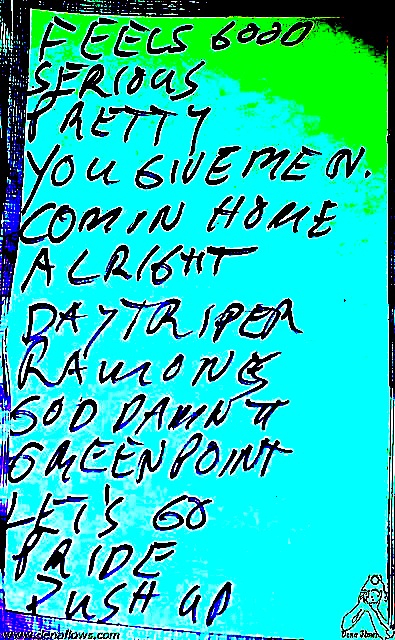
The Fleshtones Setlist, 9/11/12 show in Bilbao, Spain,
 Editor’s Note: July 18th, 2012 has been designated as World Listening Day by the World Listening Project, a nonprofit organization founded in 2008 “devoted to understanding the world and its natural environment, societies and cultures through the practices of listening and field recording.” World Listening Day is a time to think about the impacts we have on our auditory environments and, in turn, its affects on us. This year, Sounding Out! has decided to observe World Listening Day by planning a month-long special forum of posts exploring several different facets of listening such today’s offering by SO!‘s Multimedia Editor Aaron Trammell on listening’s relationship to the body and next week’s discussion by novelist Bridget Hoida on the impact of listening on her writing process. We will also explore questions that we need to remember when we celebrate listening as a cultural, embodied act. What happens when listening is interrupted? distorted? A post on tinnitus by Mack Hagood will help us think through what happens when we take listening (and the able body) for granted as a universal, normative experience. We’ll also publish a special bonus multi-sensory post by our newest regular writer, Maile Colbert, on World Listening Day itself and we will launch our regular quarterly spring podcast for on July 12th, which will feature Eric Leonardson, director of the World Listening Project. In addition to being interesting as all hell, the podcast will suggest some ideas for how to get involved in WLD activities–or how to embark on a listening project of your own this July. Enjoy our ear-opening extravaganza and please keep those comments coming. We’d love to hear from you! –JSA, Editor-in-Chief
—
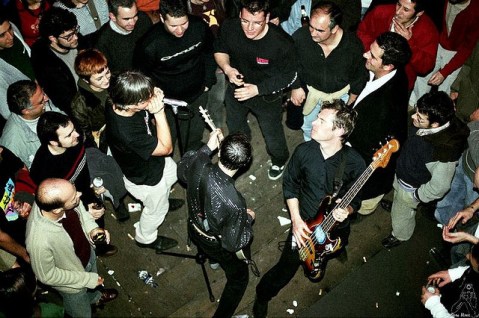
The Fleshtones, October 23, 2008, Image by Flickr User Dena Flows
What happens when the body translates sound from one medium to another? How is the body both affected by a song (when listening), and affecting it’s content (when writing)? In this post, I will relate my experience transcribing the lyrics of the song “Hexbreaker!” by The Fleshtones in an effort to answer these questions.
I love to sing. Often, I feel that it is only through singing that I feel that I can adequately relate to the emotions, ideas, and narrative of the songwriter. This relational practice is called embodiment. While psychologists such as Sigmund Freud and Carl Jung had at one point considered this sort of emotional relationship to be a libidinal drive – either to the phallus (in Freud’s case), or a unifying mythological symbol like the mandala (in Jung’s). These feelings, or drives, in classical psychoanalytic theory are part of our interior psyches, the unconscious mind.
Contemporary physiological research has departed from the sharp dichotomy of the conscious/unconscious mind. Instead, emotions are looked at as exterior phenomena – invisible links which form between bodies. As Lisa Blackman (2010) explains in her essay Embodying Affect: Voice-hearing, Telepathy, Suggestion and Modelling the Non-conscious: “The voices can be materialized through particular technologies of inscription such as neuro- imaging scans, and can even be located within the right temporal-parietal lobe, showing the capacity of the right brain not only for psychological attunement, but also for registering the affects of others” (166). Other theorists such as Sara Ahmed (2004) have argued that emotions float between and stick to bodies. Julian Henriques (2010) has even noted the ways that sonic vibrations work to activate reciprocal affective moods in others (75), a point very much in line with Blackman’s musings on the voice’s centrality to “psychic,”right brain, linkages. To these points, it is important to consider exactly what it means for the body to work as a medium of translation. What emotions can a song activate in my body, and how do these feelings become words, stored in the mnemonic confines of paper?
Because listening is central to the transmission and construction of emotional bonds, I will now detail my experience transcribing “Hexbreaker!”.
The Fleshtones are a band that I love. Their songs find the perfect balance of Animal House cool, Swinging Medallions style garage rock, and campy B-movie flavor. They have cred too, as they were a frequent act in the late-70s CBGB punk scene who shared a rehearsal space with The Cramps (a similar, but notably more famous band). Their song “American Beat” was key in the soundtrack of Tom Hanks’ shlocky 1984 film Bachelor Party. Peter Zaremba, the group’s singer, was a host on MTV’s interview based program, I.R.S. Records Presents the Cutting Edge. And, best of all, The Fleshtones have been largely eclipsed by bands with more visible albums, members, and histories. The band is all mine, and they serve as the perfect accent to any mixtape or conversation trivia at a mixer.
The digital footprint left by The Fleshtones is surprisingly sparse. Only a handful of key songs (from movie soundtracks) come up when a search for “fleshtones lyrics,” is queried on Google. A search for guitar notation or chord charts is completely fruitless, a rare feat in today’s search ecosystem. Even their vintage releases, 1982’s Roman Gods and 1983’s Hexbreaker!, were hard to pin down until the Australian label Raven re-released them on CD in 2011. For whatever reason, this sense of scarcity does nothing but excite me. It makes me feel an increased sense of intimacy and ownership. The Fleshtones, in this sense, are a knowledge commodity that has been underappreciated. By transcribing “Hexbreaker!”, and submitting it to the lyrics archive at lyrics.com (yet to be posted), I feel that I am laying claim to a space of knowledge and expertise neglected by many others.
Transcription is generally dull. Having transcribed many interviews in the past, I admit to regarding it as a job that requires patience more than practice: Press play. Listen for ten seconds. Jot down what was said. Forget half of what I was writing. Rewind five seconds. Listen again. Not quite enough to replace when I missed. Rewind eight seconds. Finish constructing the first sentence. Repeat. Hang in there for a few hours. Slow, repetitive, and monotonous is the work of interview transcription. In lieu of my previous experiences, I was happy to learn that the work of song transcription is notably more pleasurable. Although it came with its own share of frustrating and repetitive points, the presence of melody, cadence, and rhyme schemes made the entire process much more endearing and predictable.
One of the most engaging portions of song transcription came with the puzzling-out of unintelligible lyrics. The second verse of “Hexbreaker!” begins with a line that sounded like “With ____-____ mud and a hoodlum stack, finding fire in a mangled park” on first listen. It wasn’t until I had listened to each phrase five times in a row that I was able to revise to, “Well knee-high mud, and a moon lit shack, fightin’ flies in a mangled marsh.” Still not confident with that wording, I decided to do a dictionary search for similar words. To my elation after I had typed m-a-n-g into the dictionary the first word to appear was “mangrove,” the perfect word which I would never have guessed (it’s a weed-like tree found in coastal swamps!). Next I was spirited to discover that the following line evoked images of conquistadors sailing and exploring: “Well knee-high mud, and a moon lit shack, fightin’ flies in a mangrove marsh / Sendin’ sabres across the seven seas, or any foreign shores they may wash / I need a hexbreaker!”
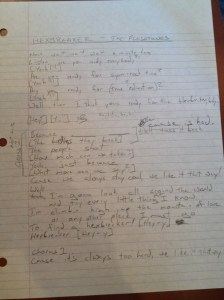
A transcript well done!
After I was able to get a gist of the overall narrative through transcription, I went back through the piece and was better able to make educated guesses about what the lyrics were. Although Zaremba often takes an unintelligible pitch when singing, the context of 17th century exploration helped me to piece together many of the tougher bits of the song. For instance, I revised the beginning of the chorus from “Well toss it back / [The bottles they break],” to fit the overall theme of colonial exploration, “The cause is had. / [The bodies they break].” Although, I’m not certain that these are the words to the song, I’m very confident because they match the overall theme. The practice of song-transcription has been fulfilling in the same way that figuring out a jigsaw, or tangram is exciting. It is a creative sort of problem solving, one that combines both analytic (left brain) and spatial, metaphoric (right brain) intelligence.
Emotionally, however, I did not feel the same satisfaction that I do when singing. Perhaps this has something to do with transcription alternate mode of embodiment. Transcription, and the pleasures associated – problem solving, precision, and permanence – are all of an analytical, and somewhat strategic sort. These are the pleasures of a conduit, processes associated more with the enduring construction of emotional bonds (belonging, and community), than the lucid enjoyment of them. It is my hope that one day another Fleshtones fan plumbs the depths of Google to find the lyrics of “Hexbreaker!” and that the fruit of my efforts, a completed transcript on lyrics.com, greets them and helps them to sing along and revel. Until then, it is enough to know that the work of transcription, for myself at least, is analytic and dry–definitely worlds apart from the euphoric mode of singing where my entire body vibrates in rhapsody to the melody, rhythm, and harmony of song.
—
Aaron Trammell is co-founder and multimedia editor of Sounding Out! He is also a Media Studies PhD candidate at Rutgers University.
Share this:


Current Top Posts





April 2021

January 2020

November 2019

October 2019

August 2019

April 2014

November 2017

March 2015

December 2017

October 2015
 Sounding Out!
Recent Comments