
The Absurdity and Authoritarianism of Now: My Chemical Romance’s The Black Parade Resonates Queerly, Anew
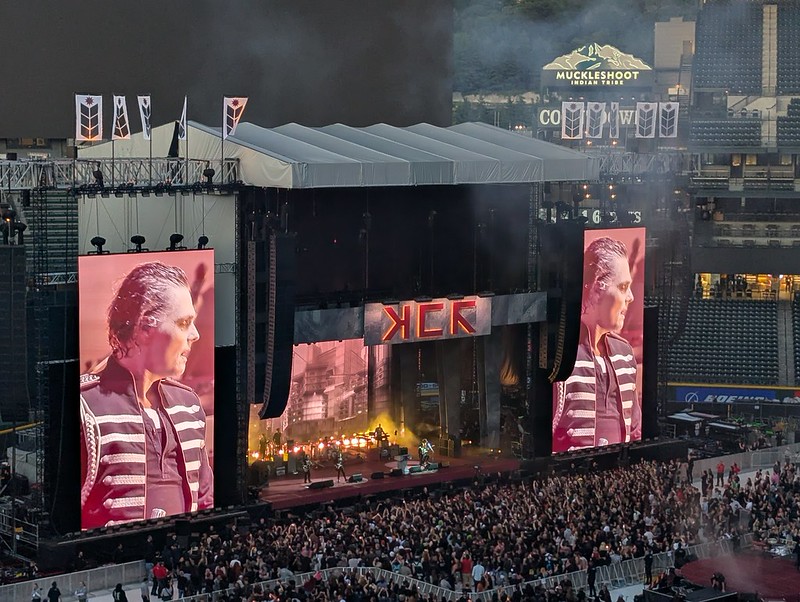
My Chemical Romance fans are speculating about new music after the band wiped their X account clean and wrapped up the Latin America leg of their tour this month. Whether another album is on the way or not, MCR’s magnum opus – The Black Parade – continues to endure two decades later. The sound now resonates through MCR’s commentary on fascism, critiquing the nation while holding the crowd accountable for our participation or passivity.
As the band tours The Black Parade for its 20th anniversary, the members have rejected nostalgia in favor of a new storyline, playing alter-ego characters who have been conditioned to perform for a dictator. The plot, slightly shifting night to night, encourages fans to follow along.
In the first run of the tour, each concert paused midway for an “election.” Four hooded figures walked out to the center stage. Nearby, an army official watched. Singer Gerard Way asked the audience to vote: Support these candidates or reject them? Each person in the crowd had a sign. One side: YEA. The other side: NAY.
“Now we need to hear you,” Way says. The audience roars, jeering and cheering.
No matter the spectators’ will, the result is the same: execution.
The warped election – and the sound of The Black Parade – reflects the absurdism of authoritarianism. Here is a democracy that ends in death, regardless of how you vote. Viewers log into livestreams to watch the fanfare repeat.
MCR’s commentary echoes the ramping authoritarianism and upheaval in the United States:
- The Supreme Court cleared the way for immigration agents to use race as a reason to stop and check someone’s citizenship documents. Daily ICE arrests reached a decade high last year. 2025 also marked the deadliest year for people in ICE custody in two decades.
- Protests have swept the nation, with outrage further increasing after federal agents killed two Minneapolis demonstrators this January.
- Cuts and changes to Medicaid and SNAP are on their way. The longest government shutdown also ended without extending subsidies for health care.
- The Epstein files were released, showing ties between powerful leaders and sex offender Jeffrey Epstein.
- The Department of Governmental Efficiency, named after an outdated Internet meme (DOGE), has resulted in the elimination of at least 290,000 jobs.
- The U.S. withdrew from the Paris Agreement and World Health Organization. The country also pulled out of 66 international organizations.
- Trump continues to enact steep tariffs after a Supreme Court ruling against his policy.
- Layoffs soared past 1.1 million job cuts in 2025, the highest since 2020’s COVID-19 shutdown.
This list represents a fraction of stories and executive orders in 2025; a “flood the zone” strategy overwhelmed the news cycle. Despite censorship efforts – such as the federal defunding of NPR and PBS – much of this information is available to us at the click of a button. State-sanctioned propaganda even encourages the spectacle. Just take a look at footage of ICE raids on the WhiteHouse’s TikTok account, set to songs and images of pop stars:
Yet fatigue and fearmongering keep many complacent; looming economic crises also draw our attention and time. I do not mean to diminish people’s efforts of resistance. But I am interested in the way technology has expanded our potential to witness violence, without ever requiring us to act – as well as the power of entertainment to distract.
So I turn back to MCR’s spectacle, which twists and mirrors this descent into fascism. Up against the tour’s faux-executions, the boos and the cheers of the crowd collapse into a cacophony. I locate the sound of our times within these screams, where dissent seems to go unheard and melds into the chorus of support.
The Black Parade is full of these bombastic wails, but the most intense of them are in “Mama,” a song that balloons into an extended eight-minute performance in the Long Live the Black Parade Tour. Within “Mama,” I try to make some sense of these screams, finding queer resonance with the present moment.
With my analysis, I ask: How might we hold fascist figures to account without squirming out of our own role in the daily exchange of authoritarianism? I argue My Chemical Romance’s 2025-2026 performance of “Mama” highlights structures of violence but also criticizes our participation within them.
In “Mama,” the indulgence of sin is contagious. It’s loud. It’s repeated: “Mama, we all go to hell.” This refrain, set to a polka beat, creates an abject intimacy around our shared fate. Queer listeners have interpreted this song as an angry anthem against the rejection we face from our families and dogmatic religion. For those of us who have heard, “You’re going to hell,” the response, “We all go to hell,” serves as a relief. Verses like “You should’ve raised a baby girl, I should’ve been a better son” have been reclaimed by transgender fans.
Other fans have taken issue with these interpretations, arguing queer attachments distract from the “true” meaning of the song. Indeed, “Mama” tells the story of a soldier writing from the trenches of war, while his mother judges him from afar. But I argue that by placing a queer reading in tandem with the canonical narrative, generative meanings emerge. Queer theory provides tools to understand the role of the mother here. Mama is the title of the song. Mama is pervasive. Mama is mean. Mama is on his mind. But she is also almost entirely absent, avoiding accountability for her son’s violence and instead blaming him: “She said, ‘You ain’t no son of mine.’”
The soldier finds that the trenches are not just his domain, but also his mama’s: “Mama, we’re all full of lies…And right now, they’re building a coffin your size.” His plea to his mother helps us wonder: What about the culture that birthed this violence? In this metaphor, critiquing the mother extends to critiquing the nation.
At the climax of the song, these sentiments come through screams: 30 seconds of an extended, “AHHHHHH” and a crying out of, “Mama, Mama, Mama.” In these wails, I find a soldier begging to share responsibility with his motherland, even as he contends with his own role in the violence. The cries puncture the polka, demonstrating “Mama” is not a celebration, after all.
Mama only sings one line back, through the voice of theater icon Liza Minnelli: “And if you would call me a sweetheart/I’d maybe then sing you a song.” Minnelli’s voice connects the song’s sound to her role in Cabaret, a musical which mixes together queer aesthetics and indulgent decadence with a foreboding rise of fascism. This allusion to Cabaret, as well as the tour performance, serve as a reminder: pleasure and entertainment does not always equal resistance.
In the extended version of “Mama” on tour, these lines are sung by an opera singer, whose voice, too, serves the dictator. Preceding her performance, the song briefly opens up a space for resistance. A new section of the song, debuted on the tour, includes the lyrics:
A dagger, a dagger
Please fetch me a dagger
A tool for our treasonous needs…
With tears in our eyes we collapse on the crosses
And said death be the son of us all
This war is the son of us all.
Even as Gerard Way’s character plots treason against the dictator, these new lyrics make clear: this “death” and “war” is “the son of us all.” Though we might want to pin fascism on one figure, many Americans have participated in the creation of this “death/war.” There are fatal consequences for our collective actions – or our passivity.
Ultimately, the dramatics of this song, delivered like a sinister weapon, critique violence, while ironically trapping us in its pleasures. If prayer is crying out to our father who art in heaven, “Mama” is yelling back at our mother to bring her to where she belongs: the hell in which we both exist. Given the stakes of our political moment, I argue we need to scream louder, with purpose and strategy, against our motherland.
—
Featured Image: “My Chemical Romance Live at T-Mobile Park 6/11/25,” Image by Flickr User Laura Smith CC BY-ND 4.0
—
Max Lubbers (he/she) is a first-year PhD student in the American Studies and Ethnicity department at the University of Southern California. His research centers on transgender affects and sounds. Max earned a bachelor’s degree in Journalism and Gender and Sexuality Studies from Northwestern University, with a senior thesis on butch affect. She previously worked as a journalist, with pieces in Chicago’s NPR station, Colorado Public Radio, and Windy City Times.
—

REWIND!…If you liked this post, check out:
The Sounds of Equality: Reciting Resilience, Singing Revolutions–Mukesh Kulriya
Vocal Anguish, Disinformation, and the Politics of Eurovision 2016–Maria Sonevytsky
“To Unprotect and Subserve:” King Britt Samples the Sonic Archive of Police Violence —Alex Werth
Share this:

“Just for a Few Hours, We Was Free”: The Blues and Mapping Freedom in Sinners (2025)

In the 2025 blockbuster Sinners, Ryan Coogler has a vampire story to tell. But before he can begin, he needs to tell another story—a blues one. Sinners opens with a voiceover thesis statement performed by Wunmi Mosaku (who plays Annie in the film—more on her below) about the work the blues can do, then rambles the narrative through and around 1932 Clarksdale, eventually settling into a juke joint outside of town. Here, the blues story builds to a frenzied climax, ultimately conjuring the vampires propelling the film’s second half. It’s those vampires that most immediately register as cinematic spectacle, but Coogler’s impetus to film in IMAX and leverage all of his professional relationships for the movie wasn’t the monsters—it was to showcase the blues at a scale the music deserves. In Sinners, the blues takes center stage as a generative sonic practice, sound that creates space to be and to know in the crevices of the material world, providing passage between oppression and freedom, life and death, past and future, and good and evil.
I’m not exaggerating in calling the opening voiceover a thesis. In a movie where Coogler trusts his audience with a great deal of interpretation, he puts an incredibly fine point on the role that blues performs here. We’re told that some musicians—be they Irish, West African, Native American, or southern US Black—are so skilled that they can pierce the veil separating the living from the dead, and while this piercing can help heal a community, it can also attract a certain evil that wants to exploit this rupture. The narrator doesn’t say “It’s the blues!” but the next visual information we get is that it’s Clarksdale, MS, in 1932, and an injured, blood-soaked Sammie (Miles Caton) is stumbling into his father’s church, clutching what’s left of the neck of a guitar. No one in Sinners says the word “crossroads,” but here we are, at the place where the blues meets the devil—where the end meets the beginning–and our young hero has a choice about which way he’s going to go.

If Coogler doesn’t fully trust his audience to know what to do with the blues without being told, it’s likely due to decades of commercialized attempts to defang the genre that have filtered out 21st century listeners’ ability to hear most of what makes the blues potent. Drawing on what Clyde Woods in Development Arrested (1998) has termed the “blues epistemology,” a blues way of knowing, B Brian Foster speaks with contemporary Black Clarksdalians in I Don’t Like the Blues (2020) to chart much of the current state of the blues. Pulling on one particular thread of Foster’s ethnography can help clarify what’s happening in Sinners, as he unpacks the many reasons why the blues don’t resonate quite like they used to.
In Woods’s framework, the blues is more than a musical genre; it’s a way of understanding and, crucially, reshaping one’s world. The blues, a genre arising in the late 19th century and reverberating through the 20th, functioned as epistemology in order to explore a way out from under plantation power after Reconstruction and through Jim Crow. Woods chronicles centuries of “plantation power” in the Delta and how that power reconfigures itself over and again through different eras of US history, always with the goal of extracting labor and life from Black Mississippians. The blues pushed against the edge of what was considered possible and sought to imagine and create a world that was free—not just from plantation power but from all the logics that support it or would circumscribe Black self-determination and autonomy. In I Don’t Like the Blues, Foster encapsulates the heart of blues epistemology with a flourish: “While many people hear the blues as performance and play, Black residents of Clarksdale knew it to be flesh and bone, a spirit in the dirt. Their blues was a conduit. A map. A method” (15-16). Throughout his book, Foster demonstrates that what the blues was is no longer what the blues is. One of those reasons is that resistance to plantation power (whether in the Delta or beyond) simply sounds different now, having worked its way through jazz and funk and soul and hip hop and trap.

In Sinners, Coogler starts by telling us what the blues could do, then he shows us that power in a climactic scene midway through the film, reminding his audience that a blues epistemology might not always sound the same, but it can still do the work of mapping out freedom. After the camera cuts away from Sammie at the crossroads in his church, we loop a bit back in time to meet Sammie’s cousins, the SmokeStack brothers (twins played by Michael B Jordan), who purchase the juke joint’s eventual location. The first half of the movie follows the brothers as they split up and get the band—and hospitality crew—together to open the venue that night. Sammie is new to this life, but a deeply gifted bluesman, and he receives counsel along the way about what the music is and how it works. Once the juke is packed, the booze is flowing, and the dancefloor is sweating, Delta Slim (Delroy Lindo) invites Sammie to take the stage and tell the people who he is and where he’s from. What follows is an ambitious narrative and technical feat that pays off the opening voiceover.
Sammie, also known as Preacher Boy, launches into a song called “I Lied to You,” addressed to his minister father (played by Saul Williams). It’s a confession that he’ll take the blues over the church any day. His singing pierces the veil, and we witness a litany of musicians joining the space from the past, present, and future: an Afrofuturist rock guitarist, hip hop DJs, breakers, twerkers, a ballerina, a Zaouli dancer, and Beijing opera performers, among others. Weaving in and out of Sammie’s blues, the sounds of each of these musicians layer and feed back into the mix to create a densely ecstatic sequence. This is the community healing piece of the voiceover thesis. The performers joining from far-flung places and times connect to an ancestral lineage of creative self-determination that runs through the patrons of the juke joint (Bo and Grace—played by Yao and Li Jun Li, respectively—are Chinese shop owners helping out at the juke joint and the presumed source of the Beijing opera performers).
Sinners’s musical conjuring isn’t an academic article, but it does have some musicological points to make. Audiences encounter musical styles uprooted from specific times and places, all mingling around this blues moment in 1932 Clarksdale. Coogler structures the scene by stacking out-of-time sound and movement, emphasizing the potency of a blues epistemology while also acknowledging that the blues’s power is situational. In its time—post-Reconstruction and Jim Crow—the blues could call in and draw on the fullness of diasporic music-making and world-mapping. But at other times, and in other places—say, a 2025 music venue—the blues is less likely to ignite such a moment as it is to show up as a participant, arriving as one of many in the musical ancestry to support the veil-piercers of the day. This phenomenon is the “changing same” of Black music, as Amiri Baraka put it in Blues People: “consistent attitudes with changed contexts” that explain why the sound changes over time (153). In Sinners, the immediate context is a community of Mississippi sharecroppers who seek healing, and the blues widens the frame so that the juke joint revelers can connect to and draw strength from a broader, deeper community beyond the edges of their material world.
As “I Lied to You” mingles with sounds past and future, the camera moves through the juke in a counterclockwise motion, grounding the scene further in diasporic ancestral practices. In Slave Culture (1987), Sterling Stuckey traces elements of Bakongo burial ceremonies throughout the New World, focusing especially on the ring shout, a sacred ceremony practiced by enslaved people in the United States involving a shuffling circular dance accompanied by song. Consistent across these traditions is counterclockwise movement:
Wherever in Africa the counterclockwise dance ceremony was performed—it is called the ring shout in North America—the dancing and singing were directed to the ancestors and gods, the tempo of the circle quickening during the course of movement. The ring in which the Africans danced and sang is the key to understanding the means by which they achieved oneness in America (12).
The counterclockwise circulation rehearses the life cycle, with the sun rising in the east (birth) and setting in the west (death), only to rise again (gesturing toward the connected nature of all life).
Stuckey draws on Robert Farris Thompson to note that special emphasis on counterclockwise motion would happen in Bakongo rituals that superimposed a cross on the circular movement, where the horizontal line represented the division between the living (above) and the dead (below). Here is the dividing line of Sinners, then: an ancestral ceremony with a crossroads superimposed on it, a blues invocation where the audience is propelled counterclockwise through the circle of juke joint dancers, where the dead and not yet alive join in the festivities.
The theme of lineage and ancestry courses through Coogler’s work. On the personal level, this may play out as a boxer sparring with his late father’s legacy. On a larger scale, Coogler often traverses the land of the Great Migration and the sea of the Middle Passage, tying back together the threads left dangling by the terrorisms of the transatlantic slave trade and Jim Crow. For a people whose lineage was savagely untethered by their ancestors’ enslavers, the power of a blues epistemology comes from its ability to tap into traditions and rituals that couldn’t be fully severed, restoring the “oneness” of those engaged in the dance and fueling their ability to imagine and create a path to freedom.
There is the other part of the voiceover’s thesis statement, though. When you pierce the veil, evil seeks to charge through. As the “I Lied to You” sequence hits peak intensity, Coogler treats movie audiences to another visual effect that the blues performers cannot see but feel; the juke joint appears to spontaneously combust and its roof is on fire (the roof, the roof. . .). Coogler metaphorically lets the motherfucker burn, down to the concrete foundation supporting the people as they continue to dance. At the edge of the dusty parking lot, the movie’s villain—an Irish vampire named Remmick—watches lustily while flanked by his latest converts. He wants Sammie; particularly what Sammie knows how to do.
Because Remmick hive-minds with whomever he turns into a vampire, taking on their memories and abilities, if he can get at Sammie, he’ll be able to pierce the veil, too, and commune once again with his long lost ancestors. We could read Remmick’s drive as an allegory about cultural appropriation, a white man who wants to steal the blues, and certainly there’s an element of that at play. But the “Killmonger was right” corollary of Coogler films suggests that villains are often more complex than they may at first seem. In Sinners, there’s a mob of Klansmen that function as the more straightforward baddies, but Coogler isn’t interested in giving them much screen time. Yet he lingers with Remmick just as he did with Killmonger and Namor in his two Black Panther installments. In each of these cases, Coogler explores different experiences of what it’s like when the boot of Empire is on your neck. Remmick, coming from Britain’s first colony, speaks of his home being taken and of religion being forced on him. He seems to hold genuine disdain for the Klan and notes that he’s happy to turn them all to prey, not because he wants what they have but because they deserve a gruesome death. He plays and dances to the music of his ancestors with care and devotion. And he argues that what he has to offer—community with his coven, the power to overtake the plantation class, eternal life—is better than what Smoke, Stack, Sammie, and the rest of the juke joint patrons currently have.

No one living trusts Remmick—in fact, Annie (Mosaku), the heart, brain, and wisdom of the movie, specifically distrusts him even before he reveals his true vampiric nature. And Coogler doesn’t position Remmick to be perceived as “good” in any sense of the word, except at playing that banjo. But, like Killmonger and Namor, Remmick gets to be right about some things. It appears in flickers of concession on characters’ faces when Remmick tells them they live in a place where they’ll always have to fight to even try to be truly free. It appears again when the juke joint protectors melt a bit during Remmick & Co’s performance of “Pick Poor Robin Clean,” a glimmer of a thought of “wait, should we let them come inside and play this absolute bop??” (for detailed historical context for this song see Daphne Brooks’s “See My Face on the Other Side” [2017]). Coogler’s villains ultimately suffer defeat, but before they do, he makes sure audiences glimpse how they’ve suffered under Empire, offering an understanding of their destructive actions as born of unhealed generational trauma.
Piercing the veil is tricky work. Dangerous work. In The Long Emancipation (2021), Rinaldo Walcott notes that “much of what we have come to call Black culture is a mode of living life within, against, and beyond plantation logics” (20), not only a rejection of logics of oppression but also a practice of creating and nurturing something else. To set about finding knowledge and being, as Sylvia Wynter puts it, “completely outside our present conception of what it is to be human” is to set off into the not-fully-known, where one may encounter a variety of ideas and beings who won’t ultimately lead you to freedom but who may offer you something a little better than what you’ve got (Wynter, 2000 interview with David Scott, 136). Walcott calls this the difference between emancipation and actual freedom. While emancipation is often mistaken for freedom, Walcott argues that “postemancipation acts of Black life have been consistently interdicted, thereby preempting and often violently preventing Black life from authorizing its own desires for bodily autonomy” (105), preventing Black life from being free.
In Sinners, Coogler shows us the way the blues could clear space for finding freedom, but none of the characters in the movie make it all the way there. It’s a movie situated in the long emancipation, where an imposed religion calls the blues the devil’s music, where plantation sharecropping and the Klan violently forestall Black freedom (but sometimes get what’s coming to them), and where various vampires carrying their own intergenerational trauma try to seduce Black people into accepting a different flavor of emancipation in place of the freedom the blues leads them toward. The map to freedom may not sound like the blues anymore, but Sinners reminds us the work isn’t done.
—
Featured images: Screen Capture by SO!: Sammie’s right hand clutching broken guitar neck, black cross in the background against white wall [2:10]
—
Justin Burton is a Professor of Music at Rider University, teaching primarily in the Music Production degree as well as in the Gender & Sexuality Studies program, and author of Posthuman Rap (Oxford, 2017) and co-editor of the Oxford Handbook of Hip Hop Music (Oxford, 2018).
—

REWIND! . . .If you liked this post, you may also dig:
They Can Hear Us: Surveillance and Race in “A Quiet Place”–Justin Burton
Can’t Nobody Tell Me Nothin: Respectability and The Produced Voice in Lil Nas X’s “Old Town Road”–Justin Burton
SO! Amplifies: The Blues and Jazz Dance Book Club–Chelsea Adams
“Music More Ancient than Words”: W.E.B. Du Bois’s Theories on Africana Aurality — Aaron Carter-Ényì
Music Meant to Make You Move: Considering the Aural Kinesthetic–Imani Kai Johnson
Share this:


Current Top Posts





April 2021

January 2020

November 2019

October 2019

August 2019

April 2014

November 2017

March 2015

December 2017

October 2015
 Sounding Out!
Recent Comments