
The Love Below (the Mason Dixon Line): OutKast’s Rejection at the 1995 Source Awards

During his acceptance speech at 2017’s Golden Globe awards, actor and rapper Donald “Childish Gambino” Glover thanked the black people of the city of Atlanta for “being alive,” and the Atlanta trap rap group Migos for their single “Bad and Boujee.” As the camera panned out into the crowd, it showed dominantly white faces full of confusion and polite yet uncomfortable laughter. These audience members seemed unfamiliar with Migos and with categorizing a “black” Atlanta (and South) separate from the pop culture hub we know as Atlanta today. Glover’s speech re-affirmed the sentiments of Outkast’s Andre “3000” Benjamin over twenty years’ prior at the 1995 Source Awards, that the (black) South got something to say.
As I’ve argued previously, Andre and Big Boi’s acceptance speech at the Source Awards was the springboard for what I call the “hip hop south,” the social-cultural experiences that frame southern blackness after the Civil Rights Movement. The declaration “the South got something to say”—and the booing that ensued—is important to engaging how southerners see and hear themselves in a contemporary landscape. The Source Award’s dominantly New York audience booing both jolts the ear and affirms hip hop’s hyper-regional focus in the early to mid 1990s. The booing crowd identifies hip hop as northeastern, urban, and rigidly masculine, an aesthetic that was a daunting task for non-northeastern performers to try and break through. Even celebrated west coast artists like Snoop Dogg, who menacingly and repeatedly asked the crowd “you don’t love us?” during the show, struggled with the challenge of being recognized – and respected – by northeast hip hop enthusiasts.

The 1995 Source Awards proved to be the climax of the beef instigated by both West Coast Death Row Records and East Coast Bad Boy Records, the bitter lyrical and personal battle between Tupac Shakur and Notorious B.I.G., and OutKast, a Southern act, chosen as “Best New Rap Group.” The crowd’s increasingly despondent sonic rejection of hip hop outside of New York foregrounds my reading of OutKast’s acceptance speech as blatant and unforgiving southern black protest, a rallying cry that carves a space for the hip hop south to come into existence.
A recap of that night, in which Christopher “Kid” Reid and Salt-N-Pepa presented OutKast their award. Upbeat and playful, Kid says “ladies help me out” to announce the winner, but there is a distinctive drop in their enthusiasm when naming OutKast the winner of the category. The inflection in their voices signifies shock and even disappointment, with Kid quickly trying to be diplomatic by shouting out OutKast’s frequent collaborators and label mates Goodie Mob. The negative reaction from the crowd was immediate, with sharp and continuous booing.
Big Boi starts his acceptance speech, dropping a few colloquial words immediately recognizable as proper hip hop – “word” and “what’s up?” Over a growingly irritated crowd, Big Boi acknowledges that he is in New York, “y’alls city,” and tries to show respect to the New York rappers by crediting them as “original emcees.” Big Boi recognizes he is an outsider, his southern drawl long and clear in his pronunciation of “south” as “souf,” yet attempts to be diplomatic and respectful of New York. There is also a recognition that where he is from, Atlanta, is also a city: his statement, “y’alls city,” is not only a recognition of his being an outsider but a proclamation that he, too, comes from a city—except it’s a different city.
Big Boi’s embrace of Atlanta as urban challenges previous cultural narratives of southerners as incapable of maneuvering within an urban setting. Because of a long-standing and comfortable assumption that the American south was incapable of anything urban (i.e. mass transit, tall buildings, bustling neighborhoods and other forms of communities), beliefs about southerners’ perspectives remained aligned with rural – read ‘country’ and ‘backward’ – sensibilities incapable of functioning within an urban cultural setting. These sensibilities often played out in longhand form via literature or in popular black music, with focus on dialect and language standing in as a signifier of regional and cultural distinction.

Big Boi still repping ATL in 2012, Outside Lands Music Festival, San Francisco, CA, Image by Flickr User Thomas Hawk, (CC BY-NC 2.0)
Consider Rudolph Fisher’s southern protagonist King Solomon Gillis from the short story “City of Refuge” (1925). Fisher’s characterization of Gillis, a black man from rural North Carolina, is one of naiveté and awe for not only New York and its sounds, but the premise of city life in general. In the opening of the story Fisher describes Gillis’s ride on the subway as “terrifying,” with “strange and terrible sounds.” References to the bang and clank of the subway doors and the close proximity of each train as “distant thunder” is particularly striking, a subtle sonic nod to Gillis’ rural southernness and his inability to articulate the subway system outside of his limited southern experiences. The references to “heat,” “oppression,” and “suffocation” also lend premise to southern weather, a well as the belief of the American south as an unending repetition of slavery and its effects.
It is important to point out that Gillis certainly isn’t a fearful man in the literal sense: his reason for migrating to Harlem was out of necessity and desperation after shooting a white man back home to avoid being lynched. Yet Fisher’s attention to sound presents Gillis as an outsider. Further, Fisher describes Gillis as “Jonah emerging from the whale,” both a biblical allusion to triumph over a difficult situation as well as a rebirth, the possibility of a new life and new purpose. This can be connected to the biblical reckoning of southern black folks migrating out of the south for social-economic change and advancement.
Still, southern black folks emerging in the city is not an easy transition, with Gillis’ train ride and his discomfort with the sounds it produces symbolizing the move from one difficult landscape to another. Although Gillis ultimately is confronted with the brutality he was trying to avoid in North Carolina, his repetitive proclamation, “they even got cullud policemans!” amplified his southernness and naiveté. Fisher’s intentional use of written dialect enhances the repetitiveness of the impact of seeing black police officers, which blots out the characteristic of region but not white supremacy as a whole. Gillis’s acceptance of black police officers blurred the binaries of the Great Migration as a testament to black folks not only looking for social-economic change outside of the American South, a terroristic space for blacks, but the unfortunate anxiety of those deciding to remain in the south, complacent in the lack of social equality.

Panel 35 of Jacob Lawrence’s Migration Series, documenting Black Americans’ move to Northern Urban Centers : “They Left the South in Great Numbers. They Arrived in the North in Great Numbers.” Photo by Flickr User Ron Cogswell, (CC BY-NC 2.0)
Seventy years later Big Boi, a Georgian, returns to New York with the confidence of both rural and southern sensibilities outside of the immediately recognizable urban trope embodied by New York. Big Boi’s full embrace of being “cullud,” in both the linguistic and cultural elements that Fisher’s long-hand dialect represented as authentic southernness, is jarring because his intentional embrace of southern blackness as othered anchors his approach to rap music. Big Boi does not posture the south as a space or place in need of escape or reposturing. Rather, the hyper-awareness from both Big Boi and Andre in front of the dominantly New York crowd ruptures the accepted narrative of the south as needing saving by non-southern counterparts. Big Boi’s speech forces the audience to de-romanticize their notions of northeastern supremacy and recognize the south as capable of hip hop. Their direct booing is a sonic representation of that discomfort.
From this perspective, André’s now iconic remarks from the acceptance speech further emphasized Big Boi’s departure from reckoning with northeastern hip hop as the standard. He stumbles in his speech, possibly because of nerves or irritation, and, like Big Boi, must talk over the crowd. André speaks about having the “demo tape and don’t nobody wanna hear it,” a double signifier of not only being rejected for his southernness but also the difficulty of breaking into the music industry. André’s frustration with being unheard as a southerner can also be extended into the actual production of the tape by OutKast’s production team Organized Noize, who drew from southern musical influences like funk, blues, and gospel to ground their beats. Andre’s call-to-arms, “the south got something to say,” rallied other southern rappers to self-validate their own music. It is important to note that André’s rally called to the entire south, not just Atlanta. This is significant in thinking about southern experiences as non-monolithic, the aural-cultural possibilities of multiple Souths and their various intersections using hip hop aesthetics.

OutKast at the Pemberton Music Festival, CREDIT MARK C AUSTIN(CC BY 2.0)
OutKast moves past their rejection at the Source Awards via their second album ATLiens (Atlanta aliens), which offered an equal rejection of hip hop culture’s binaries. The album’s use of ‘otherworldly’ sonic signifiers i.e. synthesizers and pockets of silence that sounded like space travel – embodied their deliberate isolation from mainstream hip hop culture. Still, OutKast didn’t forget their rejection, sampling their acceptance speech in the final track from their third album Aquemini titled “Chonkyfire.” The brazen and hazy riffs of an electric guitar guide the song, with the recording from the source appearing at the end of the track. There is a deliberate slowing down of the track, with both the accompaniment and the recording becoming increasingly muddled. After André’s declaration “the south got something to say,” the track begins to crawl to its end, a sonic signifier of not only the end of the album but also the end of OutKast’s concern with bi-coastal hip hop expectations. Sampling their denial at the Source Awards was a full-circle moment for their music and identities. It was a reminder that the South was a legitimate hip hop cultural space.
In this contemporary moment, there is less focus and interest in establishing regional identities in hip hop. The dominance of social media collapses a specific need to carve up hip hop spaces per physical parameters. Sonically, there is an intriguing phenomenon occurring where rappers from across the country are borrowing from southern hip hop aesthetics, whether it be the drawl, bass kicks, or lyrical performance. Although our focus on social media has seemingly collapsed the physical need to differentiate region and identity, geographical aesthethics remain central to our listening practices. With this in mind, OutKast’s initial rejection from then mainstream hip hop in favor of sonic and cultural reckonings of southern blackness keep them central to conversations about how the Hip Hop South continues to ebb and weave within and outside the parameters of hip hop culture. Their rejection of hip hop’s stage solidified their place on it.
—
Featured Image “Big Boi I” by Flickr user Matt Perich (CC BY 2.0)
—
Regina N. Bradley, Ph.D is an instructor of English and Interdisciplinary Studies at Kennesaw State University. She earned her Ph.D in African American Literature at Florida State University in 2013. Regina writes about post-Civil Rights African American literature, the contemporary U.S. South, pop culture, race and sound, and Hip Hop. Her current book project explores how critical hip hop (culture) sensibilities can be used to navigate race and identity politics in this supposedly postracial moment of American history. Also known as Red Clay Scholar, a nod to her Georgia upbringing, Regina maintains a blog and personal website and can also be reached on Twitter at @redclayscholar.
—
 REWIND! . . .If you liked this post, you may also dig:
Caterpillars and Concrete Roses in a Mad City: Kendrick Lamar’s “Mortal Man” Interview with Tupac Shakur—Regina Bradley
I Been On: BaddieBey and Beyoncé’s Sonic Masculinity — Regina Bradley
The (Magic) Upper Room: Sonic Pleasure Politics in Southern Hip Hop—Regina Bradley
Share this:

An Evening with Three Legendary Rebel Women at Le Poisson Rouge, January 27, 2017: Margot Olavarria, Bibbe Hansen, and Alice Bag
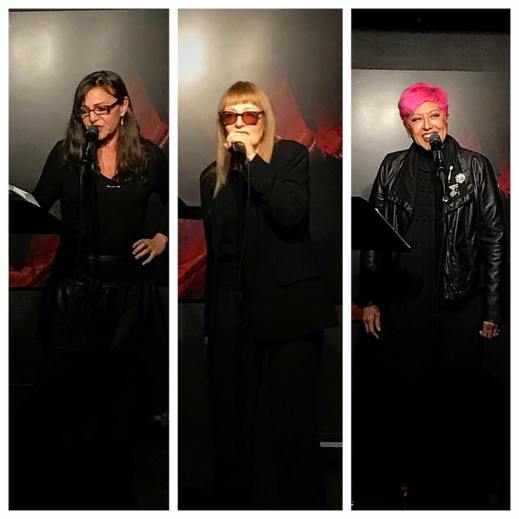

Image of Alice Bag used with her permission (thank you!)
For full intro and part one of the series click here. For part two, click here. For part three click here.
Our Punk Sound series implicitly argues that sound studies methodologies are better suited to understanding how punk works sonically than existing journalistic and academic conversations about musical genre, chord progressions, and/or genealogies of bands. Alexandra Vasquez’s sound-oriented work on Cuban music, for example, in Listening in Detail (2014) opens up necessary conversations about the “flashes, moments, sounds” in music that bear its meanings and its colonial, raced, classed, and gendered histories in material ways people can hear and feel. While retaining the specificity of Vasquez’s argument and the specific sonic archive bringing it forth, we too insist on “an ethical and intellectual obligation to the question: what do the musicians sound like” (12) and how do folks identifying with and through these musical sounds hear them?
In this series, we invite you to amplify varied historicized “details” of punk sound–its chunk-chunk-chunk skapunk riffs, screams, growls, group chants, driving rhythms, honking saxophones–hearing/feeling/touching these sounds in richly varied locations, times, places, and perspectives: as a pulsing bead of condensation dripping down the wall of The Smell in Downtown LA (#savethesmell), a drummer making her own time on tour, a drunk sitting too near the amp at a backyard party, a queer teenager in their bedroom being yelled at to “turn it down” and “act like a lady[or a man]”. . .and on and on. Today we feature Elizabeth Keenan, documenting an evening with three of punk’s legendary Rebel Women at a time of political crisis.
SOUND!
–Aaron SO! (Sounding Out!) + Jenny SO! (Sounding Out!)
This is not normal/let’s not pretend.
–Alice Bag, “Reign of Fear”
Since November 8, nothing has felt normal in the United States. Instead, every day brings new concerns about what the Trump administration might dismantle, destroy, or defund. The first two months have brought two attempts at an executive order barring immigrants to the US from predominantly Muslim countries and re-introduced the nation to the following cast of characters: a billionaire with no public education experience placed in charge of the Department of Education seeking to push a religious agenda; a man who once vowed to abolish the Department of Energy nominated to helm it; a white supremacist, Breitbart-editor consigliere; and a conspiracy-theorist National Security Advisor with suspicious ties to Russia.
This is not normal.
Let’s not pretend.
But in her song, “Reign of Fear,” Bag counters with defiance: “We’ll resist you/We won’t stand by.”
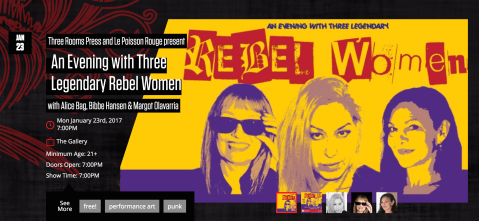
“Reign of Fear,” which Bag performed last at “Rebel Woman,” an event at (le) Poisson Rouge in New York City, encapsulated the evening’s message of resistance. Hosted by Three Rooms Press, “Rebel Women” featured readings from Margot Olavarria, Bibbe Hansen, and Alice Bag, all of whom have crafted careers that blend music and literary performance. Olavarria is the founding bass player for the Go-Go’s; she later played bass for post-punk experimental band Brian Brain, and holds a PhD in political science. Hansen, an actress, artist and musician, grew up in New York City’s art world. As a teen, she worked with Andy Warhol and played music with Jan Kerouac. Later, she co-founded the ironic Black Flag tribute band, Black Fag, with “terrorist drag artist” Vaginal Creme Davis (who also played with Alice Bag in Cholita). As lead singer and co-founder of the Bags, Alice Bag emerged as one of the most influential Chicana voices in the punk rock scene in Los Angeles in the 1970s (She later documented the women of this scene on her website). Since then, her musical career has included groundbreaking bands Castration Squad, Cholita, and Las Tres, as well as her self-titled solo debut in 2016. Her memoirs Violence Girl (2011) and Pipe Bomb for the Soul (2015) document her music and activism, from L.A. to Nicaragua.
“Rebel Women,” held just two days after the Women’s March on Washington, D.C.—and the satellite marches across the country and internationally—offered an opportunity to reflect on approaches to resistance, whether through music, words, or direct action. Although the Women’s March came under criticism for an initial lack of diversity, it became a protest led by activist women of color, with speakers and performers pushing back against the normalizing of misogyny from a pussy-grabbing president. Both Bag and Olavarria had attended the march in Washington, D.C.; many in the audience had marched there or in the crowd of 500,000 in New York City, which gave “Rebel Woman” a particularly urgent charge.

Image from Flickr user astoller (CC BY-NC-ND 2.0)
And our present moment calls for such urgency; among many other necessary actions, we need popular music scholars to rethink how resistance continues to be a productive idea for musicians and protesters, especially those with marginalized identities. In the past few months, “resistance” has experienced a resurgence in political circles. Many of the most popular posters at the Women’s march picked up on the idea of resistance, including one featuring Star Wars’ Princess Leia and the slogan, “A Woman’s Place Is in the Resistance.” #Resist has become a buzzword for organizing against the Trump administration, whether for women’s rights or against the administration’s racism, for health care or against various cabinet nominations. As a hashtag, #resist is remarkably open, allowing social media users to make connections between causes. This is what the performances of “Rebel Women” did so well for the audience at Le Poisson Rouge.
Calling an event “rebel women” positions Bag, Hansen, and Olavarria as “resistance” fighters. The title “Rebel Women” conjures Bikini Kill’s “Rebel Girl” and the punk-rock feminism of Riot Grrrl, a generation of feminism after Bag and Olivarria participated in the L.A. punk scene and nearly two decades after Hansen starred in a Warhol film based on her own life. Bag and Olavarria, first active as musicians during the 1980s, connected the present moment to the time when punk rock positioned itself against the policies of the Reagan administration. Situating their resistance in their Latina identities (Bag is Chicana, Olavarria is Chilean, both are Angelenos), they conveyed to the mostly white, mostly middle-class New York audience an urgent, intersectional politics. Hansen, who said she wasn’t “given the memo” to connect her reading to politics, read what she called a “time capsule.”
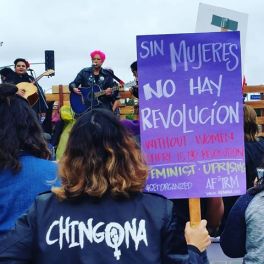
Alice Bag performing at the International Women’s March, January 21, 2017
The stark contrast between these performances brought up questions of power and privilege around what types of memoir are available to different types of women. Bag and Olivarria performed the intersectional oppressions that shaped their lives and connected them to politics, while Bibbe got to be “herself” (that is, unmarked, apolitical, and white). Was this a sign of a tacit understanding white women aren’t going to be as affected by Trump’s policies? (after all, white women elected Trump). Are women of color always expected to perform the emotional labor of connecting their oppressions to political policy, while white women can merely tell stories? Because it is exhausting for women of color to perform this emotional labor–and it can often be exploitative–its all the more important to recognize that Bag and Olivarria chose to do so at Le Poisson Rouge, as I am certain they constructed their performances to speak to this audience (to think otherwise would deny some incredibly smart women their agency).
With those differences in mind, “Rebel Women” underscored for me that intersectional feminism has much to offer in terms of reframing studies of resistance within popular music and is key to ensuring the field’s continued viability in the face of multiple, destructive Trump policies. The concept of intersectionality, developed by Kimberlé Crenshaw to describe the ways that multiple axes of identity—for example, gender, race, ethnicity, religion, or class—affect people in multi-dimensional ways. Crenshaw’s work stresses the importance of seeing intersectionality as an expression of structural power, not just an individual’s conception of their personal identity. Drawing on these intersections can help add complexity to how we understand “resistance” (or even #resistance).
While the study of resistance used to be common in popular music studies—especially in the 1990s—the framework rightly came under criticism as too binary, a position of counterculture vs. mainstream that worked well for glossing 1960s antiwar protests and punk rock, but too simplistic for exploring the nuances of the late-capitalist marketplace. As a theory that emerged from Marxist scholars and examined mostly close-knit, male-dominated subcultures (with formative texts such as Resistance Through Rituals and Subculture: the Meaning of Style), “resistance” was never ideal for grappling with networks organized from a diverse population. An intersectional view, however, understands that the “resistance” group is not evenly or equally affected by the policies of the dominant group; that multiple oppressions shape the forms of resistance available to individual actors; that people facing multiple oppressions also face heightened stakes when they engage in political protest; and that responding to the dominant group requires a commitment to others whose oppressions you may not share.
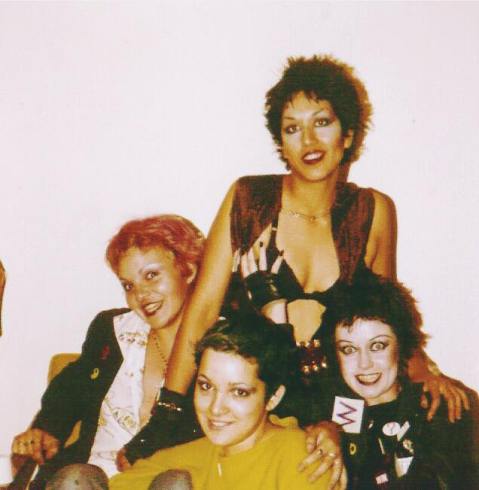
Archival Photo courtesy of Alice Bag, (from l-r) Margot Olavarria, Alice Bag, Jane Wiedlin, and Shannon Wilhelm
Olavarria’s performance, which opened the evening, illustrated intersectional resistance by interweaving work from the past and present. Instead of feeling piecemeal, each fragment signaled how structural power and resistance intersected in her life. In the first vignette, she described how, shortly after Trump received the Republican nomination, she ducked into a bar in Florida to escape the rain. A man next to her began to praise Trump. So did another. Finally, one turned to her, to ask what she thought of Trump’s policies. She responded: “’No habla Inglés. Yo soy Mexicana.’ I’m not really Mexican. I’m from Chile, known for poetry and protest. But today we are all Mexican, all Muslims, all immigrants.” Of course, we aren’t all Mexican, Muslims, or immigrants—but we can show thoughtful solidarity. Olavarria’s act of resistance worked because she effectively deployed her Latina identity to make a powerful intersectional point.
Intersectionality offers an important understanding, that not all moments are prime for resistance from every body in the same way. Women of color, for example, face different stakes and consequences than white women at the airport and at border crossings. In an excerpt from her entry in the musician’s guide Tour Smart, Olavarria recalled her band Brian Brain being pulled over by the US border patrol in the late 1980s. Dressed head-to-toe in thrift-store plaid in honor of their record label, Plaid Records, Olavarria didn’t look the part of a stowaway. But that didn’t stop the border guards from questioning her although she had a valid driver’s license, and her English bandmate’s visa had expired: “I was quizzed on civics. Then it was where did you go to high school? Who was your kindergarten teacher?” As the questioning grew more in depth, Olavarria “started to imagine working in Juarez in plaid attire.”
Olavarria’s story cannot be separated from Latinx identity, nor can they be separated from the politics of race, borders, and national identity in the United States. Instead, she illustrates that proposals such as Trump’s proposed “wall” have deep roots in anti-Mexican, anti-immigrant policies, and they show dark possibilities about the eagerness with which ICE embraced Trump’s “Muslim Ban.” Her story also emphasizes that, although our current moment is certainly an intensification of such harassment, deportation, and incarceration, women of color have faced these dangers in the U.S. for a very long time. What’s new, beyond Trump’s policies, is increased white feminist attention to these issues, an opportunity for both increased resistance and wary skepticism. Olavarria ended her segment with six suggestions for resistance reminding the audience that in these dark times, “walking around thinking we’re totally fucked will not change anything.” She certainly spoke to my struggle in that moment; the response in the room suggested I wasn’t alone.
Margot Olivarria’s Tips for Resistance:
- Wear your safety pin. It is appropriate that a punk fashion accessory has become the symbol of political dissidents. It may also come in handy when militarized police tear your clothes.
- Enjoy yourself. Walking around thinking we’re totally fucked will not change anything.
- If you have numb yourself, go ahead, as long as you don’t become addicted.
- Spread love. The only thing that will counter Trump’s hate is love.
- It may be that the only way we can say, “You’re fired!” to Trump is through the vote. Register as many progressive minded people as you can. Midterms will be crucial.
- If you see something, do something. Protest against all injustices we witness. Art mightier than the sword. Surround yourself with like-minded people and express outrage. As love Trumps hate, expression beats depression.
Hansen’s “time capsule” from 1964 described events leading to her starring in Andy Warhol’s film, Prison, based on her experiences in reform school. Hansen’s performance, told from behind her dark “reading sunglasses,” took on the tenor of a world-weary teenager.
She had run away from her parents—her father was Fluxus painter Al Hansen and her mother was poet and New York bon vivant Audrey Ostlin Hansen (who died at age 37 in 1968)—and was feeling stir-crazy at her friend Jeff’s apartment, because he only had “the same 40 books every hipster has.” So when her pal Janet Kerouac called with an invite of learning to cook spaghetti and taking acid for the first time, she jumped at the chance, even though she wasn’t sure about the acid part, because it was “too earnest.”
By ten that night, we’re rolling around, and spaghetti is everywhere. We’re dipping it in sauce, hurling it everywhere. We slither and roll across the floor like the first reptiles emerging from the primordial ooze. All the guys have hard-ons. I’m not really into orgies. They’re more like work, you know?
Hansen’s skill as an actor was on full display in her reading, as she vanished into her narration, capturing a unique combination of jadedness and enthusiasm. But every once in a while, a line like, “I may be a kid, but I’m also a freak,” would jump out. It was only toward the end of her reading, when Bibbe describes herself, still high, playing hopscotch with kids in the neighborhood that she reminds us: this is a child of twelve. The kids’ mom takes Bibbe in and gives her some cake, and she is astonished that this what normal parents do for kids.

Still from Bibbe Hansen’s screen test for Andy Warhol, 1964
The moment reveals the vulnerability of Bibbe, the runaway. She might have some agency in choosing to spend time with hipster boys and Jan Kerouac, but those come along with expectations of orgies and acid. It doesn’t leave much room for childhood, hopscotch, and cake. After this realization, Bibbe decides to call her father, who tells her, “I ain’t going to jail, so I guess you are.” In this powerlessness, Hansen found an upside: the day her father got her out of juvenile detention, he took her to lunch with Andy Warhol. Finding that upside does not mean that Hansen lacks self-awareness; instead, the moment read as one of acceptance. She cannot create a new girlhood for herself, just as she couldn’t escape her family by hiding with hipsters. “In the end,” she said, “you get what you get.”
Although Hansen’s reading felt disconnected from current politics, I heard her contribution to the evening as a moment of personal resistance. Hansen has often been defined by the men surrounding her: daughter Al Hansen, youngest of Andy Warhol’s Factory stars, mother of musician Beck. Instead of giving us Bibbe through her connections to her father, or to Warhol, she reframed her adolescent experiences so that they became side characters, opening up space for her unique, clear, adolescent voice, recast through a woman’s perspective.
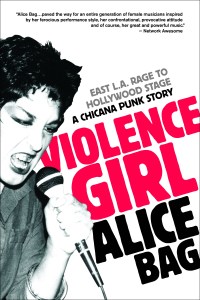 Alice Bag, singer of The Bags, finished out the night with combined spoken word and live musical performance. After playing in many bands since, Bag released her first solo album in 2016 on the independent punk label Don Giovanni Records. In the intervening years, she worked as an activist and teacher, both in the United States and in Central America. Her combination of readings from her memoirs and musical performance with Tanya Pearson evoked a lifetime of resistance. As the only performer to combine spoken word and live musical performance, Bag situated her songs in the readings she selected from her memoirs. Although the songs are relatively new, they drew on her rich experience with Latinx activism and education.
Her first excerpt, from Violence Girl, described the march for the National Chicano Moratorium on March 29, 1970, the largest anti-Vietnam protest by a minority group. Bag went to the march with her father. Until that moment, she said, “I had never realized I was part of a minority. Our enemies were not afraid to throw bottles at us, or shoot us.” The moment inspired a song that Bag performed, “White Justice.” Framed from a child’s perspective, “White Justice” explores the dawning realization that a march is not a parade, and that it may have dangerous consequences, even violence. At first filled with vivid colors of “blue skies/brown berets,” “green lawns,” and “yellow corn,” the mood turns when the police arrive, with “black gloves/blue collars/blood red/silver dollars,” a moment she connected to the present day: “Our struggle then was here at home/And it’s still going on.”
Bag encouraged the audience to sing along at the chorus of “White Justice”—and many members of the mostly white audience did. This eager participation stood in stark contrast to an incident I witnessed at the Women’s March in New York City, when a man tried to get a “Black Lives Matter” chant going during the New York City march and it was slow going.
 Bag’s next story, from Pipe Bomb for the Soul, illustrated that, while she was a member of an oppressed minority in the United States, she brought privilege with her as a teacher in Nicaragua. In her words, “I discovered a lot of things, mostly my own ignorance.” She returned to the United States and taught for over 20 years. Her next song, “Programmed,” expressed her frustration at the post-Leave No Child Behind state of education. At a certain point, she said, “The kids were asked to bubble in Scantrons. We need to teach kids to think for themselves, to value their heritage and experience.”
Finally, Bag ended with the song that began this blog post: “Reign of
Fear.” Inspired by the election, the song acknowledges both fear and
resistance. It is fear that elected Trump; it’s fear that now
motivates some of thethe resistance against him is a stance against
that fear. The fears that elected Trump are fears that treat rights as
a zero-sum game—that if women, or people of color, or queer people, or
Muslims, or Mexicans, or anyone else should gain rights or power, then
white men will lose theirs. In rejecting this view, Bag offers an
intersectional resistance in a punk song, noting “the future comes in
all colors and creeds.” Women of color have been leaders of the
resistance since Trump was elected, but they have also laid a
groundwork for intersectional feminist activism over decades of work.
This is not normal. Let’s not pretend.
But, in resistance lies hope.
In the small space below Le Poisson Rouge, Bag’s voice and Pearson’s guitar swelled to fill the room with that hope:
We reject your/Reign of fear. The future is female/the future is queer. Look out, man/’Cause the future is here.
—
Featured Image of Margot Olavarria, Bibbe Hansen, and Alice Bag by Christine Tottenham, Used here with permission of the Women of Rock Oral History Project.
—
Elizabeth K. Keenan completed her doctorate in ethnomusicology at Columbia University in 2008.She is currently reworking her academic work on popular music and feminism since 1990 into a book for normal humans. She has published in Women and Music, Journal of Popular Music Studies, Archivaria, and Current Musicology, as well as two chapters in Women Make Noise: Girl Bands from Motown to the Modern (2012). Her proudest moment is finally getting to interview Carrie Brownstein, for NYLON, more than ten years after she tried to interview Brownstein for her dissertation. She sometimes writes for the Chronicle of Higher Education’s Vitae website, and her occasional blogging can be found at badcoverversion.wordpress.com.
—

REWIND! . . .If you liked this post, you may also dig:
G.L.O.S.S., Hardcore, and the Righteous White Voice – Chris Chien
If La Llorona Was a Punk Rocker: Detonguing The Off-Key Caos and Screams of Alice Bag– Marlen Ríos-Hernández
Riot-Grrrl, Punk and the Tyranny of Technique – Tamra Lucid
SO! Amplifies: The Women in L.A. Punk Archive
Share this:


Current Top Posts





April 2021

January 2020

November 2019

October 2019

August 2019

April 2014

November 2017

March 2015

December 2017

October 2015
 Sounding Out!
Recent Comments