
Karaoke and Ventriloquism: Echoes and Divergences
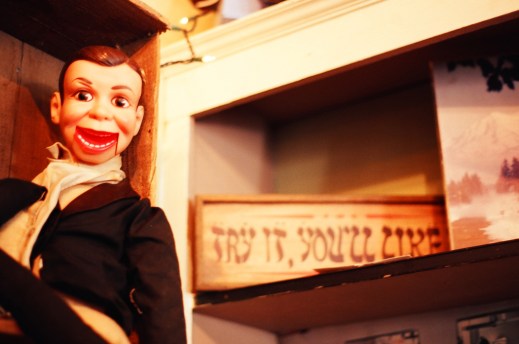
This piece is co-authored by Sarah Kessler and Karen Tongson.
Scholarship rarely happens in isolation, despite quantitative demands in the humanities for “single-authored” works. Instead, intimacies of different shapes and configurations, transpiring in spaces as variegated as “the institution,” cocktail bars, cars, and even boudoirs, have profound effects on how we think, and on what we eventually write. However, academics have very few forms beyond the citation, the footnote, or even the acknowledgment, through which to admit our debts, recognize our inspirations, and lay bare the narcissisms of our small differences.
Our current areas of research—karaoke for Karen, ventriloquism for Sarah—traverse what may appear to be a narrow terrain of sound studies currently focused on “voice” or “the voice.” And yet the strains of sound studies that draw us to these topics do not exclusively concern themselves with the tropes or techniques of voice and vocalization that karaoke and ventriloquism conjure. Though voice presents itself as the most basic and fundamental connection between these two concepts and practices, we are each more invested in exploring karaoke and ventriloquism as actual sound technologies, as well as technologies of power. As you will read below, ventriloquism, for all its associations with archaism and mysticism in certain historical contexts, is also depicted as a technology and technique of deception, statecraft, and power. Meanwhile, karaoke, for all its associations with the expressive and participatory potential of amateur vocalization is also, crucially, a technological apparatus, whose media archaeology bears the traces of intercolonial conflicts, negotiations, and aftermaths. Finally, we are also both interested in the ways in which these sound technologies and techniques have been transformed into critical, intellectual, and affective methodologies, especially since they’ve both been harnessed as broader cultural metaphors for judgments at once moral and aesthetic.
 .
.
Over an obscenely caloric breakfast, we devised several questions touching upon some keywords and concepts we believe are applicable to both karaoke and ventriloquism, two topics that undermine notions of authorship, source, and origin. In our respective writing about these two subjects, we’ve both occasionally (or more than occasionally) been besieged by the anxiety that our work is melding together into some indeterminate blob. To put it another way: like any other lesbionic duo resisting the “urge to merge” (as so many other queers have warned against), we’ve arrived at that moment in our intimate and intellectual relationship where we’ve decided to sort out whose socks are whose. Somewhat ironically, then, we wrote this post together to establish some of the crucial differences between karaoke and ventriloquism.
The following “ventrilokeal” dialogue shows, from a conceptual standpoint, where some of the boundaries between karaoke and ventriloquism harden, while others remain porous.
We each provide separate answers, engaging the other person’s answer when appropriate. Feel free to supplement some of our questions in the comments section, addressing either or both of us. And thanks for indulging.
***
1) How do both karaoke and ventriloquism—as terms, metaphors, and practices—conjure and/or reframe our understandings of originality and derivation?
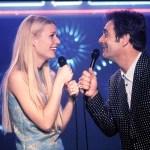
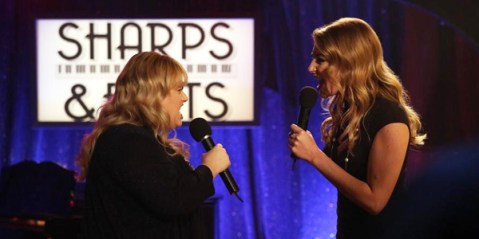
 KT: Karaoke, at least in my mind, has become the prevailing metaphor for derivation in the contemporary moment. Whenever the term is tossed about casually as a cultural metaphor, with little regard to the geographical contexts, modes of performance or the technologies that underlie its current practice, “karaoke” functions as a kind of shorthand for “the unoriginal,” the debased copy, the amateur reenactment. Novelist Dubravka Ugresic’s long essay on “Karaoke Culture” (2011) provides a perfect example of these applications of “karaoke.” And yet, karaoke in the U.S. in the last 15 years or so has also been construed as something that unlocks the creative and expressive potential of beleaguered, repressed or emotionally stunted individuals, usually men (see Lost in Translation, the forgotten Huey Lewis and Gwyneth Paltrow vehicle, Duets, and a recent pair of books I actually quite like, Brian Raftery’s Don’t Stop Believin’: How Karaoke Conquered the World and Changed My Life and Rob Sheffield’s Turn Around Bright Eyes: The Rituals of Love and Karaoke). Of course, it will take all of Empty Orchestra (my working book title), to answer this question properly, but one of the principles guiding my own account of karaoke as a metaphor for copies and reenactments (in addition to my exploration of its material practices and technological history), is that derivation and mimicry have always been a key concern of—and a point of intersection between—queer theory, aesthetics, critical race studies, and (post)-colonial studies.
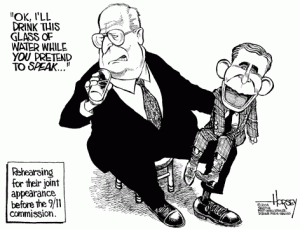 SK: When ventriloquism is employed as a metaphor in popular cultural contexts, it’s also often used to connote a lack of originality. The term tends to describe (and to fantasize) a situation in which one individual acts as the communications medium—usually the speaking or singing vessel—for words, songs, and other ideological formulations that originate or originated with someone else. So, in contrast to the mass copying and amateurism invoked by “karaoke,” “ventriloquism” suggests an unoriginality that can, and that must, be traced back to a discrete body and distinct point of origin. Think, for example, of George “Dubya” Bush and Dick Cheney, who were often represented as a ventriloquial duo. Political cartoons depicted Dubya as Cheney’s open-mouthed dummy, perched on the knee of his puppet master, the “actual” leader of the free world. Here, ventriloquism was used to image a scenario wherein the man who seemed to be in power was both secretly and openly manipulated by another man, who was the true source of power. In this case, unoriginality on Bush’s part connoted originality on Cheney’s, whereas in the case of the Beyoncé lip-synch scandal (more on this below), unoriginality signified very differently. Generally speaking, however, “ventriloquism” implies that a deceptive act has occurred, one that masks the origin of its own workings. It signals the veiling and subsequent exposure of a powerful apparatus. This apparatus is usually vocal in nature, the voice’s historical connections to power being well documented. In his Western cultural history of ventriloquism, Dumbstruck (2001), for example, Steven Connor traces the form back to Greco-Roman oracular myths in which divine prophecy is primarily accessible as a voice, transmitted through the mediating body of a priestess.
 Contemporary ventriloquists like the British performer Nina Conti often claim to be surprised by what their dummies say, which suggests that, far from being an omnipotent machinator, the ventriloquist is a bifurcated entity—one whose practice places her beside herself, in conversation with herself (or, as others have noted, with her unconscious). My recent work argues for bifurcation as a workable antidote to the tired, either/or question of originality vs. derivation to which popular cultural forms are repetitively subjected.
2) The terms “karaoke” and “ventriloquism” are both frequently employed in adjudicatory ways. As Karen has pointed out elsewhere, “karaoke” is often used in reality TV contexts (American Idol, The Voice) as a negative judgment of performance quality, i.e. “that performance was shit—mere karaoke.” “Ventriloquism,” for its part, is often used to connote a deviousness or deception that disqualifies a performance (think folks condemning Beyoncé post-lip-synched inauguration performance). What are the differences between “karaoke” and “ventriloquism” as judgments?
 KT: I actually think that one of the primary differences between these two terms as judgments, and perhaps more simply as just terms, is that “karaoke” condemns the person performing it, or performing something in “the style of” karaoke (i.e. derivatively, as a copycat, as a mere echo of the “original”), as a lightweight. Pulling off a feat of ventriloquism seems like a heavier, more sinister, and more complex operation of power, at least as I’ve heard you explain it, and as you describe it viz. Bush/Cheney above. Karaoke as a performance practice also lacks ventriloquism’s gravitas and requisite skill, insofar as ventriloquism is an archaic-seeming art form. Karaoke is the opposite of serious or sinister: it’s laughable, buffoonish, and absurd. It’s all surface and no depth. Ventriloquism, at least as I’ve heard you describe it to me on many occasions, in different situations, seems more layered. This is not to say, however, that I actually believe that karaoke is lightweight, or only about surfaces, but as a term of adjudication, it can’t really break free from those associations to mean anything more.
SK: Yes, as you say above, “karaoke” as judgment indicates amateurism and insubstantiality, whereas “ventriloquism” suggests a more menacing, or at least a more complicated, operation. And when one actually does karaoke, one can’t even conceal one’s appropriation—it’s part and parcel of the practice. A ventriloquist, on the other hand, hides herself in plain sight: the greater the attention focused on her dummy, the less it matters that—as the audience well knows—she’s the one talking. This is called “misdirection”: if the eyes are on the dummy, the ears will follow, and the dummy will appear to speak even if he doesn’t have his own microphone.
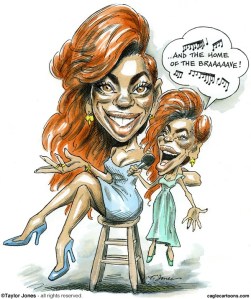 The interesting thing about the liberal accusation that Bush was Cheney’s ventriloquist dummy was that, though the image of Cheney as evil puppetmaster was sinister, it still served a reassuring function, in that it allowed for the continuation of the idea that there was a source, or origin, of power, period. As opposed, let’s say, to a more Foucauldian understanding of power as dispersed, not traceable to an isolated sovereign body. In contrast, when Beyoncé allegedly lip-synced, but in fact sang over, her own recording of the National Anthem at the 2013 presidential inauguration, her performance—which, as many have pointed out, was not unusual by pop industry standards—was framed as ventriloquism in order to cast doubt on her legitimacy as a live performer, i.e. as a performer whose voice could “stand up” in non-studio conditions (which are still, and ironically, just as much mediated as studio conditions). These ventriloquial scenarios are, it should go without saying, gendered and racialized: Bush-Cheney as ventriloquism emasculated Bush while restoring power to Cheney’s white, male, visibly disabled body; Beyoncé-Beyoncé as ventriloquism rather unsuccessfully attempted to pit Bey against herself (mediated, recorded Beyoncé vs. live Beyoncé) in order to devalue her corporeal body and frame her as unworthy of (national) subjectivity.
3) Both karaoke and ventriloquism are mass, but not mainstream, cultural practices. Karaoke is a mass cultural activity, but one that still carries with it the frisson of doing something slightly risqué (hence its frequent overlap with inebriation). Ventriloquism, while not being a cultural activity practiced by the masses, is a mass-mediated and mass-consumed cultural form, despite the aura of Vaudevillian anachronism (and/or pathology) it persistently conveys. How might we account for the “mass but not mainstream” quality of both practices?
 KT: I actually have to credit Zhou Xun and Francesca Tarocco, co-authors of an ambitious book, Karaoke: The Global Phenomenon (2007) with the “mass vs. mainstream” formulation. At this point, karaoke is globally ubiquitous, thanks to the many delivery systems that have evolved from the first karaoke and sing-along machines from Japan and the Philippines. There’s actually a popular app called Sing!, which enables you to perform karaoke and compete against anyone in the world. Meanwhile, YouTube is replete with karaoke videos to perform and practice with (some KJs, or “karaoke jockeys,” use YouTube as their primary interface), as well as with videos of people from all walks of life performing karaoke in various bars or at family functions in the home or elsewhere. These days, practically every sitcom on primetime TV stages a requisite “karaoke outing,” that usually leads to disastrous, if hilarious consequences for its characters.
 And yet karaoke as a mass practice can’t quite broach the mainstream, because of its various “abject” associations with immigrant communities, aspirational everymen longing to be idols, isolate geeks who only interact with the outside world through their computers, drunkards, gaggles of girls group-singing to Madonna, queens bereft of the piano bar’s liveness, slumming with an electronic delivery system for their show tunes, and other such “sad” spectacles. Once someone excels at karaoke—at singing someone else’s song so well that they transform it in some way—we are apt to think they actually exceed karaoke, and leave behind the form, much in the same way that, as you suggest in your opening comments, a good dummy eclipses its ventriloquist. When (in the words of many an Idol judge), someone makes someone else’s song “their own,” we enter into the territory of the cover, the reboot, the repurposed. The failure of the form to transcend its own limitations, even if it serves as the vehicle for many to otherwise achieve transcendence in myriad ways, is what keeps karaoke abject and not quite ready for mainstream acceptance.
SK: In the U.S., there’s a genre of white, masculine ventriloquism that’s currently extremely popular. This genre is typified by U.S. ventriloquism’s two biggest guns, Terry Fator and Jeff Dunham, who, following in the footsteps of Edgar Bergen, brought their ventriloquism to television to increase the art’s spread. Fator won America’s Got Talent in 2007 and now gives nightly performances at The Mirage in Vegas, where he has a theater named after him. He’s made hundreds of millions this way. Dunham has a strong presence on Comedy Central and is also one of the top-grossing U.S. standup acts. Both vents are especially popular with “Heartland” audiences, and both have casts of gendered and racialized puppets to whom they, as white male ventriloquists, play the straight man. Dunham, in particular, takes an unapologetic stance towards his own redneck identity, which permits him to criticize and recuperate this identity in one fell swoop. For instance, Dunham’s “white-trash trailer-park” dummy Bubba J drinks a surfeit of beer and is of low, if any, intelligence, but he remains benign in comparison to the rest of Dunham’s cast of characters, which includes Achmed the Dead Terrorist (a bin Laden caricature) and José Jalapeño on a Stick (use your imagination). Fator and Dunham’s ventriloquism evokes the practice’s historical connections and overlaps with minstrelsy, consolidating a fragile white masculinity in the process.
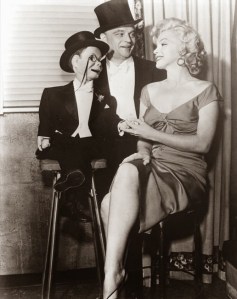 This culturally bounded reading of contemporary ventriloquism’s mass popularity directly resonates with your reading of karaoke as a practice with “abject” associations that is accordingly repurposed to “unlock the creative and expressive potential of beleaguered, repressed or emotionally stunted individuals, usually men.” While ventriloquism is difficult to perform well, vent instruction manuals always stress that, with practice, anyone can ventriloquize. One of the reasons that the practice isn’t mainstream is that it’s associated with a perverse desire, even a need, to speak through someone else in lieu of being able to speak “for oneself.” Edgar Bergen was always said to be shy with women, and to woo them through his brash, confident alterego Charlie McCarthy. And in his autobiography, Who’s the Dummy Now? (2008), Terry Fator (or his ghostwriter) writes about how his father found his ventriloquism perverse, and how he literally closeted his dummy as a result. Ventriloquism is too blatant a form of triangulation to be normal, and is thus coded as deviant, a perversion of heterosexuality’s direct, unmediated operation. Hence Fator’s book title, which aggressively restores authority to the formerly emasculated ventriloquist.

4) As the previous question suggests, and as prominent scholars of ventriloquism have also suggested, ventriloquism is ever anachronistic. Karaoke, too, is suffused by a sense of belatedness, reflected in nostalgic, hits-driven karaoke song choices and/or by the practice’s enduring connection to seemingly obsolete technological forms like laser discs. In what ways is each form out of time, or behind the times, and, alternatively, why do these forms appear as such even as they continue to exist in time?
 KT: As I mentioned above, karaoke’s purported abjection in the U.S. is, in many ways, a consequence of its association with the immigrant communities from Asia who imported the practice, as well as karaoke technologies, to the west coast as early as the mid-1970s. In that sense, karaoke functioned as a vehicle of nostalgia for those in the diaspora who longed to connect with memories of “home” through certain musical repertoires, even if some of those repertoires were actually already comprised of American pop hits folks grew to love when they were still “back home” (e.g. songs by the Carpenters, or any of the Johns—Elton, Olivia Newton, Denver). I haven’t quite worked it all out yet, but there is a certain circular temporality to karaoke. I have a hunch that the form is Romantic insofar as it is, at once, about the moment and its “spontaneous overflow of powerful feelings,” yet prone to saturating those powerful feelings with the “passionate recollection of youth.” There’s also something anticipatory and performative about karaoke, insofar as it has the capacity to do what it purports to articulate. I wrote something about this from a personal perspective in a piece about my favorite L.A. karaoke bar, the Smog Cutter. As the question above remarks, karaoke also feels belated, or emblematic of a particular era, because of the visual peripherals that accompany some song catalogues, especially those released on laser disc in the late 1980s and early-to-mid-1990s (i.e. the videos comprised of b-roll, and oblique narrative re-imaginings of certain songs). I can’t get into all of it here, but my plan is to devote a chapter to the karaoke video—from its production history (of which Brian Raftery offers an excellent preliminary account), to its repurposing in contemporary queer performance art.
 SK: I’m still working on understanding ventriloquism’s anachronism—why it continues to appear, or to feel, outmoded despite its present popularity—besides the obvious fact that its contemporary iterations evoke Vaudevillian performance. Nina Conti, who has, like Fator and Dunham, distributed her ventriloquism across multiple media platforms, makes many jokes about this. Her puppet Monk, who sounds like a muffled Sean Connery trapped in a fuzzy, simian body, will often deride her for practicing such a “dead art,” and Conti’s documentary, Her Master’s Voice (2012), theorizes the ventriloquist dummy as a “bereaved object” that loses its voice repeatedly, and finally for good. Conti’s film, however, argues with its own assertion by reanimating the dummies of a dead ventriloquist with new voices, a process that could theoretically continue ad infinitum. Steven Connor argues that present-day “revivals” of ventriloquism like Conti’s are always “necromantic,” conjuring the form’s prehistory while at the same time referencing “newer” media like film (which, according to Rick Altman (c. 1980) and Michel Chion (c. 1982) is itself a form of ventriloquism). Writes Connor, “Whether because it is scandalously or mysteriously archaic, or uncannily premonitory, ventriloquism is always anachronistic, never quite on time.” And Mladen Dolar tells us that the voice itself is ventriloquial, leading to the extrapolation that ventriloquism literalizes or visualizes what the voice has always already done.
I tend to think of ventriloquism as temporally bifurcated. A ventriloquist has to exist in both the future and the past to make her practice work. She has to anticipate what’s going to be said next while remembering what’s just been said, and she has to keep her lips still while moving her tongue—acts that circumvent linearity and synchronization. In saying this I’m not arguing for ventriloquism as a “resistant cultural practice”; rather, I’m simply pointing out the temporal perversion to which the art lends itself.
***

Reflecting upon this conversation on karaoke and ventriloquism—a conversation that is, of course, ongoing—it has become even more apparent to us that both forms are sound technologies struggling against obsolescence, even as they are so frequently imagined as possible gateways to some human “truth” or “essence” precisely because of their associations with the voice. Though vocalization and vocality are reflexively associated with both forms, we hope we’ve been able to underscore some of the ways in which their powerful associations with “voice” naturalize, and to a certain extent also neutralize, the technical elements of each practice. We appreciate the opportunity to make some key distinctions, and to sound some of these issues out, here on the SO! Blog. Many thanks to Jennifer Stoever and Liana M. Silva for their generous editorial input. Like Conti’s bereaved puppets, who lose their voices only to be invested with new ones, we now relinquish ours—for the time being.
SK & KT
—
Featured Image by Flickr User Sam Grover
—
Sarah Kessler is a Ph.D. candidate in Comparative Literature at the University of California, Irvine, where she is writing a dissertation on ventriloquism in contemporary British and U.S. popular culture. She received an M.A. in Modern Studies from the University of Wisconsin-Milwaukee in 2008. Kessler’s writing on art, film, and media has appeared in artforum.com, the Brooklyn Rail, In These Times, and Public Books, among other publications, and she has held editorial positions at Triple Canopy and Afterall: A Journal of Art, Context and Enquiry. She is currently completing an article on the documentary work of ventriloquist Nina Conti.
Karen Tongson is Associate Professor of English and Gender Studies at the University of Southern California, and the author of Relocations: Queer Suburban Imaginaries (NYU Press, 2011). Her work has appeared in numerous venues in print and online, including Social Text, GLQ, Nineteenth-Century Literature, and Novel: A Forum on Fiction. She is currently the series editor for Postmillennial Pop at NYU Press, and just completed a multi-year term as co-editor-in-chief of the Journal of Popular Music Studies. Her current book project, Empty Orchestra: Karaoke. Critical. Apparatus. critiques prevailing paradigms of imitation in contemporary aesthetics and critical theory, while offering a genealogy of karaoke technologies, techniques, and desires.
—
 REWIND!…If you liked this post, you may also dig:
“Hearing Queerly: NBC’s ‘The Voice’”-Karen Tongson
“Head Games?: The Strategic View of Liveness and Performance”-Andreas Duus Pape
“New Wave Saved My Life*”-Wanda Alarcon
Share this:

Live Electronic Performance: Theory And Practice

This is the third and final installment of a three part series on live Electronic music. To review part one, “Toward a Practical Language for Live Electronic Performance” click here. To peep part two, “Musical Objects, Variability and Live Electronic Performance” click here.
“So often these laptop + controller sets are absolutely boring but this was a real performance – none of that checking your emails on stage BS. Dude rocked some Busta, Madlib, Aphex Twin, Burial and so on…”
This quote, from a blogger about Flying Lotus’ 2008 Mutek set, speaks volumes about audience expectations of live laptop performances. First, this blogger acknowledges that the perception of laptop performances is that they are generally boring, using the “checking your email” adage to drive home the point. He goes to express what he perceived to set Lotus’s performance apart from that standard. Oddly enough, it isn’t the individualism of his sound, rather it was Lotus’s particular selection and configuration of other artists’ work into his mix – a trademark of the DJ.
Contrasting this with the review of the 2011 Flying Lotus set that began this series, both reveal how context and expectations are very important to the evaluation of live electronic performance. While the 2008 piece praises Lotus for a DJ like approach to his live set, the 2011 critique was that the performance was more of a DJ set rather than a live electronic performance. What changed in the years between these two sets was the familiarity with the style of performance (from Lotus and the various other artists on the scene with similar approaches) providing a shift in expectations. What they both lack, however, is a language to provide the musical context for their praise or critique; a language which this series has sought to elucidate.
To put live electronic performances into the proper musical context, one must determine what type of performance is being observed. In the last part of this series, I arrive at four helpful distinctions to compare and describe live electronic performance, continuing this project of developing a usable aesthetic language and enabling a critical conversation about the artform. The first of the four distinctions between different types of live electronic music performance concerns the manipulation of fixed pre-recorded sound sources into variable performances. The second distinction cites the physical manipulation of electronic instruments into variable performances. The third distinction demarcates the manipulation of electronic instruments into variable performances by the programming of machines. The last one is an integrated category that can be expanded to include any and all combinations of the previous three.
Essential to all categories of live electronic music performance, however, is the performance’s variability, without which music—and its concomitant listening practices–transforms from a “live” event to a fixed musical object. The trick to any analysis of such performance however, is to remember that, while these distinctions are easy to maintain in theory, in performance they quickly blur one into the other, and often the intensity and pleasure of live electronic music performance comes from their complex combinations.

Flying Lotus at Treasure Island, San Francisco on 10-15-2011, image by Flickr User laviddichterman
For example, an artist who performs a set using solely vinyl with nothing but two turntables and a manual crossfading mixer, falls in the first distinction between live electronic music performances. Technically, the turntables and manual crossfading mixer are machines, but they are being controlled manually rather than performing on their own as machines. If the artist includes a drum machine in the set, however, it becomes a hybrid (the fourth distinction), depending on whether the drum machine is being triggered by the performer (physical manipulation) or playing sequences (machine manipulation) or both. Furthermore, if the drum machine triggers samples, it becomes machine manipulation (third distinction) of fixed pre-recorded sounds (first distinction) If the drum machine is used to playback sequences while the artist performs a turntablist routine, the turntable becomes the performance instrument while the drum machine holds as a fixed source. All of these relationships can be realized by a single performer over the course of a single performance, making the whole set of the hybrid variety.
While in practice the hybrid set is perhaps the most common, it’s important to understand the other three distinctions as each of them comes with their own set of limitations which define their potential variability. Critical listening to a live performance includes identifying when these shifts happen and how they change the variability of the set. Through the combination their individual limitations can be overcome increasing the overall variability of the performance. One can see a performer playing the drum machine with pads and correlate that physicality of it with the sound produced and then see them shift to playing the turntable and know that the drum machine has shifted to a machine performance. In this example the visual cues would be clear indicators, but if one is familiar with the distinctions the shifts can be noticed just from the audio.
This blending of physical and mechanical elements in live music performance exposes the modular nature of live electronic performance and its instruments. teaching us that the instruments themselves shouldn’t be looked at as distinction qualifiers but rather their combination in the live rig, and the variability that it offers. Where we typically think of an instrument as singular, within live electronic music, it is perhaps best to think of the individual components (eg turntables and drum machines) as the musical objects of the live rig as instrument.
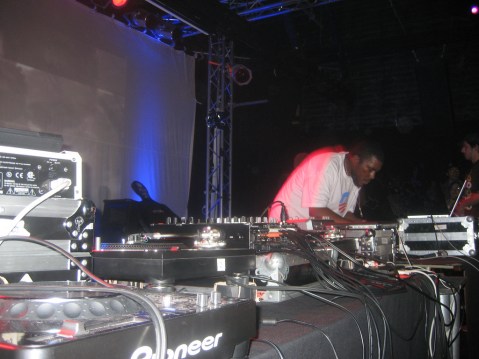
Flying Lotus at the Echoplex, Los Angeles, Image by Flickr User sunny_J
Percussionists are a close acoustic parallel to the modular musical rig of electronic performers. While there are percussion players who use a single percussive instrument for their performances, others will have a rig of component elements to use at various points throughout a set. The electronic performer inherits such a configuration from keyboardists, who typically have a rig of keyboards, each with different sounds, to be used throughout a set. Availing themselves of a palette of sounds allows keyboardists to break out of the limitations of timbre and verge toward the realm of multi-instrumentalists. For electronic performers, these limitations in timbre only exist by choice in the way the individual artists configure their rigs.
From the perspective of users of traditional instruments, a multi-instrumentalist is one who goes beyond the standard of single instrument musicianship, representing a musician well versed at performing on a number of different instruments, usually of different categories. In the context of electronic performance, the definition of instrument is so changed that it is more practical to think not of multi-instrumentalists but multi-timbralists. The multi-timbralist can be understood as the standard in electronic performance. This is not to say there are not single instrument electronic performers, however it is practical to think about the live electronic musician’s instrument not as a singular musical object, but rather a group of musical objects (timbres) organized into the live rig. Because these rigs can be comprised of a nearly infinite number of musical objects, the electronic performer has the opportunity to craft a live rig that is uniquely their own. The choices they make in the configuration of their rig will define not just the sound of their performance, but the degrees of variability they can control.
Because the electronic performer’s instrument is the live rig comprised of multiple musical objects, one of the primary factors involved in the configuration of the rig is how the various components interact with one another over the time dependent course of a performance. In a live tape loop performance, the musician may use a series of cassette players with an array of effects units and a small mixer. In such a rig, the mixer is the primary means of communication between objects. In this type of rig however, the communication isn’t direct. The objects cannot directly communicate with each other, rather the artist is the mediator. It is the artist that determines when the sound from any particular tape loop is fed to an effect or what levels the effects return sound in relation to the loops. While watching a performance such as this, one would expect the performer to be very involved in physically manipulating the various musical objects. We can categorize this as an unsynchronized electronic performance meaning that the musical objects employed are not locked into the same temporal relations.

Big Tape Loops, Image by Flickr User choffee
The key difference between an unsynchronized and s synchronized performance rigs is the amount of control over the performance that can be left to the machines. The benefit of synchronized performance rigs is that they allow for greater complexity either in configuration or control. The value of unsynchronized performance rigs is they have a more natural and less mechanized feel, as the timing flows from the performer’s physical body. Neither could be understood as better than the other, but in general they do make for separate kinds of listening experiences, which the listener should be aware of in evaluating a performance. Expectations should shift depending upon whether or not a performance rig is synchronized.
This notion of a synchronized performance rig should not only be understood as an inter-machine relationship. With the rise of digital technology, many manufacturers developed workstation style hardware which could perform multiple functions on multiple sound sources with a central synchronized control. The Roland SP-404 is a popular sampling workstation, used by many artists in a live setting. Within this modest box you get twelve voices of sample polyphony, which can be organized with the internal sequencer and processed with onboard effects. However, a performer may choose not to utilize a sequencer at all and as such, it can be performed unsynchronized, just triggering the pads. In fact, in recent years there has been a rise of drum pad players or finger drummers who perform using hardware machines without synchronization. Going back to our three distinctions a performance such as this would be a hybrid of physical manipulation of fixed sources with the physical manipulation of an electronic instrument. From this qualification, we know to look for extensive physical effort in such performances as indicators of the the artists agency on the variable performance.
Now that we’ve brought synchronization into the discussion it makes sense to talk about what is often the main means of communication in the live performance rig – the computer. The ultimate benefit of a computer is the ability to process a large number of calculations per computational cycle. Put another way, it allows users to act on a number of musical variables in single functions. Practically, this means the ability to store, organize recall and even perform a number of complex variables. With the advent of digital synthesizers, computers were being used in workstations to control everything from sequencing to the patch sound design data. In studios, computers quickly replaced mixing consoles and tape machines (even their digital equivalents like the ADAT) becoming the nerve center of the recording process. Eventually all of these functions and more were able to fit into the small and portable laptop computer, bringing the processing power in a practical way to the performance stage.

Flying Lotus and his Computer, All Tomorrow’s Parties 2011, Image by Flickr User jaswooduk
A laptop can be understood as a rig in and of itself, comprised of a combination of software and plugins as musical objects, which can be controlled internally or via external controllers. If there were only two software choices and ten plugins available for laptops, there would be over seven million permutations possible. While it is entirely possible (and for many artists practical) for the laptop to be the sole object of a live rig, the laptop is often paired with one or more controllers. The number of controllers available is nowhere near the volume of software on the market, but the possible combinations of hardware controllers take the laptop + controller + software combination possibilities toward infinity. With both hardware and software there is also the possibility of building custom musical objects that add to the potential uniqueness of a rig.
Unfortunately, quite often it is impossible to know exactly what range of tools are being utilized within a laptop strictly by looking at an artist on stage. This is what leads to probably the biggest misnomer about the performing laptop musician. As common as the musical object may look on the stage, housed inside of it can be the most unique and intricate configurations music (yes all of music) has ever seen. The reductionist thought that laptop performers aren’t “doing anything but checking email” is directly tied to the acousmatic nature of the objects as instruments. We can hear the sounds, but determining the sources and understanding the processes required to produce them is often shrouded in mystery. Technology has arrived at the point where what one performs live can precisely replicate what one hears in recorded form, making it easy to leap to the conclusion that all laptop musicians do is press play.
Indeed some of them do, but to varying degrees a large number of artists are actively doing more during their live sets. A major reasons for this is that one of the leading Digital Audio Workstations (DAW) of today also doubles as a performance environment. Designed with the intent of taking the DAW to the stage, Ableton Live allows artists to have an interface that facilitates the translation of electronic concepts from the studio to the stage. There are a world of things that are possible just by learning the Live basics, but there’s also a rabbit hole of advanced functions all the way to the modular Max for Live environment which lies on the frontier discovering new variables for sound manipulation. For many people, however, the software is powerful enough at the basic level of use to create effective live performances.

Sample Screenshot from a performer’s Ableton Live set up for an “experimental and noisy performance” with no prerecorded material, Image by Flickr User Furibond
In its most basic use case, Ableton Live is set up much like a DJ rig, with a selection of pre-existing tracks queued up as clips which the performer blends into a uniform mix, with transitions and effects handled within the software. The possibilities expand out from that: multi-track parts of a song separated into different clips so the performer can take different parts in and out over the course of the performance; a plugin drum machine providing an additional sound source on top of the track(s), or alternately the drum machine holding a sequence while track elements are laid on top of it. With the multitude of plugins available just the combination of multi-track Live clips with a single soft synth plugin, lends itself to near infinite combinations. The variable possibilities of this type of set, even while not exploiting the breadth of variable possibilities presented by the gear, clearly points to the artist’s agency in performance.
Within the context of both the DJ set and the Ableton Live set, synchronization plays a major role in contextualization. Both categories of performance can be either synchronized or unsynchronized. The tightest of unsynchronized sets will sound synchronized, while the loosest of synchronized sets will sound unsynchronized. This plays very much into audience perception of what they are hearing and the performers’ choice of synchronization and tightness can be heavily influenced by those same audience expectations.

A second performance screen capture by the same artist, this time using pre-recorded midi sequences, Image by Flickr User Furibond
A techno set is expected to maintain somewhat of a locked groove, indicative of a synchronized performance. A synchronized rig either on the DJ side (Serato utilizing automated beat matching) or on the Ableton side (time stretch and auto bpm detection sync’d to midi) can make this a non factor for the physical performance, and so listening to such a performance it would be the variability of other factors which reveals the artist’s control over the performance. For the DJ, the factors would include the selection, transitions and effects use. For the Ableton user, it can include all of those things as well as the control over the individual elements in tracks and potentially other sound sources.
On the unsychronized end of the spectrum, a vinyl DJ could accomplish the same mix as the synchronized DJ set but it would physically require more effort on their part to keep all of the selections in time. This would mean they might have to limit exerting control on the other variables. An unsychronized Live set would be utilizing the software primarily as a sound source, without MIDI, placing the timing in the hands of the performer. With the human element added to the timing it would be more difficult to produce the machine-like timing of the other sets. This doesn’t mean that it couldn’t be effective, but there would be an audible difference in this type of set compared to the others.
What we’ve established is that through the modular nature of the electronic musician’s rig as an instrument, from synthesizer keyboards to Ableton Live, every variable consideration combines to produce infinite possibilities. Where the trumpet is limited in timbre, range and dynamics, the turntable is has infinite timbres; the range is the full spectrum of human hearing; and the dynamics directly proportional to the output. The limitations of the electronic musician’s instrument appear only in electrical current constraints, processor speed limits, the selection of components and the limitations of the human body.
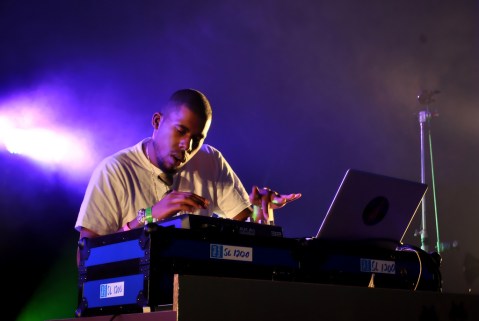
Flying Lotus at Electric Zoo, 2010, Image by Flickr User TheMusic.FM
Within these constraints however, we have only begun touching the surface of possibilities. There are combinations that have never happened, variables that haven’t come close to their full potential, and a multitude of variables that have yet to be discovered. One thing that the electronic artist can learn from jazz toward maximizing that potential is the notion of play, as epitomized with jazz improvisation. For jazz, improvisation opened up the possibilities of the form which impacted, performance and composition. I contend that the electronic artist can push the boundaries of variable interaction by incorporating the ability to play from the rig both in their physical performance and giving the machine its own sense of play. Within this play lie the variables which I believe can push electronic into the jazz of tomorrow.
—
Featured Image by Flickr User Juha van ‘t Zelfde
—
Primus Luta is a husband and father of three. He is a writer and an artist exploring the intersection of technology and art, and their philosophical implications. In 2014 he will be releasing an expanded version of this series as a book entitled “Toward a Practical Language: Live Electronic Performance”. He is a regular guest contributor to the Create Digital Music website, and maintains his own AvantUrb site. Luta is a regular presenter for theRhythm Incursions Podcast series with his monthly showRIPL. As an artist, he is a founding member of the live electronic music collectiveConcrète Sound System, which spun off into a record label for the exploratory realms of sound in 2012.
—
REWIND! . . .If you liked this post, you may also dig:
Evoking the Object: Physicality in the Digital Age of Music–-Primus Luta
Experiments in Agent-based Sonic Composition–Andreas Pape
Calling Out To (Anti)Liveness: Recording and the Question of Presence—Osvaldo Oyola
Share this:


Current Top Posts





April 2021

January 2020

November 2019

October 2019

August 2019

April 2014

November 2017

March 2015

December 2017

October 2015
 Sounding Out!
Recent Comments