
Como Now?: Marketing “Authentic” Black Music
With all the excitement over the new release of Mavis Staples’s You Are Not Alone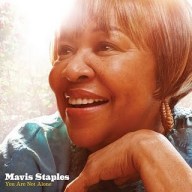 (Anti-, produced by Wilco’s Jeff Tweedy), I can’t help but be skeptical of the outpouring of Indie love for the album, even as I have been spinning (and enjoying) it myself. It isn’t the positive reaction to Staples’s talent that is surprising—at 70-plus years, Mavis has been exquisite for quite some time now—but rather the way in which critics have freighted her newest record with the “uplift” (AV Club) of a whole lot of souls that haven’t ever been to church (at least not in a good long while). Her voice is described as alternately “raw” (Paste) and full of a “depth, power, and warmth that seem increasingly rare in music today” (hear ya); Consequence of Sound, who cites Tweedy’s hand at the boards as the reason for all the current music blog attention, calls her voice “empathetic. . . powerful. . .soulful. . .touching” and “wise.” If the blogosphere is to be believed, Staples’s voice, “as authentic as it gets” (buzzine), could really save us all in these tough times. Come to think of it, the fervor of (white) faith in “authentic” black music shouldn’t be that surprising either, given the way in which race has always been entangled with popular music history in the United States.
Authenticity and the immediacy of experience it implies, have had a long history in the music industry—especially in reference to black artists—stemming back at least to the Fisk Jubilee Singers in the 1870s, an all-black acapella troupe celebrated for  powerful live performances whose breakthrough concert also happened to be for a crowd of hipsters: the wealthy congregants of Henry Ward Beecher’s Brooklyn church in 1871. Beecher gave the band his enthusiastic support, namely because he felt their sound gave listeners direct access to “the inner lives of slave hearts expressed in music” even after slavery had formally ended.
While the sound of You are Not Alone differs greatly from the Jubilee Singers, the reviews of the record belie and inflame a similar desire for unmediated access to the emotive qualities (a)historically associated with black life and sound in the U.S.: namely suffering, faith, and catharsis. And Staples’s record is indeed not alone in this. Many of the sentences from the Staples reviews could easily have been lifted from those of another recent gospel record to capture the indie imagination, Daptone Records’s 2008 release Como Now. Starkly different from the breezier, countrified sounds of You Are Not Alone, Como Now is an acapella gospel recording made in a small town in Panola County, Mississippi. The record was a risky release for Daptone, a Brooklyn-based label that has consistently produced new funk and soul records since its inception in 2002 by the likes of Sharon Jones and the Dap-Kings and The Budos Band. Although old school sound has always been a part of the label’s ethos—its engineers use primarily analog equipment, for example, a major reason Amy Winehouse recorded her throwback Back in Black album at Daptone studios in 2006—marketing stripped-down gospel to its audience of predominately white hipsters would nonetheless prove a daunting task. Treating Como Now as a labor of love and a paying of dues, Daptone attempted to spark interest in the release by relying on the familiar marketing strategies of immediacy, authenticity, and nostalgia.
 While Como Now’s tagline boldly proclaims that the music was “Recorded Live at Mt. Mariah Church on July 22, 2006”—and, thus, emphasizing the Now of the title—the cover’s vintage civil-rights era design evokes the Como of yesterday, or more accurately, encourages listeners to hear Como now and Como yesterday as one and the same through the vehicle of “raw gospel testimony.” Como Now’s depiction of the sounds of the past as echoes within the present is as ambiguous as it is uncanny, a sonic window thrown open to simpler times happening somewhere out there, “deep in the heart of Mississippi” right now.
The introductory promotional video from Como Now’s website (also uploaded on Youtube) represents the record as an aural time machine to a land and a people isolated from and largely unchanged by technology, modernity, and history.
Producer Michael Reilly’s voiceover locates rawness, emotional release, and “real religion” in the sound of black voices, in no small part because the video places his measured Yankee pacing in sonic tension with the song that accompanies it, Mary Moore singing “When the Gates Swing Open.” Over Moore’s impassioned singing, Reilly assures listeners in a muted deadpan that they will hear “no pretty piano playing or clever guitar picking, just voices. Pure soul stirring fire from the heart.” Reilly’s sentiments not only evoke the gushing Jubilee Singers’ press, but also the ethos of the infamous folklorist John Lomax, who made field recordings in Southern prisons in the 1930s because he sought “negro singers untainted by white musical conventions” (as he wrote in 1934’s “Sinful Songs of the Southern Negro”); singers in Como were actually recorded by John’s son Alan in the 1940s. Reilly’s voiceover goes on to frame the Como singers as practitioners of what the senior Lomax called “the real art of simplicity,” as stripped-down, natural singers who are artful mainly in their artlessness. While Reilly’s webcopy mentions how “children and grown folks alike have been living and breathing gospel for as long as they can remember,” for example, he fails to mention how the residents of Como have also been writing, rehearsing, and performing it.
Thus, Como Now’s marketing disavows the real artistry of the Como singers, even as it seeks to celebrate it. The simple, natural quality endowed to the singers of Como is visually accentuated by stark imagery representing the town as a down-at-the-heels, living museum of the black life of yesteryear. In the youtube clip, Moore’s soaring and spirited singing animates stills of blooming cotton fields, vintage RCA microphones, and splintering upright pianos.  Save for the album cover and one blurry still of a child, there are no shots of the people of Como in the introductory promo, effectively isolating Moore’s voice from her corporeal and historical body. This isolation allows listeners to supply their own fantastic imagery and forces them to rely on historical stereotypes about the naturally sonic qualities of black people. By choosing to disembody Como’s voices, the promotional video represents the album’s music as emanating from, and even haunting, Panola County’s lush green fields and battered strip-malls rather than showing it to be a hard-fought creation of the residents themselves. To quote Lomax again: “[The Negro’s] songs burst from him, when in his own environment, as naturally as those of a bird amid its native trees.”
Although the impulse to make the album reflects a progressive desire to respectfully pay tribute to the black gospel tradition in American popular music—and to provide quality artists like The Como Mamas with critical renown and monetary compensation—Como Now relies on well-worn racial tropes to do so. It also points to the continued presence in American culture of an essentialized “black voice” that is naturalized as more emotive, truthful, and soulful than other voices. While this phenomena is socially constructed and the sounds thought of as “black” have shifted considerably—when I play early recordings of the Jubilee Singers my students consistently tell me that they sound “white” like a “glee club”—I find it fascinating that the language used to describe them has largely remained the same. While Como Now’s producer at least acknowledges that, in Como, “no one has to pick up cotton anymore, thankfully,” the marketing trades on the possibility that, while slavery and sharecropping have ended, its sonic labors have not only endured, but are readily available for download.


Share this:

Singing to my Imagined Listener
Three hours a week, I speak to a group of ninety-nine people and explain how to make choices. I talk loudly, to the back of the room, then I lower my voice to engage them more intimately. I pause and let the room grow silent. Near the end of the twice-weekly performance, I review my main points. Like a bell, this signals to my audience that they will leave soon; they begin to rustle in their chairs. I say, “Hey, I’m not done! You can’t go yet!” And they laugh. And they stay.

Album Cover: Andreas Pape's The Big Hit
I am an economist and a musician. In both of my chosen fields, performance is a necessary component. As an economist, I teach and I present papers; as a musician, I put on shows. Performance is the willful construction of a series of events using the body—hands, voice, gesture—and the instruments the body can manipulate to create a particular mental state for the witnesses. In the days leading up to my next show on October 16th at The Beef in Binghamton, NY, I have pondered the intimate ways in which listening structures the corporeal nature of performance. As an economist, I understand that performance is strategic, in that I imagine a listener for my music and choose my actions to influence that listener. As a musician, I recall moments that I listened.
“Audience as available instrument in performance”
The audience is one of the instruments available to the performer. I plan to use this to my advantage at my upcoming show. When I envision my fingers first passing across my guitar, the audience will not be engaged with me: they will be talking to each other, getting a drink, finding a seat. I will play a song at a normal volume; given the other noise, it will be background, not a centerpiece. Most people will hear it, but not many will notice it. The climax of the song will involve me holding a loud, high vocal note until all other noise dies. Each person there will have a moment in which they hear that note and wonder what it is and they will grow silent. By the end of the note, every person in the room will realize that the performance has started and that this sustained note is part of a song they have been hearing but not listening to for several minutes. As the note draws to a close, they will feel compelled to shout, to clap, to exclaim. Their part in this performance—the noise, the silence, then the noise—will be one they will play without knowing, beforehand, that they were included.
I imagine this moment like the opening to Belle And Sebastian‘s “I Don’t Love Anyone:” ‘I don’t love anyone/ You’re not listening/ … I don’t love anyone/You’re not listening even now.’ As a listener, you realize as he says ‘even now,’ that he’s right: you weren’t listening. It was a transcendent moment that shocks me as a listener: the author of the song had climbed inside my head without me knowing, and then was able to name exactly the listening experience I was having.
“Rhythm to Organize Silence”
In Chronicles, Bob Dylan describes a listening experience built around a singer who constructs her own way to view the rhythm of a song. “I’d seen [Martha Reeves] in New York … where she’d been playing with the Motown Revue. Her band couldn’t keep up with her, had no idea what she was doing and just plodded along. She beat a tambourine in triplet form, up close to her ear and she phrased the song as if the tambourine was her entire band” (160). This phrasing that is out-of-phase with the band (or the audience) reminds me of Odetta.

Odetta might be best known for her performance of “I’ve been driving on Bald Mountain/Water Boy.” She rebuilt those two traditional 4/4 folk songs swung onto a three-beat triplet, so what emerges is a swinging triplet where beats two and three are rushed in after a lethargic one: ONE… two three; ONE… two three; ONE… two three. After several times though the verses, she stops the guitar entirely and carries a long vocal note, setting up a moment of unnaturally long silence. The guitar and grunt that end the silence seem arrhythmic to my ear, but Odetta can sing by her own time that swings in and out of phase with the rest of us. We’re not meant to know when resolution comes, and it’s that uncertainty that Odetta wants us to experience.
I once saw Jeff Tweedy use a controlled complete silence with Wilco‘s performance of “Misunderstood” from Being There in 2001. Tweedy doesn’t use uncertainty as Odetta does; his use of silence is more akin to methodically turning on and off a bedroom light in the middle of the night. In particular, the band performs an extended outro which involves two beats of sound and two beats of silence: “NOTHING – -.” On “NAH” and “THING” the whole band is together on two identical, stinging staccato notes.
On the off beats, the entire theater is silent. When I was in the audience, it was so quiet you could have heard the audience breathe. . .if anyone had been taking a breath. On some level, I was in a state of shock, or at least, a state of being constantly startled; everyone must have been, because the silences were complete. On another level, I felt at peace. I calmly looked from face to face in the audience behind me, and everyone had the same startled, smiling expression I’m sure I had. I looked around the room–just looked, without an agenda, just idle curiosity–for the first time in what felt like years.
Seeking to recreate a combination of those listening experiences in my audience, I wrote “Something This Easy,” a song about confusing interactions with an ex. The song is forty percent silence: nineteen beats of melody followed by thirteen beats of silence. I don’t tap my foot or keep time during the silence, save for holding my breath, and I bring back the sound when I (have to) exhale. I try to keep the audience slightly and repeatedly startled by resisting any precise expectation of sound that they may hold. After a beat, the audience will break the silence when I make them laugh with the line: “I know your body like a Swedish furniture map.” With the eruption of laughter in an otherwise silent room, my audience becomes the instrument creating the music that they are listening to at that moment. That is, they are the only instrument I’m playing.
As a musician, this is the listening experience I designed: the laughter rings after I’ve triggered it like a overtone ring on a string long after having been plucked and left. As an economist, I see how I used the imagined listener successfully: I forecasted how these real listeners would react, and was able to use that forecast to design not only this moment, but potentially many others as well.
Downloadable Pape Mix of Wilco, Odetta, and his own “Something this Easy”:
Rhythm to Organize Silence (Misunderstood_Tweedy_ Bald Mtn_Odetta_ SmthThisEasy_Pape)
View Andreas Duus Pape’s latest album The Big Hit here

Share this:


Current Top Posts





April 2021

January 2020

November 2019

October 2019

August 2019

April 2014

November 2017

March 2015

December 2017

October 2015
 Sounding Out!
Recent Comments