
Digital Analogies: Techniques of Sonic Play

 Editor’s Note: Welcome to Sounding Out!‘s fall forum titled “Sound and Play,” where we ask how sound studies, as a discipline, can help us to think through several canonical perspectives on play. While Johan Huizinga had once argued that play is the primeval foundation from which all culture has sprung, it is important to ask where sound fits into this construction of culture; does it too have the potential to liberate or re-entrench our social worlds? Here, Roger Moseley challenges us to rethink the philosophical discourses of both sound and play and locates the moments in which they intersect and interface. From games of Telephone to Guitar Hero, Moseley considers the ways in which sonic play can help us understand the phantasmic binaries of the analog and digital.–AT
—
Throughout the distinguished intellectual lineage of play (where it is touched on by notable philosophers such as Plato, Montaigne, Kant, Schiller, Gadamer, Derrida, and Baudrillard), little attention has been paid to the parallels that can be drawn between sound and play as both media and phenomena. The very name of today’s most prominent cultural and technological locus of play, the video game, overtly privileges the eye at the expense of the ear. As recent research and creative work by such figures as Aaron Oldenburg, Aaron Trammell, George Karalis, and Enongo Lumumba-Kasongo indicates, a surge of interest in audio games, as well as video games that emphasize the importance of sound while eschewing or minimizing visual stimuli, is acting as a salutary corrective to this oculocentrism. In what follows, I suggest that bringing sonic and musical techniques to bear on this history might afford new insights into play and its myriad configurations. Conceiving of play sonically entails thinking of sound playfully. This intersectional logic can, I argue, unpick binarisms that enforce problematic distinctions and constrict thought. To demonstrate this, I conclude by deploying the concept of play to redefine the relationship between the digital and the analog—and vice versa.
How can play be defined in a manner that encompasses its farrago of meanings and associations? For video game designers and theorists Katie Salen and Eric Zimmerman, the answer is deceptively simple: play is “free motion within a more rigid structure” (Rules of Play, 304). To illustrate the flexibility of this definition, Salen and Zimmerman allude to the phenomenon of light playing upon the ocean waves. They leave unexamined, however, the intimacy and richness of the relationship between play and sound. From a scientific perspective, the patterned oscillation of which a sequence of sound waves is constituted consists of free motion within the limits set forth by the laws of physics. When disciplined and deployed as a cultural technique–take the play of musical instruments for example–sonic play is humanized and rendered transitive. But, we might also suggest that instruments play people, citing the sensation of automation with which fingers flash over fretboard or keyboard. Moving further away from anthropocentrism, we can observe how sonic technologies render play intransitive once more. From the barrel organ to the iPod, sound plays without human aid when mechanically reproduced. This way of framing reproduction invokes and extends Roger Caillois’s playful category of mimicry, which can be construed as faithful imitation, deceptive fakery, or even a Baudrillardian attempt to simulate a phenomenon that never existed.
In order to pay due attention to both the technologies through which sonic play is mediated as well as the cultural techniques imbue it with significance, I suggest that we supplement Salen and Zimmerman’s definition by thinking of freedom, motion, and structure in both digital and analogical terms. To an extent, the adoption of this modish epistemological framework acknowledges that conceptions of play are always constrained by their prevailing intellectual context. More importantly, however, I contend that technologies of sonic generation and representation from the seventeenth to the nineteenth centuries can be understood to play with the categories of the digital and the analog avant la lettre (ou le chiffre). The two categories are not mutually exclusive and to treat them as such would be to subjugate the granularity of the analog to the binary logic of the digital. Rather, they co-exist as modes between which sounds and players freely oscillate.
The origins of digital sonic play lie within the human body. As Johan Huizinga put it, “the link between play and instrumental skill is to be sought in the nimble and orderly movements of the fingers.” In the course of musical performance, human digits perform innumerable calculations. At its crudest level, musical performance from a score can be construed as a sort of algorithmic play through which mimetic fidelity is evaluated (and wrong notes relentlessly tallied). This ludic logic is at its most visible in rhythm-action video games such as Guitar Hero in which the score is no longer a text but rather a quantitative analysis. The iconography of these games usually indexes a set of digital technologies used primarily for the recording, editing, and playback of music. On the one hand, this relationship can be traced back to Leibniz’s exposition of ars combinatoria and his “invention” of binary; on the other, it is realized by the hydraulic organ and composing machine devised and programmed by the Jesuit polymath Athanasius Kircher, both of which are depicted in his Musurgia universalis (1650). In media-archaeological terms, the combination of Leibniz’s concepts and Kircher’s mechanisms gave rise to the hardware and software of Joseph Marie Jacquard’s revolutionary loom, Charles Babbage’s prototypical Analytical Engine, the player piano, the IBM punch card, and the MIDI sequencer before resurfacing in Guitar Hero, a piece of software that, in purely algorithmic terms, enlists the player’s digits to verify checksums.

An example of Kircher and Schott’s Organum, an early example of the digitization of music.
Such digital grids may constitute the field and the rules of sonic play, but they must be supplemented by analog elements if play is to flourish. As detailed in C. P. E. Bach’s Versuch über die wahre Art das Clavier zu spielen (1753/62), the clavichord and its descendants distinguished themselves from the harpsichord and the organ by endowing the keyboard with an infinite sensitivity to touch, thereby enabling a mimetic spectrum of emotional flow with unprecedented verisimilitude. Analogicity also provides another perspective on Caillois’s concept of mimicry, according to which one object or activity playfully stands in for another via imitation, deception, or make-believe. Additionally, the curves of Ernst Chladni’s figures, which materialized sound as sand, exemplify this sonic and mimetic trajectory as they rely on both Hermann von Helmholtz’s pioneering work on acoustics and the complex history of phonography to the development of analog synthesis.
In terms of sonic play, digital and analog elements can be chiastically recombined and reconfigured. A sonic communication game such as Telephone relies on the human propensity for analogy and its corrupting influence on the integrity of information transfer, playfully inverting the conditions and functions of the “real” telephone (which was engineered to compress informational content digitally without jeopardizing meaning). In much electronic dance music, the digital latticework, simultaneously visualized and rendered audible by the sequencer’s grid, constitutes a field of play overlaid with vocals, sweeps, and other analog elements that, in turn, have been captured via digital sampling. As a kind of meta-game, a mash-up plays with sonic elements whose relations can be parsed in the digital terms of Leibnizian recombinatorial play, but equally important are the unintended associations and analogies which inevitably emerge. And while games such as Guitar Hero foreground digital techniques of sonic reproduction, they simultaneously foster diverse forms of analogical play involving the player’s manipulation of the sonic (and social) behavior of her on-screen avatar—and vice versa.

Playing telephone. Image borrowed from diamondmanga @Wikimedia.
There is no doubt that the status of sound and its mediation through and as play have too often gone unacknowledged. As well as seeking to rectify this state of affairs by stressing the importance of sound in relation to the playful operations of other media, we might also dwell on the distinguishing features that set it apart: sound and the techniques that shape it are unique in the ways they simultaneously trace and are traced by the materials, technologies, and metaphors of play.
–
Roger Moseley is an Assistant Professor in the Department of Music at Cornell University. His most recent research brings a media-archaeological perspective to bear on musical performance and improvisation. He is particularly interested in how the concept of play informs sonic practices and cultural techniques. Active as a collaborative pianist on both modern and historical instruments, he has recently published essays on digital games in the contexts of musical and visual culture. His current book project is entitled Digital Analogies: Interfaces and Techniques of Musical Play.
—
 REWIND! . . .If you liked this post, you may also dig:
Papa Sangre and the Construction of Immersion in Audio Games– Enongo Lumumba-Kasongo
Playing with Bits, Pieces, and Lightning Bolts: An Interview With Sound Artist Andrea Parkins— Maile Colbert
Experiments in Aural Resistance: Nordic Role-Playing, Community, and Sound— Aaron Trammell
Share this:

Fade to Black, Old Sport: How Hip Hop Amplifies Baz Luhrmann’s The Great Gatsby
When I heard of people flocking to recreate “Gatsby Dress” costumes for Halloween 2013, I couldn’t help but ponder the seemingly-perpetual cultural allure of F. Scott Fitzgerald’s The Great Gatsby, particularly its latest cinematic incarnation in spectacular Baz Luhrmann-style. More than a little of the momentum of the recent revival, however, had everything to do with the film’s soundtrack–executive produced by Jay-Z (who also executive produced the film)–that drew heavily on hip-hop. This sonic move was not without controversy, however, sparking intense debate when the film was released in May 2013. Take this line from Vice Magazine’s UK music blog Noisey (from a post snarkily entitled “Who Let The Great Gatsby Soundtrack Happen?”) that describes Kanye West and Jay-Z’s Watch the Throne album, from which many of the film’s songs are taken, as “a record that couldn’t be further removed from West Egg than a pauper trying to gain access to a Gatsby soiree.” This statement reveals more about this particular listener than it does about either the record or the film, which are intimately connected through the labor of Jay-Z and what I theorize here as a “sonic hip hop cosmopolitanism.”
I’ll admit that when I was first hip to The Great Gatsby my junior year of high school, I thought it was boring and couldn’t stand Tom or Daisy Buchanan or their rich white folk problems. I rooted for Jay Gatsby but couldn’t for the life of me understand why he was so sprung over Daisy, who wanted her daughter to be a “beautiful little fool” (17). But as I got older, I found myself returning to the novel time and time again, coming back to Gatsby like a forlorn lover and reconsidering what Jay Gatsby’s character represents: unrequited love, American idealism, (capitalistic) hustle, and (white) masculine performance. However, I’ve always been part of the camp that secretly hoped Gatsby was a black man passing for white, yearning for a life – and a woman – out of his grasp no matter how much “new money” he acquired.
It was not until Baz Luhrmann’s film adaptation of Gatsby that I realized how hip (hop) Gatsby really could be.

Image from Vulture’s “Quiz: Jay-Z Lyric or Line From The Great Gatsby?”
Luhrmann’s modernization of classic literary texts is not new; Romeo + Juliet (1996) got me through high school readings of Shakespeare’s play in ways Sparknotes could not. While Shakespeare’s words remained intact, the scenery and aura of the play burst to life on the big screen. Luhrmann uses in that film sonic cues of contemporary (youth) popular culture to make Shakespeare’s characters relatable. Verona is a hip, urban hub of violence that vibrates to grunge and pop artists such as Garbage, Everclear, and Quindon Tarver instead of mandolins and harps. The grittiness of grunge rock signifies the grittiness of Verona street life while Quindon Tarver’s angelic voice signifies the innocence and vulnerability of (first) love.
But Luhrmann’s Gatsby takes it up a notch, looking to hip hop culture as a bridge between the roar of the 1920s and the noise of the present. Aside from the literal presence of hip hop sound – mostly snippets from Jay-Z and West’s Watch the Throne – the materiality of hip hop sound also serves to update the Gatsby narrative. Consider how Gatsby’s parties are loud and bass-filled with a live jazz band. The loudness of the party and “surround sound” stereo sound of the film amplifies the vibrancy of the Jazz era while drawing in the audience with a contemporary interpretation of live parties seen and heard in contemporary hip hop culture. “The question for me in approaching Gatsby was how to elicit from our audience the same level of excitement and pop cultural immediacy toward the world that Fitzgerald did for his audience?” Luhrmann told Rolling Stone. “And in our age, the energy of jazz is caught in the energy of hip-hop.”
.
The film itself is stunning: vividly colored with panoramas and ground shots of New York City, Luhrmann’s film draws in an audience possibly unfamiliar with Fitzgerald’s novel. The film utilizes the more traditional jazz aesthetic that captures the novel’s initial element, but invokes hip hop to span a generational divide and update the (black) cool factor of the film. Indeed, both jazz and hip hop best signify black cool and its commodification into mainstream white America. For example, Norman Mailer’s discussion of the white hipster and Jazz aficionado as a “white Negro” is also tantalizingly useful in thinking of Gatsby as a black man passing for white. His affinity for Jazz and throwing jazzy parties incites the probability of Gatsby’s racial and social background. The film uses sound to create a hybrid of timeless black cool, while highlighting the presence of African Americans’ contributions to American culture. Hip hop’s birthplace and the portal for many immigrants into America, New York is arguably America’s most mythological city, grounded in both white and African American culture memory as such. Jay-Z’s own mythic rise to fame, wealth, and power in New York City–exemplified in some lines from 2009’s “Empire State of Mind,” “Yeah I’m out that Brooklyn, now I’m down in TriBeCa/ Right next to De Niro, but I’ll be hood forever/ I’m the new Sinatra, and since I made it here/I can make it anywhere, yeah, they love me everywhere”– grounds the film’s rags-to-riches mystique.
In addition to such extradiegetic associations, the film’s soundscape itself enthralls, with brassy, lively instrumented notes of jazz – which carried the sonic narrative of the 1920s – sounds of the hustle and bustle of urban spaces, particularly New York City, and hip hop. The film’s soundscape presents a hybrid of sonic black identities – jazz and hip hop – and uses their blended aesthetics to speak to the continued framework of black popular culture as a gauge of Americanism. In other words, the marginalized perspective is used to decide whether or not something is authentically American or not.
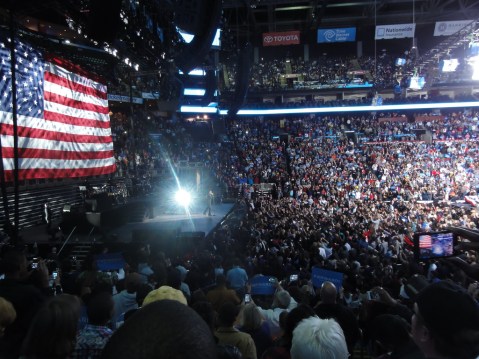
Jay-Z performs at Obama Pre-Election Rally 2012 in
Columbus, Ohio, w/ Bruce Springsteen, Image by Flickr User Becker1999
Hip hop aesthetics bridge old New York with the current New York as a foundation of Americanness. Gatsby bridges the old adage of New York as a space of opportunity with the familiar New York adage that Harlem-born and Mt.-Vernon-raised P. Diddy drops in Jermaine Dupri’s “Welcome to Atlanta,” “if you can make it here, you can make it anywhere,”a call back to Sinatra’s “New York, New York” that is also echoed by Jay-Z that forms a foundational trope of the film and the novel. A particular striking example of the merging of these adages is a scene in the novel where Nick and Gatsby are on their way to the city. They pass a car with black passengers and a white chauffeur:
As we crossed Blackwell’s Island a limousine passed us, driven by a white chauffeur in which sat three modish negroes, two bucks and a girl. I laughed aloud as the yolks of their eyeballs rolled toward us in haughty rivalry.
“Anything can happen now that we’ve slid over this bridge,” I thought; “Anything at all” (69).
While the novel does not describe a sonic accompaniment to Carraway’s observation of the black folks in the limousine, there is an inherent understanding of the “modish” fashion of the black folks as jazzy, as cool. In the film, there is an audible sound associated with the black folks. They are sipping champagne and listening to Watch the Throne. Although visibly symbolic of the 1920s – dressed in zoot suits and flapper dresses – the aural blackness associated with the scene suggests a merger of jazz and hip hop cool and cosmopolitanism.

Still from The Great Gatsby (2013)
In order to understand how hip hop updates the struggle for realness, entitlement, and respectability in the Gatsby film, it is important to return to the major sonic influence of the literal hip hop sound in the film: Jay-Z and Watch the Throne. Jay-Z’s work on the album raises questions of how hip hop culture impacts not only the American dream but the aspirations of mogul-dom seen and heard in the film and novel. Christopher Holmes Smith’s discussion of hip hop moguls in Social Text (Winter 2003) is particularly useful in teasing out the implications behind the hip hop mogul and such figures’ social-cultural responsibility to their respective communities. Holmes Smith argues:
The hip-hop mogul bears the stamp of American tradition, since the figure is typically male, entrepreneurial, and prestigious both in cultural influence and wealth. The hip-hop mogul is an icon, therefore, of mainstream power and consequently occupies a position of inclusion within many of the nation’s elite social networks and cosmopolitan cultural formations (69).
Jay-Z’s status as a hip hop mogul – serving both as a creative talent and corporate backer – lends credence to thinking about hip hop as a space of entitlement and a site of struggle to attain that entitlement. It is from this perspective that I think of Gatsby as a hip hop figure/mogul: his working class background, hyper-performance of white privilege, materialistic pursuit of wealth for visibility, and desperate need for approval as “authentic.” To borrow from rapper Drake, Gatsby “just wanna be successful.”
Mark Anthony Neal’s discussion of Jay-Z as a hip hop cosmopolitan figure in Looking for Leroy (2013) further enables an understanding of how Jay-Z lends his (sonic) hip hop cosmopolitanism to sonically navigate between hip hop’s working class aesthetics and his own sense of entitlement because of the way he mobilized those working class experiences to become wealthy. While the film does have performances by artists who are not considered hip hop – i.e. Lana Del Rey, Jack White, and Florence+the Machine – Jay-Z’s use of his own raps, including tracks from the Kanye West collaboration Watch the Throne suggests a “sonic hip hop cosmopolitanism” complements any sense of the film as a case study of white entitlement. Tracks like “100$ bill,” “No Church in the Wild,” and “Who Can Stop Me” both prop up and tear down Luhrmann’s visual rendition of Fitzgerald’s critique of the uppercrust of America as corruptibly entitled.
.
Baz Luhrmann’s adaptation of The Great Gatsby is an intriguing and useful tool through which to analyze the (in)consistencies of race and cultural authenticity in the United States. Both jazz and hip hop exist in the interstitial spaces that lie between black cultural expression and white entitlement to those expressions. Luhrmann uses hip hop’s sonic and cultural aesthetics to pump up the capitalistic and all-American narrative of “pull yourself up by the bootstraps” narrative in Gatsby by also declaring, “get yours by any means necessary.”
—
Featured Image adapted from Flickr User kata rokkar
—
Regina Bradley recently completed her PhD at Florida State University in African American Literature. Her dissertation is titled “Race to Post: White Hegemonic Capitalism and Black Empowerment in 21st Century Black Popular Culture and Literature.” She is a regular writer for Sounding Out!
—
REWIND! . . .If you liked this post, you may also dig:
“‘I’m on my New York s**t’: Jean Grae’s Sonic Claims on the City”— Liana Silva
“I Like the Way You Rhyme, Boy: Hip Hop Sensibility and Racial Trauma in Django Unchained“– Regina Bradley
“The Victoria’s Secret Fashion Show and the Soundtrack of Desire“— Marcia Dawkins
Share this:


Current Top Posts





April 2021

January 2020

November 2019

October 2019

August 2019

April 2014

November 2017

March 2015

December 2017

October 2015
 Sounding Out!
Recent Comments