
Listening to the Beautiful Game: The Sounds of the 2018 World Cup

I heard them before I saw them. Walking to my apartment in Moscow’s Tverskoy District, I noticed a pulsating mass of sound in the distance. Turning the corner, I found a huge swath of light blue and white and—no longer separated by tall Stalinist architecture—was able to clearly make out the sounds of Spanish. Flanked by the Izvestiia building (the former mouthpiece for the Soviet government), Argentinian soccer fans had taken over nearly an entire city block with their revelry. The police, who have thus far during the tournament been noticeably lax in enforcing traffic and pedestrian laws, formed a boundary to keep fans from spilling out into the street. Policing the urban space, the bodies of officers were able to contain the bodies of reveling fans, but the sounds and voices spread freely throughout the neighborhood.
Moscow is one of eleven host cities throughout Russia for the 2018 FIFA World Cup, which runs from June 14 to July 15. Over one million foreign fans are expected to enter the country over the course of the tournament, and it is an important moment in Vladimir Putin’s attempt to reassert Russia’s power on the global stage. Already, it has been called “the most political tournament ever,” and discussions of hooliganism, safety concerns, and corruption have occupied many foreign journalists in the months leading up to the start. So gloomy have these preambles been that writers are now releasing opinion pieces expressing their surprise at Moscow’s jubilant and exciting atmosphere. Indeed, it seems as though the whole world is not only watching the games, but also listening attentively to try to discern Russia’s place in the world.

Police officers during World Cup 2018 in Russia, Image by Flickr User Marco Verch (CC BY 2.0)
Thus it comes as no surprise that the politics of sound surrounding the tournament have the potential to highlight the successes, pitfalls, and contradictions of the “beautiful game.” Be it vuvuzelas or corporate advertising, sound and music has shaped the lived experience of the World Cup in recent years. And this tournament is no exception: after their team’s 2-1 win over Tunisia on June 18, three England fans were filmed singing anti-semitic songs and making Nazi salutes in a bar in Volgograd. That their racist celebrations took place in Volgograd, formerly known as Stalingrad and the site of one of the bloodiest battles of World War II, added historical insult and even more political significance. The incident has shaped reception of England fans and their sounds across the country. As journalist Alec Luhn recently tweeted, police cordoned off singing England supporters in Nizhny Novgorod after their victory over Panama, ostensibly keeping the risk of hooliganism at bay. The incident stands in stark contrast with the police barrier around the Argentina fans, who were being protected not from supporters of other nationalities, but rather from oncoming traffic.
England fans in Russia sing songs…behind a line of police. Part of the reason there hasn’t been any hooligan violence pic.twitter.com/RwXz8XtLHf
— Alec Luhn (@ASLuhn) June 23, 2018
More than anything, however, sound has facilitated cultural exchange between fans and spectators. In recent years, historians and musicologists have paid more attention to the multivalent ways musical exchanges produce meaningful political and social understandings. Be it through festivals, diplomatic programs, or compositional techniques, music plays a powerful role in the soft power of nations and can cultivate relationships between individuals around the globe. More broadly, sound—be it organized or not—shapes our identity and is one of the ways by which we make meaning in the world. Sound, then, has the potential to vividly structure the experience of the World Cup—a moment at which sound, bodies, individuals, and symbolic nations collide.
At the epicenter of all of this has been Red Square, Moscow’s—and perhaps Russia’s—most iconic urban space. The site of many fan celebrations throughout the World Cup, Red Square’s soundscape brings together a wide variety of national identities, socio-economic considerations, and historical moments. To walk through Red Square in June 2018 is to walk through over five-hundred years of Russian history, emblematized by the ringing bells and rust-colored walls of the Kremlin; through nearly eighty years of Soviet rule, with the bustle and chatter of curious tourists waiting to enter Lenin’s tomb; and through Russia’s (at times precarious) global present, where fans from Poland join with those from Mexico in chants of “olé” and Moroccan supporters dance and sing with their South Korean counterparts. The past, present, and an uncertain future merge on Red Square, and the sonic community formed in this public space becomes a site for the negotiation of all three.

Map of Red Square
In the afternoon of June 19, I walked through Red Square to listen to the sounds of the World Cup outside the stadium. At the entrance to Red Square stands a monument to Grigory Zhukov, the Soviet General widely credited with victory over the Nazis in World War II. Mounted upon a rearing horse, Zhukov’s guise looms large over the square. In anticipation of that evening’s match between Poland and Senegal at Moscow’s Spartak Stadium, Polish fans were gathered at the base of Zhukov’s monument and tried to summon victory through chants and songs (Poland would end up losing the match 2-1.) Extolling the virtues of their star player, Robert Lewandowski, the fans played with dynamics and vocal timbres to assert their dominance. Led by a shirtless man wearing a police peaked cap, the group’s spirit juxtaposed with Zhukov’s figure reiterated the combative military symbolism of sporting events. Their performance also spoke to the highly gendered elements of World Cup spectatorship: male voices far outnumbered female, and the deeper frequencies traveled farther across space and architectural barriers. The chants and songs, especially those that were more militaristic like this one, reasserted the perception of soccer as a “man’s sport.” Their voices resonated with much broader social inequalities and organizational biases between the Women’s and Men’s World Cups.
From there, I walked through the gates onto Red Square and was greeted by a sea of colors and hundreds of bustling fans. Flanked by the tall walls of the Kremlin on one side and the imposing façade of GUM (a department store) on the other, the open square quickly became cacophonous. Traversing the crowds, however, the “white noise” of chatter ceded to pockets of organized sound and groups of fans. Making a lap of the square, I walked from the iconic onion domes of St. Basil’s cathedral past a group of chanting fans from Poland, who brought a man wearing a Brazil jersey and woman with a South Korean barrette into the fold. Unable to understand Polish, the newcomers were able to join in on the chant’s onomatopoeic chorus. Continuing on, I encountered a group of Morocco supporters who, armed with a hand drum, sang together in Arabic. Eventually, their song morphed into the quintessential cheer of “olé,” at which point the entire crowd joined in. I went from there past a group of Mexico fans, who were posing for an interview while nearby stragglers sang. The pattern continued for much of my journey, as white noise and chatter ceded to music and chants, which in turn dissipated either as I continued onward or fans became tired.
Despite their upcoming match, Senegalese fans were surprisingly absent. Compared to 2014 statistics, Poland had seen a modest growth of 1.5% in fans attending the 2018 World Cup—unsurprising, given the country’s proximity to Russia and shared (sometimes begrudgingly) history. Meanwhile, Senegal was not among the top fifty countries in spectator increases. That’s not to say, of course, that Senegalese supporters were not there; they were praised after the match for cleaning up garbage from the stands. Rather, geography and, perhaps, socio-economic barriers delimited the access fans have to attending matches live as opposed to watching them from home. With the day’s match looming large, their sounds were noticeably missing from the soundscape of Red Square.
Later that evening, I stopped to watch a trio of Mexico fans dancing to some inaudible music coming from an iPhone. Standing next to me was a man in a Poland jersey. I started chatting with him in (my admittedly not great) Polish to ask where he was from, if he was enjoying the World Cup so far, and so on. Curious, I asked what he thought of all the music and songs that fans were using in celebrations. “I don’t know,” he demurred. “They’re soccer songs. They’re good to sing together, good for the spirit.”
Nodding, I turned back toward the dancing trio.
“You are Russian, yes?” The man’s question surprised me.
“No,” I responded. “I’m from America.”
“Oh,” he paused. “You sound Russian. You don’t look Russian, but you sound Russian.”
I’d been told before that I speak Polish with a thick Russian accent, and it was not the first time I’d heard that I did not look Russian. In that moment, the visual and sonic elements of my identity, at least in the eyes and ears of this Polish man, collided with one another. At the World Cup, jerseys could be taken off and traded, sombreros and ushankas passed around, and flags draped around the shoulders of groups of people. Sounds—and voices in particular—however, seemed equal parts universal and unique. Emanating from the individual and resonating throughout the collective, voices bridged a sort of epistemological divide between truth and fiction, authenticity and cultural voyeurism. In that moment, as jubilant soccer fans and busy pedestrians mingled, sonic markers of identity fluctuated with every passerby.
I nodded a silent goodbye to my Polish acquaintance and, joining the crowd, set off into the Moscow evening.
—
Featured Image: “World Cup 2018” Taken by Flickr User Ded Pihto, taken on June 13, 2018.
—
Gabrielle Cornish is a PhD candidate in Musicology at the Eastman School of Music. Her research broadly considers music, sound, and everyday life in the Soviet Union. In particular, her dissertation traces the intersections between music, technology, and the politics of “socialist modernity” after Stalinism. Her research in Russia has been supported by the Fulbright Program, the Glenn Watkins Traveling Fellowship, and the Cohen-Tucker Dissertation Research Fellowship from the Association for Slavic, East European, and Eurasian Studies. Other projects include Russian-to-English translation as well as a digital project that maps the sounds and music of the Space Race.
—
 REWIND! . . .If you liked this post, you may also dig:
Cauldrons of Noise: Stadium Cheers and Boos at the 2012 London Olympics–David Hendy
Goalball: Sport, Silence, and Spectatorship— Melissa Helquist
Sounding Out! Podcast #20: The Sound of Rio’s Favelas: Echoes of Social Inequality in an Olympic City–Andrea Medrado
Share this:

Mixtapes v. Playlists: Medium, Message, Materiality
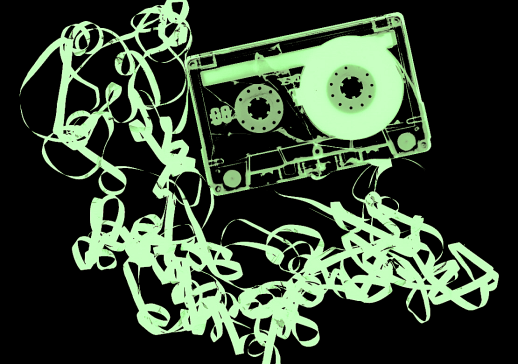
The term mixtape most commonly refers to homemade cassette compilations of music created by individuals for their own listening pleasure or that of friends and loved ones. The practice which rose to widespread prominence in the 1980s often has deeply personal connotations and is frequently associated with attempts to woo a prospective partner (romantic or otherwise). As Dean Wareham, of the band Galaxie 500 states, in Thurston Moore’s Mix-Tape: The Art of Cassette Culture, “it takes time and effort to put a mix tape together. The time spent implies an emotional connection with the recipient. It might be a desire to go to bed, or to share ideas. The message of the tape might be: I love you. I think about you all the time. Listen to how I feel about you” (28).
Alongside this ‘private’ history of the mixtape there exists a more public manifestation of the form where artists, most prominently within hip-hop, have utilised the mixtape format to the extent that it becomes a genre, akin to but distinct from the LP. As Andrew “Fig” Figueroa has previously noted here in SO!, the mixtape has remained a constant component of Hip Hop culture, frequently constituting, “a rapper’s first attempt to show the world their skills and who they are, more often than not, performing original lyrics over sampled/borrowed instrumentals that complement their style and vision.” From the early mixtapes of DJs such as Grandmaster Flash in the late ’70s and early ’80s, to those of DJ Screw in the ’90s and contemporary artists such as Kendrick Lamar, the hip-hop mixtape has morphed across media, from cassette to CDR to digital, but has remained a platform via which the sound and message of artists are recorded, copied, distributed and disseminated independent of the networks and mechanics of the music and entertainment industries. In this context mixtapes offer, as Paul Hegarty states in his essay, The Hallucinatory Life of Tapes (2007), “a way around the culture industry, a re-appropriation of the means of production.”
More recently the mixtape has been touted by corporations such as Spotify and Apple as an antecedent to the curated playlists which have become an increasingly prominent factor within the contemporary music industry. Alongside this the cassette has reemerged as a format, predominantly for independent and experimental artists and labels. The mixtape has also reemerged as a creative form in experimental music practice – part composition, part compilation, this contemporary manifestation of the mixtape is located somewhere between sound art and the DJ mix.

image by Flickr user Grace Smith, (CC BY 2.0)
This article explores these current manifestations of the mixtape. It analyses Spotify’s curated playlists and identifies some of the worrying factors that emerge from the ‘playlistification’ of recorded music. It goes on to discuss contemporary cassette culture and the contemporary mixtape identifying a set of characteristics which warrant the use of the term “mixtape” and distinguish it from forms such as the playlist. These characteristics, I suggest, may be adopted as strategies to address some of the contemporary crises in how we create, distribute, listen to, and consume music.
Playlists

“Day 213: Mix Tape – The Lost Art Form” by Flickr User Juli, (CC BY-NC-ND 2.0)
The mixtape has been presented as something of a forerunner to the music industry’s current streaming and subscription model and, in particular, of the curated playlists which Spotify sees as its, “answer to product innovation.” For Kieran Fenby-Hulse, writing in Networked Music Cultures: Contemporary Approaches, Emerging Issues, “the mixtape’s aura has underpinned the development of music streaming services such as Spotify and Apple Music” (174). Spotify’s corporate literature makes this connection explicitly via multiple references to mixtapes. The press release announcing the launch of its Discover Weekly playlist, for example, promises, “our best-ever recommendations delivered to you as a weekly mixtape of fresh music,” stating, “It’s like having your best friend make you a personalised mixtape every single week.”
Where the mixtape’s audience of one however, is the favoured other, friend, loved one, lover, Spotify’s curated and algorithmic playlists shift the focus inward. They are not created by someone for another, nor gifted to someone by another. They are created algorithmically for me and me alone. The promise of Spotify is that of “every playlist tuned just to you every single week.” Spotify delivers on this promise via its vast accumulation and exploitation of user data. The labour of the Spotify playlist thus is not the labour of love often associated with the mixtape, but rather it is an example of the increasingly prominent practice of corporations and service providers benefiting from unremunerated fan labour via, as Patrick Burkart notes in an essay entitled Music in the Cloud and the Digital Sublime , commodification of the “comments, playlists, recommendations, news, reviews, and behavioral profiles,” of music fans.
Analysis of Spotify For Brands’ corporate literature provides more insight into how Spotify utilises this data. Amongst millennials, for example, Spotify identifies “seven key audio streaming moments for marketers to tap into” – working, chilling, chores, gaming, partying and driving – and advises that “for marketers, this is a chance to reach millennials through a medium they trust and see as a positive enhancer or tool.” Spotify’s party playlists thus are an opportunity for brands to “think about enhancing the party moment by learning your audience’s favorite genres and subgenres and matching the beat” or “think audio for connected speakers and mobile display ads for that obsessive DJ always checking on their next song to further drive your message.” Spotify’s party playlists also seek to dispense with the unexpected juxtapositions and sonic clashes that have formed such a vital and valued component of DJ/sampling culture and the amateurism, imperfections, and crude edits of their supposed mixtape forebear. Thus ‘the mix,’ what Paul Miller (DJ Spooky) refers to as the process whereby “different voices and visions constantly collide and cross-fertilize one another” is replaced with promises of “professionally beat-matched music [where] every song blends smoothly with the next.” The hybrid of the mix thus is homogenised in the playlist.
In seeking to provide a music mix that is smooth, adaptable and perfectly transitioned, Spotify’s mood based playlists (“Your Coffee Break,” “Sad Songs,” “Songs To Sing In The Car”) are more closely aligned with the aura of Muzak and the Muzak Corporation than with that of the “mixtape” (a comparison previously made by Liz Pelly in her article The Problem with Muzak). The Muzak Corporation provided background music for the workplace from the 1920s and public spaces such as hotel elevators and shopping malls from the 1940s onwards aiming, as Brandon Labelle states in Acoustic Territories: Sound Culture and Everyday Life, to provide “a form of environmental conditioning to aid in the general mood of the populace.” (173)
Spotify’s promise of smoothly blended sound, for example, recalls Muzak’s mission, as quoted in Joseph Lanza’s, Elevator Music: A Surreal History of Muzak, Easy-Listening and Other Moodsong, to eliminate, “factors that distract attention – change of tempo, loud brasses, [and] vocals.”(48) Spotify’s stated desire, “to be the soundtrack of our life, […] to deliver music based on who we are, what we’re doing, and how we’re feeling moment by moment, day by day,” assigns a utilitarian function to its archive of recorded sound, recasting it, like Muzak, as quoted by Lanza again, as, “functional music,”(43) or, “stimulus progression program.” (49)
Cassette and the Contemporary Mixtape
Alongside the commercial playlists’ channeling of the mixtape’s aura there has been a reemergence of cassette, and the mixtape itself, as creative media. Cassette has become a prominent format for a host of underground labels attracted by its low manufacturing and distribution costs as well as its aesthetic qualities. Labels such as The Tapeworm, Opal Tapes, Fort Evil Fruit, and Nyege Nyege Tapes release short-run cassettes (typically 100-150 copies) encompassing noise, field recording, improv, drone, ambience, modular electronics, psychedelia and there ‘out there’ sounds. As Paul Condon of Fort Evil Fruit explains, “producing vinyl is prohibitively expensive and CDs often feel like landfill nowadays. The cassette format is a low-cost means of presenting albums as beautiful physical artifacts when they might otherwise only exist as downloads.”
As well as the economy and physicality of cassette, many enthusiasts are attracted by its sonic characteristics. The tendency of cassettes towards distortion, saturation and phasing are for many positive characteristics. Gruff Rhys of the band Super Furry Animals, for example, has observed that “listening to a cassette tape is not an exact science. Some cassette players play them a little faster. Others distort and phrase the music, changing the sound on the cassette forever.”
Since 2013 the experimental electronic duo Demdike Stare have released a series of cassette only limited edition mixtapes which form a body of work both linked to and distinct from their “official” album and EP releases. Whittaker of the duo has said of their aesthetic that, “Demdike Stare is all about records and the archive of aural culture from the last 50 years.” Where the Spotify playlist seeks to reconfigure the musical archive as functional or background music, artists such as Demdike Stare may be said to explore the recombinant potential of the archive as a vast body of aural culture which can be utilised to create hybrid works spanning temporal and cultural barriers. This reconfiguration of the aural archive arguably attains its most direct distillation on the duo’s mixtapes. These releases combine and overlay original and sampled sound in such a manner that the distinction between one and the other is obscured. They create a hybrid sound world in which sounds from multiple genres, cultures and timeframes overlap and interact, demonstrating what Joseph Standard in Wire magazine has described as, Demdike’s ability to employ sampling “as a means to release the hidden potential they detected in obscure and forgotten records.”
Dissecting 2013’s The Weight of Culture, unsubscribedblog detects:
a wave of static which quickly recedes to usher in a fine piece of Ethio-jazz from Mulatu Astatke…..a burst of the brief Les Soucoupes Volantes Vertes by French electronic prog band Heldon….a minimal rhythm track…overlaid with radio interference, muted voices, cymbals and all manner of audio artefacts before being subsumed by a wavering drone, vinyl static, plucked strings and finger bells.
While The Weight of Culture may be likened to a DJ mix (though one which exists distinct from the rhythm based, dance floor focused requirements which often determine the content of that form) elsewhere Demdike’s mixtapes serve as companion pieces to, or re-imaginings of their more mainstream releases (though again distinct from the more common forms of the remix or dub album). Circulation (2017) is “an hour-long mixtape/sketchbook of ideas and influences for…[their] Wonderland album, contrasting its heavily rhythmic stylings with this largely ambient-affair comprising archival tracks, bespoke edits and re-contextualised classics.” The Feedback Loop (2018) meanwhile reassembles elements of the catalogue of Italian improv collective Il Gruppo Di Improvvisazione Nuova Consonanza into a new collage composition and performance. As the duo themselves explain:
Tasked by the Festival Nuova Consonanza for a live performance at their 53rd Edition, with the remaining gruppo members in attendance, (Ennio Morricone, Giancarlo Schiaffini, Giovanni Piazza, Alessandro Sbordoni) we apprehensively dived into our collections for pieces by Gruppo and it’s members in order to create this homage. Using samplers, synths and effects we looped and layered chosen sections to create new pieces which we had to then play in front of the mighty Il Gruppo, captured here for posterity.
Demdike Stare, Postcollapse cassette and packaging

The German electronic composer Hainbach also reimagines the mixtape as a recombinant performance/composition hybrid. His YouTube series of C45 Lo-Fi Ambient mixtapes utilises his own self-made cassette loops, manipulated using modified cassette recorders and custom technology, and mixed amongst those of artists drawn from the contemporary underground cassette scene. The artist describes the first of these, C45 #1 | Lo-Fi Ambient Mixtape, as, “a grungy, half-speed lo-fi mix I made in one take with two cassette recorders, the Koma Electronics Fieldkit and a delay.”
What Hainbach calls mixtapes are audio visual records of live studio performances with the artist documenting the creation of the piece via video. They contain a participatory element and viewers/listeners are invited to send their own tapes to be, “mangled,” while the techniques and equipment employed are detailed in videos such as Tape Ambient Music Techniques | Making Of C45, and modification specs for some of the equipment used, such as Gijs Gieskes’ modified walkman are also available online.
Defining the Mixtape
Analysis of these works, along with more historical forms of the mixtape, suggests a set of characteristics which may be said to warrant the use of the term mixtape, even in a context wherein there is no engagement with the original material form of the medium, the cassette tape, which gave rise to the term.
- Hybridity: The mixtape is a uniquely hybrid form, part composition, part compilation. It combines elements from multiple sources, media and timeframes and frequently blurs lines between read and write cultures, or cultural consumption and production.
- Distribution: Mixtapes are distributed via non-mainstream methods. This may be via personal exchange, mail order, download from non corporate/commercial websites, purchase from merch stands at gigs, or via non-mainstream formats (in which category the cassette tape may now be placed).
- Intervention: The creator of a mixtape must be able to intervene in the recording process and to attain control over what is heard, to affect where sounds begin and end, to overlay material, and to combine elements from multiple sources.
- Labour: The creation of a mixtape involves an investment of labour at least equal to that required to listen to it in full. This time, effort, and investment of labour differentiates the mixtape from the playlist, mix CD, or disc drive filled with MP3s, often created simply by dragging and dropping file references from one window to another or via algorithmic selection.
Why set parameters around the mixtape as a genre? These characteristics may also form a series of strategies to counteract contemporary crises in how we create, distribute, listen to, and consume music – some of which are identified in the consideration of Spotify playlists within this article. The creation of hybrid works which are not easily defined or categorised, for example, might push back against the drive to assign a utilitarian function to music – to reframe it as something that happens in the background while we chill or do our chores. It might also serve as a form of resistance to the homogenisation of music and of DJ culture while also giving rise to new forms and practices.
Consideration of how and by whom music is distributed could help sustain a culture that supports independent artists and labels as opposed to corporations, brands and their marketing teams. Maintaining the ability to intervene in and act upon recorded sound sustains the ability to ‘play’ with sound and retains the potential for new forms in the lineage of the mixtape, or genres such as turntablism to emerge. Awareness of how the labour of musicians and music lovers is utilised and of who benefits from it may also serve to diminish the capacity for the exploitation of this labour.
—
Featured Image: “Untitled” by Flickr user Jenna Post (CC BY-NC-ND 2.0)
—
Mike Glennon is a Dublin based composer, audio visual artist and academic. His compositions and audiovisual works have featured in digital arts exhibitions and at music and film festivals in locations including the Venice, Paris, New Orleans and Dublin. He has been commissioned as a composer by organisations including the National Museum of Ireland and Dublin City Council. As a member of the band the 202s his music has been released to positive critical notice across Europe by Harmonia Mundi / Le Son du Maquis making him labelmates with artists including Cluster, Faust and A Certain Ratio. Mike is currently a PhD Research Scholar in the Graduate School of Creative Arts & Media (GradCAM) at the Dublin Institute of Technology where his research focuses upon the aesthetics of post-digital electronic music. He recently premiered new work stemming from his research at the Research Pavilion of the Venice Biennale thanks to the support of Culture Ireland.
—

REWIND! . . .If you liked this post, you may also dig:
Pushing Play: What Makes the Portable Cassette Recorder Interesting?–Gus Stadler
Evoking the Object: Physicality in the Digital Age of Music–-Primus Luta
Tape Hiss, Compression, and the Stubborn Materiality of Sonic Diaspora–Christopher Chien
Share this:


Current Top Posts





April 2021

January 2020

November 2019

October 2019

August 2019

April 2014

November 2017

March 2015

December 2017

October 2015
 Sounding Out!
Recent Comments