
Fiddling With Freedom: Solomon Northup’s Musical Trade in 12 Years a Slave

 Editor’s Note: Sound Studies is often accused of being a presentist enterprise, too fascinated with digital technologies and altogether too wed to the history of sound recording. Sounding Out!‘s last forum of 2013, “Sound in the Nineteenth Century,” addresses this critique by showcasing the cutting edge work of three scholars whose diverse, interdisciplinary research is located soundly in the era just before the advent of sound recording: Mary Caton Lingold (Duke), Caitlin Marshall (Berkeley), and Daniel Cavicchi (Rhode Island School of Design). In examining nineteenth century America’s musical practices, listening habits, and auditory desires through SO!‘s digital platform, Lingold, Marshall, and Cavicchi perform the rare task of showcasing how history’s sonics had a striking resonance long past their contemporary vibrations while performing the power of the digital medium as a tool through which to, as Early Modern scholar Bruce R. Smith dubs it, “unair” past auditory phenomena –all the while sharing unique methodologies that neither rely on recording nor bemoan their lack. Today, the series kicks off with Mary Caton Lingold‘s exploration of the materialities of Solomon Northup’s fiddling as represented through sheet music embedded in his 1853 narrative, amplifying a sound that was key to both his freedom and his enslavement.—Jennifer Stoever-Ackerman, Editor-in-Chief
—
Steve McQueen’s recent film Twelve Years a Slave has renewed interest in the original 1853 narrative, which has long been a valued resource for historians of nineteenth-century slavery, literature, and music. Because Solomon Northup was a highly-skilled fiddler and a keen observer of plantation culture, his autobiography is one of the most substantive accounts of musical life during slavery and, to my knowledge, the only slave narrative that includes sheet music in its text. As such, it preserves in audible form a precious record of Northup’s musical artistry and facilitates a sound-based study of nineteenth-century black fiddling, a tradition that was flourishing during Northup’s lifetime.
Uncovering the sounds of vernacular music of the pre-recorded era can be incredibly challenging. For this reason, Northup’s descriptions, when coupled with musical notation, make it possible for us to hear something historically significant. Although “slave music” was all the rage in the 1850s due to the widespread popularity of blackface minstrelsy, print-based compositions by enslaved (or free) musicians are difficult to come by and even more challenging to verify. The tune presented in Northup’s memoir has its own complex relationship to the minstrelsy genre, but it remains a unique sample of African-American music that warrants close-listening.

“Roaring River.” In Twelve Years a Slave: Narrative of Solomon Northup, by Solomon Northup, 322. Auburn, NY: Miller, Orton & Mulligan, 1854. Courtesy of the David M. Rubenstein Rare Book & Manuscript Library, Duke University
I use performance as a research method for exploring historical vernacular music, offering here my interpretation of “Roaring River: A Refrain of the Red River Plantation.” As I discuss in an essay titled “Listening to the Past,” the process of performance illuminates the subtleties of musical expression. (Do I play it like this or like that? At what tempo?) The aim of such exercises is not historical accuracy, but rather, an attunement to the sonic possibilities of a given piece. These possibilities cannot tell me how Northup would have played the song or what it meant to him, but they allow me to consider the kinds of choices that he would have had to make as a performer, thus illustrating the intellectual and sensorial richness of his music-making. Rather than simply presenting and describing the sheet music, I aim to make it possible for people to hear what would otherwise sit silently on the page.
In the first recording I play Northup’s melody solo to give you a sense of the tune.
In the second, I am joined by guitar.
The use of guitar accompaniment would have been highly unlikely during the period, but it helps to support my amateur playing by providing a livelier, fuller feeling. Northup connected with banjoists, percussionists and dancers as an enslaved and free musician and it’s interesting to imagine how a single song like this would have been transformed according to the talents, desires, and constraints of the performers assembled. It is unclear from the narrative whether or not the tune is an original composition or something Northup learned while living along the Red River, where he was enslaved in Louisiana. One also wonders how many nineteenth-century readers would have plucked the melody at a keyboard or bowed it on a family fiddle. What might their motivations have been?
Though Northup does not discuss the fiddle tune in the text, he does describe the lyrics below it, remarking that they were accompanied by a percussion technique called “patting” among his fellow slaves. He describes this widely documented practice as follows: “The patting is performed by striking the hands on the knees, then striking the hands together, then striking the right shoulder with one hand, the left with the other—all the while keeping time with the feet, and singing” (219). According to Northup, the lyrics that accompanied patting were often nonsensical because they were made to conform to the tonal and rhythmic pattern being patted. He offers “Harper’s Creek” as suitable for the practice but it’s worth noting that the lyrics voice a presumably white man’s desires to own a piece of land and a slave. Though presented below the sheet music at the end of the book, the lyrics are ill-fitting for the fiddle tune provided, which seems more likely to have been played without vocal accompaniment. In light of Northup’s descriptions, the sheet music creates an interesting blend of various performance modes, from popular folksy vocal diddy (with possible origins in minstrelsy), to patting, and fiddling. Here you can see a wonderful example of patting accompanying a nineteenth-century fiddle tune as performed by the Carolina Chocolate Drops and guest Danny Barber (Intricate patting begins at 1:22).
In addition to serving as auditory artifact, the presence of sheet music in the narrative relates to the way Northup’s musicality was commodified within the aesthetic economy of slavery during and after his captivity. After regaining freedom, his talents are presented for sale in the book presumably to appeal to the sort of audiences who would also have coveted the sheet music of minstrelsy, which caricatured and lampooned black performances. Popular appetites for representations of plantation culture left an imprint on Northup’s autobiography as well as other abolitionist publications, like Uncle Tom’s Cabin.

“Jumbo Jum,” Courtesy of the Newberry Library, Chicago. J.F. Driscoll Collection of American Sheet Music, Box 307a.
Music-making was both labor and leisure for Solomon Northup and it profoundly influenced his experiences as a slave. His narrative also illuminates the far-reaching impact that he and other black musicians had on their communities as well as nineteenth century music.
Alas! had it not been for my beloved violin, I scarcely can conceive how I could have endured the long years of bondage. It introduced me to great houses —relieved me of many days’ labor in the field—supplied me with conveniences for my cabin—with pipes and tobacco, and extra pairs of shoes, and oftentimes led me away from the presence of a hard master, to witness scenes of jollity and mirth. It was my companion—the friend of my bosom triumphing loudly when I was joyful, and uttering its soft, melodious consolations when I was sad. (217)
Solomon Northup’s biography is highly atypical of slave narratives because he is a free man who is sold into slavery. Some have criticized the popularization of his circumstances, arguing that because he conforms to modes of respectability as a literate, propertied black man, he serves as an ideal hero for white audiences while inadequately representing the experience of slavery. Though many aspects of Northup’s biography are unusual, his status as a highly sought-after musician is emblematic of a legion of black fiddlers who dominated music scenes North and South, from ballrooms to barns, beginning as early as the late seventeenth-century, as Dena Epstein explains in her indispensable study, Sinful Tunes and Spirituals: Black Music to the Civil War (1977).
Prior to enslavement, fiddling, “the passion of [his] youth,” provides Northup with supplemental income that helps to sustain his family during periods of insufficient employment in agriculture and carpentry. Music was an ideal side-career for someone in such circumstances, though, as Northup’s story shows, it did not protect him from the dangers of being black in the United States. He is captured and enslaved while touring as a circus musician. Ferrying South toward the Louisiana plantations that would become his deplorable home, Northup’s freedoms are violently stripped away. But his talent as a first-rate fiddler travels with him, becoming a defining element of his experience of slavery.
Fiddles were extraordinarily popular instruments during the era. Lightweight, portable, and increasing in mass production during the nineteenth-century, a single fiddle could service a large dance if need be. As such, slaves were encouraged (or forced) to take up the instrument and musical ability was considered a highly prized skill. Fiddling granted (primarily male) slaves an unusual degree of mobility as well as opportunities for economic advancement. The fact that numerous runaway slave ads note that the sought-after individuals were fiddlers or had in their possession a violin suggests that the increased mobility and access to income may have facilitated escape for some. For more information about these trends and their eighteenth-century origins, I highly recommend Richard Cullen Rath’s How Early America Sounded (2003), an excellent cultural history of sound.

Etching of Solomon Northup “in his Plantation Suit” accompanying his 1853 Narrative
Just before being sold at market to his first master, Northup encounters an enslaved young man in possession of a fiddle and sizes him up by asking if he could play the “Virginia Reel,” a popular dance. The young man cannot and so Northup takes the instrument from him, boldly showing off his more substantial repertoire and ability, much to the delight of those around him. Though about to be sold into an unknown and terrifying fate, this seemingly mundane interaction underscores how important musicianship is to Northup’s identity and also how significant it was to the societies through which he was forced to move. Whether in New York State, a New Orleans slave market, or a backwoods swamp plantation, fiddling was a thoroughly popular form of entertainment, widely enjoyed by Americans, slave and free, rich and poor, native and immigrant.
Northup expresses pride in the fame he earns in the Red River region, noting that he was known widely as the “Ole Bull of Bayou Boeuf.” Ole Bull was a famous Norwegian violinist, who was one of the first musicians to professionally tour the United States in the 1850s; he became a widely-known celebrity. Because of Northrup’s sought-after talents, his masters hired him out extensively to play at the fashionable balls of nearby plantations as well as the Christmas dances held yearly for slaves. At one ball, he was tipped seventeen dollars, an extraordinary amount that he used to furnish his cabin with bare necessities. In contrast to these more favorable gigs, Northup was also forced to perform during his savage Master Epps’ alcoholic binges. These events were held for hours on end in the middle of the night as Northup’s fellow slaves were commanded to dance. The violent, dreaded affairs interrupted precious sleep and were utterly humiliating for the participants. Depicted memorably in both the memoir and the recent film, the horrifying scenario shows the way slavery degrades Northup’s musicianship and his peers’ dancing, turning these arts into yet one more thing that the master possesses. For Master Epps, Northup is a mere musical device, a kind of proto-phonograph, full of tunes that can be made to play on command. Northup’s “passion” and economic livelihood are thus converted into a mechanized musical labor commodity under slavery.
Through Northup, we can see how before the eras of sound reproduction and broadcast, the circulation of music across North America was greatly facilitated by the forced migration of enslaved people. At the time of Northup’s capture, large numbers of mid-Atlantic slaves were being sold South to the booming plantations along the frontier of Louisiana and Texas. Northup brought a unique repertoire on his journey and he also learned new music that he transported back to the New York publishers of his autobiography. Afro-diasporic musicians began revolutionizing Western music centuries before Northup was born, and as we can see, continued to do so in profoundly significant ways in the Antebellum era both in spite of and due to the harsh conditions of their enslavement.
—
I’d like to thank the students in my course “Sounds of the South” for their lively discussion and excellent essays regarding music in Solomon Northup’s Narrative. I’m also deeply grateful to my musical collaborator, Eric Olsten.
—
Featured Image by Flickr User kubotake
—
Mary Caton Lingold is a doctoral candidate in English at Duke University researching early Afro-Atlantic literature, music, and sound. She leads a collaborative experiment called the Sonic Dictionary at Duke’s Audiovisualities Lab and co-directs Soundbox, a project dedicated to enhancing the practice of using sound in digital scholarship.
—
 REWIND! . . .If you liked this post, you may also dig:
“Como Now?: Marketing ‘Authentic’ Black Music,” –J. Stoever-Ackerman
Hearing the Tenor of the Vendler/Dove Conversation: Race, Listening, and the “Noise” of Texts –Christina Sharpe
How Svengali Lost His Jewish Accent––Gayle Wald
Share this:

Live Electronic Performance: Theory And Practice

This is the third and final installment of a three part series on live Electronic music. To review part one, “Toward a Practical Language for Live Electronic Performance” click here. To peep part two, “Musical Objects, Variability and Live Electronic Performance” click here.
“So often these laptop + controller sets are absolutely boring but this was a real performance – none of that checking your emails on stage BS. Dude rocked some Busta, Madlib, Aphex Twin, Burial and so on…”
This quote, from a blogger about Flying Lotus’ 2008 Mutek set, speaks volumes about audience expectations of live laptop performances. First, this blogger acknowledges that the perception of laptop performances is that they are generally boring, using the “checking your email” adage to drive home the point. He goes to express what he perceived to set Lotus’s performance apart from that standard. Oddly enough, it isn’t the individualism of his sound, rather it was Lotus’s particular selection and configuration of other artists’ work into his mix – a trademark of the DJ.
Contrasting this with the review of the 2011 Flying Lotus set that began this series, both reveal how context and expectations are very important to the evaluation of live electronic performance. While the 2008 piece praises Lotus for a DJ like approach to his live set, the 2011 critique was that the performance was more of a DJ set rather than a live electronic performance. What changed in the years between these two sets was the familiarity with the style of performance (from Lotus and the various other artists on the scene with similar approaches) providing a shift in expectations. What they both lack, however, is a language to provide the musical context for their praise or critique; a language which this series has sought to elucidate.
To put live electronic performances into the proper musical context, one must determine what type of performance is being observed. In the last part of this series, I arrive at four helpful distinctions to compare and describe live electronic performance, continuing this project of developing a usable aesthetic language and enabling a critical conversation about the artform. The first of the four distinctions between different types of live electronic music performance concerns the manipulation of fixed pre-recorded sound sources into variable performances. The second distinction cites the physical manipulation of electronic instruments into variable performances. The third distinction demarcates the manipulation of electronic instruments into variable performances by the programming of machines. The last one is an integrated category that can be expanded to include any and all combinations of the previous three.
Essential to all categories of live electronic music performance, however, is the performance’s variability, without which music—and its concomitant listening practices–transforms from a “live” event to a fixed musical object. The trick to any analysis of such performance however, is to remember that, while these distinctions are easy to maintain in theory, in performance they quickly blur one into the other, and often the intensity and pleasure of live electronic music performance comes from their complex combinations.

Flying Lotus at Treasure Island, San Francisco on 10-15-2011, image by Flickr User laviddichterman
For example, an artist who performs a set using solely vinyl with nothing but two turntables and a manual crossfading mixer, falls in the first distinction between live electronic music performances. Technically, the turntables and manual crossfading mixer are machines, but they are being controlled manually rather than performing on their own as machines. If the artist includes a drum machine in the set, however, it becomes a hybrid (the fourth distinction), depending on whether the drum machine is being triggered by the performer (physical manipulation) or playing sequences (machine manipulation) or both. Furthermore, if the drum machine triggers samples, it becomes machine manipulation (third distinction) of fixed pre-recorded sounds (first distinction) If the drum machine is used to playback sequences while the artist performs a turntablist routine, the turntable becomes the performance instrument while the drum machine holds as a fixed source. All of these relationships can be realized by a single performer over the course of a single performance, making the whole set of the hybrid variety.
While in practice the hybrid set is perhaps the most common, it’s important to understand the other three distinctions as each of them comes with their own set of limitations which define their potential variability. Critical listening to a live performance includes identifying when these shifts happen and how they change the variability of the set. Through the combination their individual limitations can be overcome increasing the overall variability of the performance. One can see a performer playing the drum machine with pads and correlate that physicality of it with the sound produced and then see them shift to playing the turntable and know that the drum machine has shifted to a machine performance. In this example the visual cues would be clear indicators, but if one is familiar with the distinctions the shifts can be noticed just from the audio.
This blending of physical and mechanical elements in live music performance exposes the modular nature of live electronic performance and its instruments. teaching us that the instruments themselves shouldn’t be looked at as distinction qualifiers but rather their combination in the live rig, and the variability that it offers. Where we typically think of an instrument as singular, within live electronic music, it is perhaps best to think of the individual components (eg turntables and drum machines) as the musical objects of the live rig as instrument.
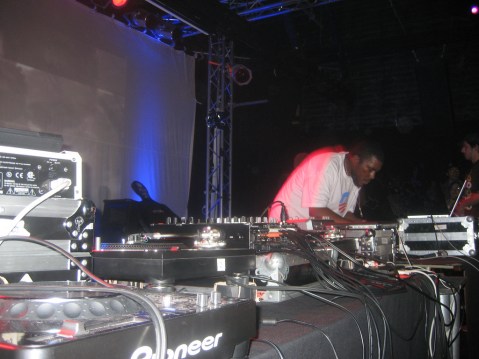
Flying Lotus at the Echoplex, Los Angeles, Image by Flickr User sunny_J
Percussionists are a close acoustic parallel to the modular musical rig of electronic performers. While there are percussion players who use a single percussive instrument for their performances, others will have a rig of component elements to use at various points throughout a set. The electronic performer inherits such a configuration from keyboardists, who typically have a rig of keyboards, each with different sounds, to be used throughout a set. Availing themselves of a palette of sounds allows keyboardists to break out of the limitations of timbre and verge toward the realm of multi-instrumentalists. For electronic performers, these limitations in timbre only exist by choice in the way the individual artists configure their rigs.
From the perspective of users of traditional instruments, a multi-instrumentalist is one who goes beyond the standard of single instrument musicianship, representing a musician well versed at performing on a number of different instruments, usually of different categories. In the context of electronic performance, the definition of instrument is so changed that it is more practical to think not of multi-instrumentalists but multi-timbralists. The multi-timbralist can be understood as the standard in electronic performance. This is not to say there are not single instrument electronic performers, however it is practical to think about the live electronic musician’s instrument not as a singular musical object, but rather a group of musical objects (timbres) organized into the live rig. Because these rigs can be comprised of a nearly infinite number of musical objects, the electronic performer has the opportunity to craft a live rig that is uniquely their own. The choices they make in the configuration of their rig will define not just the sound of their performance, but the degrees of variability they can control.
Because the electronic performer’s instrument is the live rig comprised of multiple musical objects, one of the primary factors involved in the configuration of the rig is how the various components interact with one another over the time dependent course of a performance. In a live tape loop performance, the musician may use a series of cassette players with an array of effects units and a small mixer. In such a rig, the mixer is the primary means of communication between objects. In this type of rig however, the communication isn’t direct. The objects cannot directly communicate with each other, rather the artist is the mediator. It is the artist that determines when the sound from any particular tape loop is fed to an effect or what levels the effects return sound in relation to the loops. While watching a performance such as this, one would expect the performer to be very involved in physically manipulating the various musical objects. We can categorize this as an unsynchronized electronic performance meaning that the musical objects employed are not locked into the same temporal relations.

Big Tape Loops, Image by Flickr User choffee
The key difference between an unsynchronized and s synchronized performance rigs is the amount of control over the performance that can be left to the machines. The benefit of synchronized performance rigs is that they allow for greater complexity either in configuration or control. The value of unsynchronized performance rigs is they have a more natural and less mechanized feel, as the timing flows from the performer’s physical body. Neither could be understood as better than the other, but in general they do make for separate kinds of listening experiences, which the listener should be aware of in evaluating a performance. Expectations should shift depending upon whether or not a performance rig is synchronized.
This notion of a synchronized performance rig should not only be understood as an inter-machine relationship. With the rise of digital technology, many manufacturers developed workstation style hardware which could perform multiple functions on multiple sound sources with a central synchronized control. The Roland SP-404 is a popular sampling workstation, used by many artists in a live setting. Within this modest box you get twelve voices of sample polyphony, which can be organized with the internal sequencer and processed with onboard effects. However, a performer may choose not to utilize a sequencer at all and as such, it can be performed unsynchronized, just triggering the pads. In fact, in recent years there has been a rise of drum pad players or finger drummers who perform using hardware machines without synchronization. Going back to our three distinctions a performance such as this would be a hybrid of physical manipulation of fixed sources with the physical manipulation of an electronic instrument. From this qualification, we know to look for extensive physical effort in such performances as indicators of the the artists agency on the variable performance.
Now that we’ve brought synchronization into the discussion it makes sense to talk about what is often the main means of communication in the live performance rig – the computer. The ultimate benefit of a computer is the ability to process a large number of calculations per computational cycle. Put another way, it allows users to act on a number of musical variables in single functions. Practically, this means the ability to store, organize recall and even perform a number of complex variables. With the advent of digital synthesizers, computers were being used in workstations to control everything from sequencing to the patch sound design data. In studios, computers quickly replaced mixing consoles and tape machines (even their digital equivalents like the ADAT) becoming the nerve center of the recording process. Eventually all of these functions and more were able to fit into the small and portable laptop computer, bringing the processing power in a practical way to the performance stage.

Flying Lotus and his Computer, All Tomorrow’s Parties 2011, Image by Flickr User jaswooduk
A laptop can be understood as a rig in and of itself, comprised of a combination of software and plugins as musical objects, which can be controlled internally or via external controllers. If there were only two software choices and ten plugins available for laptops, there would be over seven million permutations possible. While it is entirely possible (and for many artists practical) for the laptop to be the sole object of a live rig, the laptop is often paired with one or more controllers. The number of controllers available is nowhere near the volume of software on the market, but the possible combinations of hardware controllers take the laptop + controller + software combination possibilities toward infinity. With both hardware and software there is also the possibility of building custom musical objects that add to the potential uniqueness of a rig.
Unfortunately, quite often it is impossible to know exactly what range of tools are being utilized within a laptop strictly by looking at an artist on stage. This is what leads to probably the biggest misnomer about the performing laptop musician. As common as the musical object may look on the stage, housed inside of it can be the most unique and intricate configurations music (yes all of music) has ever seen. The reductionist thought that laptop performers aren’t “doing anything but checking email” is directly tied to the acousmatic nature of the objects as instruments. We can hear the sounds, but determining the sources and understanding the processes required to produce them is often shrouded in mystery. Technology has arrived at the point where what one performs live can precisely replicate what one hears in recorded form, making it easy to leap to the conclusion that all laptop musicians do is press play.
Indeed some of them do, but to varying degrees a large number of artists are actively doing more during their live sets. A major reasons for this is that one of the leading Digital Audio Workstations (DAW) of today also doubles as a performance environment. Designed with the intent of taking the DAW to the stage, Ableton Live allows artists to have an interface that facilitates the translation of electronic concepts from the studio to the stage. There are a world of things that are possible just by learning the Live basics, but there’s also a rabbit hole of advanced functions all the way to the modular Max for Live environment which lies on the frontier discovering new variables for sound manipulation. For many people, however, the software is powerful enough at the basic level of use to create effective live performances.

Sample Screenshot from a performer’s Ableton Live set up for an “experimental and noisy performance” with no prerecorded material, Image by Flickr User Furibond
In its most basic use case, Ableton Live is set up much like a DJ rig, with a selection of pre-existing tracks queued up as clips which the performer blends into a uniform mix, with transitions and effects handled within the software. The possibilities expand out from that: multi-track parts of a song separated into different clips so the performer can take different parts in and out over the course of the performance; a plugin drum machine providing an additional sound source on top of the track(s), or alternately the drum machine holding a sequence while track elements are laid on top of it. With the multitude of plugins available just the combination of multi-track Live clips with a single soft synth plugin, lends itself to near infinite combinations. The variable possibilities of this type of set, even while not exploiting the breadth of variable possibilities presented by the gear, clearly points to the artist’s agency in performance.
Within the context of both the DJ set and the Ableton Live set, synchronization plays a major role in contextualization. Both categories of performance can be either synchronized or unsynchronized. The tightest of unsynchronized sets will sound synchronized, while the loosest of synchronized sets will sound unsynchronized. This plays very much into audience perception of what they are hearing and the performers’ choice of synchronization and tightness can be heavily influenced by those same audience expectations.

A second performance screen capture by the same artist, this time using pre-recorded midi sequences, Image by Flickr User Furibond
A techno set is expected to maintain somewhat of a locked groove, indicative of a synchronized performance. A synchronized rig either on the DJ side (Serato utilizing automated beat matching) or on the Ableton side (time stretch and auto bpm detection sync’d to midi) can make this a non factor for the physical performance, and so listening to such a performance it would be the variability of other factors which reveals the artist’s control over the performance. For the DJ, the factors would include the selection, transitions and effects use. For the Ableton user, it can include all of those things as well as the control over the individual elements in tracks and potentially other sound sources.
On the unsychronized end of the spectrum, a vinyl DJ could accomplish the same mix as the synchronized DJ set but it would physically require more effort on their part to keep all of the selections in time. This would mean they might have to limit exerting control on the other variables. An unsychronized Live set would be utilizing the software primarily as a sound source, without MIDI, placing the timing in the hands of the performer. With the human element added to the timing it would be more difficult to produce the machine-like timing of the other sets. This doesn’t mean that it couldn’t be effective, but there would be an audible difference in this type of set compared to the others.
What we’ve established is that through the modular nature of the electronic musician’s rig as an instrument, from synthesizer keyboards to Ableton Live, every variable consideration combines to produce infinite possibilities. Where the trumpet is limited in timbre, range and dynamics, the turntable is has infinite timbres; the range is the full spectrum of human hearing; and the dynamics directly proportional to the output. The limitations of the electronic musician’s instrument appear only in electrical current constraints, processor speed limits, the selection of components and the limitations of the human body.
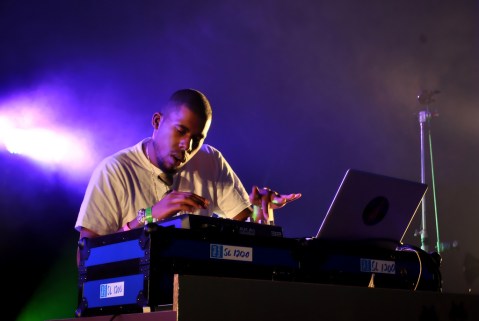
Flying Lotus at Electric Zoo, 2010, Image by Flickr User TheMusic.FM
Within these constraints however, we have only begun touching the surface of possibilities. There are combinations that have never happened, variables that haven’t come close to their full potential, and a multitude of variables that have yet to be discovered. One thing that the electronic artist can learn from jazz toward maximizing that potential is the notion of play, as epitomized with jazz improvisation. For jazz, improvisation opened up the possibilities of the form which impacted, performance and composition. I contend that the electronic artist can push the boundaries of variable interaction by incorporating the ability to play from the rig both in their physical performance and giving the machine its own sense of play. Within this play lie the variables which I believe can push electronic into the jazz of tomorrow.
—
Featured Image by Flickr User Juha van ‘t Zelfde
—
Primus Luta is a husband and father of three. He is a writer and an artist exploring the intersection of technology and art, and their philosophical implications. In 2014 he will be releasing an expanded version of this series as a book entitled “Toward a Practical Language: Live Electronic Performance”. He is a regular guest contributor to the Create Digital Music website, and maintains his own AvantUrb site. Luta is a regular presenter for theRhythm Incursions Podcast series with his monthly showRIPL. As an artist, he is a founding member of the live electronic music collectiveConcrète Sound System, which spun off into a record label for the exploratory realms of sound in 2012.
—
REWIND! . . .If you liked this post, you may also dig:
Evoking the Object: Physicality in the Digital Age of Music–-Primus Luta
Experiments in Agent-based Sonic Composition–Andreas Pape
Calling Out To (Anti)Liveness: Recording and the Question of Presence—Osvaldo Oyola
Share this:


Current Top Posts





April 2021

January 2020

November 2019

October 2019

August 2019

April 2014

November 2017

March 2015

December 2017

October 2015
 Sounding Out!
Recent Comments