
“I Dreamed and Loved and Wandered and Sang”: Sounding Blackness in W.E.B. Du Bois’s Dark Princess


DOI: https://doi.org/10.59350/z2hs6-msj55
Inspired by the recent Black Perspectives “W.E.B. Du Bois @ 150” Online Forum, SO!’s “W.E.B. Du Bois at 150” amplifies the commemoration of the occasion of the 150th anniversary of Du Bois’s birth in 2018 by examining his all-too-often and all-too-long unacknowledged role in developing, furthering, challenging, and shaping what we now know as “sound studies.”
It has been an abundant decade-plus (!!!) since Alexander Weheliye’s Phonographies “link[ed] the formal structure of W.E.B. Du Bois’s The Souls of Black Folk to the contemporary mixing practices of DJs” (13) and we want to know how folks have thought about and listened with Du Bois in their work in the intervening years. How does Du Bois as DJ remix both the historiography and the contemporary praxis of sound studies? How does attention to Du Bois’s theories of race and sound encourage us to challenge the ways in which white supremacy has historically shaped American institutions, sensory orientations, and fields of study? What new futures emerge when we listen to Du Bois as a thinker and agent of sound?
Over the next two months, we will be sharing work that reimagines sound studies with Du Bois at the center. Pieces by Phillip Luke Sinitiere, Kristin Moriah, Aaron Carter-Ényì, Austin Richey,Julie Beth Napolin, and Vanessa Valdés, move us toward a decolonized understanding and history of sound studies, showing us how has Du Bois been urging us to attune ourselves to it. To start the series from the beginning, click here.
Readers, today’s post by Kristin Moriah looks at Du Bois’s novel Dark Princess, and explores the relationship between sound and freedom in the text.
–Jennifer Lynn Stoever and Liana Silva, Eds.
Summer is come with bursting flower and promises of perfect fruit. Rain is rolling down Nile and Niger. Summer sings on the sea where giant ships carry busy worlds, while mermaids swarm the shores. Earth is pregnant. Life is big with pain and evil and hope. Summer in blue New York; summer in gray Berlin; summer in the real heart of the world!
W.E.B. Du Bois, Dark Princess (1928)

It is summer in Harlem now. Thick blankets of heat roil the city, and the pavement shimmers. Even the most die-hard city dwellers try to create distance between themselves and the noisy streets where political tensions threaten to boil over this season, as they always seem to. Airy tunes are often sung in vain here. More often than not, summer in New York City can be characterized by the sounds of the protests Julie Beth Napolin writes about so powerfully. At the moment, many of those protests are directed towards immigration detention centers and against forced family separation policies. Harlem, long a nexus for African diasporic and Latinx immigration and culture, has become a site of forced migration for migrant children separated from their families at the U.S. border and relocated to foster shelters like East Harlem’s Cayuga Center. Thus, contemporary nostalgia for Harlem as a site of creative freedom can be belied by reality.
But is there another place like this, not here, where one can go? An urban metropolis where one can be more attuned to sounds of the city and cries for justice? Where summer sings songs of freedom? Historically, there have been other options, especially for black travelers and migrants, and those options can tell us much about the way African American writers have conceptualized the relationship between sound and freedom. There was a strong correlation between sound and travel for African American intellectuals and performers during the Harlem Renaissance. During the brief period between Reconstruction and World War II, Europe, particularly Berlin, presented African Americans who traveled abroad with opportunities to hear and be heard differently. In The Sonic Color Line (2016), Jennifer Stoever has argued that W.E.B. Du Bois’s attention to the problem of the color line should inform our understanding of the centrality of sound in U.S. racial formations. But what happens to perceptions of the sonic color line once you cross the U.S. border? How have African American writers reflected on the sonic color line from a distance? W.E.B. Du Bois’s 1928 novel Dark Princess is an ideal place to begin exploring these questions.

W.E.B. Du Bois fictionalized the experience of traveling to Berlin at the turn of the 20th century. As a whole, his work on travelling in Europe while black contributes to the discourse around race and sound by illustrating the importance of sounding blackness to political discourse. Du Bois continually accounted for sound in both his prose and fiction about his European travels during the early 20th century. For instance, in his autobiography Darkwater, Du Bois writes “as a student in Germany, I built great castles in Spain and lived therein. I dreamed and loved and wandered and sang; then after two long years I dropped suddenly back into ‘nigger’—hating America!” (16). Here and elsewhere, Du Bois portrays singing, performing, and listening–or what I identify here as sounding blackness–as crucial activities that foster intellectual development, creativity, and political awareness. In “Death Wish Mixtape,” Regina Bradley observes that contemporary instances of sounding blackness in popular culture are often linked to commodification and death. But the act of sounding blackness can be pliable, even as it signifies keen political awareness. In the Harlem Renaissance, sounding blackness was linked to black internationalism. In Du Bois’s work, sounding blackness involves testing the limits of blackness abroad and making African American culture audible by introducing blackness into political discourse for progressive purposes.
In the opening epigraph of the novel Dark Princess, at the beginning of this post, a summer journey begins with a song in the wake of tragedy. Written during the height of the Harlem Renaissance, in W.E.B. Du Bois’s Dark Princess, African American hero Matthew Towns travels to Europe to heal himself from racism’s psychic wounds, macroagressions, and foreshortened career prospects. Like Du Bois, Towns seeks respite from the systemic racism he encounters in the U.S. educational system, in this case at the University of Manhattan, a fictional Harlem medical school that is a stone’s throw from the City University of New York’s City College. In other words, Towns is a refugee of American racism.
Matthew Towns experiences new forms of freedom when he travels abroad. Fin-de-Siècle Berlin’s ambiguous racial boundaries allow Matthew Towns to practice American citizenship, perform an unfettered African American identity, and act as a spokesperson for the first time. Faced with the question of whether African diasporic “blood must tell,” or reveal its weaknesses through inarticulate discourse, Towns boldly asserts that it won’t tell “unless it is allowed to talk. Its speech is accidental today” (22). He begins to advocate for African Americans using various performative modes. Du Bois depicts Towns as what Alex Black might term a “resonant body,” a performer who uses embodied sound to shape the viewers’ perceptions of his or her humanity. In Berlin, Towns becomes a resonant body who sounds blackness outside the boundaries of the American color line in an attempt to ameliorate conditions for African Americans at home. As such, Towns echoes Du Bois’ insistence on the importance of song to the African American tradition and socio-political ambitions in The Souls of Black Folk (1903). Thus, Dark Princess picks up on the sonic themes Du Bois proposed in his earlier works.
As Du Bois’s novel unfolds, readers learn how Berlin could both confound and appeal to the African American imagination as a utopic site of black performance. Towns sings to a multi-ethnic group of elite political activists at a dinner party in Berlin. Invited by Princess Kautilya of Bwodpur, at first, “Matthew felt his lack of culture audible, and not simply of his own culture, but of all the culture in white America which he had unconsciously and foolishly, as he now realized made his norm” (24). Initially, American racism prevents Towns from sounding blackness and participating in global discourses around race and freedom. And yet, at the same party in Berlin, Towns is also overcome by the memory of Negro spirituals. He becomes a resonant body by reclaiming black working-class sensibility and pride: “it was as if he had faced and made a decision, as though some great voice, crying and reverberating within his soul, spoke for him and yet was him” (23). For Matthew Towns, sounding blackness abroad is not just personally empowering; sounding allows him to imagine himself as a key contributor to larger social movements and, potentially, black liberation. In both examples, the acts of hearing, verbalizing, and singing are depicted as necessary modes of political awareness and engagement. Without access to these sonic forms, Matthew is divorced from meaningful political participation.
Eventually, Matthew finds his way into the conversation by making a powerful argument for the cultural achievements of African Americans, or “the black rabble of America,” (26) by way of Negro Spirituals: “silence dropped on all, and suddenly Matthew found himself singing. His voice full, untrained but mellow, quivered down the first plaintive bar…” (26). It is the most striking instance of black performance in the novel:
The blood rushed to Matthew’s face. He threw back his head and closed his eyes, and with the movement, he heard again the Great Song. He saw his father in the old log church by the river, leading the moaning singers in the Great Song of Emancipation. Clearly, plainly he heard that mighty voice and saw the rhythmic swing and beat of the thick brown arm. Matthew swung his arm and beat the table; the silver tinkled. (25)
Du Bois continues: “He forgot his audience and saw only the shining river and the bowed and shouting throng […] Then Matthew let go of restraint and sang as his people sang in Virginia, twenty years ago. His great voice, gathered in one long deep breath, rolled the Call of God” (26).
Towns’s newfound ability to sound blackness in Berlin, or in other words vocalize African American claims to citizenship and freedom, stand in contrast to his earlier inability to respond coherently to Northern racism in New York City, where he is left “sputtering with amazement” at his exclusion from a medical school at which he has rightfully earned his place. In that instance, Matthew is rendered speechless. When “his fury had burst its bounds” it resulted in not a stream of invectives or vain pleas for justice, but a physical response. He throws “his certificates, his marks, and commendations straight into the drawn white face of the Dean” (4). Afterwards, isolated and alone, he stalks New York City. If there is a distinct sonic dimension to this flight from discrimination, readers are not privy to it. The sounds of Matthew’s footsteps, and cries of righteous indignation, fade into the background of Harlem’s streets. They are perhaps indiscernible amidst the ebb and flow of any number of similar city sounds and experiences. In this instance, Du Bois seems to suggest that the sound that emanates from physical gestures loses potency in certain urban contexts.
When Matthew Towns returns to Harlem, we are told that it’s with a renewed ear and life purpose. Standing on Seventh Avenue, with City College to his left, “he turned east and the world turned too – to a more careless and freer movement, louder voices and easier camaraderie” (41). From the sounds of church music to the accents of West Indian immigrants, he is much more attuned to the city’s diverse African diasporic presence. Hearing these African diasporic connections in a new way, he is fueled for black leadership and political activism.
Thus, Towns’s experiences sounding blackness abroad are a pivotal step in his political awakening and activism on U.S. soil. In locating the project of sounding blackness between Harlem and Berlin, Du Bois’s fiction makes space for the privileged summer traveler, the forced migrant, and immigrant. All are bound by the desire for social progress on local and global scales. Finally, I argue that the dynamic relationship between sound, space, justice and travel that Du Bois maps out has striking relevance to contemporary political and ethical crises. As in Dark Princess, justice in the here and now can be measured by the ability to sound aloud and effect social change the world over and on street corners.
—
Featured image: “Mapping Courage” by Flickr user Laurenellen McCann, CC BY-NC 2.0
—
Kristin Moriah is an Assistant Professor of African American Literary Studies in the English Department at Queen’s University. She is the editor of Black Writers and the Left (Cambridge Scholars Press, 2013) and the co-editor of Adrienne Rich: Teaching at CUNY, 1968-1974 (Lost & Found: The CUNY Poetics Document Initiative, 2014). Her work can be found in American Quarterly, PAJ: A Journal of Performance and Art, Theater Journal, and Understanding Blackness Through Performance (Palgrave Macmillan, 2013). Her research has been funded through grants from the Social Science and Humanities Council of Canada, the Freie Universität Berlin, the CUNY Graduate Center’s Advanced Research Collaborative and the Harry Ransom Center. In spring 2015 Moriah was a Scholar-in-Residence at the NYPL Schomburg Center for Research in Black Culture.
—

REWIND! . . .If you liked this post, you may also dig:
Black Mourning, Black Movement(s): Savion Glover’s Dance for Amiri Baraka –Kristin Moriah
“Most pleasant to the ear”: W. E. B. Du Bois’s Itinerant Intellectual Soundscapes — Phillip Luke Sinitiere
The Noise You Make Should Be Your Own–Scott Poulson-Bryant
—
Share this:

My Music and My Message is Powerful: It Shouldn’t be Florence Price or “Nothing”
DOI: https://doi.org/10.59350/6pw71-rtv91
Flashback to the second day of the recent Gender Diversity in Music Making Conference in Melbourne, Australia (6-8 July 2018). In a few hours, I will perform the first movement of the Sonata in E minor for piano by Florence Price (1887–1953). In the lead-up, I wonder whether Price’s music has ever been performed in Australia before, and feel honored to bring her voice to new audiences. I am immersed in the loop of my pre-performance mantra:
My music and message is powerful, my music and message is powerful.
Repeating this phrase helps me to center my purpose on amplifying the voice of a practitioner who, despite being the first African-American woman composer to achieve national and international success, faced discrimination throughout her life, and even posthumously in the recognition of her legacy.
In Price’s time, there were those in positions of privilege and power who listened to her music and gave her a platform. One such instance was Frederick Stock of the Chicago Symphony Orchestra and his 1933 premier of her Symphony in E minor. But there were times when her musical scores were met with silence. For example, when she wrote to Serge Koussevitzky of the Boston Symphony Orchestra requesting that he hear her music, the letter remained unanswered. There was a notable intermittency in how Price was heard, which continues today. It seems most natural for mainstream platforms to amplify her voice in months dedicated to women and Black history; any other time of the year appears to require more justification. And so, as I am repeating this mantra—my music and message is powerful—I am attempting to de-centre my anxieties, and center my service to amplifying Price’s voice through an assured performance.
I applied to the conference a few months ago. I was keen to bring my research to new audiences. Upon seeing that the conference was in Australia, I knew this would be a fantastic opportunity to gain transnational insight into the ongoing work around representation and inclusion in music. Fast-forward to July: here I am, in Australia for the first time. The venue is unfamiliar and I have not met anyone here before this visit. However, this is what I do know: I have fifteen minutes for my performance; hence, I have only prepared the first movement of the sonata. Looking in the program, I noticed there will be a paper taking place at the same time as my performance, given by an academic who identified himself in his printed abstract as “a white, old, straight man with power and privilege.”
The title of his paper? “I Have Nothing to Say.” While gender diversity was the overarching theme of the conference, the goal towards inclusion negated the fact that not all platforms are created equal. The speaker’s proposed topic advertised the ease with which the dominant voice may access a space for its mere presence, regardless of what will be said. Conference logistics then set this voice and its contribution against the radically diverse sounds of our time slot. In addition to my lecture and performance, there are several other events taking place simultaneously. The subjects include: mentoring women composers, creative realizations of parenthood in composition, gender balance in Australian jazz, interpretative approaches to the music of Kaija Saariaho, music as a vehicle for navigating the challenges around non-binary and transgender identity, and a cis-gendered white man’s exploration of ceding power and listening.
I remember a casual conversation the night before in which the joke arose of the speaker being “the token white man.” Of course it was a joke; the very notion is absolutely ridiculous. I remember reflecting on tokenization earlier that day and tweeting to that effect:
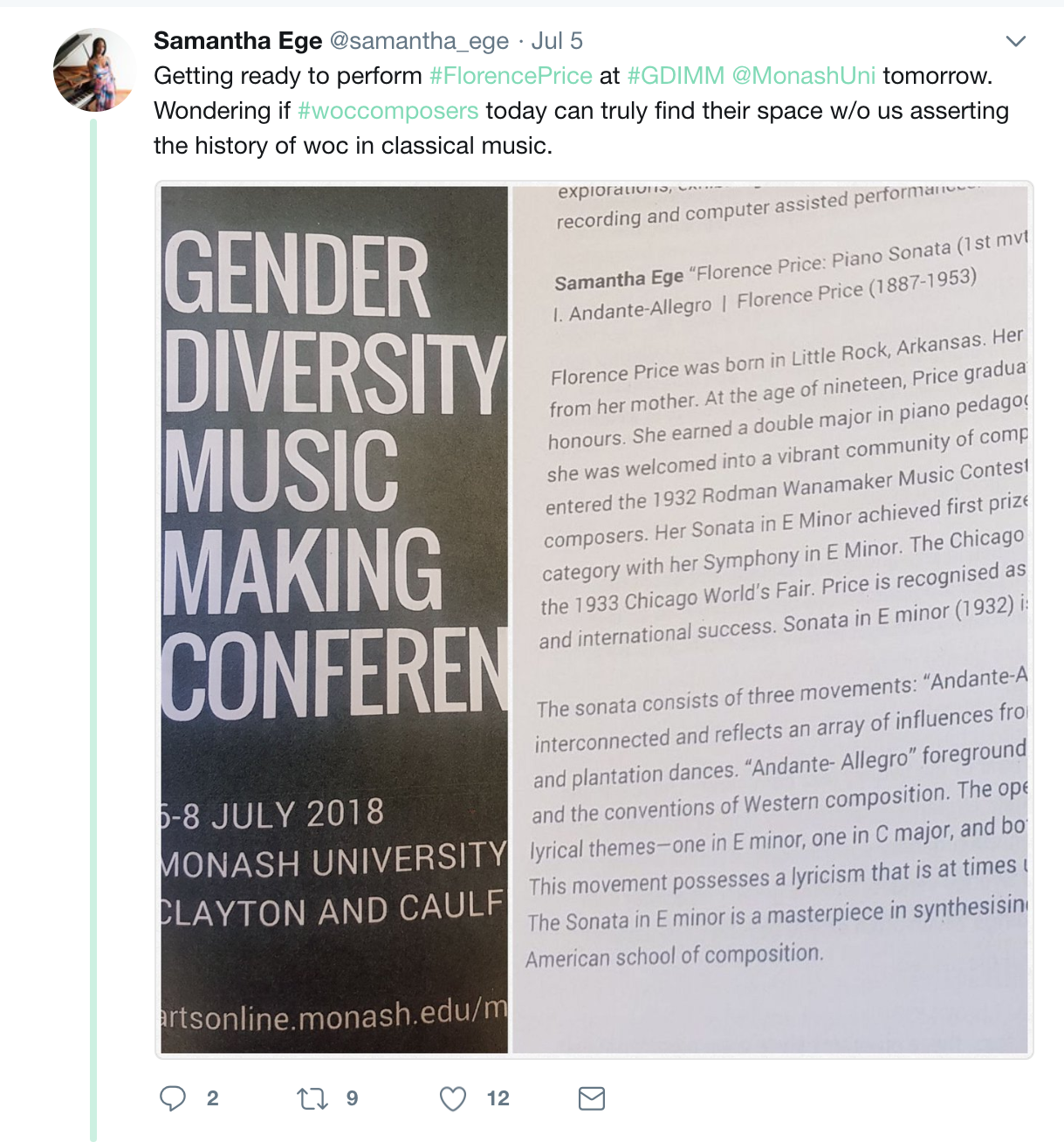
I knew the joke was light-hearted, but there is nothing light-hearted about being a token, nothing light-hearted about knowing your excellence, yet wondering if it will even factor into the decisions around your involvement. Anyway, I did not want to prioritize thoughts about the token white man over my purpose at the conference because that would take up time, space and energy, and in my pre-performance rituals, that time, space and energy belongs exclusively to the women that I seek to honour.
When it is time to perform, I bow, then sit, then sink into the first sound, which is this rich e minor chord that engages almost all of my fingers. I relish the rich tones in the grandeur of the introduction. But as the first theme comes in, conjuring up the soundworld of plantation songs, I calm the mood down to ensure that the lyricism of the top melody really sings.
My music and message is powerful.
The performance is followed by a presentation where I talk more about the sonata, who Price was, and what she achieved. I make sure to highlight her Arkansan roots and her Chicago successes, particularly around the Symphony in E minor. I speak about the influence of the spirituals within the classical frameworks of her compositions. I also speak about the privilege and the incredibly moving significance of being able to present and perform her music for an audience, largely of African descent, at the Chicago Symphony Center.
I play excerpts from the rest of the sonata off my recent album Four Women on Spotify and struggle to find the best time to pause the track because there is so much that I want the audience to hear: from the development of spiritual themes in the second movement, to the virtuosic whirlwind that is the final movement.
A dynamic discussion ensues, weaving in the narratives of Nina Simone, African-American folk tradition and my passion for this repertoire. I elaborate upon the ways in which exploring classical music by women has been an empowering personal journey. I articulate how the perception of men achieving “firsts” renders them gods while women achieving “firsts” are miracles that were never supposed to happen, that may never happen again. I express my role as a musicologist-pianist as demonstrating a long and rich history of women music-makers and, therefore, evidencing precedents—her-stories—for the creative contributions of women now. My time comes to an end and I am left feeling proud to have represented Price’s music and legacy here, today.
After my performance, I tweeted the following thought-through (but clearly not proof-read) thread expressing my disappointment:
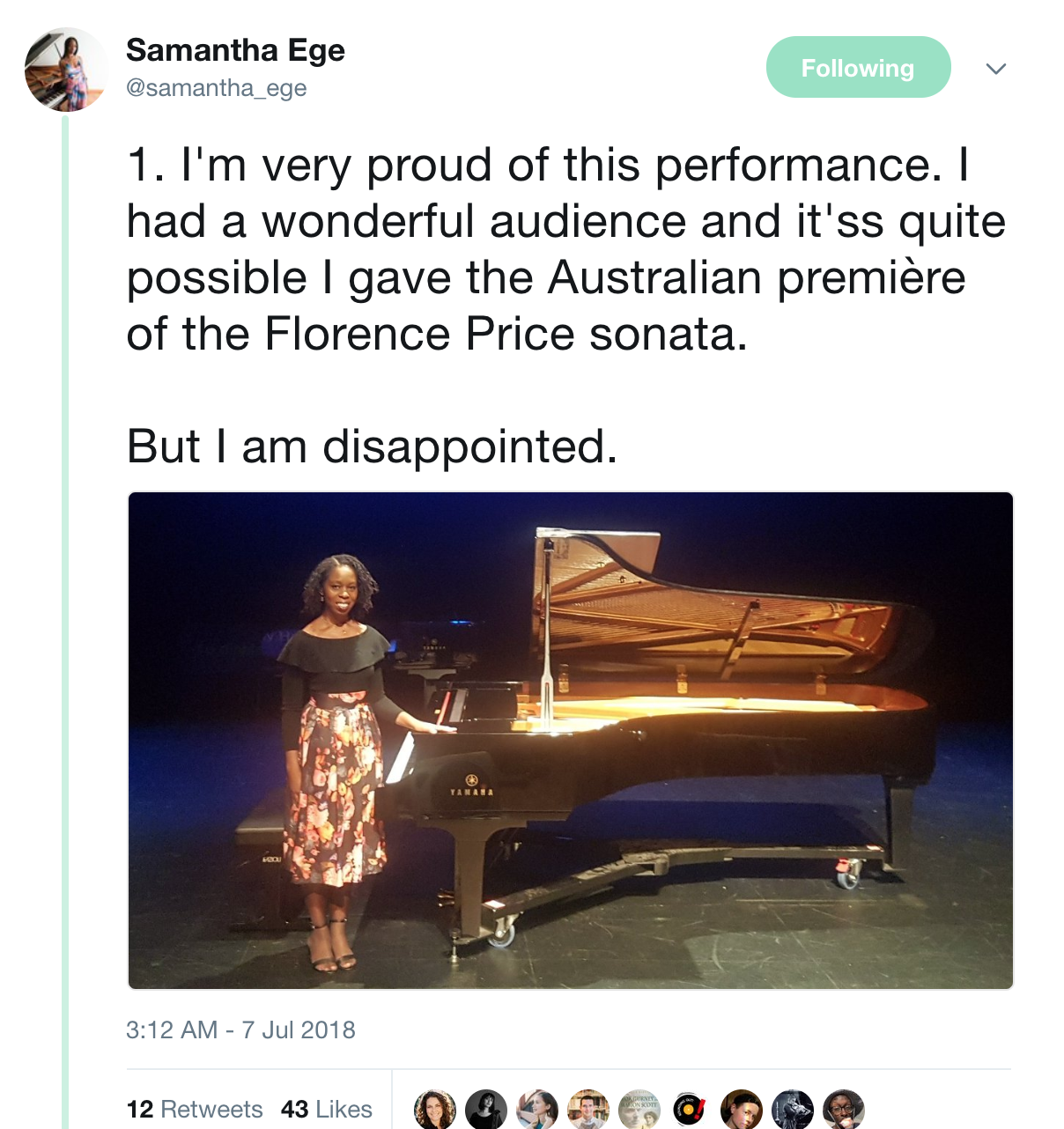
My goal with this post was to juxtapose this paper with Price’s music and career, spotlighting the implications of uneven power and access therein.
3. His talk was called “I have nothing to say.”
Some people therefore chose to listen to a man who has “nothing to say” over the music of an African American woman composer who has historically been silenced and is barely heard in this current day.
Let that sink in.
— Samantha Ege (@samantha_ege) July 7, 2018
Wrapped up in my post was the criticism of the fact that, being a university professor, the speaker of “I Have Nothing to Say,” has access to this kind of platform year-round, while marginalised voices only get amplified in the specific and limited spaces that society has carved out for them.
My critique is not about the individual, but about the systemic and institutionalized undermining of underrepresented voices, even at a conference designed to amplify them. The fact that such a work was placed on such a program evidences the extent to which we are so conditioned to ensuring the most powerful and privileged voice speaks in every single space, even when they acknowledge they have nothing to say.
Since posting that evening to both Twitter and Facebook, I have received a backlash on the latter, one that is, at present, unaffiliated with the organisers of the event. It has, however, attempted to derail the conversation. Apparently I was only upset because my program faced competition from other papers. Maybe I should have looked into the scheduling to make different arrangements. Or I should have found out what the speaker’s talk was about because there is a chance that I would have enjoyed it. Repeatedly, the onus was placed on me to reach out to the “token white man” and better understand his position. I also learned something new: passing judgement on a presentation because of its title is no better than passing judgement on a composer because of their gender. However, I was under the impression that the paper title was a choice and that Price’s identity as a black woman was not.
Anyway, I did not judge by the title. I judged by the abstract:
When one of the organisers of this conference suggested in a Facebook exchange on someone else’s post that I should submit an abstract for a paper, I was surprised. And a little frightened. What could I possibly contribute to such an event? I am the problem. I am a white, old, straight man with power and privilege. Surely my voice could only be heard by others as a violence in this context. Surely, my job is to get out of the way, to shut up, to not be heard. Surely, the only thing I could ethically and honourably bring to this is my listening. But then I felt that this is what needs to be said. I am and old straight white man who says that the job of people like me is to actively get out of the way, actively cede power and authority, actively be told, actively shut the fuck up. So I decided to use the occasion to practice a way of speaking that does those things, gets out of the way, cedes power and authority, gets told, shuts the fuck up. To practice speaking which listens. A listening-speaking. So that’s what I am trying to do in this paper. To enact a listening-speaking that gets out of the way, cedes power and authority, gets told, shuts the fuck up.
The speaker’s participation was invited and his proposal both encouraged and evidently accepted by the organizers. The abstract presents a sense of knowing better. “Surely my voice could only be heard by others as a violence in this context.” Yes. “Surely, my job is to get out of the way, to shut up, to not be heard.” Yes. “Surely, the only thing I could ethically and honourably bring to this is my listening.” Yes! “But…”
Ultimately, what needed to be said, actually needed to be done. The enacting of a listening-listening with neither platform nor audience would have been a powerful statement, quietly powerful, but powerful nonetheless. To reiterate, not all platforms are made equal—could I, realistically, have told him to shut the fuck up? How would that have sounded? How would I have sounded?
The derailing responses I have received pointedly ignore how the very presence of this paper disrupted the multiple and intersectional conversations happening in that moment. It distracted from the rarity of these subjects and their platform, and quite materially, culled an audience who could and should have been doing the very listening the abstract advertises. Scheduling this paper restored the speaker’s position to the center, and re-centered his power and authority to speak about everything and “nothing.” His privilege remained intact. In the midst of the most diverse and pertinent themes was the voice that has, both historically and to this day, spoken over the top of so many others.

I chose not to reach out directly to the institution nor its organisers because of the emotional labor this would entail. To put the issue forward in a quiet behind-the-scenes way that is sensitive to those who created the issue, is to chip away at my voice and its power. On the otherhand, to project the issue with a loud “shut the fuck up” is to perform a type of power and privilege on a platform that I do not have. I enact a public conversation here via Sounding Out! so that this experience may inform wider work towards diversity and representation. I enact this conversation in order to progress definitions of inclusion to a point where the choice to engage the dominant voice factors in a listening-listening as an exceedingly valuable contribution to the narratives offered by lesser heard voices.
I have since received a written acknowledgement from the organizers of this problematic programming, with a formal apology for the impact. But I must bring to light the important action of two allies, in particular, who recognised the emotional work required of me to bring this forward institutionally. They offered to continue the conversation on my behalf. We talked about the way in which the ensuing discussion must center listening. We shared that the process towards inclusivity may result in mistakes being made along the way. We discussed that while compassion and sensitivity can be important parts of the dialogue, I cannot afford to extend that compassion and sensitivity without becoming emotionally drained. And so, they wrote to the institution with the message of actively learning and making efforts towards change. I am so grateful for that allyship because while I knew that my voice would be heard, I could not guarantee how it would be heard. After all, if there is one take away to be had from this experience, it is that regardless of intention—and regardless of occasion—the dominant voice is very much conditioned to speak up, and speak over. And the dominant ear cannot help but listen.
So, how do I move forward?
My music and my message is powerful.
—
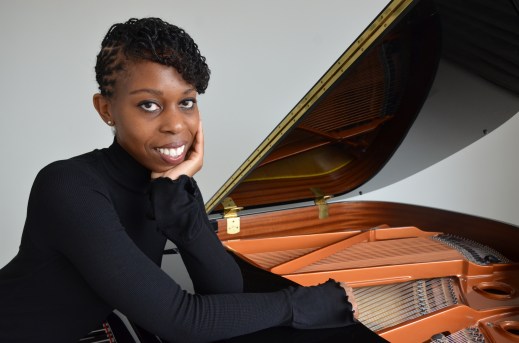
Featured Image: Courtesy of Author
—

Samantha Ege is a British musicologist, pianist and teacher based in Singapore. She is a Ph.D. candidate in Music at the University of York, UK. Her research focuses on the aesthetics of Florence Price. As a pianist, her focus on women composers has led to performances in Singapore (supported by the British High Commission and International Women’s Day), and lecture-recitals at the University of York, the Chicago Symphony Center and the Women Composers Festival of Hartford, USA. Her album Four Women: Music for Solo Piano by Price, Kaprálová, Bilsland & Bonds reflects her journey into a rich and unrepresented repertoire.
She would like to thank Deborah Torres Patel for the gift of this mantra.
—

REWIND! . . .If you liked this post, you may also dig:
Spaces of Sounds: The Peoples of the African Diaspora and Protest in the United States–Vanessa Valdes
becoming a sound artist: analytic and creative perspectives–Rajna Swaminathan
Sounding Out Tarima Temporalities: Decolonial Feminista Dance Disruption–Iris C. Viveros Avendaño
Gendered Soundscapes of India, an Introduction –Praseeda Gopinath and Monika Mehta
On Whiteness and Sound Studies–Gustavus Stadler
—
Share this:




Current Top Posts





April 2021

January 2020

November 2019

October 2019

August 2019

April 2014

November 2017

March 2015

December 2017

October 2015


Recent Comments