
If La Llorona Was a Punk Rocker: Detonguing The Off-Key Caos and Screams of Alice Bag


Image of Alice Bag used with her permission (thank you!)
For full intro and part one of the series click here. For part two, click here. For part three click here. For part four click here.
Our Punk Sound series implicitly argues that sound studies methodologies are better suited to understanding how punk works sonically than existing journalistic and academic conversations about musical genre, chord progressions, and/or genealogies of bands. Alexandra Vasquez’s sound-oriented work on Cuban music, for example, in Listening in Detail (2014) opens up necessary conversations about the “flashes, moments, sounds” in music that bear its meanings and its colonial, raced, classed, and gendered histories in material ways people can hear and feel. While retaining the specificity of Vasquez’s argument and the specific sonic archive bringing it forth, we too insist on “an ethical and intellectual obligation to the question: what do the musicians sound like” (12) and how do folks identifying with and through these musical sounds hear them?
In this series, we invite you to amplify varied historicized “details” of punk sound–its chunk-chunk-chunk skapunk riffs, screams, growls, group chants, driving rhythms, honking saxophones–hearing/feeling/touching these sounds in richly varied locations, times, places, and perspectives: as a pulsing bead of condensation dripping down the wall of The Smell in Downtown LA (#savethesmell), a drummer making her own time on tour, a drunk sitting too near the amp at a backyard party, a queer teenager in their bedroom being yelled at to “turn it down” and “act like a lady[or a man]”. . .and on and on. In today’s essay Marlen Rios-Hernandez discusses how all the politics of punk sound, queer chicana identity, and feminism can be found in the scream.
SOUND!
–Aaron SO! (Sounding Out!) + Jenny SO! (Sounding Out!)
—
Mexican cultural theorist Carlos Monsiváis looked at various aspects of Mexican youth subcultures in the early 80s and revealed how youth relied on “caos” or chaos as a way to attain pleasure within disruption, spontaneity, and noise (68-79). How does the scream emerge through caos as a instrument of resistance? Alongside scholars like Fred Moten, I argue that the scream ruptures caos and allows us to glimpse the pleasure of resistance. In Alice Bag’s scream we find this medley of pleasure, interruption, and spontaneity. Bag explains, “once the Bags hit the stage and the music started, ego checked out and id took over, channeling my libido, my inner rage, whatever… I was free to be myself with no holds barred. It was the ultimate freedom” (221). These elements epitomize what I consider a queer Chicana feminist exorcism of tonality.
As explained in Bag’s memoir, particular to punk, there is a general reliance on informal/community-based ear training where musicians teach each other (183). European traditions of musical analysis both negate the horizontal learning central to punk while also normalizing the historical colonial presence within the Borderlands. In order to reveal how Bag’s scream exorcises these Eurocentric traditions, I consider her performance of “Violence Girl” at the Whiskey (1978), footage of “Gluttony” from The Decline of Western Civilization Part 1 (1981), and a brief clip of The Bags’ “Survive” in What We Do is Secret (2007). Because of how the scream disrupts formal analysis, there is an urgency to understand how it works against the grain.
In the face of Chicana women being politically silenced by the Chicano Movement and Women’s Movements during the late 70s and 80s, it was important for Chicanas to speak up for increased autonomy and access to space. Thus, Alice Bag’s caos is informed by an intersectional ethic of Chicana feminism. At the time queer Chicanas were largely absent from Chicano nationalist organizing. Between the Chicano Movement and unruly Chicana punks, the screaming voice became a multi-layered instrument of protest and empowerment necessary to invert normative gender and sexual politics within punk, the Chicano movement, and second wave feminism. The ability of the Chicana scream to contest oppression is not new. Such a linage can be drawn from La Llorona–– the villanized folkloric mother that drowns her children and haunts Mexico’s shores by wailing in the night.
Drawing on Latinx scholarship and a sonic reimagining of La Llorona’s wailing (as a feminist cry and public display against patriarchy), this post reimagines Alice’s scream as simultaneously resistance and pleasure. This aligns with Gloria Anzaldúa’s notion of deslengualidad. Suturing Anzaldúa’s concept of deslengualidad (detonguing)–which I define as Chicanas speaking with an orphan tongue–with caos shows how Chicanas can claim visibility through the scream. Deslengualidad and caos account for colonial interventions within the Chican@ identity, they demand the preservation and celebration of the mestiza language and help to provide visibility to Chican@ art.
Though the voice has been rendered repeatedly as a gendered instrument, usually legible via lyrics, and always harmonic, some examples tell us otherwise. For example, Alice’s scream is interrupted by her microphone malfunctioning in her performance of “Violence Girl” at the Whiskey (1978). This multi-layered recording with it’s already grainy inaudible features, helps us to understand the scream as a stand alone act of caos. Although the scream is interrupted by multiple forms of dissonance, it also persists as a public gesture of empowerment. The quality of the recording is poor and in it Alice experiences technical issues on stage. These distortions lead Alice to artfully perform a sonic delengualidad by making use of silence, inaudible screaming, and the body. She continues to move, interrupt, and most importantly still is accompanied by stable beat of the Bags despite singing without a microphone. Yet, in the absence of aurally decipherable lyrics (like the absence of a singular Chicana language) a lyrical analysis here wouldn’t serve any other purpose than to organize that which is on its own refuses order––her voice.
The seminal footage of “Gluttony” in The Decline of Western Civilization Part 1 (1981), features an aural scream. It helps us think about how the Chicana scream goes beyond mere aurality. Michelle Habell-Pallán’s notion of “el grito,”–the shout–relates to Alice’s shriek in “Gluttony.” Both punctuate emotional drama and harken back to Ranchera music. I suggest, however, that Bag’s shriek in “Gluttony” also signifies a growing concern with the homogeneity of white suburban beach punks who had infiltrated the scene. In her memoir Bag shares, “as I looked out into the audience, I could see that the once quirky men and women artists who prized originality above all else were being replaced by a belligerent, male dominated mob…playing for a belligerent group of individuals can be quite satisfying. What I didn’t like was the sameness” (308). Pushing back against the scene’s homogeneity, Bag does not end “Gluttony with a full closed cadence. Rather, she ends abruptly, leaving the listener with a sense of incompleteness.
The combination of repeated interruptions throughout “Gluttony” and the inability to conclude pushes the listener to a place of discomfort, where they are left yearning for some kind of ending. The musicologist Susan McClary argues that the absent cadences in Carmen signify how the cadence represents a return to normality and a satisfying feeling of closure. By withholding a full cadence in “Gluttony” and using her “grito” to celebrate difference, Bag enacts caos by rejecting the emerging uniformity of the scene. Much like Bag’s performance of “Violence Girl” at The Whiskey, the scream is less about being musical and ordered but instead a gesture to making do with what one has, a similar manifestation of deslengualidad.
The brief sound clip of the Bags’ “Survive” in What We Do is Secret (2007) illustrates how Alice’s scream offers a genealogy of caos via her disruption of the story of L.A. punk. The Bag’s “Survive” for the duration of a few seconds plays in the background during a scene in which fans are getting ready to watch The Germs perform at The Masque. In this clip, Alice’s voice isn’t immediate because of how it resonates within the background music. Hence, her voice refuses containment by emanating from the periphery. Alice’s voice emerges as delengualidad within the film precisely because women are written out of the story of L.A. punk. They are depicted as secondary players in the film. Fred Moten’s In The Break reminds us that the site “where shriek turns speech turns song–– remote from the impossible comfort of origin–– lies the trace of our descent.” Within the shriek also lies our resistance tactics as Chicanas. The map of our survival through loudness–though heavily stereotyped–is a testament to the unwavering and inherited conocimiento that silence has never protected us. It is the task of women of color to interrupt, archive, and preserve their roles in the L.A. scene.
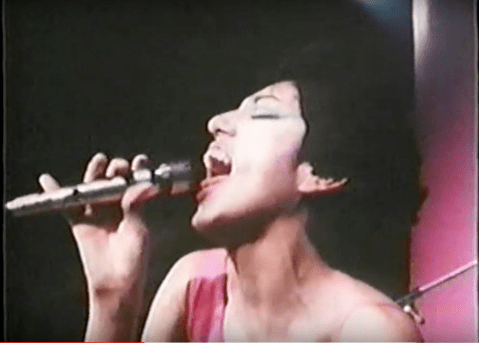
Screenshot from Alice Bag Band’s video “Gluttony.” Image used for purposes of critique.
Within Bag’s screaming from the Whiskey performance, Decline, to What We Do is Secret are snapshots or sonic/visual testimonios of queer Chicana women during the early 80s. These sonic snapshots/testimonios speak to the severely gendered and racialized repression of queer Chicana youth while still reconfiguring what empowerment looked like in the aftermath of the major socio-political movements of the 60s and 70s. In a casual conversation with Alice in a panel I guest moderated, she mentioned that watching “Gluttony” today was irksome to her because she was off-key. Perhaps, being off-key is one way that Chicana feminisms audibly reject neoliberal (and gendered) state repression. When we are surrounded by noise, we must remain enveloped in its infinite shape and simply listen. In noise we can resist, interrupt, and move away from orthodoxy and order. In today’s political climate, we need this framework now more than ever.
The return to Alice’s voice in this current moment is no coincidence. In preparation for this piece, I reflected on my brother’s deployment to Iraq during George W. Bush’s term. I was in community college taking a music appreciation course and I was searching for a paper topic that would be palatable to me as both a newly politicized queer Chicana and a former regular in the South Gate punk scene. It was through an interview with Teresa Covarrubias of The Brat and Alice Bag in an issue of Los Angeles Magazine that I heard Alice’s scream for the first time. It was the description of these women’s careers that led me to look up Chicana punk and come across the Whiskey performance of “Violence Girl.” To this day, Alice’s voice reminds us that if “Alice Bag was born from chaos” (310) then the Chicana punk voice remains a testament to punk’s resilience in the face of political uncertainty.
–
Featured image “Alice Bag Performing at Club Lingerie with the Cambridge Apostles” (CC BY 2.0)
–
Marlen Ríos-Hernández is a Ph.D. Candidate in the Ethnic Studies Department at the University of California, Riverside. Her current research revolves around queer Chicana/Mexicana punks in Mexico and Los Angeles from 1977-early 2000s respectively. Her dissertation aims to theorize and argue how Alice Bag, an innovator of the 1970s Los Angeles punk scene alongside other Mexicana punks, utilized noise to correlate the systemic disenfranchisement of womxn of color with the desire for transformational change integral to the survival of Mexicanas and first generation Chicana womxn especially during the Reagan and Bush Administrations. Via Ethnic Studies as her area of study along with her humanities and arts training as a Musicologist, Marlen investigates the relationship between unruly Chicana/Mexicana performing bodies and bisexuality, swapmeets, police brutality, photography, and film as instruments of noise-making.
–
 REWIND! . . .If you liked this post, you may also dig:
G.L.O.S.S., Hardcore, and the Righteous White Voice – Chris Chien
Feeling Through the Keen and Grind: Team Dresch’s Personal Best – Gretchen Jude
Riot-Grrrl, Punk and the Tyranny of Technique – Tamra Lucid
Share this:

Singing The Resistance: January 2017’s Anti-Trump Music Videos

 SO! Amplifies. . .a highly-curated, rolling mini-post series by which we editors hip you to cultural makers and organizations doing work we really really dig. You’re welcome!
—
The US presidential campaigns in 2016 were escorted by a number of songs regarding the person who was recently inaugurated as president. These songs served mostly as a kind of dystopic, fear-indulging, angsty “comedy music”—to reference Frank Zappa’s 1971 “Dental Hygiene Dilemma”—with a perverted thrill, or functioned in the retro manner of balladesque storytelling in songform. Performance art band Pussy Riot’s rather blunt “Make America Great Again” falls in the former category, while many examples from the brave and radiating 30 Days, 30 Songs project fall in the latter, summoning indie-rock icons as Death Cab For Cutie, R.E.M., Bob Mould, EL VY, Jimmy Eat World and Franz Ferdinand.
Lesser known tracks like “Trump,” produced by German DJ and producer WestBam, used a collage with sampled footage organized on a 4/4-beat to uncover Trump’s lies and remodel them into articulations of the vocal intentions of this subject: “We need drugs. We need crime.” However, as horrific and uncanny as this video seems, this subject as head of government then figured only in an unthinkable, impossible world.
In June 2016, Los Angeles rappers YG and Nipsey Hussle apparently sensed the horrible threat so creepily approaching the Oval Office, releasing “Fuck Donald Trump,” which produced a long string of versions, extensions, and new parts in the months afterward: “Don’t let Donald Trump win, that nigga cancer / He too rich, he ain’t got the answers / He can’t make decisions for this country, he gon’ crash us / No, we can’t be a slave for him.” In this song, before the votes were cast, the rappers and the Angelenos in the video address the urgency of a pending openly white supremacist government and the need to publicly resist it. For very good reasons, these musicians did not put the subject now in power into the box of a neglectable funny weirdo candidate. They recognized the threat as being as serious and imminent as it really was. “Fuck Donald Trump / Fuck Donald Trump / Yeah, nigga, fuck Donald Trump/ Yeah, yeah, fuck Donald Trump.”
In the week before the inauguration, artists released a string of music videos that struck very different tones from 2016. A comedy? No more. A gruesome, colorful story to tell? Too vague, too meek. “Hallelujah Money,” sings Benjamin Clementine in the song by the ever-so dystopic anime-band Gorillaz. The new song—the band’s first release in almost 7 years—is a freaked out lament, engendering bewilderment and prayer, taking on a sonic persona that cries out to The One & Only God Of Mammon – the lyrical subject is here the governing subject: “And I thought the best way to perfect our tree / Is by building walls / Walls like unicorns / In full glory / And galore.” In the video, the KKK marches along, the pigs in George Orwell’s animal farm blare, a lone and deathstruck cowboy meditates on the horizon behind Clementine, swinging in distorted rhythms and harmonies. In the end, Clementine burns his hair in a gigantic megaton-explosion while praying for money, praying for the last credible authority: “Hallelujah money (Past the chemtrails) / Hallelujah money (Hallelujah money).”
An angered, revolutionary will also stokes the song “Smoke ’em Out,” released on Jauary 17th, 2017 by a feminist trio consisting of sisters Sierra Casady & Bianca Casady (known as CocoRosie) and transgender singer Anohni (also known as the lead singer for Antony and the Johnsons). The song matches solid beats with serene pizzicatos, creating a surprisingly catchy melody of intriguing courage and uplifting collective resistance: “Burning down the house / The dead girl shouts / Smoke em out!”
Rhythmically demanding and just as sonically unforgiving comes “I Give You Power” by the Arcade Fire featuring Mavis Staples, an amalgamation of anger and the will to move ahead, to transcend current limitations of micro politics into a desired and imagined near future. The song opens with a flat electronic beat that builds up to a fat bulldozing bass sequence with added effects over which Mavis Staples’s multiplied voices lament and demand and call out in grief and angry bewilderment. The song merges disco, soul and funk with traditions of protest chanting, topped off with church organ chords. The music video reveals nothing beyond an older analog mixing desk operated now and then with calm sensitivity and deep knowledge of how this production tosses and turns: bright and glaring lights flicker over the image of the desk.
The Brooklyn-based Sateen, in contrast, perform “Love Makes The World” in a lavish scenery replete with luxurious flashing red gowns of large ruffles. They sing in the woods and in a brick underpass, while joined and complemented by a series of queer singers, dancers & personae presenting themselves, their love and their resistance in public and in private situations. Angelic voices sing over the cycling and motorized club beats, providing electronic sounds of hope whose joyful alien flavors are often in tension with the song’s lyrics: “How can we progress: / When we’re ruled by racists?”
The first music video, however, that drew my attention to this prolific phenomenon of songs against the US’s new governing subject was a cover of Morrissey’s “Interesting Drug” (1989), released by the notorious OK Go:
This time OK Go does not flatter us with their usual acrobatic and meticulously choreographed video performance, but rather present plain white-on-black-text between brief seconds of footage and screenshots of “the bad people on the rise” now in charge of the US, images ready to become the memes and gifs of a resistance movement. The music video ends with an explicit call to action–“It’s a difficult time but fear and anger aren’t the answer. Work to make a better world” followed by a list of five civil rights organizations including the American Civil Liberties Union, the Immigrant Defense Project and Planned Parenthood, headed by an unmistakable imperative: “Volunteer and donate.”
Discovering this song and video, I soon stumbled across yet another song that struck me first of all as a very clever and all too obvious marketing move, Green Day’s “Troubled Times,” which of course resonates with the band’s hit record “American Idiot” about the George W. Bush presidency.
“What good is love and peace on earth / When it’s exclusive.” In the visual style of traditional black and white newspaper collages—with splashes of red that summon Schindler’s List–the band animates the contemporary pandemonium of hatred, racism, sexism and plutocratic sadism to stage yet another traditional Green Day pop punk song, though one with a rather less disruptive, and much more forlorn note. I have to note a ertain awkwardness here, as the business model of lining up with this protest movement seems rather obvious, and many sections of these lyrics and the video’s imagery seems more cliché than genuine. Are these times really only structurally and anonymously “troubled? Are there no actual wrongdoers, criminals and hatemongers to be named, accused, and condemned? Roger Waters truly unexpected—and much more direct—recent live performance of “Pigs” in Mexico City in October 2016 comes to mind, with its massive projection of KKK & TRUMP-imagery as icons of hate – reinvigorating the political urgency present in a song from 1977.
Still, the song by Green Day might get airplay on nationwide rock radio unlike many of other songs of resistance, and by this it could actually succeed in its overstated mission.
The most aggressive and decidedly agitprop-productions come from Moby and Fiona Apple. Collaborating with Michael Wahlen, Apple recorded a chant for the massive Women’s March on Washington (and the many simultaneous marches occurring across the US and the world) the day after the inauguration:
With lines like “We don’t want your tiny pants / Anywhere near our underpants” Wahlen and Apple revive the protest chant traditions of the 1960s with its mean, challenging, and unforgiving humor. Late last year Apple already released a joyful yet sadistic little piece in the style of a sentimental Christmas carol that keeps “Trump’s nuts roasting on an open fire (…) Merry Christmas, Merry Christmas: Donald Trump, fuck you.”
In contrast, Moby merges his 1990s rave skittishness with an unrepentant love for precisely-targeted guitar punk riffs in “Erupt & Matter.” Original footage of demonstrations, resistance gatherings, and a selection of the absurd and terrifying authoritarian and nationalist figures of our time – first Erdoğan, Farage, Assad, then Duterte, Trump, Wilders, Le Pen, Petry, Hofer and many more – alternate with classic performance shots of Moby and his band The Void Pacific Choir, generating a sentiment of accelerating urgency: “WE DON’T TRUST YOU ANYMORE. WE DON’T TRUST YOU ANYMORE.”
But the anger against sclerotic oligarchies and a condescending establishment is ironically mimicked by exactly the most unsettling and authoritarian protagonists of various nationalist parties worldwide. Even as Moby’s aggressive protest chant becomes an infectious and intriguing earworm, does he render such a revolutionary impetus dubious? Pondering this reminded me of the Atari Teenage Riot line from 1995: “Riot sounds produce riots.” (Atari Teenage Riot 1995)
In the first few weeks of January alone, several consortiums have launched protest song campaigns to ensure that songs like these will just keep coming. On inauguration day, the platform “Our First 100 Days” was launched. Here, one new protest song will be released on every day for the first one hundred days of the current president’s administration, with all profits raised from the sales of songs by groups such as PWRBTTM going, as their website states, “directly to organizations working on the front lines of climate, women’s rights, immigration and fairness.” Paste Magazine expanded its “30 Days, 30 Songs” campaign for the long haul, offering up to 1000 Songs in 1000 Days— one song a day for every weekday of Donald Trump’s term.
However, as I write these last lines, the global public is remixing the resistance in its own lightning-fast ways. The recent public sucker-punch of white supremacist neo-Nazi Richard Spencer has already become a legendary object of meme culture. Folks have synched this clip to multiple—and diverse—soundtracks that invite repeated viewings, from Celine Dion’s “My Heart WIll Go On,” Bruce Springsteen’s “Born In The USA,” Queen’s “We Will Rock You,” Gwen Stefani’s “Hollaback Girl,” Pharrell Williams’s “Happy,” The Notorious B.I.G.’s “Hypnotize” to Frank Zappa’s “Black Page #2”. . .and the list continues.
Singing the resistance in the 21st century poses a truly complex task. Artists must sonically navigate a wide array of musical aesthetics—some geared toward more immediate public appeal, while others evoke more erratic and dissonant affects—and keep an eye toward combining sound with impactful media events and artifacts, while never forgetting to consider the critical question “How Does it Feel?”
This blogpost has its own playlist: click here
—
Holger Schulze is full professor in musicology at the University of Copenhagen and principal investigator at the Sound Studies Lab. His research focuses on the cultural history of the senses, sound in popular culture and the anthropology of media. Recent book publications are: American Progress (2015), Sound as Popular Culture (2016, ed.) and Krieg Singen: Singing The War (2017, ed.).
—
 REWIND!…If you liked this post, you may also dig:
On Ventriloquism, Dummies, and Trump’s Voice – Sarah Kessler
À qui la rue?: On Mégaphone and Montreal’s Noisy Public Sphere – Lillian Radovac
The Noise of SB 1070: or Do I Sound Illegal to You? – Jennifer Stoever
Share this:


Current Top Posts





April 2021

January 2020

November 2019

October 2019

August 2019

April 2014

November 2017

March 2015

December 2017

October 2015
 Sounding Out!
Recent Comments