
Karaoke and Ventriloquism: Echoes and Divergences
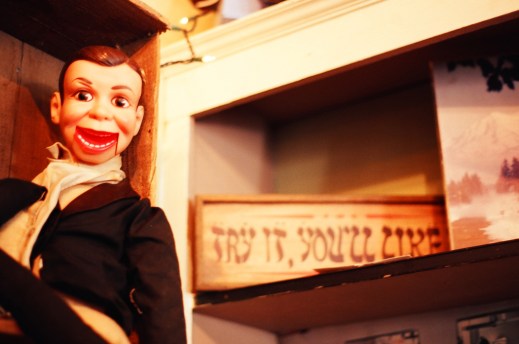
This piece is co-authored by Sarah Kessler and Karen Tongson.
Scholarship rarely happens in isolation, despite quantitative demands in the humanities for “single-authored” works. Instead, intimacies of different shapes and configurations, transpiring in spaces as variegated as “the institution,” cocktail bars, cars, and even boudoirs, have profound effects on how we think, and on what we eventually write. However, academics have very few forms beyond the citation, the footnote, or even the acknowledgment, through which to admit our debts, recognize our inspirations, and lay bare the narcissisms of our small differences.
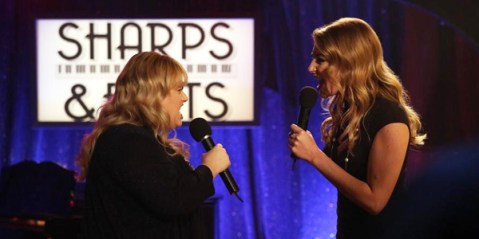
Our current areas of research—karaoke for Karen, ventriloquism for Sarah—traverse what may appear to be a narrow terrain of sound studies currently focused on “voice” or “the voice.” And yet the strains of sound studies that draw us to these topics do not exclusively concern themselves with the tropes or techniques of voice and vocalization that karaoke and ventriloquism conjure. Though voice presents itself as the most basic and fundamental connection between these two concepts and practices, we are each more invested in exploring karaoke and ventriloquism as actual sound technologies, as well as technologies of power. As you will read below, ventriloquism, for all its associations with archaism and mysticism in certain historical contexts, is also depicted as a technology and technique of deception, statecraft, and power. Meanwhile, karaoke, for all its associations with the expressive and participatory potential of amateur vocalization is also, crucially, a technological apparatus, whose media archaeology bears the traces of intercolonial conflicts, negotiations, and aftermaths. Finally, we are also both interested in the ways in which these sound technologies and techniques have been transformed into critical, intellectual, and affective methodologies, especially since they’ve both been harnessed as broader cultural metaphors for judgments at once moral and aesthetic.
 .
.
Over an obscenely caloric breakfast, we devised several questions touching upon some keywords and concepts we believe are applicable to both karaoke and ventriloquism, two topics that undermine notions of authorship, source, and origin. In our respective writing about these two subjects, we’ve both occasionally (or more than occasionally) been besieged by the anxiety that our work is melding together into some indeterminate blob. To put it another way: like any other lesbionic duo resisting the “urge to merge” (as so many other queers have warned against), we’ve arrived at that moment in our intimate and intellectual relationship where we’ve decided to sort out whose socks are whose. Somewhat ironically, then, we wrote this post together to establish some of the crucial differences between karaoke and ventriloquism.
The following “ventrilokeal” dialogue shows, from a conceptual standpoint, where some of the boundaries between karaoke and ventriloquism harden, while others remain porous.
We each provide separate answers, engaging the other person’s answer when appropriate. Feel free to supplement some of our questions in the comments section, addressing either or both of us. And thanks for indulging.
***
1) How do both karaoke and ventriloquism—as terms, metaphors, and practices—conjure and/or reframe our understandings of originality and derivation?
 KT: Karaoke, at least in my mind, has become the prevailing metaphor for derivation in the contemporary moment. Whenever the term is tossed about casually as a cultural metaphor, with little regard to the geographical contexts, modes of performance or the technologies that underlie its current practice, “karaoke” functions as a kind of shorthand for “the unoriginal,” the debased copy, the amateur reenactment. Novelist Dubravka Ugresic’s long essay on “Karaoke Culture” (2011) provides a perfect example of these applications of “karaoke.” And yet, karaoke in the U.S. in the last 15 years or so has also been construed as something that unlocks the creative and expressive potential of beleaguered, repressed or emotionally stunted individuals, usually men (see Lost in Translation, the forgotten Huey Lewis and Gwyneth Paltrow vehicle, Duets, and a recent pair of books I actually quite like, Brian Raftery’s Don’t Stop Believin’: How Karaoke Conquered the World and Changed My Life and Rob Sheffield’s Turn Around Bright Eyes: The Rituals of Love and Karaoke). Of course, it will take all of Empty Orchestra (my working book title), to answer this question properly, but one of the principles guiding my own account of karaoke as a metaphor for copies and reenactments (in addition to my exploration of its material practices and technological history), is that derivation and mimicry have always been a key concern of—and a point of intersection between—queer theory, aesthetics, critical race studies, and (post)-colonial studies.
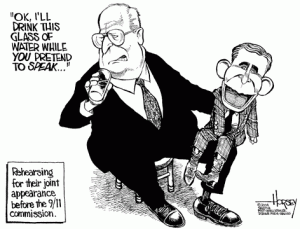 SK: When ventriloquism is employed as a metaphor in popular cultural contexts, it’s also often used to connote a lack of originality. The term tends to describe (and to fantasize) a situation in which one individual acts as the communications medium—usually the speaking or singing vessel—for words, songs, and other ideological formulations that originate or originated with someone else. So, in contrast to the mass copying and amateurism invoked by “karaoke,” “ventriloquism” suggests an unoriginality that can, and that must, be traced back to a discrete body and distinct point of origin. Think, for example, of George “Dubya” Bush and Dick Cheney, who were often represented as a ventriloquial duo. Political cartoons depicted Dubya as Cheney’s open-mouthed dummy, perched on the knee of his puppet master, the “actual” leader of the free world. Here, ventriloquism was used to image a scenario wherein the man who seemed to be in power was both secretly and openly manipulated by another man, who was the true source of power. In this case, unoriginality on Bush’s part connoted originality on Cheney’s, whereas in the case of the Beyoncé lip-synch scandal (more on this below), unoriginality signified very differently. Generally speaking, however, “ventriloquism” implies that a deceptive act has occurred, one that masks the origin of its own workings. It signals the veiling and subsequent exposure of a powerful apparatus. This apparatus is usually vocal in nature, the voice’s historical connections to power being well documented. In his Western cultural history of ventriloquism, Dumbstruck (2001), for example, Steven Connor traces the form back to Greco-Roman oracular myths in which divine prophecy is primarily accessible as a voice, transmitted through the mediating body of a priestess.
 Contemporary ventriloquists like the British performer Nina Conti often claim to be surprised by what their dummies say, which suggests that, far from being an omnipotent machinator, the ventriloquist is a bifurcated entity—one whose practice places her beside herself, in conversation with herself (or, as others have noted, with her unconscious). My recent work argues for bifurcation as a workable antidote to the tired, either/or question of originality vs. derivation to which popular cultural forms are repetitively subjected.
2) The terms “karaoke” and “ventriloquism” are both frequently employed in adjudicatory ways. As Karen has pointed out elsewhere, “karaoke” is often used in reality TV contexts (American Idol, The Voice) as a negative judgment of performance quality, i.e. “that performance was shit—mere karaoke.” “Ventriloquism,” for its part, is often used to connote a deviousness or deception that disqualifies a performance (think folks condemning Beyoncé post-lip-synched inauguration performance). What are the differences between “karaoke” and “ventriloquism” as judgments?
 KT: I actually think that one of the primary differences between these two terms as judgments, and perhaps more simply as just terms, is that “karaoke” condemns the person performing it, or performing something in “the style of” karaoke (i.e. derivatively, as a copycat, as a mere echo of the “original”), as a lightweight. Pulling off a feat of ventriloquism seems like a heavier, more sinister, and more complex operation of power, at least as I’ve heard you explain it, and as you describe it viz. Bush/Cheney above. Karaoke as a performance practice also lacks ventriloquism’s gravitas and requisite skill, insofar as ventriloquism is an archaic-seeming art form. Karaoke is the opposite of serious or sinister: it’s laughable, buffoonish, and absurd. It’s all surface and no depth. Ventriloquism, at least as I’ve heard you describe it to me on many occasions, in different situations, seems more layered. This is not to say, however, that I actually believe that karaoke is lightweight, or only about surfaces, but as a term of adjudication, it can’t really break free from those associations to mean anything more.
SK: Yes, as you say above, “karaoke” as judgment indicates amateurism and insubstantiality, whereas “ventriloquism” suggests a more menacing, or at least a more complicated, operation. And when one actually does karaoke, one can’t even conceal one’s appropriation—it’s part and parcel of the practice. A ventriloquist, on the other hand, hides herself in plain sight: the greater the attention focused on her dummy, the less it matters that—as the audience well knows—she’s the one talking. This is called “misdirection”: if the eyes are on the dummy, the ears will follow, and the dummy will appear to speak even if he doesn’t have his own microphone.
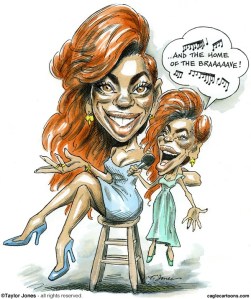 The interesting thing about the liberal accusation that Bush was Cheney’s ventriloquist dummy was that, though the image of Cheney as evil puppetmaster was sinister, it still served a reassuring function, in that it allowed for the continuation of the idea that there was a source, or origin, of power, period. As opposed, let’s say, to a more Foucauldian understanding of power as dispersed, not traceable to an isolated sovereign body. In contrast, when Beyoncé allegedly lip-synced, but in fact sang over, her own recording of the National Anthem at the 2013 presidential inauguration, her performance—which, as many have pointed out, was not unusual by pop industry standards—was framed as ventriloquism in order to cast doubt on her legitimacy as a live performer, i.e. as a performer whose voice could “stand up” in non-studio conditions (which are still, and ironically, just as much mediated as studio conditions). These ventriloquial scenarios are, it should go without saying, gendered and racialized: Bush-Cheney as ventriloquism emasculated Bush while restoring power to Cheney’s white, male, visibly disabled body; Beyoncé-Beyoncé as ventriloquism rather unsuccessfully attempted to pit Bey against herself (mediated, recorded Beyoncé vs. live Beyoncé) in order to devalue her corporeal body and frame her as unworthy of (national) subjectivity.
3) Both karaoke and ventriloquism are mass, but not mainstream, cultural practices. Karaoke is a mass cultural activity, but one that still carries with it the frisson of doing something slightly risqué (hence its frequent overlap with inebriation). Ventriloquism, while not being a cultural activity practiced by the masses, is a mass-mediated and mass-consumed cultural form, despite the aura of Vaudevillian anachronism (and/or pathology) it persistently conveys. How might we account for the “mass but not mainstream” quality of both practices?
 KT: I actually have to credit Zhou Xun and Francesca Tarocco, co-authors of an ambitious book, Karaoke: The Global Phenomenon (2007) with the “mass vs. mainstream” formulation. At this point, karaoke is globally ubiquitous, thanks to the many delivery systems that have evolved from the first karaoke and sing-along machines from Japan and the Philippines. There’s actually a popular app called Sing!, which enables you to perform karaoke and compete against anyone in the world. Meanwhile, YouTube is replete with karaoke videos to perform and practice with (some KJs, or “karaoke jockeys,” use YouTube as their primary interface), as well as with videos of people from all walks of life performing karaoke in various bars or at family functions in the home or elsewhere. These days, practically every sitcom on primetime TV stages a requisite “karaoke outing,” that usually leads to disastrous, if hilarious consequences for its characters.
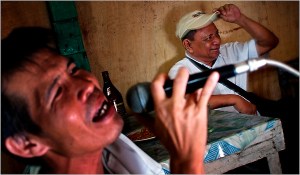 And yet karaoke as a mass practice can’t quite broach the mainstream, because of its various “abject” associations with immigrant communities, aspirational everymen longing to be idols, isolate geeks who only interact with the outside world through their computers, drunkards, gaggles of girls group-singing to Madonna, queens bereft of the piano bar’s liveness, slumming with an electronic delivery system for their show tunes, and other such “sad” spectacles. Once someone excels at karaoke—at singing someone else’s song so well that they transform it in some way—we are apt to think they actually exceed karaoke, and leave behind the form, much in the same way that, as you suggest in your opening comments, a good dummy eclipses its ventriloquist. When (in the words of many an Idol judge), someone makes someone else’s song “their own,” we enter into the territory of the cover, the reboot, the repurposed. The failure of the form to transcend its own limitations, even if it serves as the vehicle for many to otherwise achieve transcendence in myriad ways, is what keeps karaoke abject and not quite ready for mainstream acceptance.
SK: In the U.S., there’s a genre of white, masculine ventriloquism that’s currently extremely popular. This genre is typified by U.S. ventriloquism’s two biggest guns, Terry Fator and Jeff Dunham, who, following in the footsteps of Edgar Bergen, brought their ventriloquism to television to increase the art’s spread. Fator won America’s Got Talent in 2007 and now gives nightly performances at The Mirage in Vegas, where he has a theater named after him. He’s made hundreds of millions this way. Dunham has a strong presence on Comedy Central and is also one of the top-grossing U.S. standup acts. Both vents are especially popular with “Heartland” audiences, and both have casts of gendered and racialized puppets to whom they, as white male ventriloquists, play the straight man. Dunham, in particular, takes an unapologetic stance towards his own redneck identity, which permits him to criticize and recuperate this identity in one fell swoop. For instance, Dunham’s “white-trash trailer-park” dummy Bubba J drinks a surfeit of beer and is of low, if any, intelligence, but he remains benign in comparison to the rest of Dunham’s cast of characters, which includes Achmed the Dead Terrorist (a bin Laden caricature) and José Jalapeño on a Stick (use your imagination). Fator and Dunham’s ventriloquism evokes the practice’s historical connections and overlaps with minstrelsy, consolidating a fragile white masculinity in the process.
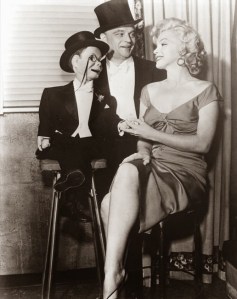 This culturally bounded reading of contemporary ventriloquism’s mass popularity directly resonates with your reading of karaoke as a practice with “abject” associations that is accordingly repurposed to “unlock the creative and expressive potential of beleaguered, repressed or emotionally stunted individuals, usually men.” While ventriloquism is difficult to perform well, vent instruction manuals always stress that, with practice, anyone can ventriloquize. One of the reasons that the practice isn’t mainstream is that it’s associated with a perverse desire, even a need, to speak through someone else in lieu of being able to speak “for oneself.” Edgar Bergen was always said to be shy with women, and to woo them through his brash, confident alterego Charlie McCarthy. And in his autobiography, Who’s the Dummy Now? (2008), Terry Fator (or his ghostwriter) writes about how his father found his ventriloquism perverse, and how he literally closeted his dummy as a result. Ventriloquism is too blatant a form of triangulation to be normal, and is thus coded as deviant, a perversion of heterosexuality’s direct, unmediated operation. Hence Fator’s book title, which aggressively restores authority to the formerly emasculated ventriloquist.

4) As the previous question suggests, and as prominent scholars of ventriloquism have also suggested, ventriloquism is ever anachronistic. Karaoke, too, is suffused by a sense of belatedness, reflected in nostalgic, hits-driven karaoke song choices and/or by the practice’s enduring connection to seemingly obsolete technological forms like laser discs. In what ways is each form out of time, or behind the times, and, alternatively, why do these forms appear as such even as they continue to exist in time?
 KT: As I mentioned above, karaoke’s purported abjection in the U.S. is, in many ways, a consequence of its association with the immigrant communities from Asia who imported the practice, as well as karaoke technologies, to the west coast as early as the mid-1970s. In that sense, karaoke functioned as a vehicle of nostalgia for those in the diaspora who longed to connect with memories of “home” through certain musical repertoires, even if some of those repertoires were actually already comprised of American pop hits folks grew to love when they were still “back home” (e.g. songs by the Carpenters, or any of the Johns—Elton, Olivia Newton, Denver). I haven’t quite worked it all out yet, but there is a certain circular temporality to karaoke. I have a hunch that the form is Romantic insofar as it is, at once, about the moment and its “spontaneous overflow of powerful feelings,” yet prone to saturating those powerful feelings with the “passionate recollection of youth.” There’s also something anticipatory and performative about karaoke, insofar as it has the capacity to do what it purports to articulate. I wrote something about this from a personal perspective in a piece about my favorite L.A. karaoke bar, the Smog Cutter. As the question above remarks, karaoke also feels belated, or emblematic of a particular era, because of the visual peripherals that accompany some song catalogues, especially those released on laser disc in the late 1980s and early-to-mid-1990s (i.e. the videos comprised of b-roll, and oblique narrative re-imaginings of certain songs). I can’t get into all of it here, but my plan is to devote a chapter to the karaoke video—from its production history (of which Brian Raftery offers an excellent preliminary account), to its repurposing in contemporary queer performance art.
 SK: I’m still working on understanding ventriloquism’s anachronism—why it continues to appear, or to feel, outmoded despite its present popularity—besides the obvious fact that its contemporary iterations evoke Vaudevillian performance. Nina Conti, who has, like Fator and Dunham, distributed her ventriloquism across multiple media platforms, makes many jokes about this. Her puppet Monk, who sounds like a muffled Sean Connery trapped in a fuzzy, simian body, will often deride her for practicing such a “dead art,” and Conti’s documentary, Her Master’s Voice (2012), theorizes the ventriloquist dummy as a “bereaved object” that loses its voice repeatedly, and finally for good. Conti’s film, however, argues with its own assertion by reanimating the dummies of a dead ventriloquist with new voices, a process that could theoretically continue ad infinitum. Steven Connor argues that present-day “revivals” of ventriloquism like Conti’s are always “necromantic,” conjuring the form’s prehistory while at the same time referencing “newer” media like film (which, according to Rick Altman (c. 1980) and Michel Chion (c. 1982) is itself a form of ventriloquism). Writes Connor, “Whether because it is scandalously or mysteriously archaic, or uncannily premonitory, ventriloquism is always anachronistic, never quite on time.” And Mladen Dolar tells us that the voice itself is ventriloquial, leading to the extrapolation that ventriloquism literalizes or visualizes what the voice has always already done.
I tend to think of ventriloquism as temporally bifurcated. A ventriloquist has to exist in both the future and the past to make her practice work. She has to anticipate what’s going to be said next while remembering what’s just been said, and she has to keep her lips still while moving her tongue—acts that circumvent linearity and synchronization. In saying this I’m not arguing for ventriloquism as a “resistant cultural practice”; rather, I’m simply pointing out the temporal perversion to which the art lends itself.
***

Reflecting upon this conversation on karaoke and ventriloquism—a conversation that is, of course, ongoing—it has become even more apparent to us that both forms are sound technologies struggling against obsolescence, even as they are so frequently imagined as possible gateways to some human “truth” or “essence” precisely because of their associations with the voice. Though vocalization and vocality are reflexively associated with both forms, we hope we’ve been able to underscore some of the ways in which their powerful associations with “voice” naturalize, and to a certain extent also neutralize, the technical elements of each practice. We appreciate the opportunity to make some key distinctions, and to sound some of these issues out, here on the SO! Blog. Many thanks to Jennifer Stoever and Liana M. Silva for their generous editorial input. Like Conti’s bereaved puppets, who lose their voices only to be invested with new ones, we now relinquish ours—for the time being.
SK & KT
—
Featured Image by Flickr User Sam Grover
—
Sarah Kessler is a Ph.D. candidate in Comparative Literature at the University of California, Irvine, where she is writing a dissertation on ventriloquism in contemporary British and U.S. popular culture. She received an M.A. in Modern Studies from the University of Wisconsin-Milwaukee in 2008. Kessler’s writing on art, film, and media has appeared in artforum.com, the Brooklyn Rail, In These Times, and Public Books, among other publications, and she has held editorial positions at Triple Canopy and Afterall: A Journal of Art, Context and Enquiry. She is currently completing an article on the documentary work of ventriloquist Nina Conti.
Karen Tongson is Associate Professor of English and Gender Studies at the University of Southern California, and the author of Relocations: Queer Suburban Imaginaries (NYU Press, 2011). Her work has appeared in numerous venues in print and online, including Social Text, GLQ, Nineteenth-Century Literature, and Novel: A Forum on Fiction. She is currently the series editor for Postmillennial Pop at NYU Press, and just completed a multi-year term as co-editor-in-chief of the Journal of Popular Music Studies. Her current book project, Empty Orchestra: Karaoke. Critical. Apparatus. critiques prevailing paradigms of imitation in contemporary aesthetics and critical theory, while offering a genealogy of karaoke technologies, techniques, and desires.
—
 REWIND!…If you liked this post, you may also dig:
“Hearing Queerly: NBC’s ‘The Voice’”-Karen Tongson
“Head Games?: The Strategic View of Liveness and Performance”-Andreas Duus Pape
“New Wave Saved My Life*”-Wanda Alarcon
Share this:

Sounding Out! Podcast #28: Off the 60: A Mix-Tape Dedication to Los Angeles

CLICK HERE TO DOWNLOAD: Off the 60: A Mix-Tape Dedication to Los Angeles
SUBSCRIBE TO THE SERIES VIA ITUNES
ADD OUR PODCASTS TO YOUR STITCHER FAVORITES PLAYLIST
–
Off the 60: A Mix-Tape Dedication to Los Angeles
With the slight return of warmth to the East Coast of the U.S. and Tropics of Meta’s very recent release of Troy Andreas Araiza Kokinis’s fantastic history“’The Sky is Black and the Asphalt Blue’: Placing El Monte in the Early LA Punk Rock Scene” and its accompanying archival project (bring your old flyers and pics down to scan at Bridgetown DIY, 1421 N. Valinda Ave, La Puente, CA on May 3rd from 2-6 pm), we thought it was high time to bring Jennifer Stoever-Ackerman’s LA mixtape Off the 60 into the sunlight for everyone to bump with their windows down.
Off the 60 was initially commissioned as a sonic installation for the re:present L.A. Exhibition at East LA’s Vincent Price Museum from May 3 – July 27, 2012. re:present L.A. was curated by Museum Studies students at Claremont Graduate University (and coordinated by performance artist, scholar, and poet reina alejandra prado saldivar, who wrote about the experience for SO! in 2011). The exhibit sought “to explore, challenge, and depict the multiple representations of Los Angeles that responds to the present social landscapes of city” through both sight and sound.” Click these links for the exhibit’s virtual catalogue and list of participating artists. Both the liner notes and the track listing have been modified slightly from the original for publication here.
—
Off the 60: Liner Notes
When I began to make this mix-tape that somehow would re-present L.A. in a mere 80 minutes, my enabling fantasy was that I could make a playlist that would be my musical calling card, a sonic Rosetta Stone for “home” that would unravel the complex knot of feelings about L.A. I carry around with me, something I could share with my son, whom I am somewhat reluctantly raising as a New Yorker. You know, a musical study guide so the sounds that raised and shaped me could tell him all the things I just can’t put into words about Los Angeles, namely how much music and place are wrapped together in my memory’s DNA. Therefore, this mix deliberately dates and locates me, enabling, in the words of Ronnie Hudson’s “West Coast Poplock,” the intimate knowledge of “listening to the map.” And—there was more than a little magical thinking involved here—I thought that perhaps if I arranged these songs just so, then the barren Sleepy Hollow landscape of wintry upstate New York would transform itself into the desiccated foothills, dried river beds, and dense strip malls of Southern California. I’d turn a bend and, with a little help from the Go-Go’s and Union 13, 79 would suddenly become “the” 60.
 And thus the title, a tongue-in-cheek reference to J.Lo’s debut album On the 6 (1999), named after the subway line between Manhattan and the Bronx, where she grew up. Off the 60 references the freeway whose red brake lights stretch between Los Angeles and Riverside, my hometown, and the mix is just the right length for a one-way trip, provided there’s no traffic (I told you there was some magical thinking involved here!). The 60 is one of the most heavily trafficked commuter pathways in the country; I know people in Riv who will make this 60-mile drive 5 days a week, 51 weeks a year, for decades (I have also met people in Los Angeles who had never made this trip east, and who used to look askance at my 951 cell number, in the same way that my current 323 area code causes looks of consternation to New Yorkers). For many people coming of age in the Inland Empire, Los Angeles exerts a tidal pull, and we make many trips there before hitting the commuter treadmill—in family cars, in our imaginations, in movies, in books, on school busses and tour busses, in broken-down band vans, in hoopties borrowed from our friend’s uncle that may not make the return trip—and some of us make that 60-mile move West and never really come back, like me. I ended up living on St. Andrews instead of only singing about it.
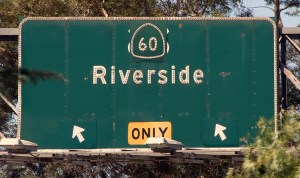 But you never know, The Riv has a deep hold on people. I closed Off the 60 with a band from Riverside, old friends of mine Chicano punk rockers the Voodoo Glow Skulls, because one second you are going to law school in Queens or Dap-Toning with Sharon Jones and the next you are back, public defending in San Bernardino or married with big fam filling a house by Mt. Rubidoux, respectively. True stories. But I am already taking a detour Off the 60, in the hopes that the music on this mix invites you to do that. Unlike J.Lo’s subway, you can’t stay on the 60 and really get to know Riverside, Los Angeles, or all the many places in between that are intertwined socially, historically, culturally and economically with both cities: Glen Avon. Corona. Chino. Diamond Bar. Rowland Heights. La Puente. Hacienda Heights. El Monte. Montebello. East L.A. Boyle Heights.
A sonic exit ramp of sorts, Off the 60 is a mix-tape in digital format, crafted in the old style: a painstaking arrangement of songs really familiar and much beloved to me, listened to obsessively throughout the process to create fresh transitions that are laden with significance—and of course, car tested L.A.-style until smooth like butter. For Off the 60, I deliberately picked songs without the aid of Wikipedia or any of the copious L.A song lists, sitting down with just a blank page, my memory, and a sharp pencil (as I hope you can tell by many of the songs, I’m kinda old school) to come up with a set of songs that aren’t necessarily about L.A., but of it. This is a small, symbolic sample of the music that once scored my life in the Southland from the 1970s-the 2000s through the perspective of my current “home away from home” in New York. Now, in what my colleague and homegrrl Karen Tongson (another Riversidean, now turned proud Silver Lake home owner) has poignantly dubbed “remote intimacy” in Relocations (New York University Press, 2011). And these sounds still make me feel L.A. even though I often feel like I live “a million miles away.” I hope you feel it too.
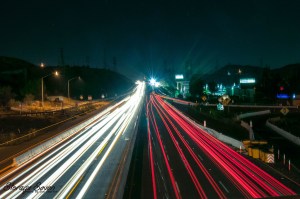 The songs on Off the 60 are arranged to speak to each other, sometimes sonically, sometimes thematically, sometimes historically (and occasionally I pull off the trifecta! Listen carefully!). I designed the mix to flow along with the narrative rhythms of a timeless (yet intentionally dated) Saturday in L.A., from waking up with the sound of Friday night still in your ears to basking in the warm afternoon—which can feel so good you almost get knocked off your game—until the purplish-orange twilight descends, with its regret and uncertainty, on into the pulsing promises of the night. Sonically blending vulnerability with hardness—and revealing both where you least expect them—I hope the songs on this mix share an overall L.A. vibe that is more than merely the sum total of the musical parts, a feeling that’s ephemeral and hard to put your finger on, but—paradoxically—one whose resonance lasts.
And because I am a sound/music scholar in addition to a product of the 714 909 951, you’ll get plenty of L.A. music history through this this mix. All the bands featured are based in L.A. or Riverside, except for two artists whom I have awarded honorary Angeleno status: Smokey Robinson and Debbie Deb. Never mind the fact Motown had already moved to L.A. by the time Robinson’s “Crusin’” was released in 1982 and he used to host one of my favorite radio shows on 92.3 in the 2000s, but these two songs have bumped out of so many cars, clubs, backyard parties and Art Leboe sets that both Smoke and Deb own some symbolic real estate in Southern California, at least in my heart.
In putting the work of so many different L.A. artists together, I challenged myself to create a coherent musical feel without placing songs from similar genres, scenes, or time periods right next to each other. I worked hard to create a sense of the diversity of the Los Angeles area without being either gratuitously culture clash-y or post-multiculti Velveeta, but using sound to make palpable both the dissonant tensions and the productive energies of everyday encounters in the city in a way that “represents” without claiming to be representative. Think of Off the 60 as a flash-sample of what you might hear while whiling away a scorching Friday night in traffic, when everybody’s got their windows open, cooling off the outside with their tunes. As a result, you’ll hear classic L.A. musical sounds in conversation—mariachi horns, surf guitar, nasally Val-Speak, fat funky synth, staccato punk growls, metal licks, downtempo samples, polyrhythmic percussion, and that power pop tone that my Vox amp calls “Cali Clean”— calling and responding across genres and decades: re-mixing, recontextualized, distorting, hyperembodying those terribly glamorous L.A. sounds, across this town, our town. Por vida.
—
Off the 60 is dedicated, Art Leboe-style, to my SGV homegirl Melissa Contreras-McGavin for always (even though she lived off the pinche 10 for so long). Mwah.
—
Off the 60: Track Listing–Click to Jump to Track Description
1. “This Town” by The Go-Go’s
2. “Del-Tone Rock” by Dick Dale and his Del-Tones
3. “La Bamba” by The Plugz
4. “Chango” by Ozomatli
5. “Unyielding Conditioning” by Fishbone
6. “Blessings” by The Visionaries and the Beat Junkiez
7. “All Day Music” by WAR
8. “Concrete Schoolyard” by Jurassic 5
9. “Cruisin’” by Smokey Robinson
10. “It was a Good Day” by Ice Cube
11. “A Million Miles Away” by The Plimsouls
12. “I Can’t Stand it Anymore” by Union 13
13. “Jane Says” by Jane’s Addiction
14. “Destination Unknown” by Missing Persons
15. “Look Out Weekend” by Debbie Deb
16. “West Coast Poplock” by Ronnie Hudson and the Street People
17. “Make Ya Neck Lock” by Medusa and Feline Science
18. “This Town” by Ceci Bastida with guest Tim Armstrong
19. “Here Comes the Sun” by Voodoo Glow Skulls
- “This Town” by The Go-Go’s (Beauty and the Beat, I.R.S. Records, 1981): The Go-Go’s were formed in Hollywood in 1978 by members of the early L.A. punk scene and this song reflects their lives in that moment. The Go-Go’s initially consisted of Belinda Carlisle (vocals), Jane Wiedlin (guitar, vocals), Margot Olavarria (bass), and Elissa Bello (drums). Members Charlotte Caffey (guitar), Gina Schock (drums) and Kathy Valentine (bass) were added by 1981, after founding members Margot Olvarria (bass) and Elisa Bello (drums) were fired. The Go-Go’s were the first female band writing and playing their own music to reach number one on the Billboard Charts. This was the first record I purchased with my own money.
- “Del-Tone Rock” by Dick Dale and his Del-Tones (The B-Side of “Let’s Go Trippin’,” Deltone Records, 1961): Dick Dale was born in Boston, Massachusetts and came to Southern California in 1954—Orange County, but we’ll let that slide—where he was one of the innovators in the “Surf Music” genre that many still associate with Los Angeles. “Del-Tone Rock” was the B-Side of the alleged first surf song ever, “Let’s Go Trippin.’” An avid surfer, Dale sought to imitate with his guitar the sounds that he heard while riding waves—and he pushed his equipment to the max while doing so (Fender guitars, another Southern California staple, designed several custom guitars and amps for Dale and still sell a “Dick Dale Custom Shop Stratocaster” model). My dad once got in trouble for sneaking out to see Dick Dale play a “stomp” at the Riverside Armory in 1963. I saw him play at the Dragonfly in 1996.
- “La Bamba” by The Plugz (Electrify Me, Plugz Records, 1979): The first rock and roll version of this Mexican folk song was of course recorded by Richie Valens of Pacoima in 1958—he was first known as “Little Richard of the Valley”—and his life and music inspired countless musicians after his untimely death at age 17 in a plane crash in Clearlake, Iowa. The Plugz’ punk-rock version both pays homage to Valens and signifies on the outsiderness of his music career—his manager insisted he whiten his surname by changing it from Valens to Valenzuela, for example. The Plugz formed in 1977 in East Los Angeles and their version of “La Bamba” was recorded with the original line-up: Tito Larriva (lead vocals/guitar), Charlie Quintana (drums), and Barry McBride (bass/backing vocals). The Plugz were staples in the early LA punk rock scene, but they challenged its Hollywood-centricity with a sound that also had firm roots in Chicano garage rock from bands like Thee Midnighters. I first heard The Plugz on the soundtrack to Repo Man, and I can’t tell you how many batteries I went through fastforwarding from “El Clavo y Cruz” to “Hombre Secreto” and back again.
- “Chango” by Ozomatli (Ozomatli, Almo Sounds, 1998): Ozomatli was formed in Los Angeles in 1995, after meeting through their affiliation with the Peace and Justice Center. A multiethnic, multiracial collective that, at the time “Chango” was recorded was comprised of Wil-Dog Abers (bass, vocals), Ulises Bella (clarinet, guitar, tenor saxophone, vocals), Chali 2na (MC), Cut Chemist (DJ), Raúl Pacheco (guitar, vocals), Justin Porée (percussion), Asdru Sierra (trumpet, vocals) and Jiro Yamaguchi (tabla, cajón, other percussion, vocals), Ozomatli is unabashedly and proudly political through and through: in their lyrics, in their brilliantly miscegenated music—described by Bella and Yamaguchi as “that crazy blend that’s going on between that cacophony of sound” on the streets of L.A. (NPR, 2007)—and in the shows they choose to perform. Ozomatli famously played their cumbia-funk-hip hop-salsa-merengue jams in front of the 2000 Democratic Convention in Downtown Los Angeles and continued to record after the LAPD shut them down and began to shoot rubber bullets, tear gas, and pepper spray paint balls at the peacefully gathered crowd (the footage opens their second record Embrace the Chaos). I included this particular song to also give props to the way in which Ozo has politicized collective dancing—and dances their politics—I have seen them play in many diverse venues from the Cal Plaza to the Warped Tour and I have never seen them fail to move the crowd in more ways than one.
- “Unyielding Conditioning” by Fishbone (Give A Monkey A Brain and He’ll Swear He’s the Center of the Universe, 1993): One of the best (and most virtuostically versatile) bands from Southern California, hands down, Fishbone was formed by high school buddies John Norwood Fisher (bass, vocals), Kendall Jones (guitar), Phillip “Fish” Fisher (drums), Angelo Moore (vocals, saxophone, and theremin); “Dirty” Walter A. Kibby II (vocals, trumpet); and Christopher Dowd (keyboards, trombone, vocals) in South Central Los Angeles in 1979. Their coming together is a very 1970s L.A. story; everyone but San Fernando Valley local Moore was bussed from Compton to the overwhelmingly white high school, an 100 mile round trip that you can hear in their music. If you have never heard of this wonderful fusion band—everything from heavy metal to ska to funk to soul to punk—but find that this song sounds teasingly familiar, consider even just the LA-area bands that have stood on these giant’s shoulders: the Red Hot Chili Peppers, Jane’s Addiction, No Doubt, the Skeletones, the Voodoo Glow Skulls, Hepcat. While it has always burned me up that Fishbone has never seen the level of fame that many of these acts have—too bad you can’t pay the rent with respect—I refuse to talk about them as a failure, especially not as an act who has unceasingly worked so hard to portray Los Angeles they live in story and sound. In a recent interview with the Japanese Metropolis, Norwood Fisher stated: “you know we came from gang-related neighborhoods, so for me the violence of punk made sense. There was a big cross-cultural surge, everybody was listening to everything—mod and ska and new wave—everybody could enjoy it, and for a moment it didn’t matter what color you were.” To create that “one moment,” Fishbone has never stopped telling the stories of the numerous moments where it does matter—the tensions embodied in “Unyielding Conditioning”—and that is why I will always love them. By the way, these veteranos still tour so please support Fishbone whenever they come to home to play.
- “Blessings” by The Visionaries and the Beat Junkiez (Galleries, Up Above Records 1998). This virtuostic Los Angeles hip hop super group in the tradition of multicultural, multiracial Angeleno musical collectives like WAR and Ozomatli, blends the MC talents of Visionaries 2 Mex, LMNO, Lord Zen, Dannu, Key Kool, and DJ Rhettmatic with the legendary turntablist crew the World Famous Beat Junkies (who were formed in Orange County in 1992 by J-Rocc) and whose members over the years have included Rhettmatic, Curse, Melo-D, D-Styles, Red-Jay, Havik, Tommy Gun, & What?!, Symphony, DJ Babu (also of Dilated Peoples) and Mr. Choc. The cream of the backpack crop, this group was the sound of L.A. underground positivity for myself and so many artists, writers, and musicians I knew in the 2000s. Not to mention that this amazing downtempo beat also reminds me of dancing with my best girls at turn-of-the-millennium late night chill spots all over the city—after long days grinding hard, working toward our Ph.D.s in American Studies and Ethnicity at USC—life-affirming spots like the Little Temple, Carbon, Bounce Rock Skate, the Dub Club, the Root Down, and Nappy at the Roots at the Fais Do Do.
- “All Day Music” by WAR (All Day Music, United Artists, 1972) The title song from their first album after changing their name from “Eric Burdon and WAR,” “All Day Music” is a musical manifesto of sorts for the multiethnic 7-piece funk/soul band that came together in 1969 in Long Beach (although the core of the band had been together since 1962 as The Creators). The new line-up was comprised of Howard Scott (guitar, percussion, vocals), B.B. Dickerson (bass, percussion, vocals), Lonnie Jordan (organ, piano, percussion, vocals), Harold Brown (drums, percussion, vocals), Harold Brown (drums, percussion, vocals), Papa Dee Allen (conga, bongos, percussion, vocals), Charles Miller (flute, sax, percussion, vocals), and Lee Oskar (harmonica, percussion, vocals). The gentle strains of this song always take me right back simultaneously to the parks I have loved in in Los Angeles—Pan Pacific Park, Lincoln Park, MacArthur Park, Elysian Park, and Echo Park.
- “Concrete Schoolyard” by Jurassic 5 (Jurassic 5, TVT/Interscope, 1998) Jurassic 5 formed like Voltron back in 1994, from the wreckage of two earlier hip hop groups,Rebels of Rhythm and Unity Committee, and was made up MCs Charles Stewart (Chali 2na), Dante Givens (Akil), Courtenay Henderson (Zaakir), Marc Stuart (Mark 7even), and disc jockeys Mark Potsic (DJ Nu-Mark) and Lucas Macfadden (Cut Chemist)—both Cut Chemist and Chali 2na were also in Ozomatli until 2000. J5 cut their teeth at L.A.’s legendary “Good Life,” a South Central health food store owned by B. Hall that became an influential hotbed of rhyme in the early 1990s, hosting a “no cursing” open-mic night that nurtured innovative acts like J5, Medusa, the Pharcyde, and the Freestyle Fellowship. While I didn’t make it to Leimert in time for The Good Life, I loved Thursdays at Project Blowed, the next incarnation of the hip hop workshop held at filmmaker Ben Caldwell’s community arts, multimedia, and performance space, KAOS Network, which he founded in 1990. It is still held every Thursday night at 43rd Place and Leimert Blvd., and will be celebrating its 20th Anniversary on 12/29/14. Follow @Blowdians for the latest.
- “Cruisin’” by Smokey Robinson (Where There’s Smoke, Motown/Tamla 1979) Smokey Robinson was already quite famous as a Motown originator by the time he scored this throwback hit at the end of the disco era. Motown had been based in Los Angeles since 1972, and this song—an instant classic in the Lowrider Oldie genre co-written by Robinson and fellow Miracle Marv Taupin—shows just how much L.A. had impacted the label, especially Latino car culture. Now a staple on Art Laboe’s “Killer Oldies,” a long-running Los Angeles radio show famous for playing “Oldies but Goodies” by special request. Give your loved one a musical shout out by calling 800-681-2121 M-F between 7pm-Mid and Sun 6pm-Mid PST.
- “It was a Good Day” by Ice Cube (The Predator, Priority Records, 1993) Born O’Shea Jackson in Compton, Ice Cube took on his famous moniker when he joined old school rap group CIA in the mid-1980s (the group sang backing vocals on “Cabbage Patch”—remember that?) and then became a member of legendary hip hop group NWA in 1986. He went solo upon NWA’s break up in 1989 and produced club bangers for a good many years. I almost picked “Bop Gun” for this compilation—I love the George Clinton reference and the way it so perfectly captures the best vibes of the 1990s—but there is a world of LA knowledge embedded in the way in which the minor key sample from the Isley Brothers’ beautiful 1977 hit “Footsteps in the Dark” subtly undercuts Ice Cube’s Southern California fantasy that it could only be this song. Not to mention the long afterlife of “Good Day”: while I usually shy away from gross generalizations, I think I am safe to say that everyone who grew up in the L.A. region in the 1990s has a special love for this song. It is the day by which many of our good days are judged. People have such enduring love for the song that someone at the blog Murk Avenue spent many many hours using context clues to determine once and for all that this legendary good day was in fact, January 20, 1992. While you may have missed its twentieth anniversary, it’s not too late to order up the blimp for the 25th in 2017.
- “A Million Miles Away” by The Plimsouls (Everywhere At Once, Geffen, 1983) Formed in Paramount, from the ashes of the power pop/punk trio The Nerves in 1978—who performed the killer original version of “Hanging On The Telephone,” covered more famously by New Yawk’s Blondie—the classic line up includes singer, guitarist and songwriter Peter Case, drummer Louie Ramírez, guitarist Eddie Munoz and bassist Dave Pahoa. Their first break came when Long Beach promoter Stephen Zepeda signed the group to his Beat Records label for a five-song EP called Zero Hour, whose title song received a lot of KROQ airplay. Their second crack at fame occurred when they were hired as the “club band” in the film Valley Girl (1983), which my little sister and I watched over and over again, thanks to ON Television and lax babysitters.As a result, this song was the soundtrack to some of my earliest LA dreamings, and it—plus a very young Nicolas Cage as the rough guy from “over the hill” in Hollywood—gave punk rock boys permanent real estate in my heart.
- “I Can’t Stand it Anymore” by Union 13 (East Los Presents. . ., Epitaph Records, 1997) Formed in Boyle Heights in 1992, and influenced by punk rock, hardcore, metal, and their shared Mexican—Central American upbringing, the original lineup on this recording consisted of Edward Escoto on vocals, José Mercado and Ben Sandoval on guitars, Jerry Navarro on bass, and Louie Villareal on drums. I eventually spent so much time with these guys, in vans and in clubs on both sides of the border, that even though I haven’t seen them in years, I still think of Union 13 like family—even more so after they played a show in my backyard in Riverside and they got into a friendly familial brawl in the front.
- “Jane Says” by Jane’s Addiction (Nothing’s Shocking, Triple XXX Records, 1988): This band came together in Venice in 1985 out of the remains of Psi-Com, the first LA-area band of Queens transplant Perry Farrell (government name Peretz Bernstein) and included Dave Navarro (guitarist), Eric Avery (bass), and Stephen Perkins (drums). Both this song and the band were named after the struggles of Farrell’s drug addicted roommate, Jane Bainter, whom he lived with on Wilton Street in Hollywood in the early days of the band’s history. My first history with this song begins with high school subjection coupled with a lustful yearning for the sound of the bohemian unknown; I remember my best friend was almost suspended for wearing a Nothing’s Shocking T-Shirt to school because it featured plaster casts of naked women with their hair on fire—“but the female body is beautiful” I remember her saying, as she reluctantly turned the shirt inside out. The second is of moving to Los Angeles and living in Koreatown, on the fabled St. Andrews street mentioned in the song, and though the intensity of my feeling sfor this band had long since faded, “Jane Says” would pop into my head at least once a day as I headed out to hit the red line, find a coffee shop, walk past the Wiltern on my way to the Sav-on, or grab some Pho 2000 in the middle of the night. And I would stop, look up at the gently waving palm fronds, and remember that no matter what was going on in my life—high drama, money struggles, the mundanity of getting older—“at least I live in Los Angeles.”
- “Destination Unknown” by Missing Persons (Spring Session M, Capitol Records, 1982) Missing Persons, a new wave staple on the radio and MTV in its infancy, were founded in 1980 in Los Angeles by Warren Cuccurullo (guitar), Dale Bozzio (vocalist), Terry Bozzio (drummer) and later Patrick O’Hearn (bass) and Chuck Wild (keyboard). While this song is much lesser known that “Walking in L.A.”—which I still get asked about occasionally out here on the East Coast. . .”is it true?” . . .um, once and for all, “NO!”—I think it really captures a particular alternative New Wave sonic alterity that scholar, poet, and Highland Park native Wanda Alarcon describes in an SO! post entitled “Last Night a DJ Saved My Life” as having told her “there were options out there. . .and that was all I needed to survive—to save my queer soul.” Sometimes not knowing your destination can be truly liberatory.
- “Look Out Weekend” by Debbie Deb (single on Jam Packed Records, 1984) While the bad ass Deborah Claire Wesoff-Kowalski (known of course as Debbie Deb) was born in Brooklyn and raised in Miami, she is an honorary Angelena as far as I am concerned. Her music was the soundtrack to many an Aqua Net set as my friends and I teased our bangs to untold heights to hit Roller City 2001, or later to attempt to rule the dance floor (and work out our Riverside-ness) at Hollywood’s Florentine Gardens—a basketball gym-sized dance floor replete with go-go dancers, a taco bar on the patio, a dress-to-impress crowd and a broad spectrum of ground effects in the parking lot. We loved it so much we claimed the sound of Miami freestyle as “L.A. Disco.” To this day, when I throw on Deb at a party, I can’t help but smell Drakkar Noir and the scent of burning eyeliner pencils—well, how do you soften it to make your Cleopatra-eyes?. Then, as now, I used Deb’s pounding beat, synth stabs, and tough girl vocals to armor myself for life’s increasing challenges—to transform “Oh, what now?” into that world-famous and oh-so-necessary L.A. challenge “So now what?” And I thank her profusely for that.
- “West Coast Poplock” by Ronnie Hudson and the Street People (Single on HouseJam Records, 1982) In this multi-layered song by early Los Angeles B-Boys, Ronnie Hudson and the Street People, you can hear the echoes of earlier hits—lyrical shout outs to “Rapper’s Delight” by The Sugar Gang (1979) and Zapp and Roger’s “So Ruff, So Tuff” (1981) as well as a killer hook borrowed from Booker T. and the M.G.’s “Bootleg” (1965)—and some really excellent futureshocks of the many L.A. acts to later sample it in songs like Mixmaster Spade and the Compton Posse’s “Genius is Back” (1988), N.W.A.’s “Straight Outta Compton” (1988), Dr. Dre and Snoop Dogg’s “Nuthin’ But a G Thang” (1992), and Tupac and Dr. Dre’s much beloved monster hit “California Love” (1994). But you can also listen for the way its soundscape takes you back to the days when pop-locking ruled the scene so hard that Ronnie Hudson made a special version called “East Coast Poplock” to take the moves created by Don Campbell, a commercial art student at L.A. Trade Tech, all the way to the other coast.
- “Make Ya Neck Lock” by Medusa and Feline Science (Undaground Crewed, Project Blowed, 2002). Another amazing fusion artist who should not be an LA-area secret, Medusa (also known as Baby NeNe, Triple Kahlua, Sister Monet, Medusa, Microfro, and that “cool-playa-pimp nigga Sean”)began her long Los Angeles reign as a 16 year old pop-locker with the Groove-Atrons and honed her rhyme talents at The Good Life Café (and later Project Blowed) in Leimert Park, along with Freestyle Fellowship,Yo Yo, J5 and the Pharcyde. Medusa, along with her live back-up band and hip hop crew Feline Science—which includes a DJ, drummer, bassist, keyboard, percussionist, guitar and background singers—has reigned supreme on the L.A. club circuit for many years, most famously transforming the Fais Do-Do on West Adams into her own personal queendom called “Nappy at the Roots”—a fecund female and queer-friendly performance space for innovative acts that fused musics from across the city like Quetzal, Wozani, and Burning Spear—where she always brought down the house. I can vouch—I was a devoted subject for all of the years I lived in L.A.
- “This Town” by Ceci Bastida with guest Tim Armstrong (Veo La Marea, EMI, 2008). Ceci Bastida has been an integral part of the transborder music culture circulating between Tijuana and Los Angeles since age 15, when she joined what would become one of the most classic Rock en Español bands, Tijuana NO!, as a singer, keyboardist and songwriter. While with TN!, Ceci collaborated with bands like Fishbone and Manu Chao. After leaving the band in 2000, she played with Julieta Venegas’s band for seven years, whereupon she started her solo turn, from which this track is taken, a bi-lingual, multi-genre revisioning of the Go-Go’s 1980s Valley soundscape, one that reminds listeners that the founder of the Go-Go’s was actually Chicana punk rocker Margot Olvarria (who was eventually kicked out of the group for refusing to conform to the band’s shift from punk aggression to power pop harmonies). I’ll forgive her the guesting by Rancid’s Tim Armstrong, because I love this song so much, especially its movements from English to Spanish to Spanglish, its deft juxtapositions of sounds and musical styles, and the way it manages to be celebratory and confrontational all at once. It’s might be our town, but it’s still “so ruff, so tuff out here, baby.”
- “Here Comes the Sun” by Voodoo Glow Skulls (Who Is This Is?, Dr. Strange Records, 1994) Founded in La Sierra (an unincorporated area in Riverside County), Inland Empire Chicano punk-ska-metal band the Voodoo Glow Skulls have been at it since 1989. The “classic” line-up has a trio of brothers at its heart: Frank Casillas (Vocals), Eddie Casillas (Guitar) and Jorge Casillas (bass), with a pulse provided by Jerry O’Neill (drums), and the unique warped mariachi-1950s rock bop horn sounds provided by Joe McNally (trumpet), Joey Hernandez (sax), and Brodie Johnson (trombone). Confession: I have known Joe since elementary school and Brodie since he was a high school metal head and you can still read their bio I wrote for Epitaph 1996 here (and they say the Internet is ephemeral!). Even though I have some personal rough water under the bridge where VGS is concerned—an ex, and that’s all I am gonna say—I haven’t stopped loving this song, a speeded-up Beatles cover that embodies the tensions, excitement, danger, and hope in California’s eternal promise of new beginnings.
–
Jennifer Stoever is co-founder and Editor-in-Chief for Sounding Out! She teaches African American literature and sound studies at Binghamton University and was a former Fellow at the Society for the Humanities at Cornell University (2011-2012). You can catch her full CV at http://jenniferstoever.com/
—
Featured image borrowed from Flickr user Daniel Orth.
—
 REWIND! . . .If you liked this post, you may also dig:
Sounding Out! Podcast #19: Solid Gold Summer— The Sounding Out! Crew
Sounding Out! Podcast #26: Wobbling the Speakerspace— Justin Burton
Sounding Out! Podcast #3: Awesome Sounds from a Future Boombox— The Sounding Out! Crew
Share this:


Current Top Posts





April 2021

January 2020

November 2019

October 2019

August 2019

April 2014

November 2017

March 2015

December 2017

October 2015
 Sounding Out!
Recent Comments