
To Sir, With Ratchety Love: Listening to the (Dis)Respectability Politics of Rachel Jeantel

 Editor’s Note: July 18th, 2013 has been designated as World Listening Day by the World Listening Project, a nonprofit organization founded in 2008 “devoted to understanding the world and its natural environment, societies and cultures through the practices of listening and field recording.” World Listening Day is a time to think about the impacts we have on our auditory environments and, in turn, its affects on us. Once again, Sounding Out! has decided to observe World Listening Day by planning a month-long special forum of posts exploring several different facets of listening such today’s offering by SO! regular Regina Bradley, questioning how American racial ideologies impact listening as a cultural, embodied act. Listen carefully, because we will be following Regina’s post with a special Sounding Out! Comment Klatsch on Wednesday, July 3rd that considers the consequences of racialized refusals to listen. What are the consequences of a listening that is interrupted? distorted? denied? perpetually deferred?—Editor-in-Chief, Jennifer Stoever-Ackerman
—
Rachel Jeantel gave me life with a curt “that’s real retarded, sir.” Responding to George Zimmerman’s attorney Don West’s suggestion that Trayvon Martin pursued and wanted to hurt Zimmerman, Jeantel undoubtedly lifted many eyebrows and possibly a few “hell naws” under the breaths of those watching her testify. Her response to West regarding his lack of understanding can be extended to assess the firestorm of controversy surrounding her testimony: questions of her literacy as oppositional to the prosecution’s hopes of conviction, surprise at her brashness and demonstrative gestures of irritation, and, worst of all, judgments about the literal and figurative fullness of her girlhood/womanhood and chocolate skin as signs to ring the alarm as grounds for dismissing justice for Trayvon Martin. Because her testimony operated outside of normal constructs of witness etiquette and respectability, it was greeted with a hailstorm of controversy paralleling the rawness of responses to scripted reality shows. The shallowness of “critique” of Jeantel—whom, it must be continually repeated, is not on trial—was disgusting.
But you don’t need me to tell you that, because if you were really listening to Rachel Jeantel, SHE told you. Jeantel’s delivery was particularly striking, offering her audience low timbred and often emphatic quips of “what?!” and “you ain’t get that from me” to indicate her irritation and frustration with West. Jeantel’s refusal and inability to conform to expected cultural and aural scripts of black womanhood within the confines of the courtroom – the epitome of a hyper-respectable space – destabilizes not only racial paradigms of black (southern) respectability but Americanized expectations of black women’s scripts of respectability. As Brittney Cooper points out, “Rachel Jeantel has her own particular, idiosyncratic black girl idiom, a mashup of her Haitian and Dominican working-class background, her U.S. Southern upbringing, and the three languages – Haitian Kreyol (or Creole), Spanish and English – that she speaks.” Her people ain’t from hea and because of her upbringing can’t be categorized like other black girls from hea. In this sense, Rachel Jeantel is ratchet.
As I previously define in an analysis of Beyonce’s “Bow Down,” [sonic] ratchetness is a means of navigating sliding representations of respectability within American popular culture. Jeantel’s testimony, however, thinly treads between ratchetness as performative discourse and lived experience. Her reference to the television show The First 48, during a line of questioning regarding how she knew the police would contact her, for example, signified to some that Jeantel was oblivious to the judicial process.
Upon closer examination, however, The First 48 is a touchstone in understanding her negotiation of the criminal justice system as a series of steps/performances surrounding the policing of black bodies from her native Miami (which, it seems, is always on the show). It provides a widely acknowledged– and commodified – representation of black trauma in relation to the U.S. justice system. Jeantel’s ratchetness, then, is a tragicomedic site of cultural and gendered trauma accessible to the national public. Her personal loss of a close friend is overshadowed by her performance of that grief in a space of hyper-respectability. Her emotionally charged question “are you listening?” jolted not only West but those watching the trial. Were we listening? What were we listening for?

Jeantel’s performance of ratchetness both pointed out and disrupted America’s racialized and gendered listening practices. I’d like to suggest her two-fold performance of ratchetness – sonic and cultural, imposed and embodied –presented ratchetness outside of a strictly pop culture lens. Instead, Jeantel’s performance and lived experiences present ratchetness as an antithetical response to (hetero)normative politics of respectability currently in place in the black (diasporic) community.
The lightning-speed meme-ification of Jeantel invoked flatter, more familiarized representations of ratchet. Because of our inability to translate Jeantel’s grief as “respectable,” she bore the brunt of public scorn and attempts of humiliation. The idea that Jeantel signifies a real life Precious, for example—the main character of Lee Daniel’s Oscar-nominated 2009 film adaptation of Sapphire’s novel Push, played by Gabourey Sidibe—demonstrates increasingly blurred lines between black women’s performative and lived experiences. It should be noted that Sidibe herself was frequently attacked in the press and on the Internet, to the point where she told her co-star Mo’nique in Interview Magazine, “I try to stay off the Internet. Just because people hurt my feelings sometimes. . .a lot of people commented that I’m an incredible actress. But other opinions weren’t so nice, physically or whatever.” Jeantel-as-Precious inadvertently suggests Jeantel’s ratchetness is grounded in the sense that she is plus-sized, dark, “illiterate,” and from a working class background. Precious-as-Sidibe becomes the medium through which Jeantel’s (il)legible womanhood is comprehensive.
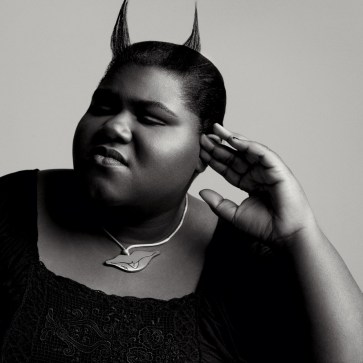
Gabourey Sidibe, from Interview Magazine, Photography by Vinoodh Matadin and Inez Van Lamsweerde
Further, meme-ing Jeantel as Precious solidifies her working class background and ultimately her testimony as a threat to Trayvon Martin’s (re)deemed middle class respectability as a portal of victimization. Returning to Cooper’s observations of Jeantel’s use of hybrid-linguistics, it is Jeantel’s sonic delivery that most threatens Martin’s perceived and scripted middle class respectability. Jeantel’s use of so-called “broken” English has overwhelmingly been heard by what Jennifer Stoever-Ackerman calls America’s dominant “listening ear” in “Reproducing U.S. Citizenship in Blackboard Jungle” as a marker of her working class background – not her trilingual background – and thus, it sonically aligns Martin with the black working class and voids prospects of him being considered a victim of violence rather than its perpetrator. Don West’s treatment of Jeantel on the witness stand attempted to impose a parallel between Jeantel’s alleged “illiteracy” and Martin’s criminality. The “crime” of illiteracy within the courtroom and supposed “crime” of Martin beating Zimmerman into shooting him co-exist within a policed space of (white) respectability that black bodies are frequently forced to adhere.

Jeantel retaliated against West’s attempts to back her into this tight space, however, with her emphatic use of “sir.” Jeantel’s brilliantly subversive tactic demonstrates ratchety resistance because it provides a subtle inversion of the white supremacist discourse directed towards her. Her use of “sir” reminded me of the unnamed protagonist’s grandfather at the beginning of Ralph Ellison’s Invisible Man, who on his deathbed commanded his family to “live with your head in the lion’s mouth:” “I want you to overcome ‘em with yeses, undermine ‘em with grins, agree ‘em to death and destruction, let ‘em swoller you till they vomit or bust wide open” (16). Indeed, Jeantel busted “the lion’s mouth” wide open vis-à-vis a hybridized slang and an emphatic “yes sir” or “no sir.” Most importantly, Jeantel sustained her dignity and self-respect in the process. Jeantel’s mastery of a low, monotone “sir” signifies her existence outside of the politics of respectability that frame not only black women’s experiences but blacks’ submission to white supremacy.
Where West and others focused on her facial features or even her delivery of “sir” as a sign of (dis)respect, what was lost upon many was how her aurally subversive delivery of arguably the most hyper-respectable word in (American) English kept her in command of her testimony.
 Rachel Jeantel is ratchety brilliance. She witnessed, performed, and sounded her truths in ways that complicated if not contradicted the normative discourse policing black women’s bodies. Although much of her cunning was shortsightedly heard as uncouth and aural evidence of a lack of (middle class) home training, Jeantel signifies the usefulness of ratchet as a form of resistance to the white privilege that dictates respectable spaces like the U.S. courtroom. Sir.
—
R.N. Bradley recently graduated with a PhD in African American Literature at Florida State University and is a regular writer for Sounding Out!
—
 REWIND! . . .If you liked this post, you may also dig:
Death Wish Mixtape: Sounding Trayvon Martin’s Death–Regina Bradley
Hearing the Tenor of the Vendler/Dove Conversation: Race, Listening, and the “Noise” of Texts–Christina Sharpe
The Noise of SB 1070: or Do I Sound Illegal to You?–Jennifer Stoever-Ackerman
Share this:

Radical Listening and the People’s Microphony: A Conversation with Elana Mann
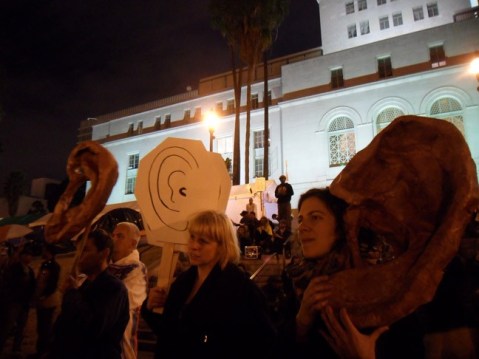
Members and collaborators of ARLA (Paula Cronan, Juliana Snapper, and Elana Mann) participating in a General Assembly at Occupy LA City Hall, November 11, 2011
Listen to everything all the time and remind yourself when you are not listening–Pauline Oliveros
“CAN YOU HEAR ME?!” “I CAN HEAR YOU!!” “IT’S A VAN GOGH PARADE!!” . . .were some of the enthusiastic replies when artist Elana Mann, musician Juliana Snapper, and other members of ARLA (Audile Receptives Los Angeles) arrived on the scene at Occupy LA with giant hand-made ears. Mann co-founded ARLA in the Spring of 2011 with Snapper, filmmaker Vera Brunner-Sung, and choreographer Kristen Smiarowski. After studying scores and techniques on listening developed by composer Pauline Oliveros, ARLA developed a workshop geared toward Occupy LA that included a listening parade in which they held up the giant ears and protest signs with ears on them. Snapper recalls, “The simple physical presence of people carrying large paper-mache ears was met with a kind of hungry recognition…recognition of what it meant that we were holding the symbols (giant ears).” They led workshops, listening sessions, and discussion groups. They performed Oliveros’ sonic meditation “Teach Yourself to Fly” and a composition written by Mann and Snapper entitled “People’s Microphony.” And a project was born. Through personal interviews and audio-visual examples, I document, contextualize, and analyze its work. 
Mp3=The People’s Microphony Camerata performing “Teach Yourself to Fly” Pauline Oliveros
I am happy that Elana Mann chose to use my Sonic Meditations for the People’s Microphony project. These pieces are meant for anyone that wants to perform them regardless of musical training.” –Pauline Oliveros
For Mann, active listening is “a process of tuning in simultaneously inward and outward. Active listening allows for an awareness of and an opening up to sounds around me and also a digestion of what is happening inside of me in relation to these sounds.” Much of the recent focus on this practice comes from the music and sound art worlds, as well as acoustic ecology, a field formed from the overlapping area between science and art that concentrates on the importance of experiencing and investigating our sonic surroundings with detailed care and respect to understand its importance on our world and our place within it. Mann’s work addresses a unique angle at the intersection of these fields: listening’s empathetic effect on those whom you are listening to, a consideration arising from a project she worked on between 2007-2010 with Iraq war veteran Captain Dylan Alexander Mack, called “Can’t Afford the Freeway.”
. “Can’t Afford the Freeway” highlights how her collaborations emerge as conversations between involved artists as well as the audience. Speaking to Mann about the project, she stated,Alex created some recordings for me and I kept listening to them over and over again trying to figure them out. I eventually produced more interviews with him and realized that he needed his story to be heard and I needed to try and understand his story. So I created a project in which I attempted to listen as best I could. Listening to his recordings made me feel close to him, but I also recognized that no matter how many times I heard his words they were still foreign to me. Still the very act of me struggling to listen was important for both of us, and I think this is true of many interpersonal/political and social situations. You can never experience what it is like to be someone else, but active listening opens up a space of empathy and connection. I also think we can see how a lack of active listening is affecting the political landscape in the United States so negatively, by producing a highly polarized and vitriolic environment.
And what about at Occupy LA?
At Occupy LA I was hopeful that there would be a place for listening to voices that had not been heard before and sometimes that happened. Other times people used the space for projecting, not receiving. I think that there needs to be strong voices making themselves heard, but I don’t want to lose the other part of that equation, which is those voices being quiet and listening to others, and themselves.

ARLA Ear Strengthening Workshop, Occupy LA site, November 11, 2011, Photo by Carol Cheh
Mann, thinking and researching about social, aesthetic, and political points of listening and voicing, felt there was something to be considered about the “radical receptivity and the core message of the OWS movement” and its global amplification of voices struggling to be heard. In the Spring of 2012, she formed The People’s Microphony Camerata with Snapper, a radical experimental choir based in Los Angeles exploring the process of the People’s Microphone. The exact history of the “People’s Microphone,” or “People’s Mic” is unclear, but its use in the Occupy Movement has already become iconic. Ted Sammons discusses the implications of the People’s Mic for communication in his October 2011 post, “‘I didn’t say look; I said listen’: The People’s Microphone, #OWS, and Beyond.” The human microphone is a way to deliver one person’s message to a large group of people in situations where amplification tools, such as bullhorns, are either not allowed or unavailable, or if the acoustics of a space distort amplification. The speaker calls, “mic check!” to alert their intentions. Those around them call back, “mic check!”, until the gathering understands something will be said. The speaker breaks their statement into short sentences, pausing to allow those around them, or the “first wave,” to repeat them in unison. They then pause for those further away, or the “second wave,” to repeat again…and so on until those in the back of the gathering have heard the statement.
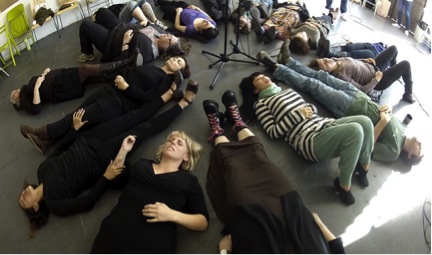
Members of People’s Microphony Camerata rehearsing in Los Angeles, April 15, 2012, Photo by Jean-Paul Leonard
The group’s trademark intensity sometimes carried over to the audience. Mann discovered such transference often had to do with prior associations with a location or context. Mann recalled a particular performance at the Occupy movement called “Chalkupy” that was formed in response to a protest running simultaneously with the LA Art Walk, in which activists had handed out chalk and told stories of police repression while chalk drawings were created on the walkways. The police shut down the art walk and a violent struggle ensued. The Occupy LA movement called for people globally to take to the street with chalk in protest, and the day was called “Chalkupy”. The audience of protestors was mixed and tense, and when the PMC began their performance of a highly emotive score called “Sob-Laugh” by Daniel Goode, people were either drawn to or repelled by the performance.
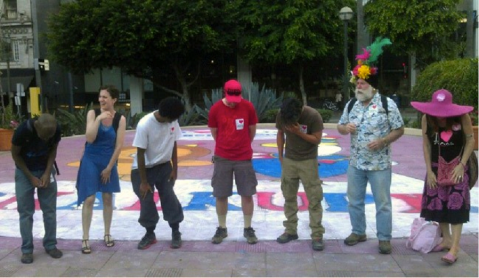
The PMC performing “Sob Laugh” at the “Chalkupy” protest in downtown Los Angeles, Image by Daniel Goode
I think there was some fear about the vulnerable revelation of emotions in the space of the protest. Many of the Occupy LA protests were so risky that everyone had to be extremely tough to exist in that activist space. I respect that. Still I think there are other things that can happen in a space of protest that bring out different feelings. Some activists wanted us to be more musically conventional, “why can’t you just sing some folk songs like normal protest choirs,” we were asked. But we really were not into that kind of thing. . .
In most protest situations, the audiences welcomed their activities. Many shared that it opened up a new space where people could meet each other as humans rather than adversaries or collaborators. Mann edited and published a monochromatic grassroots songbook with the various scores the PMC received for performance, opening up the circle for anyone and everyone to perform and feel that closeness.
Sometimes it was hard to translate a piece that worked during a group rehearsal to something for an audienceperformer situation. . .The PMC never fully developed how to deal with audience participation, but this is something I have been developing on my own in working with students on PMC materials. The scores from the People’s Microphony Songbook and the techniques Juliana and I developed when we first formed the PMC create an immediate closeness within a group, which is remarkable.

From the “People’s Microphony Songbook”: Many voices that were once silenced are now resonating through large crowds, not only of activists, but ordinary people all over the world, assisted by internet networks, and a simple technology called the People’s Microphone. The People’s Mic expressed the interrelated desires of collective and individual voices to speak and be heard, to hear one’s words spoken back through different mouths, and to digest someone else’s words through one’s own body. Beyond projecting an individual’s voice further then it can resonate on its own, the People’s Mic has implications for all of the bodies in its vicinity. It energizes listeners in ways the microphone or megaphone cannot by making listening active, vocal, and embodied. The project, like the Occupy movement, holds all the complexity, beauty, and drive of being human, whether you consider it “working” or not. When I asked Mann about how changes within and towards the Occupy Movement affected the choir, and whether they were winding down or taking a new form, she answered:
I think more than anything else, our group faced a lot of the same challenges that the Occupy Movement faced challenges in horizontality, in the push and pull between interior and exterior exploration, in the sometimes painful vulnerability of investigating the intimate personal and political space with others. I think the project is still developing. The choir still communicates, and some members are currently collaborating with composer Daniel Corral, but the PMC does not meet and rehearse like we used to I think it will continue to wax and wane. In the meantime, I am still working on ideas of active listening. I am currently creating a project called “Listening as (a) movement” within an under-served neighborhood in Pasadena, CA, exploring ideas of radical listening within a specific neighborhood.
In an age of constant bombardment of stimuli, our heads scream with thoughts, opinions, arguments, and expressions. With our current technology, our input and output can be a constant rush of snap reactions and impulses, which has a profound effect, of course, on our day-to-day lives, on our culture(s), on our politics. But these circles cannot be affectively complete without the other side. We need someone to hear us, and, more then that, we need someone to listen to us. And we, in turn, need to listen to them.
—
Maile Colbert is a multi-media artist with a concentration on sound and video who relocated from Los Angeles, US to Lisbon, Portugal. She is a regular writer for Sounding Out!
—
REWIND! . . .If you liked this post, you may also dig:
“Sensing Voice”–Nina Sun Eidsheim
“Within a Grain of Sand: Our Sonic Environment and Some of Its Shapers”–Maile Colbert
“Listening to #Occupy in the Classroom”–Travers Scott
Share this:


Current Top Posts





April 2021

January 2020

November 2019

October 2019

August 2019

April 2014

November 2017

March 2015

December 2017

October 2015
 Sounding Out!
Recent Comments