
Live Through This: Sonic Affect, Queerness, and the Trembling Body


DOI: https://doi.org/10.59350/41drh-z6x54
Marginalized bodies produce marginalized sounds to communicate things that escape language. The queer body is the site of sounds that engage pleasure, repression, rage, isolation, always somehow outside of dominant language. Sound Studies tells us that we should trust our ears as much as our eyes, justifying our trust in sound, and of the resonating body. Affect Theory goes further, saying that all senses play into a body that processes input through levels of response, experience, and anticipation. Affect is the vibrational space that is both bodily memory and anticipation. So where do sound and affect meet in queer bodies? How do marginalized peoples use sound and the body to express liberation, objectification, joy, and struggle?
Our writers in Sound and Affect tackle these questions across a spectrum of the marginalized experience. Next week, Kemi Adeyemi, sloooooooows thingggggggggs doooooooooownnnnn so that we can hear the capitalist connections between the work expected of black bodies and the struggle for escape from this reality through the sonic affects, temporal shifts, and corporeal elsewhere of purple drank. Then, Maria Chaves explores the connection between voice, listening, and queer Chicana community formation: through space, across time, and with laughter. The series finishes with Justyna Stasiowska bringing the noise in a discussion of the trans body and the performance work of Tara Transitory. Today, I open by offering the concept of the tremble, a sonic form of affect that is necessarily queer in its affective reach. Live through this. Get life from this. —Guest Editor Airek Beauchamp
—
I first became interested in the intersections of sound studies and affect theory when, in graduate school, I began to research alternative rhetorics of the AIDS Crisis. ACT UP!, the noisiest and most politically effective of the AIDS advocacy groups from 1987 through 1995, posited noise as presence and silence as loss throughout their campaigns. ACT UP! was notorious for their actions in which they invaded public spaces, from the FDA to the White House and used militaristic chants to create a disruptive cacophony that ran counter to the official silence of government policy. The organization harnessed noise as powerful weapon to shake the status quo.
The ACT UP! equation led me to a critique of AIDS-era politics in which sound and affect became the predominant modes of inquiry, allowing me to investigate how the situated body and the senses experience and invoke rhetorics of marginialization. This maneuver proved to be intellectually difficult, particularly because my post-structuralist training stubbornly insisted on a discursively constructed universe in which only language constructed reality. Instead, what sound and affective rhetoric allow for is exactly that which is beyond the text, that which communicates without strictly-defined language. Theorizing the AIDS crisis as a social event might be necessary in terms of understanding how our culture processes or catalogues such an event, but as I engaged with its archive, I felt bereft when facing the limits of such an approach. It offered nothing to soothe the pain or express the terror of those whose bodies disintegrated in the cruel grasp of the disease.
Rather than relying on abstracted theory to force the affect of the plague into a logical form, I needed something like Antonin Artaud’s work on the plague to explore the cultural but embodied affect of the disease. When Artaud was invited to speak about his essay “The Theater and the Plague” at the Sorbonne, he decided to actually incorporate his ideas about ‘liquefying boundaries” into his speech. Artaud began with a standard oratory but slowly devolved into a theatrical performance of the plague, eventually ending in shrieks of physical pain. By the end of his speech, the only people left in the lecture hall were a minor contingent of his close friends, including Anais Nin, who recounted the tale (Eshleman, 12). Artaud’s shrieks and howls engaged the whole body in the process of making sound, while also erasing semantic and syntactical codes. Here is a video compilation of Artaud performances, to provide the smallest hint of his vocal performances:
To continue my research, I realized, I needed to understand bodies as instruments for processing, producing, and receiving sonic stimuli, while, at the same time, rethink how feeling, quite literally, moves bodies. Artaud led me to connect the sound and affect of AIDS in the 1980s through the unspeakable and the pre-semantic language of the body, deeply embedding these sound/feelings in a network of past experience, present and anticipatory states of being. His work gave me a different way to theorize, to grasp, to listen, to scream—to tremble and tremble in return.
I continued to connect the sinews between sound and affect in my February 2013 post for Sounding Out!, “Queer Timbres, Queered Elegy: Diamanda Galás’s The Plague Mass and the First Wave of the AIDS Crisis.” Through Galás’s visceral interactions with the unendurable pain embedded in history, I keenly felt the presence of the material body so lacking from post-structuralist critique of lived experience, alongside an urgent sense of agency. Galás’s performances made fascinating use of the “tactile effect of layered sound that is felt with the skin, in the bones, as well as with the ears, communicating a palpable experience that lies beyond the barely-nuanced music it is seductively easy to grow accustomed to.” The experience of listening to Galás helps us to realize that the body is a series of machines of input and output—processor and producer—systems that often forego semantic language and instead listen and speak in tremblings.
In what follows, I flesh out the notion of sonic tremblings: how it links what we call sound studies and affect studies, of course, but more importantly, how it speaks past the post-structuralist insistence on a world confined to text, and how we might build upon this notion in future theory and research. Our bodies’ materiality, a site of constant unfolding, engages with the world via a series of shimmers and impulses—such as the synesthetic vibration I am calling sonic tremblings—rather than with concrete events or objects in and of themselves. These tremblings, always intersectional, encompass past lived experiences, social and cultural constructions that restrict interpretation, and interpretations falling outside social or cultural codes. I understand the trembling body as both processor and producer of sound, a connection of trembling nodes eschewing the patriarchal structures of language. And, though I write through and about the particular tremblings of my own white, queer, cis male body, that experience is by no means universal or at the center of my theorizations. Instead, I hope that the way I experience and understand sound studies and affect theory will open up new ways of hearing the world, especially for people whose experiences are not mine and who can add depth, nuance, and texture to the conversation. It is in fact through their variety and unique resonances that tremblings speak simultaneously to and against the limitations placed on queer bodies.
My articulation of affect with sound studies is necessarily queer, as it rejects binaries and speaks without definitive vocabulary, syntax, or grammar. Marta Figlerowicz, in “Affect Theory Dossier: An Introduction,” offers a good primer on the widely divergent ways in which scholars use the idea of affect. In Figlerowitz’s explanation, affect is always a self in motion, be it “the self running ahead of itself,” “the self catching up with itself,” “the self as self-discursive and always constantly mutating and adapting to ambient stimuli,” and/or “celebrations of Proustian moments when the self and the sensory world, or the conscious and the unconscious self, or the self and another person, fall in step with each other… to make a sliver of experience more vivid and more richly patterned than willful analysis could ever have” (4). In all of these cases, the body’s perception and the discourse of the self remain in motion, trembling with identifications that are at best fleeting, though richly communicative and expressive. Sound, as an always-present stimulus, works affectively in such a form of communication.
Queer bodies are inherently intertwined in theorizing sound and affect. The actual concept of affect itself is queer, implicating the unknowable, but concretely felt phenomena of the body. But rather than forming a linear narrative, affect is produced, and received, in a web of physical and neural processes that rejects the linear concept of time and instead are never static but self-referential and constantly evolving in response to our environment. To navigate this space I adopt the term “affective field,” used by Marie Thompson and Ian Biddle in their introductory essay to Sound, Music, Affect. An affective field describes a textural field of play between stimulus, meaning, and response; it relies on reproduction and broadcast, a field of listening/emitting/processing machines all working in a sort of continuous flow, always already present. The affective field model encourages the removal of emphasis on subject/object but instead focuses on interfacial relationships as a point of contact. Eradicating =the subject/object dualism is vital to exchange, as Yvon Bonenfant says in “Queer Listening to Queer Vocal Timbres“: “We cannot exchange with an object, only other subjects” (76).

Finding a theory that worked with the body and with subject/subject communication allowed me to make more sense of the ways in which ACT UP! used noise and silence as a way to build community, and allowed me to dig deeper into the idea of queer communication. The silent scream of the slogan Silence = Death succinctly articulated ACT UP!’s most definitive tactic: manipulation of the affective field. Their chants initially filled the streets, of New York, but by 1990 their actions had united them with Europe, creating world-wide noise in protest of the now-global epidemic, creating a distinct disjuncture to the silent death falling over gay communities. Noise offered the queer community both a form of protest and community, becoming an affective mechanism of agency. ACT UP!’s use of noise not only speaks to the dire need of queer bodies to exercise agency and demonstrate social worth, but it also helps break down the essential binary between encoded language and un-encoded sound. Rather than syntactical sound, noise communicates in trembles, resonating in both the psyche and in the actual body. Noise worked to unify disparate parts of identity–and disparate identities–a coalescing rather than normalizing process, a trembling vital to queer identity.
However, while ACT UP! worked to create noise—and to develop community through the trembling of their rage—they also communicated affectively with silence. Staging their now infamous die-ins, ACT UP! manipulated the affective field through the deafening buzz that accompanies silence, a somber quiet that refused to go ignored. These actions were not done to—but instead with—people, a disruption of the subject/object, or perhaps the subject/abject. But, it is the unexpected noise of the die-ins that I find most interesting. Not just the ambient noise of occupying bodies in space—people moving, coughing, breathing—but the loud silence created by the protest itself: a hushed roar that trembles through the room, the microphones, and the bodies of the listeners, a disruptive noise crafted from intentional silence. This silence itself resonates in the body, enabling them to erupt in tremblings of loss, of mourning, and of rage, the painfully loud silence of marginalized bodies at war with an epidemic about which no one in power seemed to care.
ACT-UP’s die-ins reclaimed agency within silence’s palpable materiality, using its noise to disrupt the affective field and reclaim space within it. Using the material body as both receptor and transmitter of the affective field, their noise created tremblings and spoke in associations both somatic and psychic. In the case of the die-ins, the silence mediated the noise of the voices of the dead, all talking at once through the trembling bodies of the living.
Adapting silence and the noise it brings, one of ACT UP!’s historical legacies, offers contemporary listeners agency over our marginalized bodies. We must make some noise, and then “listen out” for particular affects of noise and silence in turn, as Bonenfant suggests, seeking the tremblings that touch our skins and resonate in our brains, bone, and flesh. The affective field permeates queer communication and offers to the marginalized an opportunity, through sound, to make noise, establish self, and establish communities.
At once subversive and coalescent, noise resists the codification of what our culture might traditionally consider to be “music” or other codified sounds, making it a necessarily affective communication. The discordant, unruly strains of Throbbing Gristle’s “Discipline,” for example, jarred, shaken, and trembled me into a powerful feeling of community amid dissonance and difference, of community through difference at key moments in my life.
At other moments, the shriek, fuzz, and wail of riot grrrrl punk act Bikini Kill, in particular, Kathleen Hanna’s growl in “Suck My Left One,” has awakened in me a strain of tremblings that move freely associative in their rage against the marginalization of women and the ways in which socially constructed gender roles also marginalize and demonize queer folks. While post-structuralism maintains that the self is necessarily disunified and can only be defined by its difference to others, I have to disagree. While academic methodologies make it difficult to form an argument based on my lived experience, when I feel the tremblings connecting me to Genesis Breyer P-Orridge or Kathleen Hanna and to their audiences, I am hard pressed to feel them as anything but real.
In fact, it might just be in endurance that I can best articulate tremblings as a sonic, somatic, affective phenomenon. Born of present stimuli, always connected to past experiences and anticipatory of the future, tremblings are unruly, unable to be pinpointed. They do not just express the order or pleasure that we find in traditional music, though they can encompass this as well. Instead, tremblings are communicative, they move through the I, the subject, while unifying other subjects through their rich and unnamable identifications. It speaks simultaneously to and against the limitations placed on queer bodies, expressing joy, pain, pleasure.
—
Featured Image: Genesis P-Orridge by Flicker User Jessica Chappell
—
Airek Beauchamp is a Visiting Assistant Professor at Arkansas State University and a Ph.D. candidate at SUNY Binghamton, where he specializes in Writing Studies. Airek is currently working on his dissertation, which details ways that universities can offer social and academic writing support to graduate students to better help them professionalize in their fields. His other areas of research include queer theory, affect theory, and trauma in the LGBTQ community.
—
REWIND!…If you liked this post, check out:
“Music to Grieve and Music to Celebrate: A Dirge for Muñoz”-Johannes Brandis
“Music Meant to Make You Move: Considering the Aural Kinesthetic”-Imani Kai Johnson
“Hearing Queerly: NBC’s ‘The Voice’”-Karen Tongson
“One Nation Under a Groove?: Music, Sonic Borders, and the Politics of Vibration“–Marcus Boon
—
Share this:

Echo and the Chorus of Female Machines

DOI: https://doi.org/10.59350/ap7j3-sw607
Editor’s Note: February may be over, but our forum is still on! Today I bring you installment #5 of Sounding Out!‘s blog forum on gender and voice. Last week Art Blake talked about how his experience shifting his voice from feminine to masculine as a transgender man intersects with his work on John Cage. Before that, Regina Bradley put the soundtrack of Scandal in conversation with race and gender. The week before I talked about what it meant to have people call me, a woman of color, “loud.” That post was preceded by Christine Ehrick‘s selections from her forthcoming book, on the gendered soundscape. We have one more left! Robin James will round out our forum with an analysis of how ideas of what women should sound like have roots in Greek philosophy.
This week Canadian artist and writer AO Roberts takes us into the arena of speech synthesis and makes us wonder about what it means that the voices are so often female. So, lean in, close your eyes, and don’t be afraid of the robots’ voices. –Liana M. Silva, Managing Editor
—
I used Apple’s SIRI for the first time on an iPhone 4S. After hundreds of miles in a van full of people on a cross-country tour, all of the music had been played and the comedy mp3s entirely depleted. So, like so many first time SIRI users, we killed time by asking questions that went from the obscure to the absurd. Passive, awaiting command, prone to glitches: there was something both comedic and insidious about SIRI as female-gendered program, something that seemed to bind up the technology with stereotypical ideas of femininity.

Speech synthesis is the artificial simulation of the human voice through hardware or software, and SIRI is but one incarnation of the historical chorus of machines speaking what we code to be female. Starting from the early 20th century Voder, to the Cold-War era Silvia and Audrey, up to Amazon’s newly released Echo, researchers have by and large developed these applications as female personae. Each program articulates an individual timbre and character, soothing soft spoken or matter of fact; this is your mother, sister, or lover, here to affirm your interests while reminding you about that missed birthday. She is easy to call up in memory, tones rounded at the edges, like Scarlett Johansson’s smoky conviviality as Samantha in Spike Jonze’s Her, a bodiless purr. Simulated speech articulates a series of assumptions about what neutral articulation is, what a female voice is, and whose voice technology can ventriloquize.
The ways computers hear and speak the human voice are as complex as they are rapidly expanding. But in robotics gender is charted down to actual wavelength, actively policed around 100-150 HZ (male) and 200-250 HZ (female). Now prevalent in entertainment, navigation, law enforcement, surveillance, security, and communications, speech synthesis and recognition hold up an acoustic mirror to the dominant cultures from which they materialize. While they might provide useful tools for everything from time management to self-improvement, they also reinforce cisheteronormative definitions of personhood. Like the binary code that now gives it form, the development of speech recognition separated the entire spectrum of vocal expression into rigid biologically based categories. Ideas of a real voice vs. fake voice, in all their resonances with passing or failing one’s gender performance, have through this process been designed into the technology itself.
A SERIES OF MISERABLE GRUNTS

The first voice to be synthesized was a reed and bellows box invented by Wolfgang Von Kempelen in 1791 and shown off in the courts of the Hapsburg Empire. Von Kempelen had gained renown for his chess-playing Turk, a racist cartoon of an automaton that made waves amongst the nobles until it was revealed that underneath the tabletop was a small man secretly moving the chess player’s limbs. Von Kempelen’s second work, the speaking machine, wowed its audiences thoroughly. The player wheedled and squeezed the contraption, pushing air through its reed larynx to replicate simple words like mama and papa.
Synthesizing the voice has always required some level of making strange, of phonemic abstraction. Bell Laboratories originally developed The Voder, the earliest incarnation of the vocoder, as a cryptographic device for WWII military communications. The machine split the human voice into a spectral representation, fragmenting the source into number of different frequencies that were then recombined into synthetic speech. Noise and unintelligibility shielded the Allies’ phone calls from Nazi interception. The Vocoder’s developer, Ralph Miller, bemoaned the atrocities the machine performed on language, reducing it to a “series of miserable grunts.”

In his history of the The Vocoder, How to Wreck a Nice Beach, Dave Tompkins tells how the apparatus originally took up an entire wall and was played solely by female phone operators, but the pitch of the female voice was said to be too high to be heard by the nascent technology. In fact, when it debuted at the 1939 World’s Fair, only men were chosen to experience the roboticization of their voice. The Voder was, in fact, originally created to only hear pitches in the range of 100-150 HZ, a designed exclusion from the start. So when the Signal Corps of the Army convinced President Eisenhower to call his wife via Voder from North Africa, Miller and the developers panicked for fear she wouldn’t be heard. Entering the Pentagon late at night, Mamie Eisenhower spoke into the telephone and a fragmented version of her words travelled across the Atlantic. Resurfacing in angular vocoded form, her voice urged her husband to come home, and he had no problem hearing her. Instead of giving the developers pause to question their own definitions of gender, this interaction is told as a derisive footnote of in the history of the sound and technology: the punchline being that the first lady’s voice was heard because it was as low as a man’s.
WAKE WORDS

In fall 2014 Amazon launched Echo, their new personal assistant device. Echo is a 12-inch long plain black cone that stands upright on a tabletop, similar in appearance to a telephoto camera lens. Equipped with far field mics, Echo has a female voice, connected to the cloud and always on standby. Users engage Echo with their own chosen ‘wake’ word. The linguistic similarity to a BDSM safe word could have been lost on developers. Although here inverted, the word is used to engage rather than halt action, awakening an instrument that lays dormant awaiting command.
Amazon’s much-parodied promotional video for Echo is narrated by the innocent voice of the youngest daughter in a happy, straight, white, middle-class family. While the son pitches Oedipal jabs at the father for his dubious role as patriarchal translator of technology, each member of the family soon discovers the ways Echo is useful to them. They name it Alexa and move from questions like: “Alexa how many teaspoons in a tablespoon” and “How tall is Mt. Everest?” to commands for dance mixes and cute jokes. Echo enacts a hybrid role as mother, surrogate companion, and nanny of sorts not through any real aspects of labor but through the intangible contribution of information. As a female-voiced oracle in the early pantheon of the Internet of Things, Echo’s use value is squarely placed in the realm of cisheteronormative domestic knowledge production. Gone are the tongue-in-cheek existential questions proffered to SIRI upon its release. The future with Echo is clean, wholesome, and absolutely SFW. But what does it mean for Echo to be accepted into the home, as a female gendered speaking subject?
Concerns over privacy and surveillance quickly followed Echo’s release, alarms mostly sounding over its “always on” function. Amazon banks on the safety and intimacy we culturally associate with the female voice to ease the transition of robots and AI into the home. If the promotional video painted an accurate picture of Echo’s usage, it would appear that Amazon had successfully launched Echo as a bodiless voice over the uncanny valley, the chasm below littered with broken phalanxes of female machines. Masahiro Mori coined the now familiar term uncanny valley in 1970 to describe the dip in empathic response to humanoid robots as they approach realism.
If we listen to the litany of reactions to robot voices through the filters of gender and sexuality it reveals the stark inclines of what we might think of as a queer uncanny valley. Paulina Palmer wrote in The Queer Uncanny about reoccurring tropes in queer film and literature, expanding upon what Freud saw as a prototypical aspect of the uncanny: the doubling and interchanging of the self. In the queer uncanny we see another kind of rift: that between signifier and signified embodied by trans people, the tearing apart of gender from its biological basis. The non-linear algebra of difference posed by queer and trans bodies is akin to the blurring of divisions between human and machine represented by the cyborg. This is the coupling of transphobic and automatonophobic anxieties, defined always in relation to the responses and preoccupations of a white, able bodied, cisgendered male norm. This is the queer uncanny valley. For the synthesized voice to function here, it must ease the chasm, like Echo: sutured by a voice coded as neutral, but premised upon the imagined body of a white, heterosexual, educated middle class woman.
22% Female

My own voice spans a range that would have dismayed someone like Ralph Miller. I sang tenor in Junior High choir until I was found out for straying, and then warned to stay properly in the realms of alto, but preferably soprano range. Around the same time I saw a late night feature of Audrey Hepburn in My Fair Lady, struggling to lose her crass proletariat inflection. So I, a working class gender ambivalent kid, walked around with books on my head muttering The Rain In Spain Falls Mainly on the Plain for weeks after. I’m generally loud, opinionated and people remember me for my laugh. I have sung in doom metal and grindcore punk bands, using both screeching highs and the growling “cookie monster” vocal technique mostly employed by cismales.
Given my own history of toying with and estrangement from what my voice is supposed to sound like, I was interested to try out a new app on the market, the Exceptional Voice App (EVA ), touted as “The World’s First and Only Transgender Voice Training App.” Functioning as a speech recognition program, EVA analyzes the pitch, respiration, and character of your voice with the stated goal of providing training to sound more like one’s authentic self. Behind EVA is Kathe Perez, a speech pathologist and businesswoman, the developer and provider of code to the circuit. And behind the code is the promise of giving proper form to rough sounds, pitch-perfect prosody, safety, acceptance, and wholeness. Informational and training videos are integrated with tonal mimicry for phrases like hee, haa, and ooh. User progress is rated and logged with options to share goals reached on Twitter and Facebook. Customers can buy EVA for Gals or EVA for Guys. I purchased the app online for my iPhone for $5.97.
My initial EVA training scores informed me I was 22% female; a recurring number I receive in interfaces with identity recognition software. Facial recognition programs consistently rate my face at 22% female. If I smile I tend to get a higher female response than my neutral face, coded and read as male. Technology is caught up in these translations of gender: we socialize women to smile more than men, then write code for machines to recognize a woman in a face that smiles.
As for EVA’s usage, it seems to be a helpful pedagogical tool with more people sharing their positive results and reviews on trans forums every day. With violence against trans people persisting—even increasing—at alarming rates, experienced worst by trans women of color, the way one’s voice is heard and perceived is a real issue of safety. Programs like EVA can be employed to increase ease of mobility throughout the world. However, EVA is also out of reach to many, a classed capitalist venture that tautologically defines and creates users with supply. The context for EVA is the systems of legal, medical, and scientific categories inherited from Foucault’s era of discipline; the predetermined hallucination of normal sexuality, the invention of biological criteria to define the sexes and the pathologization of those outside each box, controlled by systems of biopower.
Despite all these tools we’ll never really know how we sound. It is true that the resonant chamber of our own skull provides us with a different acoustic image of our own voice. We hate to hear our voice recorded because suddenly we catch a sonic glimpse of what other people hear: sharper more angular tones, higher pitch, less warmth. Speech recognition and synthesis work upon the same logic, the shifting away from interiority; a just off the mark approximation. So the question remains what would a gender variant voice synthesis and recognition sound like? How much is reliant upon the technology and how much depends upon individual listeners, their culture, and what they project upon the voice? As markets grow, so too have more internationally accented English dialects been added to computer programs with voice synthesis. Thai, Indian, Arabic and Eastern European English were added to Mac OSX Lion in 2011. Can we hope to soon offer our voices to the industry not as a set of data to be mined into caricatures, but as a way to assist in the opening up in gender definitions? We would be better served to resist the urge to chime in and listen to the field in the same way we suddenly hear our recorded voice played back, with a focus on the sour notes of cold translation.
—
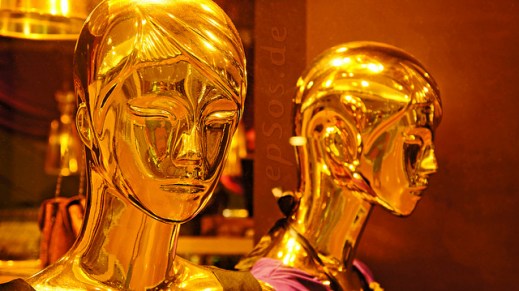
Featured image: “Golden People love Gold Jewelry Robots” by Flickr user epSos.de, CC BY 2.0
—
AO Roberts is a Canadian intermedia artist and writer based in Oakland whose work explores gender, technology and embodiment through sound, installation and print. A founding member of Winnipeg’s NGTVSPC feminist artist collective, they have shown their work at galleries and festivals internationally. They have also destroyed their vocal chords, played bass and made terrible sounds in a long line of noise projects and grindcore bands, including VOR, Hoover Death, Kursk and Wolbachia. They hold a BFA from the University of Manitoba and a MFA in Sculpture from California College of the Arts.
—

REWIND!…If you liked this post, you may also dig:
Hearing Queerly: NBC’s “The Voice”—Karen Tongson
On Sound and Pleasure: Meditations on the Human Voice—Yvon Bonefant
I Been On: BaddieBey and Beyoncé’s Sonic Masculinity—Regina Bradley
—
Share this:




Current Top Posts





April 2021

January 2020

November 2019

October 2019

August 2019

April 2014

November 2017

March 2015

December 2017

October 2015


Recent Comments