
(Dis)orienting the Bell: Aural Assault from A Game of Thrones to Richard Coer de Lyon


series co-editors Dorothy Kim and Christopher Roman
Hear YE! Below is the introduction to the latest installment of Medieval Sound, Aural Ecology, by series co-editors Dorothy Kim and Christopher Roman. To read their previous introduction, click here. To read the first run of the series in 2016, click here.
Aural Ecology
What is considered music, noise, or harmony is historically and culturally contingent. For example, some medieval musical theory, or musica speculative, such as Jan Herlinger’s “Music Theory of the Fourteenth and Early Fifteenth Centuries” in Music as Concept and Practice in the Late Middle Ages, defined music as “contemplation that serves the moral edification of the mind” (293). Influenced by the work of Boethius’s De Musica, music is not just everyday music but “connotes harmony conceived broadly enough to encompass the relationships obtaining in the human body and psyche and governing the motions of planets” (293). This kind of ecological harmony is explored in the work of Boethius, especially in his discussion of abstract qualities in the prelude to the De Musica, The Book of Arithmetic (as translated by Calvin Martin Bower) “Indeed these things themselves are incorporeal in nature and thrive by reason of their immutable substance, but they suffer radical change through participation in the corporeal, and through contact with variable things they change in veritable consistency” (24). For Boethius these “essences” are concordant with mathematical properties expressed in music. Thus, music was both speculative and moral, and these intertwining purposes derived from music’s phenomenological pleasures derived in the environment, “for nothing is more consistent with human nature than to be soothed by sweet modes and disturbed by their opposites” (Bower 32).
Boethius also comments on the psychological effects experienced in hearing music as they “affect and remold the mind into their own character” (Bower 34). Boethius gives examples of how certain groups of peoples, such as the Thracians or Lacedaemonians, delight in different kinds of music that harmonizes with their natures. For Boethius, music is transcendent in that it exists as a kind of eternal sound, but also an immanent sound, in that it appeals to various peoples depending on their nature and environment. Boethius’ speculations lead him to think about harmony and sound as available to reason and sensory perception. Thus the notion of harmony itself is “the faculty of considering the difference between high and low sounds using the reason and senses. For the senses and reasons are considered instruments of this faculty of harmony” (Bower 295). Harmony (and disharmony in the form of noise) became a marker of the aural ecology for an individual or group.
The essays in “Aural Ecologies” also address the issue of unharmonious sounds, sounds that often mark dissonant critical identities—related to race, religion, material—that reverberate across different soundscapes/landscapes. In this way, this group of essays begins to open up the stakes of Medieval Sound in relation to what contemporary sound studies has begun to address in relation to cultural studies, architectural and environmental soundscapes, and the marking of race through the vibrations of the body. —Dorothy Kim and Christopher Roman
In the neo-medieval A Game of Thrones (2011), the medieval Saracen-inspired and violent Dothraki utilize bells as a symbol of victories in battle. Each time a leader or khal defeats a foe, he incorporates the bells from his foe’s shorn black braid into his own braid. Khal Drogo, khal of the most powerful khalasar in Essos, sports an uncut braid sensuously described by George R. R. Martin as “black as midnight . . . hung with tiny bells that rang softly as he moved. It swung well past his belt, below even his buttocks” (37).
Dothraki bells serve both a hypermasculine and deterritorializing function: esteem and prowess for Eastern men comes from the symbolic castration of their enemies and the eradication of civilizations. For the Dothraki, sexualized and territorial conquest is centralized around amplitude of noise made by an aggregate of bells adorning a phallic braid. Drogo is frightening because of his noise: he wears “[b]ells so his enemies w[ill] hear him coming and grow weak with fear” (802). In the pilot episode of Season 1 of HBO’s Game of Thrones, writers David Benioff and D. B. Weiss and director Tim Van Patten emphasized the contrast in noise between the copper-skinned Dothraki and the white Valyrians of the Free Cities:
East disrupts West in this scene through a racialized auditory disruption of white silence.
The association of the Middle East with noise pervades Western culture. One need only recall juxtapositions of quietly carefully groomed news anchors in sterile American news sets conversing with correspondents struggling to be heard in earsplitting raucous streets embroiled in Middle Eastern crises in countries like Iraq and Syria. See Aron Brown of CNN announcing the U.S. War on Iraq in 2003, for example:
However, this association of the Arab world with noise is not a new one. In medieval literature, noise played a crucial role in distinguishing Saracen East from Christian West. Bells and particularly the cacophonous noise they cumulatively make came to be associated with a violent imagining of the East in literature of the medieval period. The late medieval crusading romance Richard Coer de Lyon, centered on the exploits of the twelfth-century crusading king, Richard the Lionheart, situates the pealing bell as its central object. [Note: Richard Coer de Lyon is cited by line number. All quotations come from the widely-used complete modern version, Richard Löwenherz, ed. Karl Brunner, Wiener Beiträge zur Englischen Philologie (Vienna and Leipzig, 1913)].
As in Dothraki warrior culture in A Game of Thrones, bells gain symbolic power in the romance through replication and accumulation. Richard Coer de Lyon features pealing bells in two crucial episodes concerned with the East and a maternal rather than phallic male body: 1) the exorcism of Richard’s demonic Eastern mother at Mass with a sacring bell (l.221-34); and 2) the appearance of Saladin’s demonic mare arrayed in clamorous bells attached to her crupper at the climactic battle of Acre (l.5532-49, 5753-8). Drawing on both medieval treatises on the function of bells and Gilles Deleuze and Felix Guattari’s theory of the refrain, I argue that the bell—initially a symbol of Christian order, the West, and patriarchy—becomes a disorienting aural force associated with chaos, the East, and maternity.
Early on in the romance, the king’s men try the piety of Richard’s mother, Cassodorien of Antioch, a bewitching foreigner whose only apparent fault is that she cannot remain in church to hear Mass, by physically restraining her during a service. To the shock of the English parishioners, at the ringing of the sacring bell, Cassodorien breaks free of her male captors, seizes two of her children, and flies through the church roof never to be seen again:
And whene þe belle began to ryng,
And when the bell began to ring,
The preest scholde make þe sakeryng,
And the priest was about to do the sacring,
Out off þe kyrke sche wolde away…
Out of the church she tried to go away…
Out of the rofe she gan her dyght,
Out of the roof she began to make her way/transform,
Openly before all theyr syght…
Openly before all of their sight…
— Richard Coer de Lyon, 221-5.
At this striking moment of contact between queen and masculine material object, the bell is forever altered, (re)oriented on a trajectory that transmogrifies it from a symbol of priestly power to a chaotic symbol of maternity and the East.

Sacring Bells in Aberdeen, Scotland. Image by Flickr User rethought (CC BY-NC 2.0)
Medieval thinkers conceptualized the church bell as an agent for revealing both foreign and demonic threats from within the community. In The Rationale Divinorum Officiarum of William Durand of Mende thirteenth-century French liturgical writer and bishop, William Durand,xplains the significance of the pealing of bells– “when the bell rings . . . the people are unified with the unity of faith and charity” (51) –but also expounds on this exorcising function of the church bell:
[T]he bells are rung in processions so that the demons who fear them will flee . . . They are so fearful when they hear the trumpets of the Church militant, that is the bells, that they are like some tyrant who is fearful when he hears in his own country the trumpets of some powerful king who is his enemy (51).
Durand conflates the demonic with the East, both qualities embodied by Cassodorien who hails from Antioch (near the border of Syria and Turkey). He also imbues the bell with an emasculating quality; it renders even a tyrant fearful. The measured sounding of the church bells forms a tonal refrain, an aural sequence to familiarize Christian space.
The purpose of the aural refrain, for Gilles Deleuze and Felix Guattari, is to deterritorialize and then reterritorialize unfamiliar space. In A Thousand Plateaus, they explain the refrain/‘ritournelle’ as a threefold place of disorientation, the familiar, and escape:
They are three aspects of a single thing, the Refrain (ritournelle)…. Sometimes chaos is an immense black hole in which one endeavors to fix a fragile point as a center. Sometimes one organizes around that point a calm and stable “pace” (rather than a form): the black hole has become a home. Sometimes one grafts onto that pace a breakaway from the black hole (312).
The bell was arguably the most important and pervasive aural symbol in medieval Europe, one whose refrain regularly demarcated Christian spaces in times of chaos. Sound theorist R. Murray Schafer has called the medieval church bell “the most salient sound signal in the Christian community” in The Tuning of the World (53), and a unifying force “acoustically demarking the civilization of the parish from the wilderness beyond its earshot” (55). Yet, as the bell multiplies through contact with Cassodorien and Richard wanders into the wilderness or black hole of the East, its sound is layered and its signification coopted by the East and transformed into a disorienting force that decenters Saladin’s enemies.

Richard battles Saladin, Luttrell Psalter, BL42130, 4v
The bell resurfaces once more as Richard prepares for his epic battle against Saladin at the gates of Babylon. In this climactic battle with a second pairing of mother and son, reimagined in the form of a demonic belled “mere” and her “colt” summoned by Saladin’s necromancer, bells occupy a central place of prominence on the mare’s accoutrements. In 1192, Saladin reportedly sent two new horses to Richard after his horse was slain in battle (For an overview of this event, see page 73 of Sir Steven Runciman’s A History of the Crusades, Vol.3: The Kingdom of Acre and the Later Crusades). The mare, as one of only two mothers in the romance, uses the same aural symbol to assault the English Christians that they had used to exorcise Cassodorien. As Saladin’s mare proudly strides onto the battlefield, the poet emphasizes the deterritorializing effect of her cacophonous bells:
þerffore, as þe book vs telles,
Therefore, as the book tells,
Hys crouper heeng al ful off belles,
The mare’s crupper hung all full of bells;
And hys peytrel, and his arsoun.
From the armor, too, and the saddlebow,
þree myle men my3ten here þe soun.
For three miles men could hear the sound.
Þe mere gan ny3e, here belles to ryng,
His mare began to neigh, her bells she rang
Ffor gret pryde, wiþouten lesyng.
With great pride, it is no lie.
–Richard Coer de Lyon, 5753-8.
Fascinatingly, Brunner again diverges in this passage from Caius 175, and changes “þe mere” to “his mere,” further stripping the demonic mare of her agency.
Whereas the church bell is a singular symbol of order, symmetrical and “acoustically demarking” space with its meted refrain, the bells of the mare are multiple, discordant, chaotic, and cacophonous, designed to disorient rather than to unify (see Schafer 55). The medieval illuminator of the Luttrell Psalter (c.1325-1335) similarly emphasizes the clamorous quality of the belled mare, and distinguishes Saladin’s mount from Richard’s by the vast array of bells attached to its crupper and the noise these bells suggest.
The noise, suggested in the Luttrell Psalter by the movement and detail given to the crupper bells, can be heard on a smaller scale in the following video clip of a horse merely walking noisily with a smaller bell-laden crupper:
One can easily infer the discordant sound a running mare might make with a crupper “hung all full of bells.” The poet suggests that the noise encompassed an aural disturbance of three-miles and disrupted the Christian crusaders. The bells also serve an insidious maternal purpose: they serve as a trap to lure her colt to abandon Richard and “knele adoun, and souke hys dame” (kneel down and suck his dame)” (Richard Coer de Lyon, 5547). In A Thousand Plateaus, Deleuze and Guattari suggest the layering of sounds, particularly maternal sounds, can disrupt and deterritorialize space. In their discussion of the reterritorializing effects of layered song, Deleuze and Guattari provide the strikingly maternal example of Debussy’s Sirens, which, they posit, integrates voice with orchestra to make the voices of child and woman inextricable from “the sea and the water molecule” (340). In much the same way in Richard Coer de Lyon, the mare’s imbrication of voice over bells seeks to make the dichotomies of the romance—mother and son, east and west, chaos and order, demonic and angelic—implode as the demarcated boundaries between them are dissolved in her cacophonous demonic lullaby.

Daenerys, Created in ArtRage Studio by Flickr User Happy Snapper 80 (CC BY-NC 2.0)
While A Game of Thrones and its HBO counterpart pick up on the resonances of medieval noise to differentiate between East and West, noise is gendered differently. In RCL the threat signaled by the sound of bells is that Richard will be emasculated by his inability to cut ties with the specter of his mother’s influence and disambiguate himself from the Eastern Saracens she represents. However, in Martin’s series, the Dothraki bells, like much of Dothraki culture, exist only to be subsumed under Daenerys’ imperial ambitions for an Iron Throne the Dothraki neither care about nor want. Daenerys’ bell, affixed to her hair after the death of Drogo and the dissolution of his khalasar, becomes a symbol of cultural and racial appropriation Martin stages under the guise of (white) feminism. That is, the issues noise signals have changed from the challenge of excising Christian West from Islamic East (a fear literalized in Richard’s cannibalistic consumption of Saracen flesh) to cultural appropriation (the devouring of Dothraki culture for the benefit of white colonialism).
—
Featured Image: Proceso Khal Drogo by Flickr User Orgita Sucubita, (CC BY-NC-ND 2.0)
—
Thomas Blake is Assistant Professor of English at Austin College.
—
REWIND!…If you liked this post, you may also dig:
Sounding Out! Podcast #54: The Sound of Magic-K.A. Laity
Mouthing the Passion: Richard Rolle’s Soundscapes–Christopher Roman
Playing with the Past in the Imagined Middle Ages: Music and Soundscape in Video Game–James Cook
Share this:

This is What It Sounds Like . . . . . . . . On Prince (1958-2016) and Interpretive Freedom
Can you imagine what would happen if young people were free to create whatever they wanted? Can you imagine what that would sound like?–Prince, in a 2015 interview by Smokey D. Fontaine
Prince leaves an invitingly “messy” catalog—a musical cosmos, really—just as rich for those who knew it well as for those encountering it with fresh ears. He avoided interviews like he avoided conventions. He made few claims. Read him as you will.
We are free to interpret Prince, but not too free. Yes, art is open, and perhaps Prince’s art especially. And yet many eulogies have described him as indescribable, as if he were untethered by the politics of his world; he wasn’t. Some remembrances assume (or imagine) that Prince was so inventive that he could escape stultifying codes and achieve liberation, both as musician and human being. For example, Prince has often been called “transcendent”—of race, of musical genre, even of humanity itself. This is overstated; he was rooted in all of these. Better to say, maybe, that he was a laureate of many poetics, some musical and some not. He responded to race, genre, and humanity, all things that he and we are stuck with. He was a living artwork, and these, by way of sound, were his media.
Prince was not transcendent. He was just too much for some to assimilate.

Since Prince’s passing last month, I’ve been struck by the idea that his career might have been, deliberately or not, an elaborate quotation of the career of Little Richard, who anachronistically has outlived him. Or, a sonic version of what Henry Louis Gates Jr. calls “signifyin(g)” in the African American artistic tradition in The Signifying Monkey: repetition with a difference, a re-vision—and, especially appropriate here—a riffing (66). Both Prince and Richard in their way defined rock music, even as rock—as a canonized form—held them at a distance. They were simultaneously rock’s inventive engine and its outer margins, but never, seemingly, its core—at least from the perspective of its self-appointed gatekeepers.

Rock and race have, to put it mildly, an awkward history. African-American rock artists rarely get their due from labels and taste-making outlets, in money or posterity, a phenomenon not at all limited to the well-known pinching of Elvis and Pat Boone. One might consider, for example, Maureen Mahon’s anthropology of the Black Rock Coalition, a group home to Greg Tate, Living Colour, and others dwelling on rock’s periphery. Canons are one way to understand how this denial works.
To be sure, some black artists have been canonized in rock, but always with a handicap, as Jack Hamilton has explained lucidly. In, for example, best-of lists (which I have browsed obsessively since Prince died, as if enshrinement there might confirm something about him; he is usually #40 or #50), there are only so many slots of color: Hendrix is the black guitar god; Little Richard the sexual sentinel rising in a repressed era; James Brown the lifeline to funk; Big Mama Thornton the grandmaternal footnote. Best-of lists published by major magazines and websites such as Rolling Stone and VH1, tend to name about 70% white artists, as well as 90-95% male ones. These lists have become just a smidgen more inclusive in the past decade or so. Still, only the Beatles and Rolling Stones are regular contenders to be named history’s greatest rock band.
We are free to interpret greatness, but not too free.
For those who care about lists enough to comment on them, much of the point is in the arguing, the freedom to declare an opinion that cannot be challenged on logical grounds. I certainly wouldn’t argue for more “correct” best-of lists, either for aesthetics or inclusivity. Lists have every right to be subjective. But they are also fascinatingly unmoored by any explicit standard for judgment. As a result, the debates that surround their ordering are full of unvarnished pronouncements of truth (and falsity), even for those who acknowledge the subjectivity of lists, which I observed first hand as I joined and posted on a Beatles forum and an Eagles forum to research this article (“…putting the Police and the Doors ahead of the Eagles is absurd, IMHO”). But why would anyone declare certainty about a question such as the best rock artist of all time, when it is so plainly open to personal interpretation?
Yes, lists are subjective. But who are the subjects that invest in them?
Prince’s career began in the late 1970s, a musical moment deeply reflective of what Robin DiAngelo calls “white fragility.” The Beatles were gone after the 1960s and guitar music stood under their long shadow. Led Zeppelin were bloated and breaking up. Disco was in ascent. Rock had somehow convinced itself that it was neither rooted in nor anchored by queer, female, and racially marked bodies, as it indeed was and in fact had always been. White male rock critics and fans were busily constructing the “rock canon” as a citadel—impenetrable to “four on the floor beats” and diva-styled vocals—and there was nothing in its blueprint to suggest that there would be a door for someone like Prince.
Just one month after Prince finished recording his breakthrough, self-titled album in July 1979—the record gave us “I Wanna Be Your Lover” and “I Feel For You,” which Chaka Khan would take to chart topping heights in 1984—Chicago “shock jock” Steve Dahl staged an infamous event at Comiskey Park called Disco Demolition Night. The fascistic spectacle, which took place between games of a White Sox doubleheader, asked fans to bring disco records, which would be demolished in an explosion and ensuing bonfire on the field.
It was a release of pent-up frustration and a wild-eyed effort to rid the world of the scourge of disco, which many listeners felt had displaced rock with plastic rhythms, as Osvaldo Oyola discussed in a 2010 SO! post “Ain’t Got the Same Soul,” a discussion of Bob Seger, who famously sang in 1979, “Don’t try to take me to a disco/you’ll never even get me out on the floor.” Excited, drunk defenders of the “rock canon” rioted around the fire. The nightcap was cancelled.
These are the subjects who invest in lists.
Many who witnessed the event, both in person and on television, experienced its personal, racially charged, and violent implications. Aspiring DJ Vince Lawrence, who worked as an usher at the Disco Demolition Night game, was later interviewed for a BBC documentary entitled Pump Up the Volume: The History of House Music: [see 9:00-10:15 of the clip below]:
It was more about blowing up all this ‘nigger music’ than, um, you know, destroying disco. Strangely enough, I was an usher, working his way towards his first synthesizer at the time, what I noticed at the gates was people were bringing records and some of those were disco records and I thought those records were kinda good, but some of them were just black records, they weren’t disco, they were just black records, R&B records. I should have taken that as a tone for what the attitudes of these people were. I know that nobody was bringing Metallica records by mistake. They might have brought a Marvin Gaye record which wasn’t a disco record, and that got accepted and blown up along with Donna Summer and Anita Ward, so it felt very racial to me.
Lawrence notes that blackness was, for rock’s canonizers, part of a mostly inseparable bundle of otherness that also included queer people, among others. Although the disco backlash is often regarded as mainly homophobic, in fact it points to even deeper reservoirs of resentment and privilege.
When music companies decided to mass-market the black, queer sound of disco, they first called it “disco-rock”; two words that American audiences eventually ripped apart, or demolished, perhaps. Black and queer people—and women too, of all races and sexualities—represented the hordes outside of rock’s new citadel, whose walls were made from the Beatles’ cheeky jokes, Mick’s rooster-strut, Robert Plant’s cucumber cock, and Elvis’s hayseed hubris.
Little Richard, for example, was black and queer like disco; what to do with him? His drummer invented the straight eight rhythm, perhaps the genre’s most enduring motif. Here’s Little Richard was rock incarnate, total frenetic energy; Richard’s brilliant, singular approach to the piano would launch a thousand rock tropes in imitation. But in canonization he could only be the nutrient-rich soil of rock—say, #36 on a best-of list—never its epitome, somehow.
I don’t know if Prince—a lifelong resident of Minneapolis, who came of age in the volatile Midwestern American milieu of white disco demolitions AND underground black electronic music culture—cared to consider this history, but he floated in it. He effectively signified on Little Richard not so much by quoting his music (though he owed a debt to him just like everyone who played rock), but by reproducing his position in the music industry. He was a queer noncomformist, never in the business of explaining himself, obsessed with control, whose blackness became a way of not flinching in the face of an industry that would never embrace him, anyway.

I interpret Prince’s musical personae as queer, not in the sense of inversion, as the anti-disco folks had it, but as a forever-exploration of sexual life. Prince’s queerness was not, strictly speaking, like Little Richard’s, but Prince took it on as an artistic possibility nonetheless. If Richard dwelled on this particular fringe as a consequence of his body, his desires, and the limits of social acceptance and religious conviction, Prince chose it as his identity. But Prince also lived and worked within limits of morality and, also like Little Richard, religion.
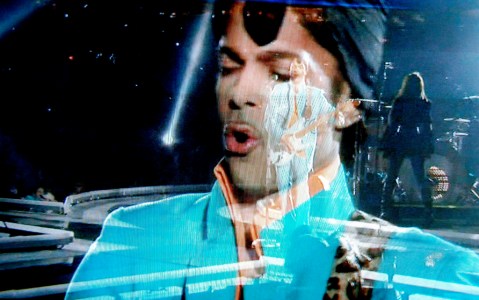
Image by Flickr User Ann Althouse, 2007
Touré writes in a New York Times obit of Prince’s “holy lust,” the “commingling” of sexuality and spirituality. Jack Hamilton writes of the doubt and moral uncertainty that coursed through songs like “Little Red Corvette.” Holy lust is arguably the central pursuit of rock; the term “rock and roll” is etymologically linked either to intercourse or worship, appropriately, emerging in both cases from African-American vernacular. Prince’s queer play with sex, sexuality identity, and religion is as rock and roll as it gets.
As punk sputtered, Simon Reynolds writes in Rip it Up and Start Again, funk appeared to rock fans as a racially tinged, politically and sexually charged savior. Bass, the heart of funk, was key to punk becoming post-punk around 1980. The instrument was suddenly charged with new symbolic and structural importance. During the same period, it is remarkable how many of Prince’s songs either have no bass, or rework bass’s role entirely. “When Doves Cry,” from Purple Rain (1984), Prince’s 6th studio album, is the best-known example of an ultra-funky track that withholds bass entirely, but “Kiss” lacks it, too, as well as “Darling Nikki.”
Earlier on Purple Rain, the bass on “Take Me with U” plays almost as a drone, buzzing like a minimalist’s organ.“Kiss,”from 1986’s Parade and Prince’s second-biggest hit —yet only #464 on the Rolling Stone list of the 500 Greatest Songs of All Time—is so tight, so locked in, so populated by alluring timbres that suggest an alien plane of instrumentation, that you forget it’s even supposed to have bass by rock top 40 convention. On much of 1980’s Dirty Mind, it is difficult to know which carefully tweaked synthesizer tone is supposed to index the bass, if any. Prince’s funk was even funkier for being counterintuitive, as Questlove notes. This gesture wasn’t rejection, of course, it didn’t “transcend” funk. Prince was still playing inarguably funky music, and the lack of bass is so unusual that it’s almost even more apparent in its absence. Free, but not too free.
Prince approached rock iconicity much as he approached bass, which is to say that he embraced clichés, but performed them inside-out, calling attention to them as both limits and possibilities, as constraint and freedom. “Raspberry Beret,” from 1985’s Around the World in a Day, is a boppy “girl group” song with sly allusions to anal sex, that uses exotic instruments and is written in an obscure mode. The virtuosic riff on “When Doves Cry,” instead of going where guitar solos go, comes right at the beginning of the track, before the drums, both seemingly isolated from the rest of the song and yet heralding it, too.
All of this worked very well, of course. His songs are just idiomatic enough to give listeners a foothold, but brave enough to evoke a world well beyond idiom. In retrospect, this is precisely what Little Richard had done. This is also what Hendrix and George Clinton and Tina Turner and OutKast have done, from where they rock out—way beyond the citadel, mastering many idioms, then extending them, at once codifying and floating away from genre.

Andre 3000 of OutKast rocking outside the box at Lollapalooza 2014, Image by Flickr User Daniel Patlán
Prince’s career calls back to the personal and artistic concerns, as well as the innovations, of Little Richard and other artists’ sonic expressions of blackness that both built rock’s house and sounded out the tall, white walls of the citadel that would exclude them. All of these artists, I suspect, find little point to hanging out near the citadel’s gates; there are other, funkier places to live. Prince himself was perfectly comfortable working athwart Warner Brothers, the press, stardom. He did more than fine.
We are free to interpret Prince, but not too free. Creative as he was, he lived in his time; he was no alien. The greatest testament to his genius is not that he escaped the world, nor that he rendered a new musical landscape from scratch, but rather that he worked in part with rock’s sclerotic structural materials to create such beautiful and fluid work.
—
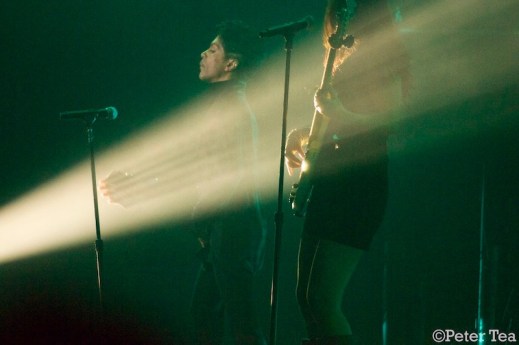
Featured Image by Peter Tea, July 12, 2011, under Creative Commons license No Derivatives 4.0 International (CC BY-ND 4.0)
—
Benjamin Tausig is assistant professor of ethnomusicology at Stony Brook University, where he works on sound studies, music, and protest in Bangkok and other urban spaces. He is on Twitter @datageneral
—
 REWIND!…If you liked this post, you may also dig:
Enacting Queer Listening, or When Anzaldúa Laughs–Maria Chaves
Learning to Listen: The Velvet Underground’s “Once Lost” LPs–-Tim Anderson
Music Meant to Make You Move: Considering the Aural Kinesthetic-Imani Kai Johnson
Black Mourning, Black Movement(s): Savion Glover’s Dance for Amiri Baraka–Kristin Moriah
Share this:


Current Top Posts





April 2021

January 2020

November 2019

October 2019

August 2019

April 2014

November 2017

March 2015

December 2017

October 2015
 Sounding Out!
Recent Comments