
The Noisiest City on Earth? or, What Can the 2012 Manhattan Noise Complaint Maps Really Tell Us?

“It’s a city, not a cemetery. You can’t tell everybody to go around wearing earplugs.”
Ex-New York City Parks Commissioner Henry J. Stern, quoted in “Many Pleas for Quiet, but City Still Thunders”
In 1905, a New York Times article declared New York City “the noisiest city on Earth.” More than a century later—this summer, to be exact—The New York Times ran a series on noise in New York City titled “What? The Long War on Loud” that proved that this city is still trying to figure out its relationship to sound. (One of the gems of that series? “New York’s War on Noise” timeline.) As a displaced New Yorker, some of my most vivid memories of the city are aural. Although New York City isn’t the only loud city out there, there are many reasons it’s called “The City That Never Sleeps”—and sound has a lot to do with it, depending on which neighborhood you call home.
Now you can see what neighborhoods are allegedly noisiest, and where all that noise comes from. Brooklyn designer Karl Sluis created the 2012 Manhattan Noise Complaints maps (click for full image), in which Sluis correlated the data on 311 noise complaints made during the year 2012 (40, 412 complaints, to be exact) that he obtained from the NYC Open Source site with Manhattan’s geographical coordinates. He used circles of various sizes to a) create an aural tracing of the island of Manhattan, sitting in a sea of turquoise blue b) showcase the number of complaints in an area. The bigger the circle, the larger the number of complaints.

Screen Capture of Karl Sluis’s 2012 Manhattan Noise Complaints maps (click for interactive image)
The maps Sluis has created are helpful for visualizing the complaints on a broad scale, but they paint an incomplete picture of what noise means in New York City. The demographics of each neighborhood are absent from each map, a slight that can perhaps be traced to the 311 data available, but in order to better understand how New Yorkers define “noise” those stats must be included. Both Sluis and John Metcalfe from The Atlantic Cities discuss notable findings, but neither takes into account the fact that some of the areas with a higher concentration of noise complaints are not just densely populated but densely populated with racial and ethnic minorities. Indeed, comparing the maps’ noisy hotspots to a map of Manhattan racial demographics reveal how urban racial dynamics intersect with ideas about sound and power: who can make sound, who must be chastised for making noise, who can complain and whose complaints are actually being heard.

“Unnecessary noise prohibited” by Flickr user Ricky Leong, CC BY-NC-SA 2.0
Mapping noise complaints gives a spatial dimension to noise, and it renders noise palpable, in a way. Sluis points out, “Noise complaints reveal the concentration of activity in the city as well as many smaller stories, such as the construction of the Second Avenue subway line, idling buses on the Upper East Side, and the homes of the loudest dogs (or the least patient neighbors).” He reminds us that the data comes from complaints and not necessarily decibels; in other words, it represents local ideas of what counts as sound and what counts as noise.
While Metcalfe correctly describes the thousands of 311 complaints about noise from 2012 as “the entire year’s expression of mass annoyance,” Sluis’s map does not go far enough toward figuring out whose annoyance, exactly. We must remember that annoyance oftentimes stems not just from physical reactions to noise but rather one’s perceptions about noise, what Jennifer Stoever-Ackerman deems “the listening ear.” How we hear others, Stoever-Ackerman argues, is not as natural as it seems. For example, whom we deem as noisy may stem from our community, our parents, and/or social conditioning. Accounting for race/ethnicity in noise maps will show how the listening ear conditions neighbors to categorize and react to certain sounds.
For the purpose of this analytic exercise, I compared Sluis’s maps and the Center for Urban Research, CUNY Graduate Center’s 2010 map of block-by-block demographic changes in New York City, in order to illustrate how population density and racial/ethnic demographics play a role in concentrated pockets of noise complaints. Drawn from 2010 census data, the CUNY map clearly delineates neighborhoods and color-codes the groups in each neighborhood per block: blue for whites, green for Latino, orange for black, purple for Asian, and grey for “Other.” Although the Center for Urban Research, CUNY Graduate Center’s maps cannot be superimposed on Sluis’s maps, they help give a general idea as to where neighborhoods are located in addition to racial demographics.
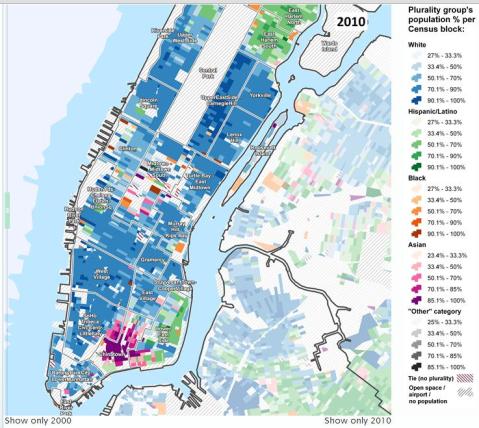
Manhattan below 110th Street in 2010, courtesy of the Center for Urban Research, CUNY Graduate Center

Manhattan above 110th Street 2010. Courtesy of the Center for Urban Research, CUNY Graduate Center
From the maps illustrating changing race/ethnicity patterns, I gathered what neighborhoods were predominantly white (West Village, Lincoln Square, Yorkville, Upper West Side), predominantly Latino (Washington Heights, East Harlem) predominantly black (Central Harlem, parts of Hamilton Heights), and predominantly Asian (Chinatown, blocks of the Lower East Side). When one compares Sluis’s overall noise map of Manhattan to the racial demographic maps of Manhattan, what stands out is that the major circles of noise complaints are also places where there are different racial and ethnic groups mingling (for example, Times Square) or places that are populated by mostly minorities (Hamilton Heights). Whereas Sluis flattens out the noise complaints, demographic stats point to the racial/ethnic contours of each neighborhood. Sluis’s maps focus on number of complaints; unfortunately this assumes everyone complaining is the same and that everyone making the noise is the same—a level aural playing field if you will. Bringing demographics into the equation underscores how not all complainers are equal and how not all complaints carry the same heft.
The city may be noisy, but “noisy” is relative. Sluis’s map shows some predictably noisy areas for those of us familiar with Manhattan’s soundscape (Union Square, Times Square) but it also draws attention to other areas not as predictable in the mainstream imagination (East Harlem South, Hamilton Heights). However, the maps by the Center for Urban Research, CUNY Graduate Center help us better understand the context for the high or low number of complaints in certain areas. For example, one of the biggest circles on Sluis’s general map of Manhattan is located in the Hamilton Heights/Washington Heights area; the Center for Urban Research, CUNY Graduate Center’s map of Manhattan above 110th Street show that these areas are densely populated by blacks and Latinos/as. This is key information because it reminds viewers that this neighborhood is a lot more ethnically diverse than other neighborhoods with a smaller number of complaints. It brings to mind: what role does race play in these complaints, in terms of those who complain and those who are the focus of the complaints? Although more people might mean more complaints, the prevalence of complaints like “loud talk” in East Harlem (Spanish Harlem) are nevertheless connected racialized ideas about people of color being “loud.” This doesn’t assume that the people complaining are white, but that they are complaining about groups that are characterized as loud, noisy, rowdy.

“Classic New York: noise, smoke” by Flickr user Will, CC BY-NC-ND 2.0
These noise maps, when put into conversation with demographic data, also indicate what areas are priorities in urban planning—the sounds of gentrification. The visualizations of the complaints by section (under the main map), combined with CUNY’s maps, are even more telling because they break down the number of complaints by category. The aforementioned northern tip of Manhattan, for example, is also where many of the complaints are concentrated. At a glance, loud parties, loud people, and loud car stereos seem to be the major complaints in those areas, according to Sluis’s visualizations. Meanwhile, noises of “urban growth,” such as construction and jackhammers, are less prevalent in these areas, whereas they are more prevalent below Central Park North, in now mostly-white neighborhoods.
Sluis’s maps of the 311 noise complaints data allow readers to see differences in terms of neighborhoods: who complains the most? what do they complain about? However, one thing to keep in mind is that first question: who makes the complaints. This is where the data falls short. Can it be assumed that those who are calling about the noise are mostly people who live in the neighborhood? Are Upper Manhattan neighbors less or more tolerant of noise? The answers to these questions, although they’re not found in Sluis’s map, point to how ideas of who is noisy or who can make noise are at play here.
I do not mean to downplay the usefulness of Sluis’s map. I instead call for the necessary addition of key missing factors to future noise maps in order to give us a more complex picture of noise complaints in Manhattan and elsewhere. Although it may not be possible to gather who the 311 callers are, including factors such as race and class may lead to very different noise maps. For example, what would a noise map of Manhattan look like if researchers brought income into the equation? Income inequality, especially in Manhattan where that imbalance is starkly on display, matters for the purpose of sound mapping. The more affluent neighborhoods are also the ones with less complaints and are the ones that are mostly inhabited by whites. Wealthier communities are more spread out and have more ability to couch themselves from noise, not to mention that it probably takes fewer complaints to get a response.

“Marcus Garvey Park Drum Circle, Harlem, NYC” by Flickr user j-No, CC BY-NC-ND 2.0
Gentrification is another factor: what kind of analysis could we do if we considered what neighborhoods have been gentrified in the past ten years? It is possible that as whites move into neighborhoods where people of color have historically lived, suddenly they find them noisy—hence, complaints. It is fitting to consider, for example, the tension between an established group of drummers in Marcus Garvey Park in Harlem and the inhabitants of a new highrise (characterized as “young white professionals”) who wanted the 30-years and running drum circle shut down, as reported in The New York Times in 2008. Moreover, if we accounted for the history of zoning in the neighborhoods that have the most or the least complaints it would add another layer of analysis to the data. Are some of these neighborhoods used as entertainment zones, for example? Is it easier to open up bars there than elsewhere in the city?
With these questions in mind, the maps go from beautiful renditions of data, to opening up a bigger conversation about the arbitrariness of noise. The demographical and sociological context of these noise complaints must accompany the raw data, especially when it comes to sound. The analysis also points to the source of the data: 311 calls. I wonder if this is the only way that people in Manhattan (and New York City at large) are dealing with noise. I’m sure that after a century of being “the noisiest city on Earth,” folks have gotten creative about it.
—
Featured image: ” Stranger 10/100 Johano” by Flickr user MichaelTapp, CC BY-ND 2.0
—
Liana M. Silva-Ford is co-founder and Managing Editor of Sounding Out! She is also known professionally as the Writer Whisperer.
—
 REWIND! . . .If you liked this post, you may also dig:
“I’m on my New York s**t”: Jean Grae’s Sonic Claims on the City -Liana Silva
The Noise You Make Should Be Your Own–Scott Poulson-Bryant
Sounding Out! Podcast Mini-Series (#16): Listening to The Tuned City of Brussels, Day 1: “Noise”
Share this:

Hello, Americans: Orson Welles, Latin America, and the Sounds of the “Good Neighbor”

 And now, we interrupt this broadcast for a message from Guest Editor Neil Verma: At 9:00 pm on July 11, 1938, the Columbia Broadcasting System unfurled a plush Tchaikovsky concerto to welcome 23 year-old wunderkind Orson Welles and his Mercury Theater troupe to national airwaves for a show destined to become the most famous dramatic radio anthology ever aired.
The Mercury Theater on the Air came with hype. Welles was fresh off a streak of innovative stage adaptations of Shakespeare’s “Julius Caesar,” Shaw’s “Heartbreak House,” and Marlowe’s “Doctor Faustus,” pledging in a New York Times article to “treat radio with the intelligence and respect such a beautiful and powerful medium deserves.” A jab at his rivals? Maybe. Legends tell of 17-hour writing sessions, of rows minutes before airtime between Welles, producer John Houseman and composer Bernard Herrmann, of sound men abusing baskets, watermelons, toilets, lawnmowers to make audio. Time described Mercury’s ambition as “bounded north and south by hope, east and west by nerve.”
Welles was by then a radio veteran, the hero of The Shadow and impersonator of newsmakers from Sigmund Freud to Fiorello laGuardia on The March of Time. Hundreds of extant recordings link Welles to rousing Norman Corwin pageants, Columbia Workshop experiments, strident war shows like Ceiling Unlimited, buffoon turns on the Jack Benny and Fred Allen Shows, picaresque Harry Lime adventures, dense thrillers on Suspense, romances on Lux Radio Theater, diplomacy on Hello Americans, and on and on. Welles gave radio new forms, as radio informed his filmmaking profoundly – the sound of Citizen Kane (1941) the characters in Mr. Arkadin (1955), the vocals in Touch of Evil (1958) the theme of F is for Fake (1974). Welles invented a cinema that is, among other things, a kind of radio play you can see.
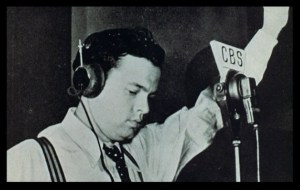
Mercury (and the Campbell Playhouse it became) undertook plays like “Dracula,” “Treasure Island,” “The 39 Steps,” “Rebecca,” “Jane Eyre,” and “The Magnificent Ambersons” and dozens of others. But none would be remembered were it not for the “War of the Worlds,” adapted from H.G. Wells’s novel by Howard Koch. In October of 1938, WOTW aired to six million listeners, hundreds of thousands of whom misheard it as news. The “Panic Broadcast” became a series of fables: listeners treated for shock in Newark; families on Boston rooftops watching the fires of New York in the distance; an Indianapolis church service interrupted by a parishioner telling congregants “you might as well go home to die;” bomb threats and a police raid on CBS headquarters. Three quarters of a century later many agree with the New York Tribune’s Dorothy Thompson, who declared the Invasion “one of the most fascinating and important events of all time,” but the meaning of that event also feels unclear, growing more ambiguous with time. Today, the alien invasion is itself increasingly alien.
To confront that issue and to open Mercury to new kinds of critical practices in sound studies, Sounding Out! is partnering with Antenna over the next six months to bring you a 12-part series entitled From Mercury to Mars: Orson Welles on Radio after 75 Years. I’m honored to serve as Sounding Out!‘s Guest Editor. We’ll be bringing you authors who engage aesthetic, historical and political aspects of Welles’ radio work with a depth and intensity unusual in Welles studies.
That’s especially true of this inaugural post by Cornell Comparative Literature Professor and SO! contributor Tom McEnaney, who has been working on a book project involving radio and the “neighborhood” of the Americas. I’m thrilled welcome Tom’s nuanced and provocative take on Welles’s adaptation of Joseph Conrad’s Heart of Darkness and his Hello, Americans program, and I hope it will encourage you to stay with us as the series unfolds.
Like Welles, we’ve got a few tricks up our sleeve. Stay tuned. — nv
—
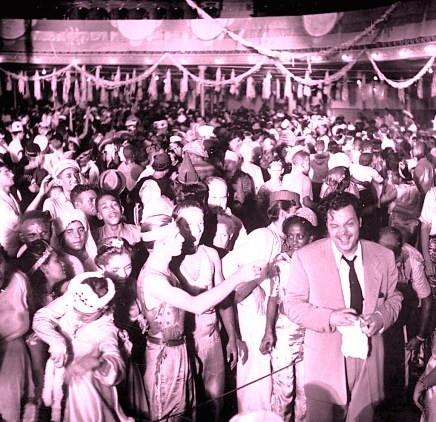
When WNYC’s Radiolab aired their live celebration of War of the Worlds five years ago, the odd laugh line was reserved for a moment at the start of the radio play when an announcer interjects “now we return to the music of Ramón Raquello and his orchestra.”
Raquello, as the Radiolab team makes clear, didn’t exist, and his “orchestra” was just an anonymous phonograph recording of the famous tango “La cumparsita.” Welles apparently chose the song for its “tedium,” hoping it would make believable the lunacy to come. That the music of the Southern Cone set up listeners in the United States for the greatest hoax in history might have been yet another of the inside jokes Welles left us to listen for.
The sounds of Ramón Raquello and the settings of some of Welles’s most famous films—The Lady From Shanghai (1947); Touch of Evil (1958)—remind us how Latin America, and its relationship to the United States, fascinated Welles in the late 30s and 40s. Five years after War of the Worlds, he began the final episode of his CBS program Hello Americans by recalling the show’s mission: “It is important for the people of this hemisphere to get better acquainted, and the Mercury [Theater] has been given the job of helping out with the introductions.”
An artful propagandist, Welles told Nelson A. Rockefeller, FDR’s head of Inter-American Affairs and Welles’s boss at RKO studios, that radio and film were the best way “to sell South America to North America.” Between 1938 and 1943 his technical innovations in film and radio, in addition to a 1942 stint as a “good will ambassador” to Latin America, created for him by Rockefeller, were meant to convince U.S. audiences of FDR’s claim in his first inaugural that the United States should follow the policy of the “Good Neighbor.” Whether listening, watching, or reading his work during World War II, Welles’s U.S. audiences were constantly reminded that they were residents of the Americas, rather than an exceptional and isolated America.
To assess the aesthetics and politics of Welles’s engagement with Latin America, it’s worth returning to the October 30, 1938 broadcast of War of the Worlds. Presented as a live news report of an alien invasion on the East Coast of the United States, War of the Worlds sent its mass audience into hysterics, proving to Marshal McLuhan that radio was “a tribal drum,” capable of calling forth the “archaic forces” of “the resonating Africa within” (301). The primitivist and racist logic in McLuhan’s Understanding Media (1964) sought to explain away the irrationality he (and his Frankfurt School forebears) identified as the enlightenment’s dialectical twin by exiling it to Africa. In this, he might have merely followed Welles’s Mercury Theater, which aired a production of Joseph Conrad’s Heart of Darkness a week after War of the Worlds, thus linking an allegory about fascism (and radio’s dangerous complicity with irrational politics) to a Conrad adaptation that critic Michael Denning calls “a fascist parable” exalting “power for power’s sake” (376).
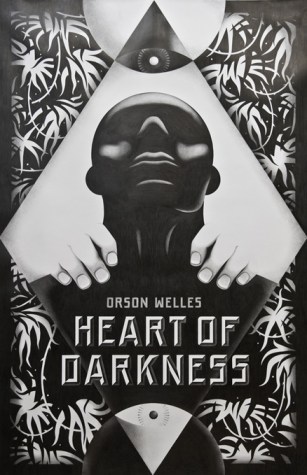
Yet these radio works concern themselves with fascism from very different narrative and social positions. While War of the Worlds depicts an alien invasion, his Heart of Darkness describes a journey towards the alien racial Other, presenting listeners with what had become by 1938 the more mundane miracle of radio—to bring them close enough to hear Kurtz’s haunting repetition: “the horror, the horror.”
Welles, who plays both Kurtz and Marlow in the conversation that leads up to these climactic lines, depicts here the seductive power of his own voice, able to encapsulate the story’s most important characters, and, as Kurtz, to impress even himself, as Marlow.
“Mr. Kurtz,” Marlow / Welles says with awe, “is a remarkable man.” Repeating a line heard throughout the play, Marlow’s words are slyly deflated when they are echoed, with a tone of critical distance, in the voice of one of the ivory company’s employees, a voice that stands in for the listening audience, and encourages their own distrust of Marlow’s naïve faith in Kurtz’s lust for power.
Meanwhile, the play tells a complimentary story of proximity and distance: as the boat moves back down the river, the music shifts from tribal drums to spiritual laments to a meandering jazz saxophone, tracing, in basic and exoticist fashion, a capsule history of African diasporic music.
One year later, Welles also attempted to adapt Heart of Darkness as his cinematic directorial debut for RKO, shifting the frame narrative to New York City, while planning to shoot on location in Panama, where expansion had begun that year on the Panama Canal to allow for the transportation of US warships. For this project, Welles planned a first-person camera technique, mimicking his radio work with first person address. The Mercury Theater’s program, originally named “First Person Singular,” placed listeners on the scene. In film the technique became even more immersive, plunging the audience into uneasy, inescapable identification with Marlow’s point of view.
 The first person in Welles’s screenplay combines Heart of Darkness’ journey into alien territory with War of the Worlds’ alien invasion—the sense that the audience was under attack. Forced to look out through the eyes of the imperialist adventurer Marlow, the audience surprisingly became the object that everyone in the film watches. The technique could prove threatening to the predominantly white and male movie audiences in the United States of 1940, as Welles planned to enlist 3,000 African American actors to play the so-called natives on the shores of the river—2500 more black extras than worked in Hollywood at the time. When the audience fell under the black gaze in the Canal Zone, where African American men increasingly worked as part of the defense industries, the story’s imperialist theme would have pointed back to the United States’ own racist working conditions, revealing the nation’s complicity and subordination to the imperialist pursuit whose destiny is the primitivist conditions it creates.
RKO rejected Welles’s screenplay, as they did his later documentary project, It’s All True, which sought to transform his 1942 trip throughout Latin America into a tale that fused “the story of samba” with “the story of jazz” to situate African American and Afro-Brazilian musical cultures at the heart of Pan-American culture. Welles soon repurposed the material from It’s All True for a radio program entitled “Hello Americans” that attempted to complete the shift in representation towards a more lateral and dialogic notion of adjacency, positioning U.S. and Latin American culture on the same plane. The means to make these introductions included interviews with and recordings by musicians from Cuba, Brazil, and Mexico, historical tales about Montezuma, Toussaint L’Ouverture, Benito Juárez, Atahualpa and others.
In the show’s most experimental section, Welles simultaneously reinforces and mocks the idea that radio’s ability to collapse distances and transcend borders makes it the medium to communicate the idea of neighborliness.
 Transporting his audience to “a clay hut somewhere in South America,” Welles introduces a small family in which the son, Juan, builds radios at a new factory, and his father, José, listens to the device. Once the broadcast begins, the listening audience within the frame—Juan, José and his mother—share the same space as the audience listening to “Hello Americans.” All listen together as a broadcast voice introduces Roosevelt’s inaugural address, then Roosevelt’s recorded voice announces his policy of the Good Neighbor, and finally static interrupts Roosevelt’s voice, and a German accented voice takes over to complain about “the republic of the Jew Franklin Roosevelt.” When José comments that the broadcast seems strange, his son Juan answers, “Oh no, they’re all like that. Señor Schmidt at the factory told us it’s uh, it’s because we’re closer to Germany.” Then, a musical curtain falls and Welles returns to reassure his audience that “Juan has learned. Today he works in another factory and he’s a member of the Latin American Confederation of Workers.”
The passage distinguishes between voices—José, Juan, the US broadcaster, Roosevelt, and the German propagandist—and reflects the imagined proximity implicit in Roosevelt’s idea of the Good Neighbor. But the technique also reveals how “Señor Schmidt” and his countrymen take advantage of the geographical confusion made possible by radio’s transcendence of borders to imply that Germany is actually more of a “neighbor” than the United States. These types of confusion between imagination and reality had once launched listeners into panic, but now Welles steps in to calmly and condescendingly reassure the audience that Juan “has learned.” Learned, that is, to join the left leaning Confederation: an untenable statement on US radio less than a decade later.
And yet, the unnamed obstacle impeding both foreign transmissions is language itself. Because everything filters through English, with accents marking the space between Spanish and German, Hello Americans imagines Pan-Americanism through one language alone. Radio’s monolingualism highlights one of the medium’s limitations. Whereas It’s All True could employ subtitles, and allow audiences to listen to a subject’s voice while reading what they said, radio faltered on its most medium-specific component – words.
 Furthermore, while Welles imagines a “neighborhood” for all Americans, listeners lose the more radical racial politics he had once placed at the center of his Haitian Macbeth (1936), Heart of Darkness (1938), his theatrical production of Richard Wright’s Native Son (1941) and It’s All True (1942). Together these works place the African diaspora at the center of U.S., Pan-American, and world culture. They insist that the attack on fascism abroad must include a change in race relations at home. More ambivalently, they reveal Welles participating in acts of love and theft – a New Deal Kurtz, he draws the power to criticize fascist power from exoticized images of Afro-Caribbean, Afro-Brazilian, and African American cultures, supporting and appropriating the art and struggles of the African diaspora to bill himself as the cultural leader of, not just the ambassador for, Pan-Americanism.

Orson Welles as Othello (1952)
—
Tom McEnaney is an Assistant Professor of Comparative Literature at Cornell University. His work focuses on the connections between the novel and various sound recording and transmission technologies in Argentina, Cuba, and the United States. He is currently at work on a manuscript tentatively titled “Acoustic Properties: Radio, Narrative, and the New Neighborhood of the Americas.”
—
REWIND! . . .If you liked this post, you may also dig:
DIANE… The Personal Voice Recorder in Twin Peaks—Tom McEnaney
On the Lower Frequencies: Norman Corwin, Colorblindness, and the “Golden Age” of U.S. Radio–J. Stoever-Ackerman
The Sound of Radiolab: Exploring the “Corwinesque” in 21st Century Public Radio— Alex Russo
Share this:


Current Top Posts





April 2021

January 2020

November 2019

October 2019

August 2019

April 2014

November 2017

March 2015

December 2017

October 2015
 Sounding Out!
Recent Comments