
“Just for a Few Hours, We Was Free”: The Blues and Mapping Freedom in Sinners (2025)

In the 2025 blockbuster Sinners, Ryan Coogler has a vampire story to tell. But before he can begin, he needs to tell another story—a blues one. Sinners opens with a voiceover thesis statement performed by Wunmi Mosaku (who plays Annie in the film—more on her below) about the work the blues can do, then rambles the narrative through and around 1932 Clarksdale, eventually settling into a juke joint outside of town. Here, the blues story builds to a frenzied climax, ultimately conjuring the vampires propelling the film’s second half. It’s those vampires that most immediately register as cinematic spectacle, but Coogler’s impetus to film in IMAX and leverage all of his professional relationships for the movie wasn’t the monsters—it was to showcase the blues at a scale the music deserves. In Sinners, the blues takes center stage as a generative sonic practice, sound that creates space to be and to know in the crevices of the material world, providing passage between oppression and freedom, life and death, past and future, and good and evil.
I’m not exaggerating in calling the opening voiceover a thesis. In a movie where Coogler trusts his audience with a great deal of interpretation, he puts an incredibly fine point on the role that blues performs here. We’re told that some musicians—be they Irish, West African, Native American, or southern US Black—are so skilled that they can pierce the veil separating the living from the dead, and while this piercing can help heal a community, it can also attract a certain evil that wants to exploit this rupture. The narrator doesn’t say “It’s the blues!” but the next visual information we get is that it’s Clarksdale, MS, in 1932, and an injured, blood-soaked Sammie (Miles Caton) is stumbling into his father’s church, clutching what’s left of the neck of a guitar. No one in Sinners says the word “crossroads,” but here we are, at the place where the blues meets the devil—where the end meets the beginning–and our young hero has a choice about which way he’s going to go.

If Coogler doesn’t fully trust his audience to know what to do with the blues without being told, it’s likely due to decades of commercialized attempts to defang the genre that have filtered out 21st century listeners’ ability to hear most of what makes the blues potent. Drawing on what Clyde Woods in Development Arrested (1998) has termed the “blues epistemology,” a blues way of knowing, B Brian Foster speaks with contemporary Black Clarksdalians in I Don’t Like the Blues (2020) to chart much of the current state of the blues. Pulling on one particular thread of Foster’s ethnography can help clarify what’s happening in Sinners, as he unpacks the many reasons why the blues don’t resonate quite like they used to.
In Woods’s framework, the blues is more than a musical genre; it’s a way of understanding and, crucially, reshaping one’s world. The blues, a genre arising in the late 19th century and reverberating through the 20th, functioned as epistemology in order to explore a way out from under plantation power after Reconstruction and through Jim Crow. Woods chronicles centuries of “plantation power” in the Delta and how that power reconfigures itself over and again through different eras of US history, always with the goal of extracting labor and life from Black Mississippians. The blues pushed against the edge of what was considered possible and sought to imagine and create a world that was free—not just from plantation power but from all the logics that support it or would circumscribe Black self-determination and autonomy. In I Don’t Like the Blues, Foster encapsulates the heart of blues epistemology with a flourish: “While many people hear the blues as performance and play, Black residents of Clarksdale knew it to be flesh and bone, a spirit in the dirt. Their blues was a conduit. A map. A method” (15-16). Throughout his book, Foster demonstrates that what the blues was is no longer what the blues is. One of those reasons is that resistance to plantation power (whether in the Delta or beyond) simply sounds different now, having worked its way through jazz and funk and soul and hip hop and trap.

In Sinners, Coogler starts by telling us what the blues could do, then he shows us that power in a climactic scene midway through the film, reminding his audience that a blues epistemology might not always sound the same, but it can still do the work of mapping out freedom. After the camera cuts away from Sammie at the crossroads in his church, we loop a bit back in time to meet Sammie’s cousins, the SmokeStack brothers (twins played by Michael B Jordan), who purchase the juke joint’s eventual location. The first half of the movie follows the brothers as they split up and get the band—and hospitality crew—together to open the venue that night. Sammie is new to this life, but a deeply gifted bluesman, and he receives counsel along the way about what the music is and how it works. Once the juke is packed, the booze is flowing, and the dancefloor is sweating, Delta Slim (Delroy Lindo) invites Sammie to take the stage and tell the people who he is and where he’s from. What follows is an ambitious narrative and technical feat that pays off the opening voiceover.
Sammie, also known as Preacher Boy, launches into a song called “I Lied to You,” addressed to his minister father (played by Saul Williams). It’s a confession that he’ll take the blues over the church any day. His singing pierces the veil, and we witness a litany of musicians joining the space from the past, present, and future: an Afrofuturist rock guitarist, hip hop DJs, breakers, twerkers, a ballerina, a Zaouli dancer, and Beijing opera performers, among others. Weaving in and out of Sammie’s blues, the sounds of each of these musicians layer and feed back into the mix to create a densely ecstatic sequence. This is the community healing piece of the voiceover thesis. The performers joining from far-flung places and times connect to an ancestral lineage of creative self-determination that runs through the patrons of the juke joint (Bo and Grace—played by Yao and Li Jun Li, respectively—are Chinese shop owners helping out at the juke joint and the presumed source of the Beijing opera performers).
Sinners’s musical conjuring isn’t an academic article, but it does have some musicological points to make. Audiences encounter musical styles uprooted from specific times and places, all mingling around this blues moment in 1932 Clarksdale. Coogler structures the scene by stacking out-of-time sound and movement, emphasizing the potency of a blues epistemology while also acknowledging that the blues’s power is situational. In its time—post-Reconstruction and Jim Crow—the blues could call in and draw on the fullness of diasporic music-making and world-mapping. But at other times, and in other places—say, a 2025 music venue—the blues is less likely to ignite such a moment as it is to show up as a participant, arriving as one of many in the musical ancestry to support the veil-piercers of the day. This phenomenon is the “changing same” of Black music, as Amiri Baraka put it in Blues People: “consistent attitudes with changed contexts” that explain why the sound changes over time (153). In Sinners, the immediate context is a community of Mississippi sharecroppers who seek healing, and the blues widens the frame so that the juke joint revelers can connect to and draw strength from a broader, deeper community beyond the edges of their material world.
As “I Lied to You” mingles with sounds past and future, the camera moves through the juke in a counterclockwise motion, grounding the scene further in diasporic ancestral practices. In Slave Culture (1987), Sterling Stuckey traces elements of Bakongo burial ceremonies throughout the New World, focusing especially on the ring shout, a sacred ceremony practiced by enslaved people in the United States involving a shuffling circular dance accompanied by song. Consistent across these traditions is counterclockwise movement:
Wherever in Africa the counterclockwise dance ceremony was performed—it is called the ring shout in North America—the dancing and singing were directed to the ancestors and gods, the tempo of the circle quickening during the course of movement. The ring in which the Africans danced and sang is the key to understanding the means by which they achieved oneness in America (12).
The counterclockwise circulation rehearses the life cycle, with the sun rising in the east (birth) and setting in the west (death), only to rise again (gesturing toward the connected nature of all life).
Stuckey draws on Robert Farris Thompson to note that special emphasis on counterclockwise motion would happen in Bakongo rituals that superimposed a cross on the circular movement, where the horizontal line represented the division between the living (above) and the dead (below). Here is the dividing line of Sinners, then: an ancestral ceremony with a crossroads superimposed on it, a blues invocation where the audience is propelled counterclockwise through the circle of juke joint dancers, where the dead and not yet alive join in the festivities.
The theme of lineage and ancestry courses through Coogler’s work. On the personal level, this may play out as a boxer sparring with his late father’s legacy. On a larger scale, Coogler often traverses the land of the Great Migration and the sea of the Middle Passage, tying back together the threads left dangling by the terrorisms of the transatlantic slave trade and Jim Crow. For a people whose lineage was savagely untethered by their ancestors’ enslavers, the power of a blues epistemology comes from its ability to tap into traditions and rituals that couldn’t be fully severed, restoring the “oneness” of those engaged in the dance and fueling their ability to imagine and create a path to freedom.
There is the other part of the voiceover’s thesis statement, though. When you pierce the veil, evil seeks to charge through. As the “I Lied to You” sequence hits peak intensity, Coogler treats movie audiences to another visual effect that the blues performers cannot see but feel; the juke joint appears to spontaneously combust and its roof is on fire (the roof, the roof. . .). Coogler metaphorically lets the motherfucker burn, down to the concrete foundation supporting the people as they continue to dance. At the edge of the dusty parking lot, the movie’s villain—an Irish vampire named Remmick—watches lustily while flanked by his latest converts. He wants Sammie; particularly what Sammie knows how to do.
Because Remmick hive-minds with whomever he turns into a vampire, taking on their memories and abilities, if he can get at Sammie, he’ll be able to pierce the veil, too, and commune once again with his long lost ancestors. We could read Remmick’s drive as an allegory about cultural appropriation, a white man who wants to steal the blues, and certainly there’s an element of that at play. But the “Killmonger was right” corollary of Coogler films suggests that villains are often more complex than they may at first seem. In Sinners, there’s a mob of Klansmen that function as the more straightforward baddies, but Coogler isn’t interested in giving them much screen time. Yet he lingers with Remmick just as he did with Killmonger and Namor in his two Black Panther installments. In each of these cases, Coogler explores different experiences of what it’s like when the boot of Empire is on your neck. Remmick, coming from Britain’s first colony, speaks of his home being taken and of religion being forced on him. He seems to hold genuine disdain for the Klan and notes that he’s happy to turn them all to prey, not because he wants what they have but because they deserve a gruesome death. He plays and dances to the music of his ancestors with care and devotion. And he argues that what he has to offer—community with his coven, the power to overtake the plantation class, eternal life—is better than what Smoke, Stack, Sammie, and the rest of the juke joint patrons currently have.

No one living trusts Remmick—in fact, Annie (Mosaku), the heart, brain, and wisdom of the movie, specifically distrusts him even before he reveals his true vampiric nature. And Coogler doesn’t position Remmick to be perceived as “good” in any sense of the word, except at playing that banjo. But, like Killmonger and Namor, Remmick gets to be right about some things. It appears in flickers of concession on characters’ faces when Remmick tells them they live in a place where they’ll always have to fight to even try to be truly free. It appears again when the juke joint protectors melt a bit during Remmick & Co’s performance of “Pick Poor Robin Clean,” a glimmer of a thought of “wait, should we let them come inside and play this absolute bop??” (for detailed historical context for this song see Daphne Brooks’s “See My Face on the Other Side” [2017]). Coogler’s villains ultimately suffer defeat, but before they do, he makes sure audiences glimpse how they’ve suffered under Empire, offering an understanding of their destructive actions as born of unhealed generational trauma.
Piercing the veil is tricky work. Dangerous work. In The Long Emancipation (2021), Rinaldo Walcott notes that “much of what we have come to call Black culture is a mode of living life within, against, and beyond plantation logics” (20), not only a rejection of logics of oppression but also a practice of creating and nurturing something else. To set about finding knowledge and being, as Sylvia Wynter puts it, “completely outside our present conception of what it is to be human” is to set off into the not-fully-known, where one may encounter a variety of ideas and beings who won’t ultimately lead you to freedom but who may offer you something a little better than what you’ve got (Wynter, 2000 interview with David Scott, 136). Walcott calls this the difference between emancipation and actual freedom. While emancipation is often mistaken for freedom, Walcott argues that “postemancipation acts of Black life have been consistently interdicted, thereby preempting and often violently preventing Black life from authorizing its own desires for bodily autonomy” (105), preventing Black life from being free.
In Sinners, Coogler shows us the way the blues could clear space for finding freedom, but none of the characters in the movie make it all the way there. It’s a movie situated in the long emancipation, where an imposed religion calls the blues the devil’s music, where plantation sharecropping and the Klan violently forestall Black freedom (but sometimes get what’s coming to them), and where various vampires carrying their own intergenerational trauma try to seduce Black people into accepting a different flavor of emancipation in place of the freedom the blues leads them toward. The map to freedom may not sound like the blues anymore, but Sinners reminds us the work isn’t done.
—
Featured images: Screen Capture by SO!: Sammie’s right hand clutching broken guitar neck, black cross in the background against white wall [2:10]
—
Justin Burton is a Professor of Music at Rider University, teaching primarily in the Music Production degree as well as in the Gender & Sexuality Studies program, and author of Posthuman Rap (Oxford, 2017) and co-editor of the Oxford Handbook of Hip Hop Music (Oxford, 2018).
—

REWIND! . . .If you liked this post, you may also dig:
They Can Hear Us: Surveillance and Race in “A Quiet Place”–Justin Burton
Can’t Nobody Tell Me Nothin: Respectability and The Produced Voice in Lil Nas X’s “Old Town Road”–Justin Burton
SO! Amplifies: The Blues and Jazz Dance Book Club–Chelsea Adams
“Music More Ancient than Words”: W.E.B. Du Bois’s Theories on Africana Aurality — Aaron Carter-Ényì
Music Meant to Make You Move: Considering the Aural Kinesthetic–Imani Kai Johnson
Share this:

Sonic Salvation: A Story of How Listening Can Change Over A Lifetime
By the age of six, I could circumscribe my world in song. I was not particularly precocious — my world was just small. Ultimately, it would be fractured by its own rebellious genesis.
Two genres of folk music marked out the poles of my preciously tiny planet. Heaven’s jubilee rang in one ear: a cappella gospel, sturdily founded upon the biblical injunction to make melody in the heart. In the other ear, however, was the music of the devil himself: alcohol-drenched, two-stepping, hell-raising honky-tonk, enticing one to sin not just in the heart, but with the entire body. Together, they formed an eternally reciprocal refrain: Saturday night sin prompted Sunday morning renewal. There was little room for anything else, particularly dissent.
Sunday morning resounded with four-part harmony based on a shape-note system of musical notation, widely referred to as Sacred Harp. We sang again at our Sunday evening and mid-week services. Throughout the year, we also hosted regional “singings,” bringing together folks from other congregations, swelling our own sound by double. It was an easy form of music to learn by design, with its origins in early 19th-century America. Its strongest base was in the American South, and I inherited at least two generations’ worth of experience. It set the tone for my interactions with the world for the first three decades of my life.
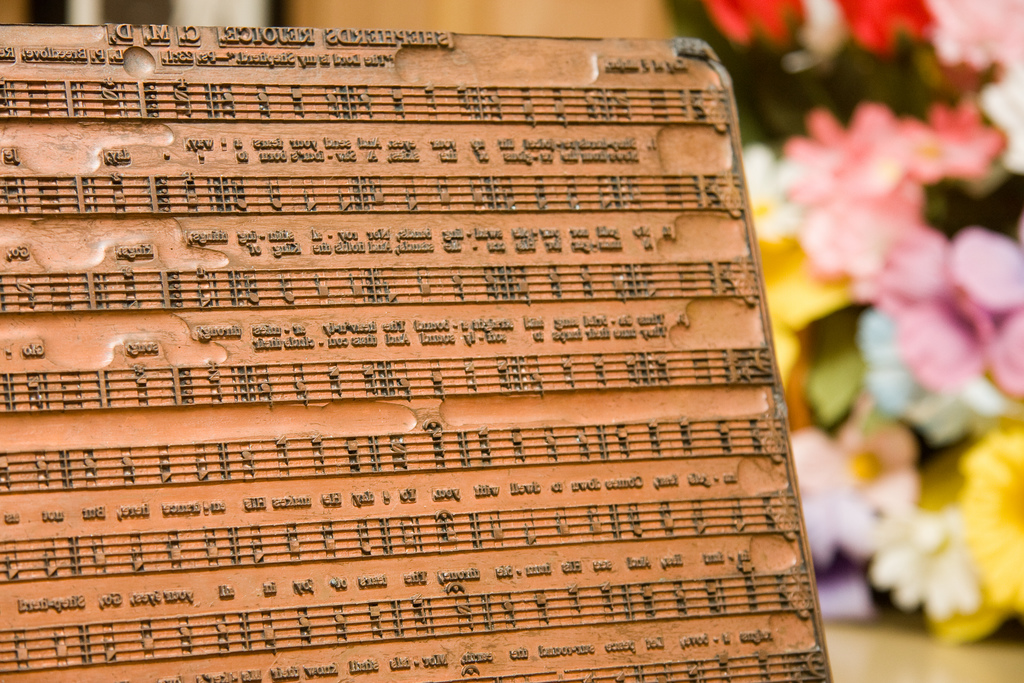
Taken at the Sacred Harp Museum by Flickr user Lance McCord, CC BY 2.0
Musicologists have documented and analyzed Sacred Harp thoroughly, with Alan Lomax having had a particular fascination for it. He considered it as not only an extension of four-square Anglo forms but also as the crossroads where the Reformation met the Democratic Experiment. In Lomax’s view—expressed in a 1982 interview at the Sacred Harp Convention at Holly Spring, Georgia—European migration to colonize America broke the established authority of the church, leaving every person to forge a singular relationship with God. This supposition harmonizes perfectly with the views of the congregational church I attended. We had no hierarchy, no choir, no piano. Every man, woman, and child added their voice, as best they knew how, to raise an egalitarian song of praise. Songs such as “This World is Not My Home,” “The Glory Land Way,” and “Blessed Assurance” exemplify the form: simple rhyme schemes; closely-yoked shifts in harmony and rhythm; and southern gospel’s initial shunning of poly-rhythms or syncopation.
For me, Sacred Harp music created an immersive and experiential soundscape; emotionally and spiritually motivating, it was the sound of temporal and eternal life. Like our singing style, our church service presented a model for our lives outside the sanctuary. “Trust and Obey” was a frequently sung hymn—and it summed up our approach to life in all matters. Obedience was expected, deviation discouraged.
Worlds away from my sheltered existence, leaders of the Civil Rights Movement embraced a cappella singing as a powerful means to encourage, motivate, and activate. In the 2009 documentary Soundtrack for a Revolution, U.S. Representative and civil rights icon John Lewis said, “It was the music that created a sense of solidarity.” His a cappella community was connected to the church and the streets, challenging the status quo, and seeking greater brotherhood. Mine was by the book, increasingly authoritarian, very narrow in scope and population.

Sacred Harp Singing, Bloomington, Indiana, Image by Flickr User Jennifer Jamison (CC BY-NC-ND 2.0)
To us, the New Testament authorized one and only one instrument for offering songs to God: the unaccompanied human voice. The root of this belief was a concise motto coined in the early 1800s by Alexander Campbell, a leader in the Second Great Awakening: “Where the Scriptures speak, we speak; where the Scriptures are silent, we are silent.” Applying this principle, then, the apostle Paul, in his epistles to the Ephesians and the Colossians, encouraged Christians to sing. But nowhere did he or another New Testament writer suggest using an instrument. This silence equals prohibition. It sets its own reality, ignoring abundant biblical evidence to the contrary: the Old Testament presents many examples of instruments used in worship, as does the New Testament’s Book of Revelations.
Our a cappella song service was, therefore, more than a sound—it was a belief system, a worldview in which other sounds or ideas were alien. We applied Campbell’s principle across-the-board, backing ourselves into corners: slaves were to obey their masters; wives were to submit to their husbands; children were to be fully subject to their parents. Questioning authority, let alone defying it, was strongly condemned by Paul in his letter to Christians in Rome: “Let every soul be subject unto the higher powers. For there is no power but of God: the powers that be are ordained of God. Whosoever therefore resisteth the power, resisteth the ordinance of God: and they that resist shall receive to themselves damnation.”
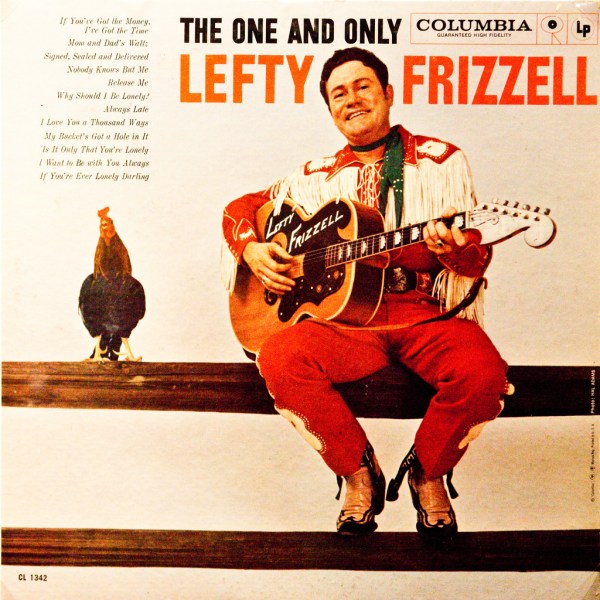
“The One and Only Lefty Frizzell” by Flickr user Thomas Hawk, CC BY-NC 2.0
Alternately, classic honky-tonk’s twangy resistance seemed to defy the innovations and complexity of modern life. As I was growing up, the sinful songs of Ray Price, Lefty Frizzell, Webb Pierce, and George Jones flowed like wine from my family’s record collection and radio settings. Songs of murder, drunkenness, alienation, revenge, adultery, and the workingman’s blues are staples of the honky-tonk catalog. Its celebrated ethic of “three chords and the truth” favored a rural do-it-yourself ethic. My church’s music was both challenged and validated by this unlikely and unruly roommate; honky-tonk was a matched bookend for Sacred Harp.
For in the background of many of those honky-tonk sounds, whether they were about larceny, war, or revenge on the boss, I heard the same harmony that filled my church. In the 1950s or so, southern gospel groups such as the Jordanaires, Blackwood Brothers, and the Statler Brothers, began backing country music artists including Johnny Cash, George Jones, Tammy Wynette, and Gary Stewart. Their sonic presence lent an almost holy sanction to the commission of sin, as if Jesus and Satan met after-hours to share a drink and balance the books.
This sonic emulsification of sin and salvation formed my youthful identity and bracketed a very small existence. My world consisted of very gendered personal struggles: man vs. temptation; man vs. alcohol; man vs. boss; woman vs. womanizer. The solution provided for these struggles was always the same: the efficacious grace of God. All failings and victories were personal, not structural or systemic. The fight against personal sin was the only fight.
Southern gospel music and honky-tonk have enjoyed an institutional relationship since the founding of the Grand Ole Opry in 1920s, sanctioning the blending of reprobation and redemption. Though initially politically ambivalent, the Opry listed towards social conservatism during the 1960s—Johnny Cash’s nascent social awareness notwithstanding. In 1970, however, the Opry and the industry it represented found itself an unlikely accessory to Richard Nixon’s “southern strategy.” He declared October 1970 to be Country Music Month, and a few years later blessed the Grand Ole Opry with its first presidential visit.
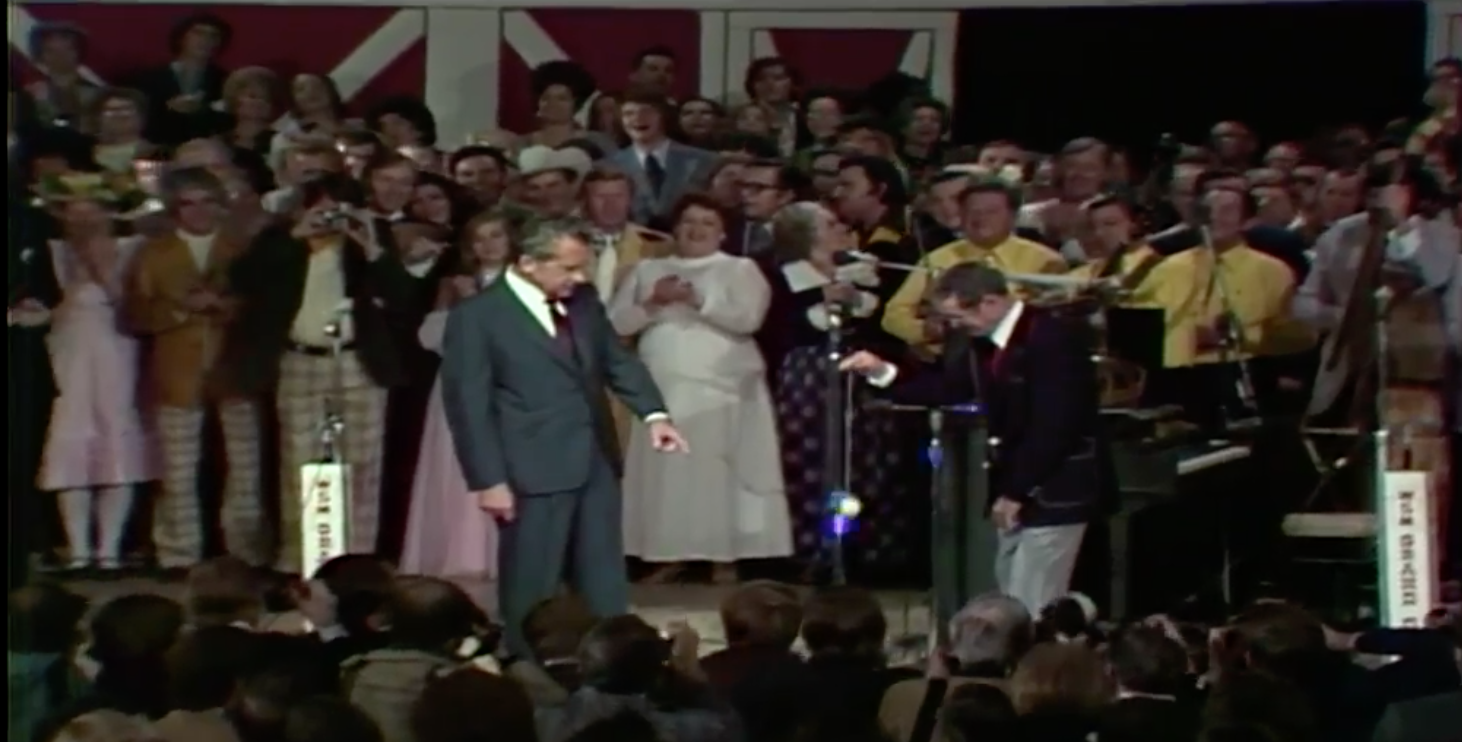
Screen capture from Billboard’s “Roy Acuff Teaches President Nixon the Yo-Yo at the Grand Ole Opry” (1974)
Politically conservative messages had entered country airwaves during the late 1960s, epitomized, if not pioneered, by Bakersfield stalwart Merle Haggard. His “Okie From Muskogee” ridiculed hippies, dope smokers, draft dodgers, long-hairs, flag burners, and college activists, all within a 3-minute single format. Though ostensibly written as a joke, it struck a chord among conservative, Christian, country music fans. Sensing a market, Haggard followed up with the flag-waving “Fightin’ Side of Me,” wherein he further shames pacifists.
These songs contained the truth as I believed it in grammar school: protestors, adulterers, and dope smokers were all in defiance of God. Haggard’s refrain in “Fightin’ Side”—“if you don’t love it, leave it”—made sense to me, and was safely non-challenging. Conveniently, the religious body of which I was a member had, a generation prior to me, actively opposed pacifism.
A world composed only of personal demons, however, leaves little room for social issues. Being so long accustomed to seeing the sin in man left me unable to recognize the sin in the system. Sam Cooke’s great risk in recording “A Change is Gonna Come,” for example, was lost on me, even though we both shared a battle between religious and secular personas.
I never heard his call to address greater systemic problems such as racism, audibly or socially. Even as I entered my 20s, my white patriarchal religious sonic defense system kept the freedom struggles of people of color at bay. Even if dissenting sounds managed to sneak through–Marvin Gaye’s struggles in “Inner City Blues” for example—I quickly dismissed them as exaggeration or the natural outcome of personal sin. I could not process a sound which conflicted with my God-given world view. I saw only men and women avoiding their duty and surrendering to temptation.
My mother frequently said that the lives portrayed in honky-tonk songs were not her life. But in another sense, those desperate lives, and the more hopeful ones portrayed in gospel music, were our lives collectively. We were part of a greater social identity: Southern, white, Fundamentalist, change-averse, full of latent conflicts. Those sounds, rich with heritage and lived-in context, formed us. In other words, our vernacular limited our hearing. Our world was formed within a fixed sonic boundary, and we ignored, resisted and sometimes even combatted discordant sounds.
Within this soundscape, I had never heard of any march from Selma to Montgomery, not from church, family, the radio, or, sadly, even school. The larger movement of which it was a part—perhaps the biggest social movement of the 20th century—was inaudible and therefore irrelevant to me. When I did begin to hear of protests against white racial violence, I could only condemn anyone who defied authority. I did not know what to say about authority which abused the people. Raised to function in a law-and-order world, I could only repeat the Apostle Paul’s instruction that we all must obey authority or incur the wrath of God.

“Selma Protesters Met By Police: 1965” by Flickr user Washington Area Spark, CC BY-NC 2.0
But thankfully, sound travels in subversive ways, such as through the transmitters of listener-supported community radio.
I found Dallas’ KNON completely by chance. Commuting to work through the city’s legendary rush hour, I’d get fidgety. While searching the dial, I heard a familiar song in an unfamiliar arrangement. I don’t recall the song now, but do remember its force: a honky-tonk classic played through a stack of Marshall amps, turned up to the proverbial ’11.’ Perhaps it was Leon Payne’s Lost Highway as rendered by Jason and the Scorchers—anarchistic, upending, challenging, it still carried enough familiarity to keep me listening. I stayed tuned in for the next song, then another. When the DJ, Nancy “Shaggy” Moore, signed off her show, I gave a listen to the next show—at least until they said something a bit too dissonant.
 But the next day, I tuned in to Shaggy again. And I listened a bit longer when the next show came on. And even longer the day after that. Dallas at that time was wracked by racial strife, some of it focused on the politicized deaths of two police officers, one white and one black, in separate incidents. I had tuned out the duplicity, but KNON gave me reason to reconsider. City council member Diane Ragsdale, an African-American woman representing one of the city’s most trod-upon districts, refused to let the issue go. KNON provided the venue for her to express her outrage unmitigated, and to explain the inconsistencies in a way that an entitled white male suburbanite, such as I, could understand.
Tim Rice suggests that we are not free agents in the creation of our identities—but given the right stimuli, we will resist, to the point of rebellion, the personhood prepared for us. The latent heretical ethics of Sacred Harp and Honky-tonk finally responded to the sonic stimuli flowing through the breach, triggering an insatiable devil’s advocacy: “Prove yourself to me,” I said to everything I had once believed, religious faith included. St. John wrote in his First Epistle: “Beloved, believe not every spirit, but try the spirits whether they are of God.” This was to be the last biblical directive I would follow.
My radical shift in musical listening also greatly impacted my political, and cultural beliefs and listening practices, something which continued throughout my life. For example, I ended my professional career as well, having understood the devastating effects that high tech industries have on the environment and workforce. I traded a six-figure salary for minimum wage in foodservice. Not once have I looked back.

“Kitchen Music” by Flickr User David Blaine (CC BY 2.0)
Kitchen work comes with immersive sound: machines hum and sometimes roar; the radio blasts through the static; humans must shout to be heard. Working throughout the western US, in a variety of independent restaurants, I learned to understand and speak Spanish. I participated in defying a language ban placed on my colleagues by an overbearing owner: I noted that she forbade speaking in Spanish, but not singing in Spanish. So sing we did, about needing a potato peeler, taking out the trash, and what we were going to do over the weekend.
As I worked my way up the ranks and crossed the country from California to Manhattan, I listened to the stories told me by immigrants from Mexico, Guatemala, Dominica, Morocco, South Africa. They shared their music with me, via radio, iPod, cassette, or any object we could plug into an overcooked boom box. Every song and conversation has pulled me into greater participation in their lives and the systemic issues faced by most of the world around me.
Dismantling one’s identity, regardless of how deliberately it is done, happens amidst lots of noise: illusions shatter, idols crash to the ground, walls tumble into rubble. Dissent comes in myriad expressions, and for me, it has come via my own three-chords-and-the-truth and through a multimedia socially-progressive dining event which I call Peace Meal Supper Club. Its very raison d’etre is to illuminate dissonance on issues such as the right to sanctuary, our diminishing seed supply, the plight of the rural poor, and other devastating threads of intersectionality. Music is a critical component of each event, as Otis Taylor, Lila Downs, and Caetano Veloso share playlist space with Manecas Costa and Majida El Roumi Baradhy. Old favorites like “Sixteen Tons” get their say, as well—for behind that song’s well-earned swagger is a system of devastating intersectional oppression that demands our action.
_
Featured Image: Image of a Stained Glass Crosley Cathedral, Image by Tubular Bob
Kevin Archer is a multi-media artist who left corporate security for a DIY life as a farmer, activist, educator, and chef. He’s planted gardens coast-to-coast, and washed his own sauté pans from Denver to Mendocino, Santa Fe to NYC, and random locations in between. Kevin’s current project is Peace Meal Supper Club, a series of immersive dining events which explore ecojustice, human rights, the capitalistic conquest of the seed and soil, and the power of progressive movements. He has written for Civil Eats, No Depression, Secular Web, and the Museum of Animals & Society. He has spoken on the intersection of food and social issues at numerous conferences within the Eastern US.
_

REWIND! . . .If you liked this post, you may also dig:
What is a Voice? – Alexis Deighton MacIntyre
“HOW YOU SOUND??:” The Poet’s Voice, Aura, and the Challenge of Listening to Poetry – John Hyland
The Sounds of Anti-Anti-Essentialism: Listening to Black Consciousness in the Classroom – Carter Mathes
The Listening Body in Death – Denise Gill
Share this:


Current Top Posts





April 2021

January 2020

November 2019

October 2019

August 2019

April 2014

November 2017

March 2015

December 2017

October 2015
 Sounding Out!
Recent Comments