
“I Love to Praise His Name”: Shouting as Feminine Disruption, Public Ecstasy, and Audio-Visual Pleasure
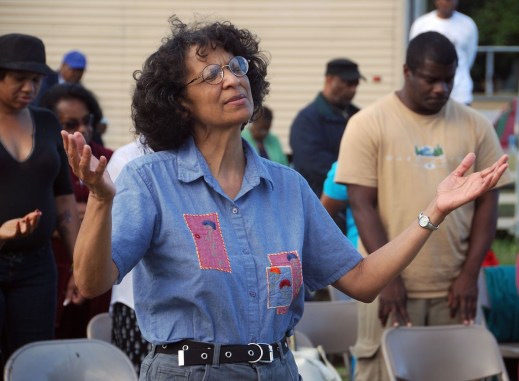
Well, if you don’t believe in shouting,
That’s alright with me
Some folk don’t believe in shouting,
That’s alright with me…
Doubt and ignore it,
But I belong to the Lord’s crew.
David said rejoice in the Lord,
And that’s the way we Christians do.
If you don’t believe in shouting,
That’s alright with me.
–Dorothy Love Coates & the Gospel Harmonettes, “That’s Alright with Me”
A handy catch-all term, “shouting” is actually a euphemism encompassing a range of ecstatic worship behaviors. These can include clapping, dancing, pacing, running, rocking, fainting, as well as using the voice in speaking, singing, laughing, weeping, yelling, and moaning. Certainly, there were men who shouted in the days of my childhood in church; there are men who shout today. The only shouts I can recall and even imitate to this day, however, are those of the women.
There is, in fact, a longstanding association between women and shouting. Perhaps because of the pronounced emotionality involved in the practice, the shouting sphere tends to be prefigured as feminine and in this bears great relevance to women. I am interested in the significances of shouting among black Christian women of struggling populations. In my view, shouting is not only a religious practice for these women, but is also a binary-breaking performance which confounds—if only fleetingly—the divisions which have so often oppressed, menaced, and harmed them. I argue that shouting has worked to codify the disruption of male-dominated services by women who have so often faced sharp sanctions by black church patriarchy. I also contend that shouting places its female practitioners and their observers within a sphere of public ecstasy and visual and auditory pleasure, which makes mischief for notions of what is proper for Christian women and for the entire church community.
.
The Shout, the Sound, and the Shriek: Black Feminine Disruption
In a 2011 post for Sounding Out! entitled “Pentecostal Song, Sound, and Authentic Voices,” Ashon Crawley posits the existence of a black church “public zone,” which serves as the conceptual, holy ground upon which “sound, song, and subject [function] as conduits for the exchange of ecstasy and ecstatics.” I’d like to track Crawley’s public zone into the shouting sphere, the very heart of ecstasy within the black worship experience.
Although culturally codified—even expected and welcomed—within the church community, the shout functions primarily as a disruption. The faces, bodies, and voices of shouting black women disrupt the flow of the service. A shout takes time and has the power to alter the program. Regarding such moments, worshippers—most often women and gay men—often proclaim in retrospect, “Baby, there was no more order!” This disruption of order through the use of the body and the voice has a distinct place within the Christian black feminine tradition of resistance to oppression.

Image by Flickr User Steve Schwartz
In the essay, “The Restorative Power of Sound,” womanist Roxanne Reed has examined the function of gendered sound within black Christianity. For Reed, the feminine “wordless cry, holler, moan, or wail” achieves “primacy over the written text,” “suggests a historical time with relying on a defined chronology,” and is legitimated by an African “ancestral heritage” which presages black musical forms (2). This distinctly feminine worship sound claims space from “patriarchal privilege,” which has often extended to black folk preaching, a tradition which excluded most black women for decades after slavery.
The sound of the black feminine in worship is thus a symbol for black women’s triumph over historically masculine arenas of writing, history, and form. The shout and the gendered worship sound can be placed in critical triangulation with Fred Moten’s “shriek,” as theorized in In the Break (2003) An expression of the distinct suffering of the black female, the shriek is a primal “phono-photo-porno-graphic disruption” of spirit and matter, and other binaries (14). The shout, the feminine worship sound, and the shriek all take center stage as black female performances which disrupt oppressive categories and assert the black woman’s voice as triumphant.
Shouting as Public Ecstasy, Scopophilia, and Sonophilia
Many observers have noted the shout’s resemblance to sexual ecstasy. The shout is often expressed through the sounds, movements, and facial expressions commonly associated with sex. Some shouters close their eyes and moan. Some hug themselves around the waist or bend over the pew in front of them, rubbing their own shoulders, bellies, or thighs. Some roll about the floor, hollering or speaking in tongues. Some whisper His Name, as in closest intimacy to a lover. Some dance with abandon before the altar or in the aisles before collapsing, spent and panting. Some quiver quietly in deepest distraction.
Shouters in the throes of their ecstasy are closely observed by all within the church community. Members of church communities often mark shared remembrances by who shouted, when, and how. Even young children can be called upon to reproduce the shouts of various church members. The conspicuousness of the shout provides reason to consider it as spectacle containing pleasure for both the shouter and those who gaze upon her.
.
Laura Mulvey’s “Visual Pleasure and Narrative Cinema” discusses “scopophilia” as a phenomenon occurring in “circumstances in which looking itself is a source of pleasure, just as, in the reverse formation, there is pleasure in being looked at” (587). In the moment in which a shout goes forth, those shouters who are aware of being watched—not all are—and their gazers may be said to enter into mutual pleasure from being watched and from watching. For the observer, the pleasure arising from the sight-based stimulation is often compounded by the narcissism of the ego which seeks to identify with its source. This may explain why in highly charged church moments, shouts become highly communicable—“thriving in concert,” as Zora Neale Hurston once phrased it. Looking upon another in worship ecstasy can be understood to reinforce one’s own relation to the Holy and to stir desire to engage that relation through shouting.
There is sufficient cause to assign what I call a “sonophilic”aspect to shouting as well, as shouting never fails to take place but within a context of sound. This sonophilic component should be understood as the means by which the sounds of ecstasy coming from a shouter provide stimulation and identification in the listener, who may in turn become a shouter. It must be noted, however, that the sonophilia can emanate from sources other than the shouter. Shouts are often roused by a complex network of sounds. Within a service, preaching and verbal exhortations, prayers, congregational chants and songs, and instrumental music designed to buoy sermonic delivery or to capitalize on swells of emotion often work in tandem to provide the sound-based pleasure essential to shouting.

Image by Flickr User Steve Schwartz
A Final Shout-Out to Shouting
From West Africa to North America, from slavery to emancipation, from the eighteenth century into the present day, the black ecstatic in the form of shouting has served several important purposes for black women. Black women’s general and persistent preoccupation with the relationship between the spiritual and the sensual, the cornerstone of black female intellectualism in my view, was first and foremost expressed in the practice of shouting. The shout can be understood as the primary site upon which black women made the spiritual physical and rendered the sensual holy.
.
Furthermore, in eras in which black women were customarily denied the right to preach and were granted but limited authority within church communities, the shout communicated a woman’s ability to engage the Holy. This proven ability undoubtedly helped to open doors for the thousands of black women who now preach and pastor all over the country. Shouting has also provided much needed relief for the unique pressures of the black female in North America, absorbing and transforming her hurts and frustrations and replacing them, down through the centuries, with the hope and strength vital to her survival.
—
Featured Image Credit: Flickr User Steve Schwartz
—
Shakira Holt is a thirteen-year classroom veteran and currently teaches high school English in Los Angeles County. She earned a doctorate degree in English from the University of Southern California, and works primarily in the area of black women’s literature and culture. She is deeply concerned about the intersections of race, religion, gender, sexuality, class, and politics in the public sphere. She is a lazy poet, a latent novelist, an intermittent blogger, a retired songwriter, and a reluctant karaoke singer. A licensed Baptist minister, she is but slowly working her way back to the pulpit. “I Love to Praise His Name” is her first published piece.
Share this:

I Will Always (Sonically) Love You: Whitney Houston on the Radio

"Whitney Houston Central Park, NYC September 1, 2009" by Flickr user asterisk611 under Creative Commons license
I knew Whitney Houston’s voice before I knew her face. She was a constant record on deck in my house, setting off a family get together or a typical Saturday night at home where I begged to stay up a little bit longer to listen to records—for-real records, vinyl—like the grown folks. Houston’s voice represented ‘grown folks talking’ but had enough effervescence that I could relate to as girlish charm. Houston’s vocal range relayed feelings and representations of sugary sweet to straight, no chaser. She could sing about loving a married man—definitely grown folks’ business—but still maintain the innocence of a school girl crush. My mom and I would dance around our great room lip synching her songs, her asking me who I loved, me declaring my name was not Susan. It was Gina and Whitney Houston’s voice was magic. Alongside Michael Jackson, she was the playlist of my childhood.
Sadly, it was my mom and me again as we listened to Houston’s funeral on the radio. We were stuck in traffic. It had to be fate, me listening to Houston one last time in the same way we were introduced: through the radio. Listening to the funeral instead of watching it on television or as it streamed across the internet triggered a nostalgic ache for Houston in the pit of my stomach, returning me to the same place as a five-year-old child who fell in love with the pretty voice from those Saturday nights.
For me, listening to Houston’s records and funeral on the radio resituated Houston as a vocalist. Detached from Houston’s well-documented shortcomings, listening to her funeral removed the static of her life that filtered her mastery of song and sound. In the last years of her life, Houston’s image was far removed from her stellar singing career. Houston’s personal conflicts and battles situated her as a fallen celebrity, quickly associating her with ill fitting jokes of drug abuse and caricatures of her former glory. Removing Houston from her sonic legacy strips her of the complexities of her persona that she highlighted and acknowledged using her voice, or as Dr. Guthrie Ramsey points out, her “instrument.” It is important to note Houston attempted to make her way back to music, slowly creeping back into public spotlight as a vocalist instead of a wayside star. Celebrity overpowered Houston’s humanity and it is unfortunate that her funeral reclaimed it. Thus, sound provides a space for rehabilitating Houston’s bruised reputation, providing an alternative, nonparodic reading of her life.
While listening to Houston’s funeral, I realized the significance of her sonic legacy, a reaffirmation of Houston’s mastery of song and voice through unending playlists and funeral performances. The radio provided a sonic space of reconciliation between Houston and her fans, uninterrupted by the visual whirl and the busyness of pomp and circumstance of a televised celebrity funeral. By listening to Houston’s funeral, the radio became a discursive space of performance, simultaneously retaining and (re)shaping Houston’s iconicity using sound as favorable space of reflection. Strictly listening to the funeral situated the listener in a position to recontextualize Houston’s legacy within sonic discourse and think about her against a musical backdrop which she constructed.
In considering Houston as not only a music but cultural icon, one must understand the significance of her prominence as a singer. Her career maps the trajectory of a post-Civil Rights black (women’s) experience, framing struggles of seeking out and validating new black identity markers within situating herself as a ‘black voice.’ Her catalog blends the secular with the sacred, effortlessly moving between gospel and pop music, frequently collapsing and creating a complex humanity within sonic soundscapes often restricted by industry and consumers alike. It is around these hybrid sonic-scapes that Houston’s funeral revolved.
Also, Houston’s funeral negotiated reconsiderations of the black church in the current popular cultural imagination, personifying grief and healing through sound. In a word, Houston’s funeral “took folks to church.” On display were prominent tropes of black cultural and musical tradition, parlaying call and response between speakers and attendees and improvisation of performers. In particular, Kim Burrell’s redressing of Sam Cooke’s “A Change Is Gonna Come” caters on numerous levels to intersection of Houston’s narrative and the role of spirituality in her life. Burrell used her voice and spirituality as a reflection of Houston’s spirituality while dictating how Houston’s life and image are redirected through song. Burrell’s retelling of Houston’s life pivots off Cooke’s original song as an acknowledged site of struggle and redemption. She improvises Cooke’s song to align with Houston’s literal birth (“She was born in New Jersey”) and the understanding of spiritual rebirth and death (“a change gonna come”).
In similar fashion to a church revival, Burrell performs her rendition of “A Change Gonna Come” as a testimony, pulling from her audience’s familiarity with the intonations, vocal runs, and whines of Sam Cooke’s performance. Burrell’s ‘remixing’ of Cooke’s song is, to an extent, an innovative form of sampling. By borrowing the familiarity of Cooke’s sound, Burrell is able to create a new sonic accompaniment. Overarching tropes of faith and redemption hinged upon the black oral tradition are intensified through using them to aurally frame Houston’s funeral. By strictly hearing Houston’s funeral, the listener becomes privy to not only the intersections of the black church and oral traditions but the unique interventions of sound and identity frequently understated in visual culture and discourse.
A fitting close to Houston’s funeral was the recording of her popular rendition of Dolly Parton’s “I Will Always Love You.” Houston’s voice rang out in the perfect intonation that solidified her place in music and cultural history, situated as a fitting goodbye to fans and this world. The tenderness of Houston’s delivery personifies the somberness of her funeral, a self-eulogy that harnesses its power from not only the moment but the untimeliness of her death. Houston’s last performance of “I Will Always Love You” detaches her from the paparazzi and scandal that suffocated her life. It is through sound that Houston’s legacy is revived.
As my mother dabbed tears away from the corners of her eyes while listening to the funeral, I silently hoped she would ask me who I loved. I would tell her I wasn’t Susan. And that I loved Whitney.
—
R.N. Bradley is a PhD candidate in African American Literature at Florida State University. She writes about African American literature, race and pop culture, Hip Hop, and her own awesomeness. She earned her BA in English from the Unsinkable Albany State University (GA) and a MA in African American and African Diaspora Studies from Indiana University Bloomington. Her dissertation project looks at negotiations of white hegemonic masculinity and race consciousness in 21st century African American literature and popular culture. You can read her work atAllHipHop, Newsone, TheLoop21, or her monthly column “The Race to Post” over atPopMatters. Scholar by day, unapologetic Down South Georgia Girl 24/7/365. Catch up with her awesomeness via twitter:@redclayscholar and her blog Red Clay Scholar (http://redclayscholar.blogspot.com).
Share this:


Current Top Posts





April 2021

January 2020

November 2019

October 2019

August 2019

April 2014

November 2017

March 2015

December 2017

October 2015
 Sounding Out!
Recent Comments