
SO! Reads: Isaac Weiner’s Religion Out Loud: Religious Sound, Public Space, and American Pluralism

 Calling devotees to prayer, preaching on the subway, broadcasted pre-recorded sermons from a moving car, organizing drum circles in the park, resounding church bells through the city – expressions of faith to some, a nuisance, or even a personal offense (or outright danger), to others. Must religion be so noisy? Must it also be so publicly noisy?
 Religious studies scholar Isaac Weiner portrays public loudness as but one of many exigencies of the religious worldview in his recent publication, Religion Out Loud: Religious Sound, Public Space, and American Pluralism (New York: New York University Press: 2014). Weiner argues that the substantive content of religious doctrine – moral claims, theological arguments, etc. – both constitutes and is constituted by how its ideas are given expression. This might seem unremarkable. However, the claim allows Weiner to re-frame religious pluralism as not only a “matter of competing values, truth claims, or moral doctrines, but of different styles of public practice, of fundamentally different ways of using body and space.” (200)
So, according to Weiner, yes: Some religious groups must be so noisy, and must be noisy publicly. If they weren’t, their religious beliefs and doctrines would be deprived of the expressive forms that imbue them with significance.

“Street Preacher” by Flickr user Tabitha Kaylee Hawk, CC BY-NC-ND 2.0
Weiner is Assistant Professor of Religious Studies in the Department of Comparative Studies at The Ohio State University. Weiner is not a card-carrying sound studies specialist. Nonetheless, his output is representative of a quickly accelerating interest about religion and spirituality within studies of sound and culture. Religion Out Loud is his first book, and builds from themes explored in his previous publications, including articles such as “Sound” (Material Religion 7, no. 1 [2011]: 108-115), “Sound and American Religions” (Religion Compass 3, no. 5 [September 2009]: 897-908), and “Displacement and Re-placement: The International Friendship Bell as a Translocative Technology of Memory” (Material Religion 5, no. 2 [July 2009]: 180-205). Forthcoming are several chapters and articles that closely relate to topics investigated in Religion Out Loud.
The text ranges from America’s colonial period through the early 2000s. It largely attends to legislative efforts seeking to circumscribe the practicing of what Weiner calls “religion out loud” – public, and perceivably exorbitant displays of sonic religiosity. On the other hand, Weiner also details the various ways in which religious practitioners have resisted legal containment. Weiner thus adds to an already copious literature about how contestations over sonic space reflect broader contestations over meaning and power, that includes texts such as Brandon Labelle’s Acoustic Territories: Sound Culture and Everyday Life (New York: Continuum, 2010), Karen Bijsterveld’s Mechanical Sound: Technology, Culture, and Public Problems of Noise in the Twentieth Century (Cambridge, MA: MIT Press, 2008), and other religion-related work like Philip V. Bohlman’s “Music Inside Out: Sounding Public Religion in a Post-Secular Europe” (in Music, Sound and Space, ed. Georgina Born, Cambridge: Cambridge University Press, 2013). This tension between the embodied practice and legal-discursive regulation of sonic spaces throws into relief what Weiner calls a “politics of religious sensation.” However, readers with an interest in the experiential dimensions of the “religious sensorium” should look elsewhere, perhaps the recent volume, Senses and Citizenship: Embodying Political Life, edited by Susanna Trnka (New York: Routledge, 2013). Religion Out Loud appeals more to readers with an interest in the political histories of religious rights and noise abatement policy, and the ways in which “religious sensation” has been regulated according to unstable conceptions of liberalism and pluralism in American jurisprudence.

“Preaching” by Flickr user Boston Public Library, CC BY 2.0
In order to span such a long temporal trajectory (essentially the history of the United States!), Weiner anchors Religion Out Loud in three historically disparate case studies. Each is preceded by a chapter of historical and theoretical contextualization. This forces Weiner to rapidly chronicle decades of developments in noise abatement policy. Yet he does so with both scrupulousness and concision, leaving remarkably few holes left unfilled. This gives the reader the benefit of charting the long-term effects of the policy changes that Weiner more focusedly interrogates. His approach thus differs quite markedly from some other important sound/religious studies literature, such as Leigh Schmidt’s Hearing Things: Religion, Illusion, and the American Enlightenment (Cambridge, MA: Harvard University Press, 2002), which investigates a single historical period in more concentrated fashion.
From chapter one’s onset, I was struck by the impressive depth of archival research Weiner has infused into his arguments. As a result, Weiner’s more speculative conclusions – generally modest in scope – have no shortage of evidence, and are altogether convincing. In chapter one, for instance, Weiner details shifting perceptions of church bells in colonial and postbellum America, an area well tilled in sound studies by the likes of Alain Corbin (Village Bells: Sound and Meaning in the Nineteenth-Century French Countryside, trans. Martin Thom, New York: Columbia University Press, 1998) and Richard Cullen Rath (How Early America Sounded, Ithaca and London: Cornell University Press, 2003). Weiner furthers this conversation by revealing how religious sounds such as church bells – what had receded to the background of what R. Murray Schafer called the “historical soundscape” – faced unprecedented scrutiny as the symbolic status of noise began to change. Likewise, city governments challenged congregants’ rights to occupy acoustic territory. In the burgeoning clamor of the modern city, noise meant progress and prosperity, for some listeners, but, for others, the stylized noise of religion practiced “out loud” signified a kind of regressive primitivism. Noise thus occupied both sides of the evolutionist coin that Weiner suggests ideologically underpinned religious self-understandings of the time.

“St. Mark’s Church Philadelphia” by Flickr user Library Company of Philadelphia
Weiner further explores the progressive/primitive duality in his first case study – Harrison v. St. Marks of 1877– in which Weiner quite brilliantly unravels how both perspectives were articulated in legal discourse. According to Weiner, complainants challenged the long-presumed public-acoustic prerogatives of Philadelphia’s fashionable St. Mark’s Protestant Episcopal Church. The main takeaway from the chapter is that St. Marks’s complainants voiced a formulation of suitable, modern, and thus normative religious practice as “properly disentangled from various forms of materiality and mediation, carefully circumscribed and respectful of its bounds, interiorized and intellectualized, invisible and inaudible.” (60) From the complainants’ perspective, noisy religion signified backward, immature religion. The court sided with this position, treating church bells as it would any other “extraneous” public noise. Yet in so doing, it ironically reinforced the cultural dominance of Protestantism. That is to say, by silencing St. Mark’s bells, the ostensibly secularized legal system set a precedent that legitimated the “subjugation” of all forms of religious practice to “proper modes of acceptable piety” – including “religious ‘others’” who lacked the pervasive influence that Protestantism could exercise in the public and political spheres, including the courts. (74)
In the second section, Weiner shifts his focus from acoustic territorialization to noisy religiosity as a form of dissent. He details how noise abatement legislation in the early twentieth century harkened a “new regulatory regime” that suppressed the activities of religious practitioners for whom “making noise was not merely incidental to their work; it was their work” (80). The Salvation and Army and the Jehovah’s Witnesses, Weiner shows, aggressively challenged norms of community outreach through provocative exhibitions of religious devotion in public spaces. However, while exercising freedoms of speech, religion, and public assembly, such groups turned unsuspecting citizens into “captive audiences,” and thus infringed upon rights to privacy. The style of practicing some liberties, as many scholars and critics have suggested, has throughout history limited the enjoyment of liberties by other parties.

“The Watchtower” by Flickr user Scott Kellum, CC BY-NC 2.0
Moreover, as Weiner rightly suggests in his second case study, Saia v. New York of 1946, civil liberties have always been carefully regulated by the state. Samuel Saia, a Jehovah’s Witness, drove around the city of Lockhart, NY, and used loudspeakers to broadcast inflammatory sermons from his car. He loudly exercised his first amendment rights through what Weiner calls “sound car religion.” Yet the city managed to treat the sermons’ noisiness as extraneous to Saia’s religion, rather than acknowledging the practice as partially constitutive of it. Lockhart’s noise abatement ordinance thus infringed upon his right to religious free exercise. To that end, Weiner repositions McLuhan’s famous “the medium is the message,” framing religion as media, as opposed to religion and media as separable concepts. Saia spread God’s word, and in doing so loudly fulfilled a core tenet of the Witness creed.
Throughout the case study, Weiner critiques the “liberal inclusionary ideology” that has come to characterize the Judeo-Christian tradition of American jurisprudence. But he curiously softens his otherwise pointed critique at the end of the chapter. Saia ultimately won the case, yet the Witnesses’ devotional style gradually became unmarked in the ensuing years, as they seemed to assimilate voluntarily to normative expectations of religious devotion. As such, Weiner suggests that dissenters in general often find that they can “afford to quiet down once they feel that their voices have been heard.” (135) While it is “important not to exaggerate the coercive effects of American law,” I would have nonetheless appreciated a more critical take on how the legal system had its cake and ate it too – that is, how it satisfied the demands of the Witnesses and also managed to keep them quiet. Indeed, Weiner’s mild conclusion may unsettle those readers who enjoyed the previous three chapters of incisive and nuanced analysis.

“Carillon of Peter And Paul Cathedral in Saint-Petersburg” by Wikimedia user RuED, CC BY-SA 3.0
In the last section, Weiner shows how a controversial 1990 Supreme Court decision – Employment Division v. Smith, spearheaded by Justice Antonin Scalia – enacted into law a conception of religiosity as interiorized, intellectualized, and privatized. It favored majoritarian notions of religious free exercise such that dissenting – or noisy – religious practice by minority religious subjects risked criminalization. As a result, the granting of religious exemption from preclusive noise ordinances was left not to the courts to decide, but rather to the political arena. Potentially disruptive religious free exercise was no longer constitutionally protected. It now required approval from a political body. The last case study, then, does not deal with legal proceedings. Rather, it examines the public debates and media spectacles that surrounded al-Islāh Islamic Center’s petition to broadcast the call to prayer in Hamtramck, MI, in 2004. Al-Islāh was ultimately granted exemption from the local noise ordinance. But over the course of an exasperating six months of debate, Weiner demonstrates, formerly unvoiced identity politics that residents invested into the city’s sonic territories were brought to light in highly contentious ways.
Weiner identifies three rhetorical-discursive tropes that various parties used to debate changing the city’s noise ordinance to accommodate the call to prayer. One of them, pluralism, will likely be of most interest to readers (the others are exclusivism and privatism). The pluralist debaters envisioned the public sphere as a neutral space in which the particularities of religious difference were accommodated, but only according to an ideal of “agonistic respect.” Against this idealistic backdrop, pluralists interpreted the call to prayer not as broadcasters intended it to be heard, but rather as a symbol for the “potential for interfaith harmony.” (186) Weiner argues that the hearings refigured – effaced, even – the call’s meaning, since the Muslim community’s political recognition was achievable only by way of the discourse of pluralist forms of tolerance. In other words, if pluralist discourse takes the form by which Muslim faith can express itself, then Muslim faith itself risks effacement as a result of such “accommodation.”

“Muezzin” by Flickr user colin, CC BY-NC-SA 2.0
Surprisingly, Weiner largely omits Muslim perspectives from the chapter. How did pluralist assimilation change the meanings of religious practice as the Muslim community saw it? How did the Muslims feel they had to modify their rhetoric of self-representation? Moreover, how did Muslims perceive – or perhaps even challenge – displays of Judeo-Christian devotion? Perhaps pursuing such questions exceeds the scope of Weiner’s project, as could the inclusion of many other issues that readers might think warrant consideration. For instance, Weiner gestures toward the sonic interpellation of Muslim and Christian subjectivity, but does not pursue the topic. Further analysis could productively complement recent work on religious acoustemology such as Charles Hirschkind’s The Ethical Soundscape: Cassette Sermons and Islamic Counterpublics (New York: Columbia University Press, 2006), Andrew J. Eisenberg’s, “Islam, Sound and Space: Acoustemology and Muslim Citizenship on the Kenyan Coast” (in Music, Sound and Space, ed. Georgina Born, Cambridge: Cambridge University Press, 2013), Jeanette S. Jouli’s “Beat-ification: British Muslim Hip Hop and Ethical Listening Practices,” and Ashon Crawley’s “Pentecostal Song, Sound, and Authentic Voices.” Additionally, Weiner glosses over counterculture in the 1960s. How might a treatment of the Nation of Islam, for but one example, complicate his conclusions about the accommodation of religion practiced “out loud” in the period?
That notwithstanding, Weiner accomplishes his proposed task with great nuance, insight, and lucidity. Religion Out Loud skillfully unites archival research with ethnographic methods, a history of sound with a history of ideas. It will appeal to those with an interest in the “politics of sensation,” as Weiner suggests, and even more so to readers with interests in the contradictions of noise abatement policy, the legal history of religious rights, and ways in which they have contributed to religious soundscapes in the United States. And of course, it provides an emphatic—and important—affirmative to that longstanding question “must religion be so noisy?”
—
Jordan Musser is a graduate student in the musicology program at Cornell University. He has a primary interest in the social practice of musical aesthetics, with a focus on roles of the avant-garde in popular culture. Using theoretical frameworks from media, performance, and cultural studies, his recent projects have investigated virtuosity in 19th-century Europe, musical reenactment, the sonic imaginary, and politics of musical mythologization. In 2012, Jordan earned the M.A. in the Humanities from the University of Chicago. Before arriving at Cornell, he was an editorial assistant with Grove Music Online, and held teaching positions from the early childhood to high school levels.
—
Featured image: “Microphone inside Al-Azhar Mosque” by Flickr user John Kannenberg, CC BY-NC-ND 2.0
—
 REWIND!…If you liked this post, you may also dig:
“Listen to the Word: Deafness and Participation in Spiritual Community”-Liana Silva-Ford
“I Love to Praise His Name: Shouting as Feminine Disruption, Public Ecstasy, and Audio-Visual Pleasure”-Shakira Holt
“Sounding Out! Podcast Episode #5: Sound and Spirit on the Highway”-David B. Greenberg
Share this:

Sounding Boards and Sonic Styles: The Music of the Skatepark
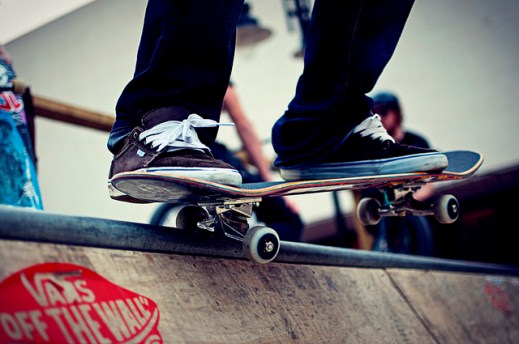
 Welcome back to our summer series on “Sound and Sport.” In today’s post, Josh Ottum discusses the sonorous sounds and unique rhythms of the sport of skateboarding. For an instant replay of last month’s post, click Tara Betts‘s “Pretty, Fast, and Loud: The Audible Ali.” For May’s post, click Melissa Helquist‘s “Goalball: Sport, Silence, and Spectatorship.” Next month’s grand finale will feature a doubleheader on Brasil, with a post by Kariann Goldschmitt on the promotional sounds of FIFA 2014 and a podcast by Andrea Medrado entitled “The Sounds of Rio’s Favelas: Echoes of Social Inequality in an Olympic City.” We’ll close with another take on the Olympics, excerpted from David Hendy‘s recent Noise broadcasts for BBC Radio 4 on the politics of boos at the games. For now, get out your board, strap on your helmet, and prepare to jam. —J. Stoever-Ackerman, Editor-in-Chief
—
Seven layers of screen-printed, sugar pine maple whack the concrete. Aluminum axles pivot on rubber bushings as they slide across steel coping. Circular, molded polyurethane encases lubricated bearings that spin in midair before slamming onto birch. Vocal cords are strained as exclamations are made in response to a maneuver. These are the unmistakeable sounds of the skatepark. As skaters ride through the park, a unique sonic tapestry emerges revealing a constantly shifting array of timbre, pitch, and rhythm. This sliding aural space is similar to the compositional flow between rehearsed maneuvers and improvisatory actions, connecting skaters in the skatepark to musicians improvising in a jam session.
Just as the results of a musical performance depend on acoustics of the venue and the idiosyncrasies of the instrument, the skater is beholden to a similarly complex signal chain. The aural atmosphere of the skatepark relies on the number of other players, as well as their chosen instruments, and unique approach to playing. While surveying the sonic and social dynamics of four skateparks in Ohio and California for this study, the line between performer and listener was often unclear. Skaters are consistently sliding between roles as passive observers and active participants, watching and being watched, making sound and listening to the sounds of others. And, just as an improvising musician aims to develop her own unique voice, the skater intertwines sonic and visual elements into a unique stylistic signature all her own. In this study I will look at the skatepark as a site for skaters to express themselves much in the same way that a musician plays an instrument at a jam session. I will explore the board and terrain, the importance of style, and the culture of the park itself. To begin, I will contextualize the ways in which the skateboard has been constructed as a sonic instrument.
The Instruments
As a skater lands an ollie in the Vans Skatepark in Orange, California, the sound of hard polyurethane wheels slamming against a hollow birch ramp emanates throughout the warehouse, entangling with distinctive sounds made by other participants. The listener is made acutely aware of each skater’s instrument and stylistic approach to performance. What differentiates the rider on a board in the skatepark from a guitarist playing in a rock club? Just as the materials of the electric guitar and its signal chain inform the sonic nature of the instrument, the skateboard and its engaged terrain sound out unique and identifiable characteristics of each device. I spoke with a skater at Flipside Skateboard Shop in Athens, Ohio about the specifics of wheel construction and his own personal preferences:
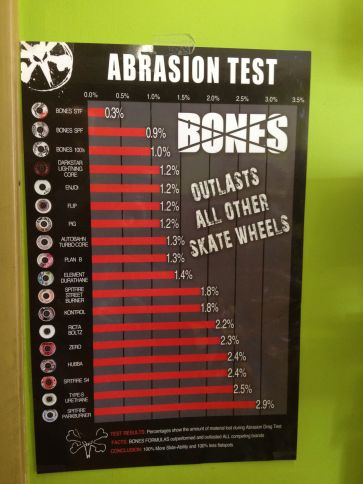
Abrasion test chart, Flipside Skateboard Shop, Athens, Ohio
Just like the layered wood of an electric guitar body, boards are made through a multistep manufacturing process that involves layering thin plies of wood. Maple is most commonly used with the relative flexibility of the deck determining qualities of audible resonance as a skater ollies or railslides. And trucks, which function as axles, can be heard grinding along a surface such as pool coping, a painted curb, or a handrail.
In order for these materials to make sound they must be controlled by a rider and engage with some kind of terrain. The combination of what materials are chosen and how they are used result in a rider’s unique approach. In the skatepark, skaters swathe themselves in clothing, pads, and helmets while riding devices wrapped in visual signposts of self-expression that sound out the priorities of the particular rider.
Sonic Style
Following Henri Lefebvre, Iain Borden speaks of the skateboard as a “lived component of the body, its actions and its self-image in relation to the terrain” (28). Similarly, from my time spent at skateparks in Ohio and California, I have noted the malleability of terrain as a domain to express one’s own unique style. Skaters use their devices as instruments, playing the park, repeating phrases, overlapping with sounds emitted from their peers. All the while, advertisements adorn both bodies and instruments and maneuvers mimic the iconic moves of sponsored skaters viewed in magazines. Visiting Focus Boardshop across the street from the Etnies Skatepark in Lake Forest, California reminds the observer that the elusive, focal point of style in the world of skateboarding is not only confined to the visual realm. As reissued decks from Powell Peralta, Slimeball wheels, and multiple videos adorn the walls of the shop, teenage skaters hang out, asking to bend and stand on decks and spin wheels, all the while watching and listening to newly released videos. Just as guitars and synthesizers reflect the users aesthetic outlook, the look and sound of skateboards signal to a skater’s audience (often other skaters in the park) what kind of skater he or she is.
Tara Rodgers’ insightful article on wood paneling on synthesizers for Sounding Out! has its analogue in the spiritual aura of the object in skateboarding. Bound up in this aura are genre-shaping histories that have taken the sport in innumerable directions. Whether it is the catwalk ethos of Vision Street Wear, Danny Way’s connection with Monster and Red Bull energy drinks, or enjoi’s self-referential marketing, the graphics that wrap around skate gear carry with them weighty connections to the sport’s most original moments. These moments are, of course, defined by marketing campaigns, hosted in influential magazines such as Thrasher and Transworld, and the zietgeist of the time. Intertwined with these branded materials is the sonic quality of the instrument. The sound of the instrument itself reflects the particular ethos of the skater who selected it. In the clip below, an employee working at Focus Boardshop in Lake Forest, California talks about the particular way his board’s sound reflects the idiosyncratic nature of its components. Notice how he skater speaks about the sound of his bearings as a direct link to his style, connecting to Borden’s idea of the board as a lived component of the body.
During my visit to the community skatepark in Athens, Ohio I come across two skaters who have returned to the sport after a two-decade break. One skater sports a longboard with 70a wheels so soft you can’t hear him skate through the concrete pool. Immediately after interacting with the longboarder, another skater finishes a session in the pool at the Athens skatepark with a long slide. I ask him about the role of his wheels and what he calls “the best sound in the world”:
Soft Wheels
Hard Wheels
Skaters related the histories of their boards to me with a sense of fond nostalgia. These histories functioned, primarily, as a mode of individuation, through which those observed were seen refining their identities within the community through conversation. As more time is spent at each of the parks, I begin to notice communal flows of conversation between skaters and their engaged terrain as well. Competitive aspects to out-do each other, synchronized maneuvers, and vocal responses are percolate the soundscape. As listeners perform and performers listen, connections with well-formed cultural codes of improvisational music begin to emerge.
Jamming the Skatepark
Improvising musicians often use the context of the jam session as an opportunity work out new ideas and rehearse repertoire. Minton’s Playhouse in New York is one of the original sites for the jazz jam session. Here, “cutting contests” allowed players the opporunity to outplay each other with virtuosic displays of improvisational prowess. Musicians play to hear each other individually and as a unit, often pushing each other to extremes. The sound is composed, listened to, and then reacted to. Skateparks provide a similar atmosphere. A trick (like an ollie) is immersed in the sonic flows of the surrounding skaters. The skatepark is simultaneously encouraging and competitive, forgiving and relentless.
When I visited the Vans Skatepark on National Go Skateboarding Day park employees tempted skaters to display their best moves throughout the park with the promise of free swag. The environment remained friendly and encouraging as skaters rose to the challenge, welcoming the pressure.
The rituals of the skatepark are varied in their scope. When a skater lands a difficult trick, it is common to hear the tapping of board tails on the ground; applause. Vocal reactions to maneuvers (landed or failed) are also quite common.
What sets the sonic atmosphere of the skatepark apart from the sound of skating outside the park is the palpable lack of intruding sounds from the outside world. As communities continue to accept the skatepark as part of their permanent landscape, the once transgressive sound of the sport takes on a new meaning. The scrapes and slides that once signaled intrusion are now contained in a controlled space. While visiting these jam sessions, it became clear that the sounds of the skatepark remain a mostly male-dominated activity. While the instruments and terrain remain available to the wider public the sound of the skatepark reflects a relatively closed environment often shrouded in platitudes of youth culture. However, once a sense of acceptance and experimentation is cultivated, some other aspects of the skatepark are revealed. The skatepark is a place to play and explore the range of one’s repertoire. It is a place to engage with the limitations of the instrument and one’s own physical faculties. And, it is an environment that encourages friction, noise, and distortion. The skatepark is a communal amplifier, obscuring and reflecting sound as the players immerse themselves in the ultimate sounding board.
Bonus Material:
While immersing myself in the sounds of the skatepark for this project, the idea came up to reimagine the sounds of the skatepark as a musical composition. I asked musicians Michael Deakers, Casey Foubert, Junior High, and Ryan Richter to make a piece that used any portion of the recordings of the four skateparks I visited. Their work reflects a deep connection to the rehearsed and improvisational aspects of music-making and skateboarding. The sounds of these pieces emerged from hours of practice and spontaneous decisions allowing for a particularly effervescent creative outcome. To hear these, check out out my Soundcloud here.
—
Featured Image, “Grinding” courtesy of Luke Hayfield Photography
—
Josh Ottum holds an MFA in Integrated Composition Improvisation and Technology from UC Irvine and is currently a PhD student at Ohio University in the School of Interdisciplinary Arts. His research interests include sound, energy extraction, Van Dyke Parks, Southern California, library music, and synthesizers. As a singer-songwriter, composer, and producer, Josh has released multiple records on various labels, completed numerous international tours, and composed music that has appeared on MTV, AMC’s Mad Men, and NPR.
—
REWIND! . . .If you liked this post, you may also dig:
“Tofu, Steak, and a Smoke Alarm: The Food Network’s Chopped & the Sonic Art of Cooking“–Seth Mulliken
“Sounding Out! Podcast Episode #5: Sound and Spirit on the Highway“–David Greenberg
“Sound-politics in São Paulo, Brazil”–Leonardo Cardoso
Share this:


Current Top Posts





April 2021

January 2020

November 2019

October 2019

August 2019

April 2014

November 2017

March 2015

December 2017

October 2015
 Sounding Out!
Recent Comments