
Mouthing the Passion: Richard Rolle’s Soundscapes


Each of the essays in this month’s “Medieval Sound” forum focuses on sound as it, according to Steve Goodman’s essay “The Ontology of Vibrational Force,” in The Sound Studies Reader, “comes to the rescue of thought rather than the inverse, forcing it to vibrate, loosening up its organized or petrified body (70). These investigations into medieval sound lend themselves to a variety of presentation methods loosening up the “petrified body” of academic presentation. Each essay challenges concepts of how to hear the Middle Ages and how the sounds of the Middle Ages continue to echo in our own soundscapes.
The posts in this series begins an ongoing conversation about medieval sound in Sounding Out!. Our opening gambit in April 2016, “Multimodality and Lyric Sound,” reframes how we consider the lyric from England to Spain, from the twelfth through the sixteenth centuries, pushing ideas of openness, flexibility, and productive creativity. We will post several follow-ups throughout the rest of 2016 focusing on “Remediating Medieval Sound.” And, HEAR YE!, in April 2017, look for a second series on Aural Ecologies of noise! –Guest Editors Dorothy Kim and Christopher Roman
—
A soundscape is an aural-based landscape, an auditory environment that surrounds a listener and constructs space. In 2009 the composer, John Luther Adams, created a music installation in Alaska that experiments with the boundaries of soundscape. Utilizing geological, meteorological, and magnetic data, Adams tuned and transformed the sounds of the landscape into electronic sound.
In his “Forward” to John Luther Adams’s composer journals compiled as The Place Where You Go to Listen, New Yorker music critic, Alex Ross comments that Adams’s work with composing with the atmospheric, geological, and ecological sounds of Alaska reveals a forbiddingly complex creation that contains a probably irresolvable philosophical contradiction. On the one hand, it lacks a will of its own; it is at the mercy of its data streams, the humors of the earth. On the other hand, it is a deeply personal work, whose material reflects Adams’s long-standing preoccupation with multiple systems of tuning, his fascination with slow-motion formal-processes, his love of foggy masses of sound in which many events unfold at independent tempos (x).
Thinking with Adam’s project and considering how sound surrounds us and can be tuned and transformed, as well as brought to the forefront of our sense perception, I turn to the medieval hermit, Richard Rolle, and his work with canor in his lyrics. In what follows, I consider the enmeshed ecology divine lyrics may invoke, and how the body—as an instrument—may experiment with, mimic, and contemplate divine sounds.

If hills could sing. Photo of Juneau Alaska by Ian D. Keating @Flickr CC BY.
In Rolle’s work, the experience of song, or canor, is one of the highest mystical gifts. As with John Luther Adams, sound unfolds in ways both translatable and ineffable. Canor creates a kind of being, one that creates place and, then, surpasses it. As he writes in the Incendium Amoris at the moment of his receiving the gifts of God:
I heard, above my head it seemed, the joyful ring of psalmody, or perhaps I should say, the singing […] I became aware of a symphony of song, and in myself I sense a corresponding harmony at one wholly delectable and heavenly (93).
In this initial receipt of canor, Rolle is made aware of aural space and the way that it is mimicked in his own biology. The space of the sacred church is transformed into an eternal space that resonates harmonically with God. In this, his first mystical experience, the musical song he hears above him transforms him internally: “my thinking turned into melodious song and my meditations became a poem, and my very prayers and psalms took up the same sound” (93). This transformation erases the boundaries between hearing external song and the translation of the internal song, and tunes Rolle into the ecology of sound, as Adams phrases it in The Place Where You Go to Listen, a “totality of the sound, the larger wholeness of the music” (1). Rolle’s body becomes a musical instrument beyond its initial sound capabilities and it resonates with the chapel space itself to become a larger harmonious work. Harmony in the form of these mystically experienced, enmeshed vibrations suggests both a local and cosmic allusion to complex systems of divine transcendence and immanence.
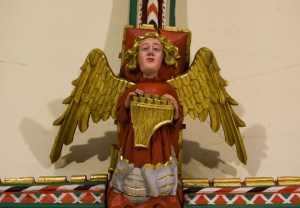
Detail of an angel with a musical instrument at All Saints’ Church on North Street in York. Image by Lawrence OP @Flickr CC BY-NC-SA.
By invoking the sounds of the Passion, conflating time and sound, and experimenting with the mouth of the lyricist to perform divine sounds, Rolle attempts to capture the panoply of emotion, action, and object surrounding his mystical experience and devotion by singing it. Invoking a queer temporality, Rolle weaves past and present, sound and sight, Jesus and singer, into an immersive, divine soundscape. The song reveals that there is no outside in the connection between the body as instrument and the God-sound.
The making of the divine into song for Rolle is a praxis, an active way to reconsider the relationship between God and man beyond visualization. Rolle’s use of the lyric is an ecological thought, what Tomothy Morton dubs a “reading practice” in The Ecological Thought that
makes you aware of the shape and size of the space around you (some forms, such as yodeling, do this deliberately). The poem organizes space […]. We will soon be accustomed to wondering what any text says about the environment even if no animals or trees or mountains appear in it (11).
In contemplating a lasting Love in , Rolle considers the gap between love and life, or, more specifically a love that is a lasting life and a love that quickly fades. This becoming-love must be separated out from other kinds of love that separate the singer from the community. Can love manifest itself in sound? Rolle exemplifies love’s abundance in the fire that “sloken may na thing” in “A Song of the Love of Jesus” (6). Love is represented as an excessive fire, one that nothing can put out and, therefore, everything is subsumed in it.

Stained glass depicting burning forests from a Richard Rolle poem at All Saints’ Church on North Street in York. Image by dvdbramhall CC BY-NC-SA.
But it is the sound of fire that Rolle connects with Love’s embrace. Rolle suggests an ecological moment, not in an apocalyptic way, but as a fire that creeps into all crevices. Nothing can “sloken” it—the sibilance of the consonant blend ‘sl’ gestures toward crepitation. It is the sound of fire touching the object as it prepares to consume—to take it into itself—as well as reveal Love’s movement in space. Rolle considers that love is created through the sound of fire (which, in his other works is an emotion he struggles with and not a visual fire).
In the lyric “Song of Love-longing to Jesus,” Rolle addresses the relationship between love and Jesus but rather than meditate on the nature of that love, as in the previous lyric, Rolle meditates on the event that causes that love: the Crucifixion. The lyric is bookended by violent acts. At the beginning, Rolle asks Christ to “take my heart intil þy hand, sett me in stabylte” (4) and “thyrl my sawule with þi spere, þat mykel luf in men has wroght” (6). In both these cases Christ’s hand and spear enter into Rolle in order to affect change. In the first line, it is to settle his heart—a theme that Rolle repeats in many of his writings. The stability of the heart allows it to open so that Christ can take up residence and, in that “indwelling,” the soul and Christ become one.
In the second piercing, the spear pierces the soul and Rolle seems to be implying that this piercing has already been done; the second piercing itself is the action that has opened the human to love. As Jesus was pierced by the lance of the Roman soldier, the soul is pierced by Jesus and in that act, love is made or “wroght.” In the second piercing, the ‘thyrl” becomes an important word because of its relationship between sonic resonance and mouth articulation. The spear pierces the soul and Rolle plays with the mouthing of the word as a kind of reverse piercing. The interdental fricative configuration of the voiced “th” in the word “thyrl” made by scraping the tongue between the teeth to form the word is like the removal of the spear from the wound itself. The lips make a wound shape and the tonguing of wounds reveals the intimacy inimical to the movement of the mouth, to sound out this pain and curl the lips to connect the lyricist with Christ.
The latter event of the poem is the scene of the Crucifixion itself. As Jesus has first pierced Rolle and in that event awoken or caused Love, we can imagine the spear as a brief linking object, something that erases the boundaries between Christ and Rolle. However, the middle third of the poem relates how Rolle lives a life of longing—and the love of Jesus will resolve this longing: “I sytt and syng of lufe-langyng, þat in my hert is bred” (29). The song is a result of the piercing; it is as if the removal of the spear has opened up a new song: that of love-longing. Rolle is lamenting the loss of the spear. The love-longing song, then, fills the hole left by the spear.

Image by .sanden. @Flickr CC BY-NC-SA.
The lyric further explores the soundscape of the Crucifixion. The meditation on the Crucifixion begins with Christ bursting forth. If the first image of the lyric is of Rolle being pierced inwardly, Christ ends the poem with a flowing out: “His bak was in betyng, and spylt hys blessed blode; þe thorn corond þe kyng, þat nailed was on þe rode” (35-36). Notice the repetition of “b” and the “th” consonant blend. The “b”’s recreate the lashes, the “th”’s repeat the piercings (the crown, the hands, the legs). The Passion is captured in two lines of sounds, but Rolle underscores the piercing of Christ as a way to show his overabundance—the flowing out of Christ in the lyric is another way to remove the boundary between singer and Christ—Christ also becomes the song as He is bound with the flowing rhyming words: fode/stode/blode/rode mimic the promise of the Passion.
Let us look closely at this stanza’s rhyme. The first and third, fode and blode, refer to the Eucharist and wine. It is out of the second and forth words: stode and rode from which we get that Eucharistic event. Jesus is beaten and Crucified; the Eucharistic feast of body and blood (or “aungel fode”) are a reminder of that event. In other words, Rolle has contained the temporal connection between Eucharist and Crucifixion in four rhyming words and the lyric becomes a witness to the sound of this event.
Rolle’s experiments with the mouthing of sound and the queer temporality of sound in his lyrics reveal Rolle’s attempt to capture canor textually. To sing God is an attempt at harmony with the divine.
—
Featured image from a mural in the Dominican friars’ chapel in the Angelicum, Rome. Photo by Lawrence OP @Flickr CC BY-NC-SA.
—
Christopher Roman is Associate Professor of English at Kent State University His first book Domestic Mysticism in Julian of Norwich and Margery Kempe deals with the creation of queer families within mystical theology. His forthcoming book Queering Richard Rolle deals with the intersection of queer theory and theology in the work of the hermit, Richard Rolle. His research also deal with quantum theory and Bede, ecocritical theory, and medieval soundscapes. He has published on medieval anchorites, ethics in Games of Thrones, and death and the animal in the works of Geoffrey Chaucer.
—
 REWIND! . . .If you liked this post, you may also dig:
Introduction: Medieval Sound–Dorothy Kim and Christopher Roman
SO! Reads: Isaac Weiner’s Religion Out Loud: Religious Sound, Public Space, and American Pluralism–Jordan Musser
“I Love to Praise His Name”: Shouting as Feminine Disruption, Public Ecstasy, and Audio-Visual Pleasure–Shakira Holt
Share this:

LMGM’s “Lost: Choirboy” & El Jefe’s “Muñoz & La Mission: A Sermon. . .” (in memoriam José Esteban Muñoz)

 Come, let us sing of great men. Well, just one man, not men—and masculine gender is not essential for our purposes. Come to think of it, his greatness isn’t nearly as important as his fierceness, his queer significance, his brown sensibility. But we’re still committed to singing—or at least to music—well, to sound and noise, in any case. José Esteban Muñoz often wrote about queer scenes where music and sound were central to participants’ world-making activities. His archives buzzed with the sounds of West Coast punk, vogue-ball house, cruisy toilets, genderqueer burlesque, and salsa echoing down the barrio streets. And so, for this Round Circle of Resonance, we at La Mission are here to make some noise about a badass thinker who deeply impacted the way we dance/sing/talk/write/sweat about dance music, identity, and politics.
And this is just the beginning of our cacophonous, four-part response to Muñoz’s intellectual holler. The first installment, written by La Mission’s resident essayist / deranged propagandist LMGM (Luis-Manuel Garcia) provides a brief introduction to our collective, some reflections on Muñoz’s relevance to our activities, and a frame for the next three missives from our fellow cultists. It is backed with a rousing sermon-cum-manifesto from our charismatic cult-leader/prophet, El Jefe (Pablo Roman-Alcalá). In the coming weeks, our Naked Mennonite/randy dramaturge (Mandie O’Connell) will prepare and film a urinary performance piece; and our saucy Choir Boy/Linguist (Johannes Brandis) will compose a dirge to our dearly departed José (August 9, 1967- December, 4, 2013).
LMGM a.k.a. Luis-Manuel Garcia
—
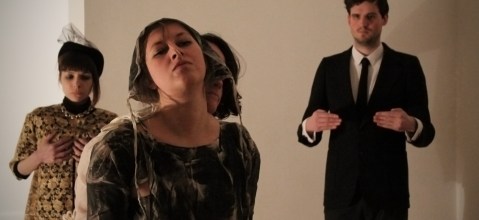
La Mission’s “(p/A)001: A non-Aristotelian Drama in Five Acts,” 2013, Image by Julien Barret
Lost: Choirboy (in memoriam José Esteban Muñoz)
La Mission
Named after San Francisco’s Latino barrio, La Mission is a satirical utopian doomsday cult, a music label, a queer situationist art-gang, a magazine, and a group of dancers with a very dirty sense of humor. We release music on vinyl, publish DIY ‘zines, and make performance art, aiming to re-politicize genres of dance music that have been important to queer people of color. La Mission’s identity is perhaps best summed up by cult-leader El Jefe’s manifesto-sermon, “The Sermon for the Steps of the Ziggurat in our Hearts,” published in our first La Mission magazine:
La Mission is a Community. La Mission is a Collective. La Mission is a Cult. La Mission is a Situationist Art Gang. La Mission is a Anarcho-Syndicalist terror cell. La Mission is a Family. La Mission is You. La Mission is Us. La Mission is gonna strip you butt nekkid, gonna check all your body cavities, gonna give you a shower, gonna give you a goodie bag, gonna give you a clean sheet and a towel. You at home with us now children, you understand me? You home with us now.

Founders Luis-Manuel, Pablo, and Mandie, caught on film at the performance for LM002, ‘a slow mutiny.'”
La Mission was first formed in 2012, in a small café in the Neukölln district of Berlin. The collective initially began with just three of us—Pablo Roman-Alcalá, Mandie O’Connell and Luis-Manuel Garcia—but like any good charismatic doomsday cult, it quickly expanded to include a broad network of lovers and collaborators, led by a core of four instigators (Johannes Brandis joined us later in the year). After a fundraising run in the fall of 2012 (witness our surrealist fundraising video here), we held our first two performances in the winter and spring of 2013, which involved experimental performance art pieces held in unusual spaces. The performances incorporated music and text from our vinyl EPs and their corresponding ‘zines, which were released at around the same time. These multi-channel productions were also conceptually coherent, with (kunst/WORK)001 introducing La Mission’s “mission” and (kunst/WORK)002 focusing on the relevance of utopianism to dance music. After a “quiet spell” where we released an out-of-series vinyl record of “lost remixes,” 2014 has been dedicated to preparing the next volume in the series (due in February 2015), which examines the depredations of capitalism, forced austerity, and false scarcity on music.
Hearing José
La Mission has no idols, but we do have influences—and José Esteban Muñoz is foremost among them. We share with Muñoz a focus on queer nightlife-worlds, a non-classical take on utopianism, a commitment to intellectual interventions outside of academic channels, and a certain brassy tone of voice. His revival of Ernst Bloch’s notion of a utopia based in real-life struggles was crucial in helping us reconcile revolutionary politics with dancefloor utopianism; or, put differently, Muñoz helped us find the critical politics latent in the queer, brown, sweaty gatherings that form the core of our scene of commitment. As “EDM” continues to blow up into a primarily white, hetero, cis, mainstream phenomenon, his insights have helped us maintain clarity and critical focus.
From the outset, we have also been profoundly influenced by Muñoz’s lifelong theorizations of brownness, affect, and (dis)identification. Since three of our four core members are Latina/os in varying states of stripped identity, we have been especially interested in Muñoz’s notion of the “brown commons,” as he was developing the concept in the last years of his life. In promotional texts that circulated ahead of his speaking engagements on the topic, he described brownness as “an expansive sense of the world, a feeling and being in common that surpasses the limits of the individual and the subject.” Notably, he understands brownness and the brown commons as being shaped not only by suffering and struggle, but also by thriving, providing a pool of resources for a better, more vibrant kind of life.
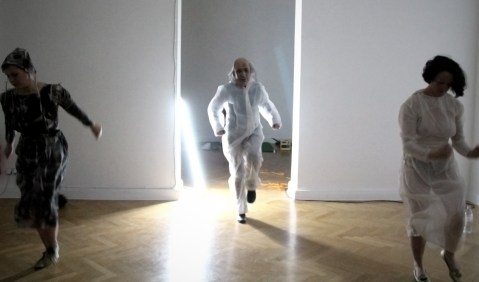
La Mission, (p/A)001: A non-Aristotelian Drama in Five Acts, 2013, Image by Julien Barret
The significance for La Mission’s project in dance music culture should be clear already, but we also take great inspiration in how Muñoz developed an expansive view of brownness and the brown commons, using Latina/o experience as an entry-point for “a vaster consideration of the ways in which people and things suffer and experience harm under the duress of local and global forces that attempt to diminish their vitality and degrade their value.” We here at La Mission are committed to exploring brownness for its potentials for lateral solidarities among people of color, who may have diverse cultural backgrounds but nonetheless share post-migrant experiences of struggle, devaluation, displacement, and inauthenticity. In fact, Muñoz’s work was a direct inspiration for the “Brown Corner” in our La Mission ‘zine (a parody of the “ladies’ corner” and “kid’s corner” of American mid-century lifestyle magazines). Published bilingually and featuring post-migrant authors, the Brown Corner reflects on aspects of brownness, as both specific to their contexts and generalizable to a wider “commons” of brown experience. In the process, we hope to highlight shared feelings, narratives, and resources for brown survival in a world of white supremacy.

A hand-drawn re-working of Frieda Kahlo’s own self-portrait, part of the Brown Corner for issue 001 of the La Mission ‘zine.
Singing into the Horizon
Brother Muñoz, what are we supposed to do with the vinyl records, the zines, the performance videos we had been accumulating for you? We’re trying to sing our way into a queer utopian horizon, and we had been counting on your voice. We know you’re not coming back. As a radical lefty utopian doomsday cult, we’re not so invested in the afterlife, anyway. But it still sucks for us and everyone else you left behind, left in the “here and now” that we struggle to turn into something less suffocating. The party was just getting started, dammit. Besides, we had such a kickass choirboy outfit picked out for you.
—
LUIS-MANUEL GARCIA aka “LMGM”: LMGM/Luis-ManuelLMGM/Luis-Manuel is a Canadian of Peruvian-Colombian origins, currently an Assistant Professor in Popular Music at the University of Groningen (NL), after migrating between Toronto, Berlin, Chicago, and Paris. He has managed to turn his love of electronic dance music into a PhD in Ethnomusicology at the University of Chicago, and into post-doctoral fellowships at the Max Planck Institute for Human Development and the Freie Universität Berlin. On the side, he writes about food and dances every chance he gets.
—

“Portrait of La Mission” by Ben Hammond, who has not seen any of its members naked
Muñoz & La Mission: A Sermon for the Imagined Sanctuary We Built Together
Welcome. La Mission is a family. A family of chosen comrades, chosen brethren, chosen hermanos, chosen сестры, chosen lovers, chosen students, chosen teachers, and chosen arms. Arms, linked and brandished through common thought, common feeling, common goals. It is with a heavy heart that we find ourselves here, remembering one of our family who (though never officially an acolyte or collaborator) was one who contributed to the ecstasy that we have felt and will feel for many years. José Esteban Muñoz was said to be a believer. Ernst Bloch and the New Revolutionary Epoch. Our utopias were described and imagined and realized and experienced. Rise up, my brown brethren, and let us celebrate Brother Muñoz’s legacy!

La Mission’s “(p/A)001: A non-Aristotelian Drama in Five Acts,” 2013, Image by Julien Barnet
The words and deeds of this fellow freedom-fighter, who infiltrated the bourgeois güero academy and infected it with a polylateral program for de- and reprogramming, has been our parallel and our inspiration. Colleague and comrade. A representative of our struggle. Not quite a patron saint—that honor we’ve reserved for communarde Louise Michel—but no less a visionary. As queers, as minorities stripped of identity, as angry and happy children in revolt for something better, we must all learn from each other as equals.
Brother Muñoz made utopia political again and located that utopianism in performance. La Mission’s performances bring forth utopias from our queer future through fleeting mindfuck happenings in the present. Through the work of Sister O’Connell and her band of terrorizing miscreants, we present a non-narrative and non-paternalistic path towards redemption, one of our own making. Can I get a “Fuck, yeah!”?

La Mission at Import Projects, 2013
Brother Muñoz loved music and dancing and life-worlds connected by the beat and said, “Take Ecstasy with Me.” He revealed to us the connections between collective dancing and feeling utopian. In his spirit, La Mission’s music strives to bring forth utopia through that ever-lasting beat. Through disassociation and reassociation, through transcendental repetition, and through getting the fuck down! Can I get a “Fuck, yeah!”?
Brother Muñoz believed in learning and critical thinking. Analysis and the great revolutionary trek through the jungle of our critically thinking minds. La Mission’s tracts enact utopia through a constant vomiting out of our recently digested learnings into the baby-bird mouths of those who read them. The brother was also a hilarious motherfucker, and from this we realize that it is not through the shrill screams of egoism disguised as activism that we will prevail. It is through the joy of laughter combined with thought that we will win our bread. Can I get a “Fuck, yeah!”?
Brother Muñoz loved fucking. La Mission’s fucking creates utopias through the ecstatic act in and of itself. If you aint fucking to make yourself a Temporary Autonomous Zone of happiness, then you aint doing it right. Can I get a copulatory “Fuck, yeah!”?
It is not all loss, though. The ideas live on. Caminamos juntos. On the dancefloor. In the reclaimed Torre David skyscraper and the Taller Tupac Amaru collective; in the informal classrooms and the sweaty bedrooms. Our hearts must burst after sagging, our heads must fill after hanging low, and our linked arms will raise! Oh honey, please don’t give your heart to a world system based on exploitation of the luckless, give your heart to US!
—

La Mission at Import Projects, Common Revilings Project, 2013, Image by Julien Barrat
—
All images courtesy of La Mission
—
PABLO ROMAN-ALCALA: Yo. I am Pablo aka “Beaner” aka “Skirtchaser” aka “El Frijolero” etc. I am an internationally working musician and dj who has enjoyed a modicum of success, but who doesn’t like what has happened to the musical landscape vis-a-vis “conservatism” in respect to both Money and Art. I mean the relationship of the two, okay? It sucks. And I want to change it.
—
REWIND!…If you liked this post, check out:
Karaoke and Ventriloquism: Echoes and Divergences–Karen Tongson and Sarah Kessler
Freedom Back: Sounding Black Feminist History, Courtesy the Artists– Tavia Nyong’o
“New Wave Saved My Life*”-Wanda Alarcon
Share this:


Current Top Posts





April 2021

January 2020

November 2019

October 2019

August 2019

April 2014

November 2017

March 2015

December 2017

October 2015
 Sounding Out!
Recent Comments