
#MMLPQTP Politics: Soccer Chants, Viral Memes, and Argentina’s 2018 “Hit of the Summer”
Note: all translations of quotations from linked media are the author’s own.
In early March, viewers of the Argentine public television cooking show Cocineros Argentinos were treated to a jaunty bit of live interstitial music as the program returned from a commercial break. In keeping with the day’s Italian theme, a small band consisting of an accordion, violin, and sousaphone played a lively but simple minor-key melody in a brisk tarantella rhythm. “Those boys can play anything,” one of the hosts remarked approvingly. The other observed, “It’s the hit of the summer!”
These sixteen seconds of seemingly innocuous instrumental music on a government-sponsored television program sparked a minor firestorm in the Argentine press. One channel wondered whether they were deliberately “picking a fight with [President] Mauricio Macri,” while another categorized the musical selection as “polemic.” Social media voices in support of the embattled president called for Cocineros Argentinos to be cancelled. Ultimately, the program’s directors apologized to the public for having “bothered or disrespected” their viewers with “ingredients that do not belong in the kitchen.”
How could a bit of instrumental, pseudo-Italian kitsch cause such an uproar? Understanding the offense – for the musical selection was indeed intended as an obscene insult to the nation’s president – requires a bit of a dive into the history and culture of Argentine politics, protest, and sports fandom. The “hit of the summer” of 2018 in Argentina is not a pop song, but a chant that started in a soccer stadium, and has become a viral sonic meme, multiplying across social media and fragmenting into countless musical iterations. By early March, listeners in Argentina heard a clear meaning in this melodic sequence, and no singer was necessary to hear the words it invoked: Mauricio Macri, you son of a whore.
The melody comes originally from a source that expresses quite a different political sentiment. In 1973, after eighteen years of forced exile, ousted populist president Juan Domingo Perón was allowed to return to Argentina, and was shortly thereafter re-elected president. Perón died in office ten months later and was succeeded by his vice president and third wife Isabelita. Isabelita’s reign would soon devolve into an infamously brutal military junta, but in 1973 populist national fervor was running high in the country, and the airwaves were full of catchy, simple patriotic marches:
“Es tiempo de alegrarnos” (“It is time for us to be happy”), by Raúl “Shériko” Fernandez Guzmán, is full of optimism for what Perón’s return means for the country. The second stanza celebrates: “I see that my people returns once more to laughter / It’s that my country has begun to live again / Pain and sadness are left behind / The days of happiness and bliss have returned.”
It’s a sentiment that would be difficult to find today in a country where political discourse is polarized and acrimonious. Macri was elected in November 2015 on a platform that was largely about undoing the policies of the decade of Peronist administrations that preceded him (his party itself is called “Cambiemos” [Let’s Change]). Since coming to power, Macri’s party has pursued a neoliberal agenda that has been increasingly unpopular with the working and middle class. Cuts to state subsidies have made the cost of utilities and mass transit skyrocket, and groups from truck drivers to teachers have organized large-scale protests in response to the austerity measures and budget cuts to the public sector. In response to these increasingly fervent protests, Macri has even authorized violent police repression of crowds. In short, as of the beginning of 2018, he’s politically embattled and a target of widespread criticism from a wide range of sectors.
Yet the “hit of the summer” is not merely an ironic repurposing of an old bit of patriotic musical fluff in a time of unrest. In fact, as the phenomenon first went viral, most Argentines were unware of the music’s original source, which had been a fleeting fad. Instead, the melody had lived on and been transformed through the great repository of popular musical memory that is Argentine soccer culture.
Soccer fandom in Argentina is a full-throated affair. As Kariann Goldschmitt has observed in the case of Brazil, the soundscape of mass gatherings in the soccer stadium, and the affective charge of crowds experiencing the collective pain of loss or the exultation of victory, is a fundamental ingredient of popular identity in Argentina. But it is not the commercial, mediatized end of what Goldschmitt calls the “sports-industrial complex” that is primarily influential here.
Rather, hinchadas, or fan clubs, pride themselves on being able to sing loudly throughout the match, arms extending in unison, typically accompanied by bombos (bass drums), trumpets, and other loud instruments. Fan clubs pride themselves on the variety and creativity of their cantitos – the ‘little songs” that repurpose popular melodies with new lyrics that praise their own side, and insult their opponents’ lack of fortitude. Any memorable melody is fair game: for example, fans of Creedence Clearwater Revival’s “Bad Moon Rising” might have found the cantito that Argentina embraced during the 2014 World Cup vaguely familiar. In the decades since its release, “Es tiempo de alegrarnos” had been used periodically by the clubs of several teams, in variants whose unifying factor was the use of the obscenity “la puta que te parió” (literally, “the whore that birthed you”) for emphasis.

Hinchada Argentina – Copa do Mundo Brasil 2014 – Estádio Beira-Rio – Porto Alegre, June 24, 2014, Image by Flickr User Felipe Castilhos
It was San Lorenzo’s fans who gave the cantito a new life in politics, during a match against Boca Juniors. The connection between Boca and President Macri was obvious for fans of both teams; Macri began his political career as the president of that team. When San Lorenzo fans felt they had been the victim of biased refereeing, the song began: “Mauricio Macri, la puta que te parió…”. All four phrases of the melody repeated the same words.
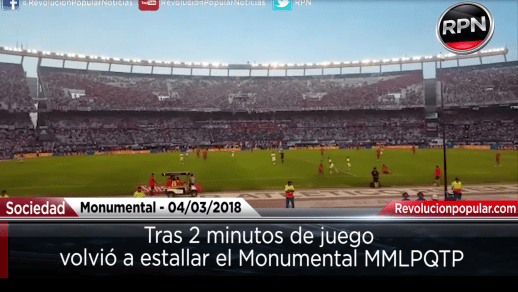
Unusually for a soccer cantito, the chant was soon picked up by the fans of another team, River Plate, who used it in similar circumstances when facing Macri’s Boca Juniors, their archrivals. Even more unusual, though, is the life that the chant has since taken on outside of the soccer stadium, where it is directed at the President not due to his association with his former club, but because of growing discontent with his political career. In the last weeks of February the cantito, now popularly known by its initials as “MMLPQTP” was heard in concert halls, basketball stadiums, and even in a crowded subway station (where, despite fare prices that have risen at eight times the rate of inflation, service remains irregular and delays are common). Journalists covering the phenomenon began to refer to it as “el hit del verano,” or “the hit of the summer.”

“Suena en las canchas, suena en los recitales, suena en el subte… Ahora también suena en los celulares!!!” Click to download an Mp3 Ringtone of “MMLPQTP”
Using the English-language “hit” made clear that the allusion was not merely to the season (February is, of course, summer in the southern hemisphere, and a popular vacation time for Argentines) but to the seasonal nature of pop music consumption. The popular music critic’s thinkpiece seeking to define the essence of the summer song, celebrate it or lament its banality is almost as much of a trope as the phenomenon of the hit summer song itself. The sonic zeitgeist of summer 2018, these journalists suggested, could best be defined not with a breezy club banger, but with the hoarse and irate voices of a nation embroiled in an economic crisis that would make idle days at the beach unthinkable for many of its citizens.
There were attempts to curtail the spread of MMLPTQTP: the national referee’s association debated suspending future soccer matches if the chant broke out, characterizing it as potentially “discriminatory” speech (some cantitos do traffic in racist, anti-Semitic, and homophobic epithets, and referees have suspended games in the past to control them). In the end, no such suspensions occurred, perhaps because soccer fans and other musicians alike had already realized that the MMLPQTP chant had re-signified its melody so strongly that the lyrics were no longer necessary. One political cartoonist pointed out the referees’ conundrum perfectly: “They’re not singing the lyrics, sir, just humming the music,” the referee observes, asking, “should I suspend [the game] anyway?” Faced with the specter of censorship, Argentines embraced the full expressive potential of non-linguistic sonic signifiers, and the democratic possibilities of virally distributed, user-created content. A sonic meme was born.
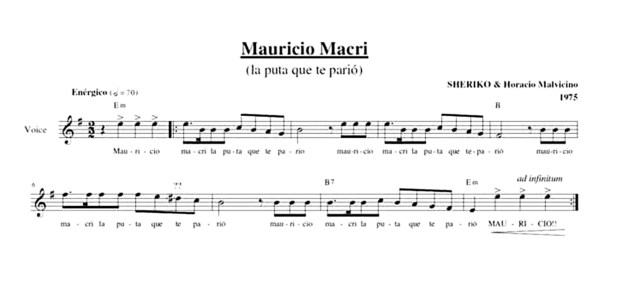
The term “meme” was coined by Richard Dawkins, who used it to mean a basic unit of information analogous to a gene, only for information or ideas. I use the term here, though, in keeping with the more contemporary popular usage, to refer to user-generated humorous content – generally captioned images — shared online. Meme sharing sites often provide templates to help users easily generate variations on a theme. In this case, the structural template was a melody and two simple chords (which musicians helpfully transcribed and shared, both in standard Western notation and instructional video formats).
Musicians of all backgrounds flocked to Twitter, Facebook and YouTube to riff on MMLPQTP. In a catalog too long to list in its entirety here, a greatest hits compilation might include solo versions for piano and charango, covers in popular genres from blues to cumbia to metal. Argentines with a strong sense of national identity might prefer tango, but Brazilian-style Carnival samba also made an appearance (playfully invoking the possibility of censorship with Spanish “subtitles” that replace the offending phrase with “la la la”). And thus finally, scandalously, the hit song made its way to national television on a cooking show, where despite its transformation into an Italian-style instrumental ditty, the sting of its insulting words was still clearly heard.
The viral success of instrumental versions of MMLPTQP is a prime example what ethnomusicologist Anne Rasmussen has recently called “the politicization of melody.” In music’s potential to comprise and thus link simultaneous linguistic and non-linguistic codes lies its ability to render those linguistic codes superfluous. These linkages provide the potential to signify political messages through melody alone, opening up possibilities for protest that are more difficult to prevent through legal means (broadcasters’ obscenity clauses, for example), or easier to circumvent through technological means (amplified instruments). It would be easy to overstate the durability or pervasiveness of such linkages, however. One need only look back to that same melody’s entirely differently politicized origin, which is today largely forgotten or seen as a curiosity, to imagine that the linkage between the melody to “Es tiempo de alegrarnos” and its current manifestation of partisan abuse might one day fade from popular memory like the one-hit wonders of summers past.
—
Featured Image: Screencapture from “Monumental MMLPQTP”
—
Michael S. O’Brien is an assistant professor of music at the College of Charleston. He has been conducting ethnographic field research on music and cultural politics in Argentina since 2003. His article examining the use of thebombocon platillo in Carnival music, soccer fandom, and political culture is forthcoming in the journal Ethnomusicology this fall. He has also published research on protest music in the U.S. in the journal Music and Politics and Smithsonian Folkways Magazine.
—
 REWIND!…If you liked this post, you may also dig:
Heard Any Good Games Recently?: Listening to the Sportscape–Kaj Ahlsved
In Search of Politics Itself, or What We Mean When We Say Music (and Music Writing) is “Too Political”–Elizabeth Newton
Twitchy Ears: A Document of Protest Sound at a Distance–Ben Tausig
The Sounds of Selling Out?: Tom Zé, Coca-Cola, and the Soundtrack to FIFA Brazil 2014–Kariann Goldschmidt
Share this:

The Firesign Theatre’s Wax Poetics: Overdub, Dissonance, and Narrative in the Age of Nixon

The Firesign Theatre are the only group that can claim among its devoted fans both Thom Yorke and John Ashbery; who have an album in the National Recording Registry at the Library of Congress and also coined a phrase now used as a slogan by freeform giant WFMU; and whose albums were widely distributed by tape among U.S. soldiers in Vietnam, and then sampled by the most selective classic hip hop DJs, from Steinski and DJ Premier to J Dilla and Madlib.
Formed in 1966, they began their career improvising on Los Angeles’s Pacifica station KPFK, and went on to work in numerous media formats over their four-decade career. They are best known for a series of nine albums made for Columbia Records, records that remain unparalleled for their density, complexity, and sonic range. Realizing in an astonishing way the implications of the long playing record and the multi-track recording studio, the Firesign Theatre’s Columbia albums offer unusually fertile ground for bringing techniques of literary analysis to bear upon the fields of sound and media studies (and vice versa). This is a strategy that aims to reveal the forms of political consciousness that crafted the records, as well as the politics of the once-common listening practices binding together the disparate audiences I have just named. It is no accident that the associative and referential politics of the sample in “golden age” hip hop would have recognized a similar politics of reference and association in Firesign Theatre’s sound work, in particular in the group’s pioneering use of language, time, and space.

The Firesign Theatre (wall of cables): John Rose, Image courtesy of author
The Firesign Theatre is typically understood as a comedy act from the era of “head music” — elaborate album-oriented sounds that solicited concerted, often collective and repeated, listening typically under the influence of drugs. But it may be better to understand their work as attempting to devise a future for literary writing that would be unbound from the printed page and engaged with the emergent recording technologies of the day. In this way, they may have crafted a practice more radical, but less recognizable, than that of poets —such as Allen Ginsberg or David Antin, both of whose work Firesign read on the air — who were also experimenting with writing on tape during these years (see Michael Davidson’s Ghostlier Demarcations: Modern Poetry and the Material Word, in particular 196-224). Because their work circulated almost exclusively on vinyl (secondarily on tape), it encouraged a kind of reading (in the strictest sense) with the ears; the fact that their work was distributed through the networks of popular music may also have implications for the way we understand past communities of music listeners as well.
The period of Firesign’s contract (1967-1975) with the world’s largest record company parallels exactly the recording industry’s relocation from New York to Los Angeles, the development of multitrack studios which made the overdub the dominant technique for recording pop music, and the rise of the LP as a medium in its own right, a format that rewarded, and in Firesign’s case required, repeated listening. These were all factors the Firesign Theatre uniquely exploited. Giving attention to the musicality of the group’s work, Jacob Smith has shown (in an excellent short discussion in Spoken Word: Postwar American Phonograph Cultures that is to date the only academic study of Firesign) how the group’s attention to the expansion of television, and in particular the new practice of channel-surfing, provided both a thematic and a formal focus for the group’s work: “Firesign […] uses channel surfing as the sonic equivalent of parallel editing, a kind of horizontal or melodic layering in which different themes are woven in and out of prominence until they finally merge. Firesign also adds vertical layers to the narrative in a manner analogous to musical harmony or multiple planes of cinematic superimposition” (181). But more remains to be said not only about the effect of the Firesign Theatre’s work, but about its carefully wrought semantics, in particular the way the “horizontal” and “vertical” layers that Smith identifies were used as ways of revealing the mutually implicated regimes of politics, culture, and media in the Vietnam era — at the very moment when the explosion of those media was otherwise working to disassociate those fields.
The group’s third album, Don’t Crush That Dwarf, Hand Me the Pliers is typically understood as their first extended meditation on the cultural phenomenology of television. Throughout the record, though there is much else going on, two pastiches of 1950s genre movies (High School Madness and a war film called Parallel Hell!) stream intermittently, as if through a single channel-surfing television set. The films coincide in two superimposed courtroom scenes that include all the principal characters from both films. By interpenetrating the school and the war, the record names without naming the killing of four students at Kent State and two students at Jackson State University, two events that occurred eleven days apart in May 1970 while the group was writing and recording in Los Angeles. Until this point rationalized by the framing fiction of a principal character watching both films on television, the interpenetration of the narratives is resolvable within the album’s diegesis—the master plot that accounts for and rationalizes every discrete gesture and event—only as a representation of that character’s having fallen asleep and dreaming the films together, a narrative sleight of hand that would testify to the group’s comprehension of literary modernism and the avant-garde.
The question of what may “cause” the interpenetration of the films is of interest, but the Firesign Theatre did not always require justification to elicit the most outrageous representational shifts of space (as well as of medium and persona). What is of more interest is the way rationalized space — the space implied by the “audioposition” of classic radio drama, as theorized by Neil Verma in Theater of the Mind— could be de-emphasized or even abandoned in favor of what might instead be called analytic space, an aural fiction in which the institutions of war and school can be understood as simultaneous and coterminous, and which more broadly represents the political corruptions of the Nixon administration by means of formal and generic corruption that is the hallmark of the Firesign Theatre’s approach to media (35-38).
While the techniques that produce this analytic soundscape bear some resemblance to what Verma terms the “kaleidosonic style” pioneered by radio producer Norman Corwin in the 1940s — in which the listener is moved “from place to place, experiencing shallow scenes as if from a series of fixed apertures” — even this very brief sketch indicates how radically the Firesign Theatre explored, deepened, and multiplied Corwin’s techniques in order to stage a more politically diagnostic and implicative mode of cultural interpretation. Firesign’s spaces, which are often of great depth, are rarely traversed arbitrarily; they are more typically experienced either in a relatively seamless flow (perspective and location shifting by means of an associative, critical or analytical, logic that the listener may discover), or are instead subsumed within regimes of media (a radio broadcast within a feature film which is broadcast on a television that is being watched by the primary character on the record album to which you are listening). According to either strategy the medium may be understood to be the message, but that message is one whose horizon is as critical as it is aesthetic.

Firesign Theatre (pickup truck): John Rose, Image courtesy of author
The creation of what I am terming an analytic space was directly abetted by the technological advancement of recording studios, which underwent a period of profound transformation during the years of their Columbia contract, which spanned the year of The Beatles’s Sergeant Pepper’s Lonely Hearts Club Band (arguably the world’s first concept album, recorded on four tracks) to Pink Floyd’s Wish You Were Here (arguably that band’s fourth concept album, recorded on 24 tracks). Pop music had for years availed itself of the possibilities of recording vocals and solos separately, or doubly, but the dominant convention was for such recordings to support the imagined conceit of a song being performed live. As studios’ technological advances increased the possibilities for multitracking, overdubbing, and mixing, pop recordings such as Sgt. Pepper and the Beach Boys’ Pet Sounds (1966) became more self-evidently untethered from the event of a live performance, actual or simulated. In the place of the long-dominant conceit of a recording’s indexical relation to a particular moment in time, pop music after the late 60s came increasingly to define and inhabit new conceptions of space, and especially time. Thus, when in 1970 Robert Christgau asserted that the Firesign Theatre “uses the recording studio at least as brilliantly as any rock group” (and awarding a very rare A+), he was remarking the degree to which distortions and experiments with time and space were if anything more radically available to narrative forms than they were to music.
The overdub made possible much more than the simple multiplication and manipulation of aural elements, it also added depth and richness to the soundfield. New possibilities of mixing, layering, and editing also revealed that the narrative representation of time, as well as spatial element I’ve just described, could be substantially reworked and given thematic meaning. In one knowing example, on 1969’s How Can You Be in Two Places at Once When You’re Not Anywhere at All, an accident with a time machine results in the duplication of each of the narrative’s major characters, who then fight or drink with each other.
This crisis of the unities is only averted when a pastiche of Franklin Delano Roosevelt interrupts the record’s fictional broadcast, announcing the bombing of Pearl Harbor, and his decision to surrender to Japan. On a record released the year the United States began secret bombing in Cambodia, it is not only the phenomenological, but also the social and political, implications of this kind of technologically mediated writing that are striking: the overdub enables the formal representation of “duplicity” itself, with the gesture of surrender ironically but pointedly offered as the resolution to the present crisis in Southeast Asia.
To take seriously the Firesign Theatre’s experiments with medium, sound, and language may be a way of reviving techniques of writing — as well as recording, and of listening — that have surprisingly eroded, even as technological advances (cheaper microphones, modeling software, and programs from Audacity and Garage Band to Pro Tools and Ableton Live) have taken the conditions of production out of the exclusive purview of the major recording studios. In two recent essays in RadioDoc Review called “The Arts of Amnesia: The Case for Audio Drama Part One” and “Part Two,” Verma has surveyed the recent proliferation of audio drama in the field of podcasting, and urged artists to explore more deeply the practices and traditions of the past, fearing that contemporary aversion to “radio drama” risks “fall[ing] into a determinism that misses cross-fertilization and common experiment” (Part Two, 4). Meanwhile, Chris Hoff and Sam Harnett’s live performances from their excellent World According to Sound podcast are newly instantiating a form of collective and immersive listening that bears a resemblance to the practices that were dominant among Firesign Theatre listeners in the 1960s and 70s; this fall they are hosting listening events for Firesign records in San Francisco.
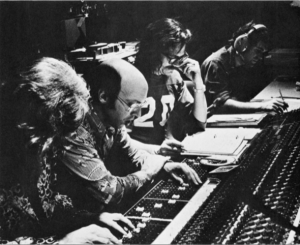
The Firesign Theatre (mixing board): Bob & Robin Preston, Image courtesy of author
It is tempting to hope for a wider range of experimentation in the field of audio in the decade to come, one that either critically exploits or supersedes the hegemony of individualized listening emblematized by podcast apps and noise-cancelling headphones. But if the audio field instead remains governed by information-oriented podcasts, leavened by a subfield of relatively classical dramas like the very good first season of Homecoming, a return to the Firesign Theatre’s work can have methodological, historical, and theoretical value because it could help reveal how the experience of recorded sound had an altogether different political inflection in an earlier era. Thinking back to the remarkably heterogeneous set of Firesign Theatre fans with which I began, it is hard not to observe that the dominant era of the sample in hip hop is one where it was not the Walkman but the jambox — with its politics of contesting a shared social space through collective listening — was the primary apparatus of playback. However unwished- for, this determinist line of technological thinking would clarify the way media audiences are successively composed and decomposed, and show more clearly how, to use Nick Couldry’s words in “Liveness, ‘Reality,’ and the Mediated Habitus from Television to the Mobile Phone,” “the ‘habitus’ of contemporary societies is being transformed by mediation itself” (358).
—
Featured Image: The Firesign Theatre (ice cream baggage claim): John Rose, courtesy of author.
—
Jeremy Braddock is Associate Professor of English at Cornell University, where he specializes on the production and reception of modernist literature, media, and culture from the 1910s throughout the long twentieth century. His scholarship has examined the collective and institutional forms of twentieth-century authorship that are obscured by the romanticized figure of the individual artist. His book Collecting as Modernist Practic— a study of anthologies, archives, and private art collections — won the 2013 Modernist Studies Association book prize. Recent publications include a short essay considering the literary education of Robert Christgau and Greil Marcus and an essay on the Harlem reception of James Joyce’s Ulysses. He is currently working on a book on the Firesign Theatre.
—
REWIND! . . .If you liked this post, you may also dig:
“Radio’s “Oblong Blur”: Notes on the Corwinesque”–Neil Verma
The New Wave: On Radio Arts in the UK–Magz Hall
This is Your Body on the Velvet Underground–Jacob Smith
Share this:


Current Top Posts





April 2021

January 2020

November 2019

October 2019

August 2019

April 2014

November 2017

March 2015

December 2017

October 2015
 Sounding Out!
Recent Comments