
“KASPLASH! SLURPLOP… KPLUNK!” Charles Mingus’s Sound Effects and the Politics of Humor

 In his autobiography, Beneath the Underdog, jazz musician Charles Mingus recounts his hatred of being ignored during his bass solos. When it was finally his turn to enter the foreground, suddenly musicians and audience members alike found drinks, food, conversations, and everything else more important. However, this small, and somewhat ironic, anecdote of Mingus’s relationship with the jazz community has now become a foreshadowing of his current status in sound studies–but no longer! This series re/hears, re/sounds and re/mixes the contributions of Mingus for his ingenious approach to jazz performance and composition as well as his far-reaching theorizations of sound in relation to liberation and social equality, all in honor of the 60th anniversary of Mingus’s sublimely idiosyncratic album Mingus Ah Um this month. In the third piece of this series, Jessica Teague grapples with Mingus’s 1957 Atlantic recording of “The Clown.” Her analysis reveals one of Mingus’s most critical questions: Is the only way to escape exploitation to exploit another, or worse yet, yourself? You can catch up with the full series by clicking here. –Guest Editor Earl Brooks
When jazz bassist and composer Charles Mingus first set out to write his memoirs in the mid-1950s he told his wife Judy that he “wanted a chance to write about the true jazz scene that has made our masters millions and taken the most famed to their penniless graves as the only escape from the invisible chains on black jazz as an art” (Santoro 175). By the time Beneath the Underdog saw publication nearly two decades later in 1971, it was considerably slimmed down from the 800+ page manuscript Mingus had produced. Financially strained and evicted from his downtown loft, Mingus hoped that the book would be a best seller and offer economic freedom from the music industry.
But as many have noted, Beneath the Underdog is not your typical jazz autobiography (see Krin Gabbard, Nichole Rustin-Paschal, Gene Santoro, and Daniel Stein). Here, Mingus rejects standard notions of the self declaring in the first sentence of his book: “In other words, I am three.” By writing in a mode that wavers between the lurid world of popular pulp-heroes and psychological high-modernism, Mingus’s autobiography (like his music) treads a slender line between clowning and critique.
In one of the most infamous scenes from Beneath the Underdog, Mingus hyperbolically describes having intercourse with twenty-three prostitutes over the course of one night in Tijuana, Mexico. The incident follows the breakup of his marriage with his first wife Barbara and his affair with Nesa Morgan, the wife of a club owner. Recounting his superhuman exploits in the language of the comic book, Mingus turns what might have been a display of his sexual prowess into a clowning circus act, complete with zany sound effects and an off-kilter sense of rhythm. It’s a scene that simultaneously reinforces the stereotype of the African American male’s hypersexuality and deflates it with comedy:
KASPLASH! SLURPLOP!
“Me, señor!”
KPLUNK!
“No! Me, sir!”
SPLATT
“You like fooke?”
“Seventeen, eighteen, nineteen, twenty!”
SPASHOOSH!
“Two dollars, sir!”
(Beneath the Underdog 176-177)
There is a certain ambiguity to the poolside scene. Mingus the narrator is notably absent and the action proceeds without any visual clues—he gives the reader only fragments of dialogue that alternate between the prostitutes selling their wares and the side conversation between Mingus and his friend Hickey, who comments upon his sexual performance. What is more, the onomatopoetic sound effects employed are demonstrably silly and absurd. There are no moans or sighs of ecstasy here—each act is punctuated by a “BLAM! BLAM!” (178). Sex is transactional and performative for Mingus, but not pleasurable.
The pulpy, comic book quality of the Tijuana scene makes Mingus a superhuman like a character from The Fantastic Four, but it also makes him into a two-dimensional cartoon. This undercutting of the self and the performative body characterizes Mingus’s concept of the fractured self of the black jazz musician—a theme he takes up in his music as well as his writing (e.g. “Self-Portrait in Three Colors” from Mingus Ah Um). Interestingly, Mingus’s affinity for comics would surface again and in 1966 he collaborated with African American illustrator Gene Bilbrew to create a comic strip-style advertisement for the Charles Mingus Record Club that appeared in the Village Voice.

Cropped image from Dangerous Minds via Stupefaction. Click there for full strip.
Biographers have argued that Mingus included these likely fictionalized sex scenes as a way to sell more books and evade the exploitative economics of the music industry. However, the comic book sound effects that render Mingus’s sexuality humorously exaggerated comes at the expense of Latinx women. Despite having grown up in a multi-ethnic community in Los Angeles, his representation of the voices of the Mexican prostitutes flattens their identities and plays upon ethnic stereotypes. With each “Sí señor,” the women are presented as both sexually promiscuous and submissive. Mingus’s relationships with women were fraught, and his anxieties about his own sexuality were inevitably tied up with race. His tendency to treat women as sex-objects is similarly on display in the comic strip above, in which a suggestively-attired white female hipster acts as a narc, exposing a bootleg record dealer. “Uh, you got anything by Charlie Mingus? Uh-h, y’know, like uh… under the counter?” she asks, dripping innuendo.
And yet, these cringe-inducing scenes are often complicated by Mingus’s use of pimping and prostitution as metaphors for exploitation throughout his Beneath the Underdog. At various points he portrays himself as both prostitute and pimp, both masculine and feminine. When his friend Hickey seems to question Mingus’s extreme behavior, he responds: “In this white man’s society what else have I got” (178). Even in moments that indulge in humor, such as the Tijuana scene, Beneath the Underdog darkly implies a pimp or be pimped world.
Mingus would become known for writing music with a political edge—one might think of “Fables of Faubus” from Mingus Ah Um (1959)—but perhaps the closest musical relative to the satirical Tijuana scene is Mingus’s 1957 Atlantic recording of “The Clown.” In the liner notes for the album, penned by Nat Hentoff, Mingus describes that as he wrote the tune, he realized that it had two parts, and started to imagine it as the story of the clown. He then told the story to radio celebrity Jean Shepherd and allowed Shepherd to improvise the telling of the story during the recording. As Mingus described it to Hentoff, the story was
…about a clown, who tried to please people like most jazz musicians do, but whom nobody liked until he was dead. My version of the story ended with his blowing his brains out with the people laughing and finally being pleased because they thought it was part of the act. I liked the way Jean changed the ending; leaves more up to the listener.
Like the Tijuana story, “The Clown” also incorporates sound effects, and it opens with the hollow laughter of men and women in a nightclub. As auditory phenomena, sound effects are especially interesting because of their artificiality—they are performances of sound. In a cinematic or radio context, sound effects typically amplify an action. Even when sounded, rather than written, they seem to act onomatopoetically. Thus, the addition of the laugh track on “The Clown” is both performance and commentary.
But part of the genius of Mingus’s composition is the way he incorporates the logic of the sound effect into the music itself. The vocal quality of his bass, the wah-wahs of the horns, and the rim shots on the drums are but one piece of this totalizing sonic landscape. “The Clown” borrows stylistic elements from other recognizable genres (like, circus music) to evoke the playfully comedic and absurd, but a second, more serious and ironic story of exploitation runs concurrently and undercuts the first narrative’s simplicity. On the one hand, we hear the more jaunty, carnivalesque melody of the trombone (Jimmy Knepper) and the tenor saxophone (Shafi Hadi) that lilts in 6/8, but that melody is punctuated by moments of dissonance and free playing under the narration—stretching the space between comedy and tragedy. The question he seems to ask in both the Tijuana story from Beneath the Underdog and in “The Clown” is essentially the same: Is the only way to escape exploitation to exploit another, or worse yet, yourself?

Close up from the cover of Charles Mingus – The Black Saint and the Sinner Lady (1963)
Black musicians who pushed back were often called “angry,” even as music didn’t always sound that way. One might think of the contrast between seemingly jaunty, upbeat rhythm of Nina Simone’s “Mississippi Goddam” and its devastating lyrics. It is the sound of political and existential crisis. Both “The Clown,” and the Tijuana scene indicate Mingus’s heightened awareness that, as much as he was known for his music, he was also known for his explosive behavior at performances—the “angry man of jazz.” As Eric Porter has pointed out, Mingus’s “irrational behavior appealed to audiences at a moment when many members of American society (of whom Beat writers were emblematic) were looking to the oppositional aspects of black culture for solutions to their dissatisfaction with consumerism, conservative politics, repressed sexuality, constrictive gender roles, and other social ills” (130-131). 1957, the year Mingus recorded The Clown, was the same year that Norman Mailer published his infamous essay “The White Negro” and Jack Kerouac published On the Road. It was also the year that Governor Faubus of Arkansas attempted to halt the integration of Central High School in Little Rock.
Subtle they may be, but the use of comic sound effects in works like Beneath the Underdog and “The Clown” highlight the absurdity of the roles black jazz musicians had come to play within American culture. In worrying the line between the comic and the tragic, the explosive and the reflective, Charles Mingus refused to concede to the identity that had been shaped by the music industry, by the press, and by institutionalized racism.
—
Featured Image: Charles Mingus 1976, Courtesy of the Wikimedia Commons, Colorized by SO!
—
Jessica Teague is an Assistant Professor of English at the University Nevada, Las Vegas (UNLV) and specializes in 20th and 21st-century American Literature and Sound Studies. The intersections between literature, sound, and technology are the focus of her research, and her book, Sound Recording Technology and American Literature: from the Phonograph to the Remix, is under contract with Cambridge University Press. Her work has been published in journals such as American Quarterly and Sound Studies, and she has also been the recipient of research fellowships from the ACLS and the Harrison Institute at the University of Virginia. (PhD, MA, Columbia University; BA, UCLA)
—

REWIND! . . .If you liked this post, you may also dig:
SO! Amplifies: The Blues and Jazz Dance Book Club–Chelsea Adams
On Ventriloquism, Dummies, and Trump’s Voice–Sarah Kessler
Afrofuturism, Public Enemy, and Fear of a Black Planet at 25–André Carrington
Share this:

On the Poetics of Balloon Music: Sound Artist Judy Dunaway (Part Two)

Last week, Carlo Patrão published “On the Poetics of Balloon Music: Sounding Air, Body, and Latex (Part One),” which examined the history of the association between balloon travel and experimentation and the idea of silence, along with a round up of conceptual artists who have used balloons in their work. Today’s post continues this exploration with an in-depth conversation between the author, producer Marina Koslock and sound artist Judy Dunaway.
We look at alien grace,
unfettered
by any determined form,
and we say: balloon, flower,
heart, condom, opera,
lampshade, parasol, ballet.
Hear how the mouth,
so full
of longing for the world,
changes its shape?
Excerpt from Difference, by Mark Doty
PLAY //
Against Levity: Experimental Music and the Latex Balloon
The term balloon music gained some virality in 2011 after Finn, the protagonist of the animated series Adventure Time, rubbed a toy balloon and improvised a rap over its squeaky sounds. “Balloon music is the future,” says the character. This few second-long scene became an instant meme, inspiring many to share their own versions of the “futuristic sound of balloon music.”
Balloons themselves are viral objects. Designed to infect our moods, they are part of social rituals ranging from the deeply personal to collective (political) euphoria. They are cheap, amusing and awe-inducing. As resonant chambers, balloon membranes are sonically responsive to touch while, at the same time, highly tuned to the vibrations of the environment. To start playing a balloon, no prior experience is required. In this sense, the balloon is a democratic instrument whose sonic textures circumvent expensive music equipment.
The Jazz composer Anthony Braxton was once asked why he used balloons in his Composition 25 (1972). Braxton replied: “I didn’t have enough money for the electronic equipment that could make those kinds of sounds. I’m interested in the expanded reality of sound opened up by the post-Webern continuum, but I’m restricted to using cheap materials. So, you know, I was walking down the street one night and I thought, Hey! I gotta have balloons!”
Anthony Braxton, B-Xo/N-0-1-47a or Composition 6G, w/ Leroy Jenkins, Leo Smith and Steve McCall, with balloon sounds, 1969
“For me, that piece (Composition 25) really best demonstrates the full symbolic meaning of the balloon in the early avant-garde,” says balloon music composer Judy Dunaway. “I’ve discussed this with Braxton himself – the balloon replicated electronic equipment that he couldn’t afford at the time, but he also saw it as a way to open up the minds of the performers to get them to think differently about how they were improvising and how they were interacting in the piece.” Braxton’s Composition 25 is scored for 250 balloons and musicians are required to produce sound by squeezing, rubbing and popping balloons. “I like the idea that he breaks down the hierarchy,” adds Dunaway, “black musicians were discriminated against and they didn’t have the financial means that the white musicians had… and he was using this as a way to get beyond that and say: Here, I’m going to do electronic sounds without any electronics, I don’t need to go buy a Buchla or be associated with an academic institution that can give me access to equipment, right?”

Judy Dunaway, Mother of Balloon Music, Innova Recordings, 2006
Producer Marina Koslock and I met Judy Dunaway at MassArt in Boston to talk about her balloon-based sculptural sonic performances and the ready-made latex balloon as a sound producing instrument. For the past 25 years, Dunaway has been developing a singular specialization in the balloon as a medium for sound and music. You can keep just broadening out and do more things with a concept; or you can work in a particular parameter as an artist and keep digging deeper and deeper and deeper, and that for me as been more interesting, is to pursue that line”, explains Dunaway.
As a consequence, her balloon work has spanned out through several records (e.g. Balloon Music and Mother of Balloon Music), scores, sound sculptures, solo performances, ensembles, and numerous installations. The poetics of the latex balloon as a sound producing instrument contrast with the atmospheric balloon explored in part one of this article. The balloon, no longer buoyant, stays in close proximity to the body of the performer. The surface of the balloon is vibrated through rubbing, stroking, squeezing, pulling, popping and through the control of air releases. These sonic tactile acts bring forth dialogues between the performer’s body and the latex body of the balloon. “I limited my playing techniques to the balloons and my body,” says Judy Dunaway, “it was essential to be able to feel everything that was happening with the balloon in order to be able to fully explore all the sonic possibilities.”
The Balloon Music, DF#, by Tina Touli, 2013-2015
The balloon functions as an external sensory organ, like a skin, that vibrates when sound passes through. In Deaf culture, balloons have a long history of being used as resonating chambers that amplify vibration and facilitate hearing. Deaf people use them at concerts, musicals, clubs and raves to hear the music through the vibration of the balloon’s membrane. David Toop writes about Alexander Bell in the 1870s encouraging students from a Boston school for deaf children to hold balloons in their hands while walking on the street as a safety measure in order to hear the vibrations from the cobblestones as fast horse-drawn wagons passed by. Vibrational information is processed in the same way as sound information. As the scholar Steph Ceraso proposes, the common definition of listening needs to be expanded to include the sensory, contextual, and material aspects of a sonic event. Dunaway’s sound installation Manual Eardrums invites participants to a different mode of listening through the vibration of the balloon. “You are given earplugs at the door and an inflated balloon, and you hold it between your hands as you walk around the space. There’s a low tone playing that sweeps between 100Hz and 150Hz and it causes different vibrational patterns in the room that you can feel and map them out,” explains Dunaway. “Your eardrum is the balloon that you’re holding.”
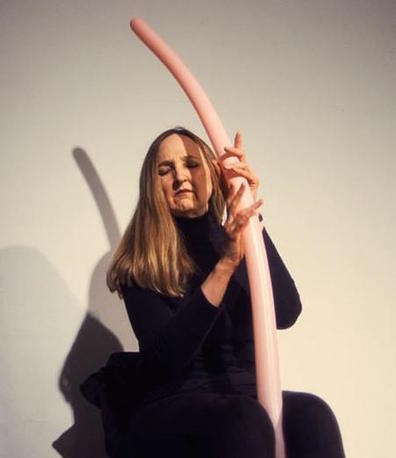
Judy Dunaway performing Amplified Twister Balloon, Photo by Mizuki Nakeshu
Judy Dunaway started to play balloon music in the late 1980s, first as a preparation for guitar string and soon after as a solo instrument. It was in the midst of the AIDS Crisis and Dunaway was part of the downtown improv scene in NYC. “Many of my friends were dying,” she recalls. “Everybody was saying what caused this? Nobody knew how the disease was being spread,” adds Dunaway. “Then, of course, there was this discovery that it was sexually transmitted and you could prevent transmission with latex condoms. Suddenly, they had this power,” she says, “latex had this power to save people’s lives, and I say that that is when balloons really began to speak to me. They were something beyond a mere mechanism to make sound.” Within the envelope of the balloon Dunaway found space for memory, life, and sensuality.
From the beginning, her balloon work has articulated tensions between explicit and implicit meaning around issues relating to social activism, environmentalism, and feminism. “In an era, which continues to be that a woman’s control of her own body is restricted or attempts are being made to restrict our bodies, I coupled myself to this instrument that expresses sensuality, sexuality, and humanity,” says Dunaway. The balloon, as a resonating chamber, bypasses western musical traditions that mechanize the body and gender stereotype musical expression. For Dunaway, the balloon generates a “non-judgmental somatic relationship.”
“Seeing my connection to the body of the balloon, that to me served as an unspoken rebellion against the patriarchy, against the power structures that have oppressed women and, ultimately, all humankind by severing the psyche and the body,” says Dunaway. Following the scholar Robin James, the patriarchy is not just a “relation among people” but is also a “relation among sounds” that are coded in a gender system of masculine absolute/feminine other. “The way I approach the balloon is not nailed or fixed or part of this history,” clarifies Dunaway. The balloon as an instrument has allowed Dunaway to develop a musical lexicon outside of a male-dominated classical heritage.
Judy Dunaway performing Piece for Tenor Balloon, written notation with improvisational passages, 2002
For example, this is her description of the round balloon as a sounding instrument:
Imagine a string, a string on a violin or guitar, and this string is held taut on either end by a the tuning pegs and the bridge now imagine that string suddenly melted and spun out into an orb and it’s all held tight by a column of air. . .this is the palette that I have to access when I play the Tenor Balloon, I have all these harmonics on this curved shape, and I control it partially with my knees.
The Tenor Balloon is placed between both knees and Dunaway applies and releases pressure on the balloon producing microtonal changes on its surface. “And I also use water,” she adds, “copious amounts of water, warm water on the balloon and on my hands because that’s the way I get this stick and slip mechanism to work.” The hands gliding on the balloon’s surface act similar to a bow on a string reaching different nodes and moving through harmonic series.
Judy Dunaway performing “Hommage à Kenneth Noland”, for amplified giant balloon, vibrators, synthesized tones, and projected video, with Max/MSP/Jitter interface, 2017
Each balloon requires its own specific touch or sounding technique. On the piece Amplified Giant Balloon, vibrators are used to resonate the surface of a giant balloon creating a low drone sound. “It’s like vibrating a giant bass string”, says Dunaway, ”I tune my vibrators, I go to the sex shop and I listen to vibrators, and I tune the vibrators to each other so there’s a little beating pattern between them that I can control.”
Around 2015, Dunaway added a new balloon to her solo performances, the Amplified Twister Balloon. The twister balloon is equivalent to the long balloons used to make balloon-animals. Due to its string-like shape, the sounds produced through rubbing or gliding differ from the sounds of a round balloon. “The harmonic series isn’t so predictable,” she continues, “the tension is highest close to the navel of the balloon and that makes it microtonal different from one end to the other like an out-of-tune bugle.” Visually, the Amplified Twister Balloon performance delivers a feminist affirming statement. Defying the tradition of the male guitarist stroking the female form of the guitar, Dunaway finds musical material in a phallic-shaped balloon. “I sort of invert this”, she says, “now I have the penis form that I’m stroking and caressing and I’m taking this phallic power for myself in the Amplified Twister Balloon.”
“My work doesn’t come out of a void,” states Dunaway. In the article My Beautiful Balloon, Dunaway maps out a detailed history of the balloon in experimental and avant-garde music. Many Fluxus artists used the balloon in events, concerts and instructional scores. The sounds of the balloon embodied Fluxus’ humorous/satirical attitude towards art and the collapse of hierarchies of experience by reframing everyday life objects. Balloons are used by DIY artists that re-invent, hack and create new music instruments (Jean Francois Laporte, Thierry Madiot, Aaron Wendell, Tom Nunn, Javier Bustos). Balloon sounds are explored by many artists with backgrounds ranging from improvised music, rock, electronic or electro-acoustic and sound installation (Ricardo Arias, David Bedford, Mauricio Kagel, Alvin Lucier, Terry Day, Tod Dockstader, Christine Sun Kim, Davide Tidoni, Sharon Gal, Eugene Chadbourne, Matmos, EVOL, Alan Nakagawa, to name a few).
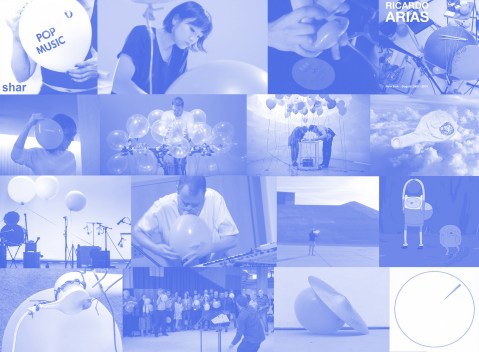
Balloon Music Compilation
To develop a practice around the accessibility of latex is to engage with politics of mass-production and exploitation of resources and labor. Dunaway mentions the connection between the air and breath that fills the balloon and the mass-extraction of latex from the lungs of the Earth. “[Balloons] are literally the blood from a tree in the Amazon,” says Dunaway, “and there’s a whole history of how the indigenous people there were and still are persecuted. Now, they are mostly farmed in Malaysia,” she adds.

Latex being collected from a tapped rubber tree, Wikimedia Commons
Between 1890 and 1920, a rubber fever led to a boom of extraction and exploitation of rubber-bearing plants in the Amazonian countries and to the forced displacement, slavery and mass killing of its indigenous people. The same happened in many African countries. As John Tully writes in his book The Devil’s Milk, “it is still true that where there is rubber there is often human suffering.” Ricardo Arias, a Columbian composer working with balloons (balloon kit) since 1987, has acknowledged this suffering through his balloon work. In Musica Global, Arias composed a series of 20 short balloon pieces called Caouchu: The Weeping Tree/El Árbol Que Llora in memory of the native Americans tortured and killed by the North American and European hunger for natural rubber latex.
These ontological relations between the balloon’s materiality and the environment inform Dunaway’s work. “I’m writing a piece for a large 30 to 35 person balloon ensemble. This piece is called Wind Ensemble and is all about the air going out of the balloon, and the sound of the mouthpiece being vibrated as the air comes out.” Dunaway shares a video recording of this work and the room is filled with high pitched sounds changing at different speeds. The experience is immersive; a meditation on air and vibration. “It’s rather minimal in the concept because I really want you to notice the small changes and nuances over time.” The performative element of the piece has balloon players squeezing the balloon’s mouthpiece and bending over large balloons to make them vibrate until the balloon’s last breath. “Ideally, I would like 60 balloon players, that would be great!” she exclaims. The embodied relationship that Dunaway has developed with the balloon over the past decades resulted in an artistic practice extremely tuned to the sonic proprieties of every inch of the latex balloon.

Still from Le Ballon Rouge by Albert Lamorisse, 1956
The poetics of balloon music bring forth alternative narratives that challenge dominant hierarchies of music production, bypassing expensive technology and expectations of gendered musical expression. The balloon as an object of childhood and of playfulness is charged with emotional resonance and invites the construction of meaning while offering an opportunity to build upon subversive themes. In this two-part article, the balloon was analyzed as an object that is able to generate a vertical dimension of self and the construction of a sense of Place within the silence of the upper air regions that informed the “listening ear” to perceive difference. As a Probe, the balloon navigates the irreversibly altered constitution of the airspace, sonifying masses of air and weather data. Filled with breath or air, in Play, the latex balloon is an extra ear attached to our bodies that vibrate in sympathy with the terrestrial agitations of the Earth. Maybe Finn from Adventure Time is on to something. “Balloon music is the future.”
—
Thanks to Judy Dunaway for the interview and records; Marina Koslock for co-producing the interview with Judy Dunaway; and Jennifer Stoever for your help and excellent editing.
—
Featured Image: Judy Dunaway, photo by Alice Bellati
—
Carlo Patrão is a Portuguese radio producer and independent researcher based in New York city.
—
 REWIND! . . .If you liked this post, you may also dig:
Queer Timbres, Queered Elegy: Diamanda Galás’s The Plague Mass and the First Wave of the AIDS Crisis– Airek Beauchamp
Botanical Rhythms: A Field Guide to Plant Music -Carlo Patrão
Sounding Our Utopia: An Interview With Mileece–Maile Colbert
Share this:


Current Top Posts





April 2021

January 2020

November 2019

October 2019

August 2019

April 2014

November 2017

March 2015

December 2017

October 2015
 Sounding Out!
Recent Comments