
SO! Reads: Danielle Shlomit Sofer’s Sex Sounds: Vectors of Difference in Electronic Music

Distance, therefore, preserves a European austerity in recorded musical practices, and electroacoustic practice is no exception; it is perhaps even responsible for reinvigorating a colonial posterity in contemporary music as so many examples in this book follow this pattern–Danielle Shlomit Sofer, Sex Sounds, 14.

Sex Sounds: Vectors of Difference in Electronic Music (MIT Press, 2022) by Danielle Shlomit Sofer brings a complex analysis for contemporary de-colonial, queer and feminist readers. This book did its best to sustain an argument diving into eleven case studies and strongly problematising the Western white cis gaze. Sofer offers readers a new perspective in both the history of music and the decolonisation of that history.
In a moment when discussions of consent, censorship, pleasure, and surveillance are reshaping how we think about media, Sofer asks: What does sex sound like, and why does it matter? Their analysis cuts across high art and popular culture, from avant-garde compositions to pop music to porn, revealing how sonic expressions of sex are never neutral—they’re deeply entangled in gendered, racialized, and heteronormative structures. In doing so, Sex Sounds resonates with broader critical work on listening as a political act, aligning with ongoing conversations in sound studies about the ethics of hearing and the politics of voice, noise, and silence

The main focus of Sex Sounds is the historical loop of sexual themes in electronic music since the 1950s. Sofer writes from the perspective of a mixed-race, nonbinary Jewish scholar specializing in music theory and musicology. They argue that the way the Western world teaches music history involves hegemonic narratives. In other words, the author’s impetus is to highlight the construction of mythological figures such as Pierre Schaeffer in France and Karlheinz Stockhausen in Germany who represent the canon of the Eurocentric music phenomena.
Sex Sounds specifically follows the concept of “Electrosexual Music,” defined by Sofer as electroacoustic Sound and Music interacting with sex and eroticism as socialized aesthetics. The issue of representation in music is a key research focus navigating questions such as: “How does music present sex acts and who enacts them? ” as well as: “how does a composer represent sexuality? How does a performer convey sexuality? And how does a listener interpret sexuality?” (xxiv & xxix). Moreover, Sofer traces: “the threats of representation, namely exploitation and objectification” (xxxvii) as the result of white male privilege and the historical harm and violence this means (xiix & 271).
By exploring answers to these questions, Sofer successfully exposes how electroacoustic sexuality has historically operated as a constant presence in many music genres, as well as proving that music and sound did not begin in Europe nor belongs only to the Anglo-European provincial cosmos. Sex Sounds gives visibility to peripheral voices ignored by the Eurocentric canon, arguing for a new history of music where countries such as Egypt, Ghana, South Africa, Chile, Japan or Korea are central.
Sofer further vivisects the meaning of sexual sounds as not only Eurocentric and colonial but patriarchal and sexist. What is the history behind sex sounds in the electroacoustic music field? Can we find liberation in sex sounds or have they only reproduced dominance? Which role do sex sounds play in the territories of otherness and racial representation? Are there examples where minoritized people have reclaimed their voice? Sex is part of our humanity. But how do sex sounds dehumanize female subjects? These are more of the fundamental questions Sofer responds to in this study.

I aim, first and foremost, to show that electrosexual music is far representative a collection than the typically presented electroacoustic figures -supposedly disinterested, disembodied, and largely white cis men from Europe and North America –Sofer, Sex Sounds,(xvi).
The time frame of the study ranges from 1950 until 2012, analysing four case studies. Sofer divides the book in two parts: Part I: “Electroacoustics of the Feminized Voice” and Part II: “Electrosexual Disturbance.” The first part contextualizes “electrosexual” music within the dominant cis white racial frame. The main argument is to demonstrate how many canonic electroacoustic works in the history of Western sound have sustained an ongoing dominance as a historical habit locating the male gaze at the center as well as instrumentalizing the ‘feminized voice’ as mere object of desire without personification and recognition as fundamental actor in the compositions. Under such a premise, Sofer vivisects sound works such as “Erotica” by the father of Musique Concretè Pierre Schaffer and Pierre Henry (1950-1951), Luc Ferrari’s “les danses organiques” (1973) and Robert Normandeu’s “Jeu de Langues” (2009), among other pieces.
Luc Ferrrari’s work from 1973 is one of many examples in which Sofer makes evident the question of consent, since the women’s voices he includes were used in his work without their knowledge, a pattern of objectivation that mirrors structures of patriarchal domination. Sofer “defines and interrogates the assumed norms of electroacoustic sexual expression in works that represent women’s presumed sexual experience via masculinist heterosexual tropes, even when composed by women” (xivii-xiviii). Sofer emphasises the existence of “distance” as a gendered trope in which women’s audible sexual pleasure is presented as “evidence” in the form of sexualized and racialized intramusical tropes. Philosophically speaking, this phenomena, Sofer argues, goes back to Friedrich Nietzsche and his understanding of the “women’s curious silence” (xxvii). In other words, a woman can be curious but must remain silent and in the shadows.
This is the case in Schaeffer and Henry’s “Erotica” (1950-1951), one of the earliest colonial impetus to electrosexual music in which female voices are both present and erased, present in the recording but erased as subjects of sonic agency, since the composers did not credit the woman behind the voice recordings. She has no name nor authorship, but her sexualized voice is the main element in the composition. This paradox shows the issue of prioritising the ‘Western’ white European cis male gaze. This gaze uses women’s sexuality as a commerce where only the composer benefits from this use. This exposes the problem of labor and exploitation within electroacoustic practice historically dominated by white men.
“Erotica” stands out for its sensual tension, abstract eroticism, and experimental use of the body as both subject and instrument. This work belongs to the hegemonic narrative of electroacoustic music with the use of sex sounds as aesthetic objects that insinuate erotic arousal as a construct of the male gaze.
Through examples like “Erotica” Sofer strongly questions the exclusion of women as active agents of aesthetic sonic creation since: “electroacoustic spaces have long excluded women’s contributions as equal creators to men, who are more typically touted as composers and therefore compensated with prestige in the form of academic positions or board dominations” (xxxix). This book considers: “the threats of representation, namely exploitation and objectification” (xxxvii). Here we navigate the questions of how something is presented, by whom, and with which profit or intention. In other words, how sounds: “are created, for what purposes, and in turn, how sounds are interpreted and understood” (xxxiii).These are problems rooted in both patriarchy and capitalism.
This book is a strong contribution to decolonize the history of music as we know it, although the citations here could be richer, including studies by Rachel McCarthy (“Marking the ‘Unmarked’ Space: Gendered Vocal Construction in Female Electronic Artists” 2014), Tara Rodgers (“Tinkering with Cultural Memory: Gender and the Politics of Synthesizer Historiography” 2015), and the work of Louise Marshall and Holly Ingleton, who used intersectional feminist frameworks to analyze the work of marginalized composers (including women of color) and the curatorial practices that shape electronic music history. Also, not to forget: Chandra Mohanty’s “Under Western Eyes: Feminist Scholarship and Colonial Discourses” (1988).
Musical artist Sylvester
I argue that, although many composers of color work in electronic music, the search term ‘electroacoustic’ remains exclusionary because of who declares themselves as an advocate of this music, and not necessarily in how their music is made–Sofer, Sex Sounds, (xiv).
After a deep dive into the genealogy of the patriarchal practices in electroacoustic music understood as electrosexual works (hence: “Sex is only re-presented in music p. xxix), Sofer moves to the territory of feminist contra-narratives. In the second part of their study, Sofer offers sonic practices and concrete examples that: “break the electroacoustic mold either by consciously objecting to its narrow constraints or by emerging from, building on, and, in a sense, competing with a completely different historical trajectory” (xlvi). Contra-narratives from the racialized periphery and underground landscapes appear in this book as case studies to hold the argument and expand the homocentric and patriarchal telos found even in the sonic archives as well as the Western theoretical corpus. These ‘Others’ reclaim their voices going a step further and gaining recognition.
After examining examples of racialisation and objectification, Sofer selects some case studies from 1975 to 2013 in the second chapter of this section titled: “Electrosexual Disturbance.” In this section, Sofer also points to new forms of exclusion and instrumentalisation via “racial othering,” specifically in the context of popular music such as Disco where we find an emphasis on the feminized voice. Disco, as a genre rooted in Black, queer, and marginalized communities, inherently grappled with racial and gendered dynamics. Donna Summer’s “Love to Love You Baby” (1975) exemplifies this tension.
The track’s erotic vocal performance (23 simulated orgasms over 16 minutes) became emblematic of the hypersexualization of Black women in popular music. Summer’s persona as the “first lady of love” reinforced stereotypes of Black female sexuality as inherently exotic or excessive, a trope traced to racist and sexist historical narratives. Simultaneously, disco provided a space for liberation: Black and LGBTQ+ artists like Summer, Sylvester, and Gloria Gaynor used the genre to assert agency over their identities and bodies, challenging mainstream exclusion. The tropes of sex and race are a paradoxical combination bringing both oppression as well as liberation.
Sofer argues that Summers was commercially recognized but her figure as a composer was destroyed, creating consequently a hierarchy of labor. She was acknowledged for her amazing sexualized voice and performance on stage, but not recognized as a musician or equal to music producers. Here we see the practice of epistemological discrimination and extreme racial sexualisation. On the positive side, Summer became the Black Queen idol for gay liberation. Nevertheless, she remained as the sexualized and racial voice of the seventies.
Sofer also presents the case of ex-sex worker, sex-educator and radical ecosex-activist Annie Sprinkle collaborating in a post-porn art video with the legendary Texan and lesbian composer Pauline Oliveros. For Sprinkle and Oliveros, Sofer offers a different phenomena at work, since both queer-women/Lesbian-women collaborated from the point of feminist independence and sexual liberation coming together for educational purposes.

Sluts & Goddesses (1992) is a porn film with an Oliveros soundtrack, produced by radical women– with only women–in a self-determined frame. The movie offers an example of collaboration moving from avantgarde sound composition expertise to trashy whoring and interracial lesbian power. This example was rare, but inspiring for the coming generations. Two lesbian Titans united for electrosexual disturbance from the feminist gaze, Sprinkle and Oliveros were a duo that broke silence.
This book revisits the acousmatic in its electronic manifestations to examine and interrogate sexual and sexualized assumptions underwriting electroacoustic musical philosophies.–Sofer, Sex Sounds, (xxi)
Sofer’s Sex Sounds enters into a vital and still-emerging conversation about how sound—particularly sonic expressions of sex and eroticism—shapes, disrupts, and reinscribes power. At a time when sonic studies increasingly reckon with embodiment, affect, and intimacy, Sofer brings a feminist and queer critique to the center of how we listen to, interpret, and culturally regulate the sounds of sex. Their book invites us to reconsider not only what we hear in erotic audio, but how we’ve been taught—socially, politically, morally—to hear it.
This book doesn’t just fill a gap—it pushes the field toward a more nuanced, bodily-aware mode of scholarship. For SO! readers, Sex Sounds offers both a provocation and a methodology: it challenges us to hear differently, to ask how power works not only through what is seen or said, but through what is moaned, whispered, muffled, or made to be heard too loudly.
—
Featured Image: “Stamen,” by Flickr User Sharonolk, CC BY 2.0
—
Verónica Mota Galindo is an interdisciplinary researcher based in Berlin, where they study philosophy at the Freie Universität. Their work goes beyond the academic sphere, blending sound art, critical epistemology, and community engagement to make complex philosophical ideas accessible to broader audiences. As a dedicated educator and sound artist, Mota Galindo bridges the gap between academic research and lived material experience, inviting others to explore the transformative power of critical thought and creative expression. Committed to bringing philosophy to life outside traditional boundaries, they inspire new ways of thinking aimed at emancipation of the human and non-human for collective survival.
—

REWIND!…If you liked this post, check out:
Into the Woods: A Brief History of Wood Paneling on Synthesizers*–Tara Rodgers
Ritual, Noise, and the Cut-up: The Art of Tara Transitory—Justyna Stasiowska
SO! Reads: Zeynep Bulut’s Building a Voice: Sound, Surface, Skin –Enikő Deptuch Vághy
Share this:

Sonic Salvation: A Story of How Listening Can Change Over A Lifetime

By the age of six, I could circumscribe my world in song. I was not particularly precocious — my world was just small. Ultimately, it would be fractured by its own rebellious genesis.
Two genres of folk music marked out the poles of my preciously tiny planet. Heaven’s jubilee rang in one ear: a cappella gospel, sturdily founded upon the biblical injunction to make melody in the heart. In the other ear, however, was the music of the devil himself: alcohol-drenched, two-stepping, hell-raising honky-tonk, enticing one to sin not just in the heart, but with the entire body. Together, they formed an eternally reciprocal refrain: Saturday night sin prompted Sunday morning renewal. There was little room for anything else, particularly dissent.
Sunday morning resounded with four-part harmony based on a shape-note system of musical notation, widely referred to as Sacred Harp. We sang again at our Sunday evening and mid-week services. Throughout the year, we also hosted regional “singings,” bringing together folks from other congregations, swelling our own sound by double. It was an easy form of music to learn by design, with its origins in early 19th-century America. Its strongest base was in the American South, and I inherited at least two generations’ worth of experience. It set the tone for my interactions with the world for the first three decades of my life.

Taken at the Sacred Harp Museum by Flickr user Lance McCord, CC BY 2.0
Musicologists have documented and analyzed Sacred Harp thoroughly, with Alan Lomax having had a particular fascination for it. He considered it as not only an extension of four-square Anglo forms but also as the crossroads where the Reformation met the Democratic Experiment. In Lomax’s view—expressed in a 1982 interview at the Sacred Harp Convention at Holly Spring, Georgia—European migration to colonize America broke the established authority of the church, leaving every person to forge a singular relationship with God. This supposition harmonizes perfectly with the views of the congregational church I attended. We had no hierarchy, no choir, no piano. Every man, woman, and child added their voice, as best they knew how, to raise an egalitarian song of praise. Songs such as “This World is Not My Home,” “The Glory Land Way,” and “Blessed Assurance” exemplify the form: simple rhyme schemes; closely-yoked shifts in harmony and rhythm; and southern gospel’s initial shunning of poly-rhythms or syncopation.
For me, Sacred Harp music created an immersive and experiential soundscape; emotionally and spiritually motivating, it was the sound of temporal and eternal life. Like our singing style, our church service presented a model for our lives outside the sanctuary. “Trust and Obey” was a frequently sung hymn—and it summed up our approach to life in all matters. Obedience was expected, deviation discouraged.
Worlds away from my sheltered existence, leaders of the Civil Rights Movement embraced a cappella singing as a powerful means to encourage, motivate, and activate. In the 2009 documentary Soundtrack for a Revolution, U.S. Representative and civil rights icon John Lewis said, “It was the music that created a sense of solidarity.” His a cappella community was connected to the church and the streets, challenging the status quo, and seeking greater brotherhood. Mine was by the book, increasingly authoritarian, very narrow in scope and population.

Sacred Harp Singing, Bloomington, Indiana, Image by Flickr User Jennifer Jamison (CC BY-NC-ND 2.0)
To us, the New Testament authorized one and only one instrument for offering songs to God: the unaccompanied human voice. The root of this belief was a concise motto coined in the early 1800s by Alexander Campbell, a leader in the Second Great Awakening: “Where the Scriptures speak, we speak; where the Scriptures are silent, we are silent.” Applying this principle, then, the apostle Paul, in his epistles to the Ephesians and the Colossians, encouraged Christians to sing. But nowhere did he or another New Testament writer suggest using an instrument. This silence equals prohibition. It sets its own reality, ignoring abundant biblical evidence to the contrary: the Old Testament presents many examples of instruments used in worship, as does the New Testament’s Book of Revelations.
Our a cappella song service was, therefore, more than a sound—it was a belief system, a worldview in which other sounds or ideas were alien. We applied Campbell’s principle across-the-board, backing ourselves into corners: slaves were to obey their masters; wives were to submit to their husbands; children were to be fully subject to their parents. Questioning authority, let alone defying it, was strongly condemned by Paul in his letter to Christians in Rome: “Let every soul be subject unto the higher powers. For there is no power but of God: the powers that be are ordained of God. Whosoever therefore resisteth the power, resisteth the ordinance of God: and they that resist shall receive to themselves damnation.”

“The One and Only Lefty Frizzell” by Flickr user Thomas Hawk, CC BY-NC 2.0
Alternately, classic honky-tonk’s twangy resistance seemed to defy the innovations and complexity of modern life. As I was growing up, the sinful songs of Ray Price, Lefty Frizzell, Webb Pierce, and George Jones flowed like wine from my family’s record collection and radio settings. Songs of murder, drunkenness, alienation, revenge, adultery, and the workingman’s blues are staples of the honky-tonk catalog. Its celebrated ethic of “three chords and the truth” favored a rural do-it-yourself ethic. My church’s music was both challenged and validated by this unlikely and unruly roommate; honky-tonk was a matched bookend for Sacred Harp.
For in the background of many of those honky-tonk sounds, whether they were about larceny, war, or revenge on the boss, I heard the same harmony that filled my church. In the 1950s or so, southern gospel groups such as the Jordanaires, Blackwood Brothers, and the Statler Brothers, began backing country music artists including Johnny Cash, George Jones, Tammy Wynette, and Gary Stewart. Their sonic presence lent an almost holy sanction to the commission of sin, as if Jesus and Satan met after-hours to share a drink and balance the books.
This sonic emulsification of sin and salvation formed my youthful identity and bracketed a very small existence. My world consisted of very gendered personal struggles: man vs. temptation; man vs. alcohol; man vs. boss; woman vs. womanizer. The solution provided for these struggles was always the same: the efficacious grace of God. All failings and victories were personal, not structural or systemic. The fight against personal sin was the only fight.
Southern gospel music and honky-tonk have enjoyed an institutional relationship since the founding of the Grand Ole Opry in 1920s, sanctioning the blending of reprobation and redemption. Though initially politically ambivalent, the Opry listed towards social conservatism during the 1960s—Johnny Cash’s nascent social awareness notwithstanding. In 1970, however, the Opry and the industry it represented found itself an unlikely accessory to Richard Nixon’s “southern strategy.” He declared October 1970 to be Country Music Month, and a few years later blessed the Grand Ole Opry with its first presidential visit.
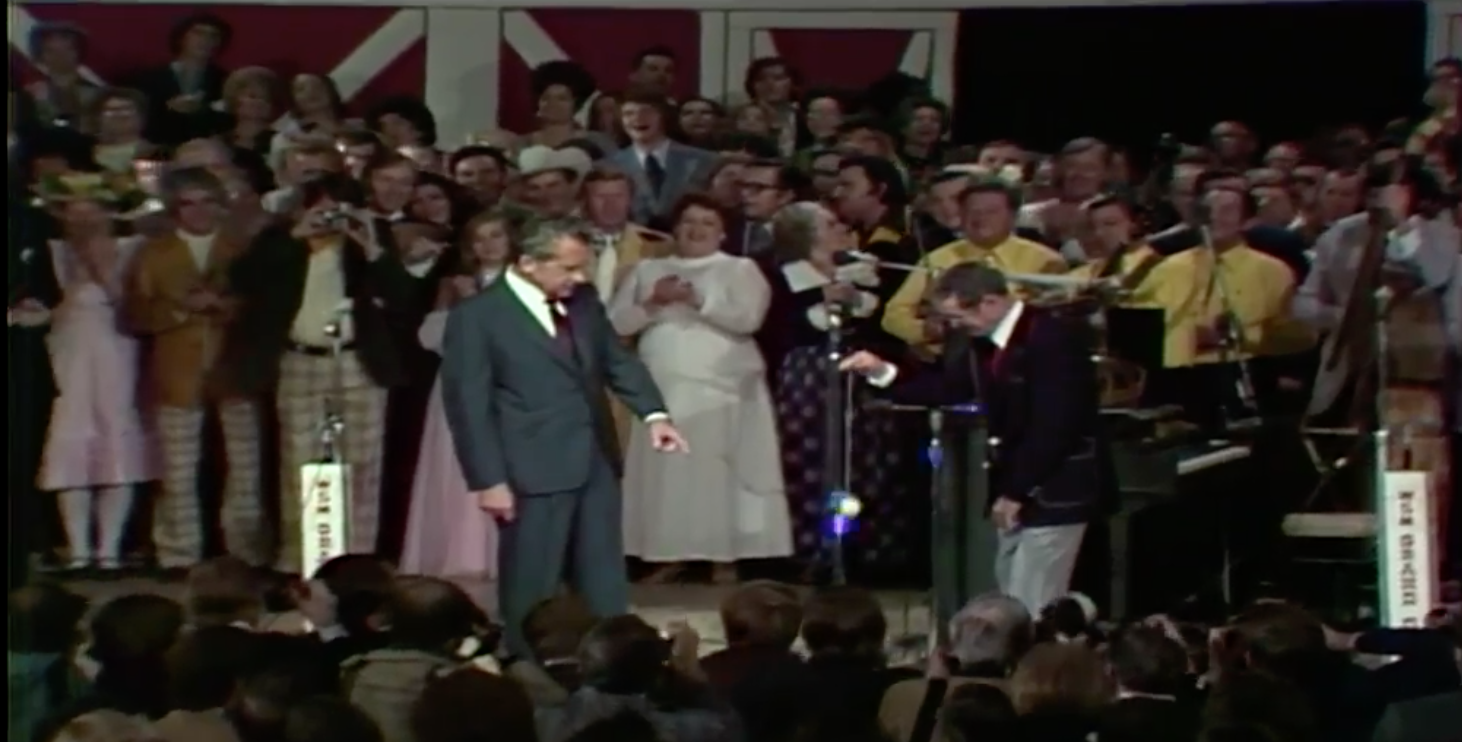
Screen capture from Billboard’s “Roy Acuff Teaches President Nixon the Yo-Yo at the Grand Ole Opry” (1974)
Politically conservative messages had entered country airwaves during the late 1960s, epitomized, if not pioneered, by Bakersfield stalwart Merle Haggard. His “Okie From Muskogee” ridiculed hippies, dope smokers, draft dodgers, long-hairs, flag burners, and college activists, all within a 3-minute single format. Though ostensibly written as a joke, it struck a chord among conservative, Christian, country music fans. Sensing a market, Haggard followed up with the flag-waving “Fightin’ Side of Me,” wherein he further shames pacifists.
These songs contained the truth as I believed it in grammar school: protestors, adulterers, and dope smokers were all in defiance of God. Haggard’s refrain in “Fightin’ Side”—“if you don’t love it, leave it”—made sense to me, and was safely non-challenging. Conveniently, the religious body of which I was a member had, a generation prior to me, actively opposed pacifism.
A world composed only of personal demons, however, leaves little room for social issues. Being so long accustomed to seeing the sin in man left me unable to recognize the sin in the system. Sam Cooke’s great risk in recording “A Change is Gonna Come,” for example, was lost on me, even though we both shared a battle between religious and secular personas.
I never heard his call to address greater systemic problems such as racism, audibly or socially. Even as I entered my 20s, my white patriarchal religious sonic defense system kept the freedom struggles of people of color at bay. Even if dissenting sounds managed to sneak through–Marvin Gaye’s struggles in “Inner City Blues” for example—I quickly dismissed them as exaggeration or the natural outcome of personal sin. I could not process a sound which conflicted with my God-given world view. I saw only men and women avoiding their duty and surrendering to temptation.
My mother frequently said that the lives portrayed in honky-tonk songs were not her life. But in another sense, those desperate lives, and the more hopeful ones portrayed in gospel music, were our lives collectively. We were part of a greater social identity: Southern, white, Fundamentalist, change-averse, full of latent conflicts. Those sounds, rich with heritage and lived-in context, formed us. In other words, our vernacular limited our hearing. Our world was formed within a fixed sonic boundary, and we ignored, resisted and sometimes even combatted discordant sounds.
Within this soundscape, I had never heard of any march from Selma to Montgomery, not from church, family, the radio, or, sadly, even school. The larger movement of which it was a part—perhaps the biggest social movement of the 20th century—was inaudible and therefore irrelevant to me. When I did begin to hear of protests against white racial violence, I could only condemn anyone who defied authority. I did not know what to say about authority which abused the people. Raised to function in a law-and-order world, I could only repeat the Apostle Paul’s instruction that we all must obey authority or incur the wrath of God.

“Selma Protesters Met By Police: 1965” by Flickr user Washington Area Spark, CC BY-NC 2.0
But thankfully, sound travels in subversive ways, such as through the transmitters of listener-supported community radio.
I found Dallas’ KNON completely by chance. Commuting to work through the city’s legendary rush hour, I’d get fidgety. While searching the dial, I heard a familiar song in an unfamiliar arrangement. I don’t recall the song now, but do remember its force: a honky-tonk classic played through a stack of Marshall amps, turned up to the proverbial ’11.’ Perhaps it was Leon Payne’s Lost Highway as rendered by Jason and the Scorchers—anarchistic, upending, challenging, it still carried enough familiarity to keep me listening. I stayed tuned in for the next song, then another. When the DJ, Nancy “Shaggy” Moore, signed off her show, I gave a listen to the next show—at least until they said something a bit too dissonant.
 But the next day, I tuned in to Shaggy again. And I listened a bit longer when the next show came on. And even longer the day after that. Dallas at that time was wracked by racial strife, some of it focused on the politicized deaths of two police officers, one white and one black, in separate incidents. I had tuned out the duplicity, but KNON gave me reason to reconsider. City council member Diane Ragsdale, an African-American woman representing one of the city’s most trod-upon districts, refused to let the issue go. KNON provided the venue for her to express her outrage unmitigated, and to explain the inconsistencies in a way that an entitled white male suburbanite, such as I, could understand.
Tim Rice suggests that we are not free agents in the creation of our identities—but given the right stimuli, we will resist, to the point of rebellion, the personhood prepared for us. The latent heretical ethics of Sacred Harp and Honky-tonk finally responded to the sonic stimuli flowing through the breach, triggering an insatiable devil’s advocacy: “Prove yourself to me,” I said to everything I had once believed, religious faith included. St. John wrote in his First Epistle: “Beloved, believe not every spirit, but try the spirits whether they are of God.” This was to be the last biblical directive I would follow.
My radical shift in musical listening also greatly impacted my political, and cultural beliefs and listening practices, something which continued throughout my life. For example, I ended my professional career as well, having understood the devastating effects that high tech industries have on the environment and workforce. I traded a six-figure salary for minimum wage in foodservice. Not once have I looked back.

“Kitchen Music” by Flickr User David Blaine (CC BY 2.0)
Kitchen work comes with immersive sound: machines hum and sometimes roar; the radio blasts through the static; humans must shout to be heard. Working throughout the western US, in a variety of independent restaurants, I learned to understand and speak Spanish. I participated in defying a language ban placed on my colleagues by an overbearing owner: I noted that she forbade speaking in Spanish, but not singing in Spanish. So sing we did, about needing a potato peeler, taking out the trash, and what we were going to do over the weekend.
As I worked my way up the ranks and crossed the country from California to Manhattan, I listened to the stories told me by immigrants from Mexico, Guatemala, Dominica, Morocco, South Africa. They shared their music with me, via radio, iPod, cassette, or any object we could plug into an overcooked boom box. Every song and conversation has pulled me into greater participation in their lives and the systemic issues faced by most of the world around me.
Dismantling one’s identity, regardless of how deliberately it is done, happens amidst lots of noise: illusions shatter, idols crash to the ground, walls tumble into rubble. Dissent comes in myriad expressions, and for me, it has come via my own three-chords-and-the-truth and through a multimedia socially-progressive dining event which I call Peace Meal Supper Club. Its very raison d’etre is to illuminate dissonance on issues such as the right to sanctuary, our diminishing seed supply, the plight of the rural poor, and other devastating threads of intersectionality. Music is a critical component of each event, as Otis Taylor, Lila Downs, and Caetano Veloso share playlist space with Manecas Costa and Majida El Roumi Baradhy. Old favorites like “Sixteen Tons” get their say, as well—for behind that song’s well-earned swagger is a system of devastating intersectional oppression that demands our action.
_
Featured Image: Image of a Stained Glass Crosley Cathedral, Image by Tubular Bob
Kevin Archer is a multi-media artist who left corporate security for a DIY life as a farmer, activist, educator, and chef. He’s planted gardens coast-to-coast, and washed his own sauté pans from Denver to Mendocino, Santa Fe to NYC, and random locations in between. Kevin’s current project is Peace Meal Supper Club, a series of immersive dining events which explore ecojustice, human rights, the capitalistic conquest of the seed and soil, and the power of progressive movements. He has written for Civil Eats, No Depression, Secular Web, and the Museum of Animals & Society. He has spoken on the intersection of food and social issues at numerous conferences within the Eastern US.
_

REWIND! . . .If you liked this post, you may also dig:
What is a Voice? – Alexis Deighton MacIntyre
“HOW YOU SOUND??:” The Poet’s Voice, Aura, and the Challenge of Listening to Poetry – John Hyland
The Sounds of Anti-Anti-Essentialism: Listening to Black Consciousness in the Classroom – Carter Mathes
The Listening Body in Death – Denise Gill
Share this:


Current Top Posts





April 2021

January 2020

November 2019

October 2019

August 2019

April 2014

November 2017

March 2015

December 2017

October 2015
 Sounding Out!
Recent Comments