Statistics of death can startle a reader. As tidy yet powerful numeric representations statistics are often used as tools of persuasion, cited routinely by journalists and politicians alike to strengthen or belittle a political objective. According to professors from Wharton’s School of Business, statistics are also gaining in importance as our society attempts “to make sense of an increasingly large and complex barrage of information.” Many have argued, quite provocatively, of the gendered and racialized nature of statistics as objective, “hard,” facts. In “2487: Giving Voice in Diaspora,” the artist Luz María Sánchez uses sound-based art to trouble a statistic brought on by institutional violence on the U.S./Mexico border.
In 2006 Luz María Sánchez used a lone statistic from 2004 – 2487, the number of bodies found dead throughout the border region of the U.S. and Mexico – to create a sound-based art installation for the San Antonio Artpace (now available as an online exhibit). The museum invited audiences to sit in sparsely furnished rooms with strategically placed speakers in order to experience the exhibition. The online access, however; makes certain the exhibit travels beyond the geographical boundaries of Texas, bellowing from the private devices of laptops. Seemingly simple, the crux of the project involves the artist stating each of the 2487 names. Its complexity, as mentioned below, lies in the actual organization of the names. The voice of Luz María Sánchez within this artistic expression reminds us, as Brandon LaBelle states, that sound “leaves a body and enters others” and is never merely a “private affair.” The use of sound forces spectators to listen closely to a statistic and in doing so, directs attention towards the parts of the sum.
The topic of immigration has become a staple of news network channels. Its somewhat mundane presence has served to lump immigrants together into one sound bite: “them” sapping social services; “them” taking away our jobs; or “them” having those anchor babies. The reporting of immigrants as a block serves to dehumanize and delegitimize intentions of family reunification held by many immigrants. Indirectly, “2487” tackles the verbal “them” head on.
Buried within discussions of immigration policy and arguments for increased border enforcement on the U.S./Mexico border are the statistics of those who have died crossing the treacherous dry desert. A series of shifts in immigration policy and increasingly anti-immigrant public sentiment have produced record setting budgets that intensified efforts to beef up border control. The once urban points of crossing in Tijuana or Juarez are now heavily discouraged; the visual yellow and black warning of a family running an insignia of those times. Many immigrants take greater risks as they walk through the Sonoran desert in southern Arizona, now considered the busiest gateway for immigrants where temperatures easily mount well into the 100s.
Within 2487, it is not merely the statistic that serves to astound, it’s the ingenuous yet powerful act of listening to the full name of each body that can engulf the listener.
José Salomon López Francisco Torres Santiago Leticia Torres Solis Adolfo Sánchez Enrique Soto Pacheco Guadalupe Valdez Sandoval Antonio Sánchez Morales Juan Antonio Sánchez Reyes Patricia Trinidad
Narrated by the artist herself, each name is voiced individually with a dignified, strong tenor. The text itself – the names – mark this sound piece as solemn. It’s as if one is listening to an obituary read out loud, a roll call with no response, or – a tradition many Latinos identify with – a rosary in honor of the dead. Despite studies that explain a Latina’s public wail as a sign of pain and grief, this piece in its parallel focus of honoring the dead stands out as the artist’s female voice never quivers, trembles, or abandons its strength. In naming each person, listeners may not necessarily focus on their death – represented numerically in 2487 – but may also find themselves imagining their risk as they hear each name. Under the website’s database tab, lies a detailed chart of each name, the location of their body, presumable age, known origin, and the cause of death. Many of the columns are listed with a tag of “unknown” or left blank except for their names.
It’s a forced, almost-awkward, tension-laden, and heavy listening experience. Sánchez makes certain that any semblance of passive listening is disrupted, disturbed, and therefore nearly impossible since the names voiced do not follow a pattern or rhythm. The eight piece sound compilation offers no sense of monotony since it is played continuously and at random. Pauses are sometimes short, long, pensive, and altogether distressing. Names are voiced either in isolation or in an overlapping manner, said to model the “organic patterns of migration itself”; an audible gesture towards the word “diaspora” itself. Because of the deliberate variation of the names, the listener can make out the names of some yet not detect the names of others.
Hundred of crosses are placed on the border wall in Nogales, Mexico to draw attention to the migrants who have died crossing into the United States. Image from rachelmetea.com.
Even as Sánchez gives voice and dignity to a statistic based on dead bodies, the topic of death certainly is not easy to translate. Regina Marchi’s “Day of the Dead in the USA” argues that the public commemoration of death by Latino communities has slowly begun to transform American Culture’s views of death. According to Marchi, Americans tend to be “removed from death” or lack positive modes of relating to those deceased. A popular case in point is the plethora of euphemisms used to characterized death: moved on, no longer with us, watching over us now, passed away. Día de los Muertos or Day of the Dead (on November 1) has become a multicultural method of publically viewing and even embodying death as different communities construct altars, dress as the dead, and openly pay tribute to those who have died. The use of art galleries, the mass media, and community centers have become public venues for these celebrations since their inception by Chicano artists in 1972.
Despite, or (perhaps more precisely) because, honoring the dead is so frequently a visual custom these sonic remembrances are that much more significant. A politicized eulogy for immigrants who have died while crossing the border merits the weight of listening. The 2487 statistic encompasses two thousand and eighty seven bodies and each, according to Luz María Sánchez, had a name that deserves our listening attention.
“It devolves on us now to invent a subject we might call acoustic design, an interdiscipline in which musicians, acousticians, psychologists, sociologists, and others would study the world soundscape together in order to make intelligent recommendations for its improvement.”
With those words, and with that book, Canadian composer, writer, educator, and environmentalist R. Murray Schafer introduced the concept of the soundscape…a sound, or combination of sounds, that forms or arises from an immersive environment. What follows is an exploration of how several key field recordists define and explore the notion of soundscape.
1. What do you do?
I capture moments.
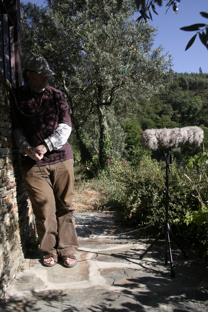
I explore environments & structures using conventional & extended field recording methods. I also use instruments & small objects. Sometimes I perform live intuitive compositions, sometimes I install work & often I compose photographic scores.
For me it is the emotive impulse that most inspires.
I listen.
2. What can that tell us?
I believe passionately that one of the most important results of an exploration of overlooked detail in daily life (in terms of sound as well as visual elements) is how it can enhance ones life. It can allow us to engage with our surrounding in different ways & appreciate what remains & what has gone before or indeed is in danger of disappearing.
it can tell us that listening is a much, much broader vista than we all understand & one can spend a lifetime exploring.
The study of the soundscape, called Acoustic Ecology, focuses on the relationship between living beings and their environment through sound. It’s a unique field in its interdisciplinary nature and beginnings, an interconnectivity between scientists, sociologists, anthropologists, and artists.
1. What do you do?
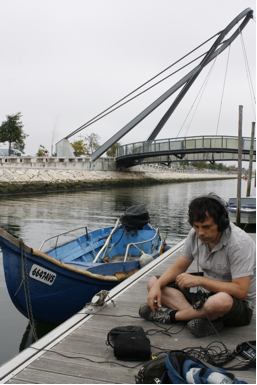
I am part of the organization Binaural/Nodar, which organizes educational and artistic creation events focused on a rural region in northern Portugal. Our creative focus is on sound and media arts that work with the natural and human environment of the region. As part of our activities, we organized a program of artist residencies dedicated to the river than passes through our region (Paiva river), which culminated in the Paivascapes festival, which took place in March this year. This was a multidisciplinary event that included a series of site-specific sound installations, a retrospective exhibition of sound and audiovisual works at a local museum, conferences on anthropological and environmental issues and nature walks. The festival had an itinerant nature, as it’s program was conceived to happen in several locations from the source to the mouth of the river.
2. What can that say?
The rural environment where we develop our activities has been inhabited for at least tens of thousands of years and each generation left their mark on the territory. So, we understand it as a infinitely complex, stratified and fragmented reality that most of the times cannot be fully comprehended if the approach is superficial, limited in time, based purely on a ‘naturalistic’ view of it that manifests itself for example on experiencing and recording the bucolic sights and sounds. It requires a more ‘relational’ approach, where what we see and listen to is mapped against other elements, stories, individual and collective memories, place names, old and new usages of the space, etc., which requires time, attention and empathy. We take these concerns on every aspect of our work such as which art projects to select, how and where to publicly present the works, how to mediate the relationship between the artists and the local communities.
Acoustic Ecology has branched out to give birth to a movement in sound art called phonography, a neologism referring to the art of field recording. It’s also shown a spotlight upon our changing sonic environment, and has become an important tool in bioacoustics and biomusicology, which help us to understand what these changes can mean. Birds communicate mainly with sound. When their calls cannot be heard, their reproduction decreases. Scientists are working with acoustic ecologists to record and study environments in which this is happening. Some of these bird calls may someday only survive on these recordings.
1. What do you do:
I am interested in the common, the everyday and the ordinary in my art practice; and in the unnoticed, the trivial and the repetitive that constitutes daily life. The birds I am interested in have ambiguous reputations and are considered pests or nuisances but they are also loved and respected. Seagulls, crows/corvids and pigeons are all very sociable species and are often much more audible than visible and they proliferate in the favorable conditions we have provided in urban centers.
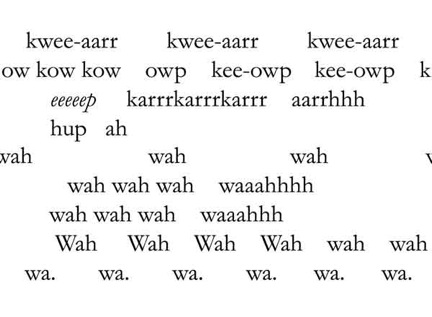
‘birdbrain’ focuses on our relationship with crows (corvids) and seagulls through voice (animal/human) and ideas about language (animal/human), including the spoken and written word. There is little philosophical discussion about animal voice, although the potential for animal language parallels current neurobiological research, which has identified that certain ‘motor and perceptual abilities’ essential for language in humans, also exist in birds.
2.What can that tell us:
The project has a number of components including an artist’s book that is posing as a mock field guide. The field guide comprises written texts of exchanges between a group of Little Ravens that I have transcribed over the course of a year using the phonetic words from conventional field guides.
The audio works consist of field recordings, mimicry and texts spoken by people with different accents. Scientific research tells us that birds also have regional accents and dialects, and that birds change their song according to place. Birds in cities sing more loudly to cope with urban noise and these songs tend to be simplified. Also, birds that have been introduced into different countries sing a song that is a variant from their brethren back in the homeland.
Cymatics is the study of sound waves made visible. Sound frequencies vibrate a surface and create distinct patterns. Sound needs a medium to vibrate, and the characteristics of the medium and sound wave will inform the shape. If you place a metal plate upon a speaker head, place sand upon that plate, and play certain frequencies through the speaker, you will see the sand vibrate into different patterns. If we could see sound around us, we would see expanding spheres with a kaleidoscopic-like pattern on its surface, effecting each other and all molecules in its path.
The interconnectivity of our world is often over looked, often not thought about. It is human nature to categorize, this is part of how we think and communicate. But what is lost when we consider our categories as islands, instead of a part of a whole, a pattern of overlapping systems? There is a saying that the whole of earth and ocean is found within one grain of sand.
1. What do you do?
I am an artist and composer who focuses on listening and the environment in my work. I am often recording my life and my travels, and the recordings or my observances from the recordings end up in my compositions, art installations, and soundwalks. In 2004, I was fortunate enough to find other people interested in sound and the environment and together, we formed The New York Society for Acoustic Ecology (NYSAE), a chapter of the World Forum for Acoustic Ecology. Through various organizations like the Whitney Museum, the Electronic Music Foundation, and free103point9, we have held events, panel discussions, and performances relating to sound and urban ecology. I am often asked how I “got into sound” and I usually don’t know how to answer it as it feels like I never got out of an interest in acoustics and space. I think that my interest in sound began when I carried around a tape recorder instead of a doll as a child. Perhaps not much has changed as I feel like my compositions reveal a layer of personal narrative conveyed through field recordings that describe how I relate to my environment. Often, my soundwalks do not include sounds that I have recorded; they are about sharing with others what I discovered about listening to the acoustics of a particular place. Points of interest are carefully arranged in guided tours with conceptual elements that emerge as sub-themes.
2. What can that say?
I am mostly interested in the relationship between people the sounds of the urban environment, particularly on how nature is defined by those who live in urban environments. When we slow down to listen to all that is in-between point A and point B, I think that we can begin to enjoy the fine details, even in a noisy city environment. I’ve worked with both children and adults in educational settings in cities who didn’t realize that they had birds living on their street until they were encouraged to listen. And I’ve discovered things like some people don’t like the sounds of birds at all, and they may prefer listening to the sounds of the subway. Sound can be just as subjective and adaptable of an art material as paint.
A drop of water falls into a puddle and creates a wave. A wave is a disturbance that travels through time and space. It affects everything it touches, it creates other waves, it continues colliding and transferring energy to molecules that do the same in turn to other molecules. It can be water, it can be light, it can be sound. It can be many things that collide into our molecules, and our system translates. The water is cold, the light is bright, the sound is loud. This is passive information. But when we actively feel how cooling the water is on a very hot day, when we actively consider how strong that sun is, and when we actively enjoy how the crash of an ocean wave makes our heart race…our world becomes so much richer.
1. What do you do?
Soundscape compositions, soundwalks, listening workshops, lectures, writing, editing, some mentoring of composition students, organizing as part of the World Forum for Acoustic Ecology (WFAE) and so on…
2.What can that say?
Everything I do seems to be focused on understanding the world through the act of listening and on the desire to share this understanding with as many people as possible. I believe that every sense perception gives us valuable and important connectedness to and information about the world in which we live. Our hearing sense has been underutilized (certainly in my lifetime, in our societies, nowadays) and a re-balancing of our senses may mean a re-balancing of how we approach life, environment, culture, politics and ideas. Experience in listening and composing has shown me ever new, changing and deepening approaches to space and time. And I wish this for everyone who learns to connect more consciously and deeply to his or her listening. What can that say: listening means noticing means inspiration means energy to do and act.
World Listening Day is July 18th. You can participate through the World Listening Day organization. Or just take the time, whatever you are doing, to stretch your ears and focus them on the rich acoustic world around you.
1. What do you do?
The World Listening Project maintains a website and online forum about its artistic and educational activities, including public workshops, forums, and lectures, as well as participating in exhibitions, symposiums, and festivals. Phonography and Acoustic Ecology inspired all of this. In the Chicago area, where we began, we formed the Midwest Society for Acoustic Ecology, a regional chapter of the American Society for Acoustic Ecology. We’re busy now inviting people to participate in the 2011 World Listening Day on July 18, the date of R. Murray Schafer’s birthday. If you visit our website you can learn how to celebrate. It’s quite open and last year the response was phenomenal.
2. What can that say?
Hearing tells us where to look. Wherever we are, every place on the planet has its own soundscape. From moment to moment the soundscape is always changing, often unpredictably. Depending on the time scale, dynamics, and frequency range we can choose to focus attention on. The World Listening Project suggests that listening is active, not passive: that listening means paying attention to the world. And when we do that we can begin to change it in a way conscious way. Bernie Krause has been a supporter. He’s making waves in the field of soundscape ecology. This is what Bernie says: “Western society bases most of what it knows on the visual. We actually ‘hear” what we ‘see.’ The World Listening Project aims to transform that perception in our otherwise urban centric and abstracted lives. At a time when we are facing not only a silent spring, but a silent summer, fall and winter, as well, it is clear that where a picture is worth a thousand words, a soundscape may soon be worth a thousand pictures.”



















Recent Comments