
Heads: Reblurring The Lines

I don’t intend to discuss the “Blurred Lines” case in this post. There are plenty of folk already committing thoughts on the ruling. While the circumstances of the recent Thicke/Williams/Gaye case are not explicitly about sampling, they are indicative of the direction sample/copyright litigation can go in the future. When samples from a composition infringe upon the copyrights for the song, it is dangerous territory. Rather than focus on those dangers however, I’d like to exemplify possibilities of a more open (and arguably the intended) interpretation of copyright laws, by doing something I should have done seven years ago – put out my project Heads (dropping on April 1st, 2015).
My position has not changed from previous writings on sample laws – transformative sampling produces original work. My intent here is to present an artist’s statement on Heads that illustrates how transformative sampling and derivatives of it require broader interpretation; they should be legally covered as original compositions.

Cover art for Proto-Heads project from 2009
I’ve kept Heads in the vaults since 2007 while continuing from its artistic direction, all the while doing little tinkerings to convince myself it wasn’t done yet (it was). I had been pursuing analog technologies I swore would be the finishing touches it needed, to convince myself it wasn’t ready yet (it was). Then I lost 4TB of files in a quadruple hard drive killer power surge. The last Heads masters were among the 500GB that survived.
The project was born in response to comments made by Wynton Marsalis, dismissing hip-hop and denying its connection to the legacy of black music.
It’s mostly sung in triplets. So what? And as for sampling, it just shows you that the drummer has been replaced by a loop. The drum – the central instrument in African-American music, the sound of freedom – has been replaced by a repetitive loop. What does that tell you about hip-hop’s respect for African-American tradition? – Wynton Marsalis
I was offended as both a hip-hop and jazz head, so I set out to produce a body of work that showed the artistic originality of sampling and tied the practice to black musical traditions.
Prior to the analog experiments, I was modeling a series of digital Open Sound Control (OSC) instruments based on the monome, starting with a sampler but expanding into drum machines synthesizers and other noise makers. Together I called them the Heads Instruments. 95% of the composition work on Heads began with these instruments, all of which were built around the concept of sampling.
The title Heads, comes from the musical head, which is a fundamental part of the jazz tradition. The head is the thematic phrase or group of phrasings that signify a song; heads can be comprised of melody, harmony and/or rhythm. Jazz musicians use the head as a foundation for improvisation, a traditional form including the alternating of head and solo improvisations . Often times in jazz, the head comes from popular songs re-envisioned through improvisation in a jazz context, such as John Coltrane’s famous refiguring of “My Favorite Things” from The Sound of Music. In addition to being covers, these versions are transformations of the original into a different musical context. The Heads Instruments were designed specifically as instruments that could perform a head in a transformative manner.
Hip-hop attacks itself. It has no merit, rhythmically, musically, lyrically. What is there to discuss? – Wynton Marsalis
Tony Wynn
I was a bit annoyed at Marsalis, just how much is illustrated by the opening track of Heads, “Tony Wynn,” eponymously named after the contemporary jazz saxophonist, who, like Marsalis, feels that hip hop is not music. In it a character berates his friend for bringing up Wynn’s position. On the surface the song talks trash, but musically it makes layers of references.
First, the song’s format (down to the title) is a nod to the Prince tune “Bob George.” In his song, Prince parodies a character berating a girlfriend for being with Bob George. The voice of the character in “Tony Wynn” and some of his comments come straight from Prince’s song, but the work as a whole is not a direct cover of “Bob George.”

“Tony Wynn” is undeniably influenced by the Minneapolis sound, that eclectic late 1970s and early 80s scene that blend of funk, rock, and synthpop, but how the track arrives there is complicated. It does contain a Prince sample, but not from “Bob George.” The sample is played in a transformative manner, chopping a new riff different from the source material. It also includes a hit from another song, a sample of only one note, yet one identifiable as signature. The drums are ‘played’ in what could be described as the Minneapolis vibe. You can also hear a refrain that mimics yet another song. All of these sampled parts create a new head, to which I added instrumental embellishments with co-conspirator Dolphin on bass, synth, and the killer Prince-esque guitar solo.
The track represents a hodgepodge of Prince influences, but because those influences are so varied, none can be individually identified as the heart of “Tony Wynn.” Furthermore, at the bridge all of the samples get flipped on each other, some re-sampled and performed anew. Nothing can be pinned down as an infringement on technicalities, without taking into account the full context of the transformation. While “Tony Wynn” is heavily influenced by Prince, it is not a Prince song.
Rap Rap Rap
The second track on Heads,”Rap Rap Rap,” features Murda Miles and Killa Trane. I chose its title and head to reference the 1936 Louis Palma song “Sing Sing Sing,” made popular by the Benny Goodman Band. Coming out of the big band era, the song is closer to a traditionally composed Western standard, the heavy percussions however distinguish it. While you will find no samples of sound recordings from any version of “Sing Sing Sing” in “Rap Rap Rap,” it still represents the primary sample head used.
The opening percussive phrases are influenced by rhythmic hand games—an important but often overlooked precursor to hip hop discussed in Kyra Gaunt’s The Games Black Girls Play: Learning the Ropes from Double-Dutch to Hip-Hop. Here the rhythm sets the pace before charging into the head with a swing type of groove as the two featured artists, Murda Miles on trumpet and Killa Trane on sax, call out the head. What distinguishes these horns however, is that they are both sample based.
The song’s head is still based on “Sing Sing Sing,” but for the dueling horn parts the samples come from the recordings of Miles Davis and John. While Davis and Coltrane played together at a fair number of sessions, these samples come from two divergent sources from their individual catalogs. I chopped, tuned and arranged them for performance so that they could play in tune with the head.
The opening half of “Rap Rap Rap” sees both sticking to the head with little flourishes, but at the half way mark, the accompaniment changes to a distinct hip-hop beat still firmly rooted in the head. The two horns shift here as well, trading bars in a way that nods to both jazz and rap. The phrasing of the sample performance itself mimics a rapping cadence here, bridging the gap between the two traditions.
La Botella
The head for next track “La Botella” (The Bottle), uses a popular salsa motif as the head, accentuated by a son influenced percussive wall of sound. The percussions vary from live tracked percussions to percussion samples to percussive synthesis. I performed many of the percussive sounds utilizing the Heads Instruments sequencer, which lends itself to the slightly off—while still in the pocket—swing.
The format of this particular head allowed for an expanded arrangement, through which I nod to the Afro-Cuban influence in the African American tradition, from jazz to hard soul/funk to rock and roll. Son evolved from drumming traditions that have their own forms of the head. There is a duality in these two traditions that pairs a desire for tightness with a looseness in spirit, and this tension continues into musics influenced by them. The percussions on “La Botella” carry that duality. The collective drums sound as an instrument, while each individual drum can be aurally isolated.
The actual samples in the song come from vocal bits of The Fania All-Stars, but the true Fania mark I emulate on “La Botella” is the horn section. They sound nowhere near as good—let’s just get that out of the way—but the role they play comes directly from the feel of a classic Fania release. Could the horns actually be attributable to a single source? I doubt it, but more importantly, they operate only as a component of the song itself, placing this inspiration in a different musical context.
Sound Power
“Sound Power” fully embraces ‘sound’ as a fundamental musical object. Sounds in and of themselves can be understood as heads. The primary instrument I used on “Sound Power” is the sound generator of the 4|5 Ccls Heads Instrument. 4|5 Ccls is an arpeggiator modeled after John Coltrane’s sketches on the cycle of fifths. I tend to think of such sounds in relationship to the latter Coltrane years when he was using his instrument as a sound generator, clustering notes together and condensing melody.
Similarly, arpeggiators group notes into singular phrases which can be interpreted as heads. The head on “Sound Power” does not push the possibilities to the extreme, as Coltrane did; it remains constrained within a rhythmic framework. However, it shows the power of sound as fundamental. All of the drums, percussive elements, bass and harmonies flow from the head, accentuated by heavyweight vocal chops from the Heads Instrument scratch emulator.
Come Clean
The intro to “Come Clean” marks a turning point in the album. The first four tracks present are technical feats to illustrate the point. “Come Clean” doesn’t slack off. Musically this track is the closest to the “Blurred Lines” case; notably, other than the intro, it contains no sample. It’s head, however, comes from the Jeru the Damaja song “Come Clean” produced by DJ Premier. I did an extensive breakdown on the technical details of “Come Clean” on Avanturb a few years ago; my online installation shows how (and for how long) I have been contemplating this track. But to paraphrase the sample here, the true power of music is helping the listener realize the breadth of their own existence in this universe. My use of the song is very intentional, and I deliberately change its themes for the album.
For “Come Clean,” I worked with percussionists Zach and Claudia who studied in the Olatunji line of drumming. They noted the physical timing challenges getting used to the song’s unique head, but, once they locked in, the head held its own. That exemplifies the power of this means of composing – new original ideas which can push music’s possibilities.
As an artist, I advocate for the interpretation of copyright laws so that someone cannot sue because three notes of a song appear in one they own, or because a sound from the recording the record company convinced the artist to sign over to them for pennies was repitched and played into a melody. I know that arriving to music via these methods can push the traditions further, everything copyright laws were written to encourage. If we don’t change the way we think about copyright, the ability to create in this manner will be lost in litigation.
Heads comes out on April 1, 2015
—
Primus Luta is a husband and father of three. He is a writer and an artist exploring the intersection of technology and art, and their philosophical implications. He maintains his own AvantUrb site. Luta was a regular presenter for Rhythm Incursions. As an artist, he is a founding member of the collective Concrète Sound System. Recently Concréte released the second part of their Ultimate Break Beats series for Shocklee.
—
 REWIND!…If you liked this post, you may also dig:
“SO! Reads: Jonathan Sterne’s MP3: The Meaning of a Format”-Aaron Trammell
“Remixing Girl Talk: The Poetics and Aesthetics of Mashups”-Aram Sinnreich
The Blue Notes of Sampling– Primus Luta
Share this:

Sculptural Dissonance: Hans Zimmer and the Composer as Engineer
Welcome to our new series Sculpting the Film Soundtrack, which brings you new perspectives on sound and filmmaking. As Guest Editor, we’re honored and delighted to have Katherine Spring, Associate Professor of Film Studies at Wilfrid Laurier University. Spring is the author of an exciting and important new book Saying it With Songs: Popular Music and the Coming of Sound to Hollywood Cinema. Read it! You’ll find an impeccably researched work that’s the definition of how the history of film sound and media convergence ought to be written.
But before rushing back to the early days, stick around here on SO! for the first of our three installments in Sculpting the Film Soundtrack.
– NV
—
It’s been 35 years since film editor and sound designer Walter Murch used the sounds of whirring helicopter blades in place of an orchestral string section in Apocalypse Now, in essence blurring the boundary between two core components of the movie soundtrack: music and sound effects. This blog series explores other ways in which filmmakers have treated the soundtrack as a holistic entity, one in which the traditional divisions between music, effects, and speech have been disrupted in the name of sculpting innovative sonic textures.
In three entries, Benjamin Wright, Danijela Kulezic-Wilson, and Randolph Jordan will examine the integrated soundtrack from a variety of perspectives, including technology, labor, aesthetic practice, theoretical frameworks, and suggest that the dissolution of the boundaries between soundtrack categories can prompt us to apprehend film sound in new ways. If, as Murch himself once said, “Listening to interestingly arranged sounds makes you hear differently,” then the time is ripe for considering how and what we might hear across the softening edges of the film soundtrack.
– Guest Editor Katherine Spring
—
Composing a sound world for Man of Steel (2013), Zack Snyder’s recent Superman reboot, had Hans Zimmer thinking about telephone wires stretching across the plains of Clark Kent’s boyhood home in Smallville. “What would that sound like,” he said in an interview last year. “That wind making those telephone wires buzz – how could I write a piece of music out of that?” The answer, as it turned out, was not blowing in the wind, but sliding up and down the scale of a pedal steel guitar, the twangy lap instruments of country music. In recording sessions, Zimmer instructed a group of pedal steel players to experiment with sustains, reverb, and pitches that, when mixed into the final track, accompany Superman leaping over tall buildings at a single bound.
His work on Man of Steel, just one of his most recent films in a long and celebrated career, exemplifies his unique take on composing for cinema. “I would have been just as happy being a recording engineer as a composer,” remarked Zimmer last year in an interview to commemorate the release of a percussion library he created in collaboration with Spitfire Audio, a British sample library developer. “Sometimes it’s very difficult to stop me from mangling sounds, engineering, and doing any of those things, and actually getting me to sit down and write the notes.” Dubbed the “HZ01 London Ensembles,” the library consists of a collection of percussion recordings featuring many of the same musicians who have performed for Zimmer’s film scores, playing everything from tamtams to taikos, buckets to bombos, timpani to anvils. According to Spitfire’s founders, the library recreates Zimmer’s approach to percussion recording by offering a “distillation of a decade’s worth of musical experimentation and innovation.”
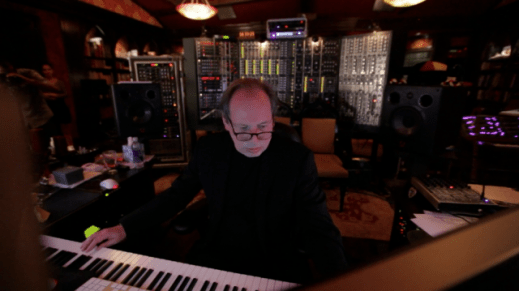
In many ways, the collection is a reminder not just of the influence of Zimmer’s work on contemporary film, television, and video game composers but also of his distinctive approach to film scoring, one that emphasizes sonic experimentation and innovation. Having spent the early part of his career as a synth programmer and keyboardist for new wave bands such as The Buggles and Ultravox, then as a protégé of English film composer Stanley Myers, Zimmer has cultivated a hybrid electronic-orchestral aesthetic that uses a range of analog and digital oscillators, filters, and amplifiers to twist and augment solo instrument samples into a synthesized whole.
Zimmer played backup keyboards on “Video Killed the Radio Star.”
In a very short time, Zimmer has become a dominant voice in contemporary film music with a sound that blends melody with dissonance and electronic minimalism with rock and roll percussion. His early Hollywood successes, Driving Miss Daisy (1989) and Days of Thunder (1990), combined catchy themes and electronic passages with propulsive rhythms, while his score for Black Rain (1989), which featured taiko drums, electronic percussion, and driving ostinatos, laid the groundwork for an altogether new kind of action film score, one that Zimmer refined over the next two decades on projects such as The Rock (1996), Gladiator (2000), and The Pirates of the Caribbean series.
What is especially intriguing about Zimmer’s sound is the way in which he combines the traditional role of the composer, who fashions scores around distinct melodies (or “leitmotifs”), with that of the recording engineer, who focuses on sculpting sounds. Zimmer may not be the first person in the film business to experiment with synthesized tones and electronic arrangements – you’d have to credit Bebe and Louis Barron (Forbidden Planet, 1956), Vangelis (Chariots of Fire, 1981), Jerry Goldsmith (Logan’s Run, 1976), and Giorgio Moroder (Midnight Express, 1981) for pushing that envelope – but he has turned modern film composing into an engineering art, something that few other film composers can claim.
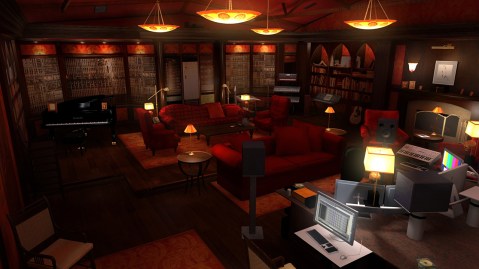
Zimmer’s studio
One thing that separates Zimmer’s working method from that of other composers is that he does not confine himself to pen and paper, or even keyboard and computer monitor. Instead, he invites musicians to his studio or a sound stage for an impromptu jam session to find and hone the musical syntax of a project. Afterwards, he returns to his studio and uses the raw samples from the sessions to compose the rest of the score, in much the same way that a recording engineer creates the architecture of a sound mix.
“There is something about that collaborative process that happens in music all the time,” Zimmer told an interviewer in 2010. “That thing that can only happen with eye contact and when people are in the same room and they start making music and they are fiercely dependent on each other. They cannot sound good without the other person’s part.”
Zimmer facilitates the social and aesthetic contours of these off-the-cuff performances and later sculpts the samples into the larger fabric of a score. In most cases, these partnerships have provided the equivalent of a pop hook to much of Zimmer’s output: Lebo M’s opening vocal in The Lion King (1994), Johnny Marr’s reverb-heavy guitar licks in Inception, Lisa Gerrard’s ethereal vocals in Gladiator and Black Hawk Down (2002), and the recent contributions of the so-called “Magnificent Six” musicians to The Amazing Spider Man 2 (2014).
The melodic hooks are simple but infectious – even Zimmer admits he writes “stupidly simple music” that can often be played with one finger on the piano. But what matters most are the colors that frame those notes and the performances that imbue those simple melodies with a personality. Zimmer’s work on Christopher Nolan’s Dark Knight trilogy revolves around a deceptively simple rising two-note motif that often signifies the presence of the caped crusader, but the pounding taiko hits and bleeding brass figures that surround it do as much to conjure up images of Gotham City as cinematographer Wally Pfister’s neo-noir photography. The heroic aspects of the Batman character are muted in Zimmer’s score except for the presence of the expansive brass figures and taiko hits, which reach an operatic crescendo in the finale, where the image of Batman escaping into the blinding light of the city is accompanied by a grand statement of the two-note figure backed by a driving string ostinato. Throughout the series, a string ostinato and taikos set the pace for action sequences and hint at the presence of Batman who lies somewhere in the shadows of Gotham.
Zimmer’s expressive treatment of musical colors also characterizes his engineering practices, which are more commonly used in the recording industry. Music scholar Paul Théberge has noted that the recording engineer’s interest in an aesthetic of recorded musical “sound” led to an increased demand for control over the recording process, especially in the early days of multitrack rock recording where overdubbing created a separate, hierarchical space for solo instruments. Likewise for Zimmer, it’s not just about capturing individual sounds from an orchestra but also layering them into a synthesized product. Zimmer is also interested in experimenting with acoustic performances, pushing musicians to play their instruments in unconventional ways or playing his notes “the wrong way,” as he demonstrates here in the making of the Joker’s theme from The Dark Knight:
The significance of the cooperative aspects of these musical performances and their treatment as musical “colors” to be modulated, tweaked, and polished rests on a paradoxical treatment of sound. While he often finds his sound world among the wrong notes, mistakes, and impromptu performances of world musicians, Zimmer is also often criticized for removing traces of an original performance by obscuring it with synth drones and distortion. In some cases, like in The Peacemaker (1997), the orchestration is mushy and sounds overly processed. But in other cases, the trace of a solo performance can constitute a thematic motif in the same way that a melody serves to identify place, space, or character in classical film music. Compare, for instance, Danny Elfman’s opening title theme for Tim Burton’s Batman (1989) and Zimmer’s opening title music for The Dark Knight. While Elfman creates a suite of themes around a central Batman motif, Zimmer builds a sparse sound world that introduces a sustained note on the electric cello that will eventually be identified with the Joker. It’s the timbre of the cello, not its melody, that carries its identifying features.
To texture the sounds in Man of Steel, Zimmer also commissioned Chas Smith, a Los Angeles-based composer, performer, and exotic instrument designer to construct instruments from “junk” objects Smith found around the city that could be played with a bow or by hand while also functioning as metal art works. The highly abstract designs carry names that give some hint to their origins – “Bertoia 718” named after modern sculptor and furniture designer Harry Bertoia; “Copper Box” named for the copper rods that comprise its design; and “Tin Sheet” that, when prodded, sounds like futuristic thunderclaps.
Smith’s performances of his exotic instruments are woven into the fabric of the score, providing it with a sort of musical sound design. Consider General Zod’s suite of themes and motifs, titled “Arcade” on the 2-disc version of the soundtrack. The motif is built around a call-and-answer ostinato for strings and brass that is interrupted by Smith’s sculptural dissonance. It’s the sound of an otherworldly menace, organic but processed, sculpted into a conventional motif-driven sound world.
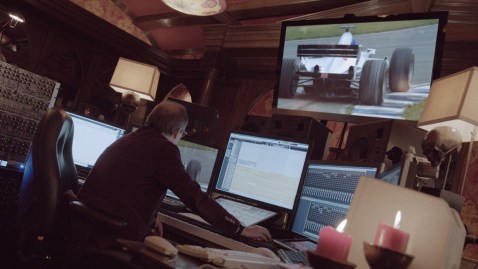
Zimmer remains a fixture in contemporary film music partly because, as music critic Jon Burlingame has pointed out, he has a relentless desire to search for fresh approaches to a film’s musical landscape. This pursuit begins with his extracting of sounds and colors from live performances and electronically engineering them during the scoring process. Such heightened attention to sound texture and color motivated the creation of the Spitfire percussion library, but can only hint at the experimentation and improvisational nature that goes into Zimmer’s work. In each of his film scores, the music tells a story that is tailored to the demands of the narrative, but the sounds reveal Zimmer’s urge to manipulate sound samples until they are, in his own words, “polished like a diamond.”
—
Ben Wright holds a Provost Postdoctoral Fellowship from the University of Southern California in the School of Cinematic Arts. In 2011, he received his Ph.D. in Cultural Studies from the Institute for Comparative Studies in Literature, Art and Culture at Carleton University. His research focuses on the study of production cultures, especially exploring the industrial, social, and technological effects of labor structures within the American film industry. His work on production culture, film sound and music, and screen comedy has appeared in numerous journals and anthologies. He is currently completing a manuscript on the history of contemporary sound production, titled Hearing Hollywood: Art, Industry, and Labor in Hollywood Film Sound.
—
All images creative commons.
—
 REWIND! . . .If you liked this post, you may also dig:
Fade to Black, Old Sport: How Hip Hop Amplifies Baz Luhrmann’s The Great Gatsby— Regina Bradley
Quiet on the Set?: The Artist and the Sound of a Silent Resurgence— April Miller
Play It Again (and Again), Sam: The Tape Recorder in Film (Part Two on Walter Murch)— Jennifer Stoever
Share this:


Current Top Posts





April 2021

January 2020

November 2019

October 2019

August 2019

April 2014

November 2017

March 2015

December 2017

October 2015
 Sounding Out!
Recent Comments