
“This Liquid Dream”: An Interview with Aquaphoneia Composer Navid Navab

Multidisciplinary composer and media alchemist Navid Navab and his team at the Topological Media Lab based at Concordia University (Montreal) presented Aquaphoneia, a sound installation which transmutes voice into water and water into air at Biennale Nemo in Paris in December 2017 (and will run until March 2018). I conducted this interview in the context of the first presentation of Aquaphoneia originally conceptualized for Ars Electronica 2016: RADICAL ATOMS and the alchemists of our time. This version of the piece looked at technology through the lens of the living materiality. As Prof. Hiroshi Ishii, of the MIT Media Lab’s Tangible Media Group, stated, artists “suggest completely new ways of looking at the role of science in our society and the interplay of technology and nature.”
***
EB [Esther Bourdages]: The theme of the 2016 Ars Electronica Festival, RADICAL ATOMS – and the alchemists of our time, is very close to the Topological Media Lab’s mission: transmutation and alchemy on the philosophical and phenomenological level. For Aquaphoneia, can you expand on alchemy and specifically on how this art piece stands out from your past work? How did alchemical thought process and production techniques come up in the process of the piece?
NN [Navid Navad]: When the 2016 theme for Ars Electronica Festival was announced I was happily surprised and thought: finally, things are coming to light at a much larger scale. Yes, please can we reverse the still prominent European Modernism’s separations—between the conceptual and the material, the precise and the messy, the sciences and the arts—and go back to the holistic richness of alchemical matter? This transition that we are currently experiencing calls for a shift away from representational technologies: from interfaces to stuff, from objects to fields of matter-in-process, from fixed concepts to processes that enact concepts. For over a decade, we as alchemists have been engaging with “bodies and materials that are always suffused with ethical, vital and material power.”
The Topological Media Lab [TML] is occupied by people who are living to fuse and confuse, ready to unlearn the apparent practicality of isolated disciplines, while playfully improvising new pathways to understanding potential futures. The TML hosts an array of projects for thinking-feeling through poetry-infused-matter and breathing life into static forms—which to me is an effortlessly artistic process, and all the while inseparable from a rigorously philosophical or scientific one. Even though it might take decades for the kinds of computational-materials that we are envisioning today to be engineered from ground up at an atomic level, with what is possible today, we explore how the messy stuff of the world could become computationally charged with the potential for play: sounding, dancing, and co-performing new ways of living with or without us.
Aquaphoneia comes out of this rich ecology of experiments. In Aquaphoneia, voice and water become irreversibly fused. The installation listens to the visitors, and transmutes their utterances into aqueous voice, which then is further enriched and purified through alchemical processes.
.
To fully realize this liquid dream, we went to great lengths in order to fuse the messy behaviour of matter flowing throughout the installation with meticulously correlated and localized sonic behaviour. For example, the temporal texture of boiling liquid in one chamber is perceptually inseparable from the spectral entropy of simmering voices which then evaporate into a cloud of spectral mist. All of this dynamic activity is finely localized: the sounds acoustically emit exactly from where the action occurs, rather than spatially schizophying loudspeakers elsewhere.
On another hand, our material-computational-centric approach lead to a tough yet rewarding meditation on control and process. As a composer, I had to let go of all desires for immediate control over sounds and surrender important rhythmical and compositional decisions to messy material processes. In Alchemical Mercury (2009), Karen Pinkus quotes Marcel Duchamp: “alchemy is a kind of philosophy: a kind of thinking that leads to a way of understanding” (159). For us, in the process of creating Aquaphoneia, essentially what had to be understood and then given up was our attachment to our far-too-human notions of time and tempo. Instead we embraced and worked within the infinitely rich and pluri-textural tempi of matter. Technically and compositionally this meant that most of our focus had to be placed on merging the continuous richness of material processes with our computational processes through an array of techniques: temporal pattern following, audio-mosaicing, continuous tracking of fields of activity using computer vision and acoustic sensing techniques in order to synthesize highly correlated sonic morphologies, careful integration of structure-born-sound, etc. We were able to co-articulate compositions by constraining material processes sculpturally, and then letting the liquid voice and the laws of thermodynamics do their thing.
[EB]: One of the first elements that we notice in the installation is the brass horn connected to an old Edison sound recording machine, that now turns into liquid instead of wax cylinders. In fact, it came from an Edison talking machine. You repurpose an authentic artifact, but you do not fall into the trap of nostalgia, and neither into the role of collector, but you embrace innovation with a dynamic approach which excavates past media technologies in order to understand or surpass contemporary audio technologies. Where does the use of the Edison horn come from and how does it speak to your relationship with the superposition of history?
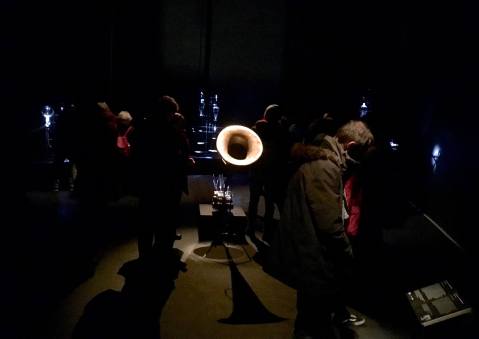
Paris, Biennale Némo, 17 October 2017 – 18 March 2018 Credit: Navid Navad, 2017
[NN]: The history of sound reproduction involves transforming audible pressure patterns or sound energy into solid matter and vice versa. The historic Edison recording machines gathered sound energy to etch pressure patterns onto tinfoil wrapped around a cylindrical drum. Sound waves, focussed at the narrow end of the horn, caused a small diaphragm to vibrate, which in turn caused a miniature steel-blade stylus to move and emboss grooves in the cylinder. The tin foil would later on be replaced by wax cylinders, vinyl disks and eventually digital encoding.
Aquaphoneia engages the intimately recursive relationship between sounding technologies and material transmutations. Our digital audio workstations are an in fact an inclusive part of this history, this endless chain of analog transmutation between energy and matter. Under the fiction of the digital there is always the murmur of electrons and of matter-energy fields in physical transmutation. As J. Fargier writes on an early book on Nam June Paik (1989) “The digital is the analog correspondence of the alchemists’ formula for gold” (translation by NN). Well, yes. The digital revolution has allowed us to shape, compute, purify, and sculpt sounds like never before… but then often at the hefty cost of a disembodying process, with interfaces that are linked to sounds only through layers upon layers of representation, far detached from resonating bodies and the sexy flux of sounding matter.
Aquaphoneia playfully juxtaposes material-computational histories of talking machines within an imaginary assemblage: sounds are fully materialized and messed with tangibly within an immediate medium very much like clay or water or perhaps more like a yet to be realized alchemico-sonic-matter. This odd assemblage orchestrates liquid sounds leveraging intuitive worldly notions—such as freezing, melting, dripping, swishing, boiling, splashing, whirling, vaporizing—and in the process borrows alchemical tactics expanding across material sciences, applied phenomenology, metaphysics, expanded materiology, and the arts. Aquaphoneia’s alchemical chambers set these materials, metaphors, and forces into play against one another. After the initial ritual of offering one’s voice to the assemblage, the aqueous voice starts performing for and with itself, and human visitors have the opportunity to watch and participate as they would when encountering the unpredictable order of an enchanted forest river.
It is also noteworthy that the horn resembles a black hole. The edge of the horn acts like an event horizon, separating sounds from their source-context. Sounds, once having passed the acousmatic event horizon, cannot return to the world that they once knew. Voices leaving the body of their human or non-human speaker, fall into the narrow depths of the horn, and are squeezed into spatio-temporal infinity. Disembodied voices, are immediately reborn again with a new liquid body that flows though alchemical chambers for sonic and metaphysical purification.
Much of my work deals with the poetics of schizophonia (separation of sound from their sources). Sound reproduction (technologies), from Edison’s talking machines to our current systems, transcode back and forth between the concrete and acousmatic, situated and abstract, materialized and dematerialized, analogue and digital. Often sounds are encoded into a stiff medium which then may be processed with an interface, eventually decoded, and re-manifested again as sound. Aquaphoneia ends this nervous cycle of separation anxiety and re-attachment by synthesizing a sounding medium capable of contemporary computational powers such as memory, and adaptive spectro-temporal modulation and morphing. To adapt Marshall McLuhan, instead of encoding and decoding a presumed message with representational technologies, it enchants the medium.
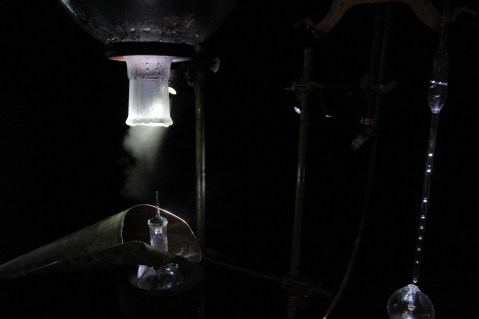
Image Credit: Topological Media Lab, 2016
[EB]: There is the tendency to think that artwork from Media Labs are stable and high tech. Aquaphoneia uses analog and digital technologies with a Do-It-Yourself (DIY) touch in the aesthetic. Since your lab is multidisciplinary oriented and influenced by diverse fields of knowledge, can you develop on the DIY dimension in Aquaphoneia under the gaze of Clint Enns—cinematographer in the experimental field of cinema—: “Adopting a DIY methodology means choosing freedom over convenience”?
[NN]: Aquaphoneia is a truly eclectic assemblage lost in time. Aquaphoneia’s mixed form reflects its extremely fluid, collaborative and playful creative process. Instead of coming up with a definitive design and executing it industrially, Aquaphoneia’s realization involved a much more playful process, where every little aspect of the installation—materials, sounds, software, electronics, etc.—was playfully investigated and messed with. Every little detail matters and every process, undulating back and forth between conception to execution, is an artistic process. The research-creation process leading to the works that come out of our lab are as critical to us as the final and fully produced art works. This was also true for the alchemists who, through their process, were seeking to develop new approaches for understanding the world, relating to matter, and surpassing nature.
Our research-creation activities concern experimenting with ethico-aesthetics of collective thinking-making: humans, non-humans, machines, and materials enacting and co-articulating the ever-changing material-social networks of relations which shape them. This DIY art-all-the-way approach, while providing a healthy dose of aesthetic freedom, is also an ethical one: we live with and within our designs and grow with them. That being said, we are not attached to a DIY process in the same way that some maker cultures might be. Sometimes we blindly find and repurpose something that does something cool, complicated, and mysterious and that is fantastic, sort of like philosophy of media meets cyber dumpster diving meets DIY hacker space meets cutting edge tech research meets miniMax (minimum engineering with maximum impact) meets speculative whatever…
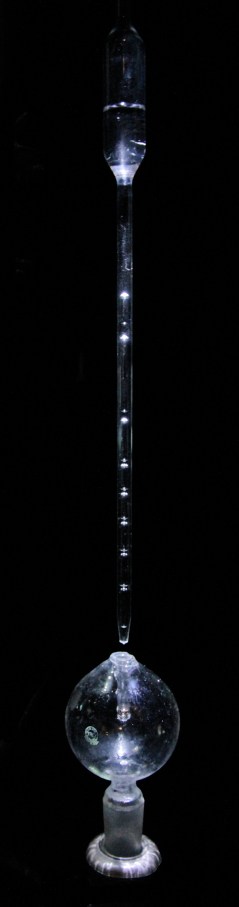
Image Credit: Topological Media Lab, 2016
For example, at some point we decided to gather sonic vapour in a glass dome and condense it back into drops, which were then guided to fall into the bottom of the installation. The purified drop of voice—sonic “lapis philosophorum”—was to fall into the depths of the earth beneath and shine upward like sonic gold, connecting heaven and earth. We had to execute this opus magnum inside a very small hole in the base of the installation. The water drop needed to be immediately sensed and sonified, leading to sounds coming out of the same hole, along with synchronized light. You can imagine that if we were relying on “black-boxed” technologies and ready-made techniques then this task would have seemed like a nightmare to design and fabricate. The water drop was to fall all the way to the bottom of the hole where it would be acoustically sensed by a small apparatus that had to be acoustically isolated from everything else. Then the result of the sonification had to be pushed through the very same hole with a high degree of intelligibility and in a way that it would be seamlessly localized. Meanwhile, light had to shine through this hole in sync with the sounds but the source of light had to remain hidden.
The solution to this technical puzzle came to us effortlessly when playing around with random stuff. We found a hipster product—a little plastic horn—that was made for turning your iPod into a gramophone. Then a speaker was mounted inside of this plastic horn in order to focus sounds towards the end tip of the horn. The back of the speaker was fully covered with foam and duct tape to stop any sound from escaping anywhere except for where we wanted it to appear. A small hole was drilled into the brass pipe in the base of the installation. Our advanced hipster horn-tip-sound-laser-thing was then inserted, allowing crisp sounds to enter the brass hole and emit from it without any visible clues for the perceiver as to where the speaker was hidden. Meanwhile, a similar lighting solution was created so that in a very small footprint we can focus, direct, and bounce enough directional light in the brass pipe without ever getting in the way of the water drops.
We had to engage with this sort of detailed fabrication/composition process throughout the whole installation in order to come up with solutions to sense the behaviour of the materials and liquids locally and to manifest them sonically and visually so that there would be no separation from local material behaviours and their computational enchantment. In trying to do so we discovered that more often than not, there was no ready-made solution or technique to rely on, and at the same time we didn’t have months ahead of us to engage in an abstract design and fabrication process. We had limited hours of collective play time to leverage and to come up with innovative techniques that we didn’t even know could exist and that was really fun.
**
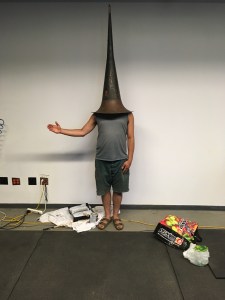
Image Credit: Topological Media Lab, 2016**
Aquaphoneia is a rich sound art piece – a manifesto by itself about innovation and inventiveness. The sound installation demonstrates that the main crafters Navid Navad and his partner Michael Montanaro, in collaboration with other members of the Topological Media Lab, swim easily into the multidisciplinary art. They are are not afraid to experiment and engage with the material, which results in an interlacing of forms, a mixture of historic references, and an interesting fusion of “low” and “high” technology. I was able to catch some of the build up of the art piece, and it was fantastic to witness the lab as a playful messy artistic field with a little team of scholars fusing their different backgrounds in convergence on the marriage of art and science.
Aquaphoneia, a sound installation which transmutes voice into water and water into air at Biennale Nemo in Paris runs until March 2018.
—
-
- NAVID NAVAB art direction, sound/installation concept and design, audiovisual composition, programming, behaviour design
- MICHAEL MONTANARO art direction, visual/installation concept, design and fabrication
- PETER VAN HAAFTEN electronics, sound, programming
- consulting assistants: Nima Navab (embedded lighting design) Joseph Thibodeau (electronics)
- research collaboration: Topological Media Lab
Featured Image: Aquaphoneia, Paris, Biennale Némo, 17 October 2017 – 18 March 2018, Credit: Navid Navad, 2017
—
Esther Bourdages works in the visual arts and technology art field as a writer, independent curator and scholar. Her curatorial research explores art forms such as site-specific art, installation and sculpture, often in conjunction with sound. She has authored many articles and critical commentaries on contemporary art. As a musician, she performs under the name of Esther B – she plays turntables, handles vinyl records, and records soundscapes. She works and lives in Montreal.
Navid Navab is a Montreal based media alchemist, multidisciplinary composer, audiovisual sculptor, phono-menologist, and gestureBender. Interested in the poetics of gesture, materiality, and embodiment, his work investigates the transmutation of matter and the enrichment of its inherent performative quali- ties. Navid uses gestures, rhythms and vibration from everyday life as basis for realtime compositions, resulting in augmented acoustical poetry and painterly light that enchants improvisational and pedestrian movements.
Navad currently co-directs the Topological Media Lab, where he leverages phenomenological studies to inform the the creation of computationally-augmented performance environments. His works, which which take on the form of gestural sound compositions, responsive architecture, site specific interven- tions, theatrical interactive installations, kinetic sound sculptures and multimodal comprovisational per- formances, have been presented internationally at diverse venues such as Canadian Center for Architec- ture, Festival du Nouveau Cinema, Ars Electronica Festival Linz, HKW Berlin, WesternFront Vancouver, McCord Museum, Musée d’art Contemporain de Montréal, Contemporary Arts Museum Houston, Inter- national Digital Arts Biennial, Musiikin Aika Finland, and Festival International Montréal/Nouvelles Mu- siques, among others. www.navidnavab.net
—
 REWIND! . . .If you liked this post, you may also dig:
Playing with Bits, Pieces, and Lightning Bolts: An Interview with Sound Artist Andrea Parkins — Maile Colbert
Sounding Our Utopia: An Interview With Mileece— Maile Colbert
Optophones and Musical Print–Mara Mills
Share this:

“Happy Homes Have Gramophones” –Gender, Technology, and the Sonic Restaging of Community Before and After the Partition of Bengal


co-edited by Praseeda Gopinath and Monika Mehta
Our listening practices are discursively constructed. In the sonic landscape of India, in particular, the way in which we listen and what we hear are often normative, produced within hegemonic discourses of gender, class, caste, region, and sexuality. . . This forum, Gendered Soundscapes of India, offers snapshots of sound at sites of trans/national production, marketing, filmic and musical texts. Complementing these posts, the accompanying photographs offer glimpses of gendered community formation, homosociality, the pervasiveness of sound technology in India, and the discordant stratified soundscapes of the city. This series opens up for us the question of other contexts in India where sound, gender, and technology might intersect, but, more broadly, it demands that we consider how sound exists differently in Pakistan, Sri Lanka, the Maldives, Bangladesh, Bhutan, Nepal, and Afghanistan. How might we imagine a sonic framework and South Asia from these locations? —Guest Editors Praseeda Gopinath and Monika Mehta
For the full introduction to the forum, click here.
To read all of the posts in the forum, click here.
—
“She compelled respect at once by refusing on any account to be phonographed: perhaps she thought, amongst other things, that if she committed her soul to a broken piece of wax it might get broken…my subsequent experiences showed that it was only too likely,” wrote the British musicologist A.H. Fox-Strangways in 1910 about Indian female singer Chandra Prabha, while remarking on the harsh reactions to the gramophone in India (90). Such deep-rooted discomfort with the gramophone speaks to the cognitive, perceptual and experiential challenges faced by a listener/performer when a new auditory technology substitutes familiar terrains of musical production.
In this post, I revisit the decades prior to and following the 1947 Partition of Bengal, a phase singularly volatile not only in India’s political but also its musical and technological histories. I examine how the introduction of European harmony/polyphony in the aural imaginary of Bengal negotiates ideologies espoused by the nationalists in the (re)constitution of gendered space post-Partition by transforming relations of consumption. The production of gendered domesticity was vitally related to rigid conceptions of physical space and its allocation in colonial Bengal which, further, influenced music reception in ways worth probing.
The auditory regimes prior to the emergence of recording/radio-broadcast typified public modes of listening based on live performances engendering affective flows and presupposed human proximity. This culture of aurality is inextricably tied to communal modes of consumption and performance, be it the high-end salon-tradition of the Bengali modern song, the hard-hitting agitprop strains of the Bengal wing of the IPTA (Indian People’s Theatre Association) or even the stylized elite classical genres. The collective nature of musical practice conjures up traditional connotations of masculine spaces, especially in the case of the elite Bengali household where the gendered ideology of spatial orientation relegated the respectable Bengali woman (bhadramahila) to the interiors of the house (antahpur/andarmahal). The delights of salon-music were to be relished by the man of the house (babu).

‘Gramophone – a home entertainer’
Thus, the communitarian character of musical practice often made it elusive to respectable women. However, the emergence and subsequent sophistication of auditory technologies ushered a radical transformation to such a dynamic by dissociating music from the human performer. Besides leading to the obvious technological alienation in the listener, the privatization of the listening experience was accompanied by a condition of a penetrating solitude and interiority, a state speaking to the voices and /sounds emanating from the phonograph. At the sociological level, the entry of recording technology redefined long-held divisions of domestic space and the gendered dynamics thereof by not only democratizing musical consumption but also forging provisional collectivities of listeners often cutting across gender, class and caste. Besides, traditional associations of musical genres with specific loci- classical music with the salon/concert space for instance- gave way to a more fluid conception of domestic space assuming multiple sonic/musical identities depending on what the gramophone played. The phonographic interface, thus, radically reconfigures listening practices and produces a different paradigm of self, sound, community, and gender.
What is at stake here is not some covert form of linear technological determinism, but a more nuanced detour around auditory-technologies, spaces of consumption, and the affordances thereof that calibrate auditory experience along new registers. What merits contemplation is how (if at all) these technological innovations in the commercial arena complement and usher formal nuances and sonic innovations in the musical works they mediate. The gramophone renders problematic the uncritical conflation of the sonic and visual registers typical of live musical performance and, in the process, sets in motion a unique dynamic of interacting with musical sound. Severed from its visual footholds in live performance, phonographic sounds often provoke the listener to imagine the singing/performing body which, in turn, informs the way the sounds are processed mentally.

Vintage Gramophone spotted in Little India, Serangoon, Singapore, Image by Flickr User Linkway88, (CC BY-NC-ND 2.0)
Indian music has traditionally been based on a single melody which, in its skeletal grammar, is an individual mode of expression, even when performed by a group. The intrinsic form of Indian and traditional East Asian music in general exhibits a non-harmonic character. The concept of musical harmony proper is considered a European import. European harmony, polyphony, and counterpoint are in their very essences a set of disparate tonal registers forging a gestalt which impresses on the mind of the listener an overarching unity. At an experiential level, the polyphonic form embodies a distinct sonic ontology and a novel dimension, as it were, and thus cannot be reduced to merely a stylistic import. It induces a new auditory condition, a new register of being-in-listening (the lecture snippet from 57:08-.1:02:07 effectively demonstrates the morphing of the basic melody of a song into its polyphonic equivalent). The new auditory condition conjoins the familiarity of the melody with the markedly different yet complementing registers of the polyphony, creating a novel sensation for the uninitiated Bengali listener.
Among the very early records to employ musical polyphony in India were two iconic musical works of the mid-20th century, one devotional in intent– Aham Rudre from Mahishasurmardini (1931) composed by the legendary music director Pankaj Mullick–and the other, a professed experiment in introducing polyphony in Bengali music, Shurer Ei Jharna (1958), by the noted composer Salil Chowdhury.
In the current context, it is important to note how the sonic dimension of musical polyphony in Aham Rudre and Shurer Ei Jharna embodies and substitutes notions of aural communities and restages a communitarian character. Notably, the creation and circulation of these works paralleled the establishment of commercial state-radio in India (1930) and the first microgroove record in Kolkata in 1958 by the Gramophone Company.
The Gramophone Company in Calcutta marketed its records with the Bengali tagline “Shukhi Grihokon Shobhe Gramophone/Happy Homes Have Gramophones,” projecting the phonograph as the symbolic ideal of the domestic idyll and in the process confronting gendered spatial demarcations head-on by invading the auditory horizons of the secluded Bengali women. The striking presence of the gramophone in the iconic Gramophone Scene (1:35:17-1:35:28) in Satyajit Ray’s movie Ghare Baire–set in the backdrop of the 1905 Partition of Bengal–beautifully illustrates the sorority forged by the gramophone which, notably, draws even the marginalized widow Bouthan within its field of influence.
However, the gramophone superseded its commodity-character to serve not only in crass exhibitionism but also as an index of a masculine, elite consumerist culture where “serious music” and musical connoisseurship often became synonymous with the gramophone and recorded sound. A new breed of “record-collectors” came into existence, mainly belonging to the upwardly-mobile/elite classes whose passion for records was their most prominent identity-marker in the domestic realm, occasionally outweighing even their professional concerns.
But even as the radio and phonograph transcended the hitherto gendered character of musical reception by entering the women’s quarters and dissolving time-honored segregations of auditory spaces within the household, it had to contend with a deep-seated psychological discomfort in the listener, a fundamental unease with befriending technology that substituted the human. I argue that the newly insulated character of the radiophonic auditory experience was counteracted by significant efforts, conscious or otherwise, at sonically restaging and reclaiming the community lost in technological mediation.

Indian farmers gathered to listen the Farm Forum programme broadcast by All India Radio in the 1950s, Image Courtesy of Flickr User Public Resources.Org, (CC BY 2.0)
Given pet notions of musical anthropology and the chronological coincidence between the early uses of harmony and the entry and sophistication of technologically mediated music in Bengal one could, at the risk of slight oversimplification, posit that the import of the harmonic form at this significant juncture sonically compensates the auditory solitude induced by radio/phonograph by recreating a modified and idealized Platonic (Platonic here is used as an allusion to ‘music of the spheres’ to point towards how musical harmony since medieval times has been associated with ideal public) community and restaging it within the confines of the constitutive plurality of the polyphonic mode. As an aside, the initial introduction of polyphony in Shurer Ei Jharna (1958) garnered flak from a large section of the audience who cognized it as a group of amateur performers ‘singing out of key’ (Salil Chowdhury’s lecture from 30:31-31:15). Over the next few decades, however, this form was trans-culturated and seamlessly assimilated within the sonic vocabulary of the Bengali/Indian masses, so much so that without the regular vocal/instrumental counterpoint, commercial songs nowadays are often felt to be lacking hue.
The sonic changes that I have been investigating preceded or followed the Partition of Bengal, which informed the gendered patterns of popular musical consumption. It is well-known that the exigencies of the Partition proved emancipatory for women in that they were exposed to the vagaries of the workplace, leaving the confines of their quarters. It is with an often uncritical celebratory fervor that the Partition is credited with fashioning the independent, self-reliant and educated middle-class Bengali working woman, on occasion emerging as the sole bread-earner of the family. Jasodhara Bagchi says that the “partition accelerated the earlier trends of the twentieth century of abolishing the ‘purdah that had confined the Bengali bhadramahila to her antahpur (private quarters)…The same stroke that brought this flood of uprooted marginalised women to Calcutta also opened the door to many new opportunities for Bengali middle-class Hindu women. They came out of the private domain of domesticity and child rearing to take up public duties.’”(8) Uditi Sen, however, in her revisionist reading of the celebratory impulse argues that “situational aberrations” notwithstanding, the Partition did not lead to “a transformation of social norms or any substantive change of women’s ideal role within the bounds of the family.”(16)
In the aftermath of the Second World War, which had also witnessed the entry of women into the professional/public sphere, the USA launched a propaganda war to restore women to their hearth, revivifying the “cult of the housewife,” deploying films and popular music to promote the trope of the ideal housewife. Redefining domestic spaces as woman’s space had also been in the cards for the Indian state post-Partition, which had to a large extent been governed by patterns of popular media consumption. Arguably, the coincidental emergence of musical harmony and sophistication of private auditory technologies in the years following the Partition contributed to efforts to restore women to their private quarters, by compensating the lost professional community of the self-reliant working woman with the poetic/sonic community embodied by the polyphonic form, in the process enlivening her insipid lived quarters. Popular media technologies often employ innovation in content to revivify clichéd formats; musical harmony coupled with sophisticated audio-reproduction provides a classic instance of inaugurating a new sonic dimension in popular music which provides a powerful and enthralling form of domestic leisure.
Thus, in the context of early 20th century Bengal, the gramophone was a significant import which not only reconfigured perceptual registers and musical cultures but also listening practices by entering the interiors of elite Bengali households. Besides democratizing the listening experience, which till then had largely been restricted to male constituencies, the gramophone privatized musical consumption. It was through the introduction of musical polyphony, which is intrinsically ‘public/ communal’ as regards its sonic character, that this impulse was counteracted. As mentioned earlier, these technical/musical innovations widened the scope and impact of musical performance and arguably contributed to the reconstitution of gendered domestic space post-Partition which points to subtle and complex relations among technology, (musical) genre and gender.
—
Featured Image: Screen Capture from by SO! Ed. Satyajit Ray’s Ghare Baire
—
Ronit Ghosh is a postgraduate student at the Department of Art and Technology, Aalborg University, Denmark. His research interests include aesthetic philosophy, critical sound studies and the sociology of Indian popular music. He has published articles on sound studies in the International Journal on Stereo and Immersive Media and The Rupkatha Journal and has an article forthcoming in the Journal of Sonic Studies. He is a classical violinist and an aspiring music composer.
—
 REWIND! . . .If you liked this post, you may also dig:
Tape Hiss, Compression, and the Stubborn Materiality of Sonic Diaspora–Chris Chien
Pushing Play: What Makes the Portable Cassette Recorder Interesting?—Gustavus Stadler
Hearing “Media-Capitalism” in Egypt–Ziad Fahmy
Share this:


Current Top Posts





April 2021

January 2020

November 2019

October 2019

August 2019

April 2014

November 2017

March 2015

December 2017

October 2015
 Sounding Out!
Recent Comments