How Many Mics Do We Rip on the Daily?
A woman’s voice to this game right now is so extremely necessary in order to save it.–MC Lyte, My Mic Sounds Nice: A Truth About Women in Hip-Hop
DOI: https://doi.org/10.59350/7qwe5-gyf93
On Monday August 30th, BET premiered My Mic Sounds Nice: A Truth About Women in Hip Hop, a documentary that traces the rise of female MCs within hip hop and that strives to challenge the view that hip hop is a “man’s game.” Although the rappers interviewed–for example Medusa, Salt N Pepa, Trina, Eve–all agreed that men are a strong presence in hip hop, they are proof that they are not living in the shadow of male rappers (perhaps in the shadow of Lauryn Hill? Yes? No? Maybe?). The documentary helped bring me back to questions I had about women and hip hop, questions that arose while doing my research on hip hop and representations of urban space.
I come to hip hop not just as a music fan, but as a cultural studies critic. I like hip hop, but I really started paying attention when I saw the connections between the music I was bopping my head to and the stuff I was reading and thinking about. It started with Kanye West, one of my favorite rappers, and his song “My Way Home” (from Late Registration). At the time I was taking a course on African American realist fiction and the City, and thinking through what the idea of home meant for all of the migrants who had come from the South to the North. Chicago weighed heavily on my mind as I drove up from New York City back to Upstate NY one weekend, and listened to Late Registration along the way. The opening sample, from Gil-Scott Heron’s “Home Is Where The Hatred Is,” came on, and I had one of those serendipitous moments researchers dream of: “Chicago is home for Kanye. Chicago is the place where many of these characters live. But is it home for them? Can this city ever be a home?”
My questions led me to revisit my iTunes and my boyfriend’s CDs (we’re both big music fans, and one of the bonuses of moving in together was that our music collections became one big collection) in search of other songs about cities. I started building a playlist for my paper and buying songs like no one’s business. I was drawing connections between the African American fiction I was reading and the songs I was listening to. They both underscored the importance of urban spaces in the development of a post-migration identity–a very urban one at that. And hip hop is an inherently urban genre. However, amidst Kanye and Mos Def, Jay-Z and Gil-Scott Heron, Murs and Ice Cube, I noticed a big, dark, deep hole: where were the female MCs? It had been easy to find plenty of songs about cities by male rappers, but songs by female rappers? Not so much.
After I got over my initial embarrassment that I had gone so long without noticing this lack in my iTunes playlist, I started to search for female MCs rapping about the city. I collected names and songs. I looked up obscure remixes online, and downloaded songs by female rappers I’d never heard of before. (My favorite from that search? “Philly Philly” by Eve. Once I start humming, I can’t get it out of my head.) But there was less of a variety, and they talked about urban space differently. Whereas many male rappers put the grit, the violence, and the dangerous streets of the city front and center in their music, this was not so for the female rappers I looked at. A good example of this is Lauryn Hill’s “Every Ghetto, Every City” where she reminisces about her childhood in Jersey, but says that “every ghetto, every city” brings her back to the streets where she grew up. I used to think that I didn’t have enough of a sample to say what was the tone of female MCs toward urban space; now I wonder if the sample issue had anything to do with the lack of female MCs nowadays.
However, the documentary ends on a positive note: after calling into question whether Nicki Minaj’s popularity is helping or hurting rap (see adurhamtamu’s post on The Crunk Feminist Collective for a more thoughtful look at Nicki Minaj’s performances), we have Glenisha Morgan from The Fembassy, who argues that if you want to listen to female MCs all you have to do is look for them. She provides viewers a long list of female rappers out there, albeit underground: Medusa, Jean Grae, Tiye Phoenix…Maybe my problem wasn’t that I couldn’t find female rappers rapping about cities, but that I was looking in all the wrong places. I am looking forward to checking out these female rappers and seeing what they have to say about their relationship to urban space through their music. Thanks, BET, for caring.
—
Liana Marie Silva
—
Share this:

And you will know us by the sound of vuvuzelas
DOI: https://doi.org/10.59350/sxsjy-mps85
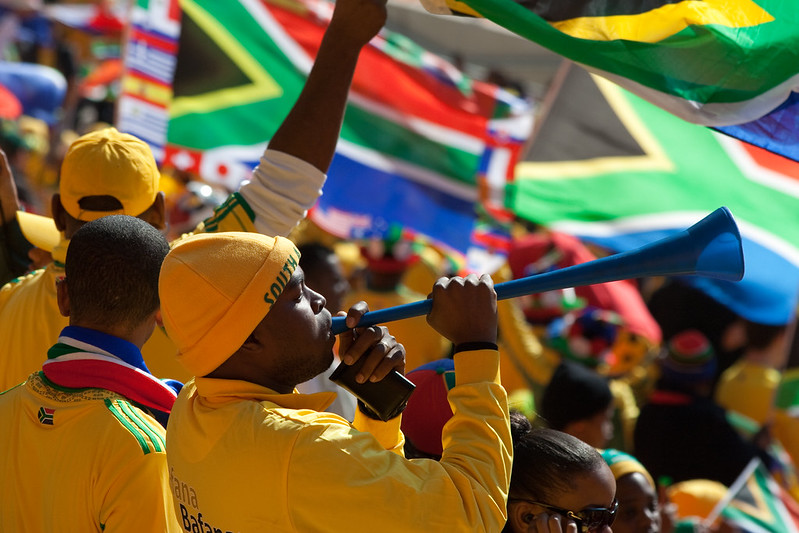
Despite some stunning matchups, the news story of the 2010 World Cup has undoubtedly been the vuvuzela. While there have been valiant efforts to the contrary (see Jennifer Doyle’s article in The Guardian about homophobia and sexual violence), not a newscycle goes by without some reference to this small plastic horn.
Designed in South Africa in the 1960s as a more portable facisimile of traditional kudu horns —and now mass-produced by the thousands in Chinese factories—the vuvuzela’s drone has been broadcast across the globe to the thrill of some and the annoyance of others. Non-African players have complained of headaches and difficulty playing because of the constant, loud sound; the BBC has created a special filter to block out some of the horn’s buzzing tones for at-home viewers. An oddly virulent backlash against the rising popularity of the horn outside of South Africa has effected bans against the vuvuzela at events as distant from South Africa and FIFA as one can get: the U.S. based Ultimate Fighting Championship, the Scottish T music festival, and, most recently, Nathan’s Coney Island Eating Competition, lest the horn “damage the competitive eating aesthetic.” The language used by many of these bans is that of contagion, like the sound of the vuvuzela is the herald of an infectious disease or a plague of locusts.
There have been many critiques of the horn at the level of decibels and hearing damage—the vuvuzela is reportedly 127 decibels, louder than a rock concert—although by that same logic the entire sport of NASCAR should be banned outright, as the New York Times reports it at a whopping 140 decibels. The pointed Nathan’s ban targeting “aesthetics” cuts to the quick of this heated debate. As an African instrument with its own particular history and cultural protocols, the vuvuzela seems to bother some people—namely members of Western and European nations—much more intensely than others, and for different reasons. Two of my husband’s coworkers, from the Ivory Coast and Grenada respectively, described the vuvuzela as a symbolic African diasporic sound of celebration that makes many white people uncomfortable; banning it outright would be not only an obvious pander to Western sensibilities—especially a preference for song over more random outbursts of sound—but also offensive, especially as South Africa is hosting the event. Or as the Botswana Voice Newsblog broke it down: “Hands Off the Vuvuzela!”
Dissenting voices have described the horn as annoyingly loud at best and disturbingly disruptive at worst. John Leicester, sports columnist for the Associated Press, managed to describe the sound of the horn as both “mindless” and “brainless” in his blog “Vuvuzela drone killing World Cup atmosphere,” as opposed to what he calls “football’s aural artistry”: the “ooohs,” “ahhhs,” and stadium chants of the “inventive” English who are “usually among the best-drilled noisemakers in football” but have been tragically drowned out by the “brainless” horns. After cultural comparisons like this—along the lines of the old racialized mind/body split concocted during the Enlightenment—it is difficult not to read Leicester’s closing plea, “Please, South Africa, make them stop. Give us a song, instead,” as a latent desire to control African people, not just their sonic output. At the very least, it is a tacit acknowledgement that the world is still divided along the lines of “us” and “them” and that sound plays a much larger role in facilitating these uneven power dynamics than previously thought.
It has also shown the world that struggles over the shifting border between sound and noise are rarely just that. It is precisely in such battles where sound studies can make an important intervention. . .so drop us a comment on the vuvuzela and the intense reactions it has elicited. What do you think? Has the vuvuzela been racialized? Is it a case of noise just being noise? Or is this phenomenon something else altogether? At the very least, blow one for yourself here and get a taste of what all the fuss is about.
JS
—
Share this:




Current Top Posts



April 2021

January 2020

November 2019

October 2019

August 2019

April 2014

November 2017
March 2015
December 2017

October 2015


Recent Comments